You know the feeling. You leave a crowded founder event with a name badge half peeled off, your throat dry, and a phone full of new contacts you probably won't talk to again. You had the same three conversations all night. What are you building? How's it going? We should catch up sometime.
Then you sit at the hotel bar or wait for your rideshare and realize nothing real happened.
That's the moment a lot of founders stop trying to win the room and start trying to build a table. I've seen it over and over. A small dinner does something a mixer can't. It slows people down. It gives context. It lets one good question breathe long enough for an honest answer.
That's what this guide is about. Private dining events are often framed like a venue choice. Pick a room. Pick a menu. Send invites. I think that misses the point. For founders, the hard part isn't finding four walls and a prix fixe. The hard part is designing trust.
Why Founders Stop Networking and Start Eating Together
A founder goes to a 200-person mixer because that feels like the responsible thing to do. More people should mean more opportunity. In practice, it usually means ten shallow chats, two interruptions, and one follow-up that turns into a sales pitch.
I stopped expecting much from those rooms a while ago. The format works if your goal is exposure. It fails if your goal is candor.
The wall most founders hit
Early on, you think networking is a volume game. Meet enough people and something good will happen. Then your company gets a little more real. You have payroll questions. Pricing problems. A co-founder disagreement you can't post about. A customer issue that needs nuance, not a quick opinion by the bar.
That's when a small dinner starts to make sense.
At a six to eight person table, nobody can hide behind performance. Each person talks. Each person listens. You hear the backstory, not the polished version. In the Midwest, that matters even more. A lot of local founder networks are thinner than people admit, and your next investor, operator hire, or customer intro is often a few relationships away, not one random handshake away.
Big rooms collect contacts. Small tables reveal character.
I also think founders get tired of feeling “on.” Dinner fixes that. The fork in your hand does some of the work. So does the rhythm of courses arriving. People settle down. They stop pitching every thirty seconds.
If you want a broader take on why that shift happens, I like this breakdown of strategies of business networking. It gets at the same problem from a different angle.
What changes at the table
The best founder dinners don't feel like events. They feel like permission.
Permission to say you're stuck. Permission to ask a dumb question. Permission to admit you don't know if the thing you're building is working yet. You won't get that in a loud room where everyone is trying to look inevitable.
A good dinner host knows this. They aren't trying to impress people with access. They're trying to assemble a table where people can be useful to each other.
That's a very different job.
What Private Dining Events Actually Are
The term is often used loosely. I don't.
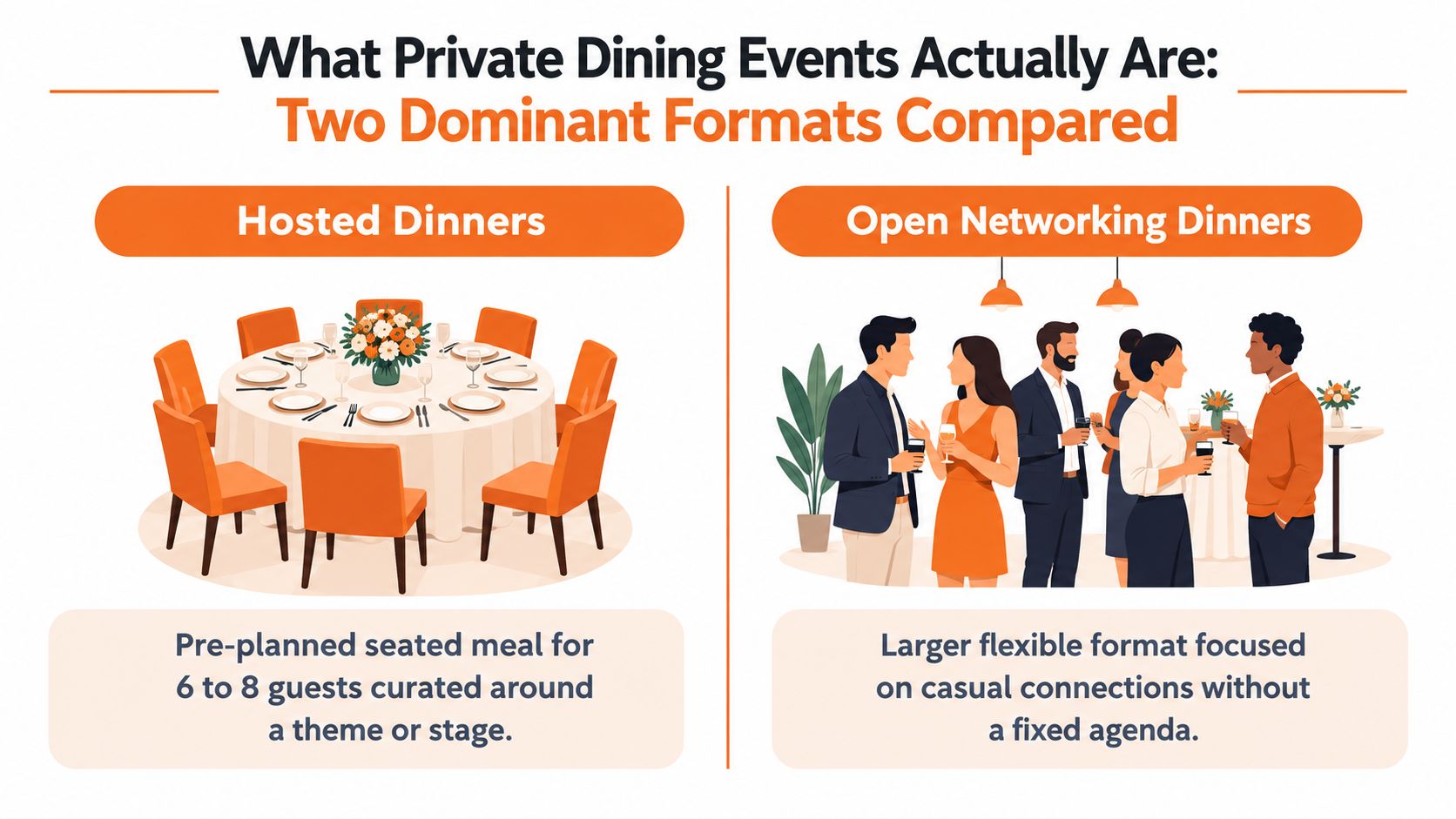
For founders, private dining events usually fall into two buckets. If you don't separate them, you'll plan the wrong kind of night and wonder why the energy felt off.
Hosted dinners
A hosted dinner is a pre-planned seated meal with a closed guest list, a set menu, and one person who owns the room. That host usually curates around a theme, a city, or a stage of company building.
A simple example is a West Loop dinner for first-time founders. Seven guests. One long table. The host opens with intros, drops in a few prompts, and keeps one person from dominating. The goal isn't to “network.” The goal is to get strangers to act like peers before dessert.
Roundtables
A roundtable is tighter and more structured. Same private setting. Same curated guest list. But the conversation has one working topic and usually a printed agenda or at least a clear sequence.
Think Fulton Market. Eight operators. One topic like hiring, pricing, retention, or fundraising. The facilitator opens each segment, keeps time, and makes sure everyone gets a turn. It feels more like a working session with plates than a social dinner with smart people.
Here's the easiest way to tell the difference:
- Hosted dinner: Relationship-first. The topic guides the room, but the chemistry matters more.
- Roundtable: Problem-first. The group gathers to pressure test one issue together.
- Both: The host is responsible for guest fit, flow, pacing, and tone.
The room matters less than people think
A lot of guides obsess over the room. I get it. Nice lighting helps. A private room helps more. But the format works because of constraint, not decor. You have a short list, a single table, one thread of conversation, and a host who keeps everyone from drifting into chaos.
That said, room choice still shapes the night. If you're planning in New York and want examples of spaces built for this kind of experience, this roundup of the best 2026 private dining NYC is useful because it shows how different venues support different kinds of dinner flow.
If nobody owns the room, the loudest guest owns it by default.
One more thing. Private dining has become a real operating channel, not some tiny edge case. One marketplace dataset says restaurant and venue customers booked $7.3 billion in event revenue in 2023, up 21% from 2022, across more than 3.5 million events, including 190,000 corporate events. The same source says the average U.S. consumer spends about 17 hours finding and booking the right private or group dining venue, 68% say they'd organize more events if booking were easier, and 42% have abandoned bookings because the process was too much hassle, according to private dining and restaurant event data.
That friction is why hosts who curate well have an edge. Guests don't want more options. They want fewer bad ones.
Why Small Hosted Dinners Beat Big Mixers
I'll take seven solid people over a crowded room almost every time.
That's not because I dislike big events. They have a use. They can create top-of-funnel awareness. They can help new people find each other. But if you care about trust, repeated contact, and actual help, the math changes fast.
The conversation math is brutal
At a mixer, every conversation is fragile. Noise breaks it. Another person joins. Someone sees a “better” contact over your shoulder and drifts away. The setting pushes people toward short, safe, repeatable talk.
At a dinner, everyone gets airtime. That alone changes behavior. You don't need to fight for a slot. You know your turn is coming, so you listen better while someone else is talking.
Recent trend coverage also points toward smaller, more intentional gatherings. Searches for private members clubs are up 623% since 2022, brand dinner searches are up 294%, and founder dinner searches are up 116%, while broad “social club” interest is down 25% since 2022, according to coverage of rising demand for curated private dining formats.
That tracks with what I see on the ground. Founders don't want generic access. They want a table with a point of view.
Small Hosted Dinner vs Large Networking Mixer
| Variable | Small Hosted Dinner | Large Mixer |
|---|---|---|
| Guest experience | Everyone speaks | Many people orbit |
| Memory | Names stick | Faces blur |
| Advice quality | Specific and contextual | Broad and cautious |
| Follow-up | Natural and warmer | Often vague |
| Host control | High | Low |
| Social risk | Lower once seated | Higher for quieter guests |
The economics can work better for venues too. Guidance for restaurants says dedicated private event programs often contribute about 8–18% of revenue in smaller independent groups and can reach 25–35% when managed well, according to restaurant private event guidance. That matters because a venue that understands private events usually runs a tighter room, handles pacing better, and doesn't treat your dinner like an awkward add-on.
The hidden advantage is safety
The best advice usually comes out after the first thirty minutes, not the first three. People need a little runway. Small dinners create it.
I've also learned that tiny details shape the room. Glassware, for example, sounds fussy until you host enough dinners to notice how much it affects pacing and mood. If you care about that layer of hospitality, this piece on how to store precious whiskey has a practical angle on handling bottles people want to share.
- Quieter guests finally talk: In a mixer, introverts disappear. At a table, they often give the sharpest answer of the night.
- War stories get specific: Founders will admit what broke when they know six people are listening, not sixty.
- Trust compounds: Monthly dinners with overlapping guests create continuity. You stop reintroducing yourself every time.
There's also a modern hospitality angle here. Research on business dinners says 22% of professionals have hosted or co-hosted a private dinner for business purposes, 64% say brand-hosted private dinners feel more exclusive than large public events, and 60% say they formed more meaningful connections there than at larger events, based on historical and modern context in restaurant dining history.
That doesn't surprise me at all.
Attendee Guidelines That Keep a Dinner Useful
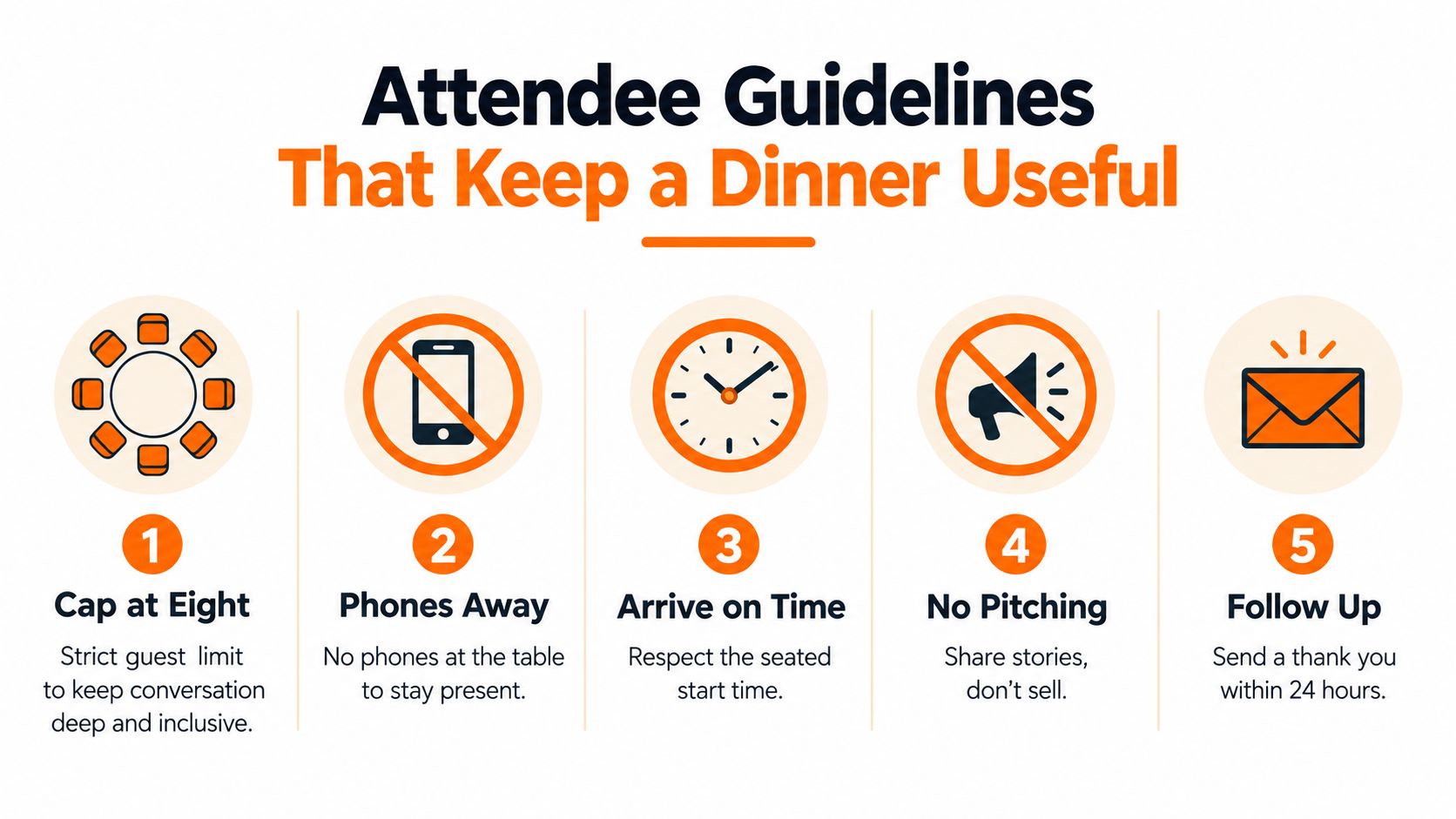
I've watched good dinners die from one avoidable mistake. One person turns it into a pitch fest. Two coworkers show up and create a side alliance. Someone arrives twenty minutes late and resets the whole table.
So I keep the rules simple.
The rules I actually use
Cap it at eight: Six is great. Seven is easy. Eight is the ceiling. Past that, the table splits into two conversations and the whole point is gone.
One seat per company: I don't want built-in voting blocs. If two people from the same startup come, other guests start editing themselves.
Vet before you invite: You don't need a background check. You do need signal. I want to know what they're building, how they treat people, and whether they can talk like a human.
No pitching: Tell stories. Share mistakes. Ask for help. If you sound like you're working the room, you are.
Phones stay off the table: A phone on the table is like a second meeting sitting beside you. Nobody relaxes.
What this looks like in practice
I send a short note before dinner. It says who's coming, what they're working on, and what kind of conversation we're having. That cuts awkwardness fast.
I also tell people how the bill works before we sit down. Don't leave that fuzzy. If the host is covering wine, say that. If everyone is splitting evenly, say that. If someone orders the giant porterhouse for themselves, fix that when the check lands.
Practical rule: Every dinner norm should remove friction before it appears.
Dropouts need rules too. Restaurants often want a final headcount 48–72 hours before the event, and some venues ask for it 3–5 days ahead, based on private dining headcount guidance. So if someone bails late, I either fill the seat fast or I eat the cost and remember it next time.
If a guest breaks a norm, I don't make a speech. I redirect. “Let's keep this non-salesy.” Or, “Hang on, I want to hear her finish that.” Short. Calm. Done.
Confidentiality Best Practices for Honest Conversations
If you run founder dinners long enough, someone will share something tender. Maybe it's revenue trouble. Maybe it's a hiring mess. Maybe it's a panic attack dressed up as “fatigue.” If the room can't hold that well, the dinners stay shallow forever.
Confidentiality is not a nice extra. It's table stakes.
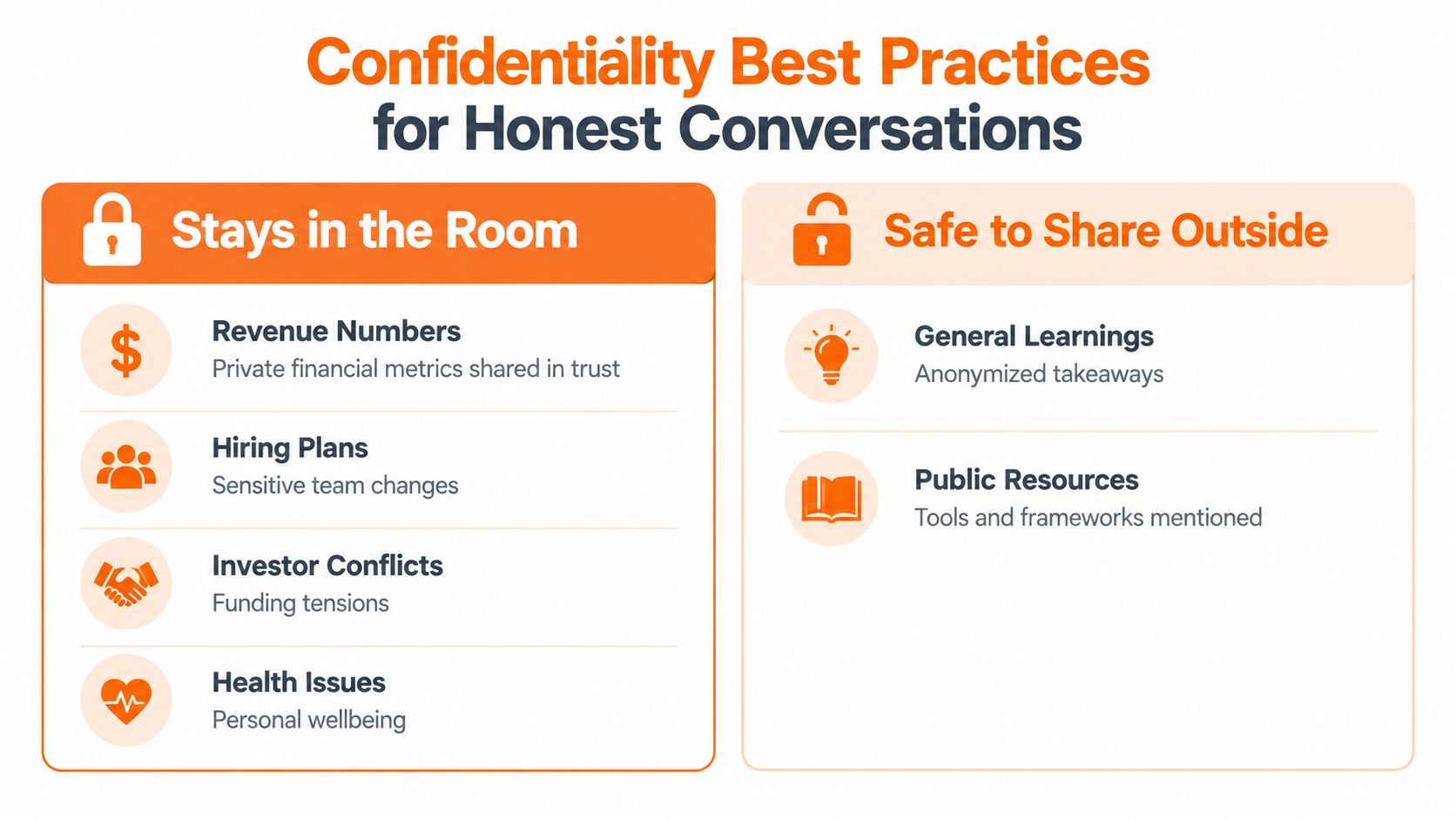
What stays in the room
I use plain language. You can share the lesson. You can't share the owner of the lesson.
That means these stay inside the dinner:
- Revenue numbers
- Hiring plans
- Investor conflicts
- Health issues
- Personal doubts tied to identity
If someone says, “We may need to let go of a senior hire,” that isn't for your group chat tomorrow morning. If someone says, “I'm struggling to keep it together,” that's not LinkedIn content in disguise.
For a deeper take on why this matters in groups, I'd point people to what confidentiality is and why it is important.
How I explain Chatham House Rule
I keep it simple at the start of dinner. You can use what you learn here. You can't identify who said it.
Good version: “A founder at dinner said they regret raising too early.”
Sloppy version: “That DTC founder in Fulton Market with the pet brand said they're regretting their round.”
One protects the person. One exposes them with two extra details.
Say the insight outside the room only after you remove the fingerprints.
How groups enforce it
You don't need to make the room weird. Just make the norm explicit.
I say it out loud at the start. If someone starts live-posting or recording, I stop it right away. No recording. No quotes. No table selfie unless every person says yes, and even then I usually skip it.
For repeat offenders, I stop inviting them. That's the only rule that really has teeth.
This is also where recurring groups have an edge. People behave better when they know they'll see the same faces again. Secrecy isn't the goal. Honest exchange is. Confidentiality is how you protect that exchange.
How to Organize a Private Dining Event Locally
If you want to host a dinner in Chicago, keep it boring in the best way. Don't try to produce a masterpiece. Try to run a clean night.
I'd start with the room, but not because decor matters most. It matters because bad logistics poison conversation.
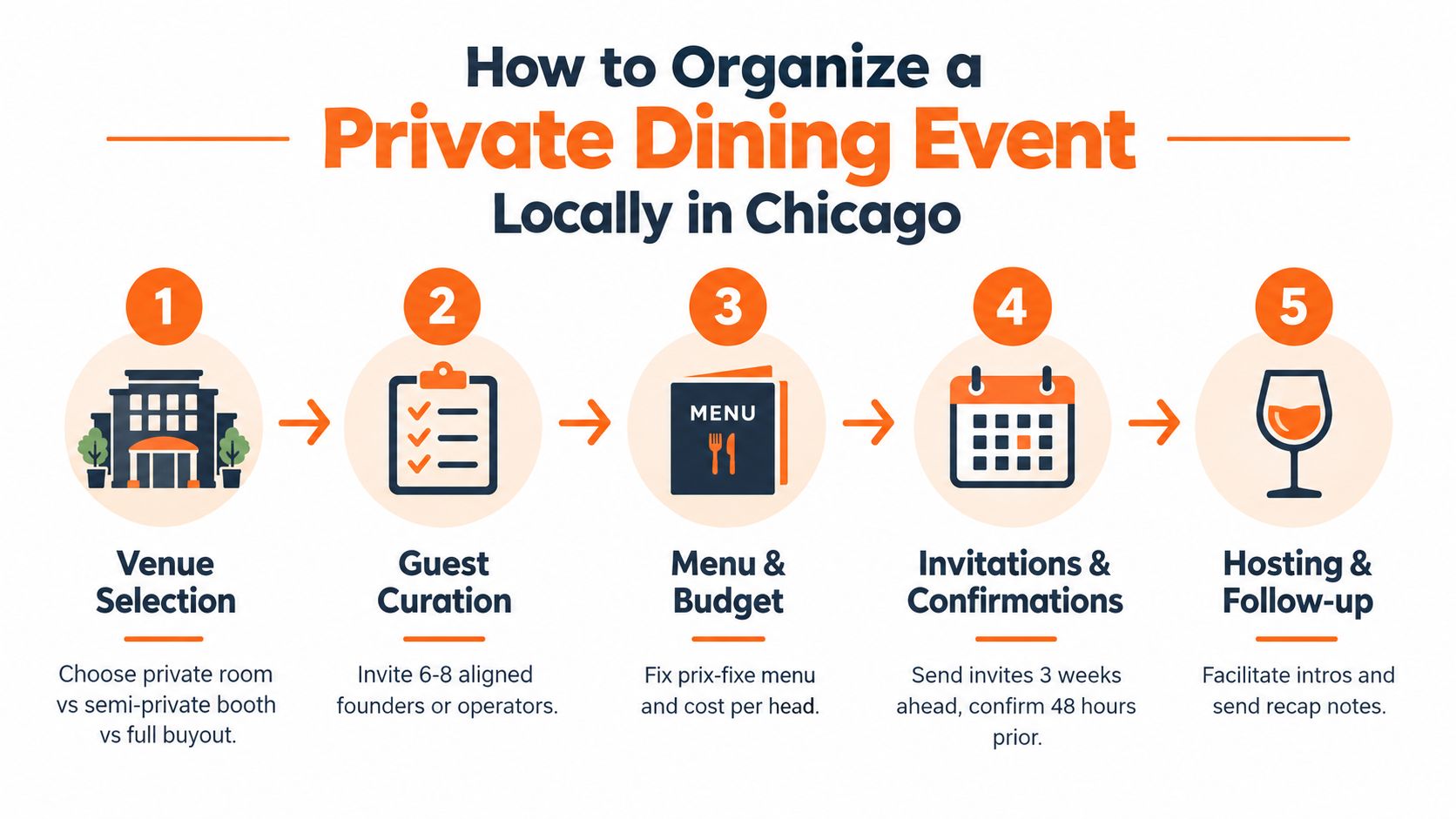
Pick the right kind of space
You have three common choices.
A private room gives you the most control. Best for real conversation. A semi-private booth can work if the restaurant noise is manageable and the table shape is good. A full buyout is overkill for most founder dinners unless you're hosting a larger community night.
Lately, hosts are also looking beyond standard back rooms. Market coverage says bookers increasingly want design-led spaces like galleries, lofts, and studios because the atmosphere cuts extra decor and production needs. The same coverage says that in New York City, private-dining inquiries for Met Gala week rose 417% year over year, average spend per booking rose 52%, and average group size rose 69%, according to private event trend coverage on design-led spaces. You don't need a gallery in Chicago for every dinner, but the lesson is useful. The room should carry some of the mood by itself.
A small detail people overlook is glassware. Bad stemware makes a dinner feel clunky fast. If you care about those hospitality edges, this write-up on elevating guest experience with glassware is a practical read.
Build the list before you book the menu
I don't start with cold outreach. I start with one or two people I trust, then build around them. The dinner works when each guest can help at least one other guest at the table.
My own checklist is short:
- Stage fit: Are they roughly in the same chapter?
- Temperament: Will they listen, not just talk?
- Reason to attend: Can they give or receive something real?
- No redundancy: I don't need four people with the exact same profile.
This is also where one option like Chicago Brandstarters fits. It runs vetted six to eight person founder dinners on a recurring cadence, which is useful if you want a starting point for the format without building every list from scratch.
Handle timing, menu, and confirmations
Lead time matters more than people think. Venue guidance says weekday corporate dinners often book in 2–6 weeks, milestone birthdays in 4–8 weeks, engagement parties in 6–10 weeks, and corporate holiday parties in 3–4 months. It also says high-demand Friday, Saturday, and fourth-quarter dates often get committed 6–12 weeks or more ahead, according to private dining availability guidance.
For guest count, smaller groups move faster. One planning guide says groups of 4–12 guests often book 1–2 weeks ahead, 8–20 guests often need 2–4 weeks, and 10–30 guests often need 3–6 weeks, based on private dining planning expectations.
I usually keep the agenda loose. Three or four prompts is enough:
- What are you trying to solve right now?
- What did you learn the hard way this quarter?
- What kind of person do you need to meet?
A fixed menu helps. Dietary choices should be easy. Pacing should be predictable. The host should never be negotiating every plate all night.
Here's a useful walk-through on room setup and flow:
Final detail. Check the contract. Group bookings may require deposits of 10–25%, and some terms say that if you reschedule and the client can't attend the new date, they may get a 100% credit instead of a refund, according to group reservation deposit and cancellation guidance. That stuff matters when one cancellation can wreck your margin.
What Changes When You Eat With the Same People Every Month
The first dinner is polite. The second is better. By the third, people stop reading from their internal press release. Around the fifth, the table starts to feel like a working kitchen instead of a stage.
That's when benefits show up.
The shift from contact to trust
Introductions get warmer because people know where to place each other. Advice gets sharper because the backstory is already on the table. Accountability sneaks in too. If you told six people last month you were going to fire the zombie project, they're going to ask whether you did it.
This is why recurring dinners beat one-off networking. Every contact at a mixer starts cold. A dinner group keeps building from shared memory.
- Hiring gets easier: People know who is careful, fast, messy, kind, stubborn, or coachable.
- Referrals improve: Guests make intros with context, not just names.
- Loneliness drops: Founders stop feeling like every hard thing is happening in private.
If you've ever looked at mastermind-style formats, there's some overlap here. This piece on mastermind groups for entrepreneurs gets at the same compounding effect from another angle.
Try one within the next month
Don't overthink the first version. Pick a weeknight. Invite six people. Choose a room where everyone can hear each other. Send a short note in advance. Keep the rules clear. Ask better questions than “What do you do?”
That's enough to start.
A lot of founders are one good table away from feeling less alone and making better decisions.
If this format sounds like how you want to build your network, Chicago Brandstarters has a free vetted community built around small six to eight person founder dinners in Chicago. It's for people who want honest conversations, practical war stories, and real follow-through instead of another loud room.
Leave a Reply