
I built my first founder circle because I was sick of swapping polite LinkedIn notes with people who vanished the minute I needed real help. The first dinner was awkward, the second got honest, and by the third I had people I could call when a launch went sideways.
The Loneliest Part of Building a Brand
At 11:47 p.m., your ad account gets flagged, your supplier stops replying, and your inbox looks like a tax audit wearing a Halloween mask. You don't need another podcast clip. You need one person who gets the problem, knows your constraints, and won't turn your mess into gossip by morning.
That's why professional friendships matter most when you're still building the thing. Early-stage founders don't lose momentum because they lack information. They lose it because every decision happens in a vacuum, and bad advice arrives dressed up as certainty. A good peer is the difference between spiraling alone and getting back to work with your head clear.
The data backs up what most builders already feel in their bones. A 2025 KPMG survey found that 81% of people say work friends are highly important, 78% report positive mental-health benefits, and 87% now say close work friendships are very important, up 6 percentage points since November 2024. That's not fluff, that's a signal that people price human connection into the job itself, not just the paycheck. KPMG's survey on workplace friendships puts hard numbers on something many founders already know.
If you've ever felt strangely isolated while doing “everything right,” you're not broken. You're just running a business without enough peer surface area. I've seen founders carry brutal decisions for weeks because they had no one safe to sanity-check them with, and I've seen the same people regain speed after they found a small circle they trusted. If that part hits close to home, start with founder mental health support and treat it like part of your operating system, not a side issue.
What a Professional Friendship Actually Is
A professional friendship is a peer bond built on mutual trust, vulnerability, and shared work experience. It isn't a title, a favor trade, or a polite coffee you forget before lunch. It's the person who knows the story behind the launch, the client drama, or the hiring mistake, and still picks up when you call.
Sort the relationship before you misuse it
A gym rack. A mentor is your coach on the sideline, watching form and giving corrections. A transactional contact is the person you swap a few reps with once, then both of you move on. A professional friend is the training partner who shows up early, spots you on heavy sets, and tells you when your form is slipping before you hurt yourself.
That matters because founders keep asking one relationship to do four jobs. They want advice, referrals, emotional support, and accountability from the same person, then they act surprised when the bond gets muddy. Use the right bucket and you stop poisoning good relationships with wrong expectations.
A clean rule helps. If the relationship is built on reciprocity, candor, and repeated work contact, it's a professional friendship. If it's one-way expertise, it's mentorship. If it's mostly pitch decks, business cards, and “let's circle back,” it's networking.
Practical rule: If you wouldn't talk about a real problem, a real mistake, or a real boundary with this person, don't call them a professional friend yet.
Once you use that filter, you'll stop confusing familiarity with trust. That saves time, and it saves you from pushing people into roles they never agreed to play. If you need a clean way to ask for support without sounding needy, use this guide on how to ask for help and keep the ask specific.
Why These Friendships Pay Off for Founders
The payoff shows up fast once you stop treating peer relationships like casual social adds. A founder who has a real professional friend gets a second brain, a steadier nervous system, and someone who understands the weight of decisions without needing the whole backstory.
Money, trust, and the hidden premium
KPMG's 2025 Friends at Work 2.0 report links close workplace friendships to an effective 20% salary premium. That matters because the premium is not about charm. It comes from repeated low-friction contact, tighter trust, and faster information flow. KPMG's Friends at Work 2.0 findings put a number on what builders feel every day when a peer relationship starts working.
The longer view points the same way. Research associated with Adam Grant says close work friendships dropped from roughly 50% of Americans in 1985 to 30% by 2004. That decline explains why founders cannot wait for a friendly office culture to hand them trust. They have to build it on purpose, person by person. This summary of workplace friendship research lays out that shift clearly.
What you actually get back
For founders, the return is practical.
A peer who knows your context cuts the noise. You do not waste time translating the basics of your market, your team, or your stress. You can talk straight about what broke, what you tried, and what still feels off.
The value also shows up in the work itself.
- Faster problem-solving. A friend who has watched you work does not need a long setup before giving useful feedback.
- Warmer intros. People trust recommendations more when they come from someone who has already seen how you operate.
- Cleaner hiring signals. A peer who has seen you under pressure can tell you whether you are ready for a bigger role or a bigger team.
- Less drift. A real peer calls out shiny-object thinking before it burns your time.
A study in Business & Society found that business friendships support greater employee innovation through knowledge transfer and network capability. That is the mechanism founders should care about. The bond matters, but the value comes from what moves through it. The Business & Society study shows that clearly.
A rough time budget helps here. Around 90 hours of contact gets you out of stranger territory. Around 200 hours is where a real friendship starts to form. That means founders need repeat touchpoints, not random coffee chats. If you only see someone once a quarter, do not pretend the trust is there. If you want a written model for building those peer habits into your routine, professional book coaching is one example of structured support that sharpens judgment without turning every exchange into a transaction.
I invest in peer relationships because trusted people move better information, and better information saves time, money, and bad decisions.
The Failure Modes Nobody Talks About
The warm version of work friendships gets sold and the mess gets skipped. That's lazy. A friend at work can become the person who leaks your comment, drags you into an in-group, or mixes business judgment with personal loyalty at the worst possible moment.
Where it breaks
The London School of Economics review calls workplace friendship a double-edged sword because it can reduce engagement, commitment, performance, and creativity when teams don't talk about boundaries or watch for exclusionary behavior. That's the part founders need to respect. The LSE review is blunt about the risks.
Here's what I watch for:
- Gossip with a memory. If someone leaks casual comments about other people, they'll probably leak yours too.
- Hidden in-groups. Cliques feel friendly from the inside and suffocating from the outside.
- Role confusion. A friend who becomes your vendor, investor, or employee can pull you into bad judgment fast.
- Breakdown risk. When a friendship and a business deal collapse at the same time, the emotional hit gets expensive.
The boundary test
Talk about the line before you cross it. I'd rather have a slightly awkward conversation early than a crooked relationship later. That means you say what stays private, what can be shared, and what happens if the business relationship changes.
Boundary rule: If the relationship only works when nobody names the rules, it's already shaky.
You don't need a colder circle. You need a clearer one. The goal is safe closeness, not vague warmth. Once you start treating boundaries like normal operating terms, you'll notice who can handle trust and who only enjoys access.
Practical Tactics and Conversation Prompts
Real friendship doesn't come from one networking event and a follow-up email that says, “Great connecting.” The time threshold matters. Research summarized from the University of Kansas friendship model puts it at about 50 hours to move from acquaintance to casual friend, 90 hours to friend, and 200 hours to close friend, while MIT Sloan advises watching how people behave when they think no one is observing. This summary of friendship thresholds and trust testing is useful because it gives you a pacing rule, not a mood.
Build the rhythm, then test the person
Start with two or three peers, not twenty. Put recurring one-on-ones on the calendar, monthly if that's all you can sustain, and show up with one current problem before you ask for anything. That keeps the interaction real instead of ornamental.
Use prompts that pull people past surface talk:
- “What's the worst advice you got on this?”
- “What would you do differently if you started over?”
- “Where are you stuck right now?”
- “What do you wish more people understood about your work?”
Then watch the person, don't just listen to them. Do they talk about subordinates with respect? Do they treat confidential details like confidential details? Do they overshare before trust exists? MIT Sloan's trust test is simple because people reveal themselves in small moments.
Keep the circle healthy
The British Psychological Society guidance is direct, discuss boundaries openly and watch for exclusionary behavior. If one person always gets included and another always gets left out, the circle is already warping. The BPS guidance on workplace friendships makes that plain.
Founder discipline matters. I'd rather have three solid peers than a noisy room full of weak ties. One strong relationship is worth more than ten polite ones if you need judgment, privacy, or a fast read on a hard decision.
Professional Friendships Versus Mentorship and Networking
I learned this the hard way. I kept lumping every useful contact into the same bucket, then wondering why some conversations gave me real momentum and others just drained time. I sort the relationship first now, then I decide what role it should play.
| Dimension | Professional friendship | Mentorship | Transactional networking |
|---|---|---|---|
| Direction of value | Mutual | Mostly one-way | Mostly one-way |
| Time horizon | Years | Can be long, but framed around guidance | Minutes or brief bursts |
| What you trade | Time, candor, vulnerability | Attention and respect | Pitches, cards, introductions |
| What you get back | Honest feedback, shared wins, real support | Experience, advice, perspective | Warm intros, surface access |
| What happens when it ends | The bond can survive because it isn't extractive | The advice stream stops | The contact usually fades |
Use each one for the right job
Mentorship is for judgment. Networking is for reach. Professional friendship is for trust, speed, and honesty.
I do not ask a mentor to be my emotional anchor. I do not expect a networking contact to care about my bad week. If I need support and pressure in the same relationship, I want a peer, not a polite exchange of favors.
A clean example is professional book coaching, which can help a writer or founder sharpen ideas through structured feedback. That is useful guidance, but it is still different from the kind of peer bond where both people bring half-finished problems and speak plainly.
The hard truth is simple. A healthy professional friendship can survive a bad week, a bad call, or even a missed introduction because neither side feels used. That is the point. You want a bond that does not fall apart the second the utility drops.
How a Vetted Community Like Chicago Brandstarters Does It
I've been in rooms that called themselves supportive and felt like a trade show with better lighting. Chicago Brandstarters takes the opposite approach. It keeps the room screened, the group small, and the expectations plain, which is why people can relax and talk like peers.
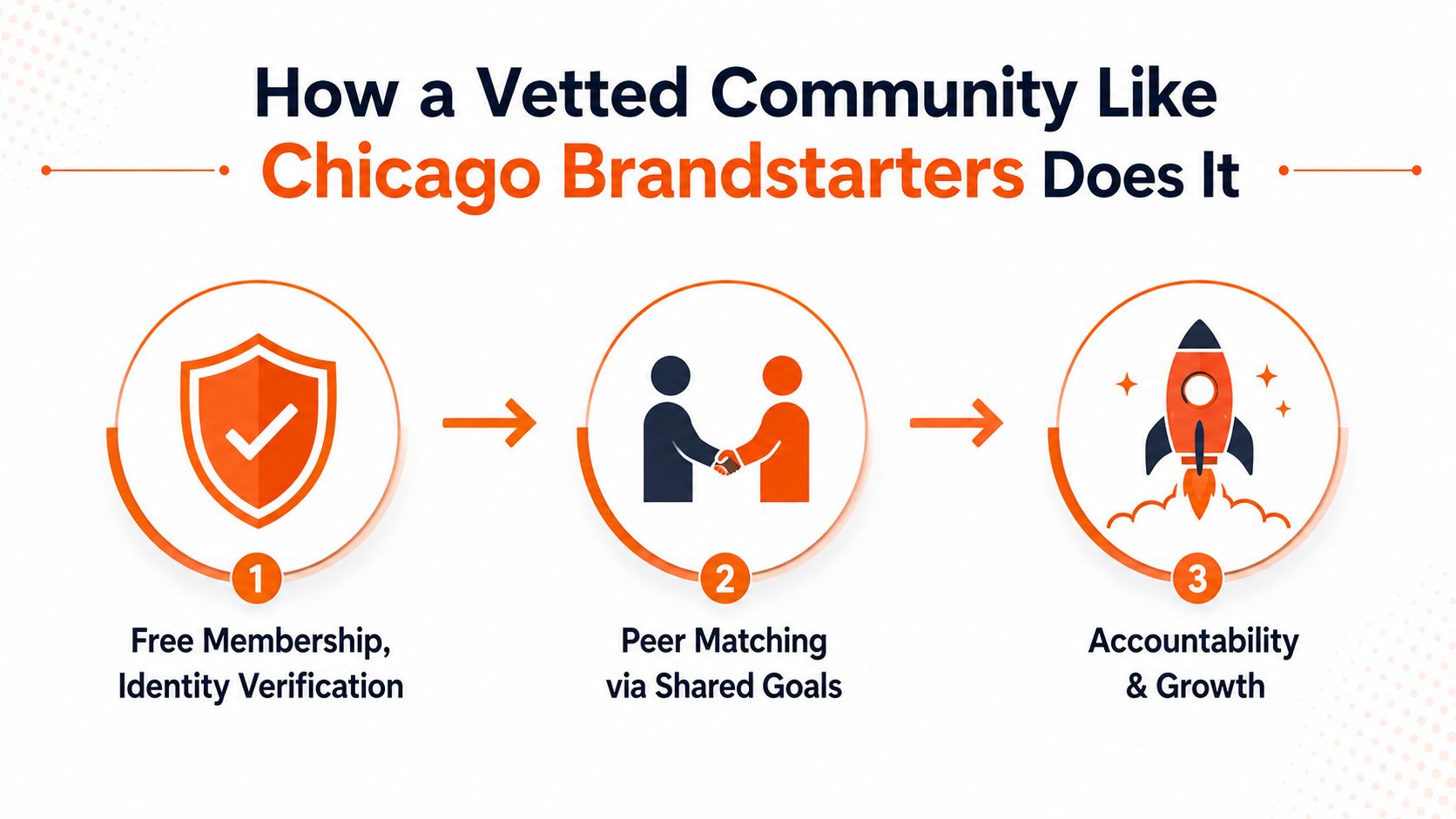
What the structure does
The community uses free membership, identity verification, and LinkedIn vetting to keep out self-promoters and service-sellers. That matters because trust gets easier when people know they are not walking into a room full of hidden sales pitches. It also runs small private dinners of 6 to 8 people every two weeks, which gives founders enough repeated contact to move past shallow introductions.
The group chat matters too. Dinner gives depth, chat gives continuity, and confidentiality gives people the nerve to be honest. When founders know what stays in the room, they stop performing and start solving.
A good community works because it changes how people exchange help. One founder shares a stubborn supplier issue, another points to a contact with factory access, and a third becomes the person you text when a launch falls apart. That is the point of a vetted room, and it matches the community design principles in LearnStream's community building guide, which treats community like an operating problem, not a slogan.
Why the model works
If you want to build a peer circle like this yourself, start with fit. Do not admit everyone. Repeat contact. Trust needs time in the room. Protect privacy. People speak when they know the room is safe. Keep the group useful. Shared work reality beats abstract inspiration every time.
For Chicago founders who want a local example, Chicago Brandstarters' business network group shows how a vetted peer room can stay practical without turning transactional. I would rather be in that room than another vague founders mixer with a name badge and no memory.
Your First 30 Days of Real Founder Friendships
Pick three peers you already respect, send each one a short invite, and make the ask small. Share one live problem before you ask for anything back, then schedule a recurring monthly check-in. After three real interactions, apply the trust test and decide whether this person belongs in your inner ring.
Join one vetted community with actual screening, especially if you're in the Midwest, and show up to at least three events in 90 days. Track your hours the way you track runway, because the math matters more than the mood. Your goal is simple, cross the 90-hour line with at least one peer inside a year.
Professional friendships aren't a side benefit of building a brand. They're the cheapest growth channel you'll ever find, and the only one that keeps paying after you stop feeding it.
If you want that kind of peer room in Chicago, Chicago Brandstarters is built for founders who want honest support, real vetting, and small-group dinners instead of transactional noise. Visit, apply, and start meeting people who will remember what you said the next time your business gets hard.
Leave a Reply