
The worst advice about productivity is to just push harder. That's how people end up answering Slack at midnight, sitting in meetings they didn't need, and calling it discipline. If you want to work smarter, start by treating your week like a capital allocation problem. Put attention where it earns, cut the rest, and stop pretending every request deserves a response.
The Real Reason You Feel Busy But Not Productive
Most founders don't have a time problem. They have an attention leak.
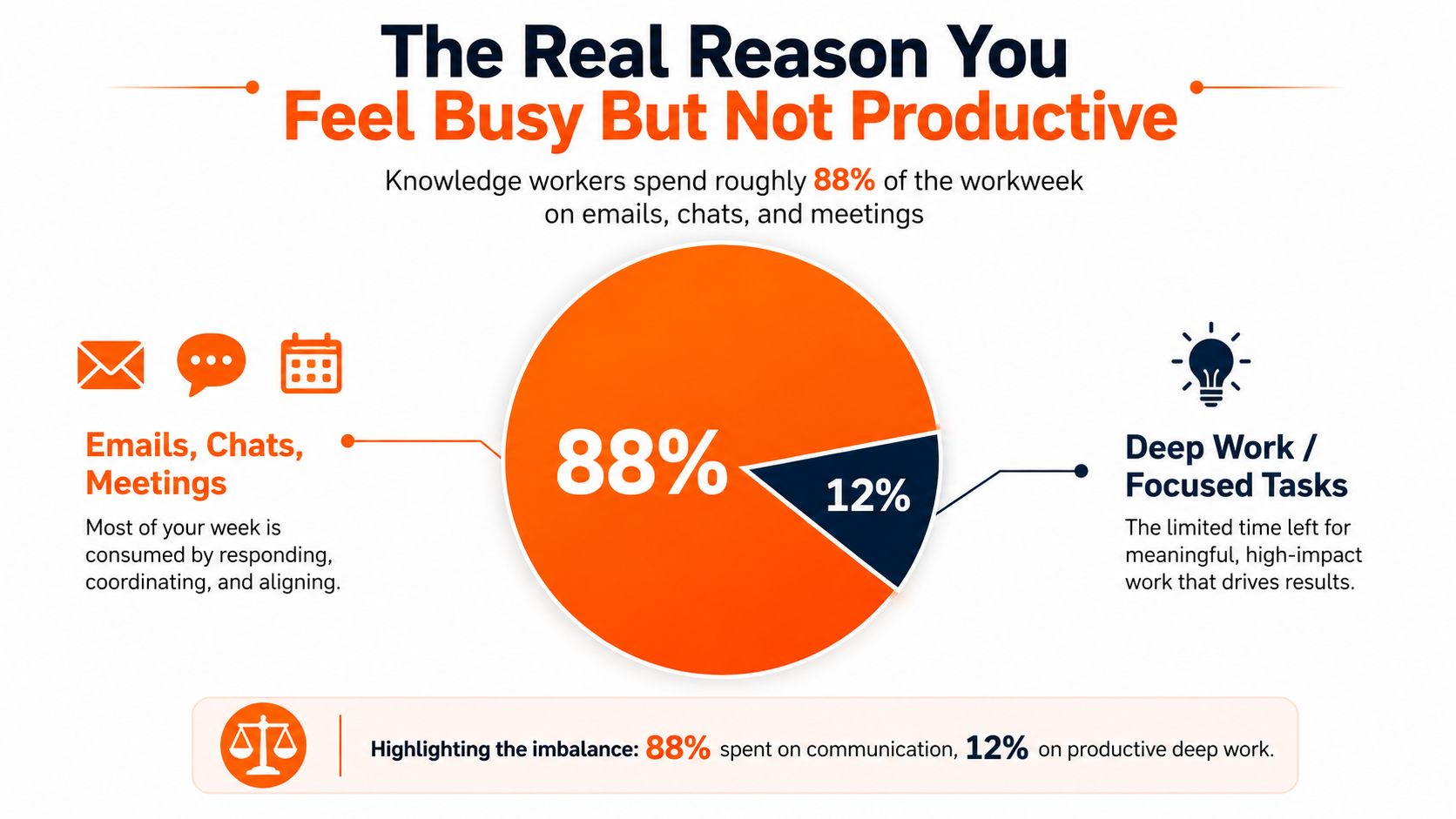
The cleanest proof is ugly. Knowledge workers spend 88% of their workweek managing emails, attending meetings, and chatting, and only 12% is left for other work, according to the time-management data in the brief. That same data set also puts the annual drag at 103 hours in unnecessary meetings, 209 hours on duplicative work, and 352 hours spent talking about work, for a total of 664 hours annually lost to coordination overhead. Clockify's time management statistics lay out the same pattern in plain numbers, and I've seen it in every founder group I run, a week fills up fast, then the actual building slips.
Urgency usually wears the wrong badge
For solo operators, urgency feels noble. It isn't. Urgent often means loud, not important.
Practical rule: if a task only exists because someone else is anxious, it probably isn't your best use of the next hour.
The second number that sticks with me is the widely cited estimate that the average employee is productive for just 2 hours and 53 minutes in an 8-hour day, also included in the brief's source set. I don't treat that as a moral judgment, I treat it as a warning. If you fill the rest of the day with fragments, you don't get more done, you just get more scattered.
That's why I point founders toward burnout solutions for executives when they tell me they're “just busy.” Burnout usually starts when the calendar becomes a trash can for other people's priorities. If you don't protect focus, your work turns into reaction management.
The reframe that changes everything
Stop asking, “How do I fit more work in?” Ask, “What am I doing that doesn't need my brain?”
That one question changes the job. Now the target isn't output at any cost, it's coordination tax. I've watched founders recover energy fast when they stopped worshipping responsiveness and started designing their week around actual creation.
The old hustle formula says stay available. The smarter one says make yourself harder to interrupt.
Pick the Work, Then Put It on the Calendar
A founder week should not be an open buffet. Pick the work first, then block it before the day gets to vote.
I use a simple filter borrowed from the Eisenhower style of thinking. Sort every task into four piles, important and urgent, important but not urgent, urgent but not important, and neither. The point is blunt, keep the important work, then cut the rest or push it down. If a task won't move the business, the customer, or your learning, it doesn't deserve prime calendar space.
Working rule: if your top task doesn't get a block, it probably won't get done.
A weekly template you can copy
Use this shape for a founder week:
- Monday morning: choose your 3 to 5 main outcomes for the week.
- Then: block the first one or two high-impact tasks on the calendar.
- After that: group similar tasks into the same window, emails together, calls together, admin together.
- End of day: compare what you planned with what you shipped.
That 3 to 5 limit comes straight from the source set via Forbes, which recommends limiting your most important tasks to three to five items, and it keeps your attention narrow enough to matter. Forbes' time-blocking guidance also points to working in 90-minute intervals, which gives your day a pace instead of a blur.
Prioritization filters side by side
| Framework | Core Question | Best Stage | Output |
|---|---|---|---|
| Eisenhower style | What is important, and what is just urgent? | Daily triage | A short list of what gets done now |
| Founder top-3 to 5 | What actually moves the business this week? | Weekly planning | A tight weekly focus list |
| Time blocking | When will I do this before the week fills up? | Calendar setup | Protected work blocks |
| Task batching | Which similar tasks can I group? | Any busy week | Fewer context switches |
I like to keep a one-page weekly review on my desk or in my notes app. Use three prompts: What shipped? What got blocked? What needs a new time block next week? That's enough to stop guessing.
Chicago Brandstarters has a useful time management for entrepreneurs tag for founders who want more founder-specific reads around this problem. I'd still start with the calendar, because strategy without a time slot is just wishful thinking.
Batching, Single-Tasking, and the Cost of a Single Ping
A single ping can ruin a good hour.
The data in the brief makes the trade-off obvious. Multitasking can make tasks take 15% longer, and it can take 23 minutes and 15 seconds to fully return to a task after an interruption. Another source says 82% of people do not have a time management system, employees get interrupted about 60 times a day, and the average worker spends 51% of the workday on tasks of little or no value. The time-management summary from Lifehack Method is blunt on this point, context switching is expensive, and it piles up fast.
Batch work like you batch laundry
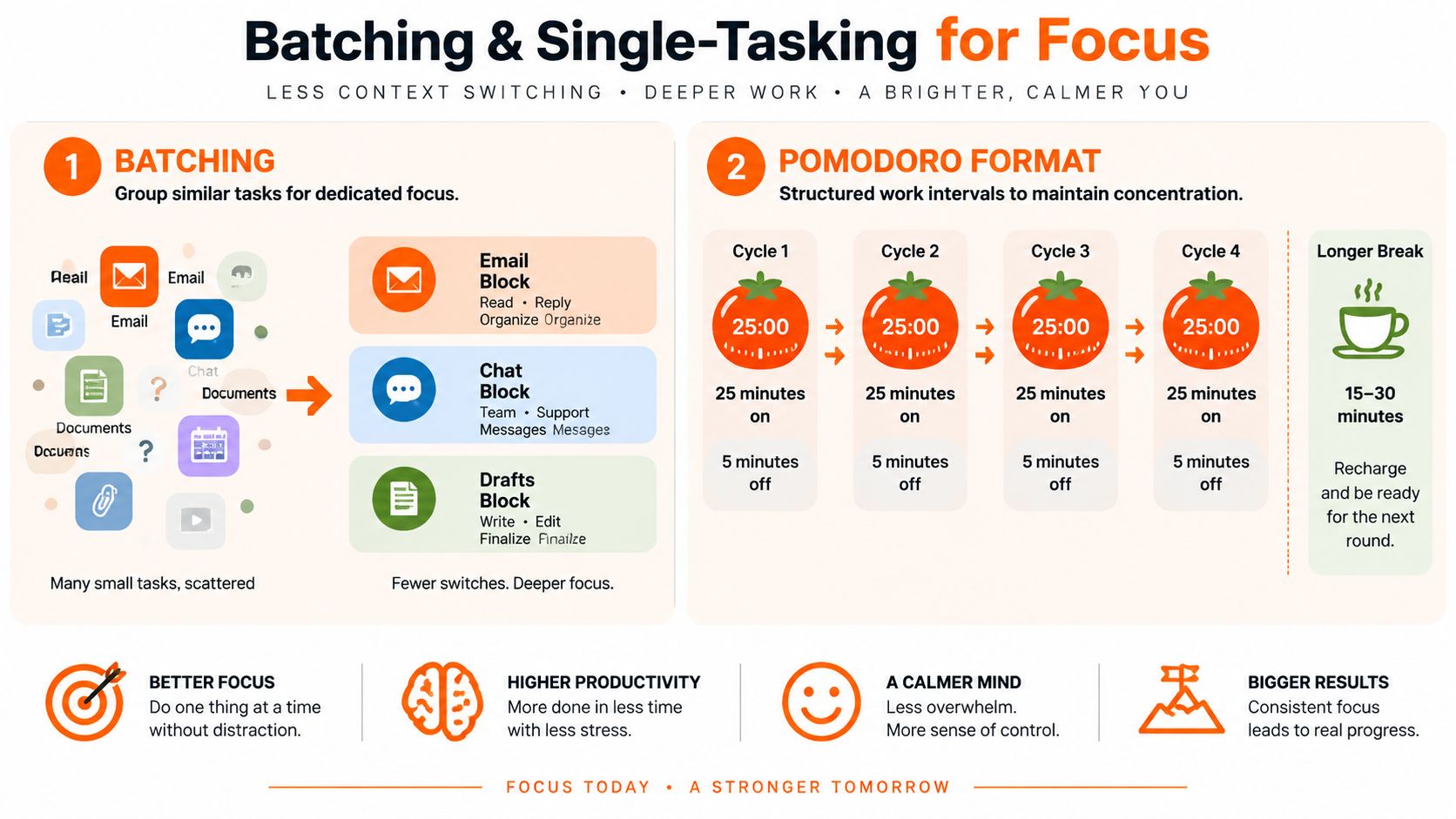
Batching means you stop bouncing between unrelated jobs. Put all Slack replies in one block. Put customer calls in one block. Put first-pass writing in one block. The win isn't fancy, it's fewer resets.
The Pomodoro format is a good fit when your brain keeps looking for exits. Work 25 minutes, break for 5, repeat four times, then take a longer 15- to 30-minute break. Rest Less gives that exact structure, and it works because the timer gives your brain a lane.
My no-sound rule for focus blocks
Kill anything that begs for your attention before the block starts.
- Turn off notifications: email, chat, and social alerts all go quiet.
- Group similar work: replies with replies, drafts with drafts, reviews with reviews.
- Protect one afternoon: I like a meeting-free stretch for deep work and decisions.
- Use a simple exit line: “I'm in a focus block and I'll reply after 3.”
If you want a sharper read on why a small interruption can cost so much, the Zemith context switching guide is a clean companion piece. I use it when founders insist they can “just check” messages without paying a price.
A quick personal inventory
Write down the task types that keep repeating. Then assign each one to a home.
- Email and chat replies: one or two short blocks a day.
- Customer calls: a fixed call window.
- Writing, planning, or product work: one long block early.
- Admin and approvals: one tidy batch at the end.
That's how you stop the day from turning into a pinball machine. The goal isn't to work harder inside each hour. The goal is to make each hour less noisy.
Delegate the Repeatable, Automate the Predictable
Founders love to hold onto tasks they should have dropped months ago. I see it all the time. The work feels personal, then it turns into a bottleneck.
Use a simple delegation matrix:
- Do: complex strategy, crisis calls, final decisions.
- Decide: budget calls, team direction, client trade-offs.
- Draft: first-pass proposals, research notes, rough reports.
- Drop: low-value meetings, stale process steps, repeated manual cleanup.
Hand off the jobs that drain your best hours
At the idea-to-growth stage, I'd hand off bookkeeping, social scheduling, research, basic customer support, and first-pass creative before I'd hand off a core customer call. Those jobs eat focus, but they don't always need your voice. If someone else can do the first 80%, your role should shift to review, taste, and decisions.
If a task has the same shape every week, your brain should not have to relearn it every week.
That's where automation helps. I'm not talking about shiny tool-chasing. I'm talking about invoice chasing, lead capture, weekly reporting, content repurposing, and SOP creation. Those are the jobs that can stop you from doing the work that only you can do.
Run a 30-minute audit this week
Set a timer and write three lists.
- What drains me most?
- What repeats on a schedule?
- What can another person or a tool draft first?
Then choose the top three wins. If a task takes your best energy and repeats often, it belongs on the delegation or automation list.
For a practical read on the handoff side, the how to delegate effectively tag from Chicago Brandstarters is a decent place to pull more founder-side examples. I'd still start by freeing up one recurring job this week, because that creates immediate room.
Decision Frameworks That Save Mental Energy
Founders waste more energy re-deciding than deciding. That's the hidden drain.
I keep four frameworks in rotation because they fit different moments. Use the wrong one, and you turn a clean call into a mental loop. Use the right one, and the answer gets clearer fast.
Four ways to decide without spinning
| Framework | Best for | How I use it |
|---|---|---|
| Eisenhower matrix | Daily triage | Sort urgent from important, then act |
| 80/20 rule | Monthly review | Find the small set of actions that drive most results |
| ICE scoring | Growth experiments | Rank ideas by impact, confidence, and ease |
| Regret minimization | One-way doors | Decide as if you'll have to live with the choice later |
Eisenhower works when your inbox is loud. 80/20 works when you need to review where revenue or learning comes from. ICE helps with tests and experiments, especially when you're choosing between good ideas. Regret minimization fits the big calls, like co-founder choice, niche choice, or a first hire.
The idea of thinking in bets pairs well with this. ForumSpace's page on Thinking in Bets is a useful companion if you want a cleaner way to handle uncertainty without freezing up.
Stop re-deciding the same thing
I like a one-page decision log. Write the date, the decision, the reason, the framework you used, and the next review date. That tiny habit keeps you from chewing on the same call three times a week.
It also helps you separate emotion from motion. When the same issue comes back, you can check whether something changed or whether your brain just wants another lap. That saves energy for the choices that move the business.
Meeting Design, Weekly Metrics, and Peer Accountability Prompts
Most meetings should earn their place. Too many don't.
Kill recurring meetings that lack a clear owner, a decision, or an end time. Replace them with written updates when the topic is simple, or a short standup when the topic needs live coordination. Microsoft reported in 2024 that employees were interrupted about every 2 minutes across meetings, email, and chats during core work hours, and that kind of pace makes sloppy meeting design expensive. Rough Notes is a good reminder that working smarter often means saying no more often.
The weekly numbers I check
I keep three numbers in view every week.
- Revenue or pipeline
- Active users or conversations
- Hours of deep work logged
That mix tells me whether the business is moving, whether people care, and whether I protected enough focus to build anything worth shipping. If the deep-work number slips, I don't blame the week. I fix the calendar.
Send this accountability prompt today
A peer prompt changes behavior faster than a private intention. Paste this into a group chat or send it to one founder you trust:
“Here's my weekly check-in. What did I ship, what am I dropping, and where do I need a war story or a blunt second opinion?”
That's the kind of exchange Chicago Brandstarters tries to create in its mastermind groups for entrepreneurs, where people can trade honest context instead of polished updates. I've seen founders move faster when they have one person who asks for proof, not vibes.
The goal is simple. Run a week with fewer meetings, fewer interrupts, and more shipped work. Then review what moved and keep the parts that worked.
If you want a founder room that talks through real trade-offs, Chicago Brandstarters is built for that kind of work. It gives Chicago and Midwest builders a place to compare notes, pressure-test decisions, and stay honest about what's draining time. Visit Chicago Brandstarters and see whether its peer group fits the way you want to build.
Leave a Reply