
It's 3 AM, and your laptop glow is the only light in the room. You're staring at cash projections, three investor emails you haven't answered, a bug that just came back, and the quiet feeling that nobody around you really gets how heavy this is. That mix of pressure, secrecy, and sleep loss is what founder mental health looks like in real life.
I've seen founders call this “just a rough week,” then keep pushing until their body forces the issue. The problem is that startup stress doesn't stay in one lane. It moves into your sleep, your focus, your tone with your team, and your ability to make clean decisions.
Facing the 3 AM Founder Crisis
At 3 AM, the hard part usually isn't one big catastrophe. It's the pileup. You've got one eye on runway, one eye on product, and another part of your brain replaying a tense Slack thread from earlier in the day.
That moment tells you something simple. You don't just need more hustle. You need a better system for founder mental health. If you keep treating stress like a temporary inconvenience, it tends to show up later as sharper anxiety, worse judgment, or a short fuse with people you rely on.
A lot of founders try to muscle through by working harder. That feels productive for a while, but it's like driving with the check engine light on and turning up the music. The car still moves, until it doesn't.
If you're trying to ask for help without making a mess of it, a practical starting point is this how to ask for help guide. The words matter less than the habit of not carrying everything alone.
Understanding Founder Mental Health
Founder mental health is the state of your mind, sleep, energy, and judgment while you carry founder risk. It is not the same as general workplace stress. Most jobs have clearer boundaries, more backup, and less identity wrapped into every decision.
Think of a founder like a high-wire acrobat. A regular job is a rope strung low over a net. Founding a company is the same rope much higher, with payroll, customer trust, and your own reputation on your shoulders. Every wobble feels bigger because the fall can touch every part of your life.
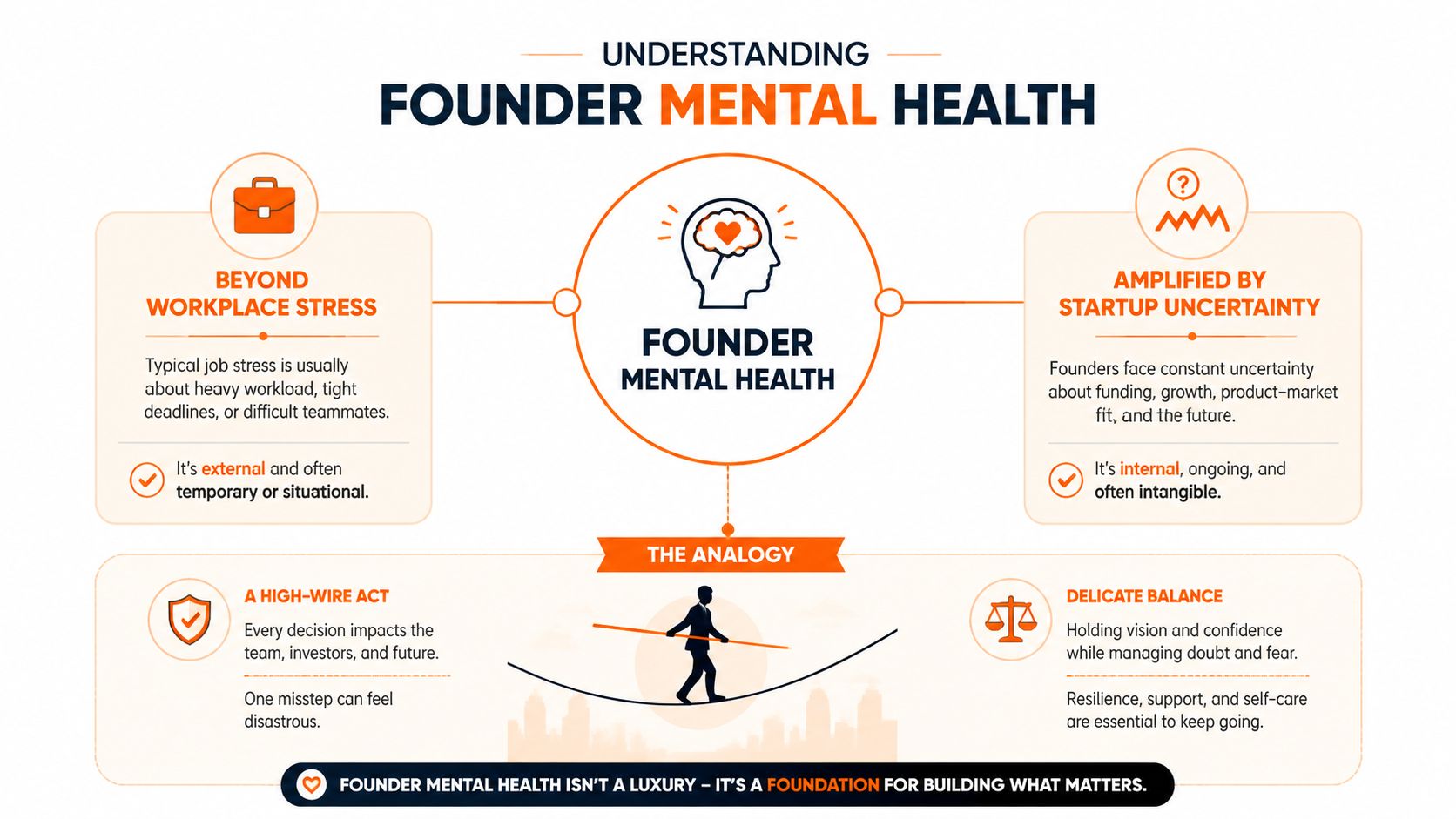
Founders also live with blurred roles. You're the salesperson, the operator, the recruiter, and often the emotional container for the team. That makes stress harder to separate from identity, which is why a bad week can feel like a verdict on who you are.
Historical evidence points in the same direction. A founder-health study reported that 72% of entrepreneurs had experienced at least one mental-health concern, compared with 48% in a comparison group, and entrepreneurs were roughly twice as likely to report depression and three times as likely to report substance-use concerns (source). That doesn't mean every founder will struggle the same way. It does mean the founder role creates a mental load that deserves its own playbook.
Common Stressors and Symptoms
Founders often think of stress as one thing, but it usually arrives in clusters. Funding pressure, long hours, conflict, and isolation each hit the nervous system in a different way. The body doesn't care that you meant well, it reacts to load.
The stressors that keep showing up
A 2026 global survey of 227 founders across 46 countries found 87.7% had at least one mental-health issue, with 50.2% reporting anxiety, 45.8% high stress, 34.4% burnout, and 26.9% loneliness (source). That pattern fits what founders usually feel in practice.
- Funding uncertainty often shows up as racing thoughts, because every conversation seems to decide the next six months.
- Long hours can flatten your emotional range until even small problems feel heavy.
- Team conflict can make you second-guess your own leadership and replay conversations after they end.
- Isolation can turn normal stress into something darker, because you stop getting reality checks from people you trust.
Practical rule: if the same stressor keeps returning, stop calling it a mood and start calling it a trigger.
Symptoms you can spot early
Anxiety often looks like urgency that won't shut off. Burnout looks like effort without recovery. Sleep disruption is sneaky, because it can start as “I'm just catching up on email” and end with a brain that never really powers down.
Decision fatigue is another common sign. You know it when small choices feel weirdly expensive. You reread the same draft, delay the same call, or snap at the same person because your mental battery is already spent.
The clearest move is to map trigger to symptom in real time. If investor news makes your chest tight, that's data. If customer churn makes you stop sleeping well for two nights in a row, that's data too. The point is not to dramatize every wobble. It's to catch the pattern early enough to do something useful.
Self Care and Management Strategies
Think of your mental health like a bank account. Big withdrawals happen during launches, layoffs, fundraises, and ugly surprises. If you never make deposits, the account goes negative fast.
The 2024 founder snapshot found 93% of founders had signs of mental-health strain, with an average of 4.9 symptoms each, and 55% had symptoms weekly or daily (source). That's why I push prevention over cleanup. You don't wait for the engine to fail before you change the oil.
Build a small routine you can keep
Start with micro breaks. Stand up, breathe, walk to water, close your eyes for a minute. A short reset is better than waiting for a full collapse. Your brain needs tiny exits from pressure, not just one long vacation you might never take.
Sleep hygiene matters too, but founders need version 1.0, not perfect behavior. Pick one rule you can keep, like no work messages in bed or a fixed cutoff for email. If your mind keeps spinning, write the next day's top three tasks on paper before you shut the laptop.
Then work on mindset shifts. I like one simple question, “What is true right now, and what am I adding to it?” That helps separate facts from panic.
Your goal isn't to feel calm all the time. Your goal is to notice strain before it starts driving the car.
Give yourself a weekly reset
Once a week, do a short review. Ask three things. What drained me? What gave me energy? What do I need to protect next week? That kind of review is boring in the best way, because boring is repeatable.
If writing helps you think, an AI journaling app for growth can make the habit easier to keep when your head feels crowded. I'd use it as a mirror, not a therapist. It can help you notice patterns you'd miss in the rush.
You can also protect your energy by setting limits around the worst pressure points, which I cover in this guide to protecting your energy. A founder who guards attention and sleep makes better calls than a founder who treats exhaustion like proof of dedication.
Building Supportive Networks
A founder can look steady in public and still be carrying too much in private. That gap is common, and it can make stress harder to spot until it starts shaping decisions, sleep, and tone in meetings. Research cited by source says many founders hide stress from investors, cofounders, or peers, which slows help-seeking and delays treatment.
Selective disclosure is the better path. You do not need to tell everyone everything. You do need a few people who can hear the truth without turning it into gossip, panic, or a pitch.
Share enough, not everything
Start with the person who has the cleanest relationship to the problem. A cofounder may need one version. An investor may need another. A therapist needs the unfiltered version. Those are different conversations for a reason.
A useful script sounds like this. “I'm under more strain than I've said out loud, and I'm handling it, but I need you to know I'm not at my best right now.” That sentence is honest without being dramatic. It also gives the other person a clear lane.
Selective disclosure works like a pressure valve. You release enough pressure to keep the system from cracking, while keeping the core structure intact. If you want a guide to mental illness support, it can help you think about what kind of group feels safe enough to use. I would look for people who listen well, keep confidences, and do not turn every struggle into a branding exercise.
Build a small trust circle
You need a few roles, not a crowd. One person for truth, one for perspective, one for accountability, and one licensed professional if you can access one. That mix covers emotional support, business reality, and clinical care.
A peer structure can help founders stop carrying every concern alone. Chicago Brandstarters is one option for founders who want a vetted peer group. It uses small private dinner groups and an active chat, with identity checks and confidentiality norms, so people can talk like real operators instead of performing confidence. I like that model because it lowers the social cost of saying, “I'm not fine.”
Before you join any group, test whether it fits the stress you are trying to manage. If the room makes you edit every sentence, it will not help much. If the room lets you name strain early, before it hardens into isolation, it gives you a place to share the warning signs before they become a crisis.
Simple test: if you cannot tell someone you are overwhelmed, they are not in your support circle yet.
Joining Chicago Brandstarters for Lasting Support
A founder group works only when people trust the room. Chicago Brandstarters uses vetting, small 6 to 8 person dinner groups, and confidential chat dynamics to make it easier to speak plainly about stress, loneliness, and hard calls. That matters because founders often need a place where they can be honest without worrying that every sentence will leak into the room next door.
The community is built for kind, bold founders who want support, not status games. Members share war stories, compare tactics, and keep each other accountable when stress makes them want to disappear. That kind of steady contact helps because isolation tends to grow in silence.
I like this model for one reason. It gives you a place to say the hard thing early, before it gets polished into a crisis. It also pairs well with professional help, because peer support and therapy solve different problems.
Next Steps for Sustained Well Being
Treat founder mental health like maintenance, not a rescue mission. Put stress check-ins on your calendar, build a short self-care routine you'll stick with, map your support circle, and write down the triggers that usually push you over the edge. Then choose one founder group that gives you real accountability.
The founders who last aren't the ones who never wobble. They're the ones who notice the wobble fast and reach for support before the floor drops out.
If you want a place to talk with other kind, serious founders who understand the grind without turning it into theater, visit Chicago Brandstarters. It's built for founders who want honest peer support, trusted relationships, and a room where stress can be discussed before it turns into silence.
Leave a Reply