You can get away with a sloppy promise once. You can't get away with a sloppy promise twice, especially when you're a founder in Chicago or anywhere in the Midwest and your name is on the invoice, the Slack thread, and the apology email. The cheap shortcut feels harmless on a Tuesday night, then it turns into a delayed delivery, a contractor who quits, or a customer who tells three other buyers you're not straight with people. I've watched that movie, and it always costs more than founders think.
Why This Guide Is for You, Not the Fortune 500
A lot of ethics advice reads like it was written for a company with a compliance officer, a legal team, and a brand budget that can absorb mistakes. That's not your world. You're probably choosing a supplier this week, writing a contractor agreement tonight, and deciding whether to soften a timeline because you're scared of missing a launch date.
I care about that version of the problem because that's where ethics lives. It's in the small call you make when cash is tight and the cleaner option looks slower. It's in the decision to tell a customer the truth about a delay instead of trying to buy one more day with vague language.
A founder doesn't need a philosophy seminar. A founder needs rules that hold when pressure is high and time is short.
Practical rule: if a decision feels too awkward to explain to a customer, contractor, or investor, it usually needs more work.
This guide is for idea-stage founders, pre-prototype operators, and first-revenue teams. It's for the founder who wants to build something people trust five years from now without torching reputation in year one. It's also for the kind, hard-working people who don't want to cheat, but also don't want to price themselves out of the market.
The reason this matters is simple. Ethical business practices are no longer just a nice label for polished companies. The data in the next sections shows that strong ethical culture tracks with reporting behavior and business results, and that bad conduct gets expensive fast. One benchmark cited in later industry analysis found that companies with the strongest ethical cultures outperform peers by about 40% across customer satisfaction, loyalty, innovation, adaptability, and growth, according to the historical survey summary at Soocial's business ethics statistics roundup.
If you're building in Chicago, Milwaukee, Indianapolis, Columbus, Detroit, or anywhere else where people still shake hands before they chase margins, this is for you. You need a system you can use before Monday, not a deck you admire later.
What Ethical Business Practices Actually Mean at the Idea Stage
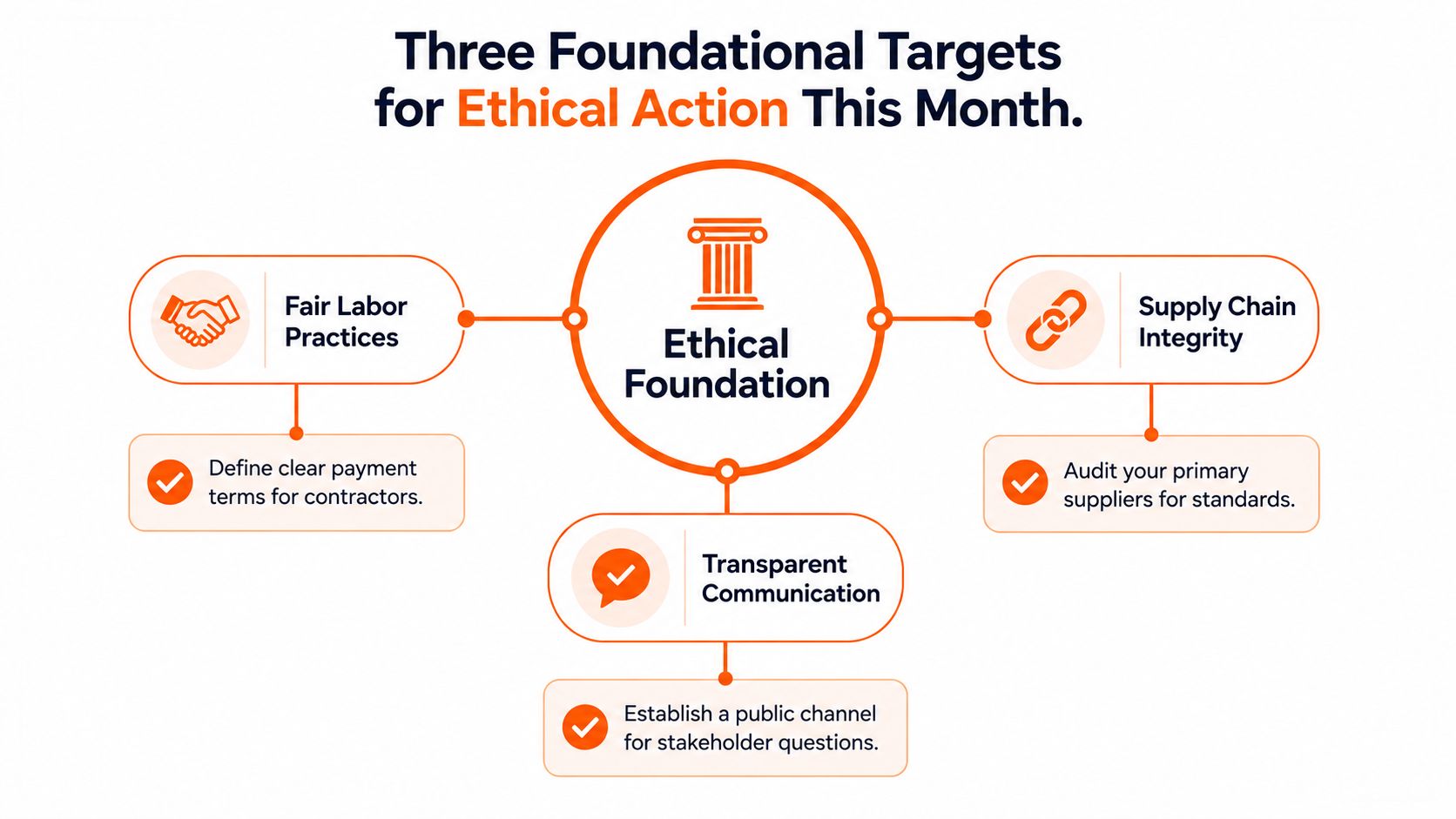
At the idea stage, I keep ethics in three buckets. If a choice doesn't touch one of these, I usually stop wasting energy on it. If it does, I slow down and check the work.
Fair labor practices
This is how you treat your first contractor, your first hire, and anyone who touches your supply chain. It means fair pay terms, safe working conditions, no bait-and-switch on scope, and no pretending “founder hustle” is a substitute for real labor standards. The North Carolina Central University examples cover fair wages, safe conditions, reasonable hours, and avoiding child labor and forced labor in the supply chain, which gives you a plain standard to work from in real life, not a slogan to tape to a wall NCCU business ethics examples.
My test is simple. If I would hate seeing my own agreement or pay terms on a group chat screenshot, I'm not done.
Environmental responsibility
This is the material and logistics side of your business. It shows up in packaging, shipping choices, returns, sourcing, and the waste you create before you even have traction. You don't need a giant sustainability program to care about this, you need to stop making lazy choices that push cost and mess onto someone else.
If you're shipping your first 100 orders, ask what you need. Can you use less packaging, fewer fillers, or a supplier closer to your buyer? If the answer is yes, and the customer won't lose value, I'd take the cleaner route.
Transparent marketing and advertising
Founders sometimes try clever tactics that backfire. This includes landing page claims, before-and-after photos, refund terms, testimonials, and any promise about speed, quality, or results. The NCCU examples emphasize honest disclosure, clear terms, and avoiding misleading claims, which is the right foundation for a small brand NCCU business ethics examples.
My test is the fastest one I know. Would a buyer still feel respected after reading the fine print?
When you look at a decision on your desk this week, ask which bucket it touches. A contractor invoice touches labor. A shipping choice touches environment. A headline touches marketing. Most ugly decisions show up in more than one bucket, which is why a vague conscience isn't enough.
The Business Case in Dollars, Not Vibes
Ethics has a financial side, and I'm not interested in pretending otherwise. The cleanest founders I know don't moralize their way through this. They look at the risk, the trust gap, and the cost of a mistake, then they make the grown-up call.
One synthesis reported that companies with effective ethics programs achieve 40% higher return on assets than competitors, and firms with strong ethical governance showed an estimated 7.8% higher market returns. Those figures came from the business-ethics summary at Bayelsa Watch, and they're the kind of numbers that should make any operator pay attention.
The other side is uglier. The same source put average corporate legal settlements related to compliance at USD 113.7 million per case since 2022, and said U.S. businesses have paid more than USD 1 trillion in regulatory fines and penalties since 2000 Bayelsa Watch. You may never land in that territory, but you don't need to. One bad supplier issue, one sloppy promise, or one messy billing practice can hit a tiny company far harder than the headline suggests.
For founders, trust acts like margin. You either keep it or you spend it. If you want a close cousin to this idea, I'd read investor trust in financial reports and think about how a buyer or investor reacts when your numbers and your promises don't match.
A lot of early operators think ethics is expensive because they only count the visible cost. They see higher wages, slower sourcing, or a delay in launch. They forget the hidden cost of customer churn, returns, legal cleanup, lost referrals, and the time you'll spend explaining a mess you could've avoided.
Rule I use: if an ethical shortcut saves a little cash now and creates a lot of explaining later, it isn't cheap.
For me, the better question is this. What's the cost of getting caught, and what's the return of doing it right? Keep those two numbers in your head. They'll save you from a lot of foolish optimism.
A Six-Step Decision Process You Can Use on a Hard Call
When the pressure hits, I don't want a founder improvising like it's jazz night. I want a process. If the product is 80% ready, the contractor underbid everyone, or the launch date is already public, you need a fast filter that keeps you honest.
The OpenStax business ethics sequence is useful because it's blunt. Start with the facts, separate facts from assumptions, list the people and the rules involved, build a possible solution, evaluate it against the ethical concerns, then recommend the action and the next steps OpenStax business ethics process. That's not theory. That's a working checklist for a messy Tuesday.
Use the six steps like a pressure test
- Define the core conflict. Name the choice. If you say “we need to move fast,” that's not the conflict. The conflict is usually “ship now or delay,” or “save money or pay fairly.”
- Gather the facts. Pull the contract, the timeline, the customer promise, the vendor terms, and the messages that created the issue.
- Identify stakeholders. Write down who takes the hit. That might be a buyer, a contractor, a supplier, a teammate, or you.
- Consider alternatives. List the real options, not the fantasy option where nobody feels pain.
- Choose and justify. Pick the move you can defend with a straight face and a clean trail.
- Implement and review. Execute, then check whether the choice worked or created a new problem.
The government trade manual on responsible conduct gives me the second half of the lens. It says responsible business conduct aims at compliance with the law, risk management, reputation enhancement, and value added to the community U.S. trade manual on responsible business conduct. I like that framework because it keeps founders out of fake tradeoffs. You're not picking between profit and principle. You're trying to run a company that survives contact with reality.
If you can't defend the choice in plain English, you're probably leaning on wishful thinking.
The point isn't to make every decision slow. The point is to make the bad decisions obvious before they cost you. If you want a simple operating habit to pair with this, I'd tie it to a decision-making framework and keep the same logic in one place.
The Four Operating Areas Every Founder Must Lock Down
Ethics gets real when it shows up in your daily operating rules. I don't care how nice your values page looks if your hiring process, supplier work, pay bands, and customer data handling are sloppy. That's where trouble lives.
Keep the code short and tied to decisions
Your code of conduct should fit on one page if you can make it fit. A new hire should be able to read it in five minutes and know what you reward, what you won't accept, and what gets someone removed from the team. The government manual also points to recognizing employee contributions, rewarding ethical behavior, and punishing unethical behavior, and I'd make those three ideas visible in the code itself U.S. trade manual on responsible conduct.
Know your supply chain and your wages
If you don't know who made the thing, who packed it, or what they were paid, you're trusting a story, not running a business. A supplier's promise isn't a shield when the facts go sideways. For a founder, the standard is plain. Know the name of every main supplier, ask about working conditions, and keep the answer in writing.
Write pay bands before the second hire
Pay equity gets messy fast if you wait. I'd write the bands before the second hire, explain the rationale, and revisit them on a schedule. That doesn't mean every person gets identical pay. It means you know why the gaps exist, and you can explain them without bluffing.
Treat customer data like a loaded liability
Small companies often become too casual. Collect only the fields you use, keep access limited, and answer rights requests quickly. The practical KPI guidance says to track consent prompts, opt-out or renewal rates, fields collected versus fields used, and turnaround for access, correction, and deletion requests Pedowitz Group KPI framework.
If you want a privacy-by-design reference point, I'd look at Ciphar design practices and use the idea, not the buzzwords. Field-level access controls, detailed audit trails, and sensitivity tagging matter even when you're tiny, because one careless spreadsheet can turn into a brand problem fast.
How to Measure Ethics Without a Compliance Department
If you don't measure ethics, you're guessing. Guessing is fine when you're picking lunch. It's bad when you're deciding whether your company can be trusted.
I like a starter scorecard because it keeps the conversation honest without turning the business into a paperwork farm. You can run this from one Notion page, one spreadsheet, or one shared doc. The point is to make the pattern visible.
Here's a simple Founder Ethics Scorecard Starter.
| Metric | What It Measures | How Often | Founder Target |
|---|---|---|---|
| Monthly ethics pulse | What your team or top customers think about honesty, fairness, and responsiveness | Monthly | A clear trend, not perfect answers |
| Complaint log | How fast you hear and respond to problems | Weekly | Every issue gets a tracked response |
| Supplier audit checklist | Whether your suppliers meet your standards | Quarterly | No missing names or missing dates |
| Data-handling scorecard | Consent quality, minimization, rights-fulfillment time, fairness monitoring | Monthly | Clean records and fast response times |
The KPI framework at Pedowitz Group's ethical performance page is useful because it gives you a way to track consent prompts, opt-out or renewal rates, and turnaround time without hand-waving. That's the kind of language founders can use when they want ethics to look like an operating discipline, not a poster.
I'd also build a monthly review around the exact controls that stop small mistakes from becoming large ones. Field-level access controls keep people out of data they don't need. Detailed audit trails let you trace what happened. Sensitivity tagging keeps the risky stuff from sitting next to normal records like it's all the same.
Practical rule: if a staffer or contractor can't tell what data they're allowed to touch, your system is already too loose.
If you want to turn the scorecard into a real operating habit, I'd pair it with how to create standard operating procedures and make the rules boring on purpose. Boring is good here. Boring means repeatable.
Chicago and Midwest Examples Worth Stealing
I like local examples because they feel closer to the desk. If you're building in Chicago or the Midwest, you don't need some glossy coastal playbook. You need moves that fit a practical operator and don't require a ten-person staff.
One Chicago consumer brand I've seen keeps its supplier list and factory audit dates on its site. That does two things at once. It tells buyers the company isn't hiding, and it forces the founder to keep the records current because the page is public.
A Midwest manufacturer I respect publishes a plain-English pay band policy and ties raises to it. No theater. No mystery. People know where they stand, and managers have fewer excuses to freelance on compensation.
A local agency I like sends a quarterly data-use report to its top fifty customers. That's smart because the agency doesn't wait for a panic call to explain itself. It starts with a calm explanation of what data it uses and why.
I've also seen Chicago founder groups vet members on LinkedIn before anyone gets into the room. That keeps the conversation between operators, not service-sellers. It matters because people speak differently when they know the room is built for truth instead of pitch decks.
The local lesson is simple. Boldness and kindness work better together than they do apart. Bold means you publish the thing. Kind means you pay fair and tell the truth. If you want your own accountability circle, find people who will ask hard questions and won't melt when the answers are awkward.
I trust a room that can handle bad news more than a room that only wants polished news.
If you're in Chicago, don't chase big, vague communities. Find a few founders who already keep their word, then trade real operating notes with them. That's how you stay honest when the pressure rises.
Your 30-60-90 Day Ethics Roadmap
Days 1 to 30
Write a one-page code of conduct. Keep it plain and tied to real decisions, not corporate poetry. List every supplier and contractor in one place, then set up a complaint inbox that a real human checks every week.
Your deliverable is simple. You should have a code, a vendor list, and a working inbox by the end of the month.
Days 31 to 60
Run the six-step decision process on your three trickiest open questions. Pick the ones that keep coming back, because those are the ones that already cost you attention. Publish a plain-English data and privacy page, then hold one supplier conversation about wages and working conditions.
Your deliverable here is a short written record of the decisions you made and why you made them. If you can't explain the answer to a teammate, the answer isn't ready.
Days 61 to 90
Build the founder ethics scorecard. Run your first monthly ethics pulse. Write a short public statement of what your brand stands for and how you measure it.
That statement doesn't need to sound polished. It needs to sound true. If customers, contractors, or investors read it, they should know what you'll do, what you won't do, and how you'll check yourself.
Ethical business practices are not a project you finish. They're a daily operating choice. The founders who win long-term are the ones who treat ethics like a system, not a slogan.
Chicago Brandstarters helps kind, bold, hard-working founders compare notes, pressure-test decisions, and build a business they can defend in five years. If you want a room of operators who care about trust as much as growth, visit Chicago Brandstarters and see if it fits the company you're trying to build.
Leave a Reply