
Team building is broken because most of it has nothing to do with how real teams work under pressure. Trust falls, awkward icebreakers, and forced happy hours don't help you ship faster, solve conflict, or keep good people when things get hard. They give you a brief sugar high, then everybody goes back to hiding problems.
I've seen better results from smaller, rawer, more honest team building strategies. The stuff that works looks less like corporate entertainment and more like building a crew for a long road trip. You need people who can tell the truth, take feedback, share context, and stay steady when the plan blows up.
That's also where the modern view of teamwork has landed. Gallup frames strong teams around common purpose, connection, communication, collaboration, and celebration, with strengths-based teaming, clear expectations, and frequent communication built into the work itself, not treated like a side activity in Gallup's teamwork guidance. If you want a useful outside take on culture mechanics, I also like Pebb's insights on fostering team culture.
I'm going to skip the fluff and give you 10 team building strategies I'd use if I were building from zero with a small team, a founder circle, or an early community.
1. Small Group Mastermind Circles
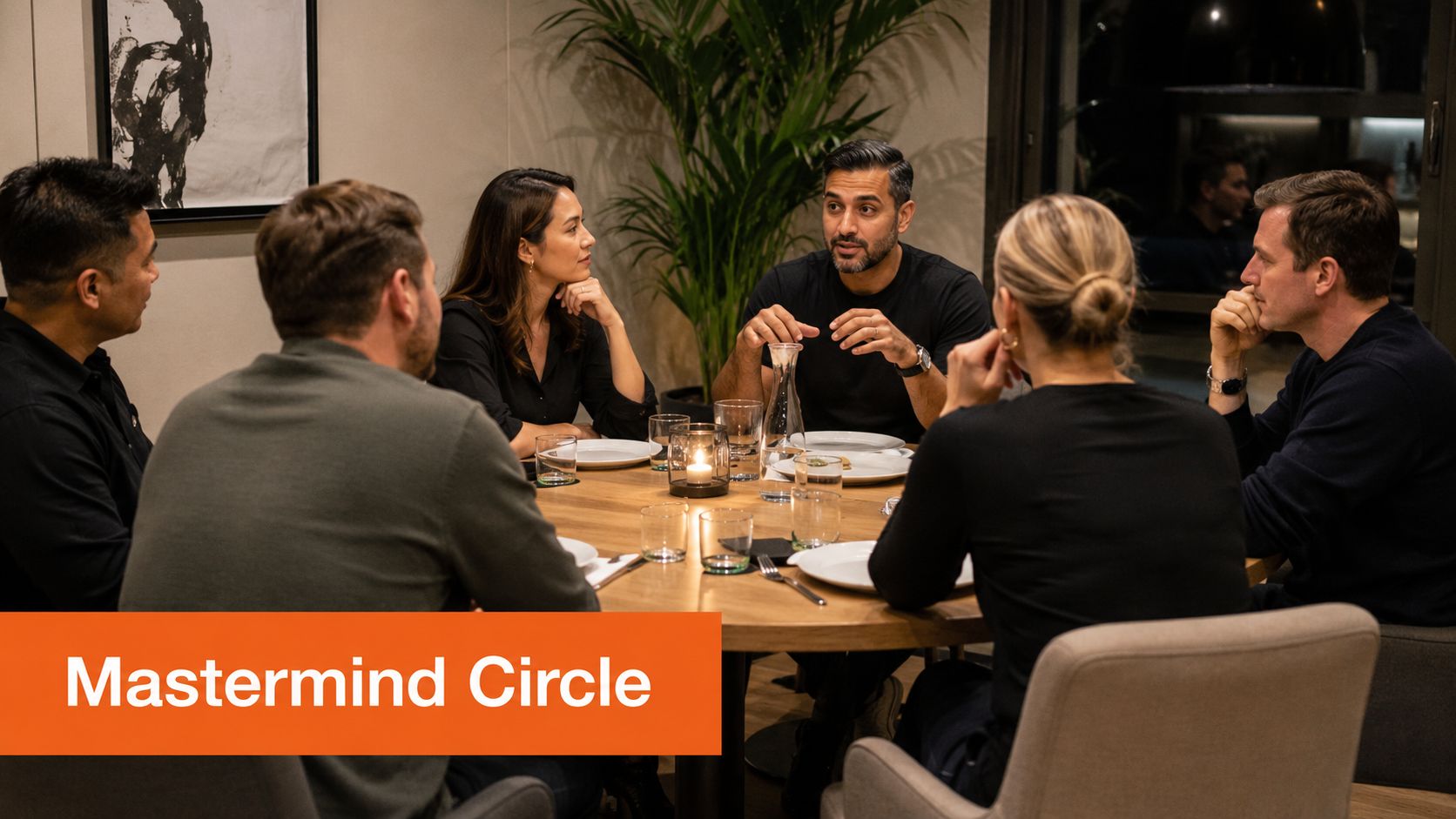
If your idea of team building is a big offsite, you're wasting time. Real trust gets built in small rooms, with the same people, on a steady cadence, talking about problems that could hurt the business.
I'd start with a mastermind circle before I spent a dollar on culture programming. Put 6 to 8 founders, leaders, or operators together. Keep it tight enough that nobody can coast, perform, or disappear into the background. In communities built from the ground up, especially founder circles that care more about truth than polish, this format creates connection fast because people have to show their thinking, not their image.
How I'd run it
Keep the rules simple and strict:
- Cap the group at 6 to 8 people: Any bigger and people start spectating instead of contributing.
- Meet every week or every other week: Long gaps reset trust and kill momentum.
- Use a hot seat format: One or two people bring a live issue, not a polished story after the fact.
- Require specifics: Revenue stall, hiring miss, conflict with a partner, broken process. Vague updates are useless.
- Close with one clear commitment per person: The next session should start with what happened, what didn't, and why.
I like this model because it forces the behavior you want on a real team: candor, pattern recognition, follow-through, and the ability to give useful input without turning every conversation into a performance. If your group can't handle direct feedback yet, fix that first with a clear process for giving and receiving feedback without defensiveness.
Chicago Brandstarters runs small in-person founder workshops and dinners built around this kind of intimate, honest discussion instead of shallow networking.
Practical rule: If people leave energized but cannot name the decision they made, the risk they surfaced, or the commitment they own, you did not build a team. You hosted a social event.
I've seen small circles do more for trust than months of forced bonding. They expose weak thinking, surface hidden tension, and create the kind of loyalty that holds up when the launch slips, the hire fails, or the plan falls apart.
2. Vulnerability-Based Trust Building

Teams often don't have a communication problem. They have a safety problem. People stay quiet because they think honesty will cost them status, influence, or belonging.
So fix that first. I don't mean turning work into group therapy. I mean leaders go first and tell the truth. Talk about the bad hire, the campaign that flopped, the fear you had before payroll, the customer call you mishandled. When you act polished all the time, your team learns to perform. When you act human, your team learns to speak.
What vulnerability should look like
Good vulnerability is specific and useful. It sounds like, “I made the wrong call, here's why, here's what I missed, and here's how I want you to challenge me next time.”
The practical side matters. If you want your team to handle tension without meetings turning into theater, build norms around civility, active acknowledgment, accurate reading of negative feedback, and clear communication, which is exactly where Workplace Strategies for Mental Health focuses its guidance on stronger teams.
A strong companion habit is learning how to disagree without making the other person feel ambushed. This piece on giving and receiving feedback inside founder communities is useful because it pushes past generic “be open” advice and gets into actual behavior.
Say the hard thing cleanly. Don't decorate it. Don't weaponize it either.
This strategy feels uncomfortable at first. Good. That usually means you've left the fake zone and entered the part where trust gets built.
3. Peer Mentorship and Reverse Mentoring
A lot of founders make the same mistake. They think mentorship only flows one way, from the veteran to the beginner. That's too narrow and usually too slow.
The better setup is two-way. Pair a more experienced operator with someone earlier in the journey, then make both sides responsible for teaching. The experienced founder shares judgment, pattern recognition, and scar tissue. The newer founder shares current tools, fresh audience behavior, and the blind spots older operators often miss.
Why this format works
This is cheaper than hiring advisors and usually more honest. Paid experts often stay at a safe altitude. Peer mentors get closer to the messy details.
Here's how I'd structure it:
- Set a narrow focus: Pick one theme per pairing, like supply chain, paid acquisition, hiring, or founder mindset.
- Meet on a fixed cadence: Monthly often works well. Keep it on the calendar.
- Make learning mutual: Each person should show up ready to teach one thing.
- Write down next moves: Insight without action is just nice conversation.
I like this approach because it gives newer founders access without making them feel small. It also keeps experienced founders sharp. If you've built anything before, you know how easy it is to become stale and keep replaying old solutions in a new market.
If your team is small, you can use this inside the company too. Pair the senior operator who knows process with the younger teammate who sees culture shifts and tool changes faster. That's a real team building strategy because both people leave stronger than they came in.
4. Identity-Verified Vetting and Community Filters
Open-door communities sound nice until the room fills with self-promoters, service sellers, and people who treat every conversation like a lead list. If you want trust, you need filters.
That means vetting. Real names. Real profiles. A short application. Clear values. A willingness to say no to the wrong fit. I know that sounds less friendly than “everybody's welcome,” but good communities die when leaders confuse access with quality.
What to filter for
I'd screen for behavior, not polish:
- Check identity: Use LinkedIn, referrals, or a short call.
- Screen for motive: Builders belong. Predators don't.
- Look for generosity: People who only take will poison the room.
- Remove repeat offenders: One high-drama person can break trust for everyone.
If you're trying to design a tighter intake process, this guide on finding your tribe as a founder gets at the core issue, which is fit, not volume. If you need technical tools for the verification side, this roundup of identity verification software options gives you a starting point.
I'd rather have a smaller room full of honest builders than a packed room full of angle-shooters. Every time. This is one of the least glamorous team building strategies, and one of the most useful.
5. Shared War Stories and Tactical Knowledge Exchange
Founders don't need more polished success stories. They need the ugly middle. The failed launch. The broken supplier relationship. The hire that looked perfect and blew up in month two. That's where the good lessons live.
When people swap war stories, they stop pretending they're the only one with dents. That lowers isolation and speeds up decision-making because someone else has usually stepped on the same rake.
What a good war story includes
A useful story has detail. It doesn't hide behind motivational fluff.
- State the problem plainly: What went wrong?
- Name the bad assumptions: Where did your thinking break?
- Show the response: What did you do next?
- Extract the lesson: What would you repeat or avoid?
I'd ban victory laps. If someone only shares neat endings, the room learns nothing. I want the timeline, the tension, the argument, and the fix.
This strategy also helps younger founders borrow judgment before they've earned it the hard way. That matters because trial and error is romantic until the error is expensive. In practice, these sessions become a living playbook. People remember stories better than frameworks, especially when the storyteller is candid enough to sound human.
6. Asynchronous Community Connection
Most team building strategies fail because they live for one hour on a calendar, then disappear. Real trust gets built between meetings. In the quick check-ins, the late-night “anyone dealt with this?” message, the quiet celebration after a hard week.
That's why I like private group chat systems. Slack, WhatsApp, and Discord all work. The tool matters less than the culture inside it.
Choose the tool, then police the vibe
A good chat space has channels for asks, wins, referrals, quick feedback, and dumb questions people don't want to ask in public. It also needs moderation. Without that, every group chat drifts into noise or turns into a promo feed.
For distributed and hybrid teams, this matters even more because belonging and coordination often break outside the room. The gap isn't a lack of games. It's weak day-to-day connection across locations and schedules, which is exactly the underserved problem described in Scion Staffing's discussion of team building for more effective teams.
I'd set a few rules early:
- Use threads or channels: Don't let every topic crash into one stream.
- Celebrate progress: Wins create momentum.
- Ask for help fast: Don't let people sit on blockers too long.
- Kill self-promotion: The second the chat feels like marketing, trust drops.
If you want extra ideas for keeping an online space active, this piece on community engagement strategies for 2025 is worth a skim.
A healthy group chat is like a team kitchen. People pop in, swap what they know, and leave with something useful.
7. Values-Aligned Recruitment and Kind Givers
You can teach skills faster than you can repair character. That's why I'd hire and recruit for values first, then train for the rest.
For founder teams, I care about three things. Are you kind? Do you work hard? Will you tell the truth when it's inconvenient? If the answer is no, I don't care how shiny the resume looks.
What I'd screen for in interviews
Don't ask people if they're collaborative. Everybody says yes. Ask for stories that reveal how they operate when there's pressure, conflict, and credit to share.
Use prompts like these:
- Tell me about a time you helped without getting credit.
- Tell me about feedback you resisted, then accepted.
- Tell me about a conflict you made worse before you fixed it.
- Tell me where you tend to overreach or shut down.
This approach lowers internal politics because you're selecting for people who want the team to win, not just themselves. It also creates a more supportive culture because generous people often share context, contacts, and airtime without being pushed.
You do have to stay honest here. “Values fit” can become a lazy excuse for hiring clones. Don't use kindness as code for sameness. You still want disagreement, edge, and different life experience. You just don't want jerks.
8. Cross-Founder Resource and Connection Sharing
Teams do not get stronger from motivation alone. They get stronger when people hand each other real advantages. I mean the vetted manufacturer, the freelance operator who delivers, the investor who replies, the lawyer who does not waste your runway, and the software stack that saves your team ten hours a week.
This is one of the few team building strategies that creates immediate payoff. In founder communities like Chicago Brandstarters, value often shows up in a sentence like, "Use this person, not that one," or, "I already made that mistake, here is who fixed it." That kind of sharing builds trust fast because it costs something. People are putting their own reputation behind the recommendation.
I would never leave this loose or accidental. Build a simple system people can use.
- Keep a live directory: List vendors, recruiters, fabricators, accountants, photographers, and fractional operators.
- Add context to every recommendation: Say what the person helped with, budget range, speed, and any watchouts.
- Set intro rules: Get permission before making a warm connection and be clear about why the match makes sense.
- Track outcomes: Note who was excellent, who was average, and who should come off the list.
Analysts at Business Research Insights in its team-building service market report project strong growth in spending on team-building services over the next decade. I take the signal seriously, but I would spend that budget carefully. Skip the rented fun. Put your energy into systems that help founders share hard-won contacts, working vendors, and tested resources they can use again.
One good introduction can save a month of bad decisions. A shared resource bench can save a company.
9. Graduated Progression and Next-Stage Pathways
A lot of communities break when everyone gets lumped together. The person with an idea on a napkin has different needs from the founder managing real revenue and a growing team. If you treat them the same, both people get frustrated.
I prefer a staged model. Know where someone is. Then point them to the next room, not the whole building.
Stage people honestly
You don't need a complicated framework. A simple progression works:
- Idea stage: You need clarity, proof of demand, and early confidence.
- Prototype stage: You need feedback, iteration, and first users.
- Early revenue stage: You need repeatability and tighter operations.
- Scaling stage: You need systems, people, and better decision cadence.
This keeps advice relevant. It also stops newer founders from comparing their day one to somebody else's year five.
Chicago Brandstarters already uses that logic in practice by helping early builders connect with peers now, then pointing some founders toward later-stage programs as they grow. I like that model because it treats community like a path, not a cage. People should outgrow rooms. That's healthy. The mistake is pretending one format can carry every founder forever.
10. Accountability Partnerships and Milestone Tracking
If trust is the fuel, accountability is the steering wheel. Without it, your team building strategy turns into good vibes and forgotten intentions.
Pair people up. Give them a cadence. Make them commit to a small number of meaningful milestones. Then make them report back. This sounds simple because it is. It also works because individuals follow through better when another human is expecting an answer.
Keep the pressure supportive
I don't like shame-based accountability. It creates hiding. I want the tone to be direct and useful.
“What did you say you'd do, what happened, what blocked you, and what's next?”
That format keeps the conversation clean. It also prevents people from drifting into vague self-justification.
The business case for this stuff is stronger than a lot of founders assume. One evidence set reports that organizations with engaged employees are 21% more profitable, with a 41% reduction in absenteeism and a 17% boost in productivity, while the same summary says regular team-building can cut workplace conflict by 20% and improve retention by 36% in Madrid Adventure's roundup of team-building statistics. I'm careful with stats in general, but those numbers line up with what I've seen in practice. Teams do better when expectations are clear and people feel connected enough to follow through.
You don't need fancy software for this. A shared doc, Slack reminder, or recurring calendar invite is enough. The hard part isn't the tool. It's staying honest when you miss the target.
10-Point Team Building Strategies Comparison
| Item | 🔄 Implementation Complexity | ⚡ Resource Requirements | 📊 Expected Outcomes (quality) | 💡 Ideal Use Cases | ⭐ Key Advantages |
|---|---|---|---|---|---|
| Small Group Mastermind Circles | Moderate, recurring facilitation, vetting | Low, member time, minimal cost | Deep trust and tailored problem-solving; ⭐⭐⭐⭐ | Early-stage founders seeking peer accountability | Intimacy, honest feedback, lasting relationships |
| Vulnerability-Based Trust Building | Moderate, leader modeling, training & norms | Low, facilitation and time investment | Psychological safety and better decisions; ⭐⭐⭐⭐ | Teams wanting authentic culture and risk-taking | Faster trust-building, improved candor |
| Peer Mentorship & Reverse Mentoring | Moderate, matching and expectation-setting | Low, mentor/mentee time, coordination | Mutual skill transfer and context updates; ⭐⭐⭐ | Newer founders needing guidance and fresh perspectives | Accessible advice, mutual learning |
| Identity-Verified Vetting & Community Filters | High, application, interviews, ongoing moderation | Moderate, verification tools and admin time | Higher trust and fewer bad actors; ⭐⭐⭐⭐ | Communities prioritizing safety and quality | Maintains community integrity, protects vulnerability |
| Shared War Stories & Tactical Knowledge Exchange | Low, session structure and facilitation | Low, member time, documentation effort | Practical tactics and faster problem resolution; ⭐⭐⭐⭐ | Product/e‑commerce founders needing concrete tactics | Actionable lessons, reduces trial-and-error |
| Asynchronous Community Connection (Group Chat) | Low, platform setup; moderate moderation | Low, platform costs + moderator time | Immediate support and sustained engagement; ⭐⭐⭐ | Distributed or busy founders needing async support | Real-time help, continuity between meetings |
| Values-Aligned Recruitment & "Kind Givers" Selection | Moderate, design of assessments and interviewer training | Moderate, interview time and training | Supportive culture and reduced conflict; ⭐⭐⭐⭐ | Communities building authentic belonging and trust | Strong cultural fit, voluntary mutual support |
| Cross-Founder Resource & Connection Sharing | Moderate, curation, protocols, maintenance | Low, wiki/platform + member contributions | Faster sourcing and vetted introductions; ⭐⭐⭐⭐ | Founders needing suppliers, intros, and vendor access | Saves time, leverages collective networks |
| Graduated Progression & "Next Stage" Pathway | High, diagnostics, partnerships, alumni management | Moderate, program management and partner coordination | Clear growth pathways and reduced mismatches; ⭐⭐⭐ | Communities serving multiple founder stages | Guided progression, alumni ecosystem |
| Accountability Partnerships & Milestone Tracking | Low, pairing and check-in cadence | Low, participant time, simple tracking tools | Higher follow-through and momentum; ⭐⭐⭐⭐ | Founders struggling with execution and consistency | Improves execution, fosters celebration and support |
Your Team Is Your Real Moat
You can build a product alone for a while. You can't build a durable company alone. At some point, every founder hits a wall where raw effort stops being enough. That's when your team either becomes your multiplier or your drag.
The mistake is thinking team building means entertainment. It doesn't. Real team building strategies change behavior. They make it easier for people to tell the truth, ask for help, recover from tension, and keep moving when things get messy. That's the standard I use.
There's also a hard business case for taking this seriously. In one workplace data set, 63% of leaders reported improved team communication after team-building participation, and 61% reported other improvements. That same source ties highly engaged teams to 18% higher sales, 23% higher profitability, 43% lower turnover, and 14% higher productivity in Flair's summary of team building statistics. I wouldn't use those numbers as a magic promise. I would use them as permission to stop treating team building like fluff.
If I were in your seat, I wouldn't try all 10 strategies at once. I'd pick one now. Start a mastermind circle. Build a better feedback norm. Pair people for accountability. Tighten your vetting. Open a private group chat and remove the self-promoters. Small changes beat grand plans that never ship.
The best teams usually share a few traits. They know why they're together. They trust each other enough to be blunt. They recover quickly after friction. They celebrate progress without getting soft. That mix is hard to fake.
If you want a founder-focused version of this, Chicago Brandstarters is one relevant option. It's a free, vetted community built around small private dinners, honest conversation, and ongoing group chat support for builders in Chicago and the Midwest. That format makes sense to me because it puts intimacy, truth, and accountability ahead of spectacle.
You do not need more people around you. You need better people around you, and better rules for how you work together. Build that, and a lot of other problems get easier.
If you want a founder community built around small vetted groups, honest war stories, and real support instead of shallow networking, take a look at Chicago Brandstarters.
Leave a Reply