

Most advice on how to become a business manager is too clean, too expensive, and too slow.
It usually goes like this: get the degree, maybe get the MBA, wait your turn, then maybe somebody lets you run a team. That advice isn't wrong. It's incomplete. If you're in Chicago, the Midwest, or anywhere people still respect hard work over polish, there's another route. You can build management chops by running real work, fixing messy problems, owning small budgets, and getting people to trust your judgment.
I'm going to be blunt. A business manager is not a professional meeting attender. A business manager is the person who makes the machine run when parts are loose, late, or missing. You connect money, people, timelines, and priorities. You make decisions with imperfect information. You keep the wheels on.
That's why operator experience matters so much. If you've run a side hustle, handled fulfillment, managed freelancers, calmed down upset customers, or cleaned up a broken process, you're already closer than you think.
Forget the MBA What Being a Business Manager Really Means
The MBA-first story gets too much airtime.
Yes, formal education still matters. Many employers expect at least a bachelor's degree, and an MBA can help in some environments. But if you think a degree alone turns you into a business manager, you're already thinking about the job the wrong way. The title comes after the behavior.
A business manager is an operator with judgment. You're paid to make choices, keep people moving in the same direction, and stop small problems from turning into expensive ones.

The job is mid-career for a reason
If you want a reality check, look at the workforce data. In the United States, there were over 87,068 business managers employed, the average age was 44, and women represented 56.8% of the occupation, according to Cedefop's business manager workforce data.
That tells you something important. This is not an entry-level role you obtain with a shiny resume line. It's a judgment role. People put managers in charge when they trust them to handle pressure, tradeoffs, and people problems.
Practical rule: Stop asking, “How do I get the title?” Start asking, “What proof do I have that I can run a system with people inside it?”
The real work is connecting moving parts
A lot of beginners think management is mostly leadership style. It isn't. Style matters, but execution matters more.
You need to know how goals connect to daily work. That's why I like The OKR Hub's strategic insights. Clear objectives force you to turn fuzzy ambition into concrete priorities. Good managers do that every week, whether or not the company uses formal OKRs.
Here's the simplest way I explain the role:
| What amateurs think | What managers actually do |
|---|---|
| Motivate people | Set priorities people can act on |
| Attend meetings | Remove friction and make decisions |
| Watch dashboards | Ask what changed and why |
| Delegate tasks | Match work to skill and follow through |
The people side matters too. If you're stiff, fake, or defensive, your team will hide problems from you. That's deadly. Real management requires trust, and trust requires honesty. If you need a better frame for that, read this piece on vulnerability in leadership. Managers who can admit what they don't know usually learn faster and lead better.
The Two Paths The Corporate Ladder vs The Operator's Path
You've got two broad ways in.
The first is the traditional route. The second is the operator's route. Both can work. One is usually a better fit if you're already building things hands-on.
The traditional path
The classic path is simple. Earn the degree, get into a company, start low, and move up. Career guidance still points many people toward a bachelor's degree in business administration, management, finance, or a related field. And the pay is real. The U.S. Bureau of Labor Statistics reported a median annual wage of $122,090 in May 2024 for management occupations, as summarized in this career guidance overview.
That path works best if you want structure, brand-name employers, and a clean promotion ladder.
It also has problems. It can be slow. It can cost a lot. And it can train you to manage slices of a business before you understand how the whole thing works.
The operator's path
The operator's path is messier. It's also more real.
You build the same muscle in a small company, a startup, a family business, a side hustle, an e-commerce brand, or a scrappy sales role. You learn by owning outcomes before anyone gives you a formal title. You might handle vendor issues in the morning, fix a spreadsheet at lunch, and train a new hire before the day ends.
That's management training. It just doesn't always come with a neat label.
If you can run a process, watch a budget, and keep people accountable, you're doing manager work even if your email signature says something else.
Side-by-side reality
| Corporate ladder | Operator's path |
|---|---|
| Structured training | Real-time learning |
| Clear titles | Blurry titles, clearer responsibility |
| Degree often expected | Experience can carry more weight |
| Narrow scope early | Broad scope early |
| Safer on paper | Faster skill stacking |
The reason I like the operator's path for Midwest builders is simple. It matches how many of us live. You don't always get perfect access. You make yourself useful. You earn trust. You solve what's in front of you.
How to translate messy experience into manager language
If you've worked in retail, operations, sales, customer service, logistics, hospitality, or your own business, don't undersell it. Rewrite your experience in business terms.
- Frontline work becomes process ownership. “Handled customer issues” becomes “resolved operational issues and improved workflow reliability.”
- Side hustle work becomes business oversight. “Ran an Etsy store” becomes “managed pricing, fulfillment, vendor coordination, and customer retention.”
- Helping coworkers becomes informal leadership. “Trained new people” becomes “onboarded team members and improved ramp-up consistency.”
- Budget pressure becomes financial judgment. “Made things work with limited cash” becomes “prioritized spending and tracked operating decisions against revenue.”
That's how you answer the question of how to become business manager without pretending you came from a giant corporate machine. You show that you already know how to make work happen.
Build Your Manager's Toolkit with Systems Not Theories
Leadership books are fine. Systems are better.
New managers usually don't fail because they care too little. They fail because they rely on vibes. They jump into solutions too fast, delegate too loosely, and never circle back to see if the fix worked.

Use the problem-solving loop every time
A proven framework from The CPA Journal's management guidance is simple: identify, analyze, generate, select, implement, evaluate.
That loop works for almost everything.
A late shipment problem. A bad handoff between sales and ops. A team member missing deadlines. A launch that fell flat. Same loop.
Here's how I'd use it in plain English:
- Identify the problem. Say what is happening, not what you fear is happening.
- Analyze the cause. Don't stop at the first obvious answer.
- Generate options. Force yourself to come up with more than one.
- Select the best option for the current constraints.
- Implement it with an owner and a timeline.
- Evaluate the result. If it failed, learn why fast.
Most beginners skip steps two and six. That's why they keep fixing symptoms.
Build a delegation filter that saves you from chaos
Delegation is not “I'm busy, you handle it.”
Good delegation has clear scope and a realistic match between the task and the person doing it. If the person can't do the task with the information, authority, or skill they have, you didn't delegate. You dumped.
Use this filter before you hand work off:
- Specific task. Can I say exactly what done looks like?
- Match to skill. Does this person have the ability to finish it well?
- Authority. Can they make the decisions needed along the way?
- Review point. When will we check progress before it goes off the rails?
- Time frame. Is the deadline real, or did I invent it in panic?
If you want a practical companion to that mindset, I like these principles for driving startup success. They fit the reality of small teams where leaders don't get to hide behind org charts.
Write the system down
You are not managing well if everything lives in your head.
That's why I push people to document recurring work. A hiring checklist. A returns workflow. A content publishing routine. A weekly inventory review. If you haven't written the steps, you haven't built a system. You've built dependence.
A simple place to start is this guide to standard operating procedures. Use Google Docs, Notion, Airtable, or even a plain checklist. The tool matters less than the habit.
Here's a useful explainer on how experienced managers think through these decisions in practice:
Learn the technical side too
Stale management advice quickly proves inadequate. If your idea of management is only leadership, communication, and presence, you're behind.
You need comfort with spreadsheets, budgeting logic, basic financial statements, operational dashboards, and tech tools. You don't need to become a data scientist. You do need to stop being allergic to numbers.
A manager who can't read a P&L is like a driver who refuses to look at the gas gauge. You might stay on the road for a while. You won't stay there long.
Get Management Experience Before You Have the Title
This is the part people overcomplicate.
You don't wait for permission. You create evidence. That's how you solve the “I need experience to get experience” trap.
Indeed's career advice gets this part right: a low-risk path is to stack education, entry-level operations experience, and small-team leadership opportunities so your resume shows actual management exposure, not just individual output, as outlined in Indeed's path to becoming a business manager.
If you have a job now
Use your current role as a training ground. Don't beg for a promotion first. Make yourself easier to trust.
Try moves like these:
- Take ownership of one broken process. Pick something annoying and recurring. Late approvals. Messy inventory counts. Weak onboarding notes.
- Lead a contained project. Holiday prep. A small product launch. A CRM cleanup. Something with a start, finish, and visible result.
- Train one person well. If you can onboard a new hire cleanly, you can already manage part of a system.
- Ask for responsibility, not status. Tell your boss you want reps in planning, coordination, and follow-up.
If you run a side hustle or small business
Then you already have raw material.
Your job now is to document it in a way employers or partners can understand. “Founder” means nothing by itself. “Managed order fulfillment, tracked cash flow, coordinated freelancers, built weekly reporting, and improved customer response workflow” means something.
Treat your side hustle like a lab. Every recurring task is a chance to prove you can build, run, and improve a system.
Turn everyday work into resume proof
Here's a clean translation table you can steal:
| Raw experience | Better manager framing |
|---|---|
| Helped with operations | Coordinated workflow across daily operations |
| Answered customer emails | Managed customer issue resolution process |
| Worked with freelancers | Directed outside contributors against deadlines |
| Kept track of sales | Reported on performance and supported decisions |
| Did a bit of everything | Oversaw cross-functional execution in a lean environment |
What to track starting now
If you want your experience to count, keep receipts.
- Projects owned. Write down the goal, timeline, your role, and the result.
- Processes improved. Save before-and-after versions of workflows or checklists.
- People supported. Note who you trained, coached, or coordinated.
- Budget decisions. Record when you had to choose where time or money went.
- Decision moments. Keep examples of tradeoffs you made under pressure.
That file becomes your interview bank later. It also teaches you to think like a manager while you're still earning the label.
Find Your People Building a Real Network in Chicago
Most networking advice is bad because it treats people like vending machines.
Show up, shake hands, collect LinkedIn profiles, hope somebody opens a door. That's not how strong careers get built. Strong careers come from trust, repeated contact, and honest conversations with people who do the work.
Chicago has an advantage here. People here usually care less about performance and more about whether you're solid. If you're useful, humble, and consistent, people remember.
Build a circle, not a contact list
The fastest-growing routes into management are about proving you can run processes, budgets, and teams, and that kind of proof gets easier to build when you're around operators who trade real tactics and feedback, a point reflected in this overview of becoming a business manager through practical experience.
That means you need a small circle of people who do three things:
- Tell you the truth. They'll say when your plan is sloppy.
- Share their playbooks. They've solved versions of the problems you have now.
- Make introductions carefully. They know who to trust and who to avoid.

What good networking actually looks like
Forget trying to impress people. Ask better questions.
Ask what process is breaking in their business. Ask what role they had to grow into the hard way. Ask what they wish they had documented sooner. Those questions get you operator answers, not cocktail-party fluff.
A healthy network also needs some depth. This guide on strategies of business networking is useful because it pushes past shallow outreach and into relationship building that lasts.
Good networking feels like comparing field notes, not trading pitches.
If you're serious about how to become business manager, spend less time chasing fancy rooms and more time finding people who've had to make payroll, fix broken workflows, or manage a team during a rough month. Those are your people.
Your 3 Year Roadmap From Operator to Manager
You do not need a perfect master plan. You need a sequence.
Think of this like strength training. In year one, you learn form. In year two, you add weight. In year three, people trust you with bigger lifts because they've seen the reps.
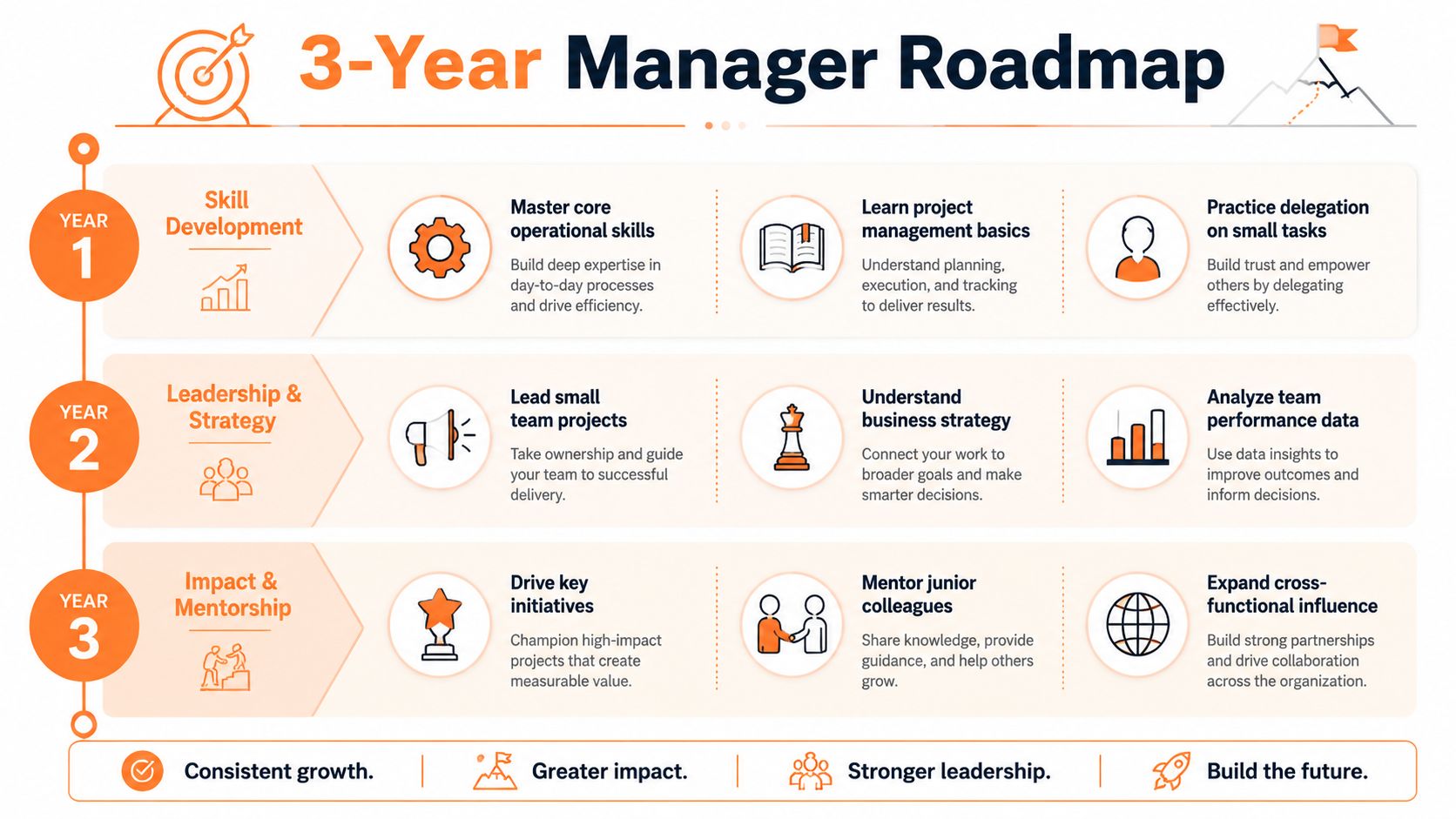
Year 1 Learn to run your own work
Your first job is to become dependable.
Get good at planning your week, tracking tasks, documenting repeatable work, and solving problems without drama. Learn Google Sheets or Excel well enough to organize data, spot simple issues, and support a decision with numbers. Get comfortable reading a basic profit and loss statement. If that sounds scary, good. That means you found a growth edge.
Focus on these habits:
- Own deadlines. Don't make people chase you.
- Write things down. Build checklists, templates, and notes people can reuse.
- Study operations. Watch where handoffs break.
- Practice delegation small. Use freelancers or teammates for contained tasks.
Year 2 Start leading pieces of the business
Now you stop acting like a strong helper and start acting like a coordinator.
Lead a small project. Run a meeting with a real agenda. Assign work with clear expectations. Handle one budget line, vendor relationship, or reporting rhythm. Your goal is to prove you can manage moving parts, not just finish your own tasks.
Use this checkpoint list:
| Area | What you should be able to do |
|---|---|
| Projects | Scope a small project and keep it on track |
| People | Coordinate at least one other person's work |
| Process | Improve one recurring workflow |
| Reporting | Present a simple update with clear next steps |
| Judgment | Explain why you chose one option over another |
Year 3 Make the jump
This is when you package the evidence.
Update your resume around responsibility, systems, and outcomes. Prepare stories about conflict, delegation, mistakes, and tradeoffs. When you interview, don't talk like a student of management. Talk like someone who has already done the work in smaller arenas.
If you need help preparing for interviews that test prioritization and product thinking, these product manager interview strategies are useful because they sharpen how you explain decisions, tradeoffs, and execution under uncertainty.
Your interview goal is simple. Make the other person think, “This person already manages. We'd just be making it official.”
A short checklist you can use now
- Pick one business skill gap and work on it this month.
- Document one process you currently do from memory.
- Ask for one piece of leadership responsibility in your current role.
- Track your decisions, projects, and people coordination in one file.
- Rewrite your resume with manager language, not helper language.
- Build relationships with operators who will tell you the truth.
- Apply when your proof is strong enough. Don't wait until you feel ready.
You become a business manager by acting like one before the market agrees with you. That's the whole game.
If you want a room full of kind, ambitious operators who'll give you an honest answer instead of networking fluff, join Chicago Brandstarters. It's free, it's vetted, and it's built for Chicagoans and Midwesterners who are serious about turning hands-on experience into practical business skill.
Leave a Reply