
Most advice about Idea Week Chicago is wrong.
People tell you to “stay open,” “follow your curiosity,” and “meet as many people as possible.” That's how you spend a full day listening to smart people, eating a stale cookie, and going home with nothing you can use on Monday.
I want you to do the opposite.
Go in narrow. Go in picky. Go in with a hit list. Treat the week like a field mission, not a school trip. If you leave with one sharper assumption, one useful relationship, and one test you can run next week, you did great. If you leave “inspired,” I'd call that a miss.
What Idea Week Chicago Is And Is Not
Chicago Ideas Week didn't start as a founder-only event. The first Chicago Ideas Week in October 2010 was built as an annual event through partnerships with museums, theatres, libraries, universities, and other civic groups across the city, according to the MacArthur Foundation announcement about the launch. The first edition ran October 10–16, and the whole setup was meant to energize Chicago and position it as a center for innovation.
That history matters because it tells you what kind of beast you're dealing with. Idea Week Chicago is broad by design. It pulls in civic people, creatives, educators, operators, students, and business folks. It is not a tight founder workshop where every session maps neatly to your startup problem.

The right way to see the event
Many individuals read the agenda like a menu. That's a mistake.
Read it like a mine. You are extracting ore. Some sessions have gold. Some have pretty rocks. Your job is to separate them fast.
Use this filter:
- Useful now: Will this help you make a decision in the next few weeks?
- Useful later: Will this open a relationship, market insight, or idea worth parking?
- Nice but empty: Is this just a smart person saying smart things with no path to action?
If it lands in bucket three, skip it.
Practical rule: If you can't answer “what will I do with this by next week?” before you attend a session, you probably shouldn't attend it.
What founders usually get wrong
Founders love conference sugar highs. A big talk gives you a rush. You feel like your company moved forward because your brain was busy. It didn't. Thinking is not progress unless it changes behavior.
That's why I'd rather you attend fewer sessions and work them harder. Sit in the hallway after a strong talk. Rewrite your positioning. Message two people you met. Kill a weak assumption. That hour is usually worth more than the next keynote.
If you want a broader list of technology events in Chicago, use it to compare where each event sits on the spectrum between inspiration and operator value. Big public events have reach. They rarely hand you clarity for free.
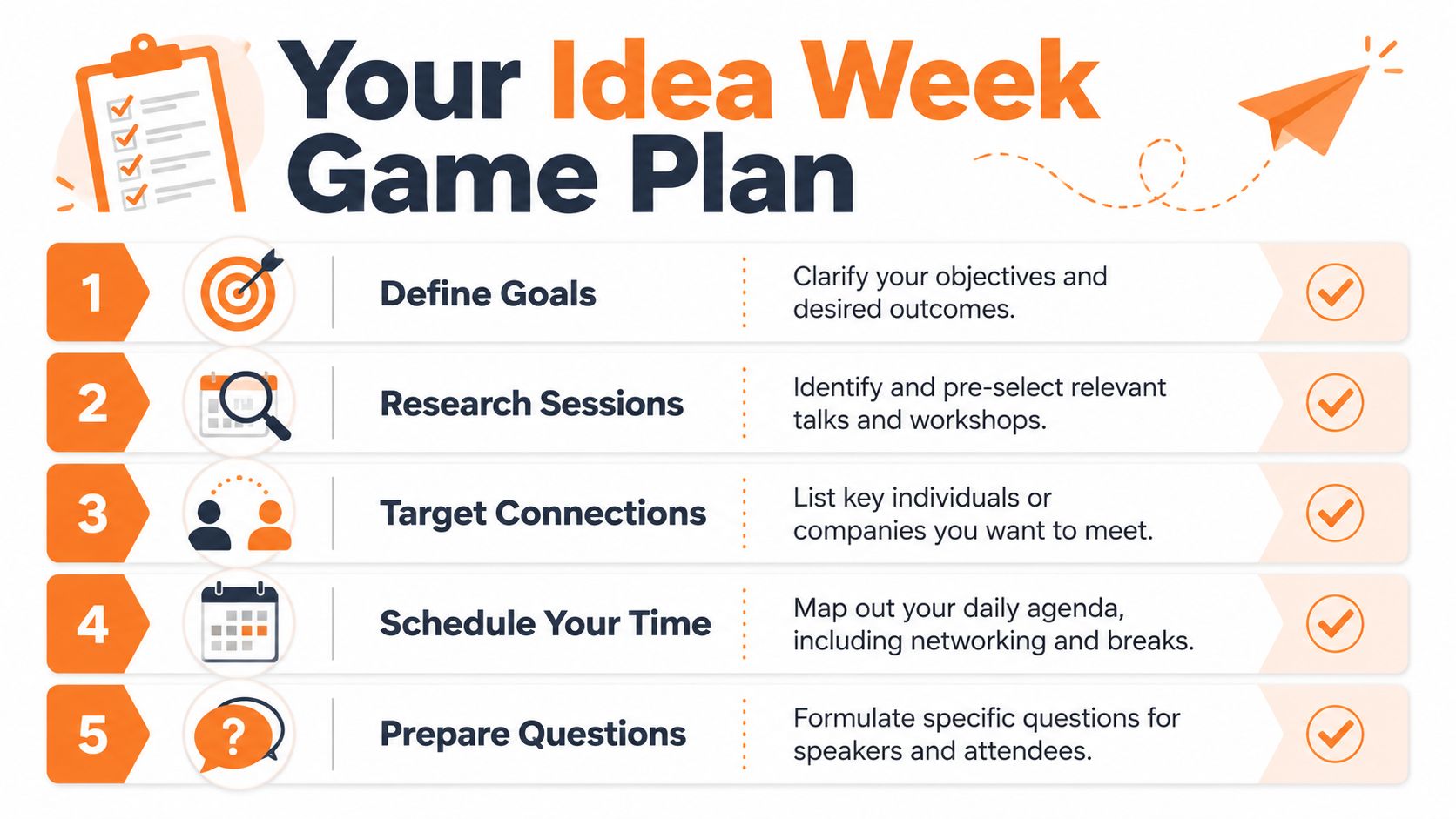
Build Your Game Plan Before You Go
Walking into Idea Week Chicago without a plan is like walking into Target when you need toothpaste and leaving with a lamp, trail mix, and a candle. You were active. You were not effective.
By 2018, the city was using ThinkChicago: Chicago Ideas Week as part of a talent strategy. Mayor Rahm Emanuel announced it as a three-day event running October 18–20 that would bring 150 top STEM, business, and design students to Chicago. That same announcement cited CompTIA data showing Chicago had 14,014 tech businesses in 2017 and 341,600 tech workers across all industries, up by 4,000 workers, according to World Business Chicago's announcement. That's a big enough ecosystem that random wandering won't cut it.
Use three buckets, not one wishlist
I sort every possible session into three buckets.
| Bucket | What it means | Good reason to attend |
|---|---|---|
| Skill-Up | Teaches a hard skill you need right now | You need better customer discovery, pricing, distribution, hiring, or storytelling |
| People-Map | Attracts the kind of person you need to meet | Customers, partners, operators, or mentors are likely in the room |
| Mind-Meld | Challenges a belief you're carrying | You need your thinking tested, not your ego protected |
Most founders over-index on Mind-Meld because it feels exciting. I'd bias toward Skill-Up and People-Map unless your whole idea is still fuzzy.
Build a schedule with a starter and a bench
Don't make one perfect schedule. Make a depth chart.
Create:
- Primary picks for each time block
- Backup picks nearby in case the room is full, the topic is weaker than expected, or the audience is wrong
- Open blocks for hallway chats, coffee, and note cleanup
Your schedule should breathe. If every minute is booked, you've already lost.
Here's the quick ranking system I use:
- A sessions solve a live business problem
- B sessions put me around useful people
- C sessions sound interesting but don't tie to an active decision
Only put A and B sessions on your live calendar.
Research the speaker, not the headline
A flashy title means very little. I care about scar tissue.
Before you commit, check:
- What they've built: product, company, team, distribution, brand
- What stage they know: idea stage, early traction, scaling, turnaround
- Whether they speak plainly: if all you find is polished leadership jargon, expect more of the same
A good speaker for founders usually has one trait. They can tell you what failed before they tell you what worked.
Inspiration is dessert. Eat it after you've covered protein.
Write your mission in one sentence
Before you go, finish this sentence:
“At Idea Week Chicago, I need to leave with ______.”
Not five things. One.
Examples:
- a clearer customer problem
- a better wedge into local distribution
- three strong conversations with consumer founders
- one test for a new positioning angle
That sentence is your steering wheel. Without it, every decent session steals your attention.
A Founder's Guide To Real Connections
I hate fake networking. You probably do too.
The usual script is awful. Somebody asks what you do, you say a compressed version of your identity, they wait for their turn, then both of you pretend to enjoy it. That's not connection. That's conversational paperwork.

Start with a real question
Good conversations start where brochures end.
Try these instead:
- “What problem are you trying to solve this week?”
- “What's been more useful than you expected so far?”
- “Which session changed your mind about something?”
- “Are you here to learn, hire, partner, or just get unstuck?”
These work because they pull the person into the present. You get context fast. You also avoid the LinkedIn recital.
Don't chase everyone
Bad conference behavior is quantity addiction. People collect contacts like they're earning airline miles.
I'd rather have a handful of conversations with signal than a pocket full of badges and zero memory. If somebody is thoughtful, honest, and working on something adjacent to your world, stay longer. If they're pitching too early, glancing over your shoulder, or talking in slogans, leave.
Use a simple internal scorecard while you talk:
- Do they think clearly?
- Do they know something I need to learn?
- Would I want to talk to them again outside the event?
If the answer is no across the board, move on.
The best outreach is small and specific
If there's someone you are eager to meet, don't send a long note. Don't flatter them. Don't ask for “their brain.”
Send this kind of message instead:
I'm attending Idea Week Chicago and saw you're part of it. I'm working on [short description]. I'd love to ask you one specific question about [specific issue]. If you have 10 minutes between sessions, I'll keep it tight.
Short. Respectful. Easy to say yes to.
If you want more ways to sharpen your in-person approach, this piece on strategies of business networking is useful because it pushes past the usual smile-and-handshake nonsense.
Learn the kind exit
A lot of founders stay trapped in weak conversations because they don't want to seem rude. That's amateur behavior. Time is your scarcest conference asset.
Use a clean exit:
- “I'm going to grab the next session, but I'm glad we talked.”
- “I want to let you keep moving, but this was useful.”
- “I'm going to make one more round before the talk starts. Good meeting you.”
You don't need a fake excuse. You need a polite boundary.
A short clip can help if you want to tune up your read on in-person communication before the event:
Ask for the next right step, not a vague future
If a conversation has legs, end with one concrete next move.
Examples:
- send me that landing page and I'll react to it
- I know a retailer you should meet, message me next week
- let's compare notes after you run those interviews
- I'll introduce you to a designer who's dealt with this
That's a real bridge. “Let's stay in touch” is social confetti.
How To Turn Talks Into Business Actions
A good talk feels productive. Usually it's just polished entertainment.
If you want real value from Idea Week Chicago, walk in with your business assumptions written down before the first session starts. Chicago Booth's entrepreneurial research advice is blunt. Identify the “most critical assumptions” and “build the component” that is most risky so you can learn faster, as explained in the Chicago Booth review on what makes a successful entrepreneur. The same body of thinking favors affordable-loss bets over expensive guessing.
That means you stop asking, “Was this talk good?” and start asking, “Did this talk help me test something that could break my business?”
Start with your top assumptions
Write down your top 3 to 5 assumptions. Not your dreams. Your assumptions.
Examples:
- busy parents will trust a meal brand they discover on Instagram
- boutique retailers want a lower-minimum supplier
- dentists will pay for this workflow tool without a long onboarding cycle
- early customers care more about speed than customization
Now rank them by danger. Which one, if false, would wreck the whole thing? Start there.
If you don't know your riskiest assumption, you're probably building to avoid learning.
Use a brutal note template
During a session, don't take school notes. Take decision notes.
I use four lines:
- Claim I heard
- Assumption it touches
- What would prove this true or false for me
- Next cheap test
That keeps you from hoarding ideas you'll never use.
Here's what that looks like in practice:
| What you hear in a talk | What you write down |
|---|---|
| “Customers buy when the problem feels expensive enough” | Assumption touched: urgency is weak in my current pitch |
| “Founders overbuild before they validate demand” | Risk: I'm spending too much time on product details |
| “Partnerships often unlock faster learning than solo guessing” | Test: ask prospective partners what would make this useful to them |
Turn each talk into a cheap experiment
The founder trap is turning every insight into a big project. Don't.
Turn it into a cheap test instead:
- Customer interviews: talk to a small set of target buyers and ask about the problem, current workaround, and buying trigger
- Landing-page smoke test: write one promise, one audience, one call to action
- Concierge MVP: do the service manually before you automate it
- Offer test: pitch a narrow version of your solution to real people and watch where they hesitate
- Partner probe: ask one supplier, advisor, or channel partner what would make them commit
Chicago Booth's advice also points to an early founder mistake that I see constantly. People build before they understand the customer, market, and need. That's like choosing wallpaper before you've checked whether the house has a foundation.
Leave the room with a calendar action
Every session needs a date attached to it. If the idea is worth keeping, schedule the action before the day ends.
Examples:
- Tuesday morning, call five target customers
- Thursday lunch, rewrite the hero statement on the landing page
- Friday afternoon, send a test offer to warm contacts
No calendar action, no learning. Simple.
The Follow-Up That Builds Relationships
Most conference value dies within days. People get home, get busy, and let the whole thing rot in their inbox.
Your follow-up needs a system. Not a burst of good intentions.
Use a three-touch sequence
I keep it plain.
Within 24 hours, send a short note. Mention one detail from the conversation that proves you were listening. Maybe it was their packaging problem, a vendor issue, or the weird lesson they learned from a launch that went sideways.
About a week later, send the LinkedIn request. Personalize it. Keep it light. The goal is not to replay your whole conversation. The goal is to make the connection easy to place.
Later on, reach out only if you can be useful. Share a tool. Make an introduction. Pass along an article that matches the exact problem they mentioned.
Write like a human, not a CRM
Bad follow-up sounds like this:
Great meeting you at the event. Would love to stay connected and explore synergies.
That message says nothing. It also sounds like you copied it from a sad sales template.
Try this instead:
Good meeting you at Idea Week Chicago. I kept thinking about what you said about retailers asking for proof before they commit. I know someone who dealt with that in a different category. If useful, I'm happy to connect you.
That works because it is specific, brief, and useful.
A good follow-up doesn't ask for attention first. It earns the right to another conversation.
Use the same discipline you'd use after a webinar
If you want a clean framework for timing and sequencing, this guide for B2B webinar ROI is worth reading. Ignore the webinar label if you need to. The follow-up logic still applies. Relevance beats enthusiasm. Timing beats volume.
Keep a simple contact list after the event with three tags:
- Worth building with
- Useful but situational
- Nice person, no next step
That last category matters. You do not need to force every pleasant interaction into a relationship.
Keep Your Momentum After The Hype Fades
The energy from Idea Week Chicago won't last. Good. You shouldn't rely on adrenaline anyway.
What lasts is a small operating system. Your assumptions list. Your cheap tests. Your follow-up habit. Your rhythm for turning conversation into action. If you want one extra move after the event, repurpose your notes. A rough page of takeaways can become a founder memo, customer questions, a revised pitch, or short posts. This content repurposing guide is a practical way to squeeze more use out of what you captured.
Big event versus small circle
Here's the tradeoff often left unsaid.
Public events are good for exposure, surprise, and surface area. Smaller trusted groups are better for honesty, context, and hard feedback. Existing coverage around events like IDEA Week often leans on inspiration and doesn't compare the public conference experience against smaller peer support options, which is exactly the gap a Midwest founder should think through, as shown on the IDEA Week events page.
Use the event for ignition. Use a smaller circle for traction.
Keep the work moving
In the week after the event, do three things:
- Cut the list down: pick the few ideas that survived contact with reality
- Run one test: not five
- Reset your goals: use a simple planning rhythm instead of post-event chaos with this guide on how to set business goals
That's the play. Idea Week Chicago can spark movement. It won't build your company for you.
If you want a better place to pressure-test ideas after the conference, join Chicago Brandstarters. It's a free, vetted community for kind, bold Chicago and Midwest founders who want honest feedback, small trusted dinner groups, and real operator conversations instead of shallow networking.
Leave a Reply