You're probably doing that thing where you open twelve tabs, stare at your notes, and wonder whether you've got a real business or just a very expensive hobby waiting to happen.
I know that feeling. Head in hands. Coffee getting cold. Brain bouncing between, “This could work,” and, “Who am I kidding?” That's a normal place to start. Most first time founders don't begin with confidence. They begin with irritation. A problem won't leave them alone, and eventually they decide to take a swing.
Good. Take the swing. But stop romanticizing it.
A startup is not a personal identity. It's a machine for learning whether people care enough about a problem to pay you to solve it. If you keep that in mind, you'll make better decisions, waste less money, and protect your sanity.
You're a Founder Now What

The first thing I'd tell a younger version of me is this. Being a founder doesn't mean you suddenly need to act fearless. It means you need to act useful.
Most first time founders burn energy asking, “Am I cut out for this?” That's the wrong question. The right one is, “What's the next thing I can test?”
The odds are hard. First-time founders have a 25.3% success rate, while serial entrepreneurs have a 36.9% success rate according to this startup statistics roundup. That 11.6 percentage point gap is real. I don't read that as bad news. I read it as a map. Experience matters, so you need to borrow experience fast.
Borrow reps before you earn them
You can do that a few ways:
- Talk to operators, not spectators: Find people who've shipped products, made payroll, dealt with returns, handled bad hires, and sold something ugly before it was polished.
- Get feedback early: One blunt conversation this week is worth more than a month of private overthinking.
- Steal proven patterns: You don't need to invent your whole operating system from scratch. If you need a useful outside read, these strategies for business growth give you a practical menu of growth ideas without the usual fluff.
I've seen founders lose months because they confuse secrecy with discipline. Nobody is going to steal your rough draft. Others are typically too busy trying to survive their own week.
Practical rule: Don't protect your ego by hiding your idea. Protect your time by testing it.
Separate your self-worth from the scorecard
This part matters more than people admit. Your company will have dumb weeks. You'll send emails that get ignored. You'll pitch people who smile and vanish. You'll think a launch is coming together, then realize nobody cared enough to buy.
That doesn't mean you're a fraud. It means you're in the lab.
Here's the mental model I use. Your startup is a series of bets. Some pay off, some don't. You are not the outcome of any single bet. If you tie your identity to each result, you'll either get cocky too early or crushed too often. Both are bad for business.
Build resilience like it's part of the product
Resilience sounds soft until you need it. Then it's the whole game.
A founder with a decent idea and steady nerves beats a founder with a flashy idea and chaotic emotions more often than people think. I'd rather back the person who can take a punch, learn, and come back on Tuesday.
Here's what that looks like in real life:
| Situation | Bad move | Better move |
|---|---|---|
| A prospect ignores you | Rewrite your whole business plan | Follow up, ask another prospect, keep the sample moving |
| Someone trashes your idea | Get defensive | Ask what problem they think is real |
| You feel behind | Doom-scroll other founders | Call one customer and learn something useful |
You don't need founder swagger. You need reps, recovery, and a small circle that tells you the truth.
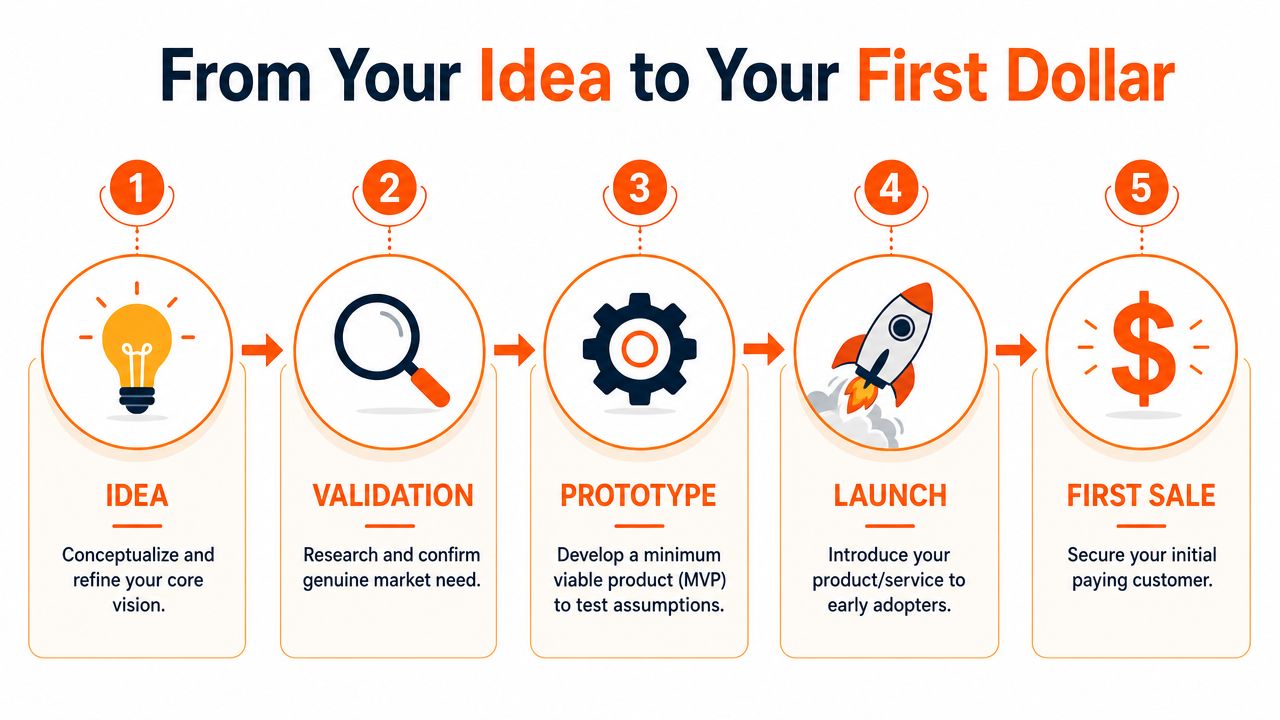
From Your Idea to Your First Dollar
Your idea is not your business. Your first dollar is the beginning of your business.
That sounds harsh, but it'll save you.
First time founders love praise because praise is easy to get. Friends say your idea is cool. People on LinkedIn click like. A stranger says, “I'd totally use that.” None of that counts. Cash counts. A serious pre-order counts. A committed pilot counts. A direct yes with money attached counts.
Be a detective, not a dreamer
Startup guidance keeps coming back to the same point. Validate the problem before you build the solution, and one practical way to do it is to deliver value to just 10 carefully chosen customers first, then scale only if the fit is real and they're willing to pay, as discussed in this founder validation video.
That's the game. Ten people. Not a giant audience. Not “the market.” Ten real humans with a sharp pain.
Start there.
Pick a painful problem
Don't chase “interesting.” Chase expensive, annoying, frequent, and emotional. If the problem wastes time, loses money, creates stress, or makes someone look bad at work, now we're talking.Find the people who already feel it
Go where they complain. Reddit. Niche Facebook groups. Slack communities. DMs. Existing customers from your day job network. Old coworkers. Friends of friends.Interview for pain, not approval
Don't ask, “Would you buy this?” Ask:- “How do you handle this now?”
- “What's annoying about that?”
- “What have you already tried?”
- “What happens if you don't solve it?”
Look for behavior
If someone has already hacked together a spreadsheet, hired a freelancer, or wastes hours every week on the issue, that's signal. Complaints without action are weaker.
Define minimum like you mean it
Most founders build too much because building feels productive. It's the startup version of reorganizing your garage instead of fixing your brakes.
Your MVP is not the smallest version of your grand vision. It's the smallest thing that proves people will pay for relief.
That might be:
- A manual service: You do the work by hand behind the scenes.
- A landing page with a clear offer: One promise, one audience, one call to action.
- A prototype in Figma: Enough to show the workflow and close a pilot.
- A pre-sell deck: You sell the result before the product fully exists.
If you need help structuring that test, this guide on how to validate a business idea is a solid starting point.
Here's a short gut check.
| If you're doing this | You're probably stuck |
|---|---|
| Picking fonts before talking to buyers | In vanity work |
| Building six features at once | In fantasy |
| Asking friends for opinions | In comfort |
| Asking strangers for money | In business |
A lot of founders also get tripped up after the first few conversations. They hear pain, but they still don't know how to turn that into revenue. That's where a simple demand path helps. If you sell to businesses, this breakdown on how to build predictable growth is useful because it forces you to think in terms of repeatable outreach, not random hope.
Ask for the first dollar early
People get weird at this point. They have a good call, the prospect sounds interested, and then the founder says, “Great, I'll keep you posted.”
No. Ask.
Say, “If I can solve this in a simple way, are you open to a paid pilot?”
Or, “If I can get you this result without all the extra features, would you pay to try it?”
Or, “I'm testing this with a small group first. Want one of the spots?”
Your first sale is not proof that your product is perfect. It's proof that the pain is expensive enough to act on.
Put a number on the offer if you can. Keep the scope tight. Promise one clear outcome. Then shut up and let them respond.
And if nobody buys? Good. That's clean information. Better to learn that in a week than after four months in a design cave.
Here's the video if you want another pass on the core idea of validation and early demand:
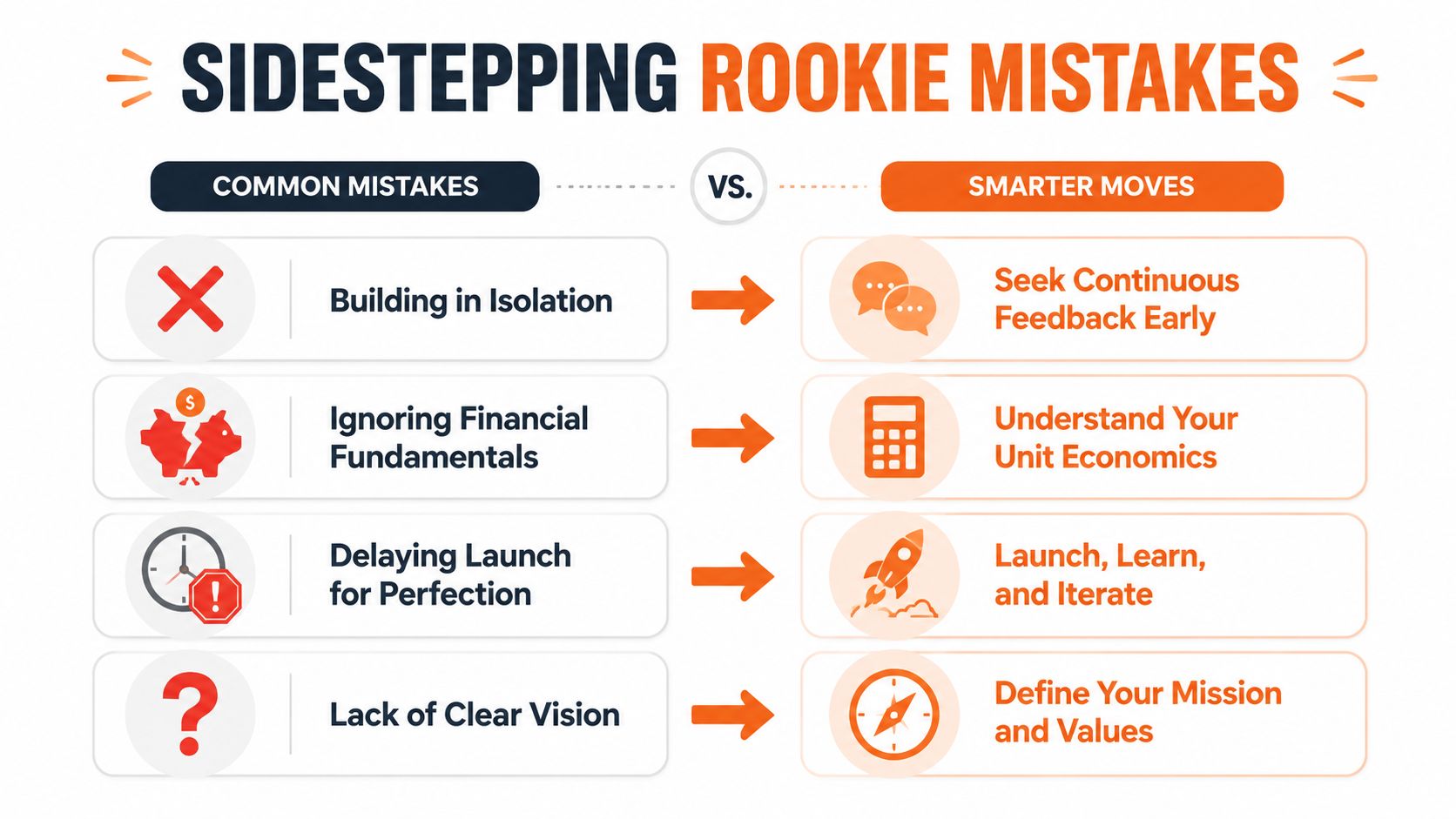
Sidestepping The Common Rookie Mistakes
Every founder makes mistakes. The trick is avoiding the expensive ones.
The cheap mistakes sting your pride. The expensive ones drain your bank account, kill your momentum, and make you question the whole thing. I want you to skip those.
Building in a cave
This is the classic first-time founder error. You disappear for months, emerge with a polished product, and then act shocked when nobody cares.
Silence is not strategy. It's usually fear wearing a clever outfit.
The counter-move is boring and effective. Put customer conversations on your calendar every week. Make it a system, not a mood. If you need accountability, ask someone to check whether you did the calls.
- Set a weekly quota: A fixed number of customer conversations beats waiting for inspiration.
- Use a simple note template: Problem, current workaround, urgency, willingness to pay.
- Review patterns: You're listening for repeated pain, not isolated compliments.
Treating cash like a future problem
A lot of founders act like runway only matters after they raise money. Wrong. Runway matters the second you spend your own first dollar.
SaaStr puts it plainly. One of the biggest first-time founder mistakes is not managing cash burn with extreme precision, and the fix is to track costs monthly and delay nonessential spending to extend runway in this founder mistakes guide.
That means you need to know what leaves your account every month. Not roughly. Know precisely.
If cash is oxygen, sloppy spending is a leak in the tank.
Here's the bare minimum system I'd use:
| Monthly category | What to do |
|---|---|
| Software | Cut anything you aren't using weekly |
| Contractors | Tie work to a direct learning goal or revenue goal |
| Branding | Delay upgrades until customers are buying consistently |
| Travel and events | Go only if there's a clear reason tied to sales, learning, or partnerships |
Looking polished instead of getting traction
Your logo is not your bottleneck. Your Notion workspace is not your bottleneck. Your lack of custom packaging is probably not your bottleneck.
Most early businesses need one thing. More truth. Truth from customer calls, buyer objections, pricing tests, and small launches.
I'd rather see a clunky offer with clear demand than a beautiful brand nobody buys. You can clean up the design later. You cannot decorate your way into product-market fit.
Hiring too early and too emotionally
Don't hire your buddy just because you trust him. Don't bring on a random freelancer because you're tired. Don't stack fixed costs onto a business that's still guessing.
Use contractors for sharp, limited jobs. Keep scopes tight. Stay close to the customer yourself. Early on, you need learning more than advantage.
What You Actually Need to Know About Funding
Funding is just fuel. That's it. People get hypnotized by fundraising because it looks like progress from the outside. Sometimes it is. A lot of times it's a shiny distraction.
If your business can start with customer revenue, start there. Revenue is the cleanest money you'll ever get. Customers don't ask for board seats. They ask you to solve a problem.
Know what each money type wants
I think of funding like vehicles.
Bootstrapping is a bike. Slower, leaner, more control. You feel every hill, but you decide where to go. Great for service businesses, ecommerce brands, and founders who want discipline baked in.
Friends and family money is borrowing your cousin's car. Useful if everyone understands the risk. Dangerous if you take vague expectations into a messy startup.
Angel money is a faster car with a passenger who has opinions. Sometimes those opinions help. Sometimes they don't. Pick your angels carefully.
VC money is rocket fuel. If your company has the shape for that kind of speed, fine. If not, it can blow up the vehicle you need.
A profitable, steady brand does not need a venture story just to sound impressive. Don't force a company into the wrong capital model because you want to look like a startup on Twitter.
Age is not your problem
A lot of first time founders think they missed the window because they're not young enough. That's nonsense.
MIT Sloan analyzed 2.7 million U.S. founders who started companies between 2007 and 2014 and later hired at least one employee. The mean age at founding was 41.9, and for the fastest-growing new ventures the average founder age was 45.0, according to the MIT Sloan working paper.
That should calm you down.
Your years in the workforce are not dead time. They're inventory. Domain knowledge, scar tissue, pattern recognition, relationships, and taste all matter. If you want a practical look at the mechanics of getting capital when the time is right, read this guide on how to find investors for small business.
Raise for the business you have
Ask yourself:
- Do customers already pay? Then protect optionality.
- Do you need capital to build before revenue is possible? Then financing may make sense.
- Do you want control? Cheap money can still be expensive if it changes who calls the shots.
- Do you have a rocket ship or a solid company? Those are different things. Respect the difference.
Funding is a tool. Don't turn it into a personality.
You Cannot Build This Business Alone
It's 10:30 p.m. You've still got your laptop open. One customer went quiet, one shipment is late, and the one person you want advice from has never had payroll, inventory, or a founder panic attack sitting on their chest.
That's the part nobody explains well enough. Building a company can make you feel isolated even when people around you care about you. They love you. They support you. They still can't help much if they've never had to make rent, keep customers, and hold the whole thing together at the same time.

Stop collecting contacts. Build a real table
I hate fake networking. You can feel the bad breath of ambition in those rooms. Everybody is half-listening, waiting for their turn to pitch themselves.
That does nothing for a founder who is in it.
You need a few people you can talk to without performing. People you can say this to: my pipeline is weak, I'm tired, I'm questioning the offer, and I need someone to tell me what to fix first. The right group won't soothe your ego. They'll help you make the next right move.
That kind of circle saves time, money, and a lot of dumb emotional decisions.
Mentors matter. Peers keep you honest.
A mentor can shorten your learning curve. Good. Keep them close.
But early on, I put huge value on peers. Peers are close enough to your current mess to give advice that still works in practical settings. They remember what the first customers felt like. They remember the bad months. They remember the mistakes before the story got cleaned up.
If you're building your support system, look for four things:
- Candor: They tell you the truth clearly.
- Discretion: Private conversations stay private.
- Reciprocity: Help goes both ways.
- Operator mindset: They build, sell, ship, and solve. They don't posture.
If you're solo and wondering whether partnership would fix the pressure, read this guide on how to find a co-founder without creating a bigger problem. A strong co-founder can steady the business. A weak match can turn stress into chaos.
Build with kind givers
Here's the philosophy I wish more founders adopted sooner. Build around kind givers.
I mean ambitious people who also share credit, make introductions, tell you the truth, and help without acting like every favor needs repayment by Tuesday. That is not soft. That is efficient. Trust removes friction. Generosity speeds learning. Honest people save you from expensive denial.
This is why I care about communities like Chicago Brandstarters. The value is not “networking.” The value is getting in the room with vetted founders who talk straight, compare notes candidly, and want to help each other build real companies in Chicago and the Midwest.
Pick your people with care. One solid founder dinner can help you more than six months of smiling through useless events.
Your Next Step as a Chicago Founder
If you're in Chicago or the Midwest, I'd keep this simple. Stop trying to look like a founder and start acting like one.
That means this week you do three things.
Do these before Friday
- Talk to real prospects: Not friends. Not your nicest cousin. Potential buyers.
- Make one concrete offer: A paid pilot, pre-order, service package, prototype test, whatever fits your business.
- Find your people: One founder dinner, one peer conversation, one honest exchange where you drop the act.
You do not need more motivation content. You need contact with reality.
Use the city the right way
Chicago has plenty of smart operators, brand builders, ecommerce people, and side-hustle killers. The mistake is treating the city like a backdrop instead of a tool.
Don't chase status. Chase rooms where people talk plainly. Chase builders who've dealt with inventory problems, ugly margins, failed launches, packaging delays, agency mistakes, and the thousand little headaches that don't make it into startup porn.
If you can find kind, sharp, hardworking people, stay near them.
Pick a philosophy and live it
My advice is blunt. Build with people who are both bold and kind. Avoid the clowns. Avoid the self-promoters. Avoid the founders who can only talk in slogans.
You want the people who tell you when your pricing is weak, your pitch is muddy, your product is bloated, or your ego is driving the car. And you want to be that person for others too.
That's how you cut years off the learning curve. Not with more noise. With better people and more honest reps.
If you're serious, your next move is not “keep researching.” Your next move is a conversation, an offer, and a room full of builders who care enough to tell you the truth.
If you want that kind of room, apply to Chicago Brandstarters. It's for kind, bold, hardworking founders in Chicago and the Midwest who want honest peer support, small private dinners, and real friendships while they build.
Leave a Reply