
Most advice on SOPs is wrong for early-stage founders.
You do not need a giant operations binder. You do not need a consultant. You do not need to act like a pharmaceutical company when you’re still packing orders from your apartment, kitchen table, or tiny warehouse corner.
You need a way to stop answering the same questions, fixing the same mistakes, and re-teaching the same task every week.
That’s what a standard operating procedure is. A good SOP is not bureaucracy. It’s a repeatable playbook. It’s the written version of “this is how we do it here.” If you want to learn how to create standard operating procedures without turning your startup into a paper factory, start smaller than generally recommended.
I’ve learned that founders usually delay documentation for one reason. They think process is for later. Then later arrives as missed handoffs, inconsistent customer experience, sloppy launches, and a team that keeps waiting on the founder for answers.
Start before you feel ready. Keep it lean. Make it useful.
Why Most Founders Get SOPs Wrong and How You Can Get Them Right
Founders get SOPs wrong when they copy big-company behavior instead of solving small-company problems.
A Fortune 500 team can survive with bloated documentation because they have layers of managers, compliance teams, and enough people to tolerate waste. You don’t. If you run a solo business or a team of three, every extra click hurts. Every vague document gets ignored. Every unclear handoff comes back to you.

The real job of an SOP
Your SOP is supposed to do three things:
- Reduce repeat explanations so you stop answering the same Slack, text, or email question.
- Protect quality so customers get a consistent experience even when you’re not doing the task yourself.
- Make delegation real so handing off work doesn’t feel like gambling.
That’s it.
Practical rule: If a document doesn’t help someone complete a task without you standing nearby, it’s not an SOP. It’s a note.
The popular myth says SOPs are boring admin work. I think that’s lazy thinking. A strong SOP buys back founder time. It lets you leave for a day without your phone exploding. It turns tribal knowledge into team knowledge.
Why waiting is expensive
When you delay documentation, you train your team to depend on memory, improvisation, and your availability. That works until the first busy season, the first hire, the first big customer, or the first week you get sick.
The fix isn’t “document everything.” The fix is to document the few things that break most often or matter most.
I also think most founders confuse freedom with lack of structure. Real freedom comes from systems. A train moves fast because it runs on tracks. Your business does the same.
If your team struggles with hard conversations while you build those systems, learn to tighten your feedback loop early. I wrote about that in how to give and receive feedback. SOPs and honest feedback belong together. One gives the expected path. The other fixes the gaps.
Think Playbooks Not Procedures What to Actually Document
I don’t want you thinking “manual.” I want you thinking “recipe card.”
A recipe card tells you what you need, what order to follow, and what done looks like. It doesn’t give you the history of agriculture. That’s how early-stage SOPs should feel.
Start with recurring pain
Document work that is both repeatable and important.
That means things like:
- Customer-facing tasks such as replying to support tickets, shipping replacements, or handling refund requests
- Revenue-linked tasks like publishing a product page, launching an email campaign, or sending wholesale follow-ups
- Error-prone tasks such as onboarding a contractor, updating inventory, or posting a blog article
- Founder bottlenecks where people keep asking you for the same answer
Do not waste time documenting one-off projects. If you’ll probably never do it the same way again, it’s a project, not a process.
Use the 9 parts as a menu
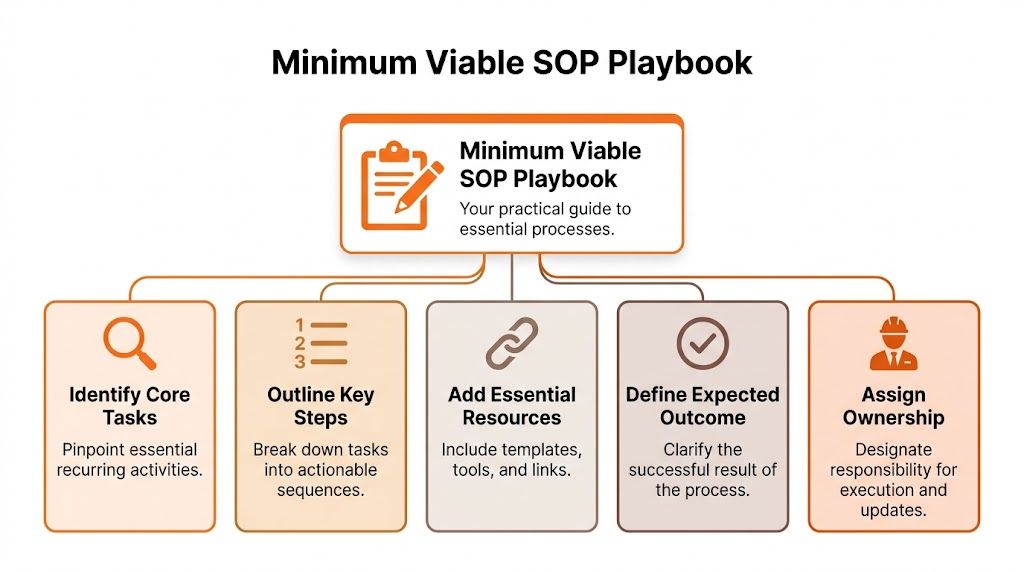
Professional SOP templates often include 9 core elements: title, table of contents, scope, overview, necessary tools, procedural steps, attached manuals, target department, and accountability measures. Used well, that structure can reduce creation time by standardizing documentation, according to MaintainX’s guide to developing standard operating procedures.
For a lean team, treat those nine parts like a menu. Not a prison sentence.
Here’s my version:
| Situation | What to include |
|---|---|
| Tiny routine task | Title, tools, steps, owner |
| Cross-functional task | Title, scope, tools, steps, owner, expected outcome |
| Messy task with files or templates | Title, overview, links, steps, owner, attachments |
| Sensitive or high-risk task | Title, scope, tools, steps, accountability, review note |
If you try to fill every section every time, your team will avoid the whole system. If you pick only what helps the person doing the work, people will use it.
What a minimum viable SOP actually looks like
A minimum viable SOP can live in Notion, Google Docs, Airtable, ClickUp, or even a shared doc pinned in a group chat. The format matters less than clarity.
A strong early-stage SOP usually includes:
The task name
Make it obvious. “Publish weekly blog post” beats “Content workflow.”Why this exists
One short line is enough. Give the user context.What you need before starting
Links, assets, logins, templates, screenshots.The steps
Use plain language. One action per line.What done looks like
Most founders get sloppy here.
If your teammate finishes a task and still has to ask, “Is this right?”, your SOP is incomplete.
That’s the whole game. Build a practical playbook, not a museum exhibit.
Find the Right SOP Format for Any Task
Most SOPs fail because founders pick the wrong format.
They turn a simple checklist into a novel. Or they stuff a complex workflow into five bullets and hope people figure it out. They won’t.
Match the format to the job
Penn State Extension gives a clean decision rule. Use simple steps for tasks with fewer than 10 steps and no decisions, a hierarchical format for tasks with more than 10 steps and few decisions, and a flowchart for any process with multiple decision points. It also warns that mismatching format to complexity is a key reason SOPs don’t get adopted, as explained in Penn State Extension’s SOP writing guide.
That rule is gold because it’s practical.
Consider it communication:
- A text message works for something simple.
- An email works when there’s more detail.
- A diagram works when people must choose between paths.
Your SOP format should work the same way.
Quick format picker
Use this table when you’re stuck:
| Task type | Best format | Example |
|---|---|---|
| Short, linear, no choices | Simple checklist | Open and close the retail booth |
| Longer task, mostly straight path | Hierarchical list | Publish a blog post with SEO, links, upload, QA |
| Many if-then branches | Flowchart | Handle support tickets based on issue type |
My blunt recommendation
If you’re a small team, use the simplest format that still prevents confusion.
That usually means:
- Checklist first when the job is basic
- Nested bullets when the task has phases
- Flowchart only when multiple branches keep causing mistakes
Do not use a flowchart because it looks impressive. Use it because a person needs help choosing between paths.
Three founder examples
Here’s how I’d decide:
Posting an Instagram Reel
Usually simple steps. Gather asset, write caption, tag links, publish, log post.Onboarding a new freelancer
Usually hierarchical. There are stages like access, context, communication norms, first assignment, and review.Customer complaint triage
Usually a flowchart. If damaged package, do one thing. If missing package, do another. If wrong size, route elsewhere.
The best SOP format feels boring to the user. They don’t notice the document. They just complete the task.
If your team keeps skipping steps, don’t only rewrite the words. Check whether the format itself is wrong.
A Simple 4-Step Playbook for Creating Your First SOP
You do not need a three-day offsite to make your first SOP. You need an afternoon, one real task, and the discipline to finish.
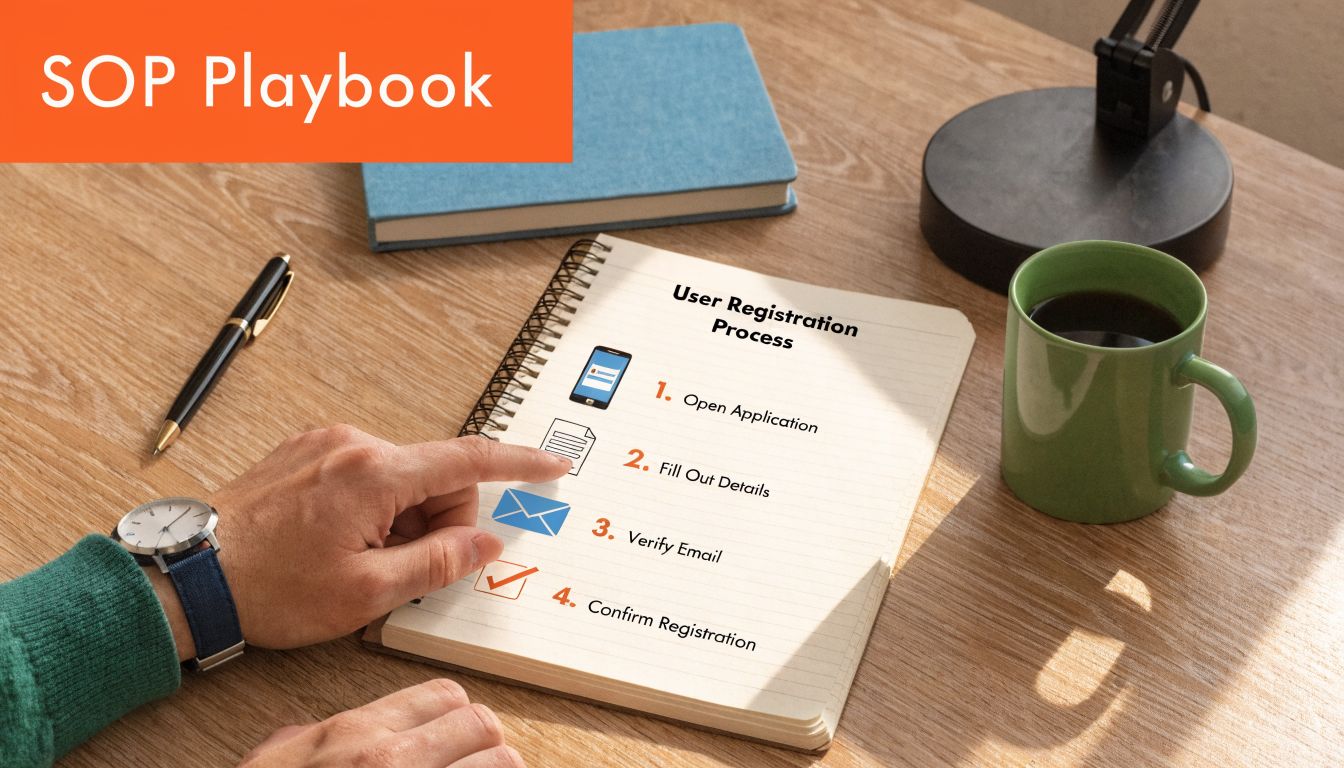
I like a simple four-step workflow because most founders quit when the process feels academic. Keep the engine small. Move fast.
A structured development and review cycle can reduce operational errors by up to 30 to 50% in various industries when processes are clear, testable, and validated before finalizing them, according to Lucidchart’s SOP development guide. You do not need all seven formal steps they describe to benefit. You do need the spirit of them.
Step 1 Identify and scope
Pick one recurring task that causes friction right now.
Good first choices include:
- Weekly content publishing
- New vendor setup
- Refund handling
- Freelancer onboarding
- Bug reporting from customer support to product
Then scope it tightly. Don’t write “marketing SOP.” Write “publish weekly blog post from draft to live.” Don’t write “operations.” Write “ship replacement order after damaged delivery claim.”
Your scope should answer three questions:
- Who uses this
- When they use it
- What finished looks like
If you can’t answer those in a sentence or two, the SOP is too broad.
Step 2 Draft and document
Many individuals hesitate at this point, believing they must write a perfect draft from scratch. Avoid that pitfall.
Do the task while recording yourself with Loom or Tella. Talk through what you’re doing. Open the tabs. Click the buttons. Mention the small stuff you normally forget to explain.
Then turn that rough walkthrough into a doc.
A good draft includes:
- Title
- Purpose
- Tools or links needed
- Steps in order
- Expected result
- Owner
Write in active voice. Use present tense. Keep each step action-based. “Open Shopify and confirm SKU” is better than “Inventory should be reviewed.”
Write for the newest person who could realistically do the task, not for your smartest operator.
That one rule fixes a lot.
Step 3 Test and refine
Now hand it to someone else and stay quiet.
Do not hover. Do not translate your own document in real time. If they get stuck, that’s not their failure. That’s your draft showing you the weak spots.
Watch for three kinds of breakdowns:
Missing setup
They don’t know where files live or what tool to open.Ambiguous language
Words like “review,” “optimize,” and “finalize” are too fuzzy.Hidden decisions
The process includes judgment calls you forgot to document.
A short visual can help if your process includes tools or UI clicks. This walkthrough is worth a look before you finalize your draft.
Step 4 Finalize and share
Once someone can complete the task cleanly, publish the SOP where the work happens.
That means:
- Notion for team wiki style access
- Google Drive for simple shared docs
- ClickUp or Asana for process-linked tasks
- Slack pinned links for fast retrieval
Then assign an owner. Every SOP needs one human who updates it when the process changes.
Here’s a simple founder rule. If a task changes twice and the SOP still reflects the old way, trust in the whole system starts to die. Your team stops checking docs and starts messaging you again.
SOP Examples for Marketing Ops and Product Teams
Examples make this real. Below are three lean SOPs written the way I’d want a team to use them.
Weekly blog post publishing SOP
Purpose
Publish one blog post with clean formatting, working links, and promotion assets.
Owner
Content lead
Tools
Google Docs, CMS, Grammarly, Ahrefs or Google Search Console, Canva, Buffer
Steps
- Confirm the final draft is approved in Google Docs.
- Check the title, meta description, slug, and internal links.
- Add headings, images, alt text, and call-to-action blocks in the CMS.
- Preview the article on desktop and mobile.
- Fix formatting issues, broken links, and spacing problems.
- Publish the post.
- Create promo assets for email and social.
- Schedule distribution in Buffer.
- Log the published URL in the content tracker.
Done looks like
The article is live, readable, linked correctly, and queued for promotion.
Common mistakes
Forgetting internal links. Uploading giant images. Publishing before checking mobile layout.
New freelancer onboarding SOP
This one needs a bit more structure because onboarding usually breaks in the handoff details.
Purpose
Get a new freelancer productive fast without repeated clarification from the founder.
Owner
Operations lead or founder
Before you start
- Contract signed
- Payment method confirmed
- Email and messaging access ready
- Role brief written
- First assignment prepared
Steps
Access
- Create required accounts.
- Share login instructions.
- Test permissions before day one.
Context
- Send the brand guide, sample work, and communication norms.
- Share one “good” example and one “bad” example if possible.
Expectations
- State deadlines, turnaround time, file naming rules, and where deliverables live.
- Explain who approves work.
First task
- Assign a small paid starter task.
- Set a review time.
- Ask the freelancer to repeat back the brief in their own words.
Done looks like
The freelancer has access, understands the brief, submits the first task correctly, and knows where future work lives.
A good onboarding SOP doesn’t try to impress people. It removes preventable confusion.
Customer bug reporting SOP
Product teams usually get burned when customer feedback arrives in fragments. This SOP creates a clean lane from complaint to action.
Purpose
Capture customer-reported bugs clearly and route them for prioritization.
Owner
Customer support lead
Tools
Help desk, product board, Jira or Linear, screenshot tool
Workflow
| If this happens | Do this |
|---|---|
| Customer reports a bug without proof | Ask for screenshot, device, browser, and exact steps |
| Customer shares a reproducible issue | Log bug in tracker with severity, steps, and customer impact |
| Issue blocks payment or core use | Flag as urgent and notify product owner immediately |
| Issue seems like user error | Confirm expected behavior before logging as a bug |
Required bug report fields
- Summary
- Where it happened
- Steps to reproduce
- Expected result
- Actual result
- Evidence
- Priority recommendation
Done looks like
The product team can read one ticket and understand the problem without chasing support for missing details.
These examples are intentionally lean. You can expand them later. Right now, useful beats polished.
How to Launch and Maintain Your SOPs Without the Bureaucracy
A lot of founders write one SOP, feel good for a day, then never build the habit. The issue isn’t writing. The issue is adoption.
If the SOP lives in some random folder and nobody trusts it, it’s dead.

Store SOPs where work already happens
Do not create a “process library” that feels separate from the actual job.
Use tools your team already opens:
- Notion if you want a searchable wiki
- Google Drive if your team likes simple docs
- ClickUp, Asana, or Monday if tasks already live there
- Slack or Microsoft Teams for pinned links and quick retrieval
The rule is simple. If someone has to hunt for the SOP, they’ll skip it.
Use a lean review loop
Effective SOPs need real review. For a lean startup, that means a new person to the task and a peer or mentor should test the draft, and the refinement often takes 3 to 5 rounds, according to peer-reviewed guidance on SOP review cycles.
That matters because founders routinely overestimate clarity. We know too much. We skip invisible steps.
Here’s the lean review rhythm I recommend:
You test it yourself
Follow your own document line by line.A new operator tests it cold
This could be a VA, intern, contractor, or teammate.A peer or mentor pressure-tests it
They spot logic gaps and weak assumptions.You update the doc immediately
Don’t collect feedback in a separate graveyard doc.
If you run any kind of physical operation, service workflow, or fulfillment process, the same discipline behind process improvements in manufacturing applies here too. Tight loops beat perfect theory.
Build ownership without making it weird
Every SOP needs one owner. Not because of hierarchy. Because otherwise everyone assumes someone else will fix it.
Use a tiny maintenance table like this:
| SOP | Owner | Trigger for update |
|---|---|---|
| Weekly blog publishing | Content lead | CMS changes, new SEO checklist |
| Freelancer onboarding | Founder or ops lead | New tool, new approval flow |
| Bug reporting | Support lead | New product team workflow |
Stale SOPs are worse than missing SOPs. At least missing docs don’t lie.
Keep the culture light and honest
You do not need signatures, red tape, or fake formality. You need team trust.
That means saying things like:
- “If this doc is confusing, mark it up.”
- “If the process changed, update the page.”
- “If you needed to DM me for clarification, the SOP is not done.”
The healthiest process culture is not rigid. It’s responsive. Your SOPs should feel like working tools with fingerprints on them, not framed posters nobody touches.
Your Next Step From Founder to Operator
The biggest shift is not tactical. It’s identity.
A founder does the work. An operator designs the work so other people can do it well.
That shift feels uncomfortable because your habits built the company. Your instinct is to jump in, clean it up, and move fast. That instinct helps early. Then it becomes the bottleneck.
The reason I push minimal viable SOPs so hard is simple. Traditional templates scare off small teams. That’s a real problem when 68% of small businesses fail due to poor internal processes, while only 27% of solopreneurs document their SOPs because traditional templates feel too corporate, according to this guide on writing effective SOPs.
What this changes for you
When you document one annoying, repetitive task, you increase your efficiency.
You make it easier to:
- Hire help
- Train faster
- Spot quality drift
- Protect your standards
- Step out of the weeds
That’s why process matters even before your first full-time hire. If you’re already thinking about scaling the team, this pairs well with how to hire your first employee. Hiring without process usually creates expensive confusion.
Your homework
Do this this week.
Pick one task that meets all three conditions:
- You repeat it often
- Someone else could do it
- It annoys you when it comes back half-done
Then write the minimum viable SOP.
Not ten SOPs. One.
Use a shared doc. Record yourself doing the task. Turn the recording into steps. Let someone test it. Clean it up. Publish it where work happens.
That’s the start.
You do not need a polished operations empire. You need one reliable brick. Then another. Then another. A seven-figure brand is not built on founder heroics forever. It’s built on standards people can follow without drama.
If you’re a kind, ambitious founder building in Chicago or the Midwest, Chicago Brandstarters is where you can pressure-test ideas like this with real operators. It’s a free, vetted community built around honest small-group dinners, practical support, and the kind of friendships that help good people build serious businesses.
Leave a Reply