
You’re probably here because someone said YPO in that quiet, loaded way people say things when they want you to know they’re in a different league.
You know the moment. You’re at a founder dinner, a conference hallway, or a “casual” networking event that somehow feels like a job interview with cocktails. Someone mentions the young presidents organisation and the mood changes. People nod like they all understand the code. If you’re early in your journey, you might feel two things at once.
First, ambition.
Second, that ugly little question. “Am I behind?”
I’ll save you some time. YPO is real. It matters. It can be a serious room for the right operator. But a lot of founders romanticize it long before it’s relevant to their actual problems. That’s a mistake.
You've Heard the Whispers About YPO Here's the Real Story
I’ve watched founders hear about YPO and react like they just discovered a hidden level in the game. They assume it’s the room where all the serious business people go. They start wondering whether they should chase it, optimize for it, or shape their whole path around becoming “YPO material.”
That’s backwards.
If you’re building from scratch, YPO is not your next move. It may be part of a later chapter. It is not your current operating system.
Why YPO feels bigger than it is
YPO has mystique because it combines three things people crave:
- Status: It signals you’ve built something substantial.
- Access: It puts you near people carrying real responsibility.
- Privacy: It promises conversations that go deeper than surface-level networking.
That last part matters most. Founders don’t just want introductions. You want a place where you can admit you’re stuck, scared, overextended, or one bad quarter away from a mess. Most “networking” spaces punish honesty. YPO built its reputation on offering the opposite.
That’s why people whisper about it.
What early-stage founders usually get wrong
Most early-stage builders hear “exclusive” and assume “better.”
Not always.
A room can be elite and still be the wrong room for your current needs. If you’re trying to find product-market fit, land your first real customers, hire your first operator, or stop your own brain from melting down, a global executive circle may sound glamorous but still be useless on Tuesday morning.
Practical rule: Don’t chase rooms built for a later version of you while your current business still needs basic traction, honest feedback, and peers close enough to your stage to be useful.
That’s the inside scoop rarely voiced. YPO is not a universal answer. It’s a stage-specific one.
And if you’re in Chicago or the broader Midwest, there’s another layer. A lot of good builders here don’t want more performance. They want truth. They want people who are kind, sharp, and willing to talk like adults about what’s hard. That’s a different need from prestige.
So yes, learn what YPO is. But don’t confuse a famous club with a practical next step.
What Exactly Is the Young Presidents Organisation
You hear someone mention YPO at a dinner, the table gets a little quieter, and suddenly it sounds like the room you are supposed to want. Here’s what it is. The young presidents organisation is a private global peer network for younger chief executives and business leaders who are already running sizable companies.
It was founded in 1950, and over time it became a worldwide membership organization with local chapters, private forums, events, and specialized groups. The point is straightforward. YPO serves people who already sit in the top seat and want peers who understand that level of pressure.

The basic shape of YPO
YPO is not a casual networking club. It is a structured membership organization with chapters around the world, formal programming, and a strong culture of confidentiality. That scale matters because members are not joining for random introductions. They are buying access to peers who carry similar responsibility and can speak openly without worrying that every conversation will turn into posturing.
It also helps to clear up a common misconception. YPO is not built only for startup founders. The membership includes entrepreneurs, family business leaders, and professional executives. If you assumed it was a pure founder club, you were aiming at the wrong target from the start.
Who it’s actually for
YPO is for people already in charge. The typical member holds a title like CEO, President, Chair, Managing Director, or Partner, and the organization is known for keeping an age cap of under 45 for joining.
That last part changes the whole picture.
This is not a place for “promising founders” who are still figuring out offer, team, or traction. It is for leaders who already have real scale, real responsibility, and enough complexity in the business to need peers who have seen similar problems before.
If you are still building toward that level, do not romanticize the badge. Start with a room that helps you make better decisions this month. For Chicago founders, mastermind groups for entrepreneurs are a better first move than chasing prestige you cannot use yet.
Why people talk about YPO like it matters
The appeal is not the logo. It is the combination of status, structure, and privacy.
Inside YPO, the smaller peer groups matter more than the broad member directory. That is where people stop performing and talk about the parts of leadership that do not belong on LinkedIn. Stress. Isolation. Succession fights. Bad hires. Board tension. The stuff that gets expensive fast if you carry it alone.
I think that is the part early-stage founders often miss. They see exclusivity and assume the main value is access to impressive people. The stronger value is being in a trusted room with operators who can handle the truth.
Where early-stage founders get this wrong
YPO is a destination for a later chapter, not a starting line.
If you are still trying to tighten positioning, get consistent revenue, hire your first serious operator, or find peers who will tell you the truth without the theater, you need proximity more than prestige. You need people close enough to your stage to be useful and solid enough as humans that you can be honest with them.
That is why communities like Chicago Brandstarters matter. Kind, vetted, local founder circles fill the gap between building alone and qualifying for elite rooms like YPO. That gap is where a lot of good founders live.
Getting Inside The Fort Knox of Business Networks
YPO keeps the door narrow for a reason. If the room is built on candor, privacy, and trust, loose screening would wreck the whole point.

The first gate is obvious
YPO starts with hard filters. You need to be under 45, hold a top executive title, and lead a company that meets specific size thresholds. According to MDS’s breakdown of the YPO application process, candidates also need 1-2 sponsorships from current members, go through in-depth membership interviews focused on vulnerability and cultural fit, and for sales firms often face a typical $15M revenue benchmark.
That should reset your expectations fast.
Meeting the published criteria only gets you to the door. It does not get you welcomed inside.
The harder gate is sponsorship
This is the part founders underestimate. A current member has to put their name behind you, and that is a reputation decision, not a casual favor.
YPO works more like a private house than an open application portal. The question is not just whether you qualify on paper. The question is who already trusts you enough to bring you in.
If you do not have genuine relationships with members, you are not close. You are early.
I see early-stage founders waste energy here all the time. They start treating YPO like a target to hack instead of a milestone to grow into. That is backwards. If you need a trusted circle now, join a local business network group for founders where people know your market, your stage, and your name.
They are judging how you show up
YPO is screening for behavior as much as business size.
The quiet questions sound like this:
- Do you contribute, or do you just collect access
- Can you speak openly without turning every conversation into self-promotion
- Do you respect confidentiality
- Will other members relax when you enter the room, or tighten up
That is why some high-performing operators still do not belong there.
I have met founders with strong companies who are terrible in peer settings. They interrupt, posture, overshare the wrong things, and make every discussion orbit around themselves. Revenue does not fix that. A title does not hide it either.
Here’s the cleaner way to look at it:
| What founders focus on | What YPO likely cares about more |
|---|---|
| Revenue or company size | Whether members trust your judgment |
| Impressive title | Whether you act like a peer |
| Ambition | Candor and steadiness |
| Knowing the right language | Knowing when to listen |
That gap matters.
A lot of kind, capable founders are still years away from YPO, and that is fine. They do not need an elite badge yet. They need a room where they can get honest feedback, build lasting relationships, and become the kind of leader trusted people later sponsor. That is exactly why communities like Chicago Brandstarters matter. They fill the wide gap between building alone and qualifying for an exclusive network.
A short explainer can help if you want the official flavor of how YPO presents itself:
Why the hard process makes sense
I respect the rigor because the product is not access. The product is candor.
If members are going to talk openly about pressure, mistakes, board conflict, family strain, and leadership failure, they need to trust who is sitting in the room. A weak filter kills that trust.
So do not romanticize the application.
Build a company with substance. Build a reputation people would stake their own on. Learn how to be useful in a peer room before you try to enter the most selective one.
If your path to YPO starts with “How do I game the process,” you’re already thinking like the wrong candidate.
The Perks and Price Tag of a YPO Membership
A lot of founders talk about YPO like it is a prize. I think that is the wrong frame.
YPO is a commitment. If you are the right fit, it can sharpen your thinking, steady your leadership, and give you a rare level of peer honesty. If you are not, it becomes an expensive symbol you keep trying to justify.
The fee matters less than the load
Yes, membership costs money, as noted earlier. But the dues are not the part that changes your life.
The true price shows up in your calendar and your attention. You are saying yes to meetings, travel, preparation, relationships, and the emotional energy required to show up as a real participant instead of a spectator. That is why I tell founders to stop asking, “Can I afford the dues?” and start asking, “Do I have the stage, maturity, and capacity to use this well?”
That question saves people years.
What members are really paying for
The draw usually falls into four clear benefits:
- Trusted peer candor: a private room where accomplished leaders speak plainly
- Strong programming: learning, speakers, and exposure to ideas outside your usual bubble
- Global reach: relationships that extend across cities, industries, and chapters
- Real belonging: a sense that other people understand the weight you carry
The last one gets underrated.
Running a company can get lonely fast, especially when your team needs confidence from you and your family should not absorb every hard decision. A serious peer group can take pressure off your nervous system, not just your strategy.
The best benefit is honest conversation with people who carry real weight
Prestige gets the headlines. The private forum experience is what makes the membership worthwhile.
You are sitting with people who know what payroll pressure feels like. They understand the cost of a bad hire, a strained board relationship, a major miss, or the kind of decision that keeps you awake at 3 a.m. That level of context changes the quality of advice.
The best peer groups do not flatter you. They make you clearer and steadier.
That is the standard early founders should pay attention to. Not the brand name. The quality of truth in the room.
Fit decides the return
Smart people still waste money in elite communities. The problem is usually simple. They joined for the wrong reason or at the wrong stage.
Here is the filter I use:
| Good reason to want YPO | Bad reason to want YPO |
|---|---|
| You want trusted peers who can challenge you | You want other people to see you as successful |
| You lead a substantial company and feel isolated at the top | You hope membership will cover weak fundamentals |
| You are ready to contribute with candor and consistency | You mainly want status or loose networking |
| You have space to participate fully | You are already overloaded and avoiding core business problems |
Read that table carefully.
I have seen founders chase named memberships the way they chase a private club scene like Soho House in Chicago. They are not buying operating value. They are buying the emotional rush of being included.
That instinct is human. It is also costly.
My blunt view on ROI
If you already run a serious company, value peer accountability, and can give the group real presence, YPO can earn its keep.
If you are still trying to tighten your offer, find repeatable sales, hire your first solid team, or build confidence as a leader, YPO is too far up the ladder. You do not need an elite circle yet. You need a trusted one.
That is the gap nobody says out loud. Early-stage, kind-hearted founders need community before they need prestige. They need a room where people know their name, tell them the truth, and care whether they grow well, not just fast.
That is why I rate local, vetted groups so highly. Chicago Brandstarters is the kind of place where you build the habits, relationships, and self-awareness that make a future YPO seat meaningful, instead of premature.
YPO vs EO vs Vistage How Do They Compare
Most founders lump these groups together. That’s lazy thinking.
YPO, EO, and Vistage may all live in the broad world of peer networks, but they serve different people and different moments.
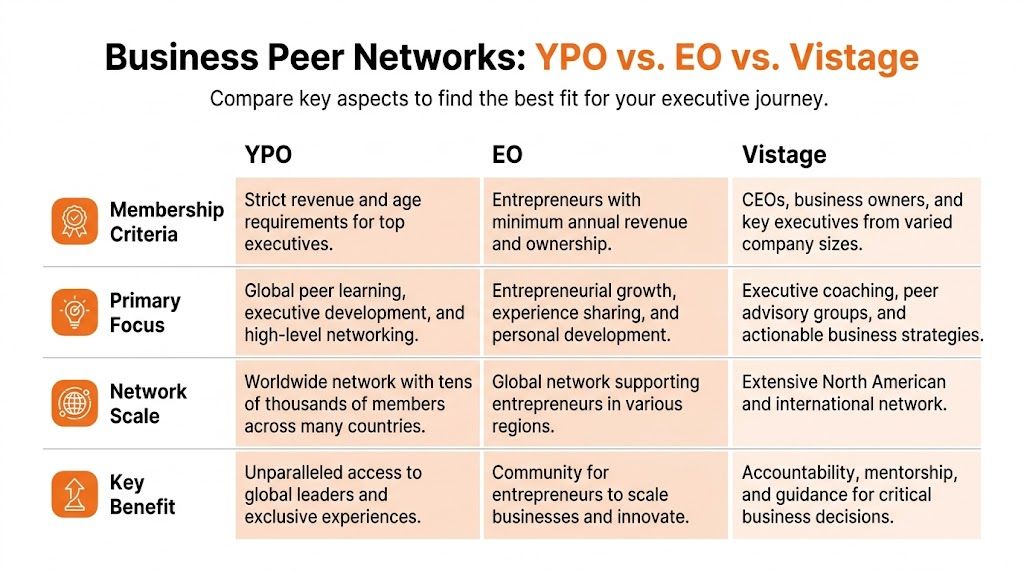
The clean comparison
Here’s the simple cheat sheet.
| Group | Best fit | Core draw | Main caution |
|---|---|---|---|
| YPO | Younger top executives leading substantial companies | High-trust peer access and global reach | Too advanced for many early builders |
| EO | Entrepreneurs who want founder-focused community | Shared growth path with other entrepreneurs | Still may be too soon for idea-stage people |
| Vistage | CEOs and executives who want advisory structure | Coaching and practical executive guidance | Can feel more formal than founder-driven |
That’s the strategic view.
Now let me translate it into plain English.
YPO sits near the top of the prestige ladder
YPO is for leaders who already crossed a meaningful threshold. It has a strong brand because it is selective and global. If you qualify and you value peer intimacy at that level, it can make sense.
But don’t force it into the role of startup support. That’s not what it was built for.
EO is closer to the founder journey
EO tends to make more sense when someone is clearly an entrepreneur and wants to grow alongside other entrepreneurs. It feels less like a private executive chamber and more like a founder-growth environment.
That said, even EO can be too mature for people at the idea stage. If you’re still shaping the first version of your offer, joining a formal organization too early can feel like wearing a suit to a garage build.
Vistage is more advisory
Vistage usually appeals to leaders who want guidance, structure, and executive problem-solving with a coaching flavor. Some operators love that. Others find it too polished or too removed from the messy founder trench.
Neither reaction is wrong. It depends on what kind of pressure you’re under and how you learn best.
What most people actually need first
Before YPO. Before EO. Before Vistage.
A lot of founders need something less branded and more honest.
They need peers who are close enough to their own stage to answer practical questions without turning everything into theory. They need people who can say, “I dealt with that last month. Here’s what broke. Here’s what worked.” That’s not glamorous. It’s useful.
For early-stage builders, the progression often looks more like this:
Small trusted founder circle
You need candor, momentum, and human support.Broader entrepreneurial network
You widen your exposure once your business has shape.Higher-level executive peer group
You step into rooms like YPO when your responsibilities match the room.
That’s the ecosystem people should understand. These aren’t just competing memberships. They’re often different floors in the same building.
Join the room that matches your current burden, not the room with the nicest reputation.
That one rule would save founders a lot of money and ego-driven detours.
Should You Aim for YPO or Start Somewhere Else
Generally, you should start somewhere else.
Not because YPO is overrated. Because your immediate problem probably isn’t “How do I access a global network of elite executives?” Your immediate problem is more likely “How do I make this thing work without losing my mind, my savings, or my conviction?”
Those are different problems.

YPO is not built for the founder in the mud
One of the clearest gaps in YPO coverage is that it doesn’t serve early-stage founders well. The available analysis notes that YPO’s costs, time demands, and strict entry criteria exclude pre-revenue and idea-stage builders, and there’s no recent sign that YPO is shifting toward early-stage inclusivity. That same analysis contrasts YPO with local vetted communities that serve founders scaling from idea to seven figures, as explained in this review of whether YPO is worth it.
That lines up with common sense.
If you’re still validating demand, your needs are immediate and tactical:
- You need feedback on the offer
- You need honest reactions, not prestige
- You need peers who won’t flinch when you say revenue is messy
- You need support that doesn’t cost attention you can’t spare
YPO is a later-stage answer to a later-stage loneliness.
Chasing YPO too early can become a form of avoidance
A lot of founders don’t want to hear this, but it’s true. Sometimes the desire for a prestigious network is really a desire to skip the awkward middle.
You want the badge because the work still feels uncertain.
You want the room because your company still feels fragile.
You want “access” because your fundamentals aren’t where you want them yet.
That’s normal. It’s also dangerous. Fancy communities can become procrastination for ambitious adults.
There’s also a quieter issue people avoid
The DEI conversation around YPO remains murky. The available commentary points out sparse outcome data for underrepresented founders and raises the concern that a North America-heavy base may reinforce existing bias patterns rather than break them. That critique appears in this discussion of YPO and inclusion questions.
I’m not interested in fake moral grandstanding here. I’m interested in usefulness.
If you are a founder from an underrepresented background, or just someone who’s tired of surface-level inclusion talk, then “exclusive” can cut two ways. It can mean high-trust. It can also mean old filters dressed up as quality control. Without clear outcome data, you should keep your eyes open.
My recommendation
Ask yourself a hard question.
Do you need a famous network, or do you need five people who will tell you the truth this week?
For early-stage founders, especially kind-hearted builders who hate performative rooms, the answer is usually the second one.
Use this quick filter:
| If this sounds like you | Your better next move |
|---|---|
| You’re still at idea stage | Find a small vetted peer circle |
| You have first traction but lots of uncertainty | Join founder groups with practical operator support |
| You run a mature company and carry real executive isolation | Consider higher-tier peer organizations |
| You mainly want status | Stop. Fix your motives first |
Don’t borrow someone else’s finish line and call it strategy.
That’s my opinionated answer. YPO may be an excellent destination someday. It is not the universal starting point. And for a lot of builders, starting local, vetted, and human is the sharper move.
Your Next Step on the Founder's Journey
Here’s where I land.
YPO is a serious organization for a specific kind of leader at a specific stage. I respect that. If you qualify later and the culture fits, great. Go in with clear eyes.
But if you’re early, stop staring at mountain peaks while ignoring the trail under your boots.
You don’t need a glamorous acronym right now. You need people. Real ones. People you can text when a supplier ghosts you, when your first product launch flops, when you don’t know whether to raise prices, when your confidence gets weirdly shaky for no obvious reason.
That kind of support changes companies because it changes founders.
The inclusion question matters here too. The available critique around YPO points to sparse DEI outcome data and raises concern that large, North America-heavy networks can reproduce familiar patterns, while smaller values-driven communities may better support underrepresented and generous founders who are tired of being used. That’s not a side issue. It affects who feels safe enough to be honest.
So build your foundation in a room that lets you be a person, not a performance.
Find the dinner table where you can tell the truth.
Find the group chat where someone will answer the question you were embarrassed to ask.
Find the peers who care whether you win and who won’t weaponize your vulnerability later.
If you’re in Chicago or the Midwest, take that seriously. The local culture can be a real advantage if you choose your people well. Kindness and hard work beat image and noise more often than the internet would have you believe.
YPO might matter later.
Your next step is smaller, closer, and more human than that.
If you’re a kind, bold, hardworking builder in Chicago, Chicago Brandstarters is the kind of place I’d tell you to look at first. It’s free, vetted, local, and built for founders from the idea stage to seven figures who want honest dinners, real peer support, and zero performative networking.
Leave a Reply