Tag: startup funding

  • A Founder’s Guide to Venture Capital in Chicago

    A Founder’s Guide to Venture Capital in Chicago

    Let's get straight to it. You've got a killer idea, the grit to see it through, and you're building it right here in the heart of the Midwest. The short answer is a resounding 'yes'—venture capital in Chicago is deep, thriving, and has a flavor all its own. Forget the coastal noise for a minute; I want to show you how this city powers founders who value solid work and real relationships more than a flashy pitch deck.

    So You Want to Raise Venture Capital in Chicago

    I get it. When you hear "venture capital," your mind probably jumps straight to Silicon Valley or New York. But that picture is missing a huge piece of the puzzle. Chicago’s ecosystem isn't about hype; it's about substance.

    Think of it like building a skyscraper here versus on the coasts. Out there, they might throw up flashy glass towers that look amazing on Instagram. Here, we build with solid foundations, steel beams, and a plan to withstand the brutal winters. That’s the exact ethos I've found in our local investment community—a deep focus on sustainable, resilient businesses built to last.

    The Real Numbers Behind the Windy City's VC Scene

    But don't mistake our practical, "show me the numbers" attitude for a lack of capital. The money is absolutely here, and it’s flowing to founders like you with real solutions to real problems. You just have to know where to find it and how to speak the language of Midwest investors, which I've learned is grounded in tangible metrics and a clear path to profitability.

    To give you a sense of the scale we're talking about, let's look at some key stats from the 2023 Chicago venture ecosystem.

    Chicago Venture Capital at a Glance

    Metric Figure What This Means for You
    Total Capital Raised $4.73 billion A huge pool of capital is available for strong companies, from early-stage startups to growth-stage businesses.
    Total Number of Deals 587 Deal activity is broad, not just concentrated in a few massive rounds. There's room for you.
    Number of Unique Investors 788 You have a wide variety of investors to connect with—angels, seed funds, and VCs—not just a few gatekeepers.

    These numbers, pulled from World Business Chicago’s 2023 Year-in-Review, tell a powerful story. This isn't a small, sleepy market; it's a dynamic and active environment where hundreds of founders are getting funded.

    The most encouraging part of all this for me? That 788 distinct investors participated in these deals. It means capital isn't just locked up with a handful of mega-funds. It’s spread across a wide network of angels, seed funds, and VCs who are actively writing checks.

    It's About More Than Just the Money

    Raising capital here feels different. It’s about joining a community. I find investors are often more accessible and genuinely willing to build relationships. They see themselves as your partners, not just another name on a cap table.

    It’s a place where a strong team and a solid, well-thought-out plan can carry you just as far as a slick presentation. If you’re at the very beginning of that journey and still building your core team, you might want to check out my guide on how to find a co-founder.

    This guide will give you the real lay of the land—my honest, no-fluff overview of what venture capital in Chicago is really like. I'll break down the key players, sectors, and strategies to show you that the capital you need is probably closer than you think.

    You've probably heard the saying, "It's all about who you know." In a lot of cities, that’s code for transactional networking and climbing some invisible social ladder.

    But in Chicago, I've found it means something completely different. Our city’s spirit is built on a genuine desire to see other people win. This isn't some fluffy, feel-good idea; it's a core piece of our DNA that directly shapes the venture capital scene.

    The result is a fundraising ecosystem that’s more accessible and, honestly, more human. It's less about flashy presentations and more about real connection. I always think of it as a potluck dinner versus a fancy gala. At a gala, everyone is posturing, trying to look important. But at a potluck, people bring their best dish, share it openly, and make sure everyone gets a plate.

    That’s Chicago. And it's a huge advantage for you.

    An Ecosystem Built on Real Support

    Here, a warm introduction isn't just a transaction. It's a personal vouch of confidence. I'm always shocked at how willing people are to connect you with someone in their network if they genuinely believe in what you're building. This collaborative spirit creates a much softer landing for first-time founders like you who might be put off by the sharp elbows found in other tech hubs.

    Don’t get me wrong, this doesn’t mean investors are just handing out checks without asking tough questions. It's the opposite. Because the community is built on trust, they expect you to be honest and know your business inside and out. But the feedback you get is almost always constructive, aimed at making you and your company stronger.

    The kindness isn't about being "soft." It's about being efficient. A connected, supportive community helps good ideas get to the right people faster, with less friction and wasted effort. It's a strategic advantage that fosters resilience and long-term growth.

    A Tangible Advantage for Diverse Founders

    This community-first mindset has created a landscape that is, by the numbers, more inclusive. The "potluck" approach means more people get a seat at the table, and what you bring is valued. The data backs this up in a big way.

    A study from Chicago:Blend covering companies founded between 2018 and 2023 found some incredible trends. It showed that 36.5% of new venture-backed companies in Chicago had at least one woman founder—the highest rate among all major U.S. cities they looked at.

    When it comes to racial and ethnic diversity, 24.4% of these companies had at least one founder of color, ranking Chicago second in the nation, just a hair behind Miami.

    What this tells you is that Chicago's focus on inclusivity isn't just talk. It’s a real, measurable feature of our market that creates opportunities for founders from all walks of life. If you’re a woman or a person of color, the data shows you have a statistically better shot at getting funded right here than you do in almost any other major city. This environment—where kindness and inclusivity are just how we do things—is a superpower for the entire Chicago VC scene.

    Alright, let's pull back the curtain and talk about who you're actually going to be sitting across the table from. The world of venture capital in Chicago isn't some faceless monolith. It's a living, breathing community of different types of investors, and each one has their own personality, focus, and appetite for risk.

    Knowing who you're talking to is everything. You wouldn't give a highly technical engineering talk to a room full of artists, right? Pitching your hot new consumer product to a deep-tech fund that only touches B2B SaaS is just as pointless. You have to know your audience.

    The Three Main Investor Archetypes in Chicago

    In Chicago, the folks writing the checks generally fall into three main buckets. Figuring out their motivations and what they're looking for is your first step toward getting a meeting that actually goes somewhere.

    • Angel Investors: These are usually successful former founders or other high-net-worth individuals who are investing their own cash. They're the ones writing the earliest, smallest checks and are often betting on you, the founder, just as much as your idea. Think of them as the experienced mentor who also puts some skin in the game.
    • Seed and Early-Stage Funds: These are the professional funds that specialize in writing checks for companies just getting off the ground (pre-seed and seed) or those that have found some initial traction (Series A). Firms like M25, Hyde Park Venture Partners, and Jump Capital are major players here. They become your first institutional partners, helping you turn a raw idea into a real, repeatable business.
    • Growth-Stage Firms: Investors like Bridge Investments step in later, once your business has a proven product, a solid customer base, and is ready to hit the gas. They provide the serious fuel to expand into new markets or just completely dominate your current one. Their focus is less on the idea and almost entirely on execution and growth metrics.

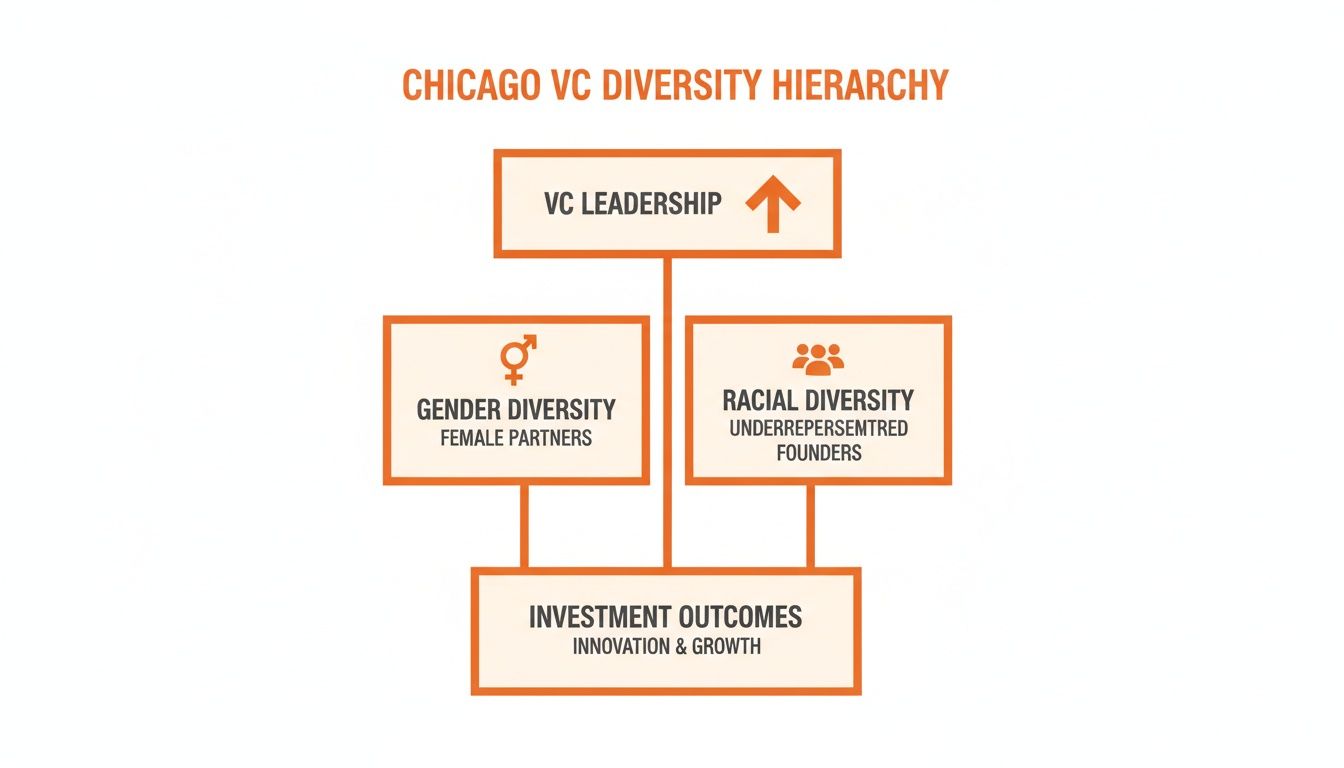
    Here’s a look at how diversity within Chicago's VC leadership can influence the kinds of founders who get funded.

    Diagram illustrating the Chicago VC Diversity Hierarchy, connecting leadership, gender, racial diversity, and investment outcomes.

    This really shows you how having diverse voices at the top of the Chicago VC ecosystem can lead to more equitable investment outcomes for founders from all backgrounds.

    A Look at Some Specific Chicago VC Firms

    While this is far from a complete list, knowing some of the key names gives you a solid starting point for your own research. Each firm has a totally different "flavor."

    • Hyde Park Venture Partners (HPVP): A true powerhouse in the Midwest, HPVP focuses on B2B SaaS and marketplace startups. They are known for being incredibly hands-on with their portfolio companies and having a network that runs deep.
    • M25: An extremely active seed-stage fund, M25 invests exclusively in startups based right here in the Midwest. They're very data-driven and have a reputation for making decisions quickly.
    • Jump Capital: With a broader focus that includes FinTech, B2B SaaS, and IT infrastructure, Jump Capital brings a ton of deep operational expertise to the table. They aren't afraid to roll up their sleeves.
    • Abundant Venture Partners: This firm often co-founds companies alongside entrepreneurs, taking a very direct role in building businesses from the ground up, especially in healthcare and media.

    The key takeaway isn't to memorize firm names, but to understand that each has a specific thesis. Your job is to find the ones whose investment philosophy aligns perfectly with your company's stage, industry, and vision.

    The Community Layer That Connects It All

    Beyond the formal investors, there’s a powerful community layer that makes Chicago’s ecosystem truly unique. This is where groups like ours, Chicago Brandstarters, come in. We aren’t investors, but we create the trusted environment where the real connections are made.

    Think of us as the friendly neighbor who knows everyone on the block. We can give you the real story on which investors are genuinely helpful and which ones you might want to steer clear of. More importantly, we can facilitate the warm introductions that get your email read instead of sent straight to the trash.

    This human side of venture capital in Chicago is where the magic happens. It’s where you get the honest, unfiltered feedback you need to sharpen your pitch long before you ever step into a formal meeting. This isn't just a list of names; it's your field guide to the people who can help you build something great.

    Getting Your House in Order Before You Pitch

    A laptop, notebooks, a pen, and a 'Ready to Pitch' sign on a wooden desk.

    Pitching an investor before you’re ready is like asking someone to marry you on a first date. It’s too much, way too soon, and you’re pretty much guaranteed to hear a "no." Before you even think about opening Canva to build a pitch deck, you need to get your own house in order.

    This is your practical, no-fluff checklist for doing just that. I’ll walk you through the things you absolutely can’t skip: knowing your numbers, getting painfully clear on who your ideal customer is, and building a simple financial model that doesn't require a Wharton MBA.

    But most importantly, we need to talk about traction. This is the secret sauce that turns a cool idea into a business someone will actually fund.

    What Is Traction and Why Does It Matter So Much?

    Traction is your proof of life. It’s the hard evidence that real, breathing humans actually want the thing you’re building. It's the polar opposite of a hypothetical business plan; it's a growing pile of facts.

    Think of it like building a case for a jury. The more evidence you have that your business is a real thing, the easier it is for an investor to believe in you and write that check. Traction isn't just one single metric; it can show up in a bunch of different ways, especially in the early days.

    Here’s how you can show it:

    • Early Revenue: This is the gold standard. Even a tiny bit of revenue proves people will open their wallets for your solution. It validates everything.
    • A Growing Waitlist: If you have hundreds (or thousands) of people lined up, eager to get their hands on your product, that’s a powerful signal of demand.
    • Passionate User Engagement: If your product is free, you can show traction with things like daily active users, how long people stick around on your platform, or a super low churn rate.
    • A Letter of Intent (LOI): In the B2B world, getting a signed LOI from a potential corporate client can be a massive green light for investors.

    The more of this evidence you can gather, the stronger your story becomes. It shifts your pitch from, "I think this will work," to "Here’s the proof that it's already working."

    Know Your Numbers Cold

    You don’t need to be a spreadsheet genius, but you absolutely have to understand the basic numbers that make your business tick. An investor will spot a founder who doesn't know their metrics from a mile away.

    At a bare minimum, you need a solid grasp on these three things:

    1. Customer Acquisition Cost (CAC): How much money does it cost you to get one new paying customer? Be painfully honest with yourself on this one.
    2. Lifetime Value (LTV): Over the entire time a customer uses your product, how much money do you expect to make from them?
    3. Gross Margin: After you pay for the direct costs of making your product or delivering your service, how much profit is left from each sale?

    Having a simple, clear financial model is non-negotiable. It shows you’ve actually thought through how your business is going to make money. If you need a solid place to start, you can use a straightforward startup business plan template that guides you through these key pieces.

    The goal isn’t to predict the future with perfect accuracy. It's to show investors you have a deep, thoughtful understanding of the levers that will make your business grow. Your model is just a story told with numbers.

    The venture capital in Chicago scene really values this kind of prep work. Investors here have a deep respect for founders who have a realistic, clear-eyed view of their business fundamentals. A Next Street analysis found that Chicago closes over $1 billion in angel and venture deals every year, with a strong focus on early-stage investments under $5 million—a perfect zone for founders who have done their homework.

    Define Your Customer with Extreme Clarity

    Finally, you need to know exactly who you are building this for. "Everyone" is not an answer. You should be able to describe your ideal customer in such vivid detail that an investor could almost picture them sitting in the room.

    Who are they? What are their biggest headaches? Where do they hang out online? Why on earth will they choose you over all the other options they have?

    When you have this level of clarity, every other decision—from product features to marketing campaigns—gets way easier and more effective. You're not just building a product anymore; you're building a solution for a specific person with a specific problem. That's a story investors can actually understand and get excited about.

    Crafting Your Story and Making the First Move

    Okay, you’ve got your numbers straight and your business fundamentals are solid. Now it’s time to switch gears from spreadsheets to storytelling. Your pitch isn’t just data—it’s the story of the future you’re building. And that story begins long before you ever step into a meeting.

    Let’s be brutally honest: cold emailing a partner at a top Chicago VC firm is like whispering your idea into a Category 5 hurricane. It’s just not going to work. Your message gets instantly buried under the hundreds of others they get every single week. The best way in—really, the only way in—is through a warm introduction. This is where your community stops being a support system and becomes your single greatest fundraising weapon.

    Building Your One-Page Teaser

    Before you even think about asking for an intro, you need a sharp, simple tool that makes it dead simple for someone to help you. I call this a one-page summary or a "teaser." Its only job is to get an investor excited enough to say, "Yes, I'll take that meeting," without wasting their time.

    Think of it like a movie trailer. It doesn't spoil the whole plot, but it shows off the best action sequences and leaves you desperate to see more. It’s a powerful snapshot of your vision, designed to be digested in under 60 seconds.

    Your teaser absolutely must include:

    • The Problem: State the pain point you’re solving, and make it feel urgent.
    • Your Solution: How your product or service kills that pain in a way no one else can.
    • The Market Size: A realistic, believable look at the opportunity. No fantasy numbers.
    • Your Traction: The hard proof you’re onto something real. Think revenue, users, waitlists.
    • The Team: A quick who's who of the founders, focusing on why you’re the ones to win.

    This little document is your calling card. It proves you’re prepared, professional, and you respect an investor’s most precious resource—their time.

    The Art of the Warm Introduction

    So you've got your teaser. Now, how do you get it into the right hands? You ask for help, but you have to do it the right way. Asking for an intro is a delicate dance, and in a relationship-driven town like Chicago, your approach says a lot about you.

    First, do your homework. Pinpoint the specific firms and partners whose focus genuinely lines up with what you're building. Then, fire up LinkedIn and find a mutual connection—a fellow founder, an old colleague, a mentor. Anyone who can vouch for you.

    When you reach out to that connection, your goal is to make their job effortless.

    Your request for an introduction should be a "forwardable email." This is a tight, well-written message that your contact can simply forward to the investor with a quick "Hey, you should meet these folks" on top. You do the work for them.

    Keep your forwardable email human, clear, and direct. You're not trying to close the deal here; you're just trying to start a conversation. But before you do any of this, you need to be sure your core assumptions are rock-solid. My guide on how to validate a business idea gives you a great framework for pressure-testing everything.

    Leveraging the Chicago Community

    This is where that Midwestern kindness I mentioned earlier becomes your superpower. Communities like ours, Chicago Brandstarters, exist for this exact reason—to help founders like you bridge these gaps. We've built a trusted network where you can get honest feedback and, when you’re ready, find those critical warm intros.

    Instead of spending months trying to network your way into the right rooms, you can tap into a group of peers and mentors who actually want to see you succeed. They’ve walked in your shoes and can point you directly to the investors who will "get" what you're doing.

    This is the real secret of the venture capital in Chicago scene. The path to funding here is paved with genuine relationships, not just transactional LinkedIn requests. Your goal isn't just to get a check; it's to build a partnership based on mutual respect.

    Navigating the Pitch Process and Avoiding Common Pitfalls

    You did it. You landed the meeting. So, what now?

    A lot of founders treat the pitch like a high-stakes final exam. I want you to completely reframe that mindset. It’s not an interrogation. It’s a conversation—a first date, really—to see if you and an investor are a good fit for what could be a 10-year partnership.

    Think of it as a joint mission to find the truth. The investor is just trying to understand three things: your vision, your market, and most importantly, you. They're asking themselves one simple question: "Is this someone I want to be in the trenches with when things get tough?"

    This is where that famous Chicago "no-BS" attitude becomes your secret weapon. Be direct. Be honest. Show them you’re a builder who gets things done, not just someone with a slick deck.

    From Coffee to Deep Dive

    The process usually rolls out in stages, starting with a casual coffee meeting and hopefully leading to a formal partner presentation. Every single step is a filter.

    The initial chat is all about the big picture and your connection to the problem you're solving. Can you tell a compelling story? Do you know your industry inside and out? If you pass that vibe check, you’ll move into the real diligence. This is where they start digging into your numbers, your go-to-market strategy, and your team.

    Your goal here is to be prepared, but also coachable. Showing you can listen to feedback and think on your feet is just as important as knowing your metrics cold.

    The biggest mistake I see founders make is getting defensive. When an investor pokes holes in your plan, they aren't attacking you. They're stress-testing your resilience and critical thinking. Welcome the tough questions—they're a sign of genuine interest.

    Common Founder Pitfalls vs. Winning Approaches

    Navigating the fundraising trail for venture capital in Chicago is less about having a perfect pitch and more about avoiding the common traps that sink promising startups. It’s often the small things, the subtle moves, that make the biggest difference in building the trust you need to get a check.

    Here’s a look at what separates the founders who get funded from those who don't.

    Common Pitfall Why It Fails A Better Approach
    Defensiveness to Feedback This immediately signals you're uncoachable and think you have all the answers. Investors want a partner, not an employee. Say, "That's a great point I hadn't considered. Here's my initial thought, but I want to dig into that more."
    Not Knowing Key Metrics Fumbling with numbers like LTV, CAC, or churn shows you aren't focused on the fundamentals of the business. It's a huge red flag. Know your three most important metrics inside and out. More importantly, be ready to explain the "why" behind them.
    Misrepresenting Traction Exaggerating your numbers will destroy trust instantly when it's discovered during due diligence. And it will be discovered. Be radically transparent. Undersell and over-deliver. Frame your current traction as a strong starting point with a clear path forward.
    "Hiding the Ball" on Risks Pretending there are no risks in your business makes you seem either naive or dishonest. Every startup has risks. Address potential hurdles head-on. Show investors you've already thought about what could go wrong and have a plan to mitigate it.

    Handling the back-and-forth with grace is critical. It’s perfectly fine for you to say, “I don’t have that exact number right now, but here’s how I’ll get it for you by tomorrow.” That response shows honesty and follow-through, which are far more valuable than faking it.

    Remember, they aren’t just betting on your idea. They're betting on your ability to figure things out when the plan inevitably breaks.

    Chicago VC: Your Questions Answered

    When you’re just getting started, the world of venture capital can feel like a maze. Let’s tackle some of the most common questions I hear from founders diving into the venture capital scene in Chicago. Here are some straight-up answers to get you pointed in the right direction.

    Do I Need Revenue to Raise in Chicago?

    Not always. Especially if you're looking at a pre-seed or seed round. While it's true that Chicago investors are a pragmatic bunch, they get that early-stage traction doesn’t always show up as dollars in the bank.

    Instead of revenue, you can show momentum in other ways. Maybe you have a waitlist that’s growing like a weed, or insane user engagement on a free product. Even a letter of intent from a big-name customer can do the trick. The real key is proving you’re solving a problem people actually have.

    Are Chicago VCs More Risk-Averse?

    I wouldn't call them risk-averse. I’d say they’re “metrics-driven.” Think of it like this: a VC on the coast might throw money at ten wild ideas, praying one of them turns into a unicorn. A Chicago investor? They’d rather back a business with a clear, believable path to actually making money.

    And honestly, that’s not a bad thing. It just means they care about sustainable growth and solid fundamentals. If you can show them a practical plan for profitability, you'll find they are very willing to listen.

    They invest in the business, not just the dream. This focus on capital efficiency means your funding often goes further, building a more resilient company from day one. It's a feature, not a bug, of our ecosystem.

    How Important Are Warm Introductions?

    They’re everything. I can’t say this enough. The entire Chicago ecosystem is built on relationships and trust. Investors are drowning in hundreds of cold emails every single week.

    A warm intro from someone they trust—another founder, a lawyer in the startup space, or a community leader—is like a golden ticket. It instantly puts you at the top of the pile. It shows that someone in their network is willing to put their own reputation on the line for you. Make this your top priority.


    If you're looking for that trusted community to help you build relationships and get those critical warm intros, join us at Chicago Brandstarters. We're a free, vetted group of kind and bold founders helping each other win. Apply to join our community.

  • A Startup Business Plan Template for Founders Who Get Things Done

    A Startup Business Plan Template for Founders Who Get Things Done

    I've seen countless startup business plan templates. They're all useless without one thing: the right mindset. Most founders treat a business plan like homework—a boring document to please investors.

    That's a huge mistake.

    Why Your Business Plan Is More Than Just a Document

    Think of your business plan as your startup's operating system. It’s the blueprint that turns an idea into a real company. This planning process is your first competitive advantage.

    A man outlines a strategic blueprint on a whiteboard in an office with a laptop and notepad.

    Imagine you're building a custom race car. You wouldn't just start welding pieces together, would you? Of course not. You’d start with a schematic—a blueprint showing how every part works together to hit top speed.

    Your startup business plan is that schematic. It’s where you engineer success before you write a line of code or place your first order.

    A Framework for Clarity and Confidence

    Writing a business plan forces you to confront the tough questions. It’s an exercise in structured thinking that brings incredible clarity. Vague ideas become concrete strategies.

    This blueprint helps you:

    • Uncover Blind Spots: Spot weaknesses in your model or cash flow problems before they become expensive disasters.
    • Align Your Team: Ensure everyone—from your co-founder to your first hire—is rowing in the same direction.
    • Make Confident Decisions: A clear plan simplifies daily choices. You can weigh opportunities against your core goals and stay focused.

    A business plan is your business's story—where it is, where it’s going, and how you'll get there. It’s less about predicting the future and more about creating it on purpose.

    Turning Hope into a Tangible Game Plan

    Hope is not a strategy. A great idea is a starting point, but the path from idea to impact is paved with deliberate planning. The data is clear.

    Entrepreneurs who write a formal business plan are 152% more likely to launch their companies. Better yet, businesses with plans grow 30% faster than their competition. This isn't just theory. Nearly 7 out of 10 VCs won't invest in a startup without a plan. Those that have one secure 133% more investment capital. You can explore more business plan statistics and see for yourself.

    At the end of the day, this document is for you. It’s your guide, your reality check, and your roadmap for building something that lasts. It turns your vision into an actionable game plan.

    Crafting Your One-Page Executive Summary

    Before anyone reads your full business plan, they read this. The executive summary is your startup's first handshake. Think of it as your movie trailer. Get it right, and doors open. Get it wrong, and the conversation is over.

    Overhead shot of a wooden desk with a notebook, pen, coffee, plant, and 'Executive Summary' banner.

    Picture this: an investor gets dozens of pitches a week. They don't have time to wade through a 30-page document. Your summary is their filter. In just a few hundred words, you must convince them your idea is worth their most valuable asset—their attention.

    This single page is a test. It proves you can distill complexity into a clear, compelling story. It shows you know what matters. Pro tip: write it last, after you’ve wrestled with every other section.

    The Anatomy of a Winning Summary

    Your goal isn't just to list facts. It's to tell a story that makes your startup feel inevitable. A great one-pager from your startup business plan template must hit four key points with absolute conviction.

    Here’s the breakdown:

    • The Problem: Paint a vivid picture of a real, painful problem. Who is struggling? Why do current options fall short? Make the reader feel the urgency.
    • Your Solution: Introduce your company as the hero. How do you uniquely solve this problem? Ditch the jargon and focus on the "magic" of what you do.
    • The Market Opportunity: Zoom out. Show them how big this problem really is. Prove there's a significant market ready for what you've built.
    • The Vision and Ask: End with a glimpse of the future. Touch on your business model, traction, team, and what you need to hit the next milestone. State your "ask" with confidence.

    Your one-page summary is the heart of your plan. It’s not about cramming in every detail; it’s about connecting the most important dots into a picture of inevitable success.

    Putting It Into Practice: A SaaS Example

    Let's make this real. Imagine a Chicago SaaS startup called "ConnectLocal" that helps small retail shops compete with e-commerce giants. Their plan is solid, but it all hinges on this summary.

    Here’s how they could lay it out:

    ConnectLocal Executive Summary

    Section Content Snippet
    The Problem Main Street retailers lose $200 billion annually to e-commerce. They lack the tools to offer the personalized, on-demand service modern customers expect, leaving them unable to compete.
    Our Solution ConnectLocal is a simple mobile platform giving independent shops big-box power. Our app lets them manage inventory, offer same-day local delivery, and run text campaigns—all from one dashboard.
    Market Opportunity The target market includes over 300,000 independent retailers in the Midwest, a $1.2 billion addressable market for our software. We're initially focused on the 15,000 shops in the Chicago metro area.
    Traction & Team We have 50 shops on our waitlist and a successful pilot with 5 boutiques, driving a 15% average sales increase. Our team is led by a former Shopify product manager and a logistics expert.
    Financials & Ask We project $1M in annual recurring revenue within 24 months. We are raising a $500,000 pre-seed round to expand our sales team and onboard our first 500 customers.

    This example works. It's specific, data-packed, and tells a complete story. It flows from a massive problem to a clear solution, a defined market, and a tangible ask. This is the kind of summary that gets you a meeting.

    Defining the Problem You Uniquely Solve

    Every great startup begins with a painful problem, not a cool product. Get this right, and your business plan falls into place. Your goal is to define the problem with such clarity that anyone who reads it instantly gets it.

    Think of yourself as a doctor. Your patient doesn’t care about your fancy medical device; they just want a diagnosis. They need to feel you understand their pain completely before they trust your cure. Your plan must diagnose a market pain point with that same precision.

    You want the reader nodding, thinking, "Yep, I know exactly what that feels like."

    Stop Building Solutions in a Vacuum

    The biggest mistake founders make is falling in love with their solution before confirming anyone has the problem. You might build the world’s most elegant key, but if it doesn't fit a single lock, it’s worthless.

    This is where you shift from assuming to gathering evidence. Get out of your head and talk to real people. This process, customer discovery, is non-negotiable. It’s the difference between building something people will pay for and building a hobby.

    Your mission is to validate that the problem is real, urgent, and widespread enough to build a business around. Before you sketch your product, you need answers:

    • Who is your customer? Get specific. "Small businesses" isn't an answer. "Independent coffee shop owners in Chicago struggling with unpredictable foot traffic" is.
    • What are they trying to do? What outcome are they trying to reach?
    • How do they solve this now? Map their current workarounds. Clunky spreadsheets? Duct-taped tools? This is your real competition.
    • What does this problem cost them? Put a number on the pain. Wasted time? Lost revenue? A problem that costs someone $10,000 a year is one they'll gladly pay to solve.

    Your solution doesn't have to be perfect on day one, but your understanding of the problem absolutely does. The deeper you dig here, the more you de-risk your entire venture.

    This initial research is everything. For practical advice, see our guide on how to validate a business idea before you commit serious time and money.

    Frame Your Solution as the Perfect Key

    Once you've defined the problem with clarity, introduce your solution. This isn't about listing features. It's about showing how your solution makes your customer's life better.

    Your solution should be the perfect key for the specific lock you just described. It’s not a Swiss Army knife; it's a specialized tool that does one thing incredibly well. This focused story is your value proposition.

    Let’s use a Chicago example.

    The Problem: Local breweries in neighborhoods like Logan Square waste hours manually tracking keg inventory in messy spreadsheets. This leads to lost kegs (costing over $100 each) and missed sales when they can't restock fast enough.

    The Solution: We're building "KegFlow," a simple QR-code app that lets brewers track every keg. With a quick scan, they know where their assets are, get alerts for returns, and can forecast demand. This saves them an average of 10 hours a week and cuts keg loss by 90%.

    See the difference? The solution isn't just "an inventory app." It's the direct, powerful answer to the painful problem you just laid out. This problem-solution fit is the foundation of a compelling startup business plan template.

    Mapping Your Market and Proving Traction

    A brilliant solution is useless without a hungry market. Too many founders build something incredible, only to realize nobody was waiting to buy it. This section proves your idea isn't just clever, but necessary.

    Think of yourself as a chef. You can craft the most exquisite dish, but if you open your restaurant in a town where everyone is allergic to your main ingredient, you're going out of business. This section is you confirming that the town is starving for what you're cooking.

    First, map out the size of your opportunity. Show investors you're not just chasing a niche hobby but a massive market.

    Demystifying Your Market Size

    You’ll hear investors use acronyms like TAM, SAM, and SOM. It sounds like jargon, but it's just a simple way to zoom in on your real customer base.

    Let’s use an analogy. Imagine you're launching a new cold brew in Chicago:

    • Total Addressable Market (TAM): This is the biggest pie. It's the entire global coffee market. It’s a huge number, but you're not going to capture all of it.
    • Serviceable Available Market (SAM): Now we're zooming in. This is the slice of the market you could realistically serve—perhaps all coffee drinkers in the Chicago metro area.
    • Serviceable Obtainable Market (SOM): This is your real-world target for the next few years. It’s the piece of the Chicago market you can realistically win with your current team and resources. This is the number that truly matters.

    Your goal isn't to present the biggest number, but the most believable one. A well-researched SOM shows you’re a realist with a concrete plan, not just a dreamer.

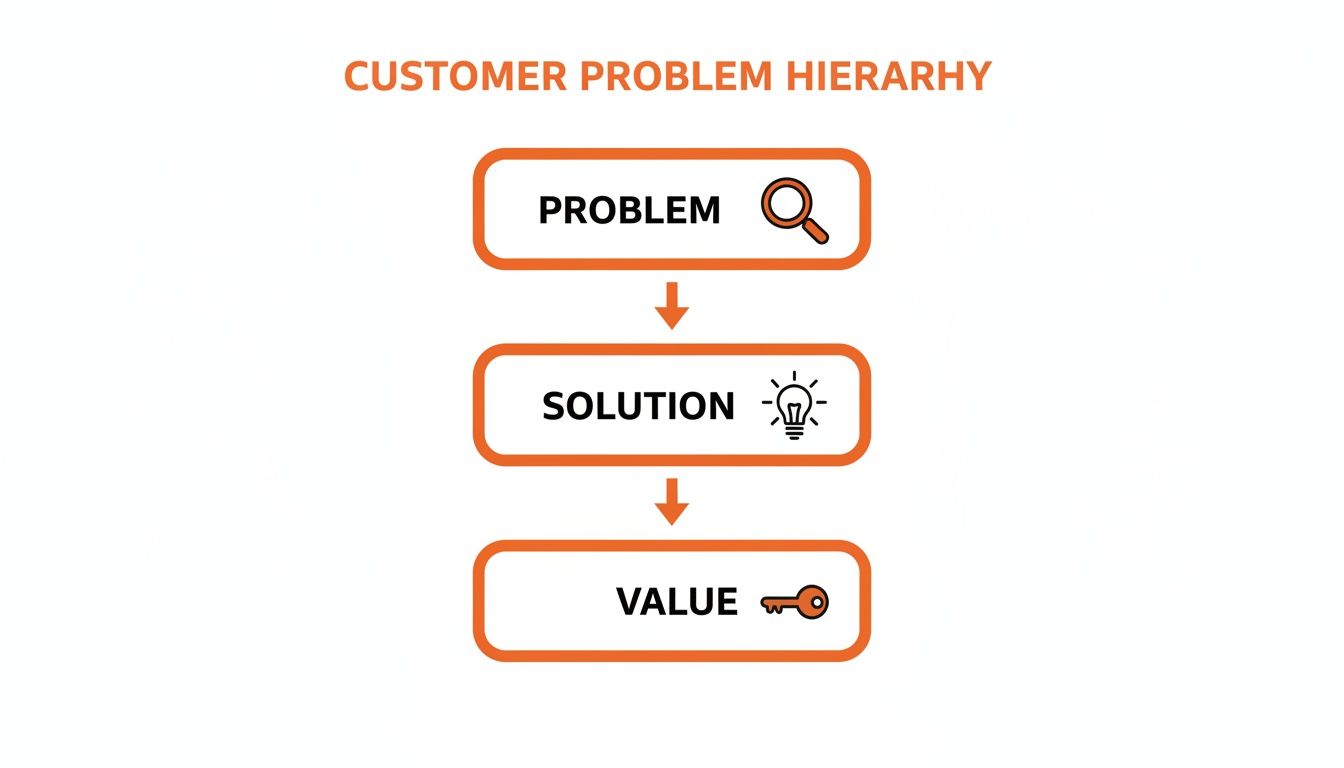
    This diagram shows how a deep understanding of the customer problem is the real starting point.

    A diagram illustrating the Customer Problem Hierarchy, showing the flow from Problem to Solution to Value.

    It all flows from the problem. Nail that, and you can create a solution that delivers real value.

    Proving You Have Traction

    Market size is theory. Traction is proof. It's the most powerful thing you can have in your business plan because it turns your story from "this could work" to "this is working."

    Traction is early evidence that people want what you’re building.

    For early startups, traction isn't always revenue. Investors look for signals of momentum—proof you're making real progress. If you need help getting those first sales, our guide on how to start a product business is a great place to start.

    Traction is the story of your progress told through data. It's tangible evidence that you're building something with momentum in the real world.

    So what counts as traction? Here are powerful examples:

    • A Growing Waitlist: Showing that 500 people have signed up to be notified when you launch is huge. It demonstrates real demand.
    • Successful Pilot Programs: Ran a test with a small group? Share the results. "Our 10 pilot users reported a 40% reduction in time spent on weekly inventory." Numbers talk.
    • Letters of Intent (LOIs): Have potential customers signed non-binding agreements saying they intend to purchase your product? An LOI from a known company is gold.
    • Key Strategic Partnerships: Landing a partnership with an established player in your industry is a massive validator.
    • Positive User Feedback: Glowing quotes from your first users provide social proof. They tell a human story that makes the opportunity feel real.

    Your job is to connect the dots. Start with the big-picture market, then bring it down to earth with tangible signs of progress that prove you're the right team to win.

    7. Showcasing Your Team and Financials

    Investors bet on people, not just ideas. I’ve seen brilliant concepts fail under a weak team and scrappy founders pivot a mediocre idea into a massive success. This section is where you prove you have the right crew to win.

    Think of your team as seasoned sailors and your idea as the ship. Investors know that even the best ship will sink in a storm without a capable crew. They're looking for proof that your team has the skills, grit, and insight to handle whatever comes.

    This is your chance to go beyond resumes.

    More Than Just Resumes

    Forget just listing job titles. Tell the story of why this specific group is uniquely qualified to solve this problem. What’s your origin story? What led you to this mission?

    A great team section connects the dots, showing a clear line between each founder's background and the company's future success.

    • Highlight Complementary Skills: Show how your team covers the critical bases. Maybe one founder is a product genius, while the other is a marketing pro. That's the balance investors love.
    • Demonstrate Industry Experience: Have you lived the problem you're solving? If you’re building a tool for restaurant owners and a co-founder managed a busy Chicago restaurant for a decade, that’s a massive advantage. Mention it.
    • Showcase Grit: Early-stage startups are a grind. Share a brief story of how your team overcame a tough obstacle. This proves your resilience.

    For solo founders, this section is just as crucial. Highlight your advisory board, mentors, or early hires who fill your knowledge gaps. If you're still looking, our guide on how to find a co-founder has practical steps for finding the right partner.

    Your team slide isn't just about who you are. It’s about why you—and only you—are the team that will make this venture succeed. It’s a statement of capability and shared purpose.

    Your Financial Sketch Not a Full-Blown Audit

    Let's talk financials. Many founders get spooked here, picturing complex spreadsheets. Relax. At this early stage, nobody expects a perfect five-year forecast.

    The real goal is to provide a clear, honest financial sketch.

    Think of it this way: you're not creating detailed architectural plans for a skyscraper. You're making a simple floor plan that shows the basic layout and how the rooms connect. It proves you've thought through how your business will make and spend money.

    Your financial sketch in the startup business plan template should clearly outline three core things.

    1. Your Business Model: In one sentence, how will you make money? A monthly subscription (SaaS)? A one-time product sale (e-commerce)? Be direct.
    2. Key Revenue Streams and Major Costs: What are your top 1-3 ways to generate income? On the flip side, what are your 3-5 biggest expenses? Usually, this includes salaries, marketing, and software.
    3. Your Use of Funds: If you're raising money, be explicit about how you'll use it. Break down your ask (e.g., "$500k") into key buckets like "40% for two engineers, 30% for marketing, and 30% for inventory."

    This simple sketch gives investors confidence. It shows you understand the economic engine of your business and that you'll be a responsible steward of their capital. It's about demonstrating thoughtfulness, not predicting the future perfectly.

    Pitching Your Plan and Building Momentum

    Think of your business plan as a living document, not a final exam. It's a conversation starter—a key you’ve forged to open important doors. Once you’ve nailed it down, the real work begins: turning that plan into powerful conversations.

    This is especially true in the Midwest. Investors in hubs like Chicago value a practical, grounded mindset. They want a real story backed by a sustainable business model. Your plan isn't a script; it's the foundation for a genuine dialogue.

    The startup journey is tough. More than two-thirds of new companies fail within 10 years, and 21.5% don't make it past their first year.

    But here’s the flip side: businesses with detailed plans grow 30% faster. That’s a critical edge, especially when 82% of business failures come from cash flow issues—a problem a good plan tackles head-on. A solid startup business plan template is your lifeline. You can read more about these entrepreneurship statistics and how to beat them.

    Adapting Your Story for the Room

    Your pitch is never one-size-fits-all. A formal VC meeting is different from a casual coffee with an advisor. Learn to read the room and adapt your narrative while staying true to your core mission.

    For a VC, you might lead with traction and market size. When talking to a mentor, you might focus more on the problem and your team.

    Your business plan gives you the core components of your story. Your job is to be the storyteller, reassembling those components to connect with whoever is across the table.

    Getting Connected in the Midwest

    Building a company is a community sport. You need to get out there and connect with people who can help. Here in Chicago and across the Midwest, the ecosystem is incredibly supportive, but you have to show up.

    Here are a few places to start:

    • Incubators and Accelerators: Programs like 1871, mHUB, and MATTER in Chicago offer incredible mentorship and resources.
    • Local Events: Keep an eye on Built In Chicago and local tech meetups for pitch nights, founder panels, and networking.
    • Peer Groups: Joining a community of fellow founders, like Chicago Brandstarters, provides a confidential space to get honest feedback on your plan.

    A Few Common Questions About Startup Business Plans

    When you’re facing your first business plan, a few questions always pop up. Let's get them out of the way. Don’t be afraid to ask the tough questions—that’s how you get to the good stuff.

    How Long Should This Thing Be?

    Clarity beats length. Every time.

    There’s no magic number, but a sharp 15-page plan destroys a rambling 50-page one. For most early-stage startups, 15-25 pages is the sweet spot.

    Your one-page summary gets your foot in the door. After that, make every page count.

    Think of it like a great presentation. It needs to be long enough to tell a compelling story but short enough that no one's eyes glaze over.

    Should I Write It Myself or Hire Someone?

    You need to hold the pen. Writing the plan isn't just about putting words on paper; it's the process of wrestling with every detail of your business. It forces you to think strategically. You can't outsource that.

    Sure, bring in a pro to help with financial modeling or deep market research. That’s smart. But the core vision, strategy, and story? That has to come from you. Investors bet on your brain, not a consultant's.

    How Often Should I Update My Business Plan?

    Your startup business plan template isn't a historical document you frame on the wall. Treat it like a living guide for your business. It's your map, not a museum piece.

    Give it a refresh:

    • Quarterly: Check your progress against your goals and tweak what isn't working.
    • Before a new funding round: Show off your latest traction and lay out what you need next.
    • After a major pivot: If you're changing direction, your plan needs to change with you.

    Keeping it current transforms the plan from a simple document into your most valuable strategic weapon.


    Ready to build your brand alongside founders who actually value kindness and hard work? Join Chicago Brandstarters, a free, vetted community for Chicago and Midwest founders. We skip the transactional networking and focus on real support. Learn more and apply at https://www.chicagobrandstarters.com.