
Tag: side hustle ideas

  • 10 Passive Income Ideas for Beginners to Build Wealth in 2026

    10 Passive Income Ideas for Beginners to Build Wealth in 2026

    I know what you're thinking. "Making money while you sleep" sounds like a line from a scam artist in front of a rented Lamborghini. But the real idea behind it is solid, and I'm going to show you how people like you and me are actually doing it. Passive income isn't a fantasy. It's about you building systems that make money for you, even when you're not at the keyboard.

    Think of it like planting an apple tree. You put in the hard work upfront—digging the hole, planting the seed, watering it every day. For a while, nothing happens. But then, it grows. Soon, that tree gives you apples every single year with just a little bit of care. You did the heavy lifting once, but you reap the rewards for years. That's what we're talking about: creating income streams that don't chain you to a desk.

    This guide is your starting line. I'm breaking down 10 real, achievable passive income ideas for beginners. I’ll cut through the hype and give you a clear roadmap. For each idea, I'll give you the honest truth about the work, the cost, and a simple 5-step plan to get you started. We'll cover creating digital products, using affiliate marketing, smarter investing, and even small-scale rental ideas that work great in a city like Chicago. My goal is to give you steps you can actually take, not just theories. You can do this.

    1. Digital Products & Online Courses

    One of the best passive income ideas for beginners is to sell what you already know. You have unique skills from your job, your hobbies, or your side projects. You can package that knowledge into an e-book, a template, a checklist, or a full online course and sell it over and over again. Once you create it, the asset works for you 24/7.

    A laptop, notebooks, coffee, and pen on a desk, with 'CREATE & SELL COURSES' text.

    This "create once, sell forever" model is powerful. Pat Flynn built his whole Smart Passive Income brand by teaching people how to build niche websites. The trick is to solve a specific, painful problem for a certain group of people. Instead of a vague "business course," you could create something hyper-specific like "My 5-Step System to Land Your First 3 Freelance Clients on LinkedIn." That’s something I can see myself buying.

    You don't need a fancy studio to start. Just document your real journey as you build something. People connect with real stories, not polished lectures. You can use platforms like Gumroad or Teachable to host and sell your stuff without needing to be a tech wizard. This is perfect if you like teaching and have a skill you're excited to share.

    Quick Start: Your First 5 Steps

    1. Identify Your Skill: What problem can you solve? What do people always ask you for help with?
    2. Create a "Minimum Viable Product": Start small. Make a simple checklist or a short e-book to see if people want it.
    3. Choose Your Platform: Set up a free account on a simple platform like Gumroad.
    4. Pre-Sell Your Idea: Tell your network or social media followers about your upcoming product to see if they're interested before you build the whole thing.
    5. Launch & Gather Feedback: Release your product. Ask your first customers for testimonials to build trust for future sales. This is a lot like launching physical goods, so you can learn more about how to start a product business to get the core concepts down.

    2. Affiliate Marketing & Product Recommendations

    Affiliate marketing lets you earn a commission by recommending products you actually use and love. Instead of making your own product, you partner with companies and get a cut of the profit for every sale you send their way. This is one of the easiest passive income ideas for beginners because you can start with any size audience—even just a few followers.

    This whole game runs on trust. Your power comes from authentic recommendations, not a slick sales pitch. For example, if you’ve built an audience, you can share the exact software you use to run your business. You help them solve a problem, and you get paid by the software companies when they sign up through your special link. It’s a win-win.

    You don't need a huge platform to start, just a place to share your thoughts. It could be a personal blog, a niche Instagram account, or a simple email newsletter. Your goal is to become a trusted source in your specific area. Focus on helping your audience by pointing them to the best solutions, and the money will follow. Just be transparent; always tell people they're using an affiliate link. Trust is everything.

    Quick Start: Your First 5 Steps

    1. Identify Your Niche: What area do you have real experience in? What products do you already tell your friends about?
    2. Find Affiliate Programs: See if the companies you love (software, gear, services) have affiliate programs. Most of them do.
    3. Create Valuable Content: Write a detailed blog post or make a video sharing your honest experience with the product.
    4. Share Your Link: Place your unique affiliate link in your content where it feels natural. Help the reader, don't just push a sale.
    5. Track and Optimize: Use the affiliate dashboard to see what's working. Do more of what your audience responds to.

    3. Content Monetization (Blog, YouTube, Podcast)

    Instead of just selling a product, you can build an audience by sharing your journey. You can turn your real experiences and knowledge into a valuable asset. When you create a blog, YouTube channel, or podcast, you attract a dedicated following. You can then monetize that audience with ads, sponsorships, and affiliate links, earning passive income while you become an expert in your niche.
    A content creator's desk with a microphone, laptop showing data, smartphone, camera, and a 'MONETIZE CONTENT' banner.

    I'm not talking about becoming a superstar influencer overnight. Think of it as a public journal that pays you. Once you upload a video or publish a blog post, it can earn you ad revenue or affiliate clicks for years with no more work. It just sits there, a little digital employee working for you.

    Your content becomes a magnet for opportunities. Start by documenting your process from day one, even the messy parts. Your authenticity is your biggest advantage; people connect with real stories. Pick one format, get good at it, and be consistent. This strategy is great if you want to build a personal brand that not only makes passive income but also brings customers to your main business.

    Quick Start: Your First 5 Steps

    1. Pick Your Platform & Niche: Choose one thing you enjoy—writing, video, or audio—and a topic you could talk about forever, like "building an e-commerce brand in Chicago."
    2. Create Your First 3 Pieces: Don't overthink it. Record three short videos or write three blog posts solving a small problem for your audience.
    3. Establish a Consistent Schedule: Commit to a publishing schedule you can stick to, even if it's just once a week. Consistency builds trust.
    4. Set Up One Monetization Channel: Start simple. Sign up for the Amazon Associates program and add relevant affiliate links to your content.
    5. Promote Your Content: Share your new stuff on one or two social media platforms where your ideal audience hangs out. Ask for feedback.

    4. Rental Income (Real Estate, Equipment, Parking)

    One of the oldest passive income ideas for beginners is turning things you own into cash flow. And I'm not just talking about houses. You can rent out anything from a spare parking spot in a busy area to specialized equipment you have sitting in your garage. Once you set up the rental and find a good user, the asset makes you money with very little day-to-day work.

    A model house, keys, and 'Rental Income' papers on a table, symbolizing property investment.

    This is all about getting the most out of what you already have. A founder in Chicago with extra warehouse space could rent it out to another small business. A tech pro could rent out a high-end camera or drone on a platform like Fat Llama. This strategy is perfect if you like tangible assets more than digital ones and you're okay with the duties of ownership.

    The key is to start small. Don't feel like you need to buy an apartment building tomorrow. Renting out a parking space on an app like Neighbor or a spare room on Airbnb are great, low-risk ways to start. If you want to get into real estate without being a landlord, you can look into REITs (Real Estate Investment Trusts), which let you invest in property passively with other people.

    Quick Start: Your First 5 Steps

    1. Inventory Your Assets: What do you own that someone else would pay to use? A spare room, parking spot, storage space, tools, or professional gear?
    2. Research Your Market: Check the rental rates for similar assets in your area to set a good price. Look on platforms like Airbnb, Vrbo, Neighbor, or Fat Llama.
    3. Prepare Your Asset: Clean it, fix it, and take good pictures to make it look attractive to renters. First impressions are huge.
    4. Choose Your Platform & List: Create a great listing on the right platform for your asset. Be clear about the rules, availability, and price.
    5. Screen Your First Renter: Check out your first applicant carefully. A great tenant is the key to a truly passive experience.

    5. Investments & Cash Alternatives (Dividend Stocks, Index Funds, P2P Lending, High-Yield Savings)

    This is maybe the most "passive" form of passive income: making your money work for you. Instead of trading your time for dollars, you put your money into assets that generate their own returns through dividends, interest, or growth. This lets your savings or business profits build a separate, compounding income stream over time. It’s like a money tree; you plant the seed (your investment), and with time, it grows and gives you fruit (your returns).

    You don't need to be a Wall Street genius to get started. The key is to be consistent and diverse. For instance, instead of trying to pick the next hot stock, you can invest in a low-cost index fund like the Vanguard S&P 500 ETF (VOO). This gives you a tiny piece of 500 of the biggest U.S. companies. For your cash, moving it from a regular savings account to a high-yield savings account can seriously boost your interest earnings with no extra risk.

    Focus on investing a little bit regularly, rather than saving up for one huge investment. The idea of dollar-cost averaging—investing a fixed amount on a schedule—is a powerful and less scary way to build wealth. This strategy is perfect if you want to build long-term wealth that's truly passive and doesn't require a special creative skill.

    Quick Start: Your First 5 Steps

    1. Open the Right Accounts: Start with a high-yield savings account for your emergency fund and a brokerage account (like Vanguard or Fidelity) for investing.
    2. Make Your First Investment: Buy a small amount of a broad-market, low-cost index fund (like VTI or VOO) to get the hang of it.
    3. Automate Your Contributions: Set up an automatic monthly transfer from your checking to your investment account. Even $50 a month builds the habit.
    4. Turn on Dividend Reinvestment (DRIP): Go into your brokerage settings and make sure any dividends you get are automatically used to buy more shares. This supercharges your growth.
    5. Set & Forget: Don't check your portfolio every day. Trust your long-term plan and let your investments grow.

    6. Membership Communities & Patreon

    If you have an audience—even a small one—you can turn that connection into a stream of recurring income. A membership community is like a private club where your biggest fans pay a monthly or annual fee for exclusive access. This could be extra content, behind-the-scenes looks, direct access to you, or just a place to connect with other people like them.

    Unlike one-time sales, memberships build on themselves. Your first members create a foundation, and their engagement attracts more people. Platforms like Patreon are great for creators, while tools like Circle or Ghost make it easy to start a paid newsletter or private forum. The key is to deliver real value consistently. You're not just selling content; you're creating a community. The value isn't just you; it's the network you're building.

    This model is less "passive" at first because you need to engage with your community. But over time, you can schedule content in advance and empower members to lead discussions, which reduces your daily work. It's a perfect strategy if you love building community and want a deeper relationship with your audience while earning reliable monthly income. For beginners who enjoy interaction, this is one of the more engaging passive income ideas.

    Quick Start: Your First 5 Steps

    1. Define Your "Velvet Rope": What exclusive value do members get? An extra podcast episode? A monthly Q&A call? Access to a private Discord server?
    2. Survey Your Audience: Before you build anything, ask your audience if they would pay for your membership and what they'd want inside.
    3. Choose a Simple Platform: Start with a tool like Patreon or Substack that handles payments for you. Keep the tech simple.
    4. Launch with a "Founding Members" Offer: Give your first 20-50 members a special lifetime discount to reward them for believing in you early.
    5. Create an Onboarding Sequence: When someone joins, send them a welcome email or video that shows them exactly where to find the value and how to get involved.

    7. Licensing & Intellectual Property (Designs, Trademarks, Patents)

    One of the most overlooked passive income ideas for beginners is monetizing your unique creations. If you have an original design, a catchy brand name, or even a great photo, you can license it to other businesses. Licensing is like renting out your ideas. A company pays you a fee, called a royalty, to use your creation, while you collect payments without dealing with manufacturing or sales.

    Think of yourself as a landlord for your ideas. Disney doesn't make every Mickey Mouse shirt; they license the character to manufacturers who do all the work. On a smaller scale, a graphic designer could license a pattern to a phone case company. A photographer could license a photo to a marketing agency. The cool part is that once you protect your intellectual property (IP), that one asset can generate income from multiple companies at the same time.

    This is perfect if you're a creative person who prefers focusing on the big idea rather than the day-to-day grind of running a business. You do what you love—create—while others handle the rest. It takes some upfront investment to create and legally protect your IP, but the potential for long-term, hands-off income is huge.

    Quick Start: Your First 5 Steps

    1. Identify Your Asset: Pinpoint a unique creation you own. Is it a logo, a piece of software, a series of photos, or a product design?
    2. Protect Your IP: File for basic protection. A copyright for creative work or a trademark for a brand name is a good place to start.
    3. Identify Potential Licensees: Research companies that could benefit from using your IP. Who serves the audience that would love your creation?
    4. Craft a Simple Pitch: Create a one-page document showing off your IP and explaining how it could help a potential partner.
    5. Consult a Professional: Before you sign anything, talk to an IP lawyer. They can help you draft a simple licensing agreement that outlines rights, royalty rates, and payment terms. This is a critical step to protect yourself.

    8. Print-on-Demand & Dropshipping

    If you're a creative person but hate the idea of managing inventory and shipping boxes, then print-on-demand (POD) and dropshipping are for you. This model lets you create designs for products like t-shirts, mugs, and posters. Then, a third-party company handles all the manufacturing and shipping whenever a customer orders something. You just upload your design, set your price, and focus on marketing.

    This is a great way to monetize a niche audience. You aren't just selling a product; you're selling an identity. The key is to create designs that really connect with a specific group, like a funny inside joke for software developers or a cool design for urban gardeners in Chicago. You get to be the creative director, and your POD partner acts as your automated fulfillment center.

    To get started, platforms like Printful or Printify connect easily with marketplaces like Etsy and Shopify, so the tech setup is simple. Your main job is to create cool designs and find your people. This is one of the best passive income ideas for beginners because you don't have the financial risk of buying inventory upfront. You can test ideas with almost no investment.

    Quick Start: Your First 5 Steps

    1. Identify Your Niche: Choose a specific audience you understand. What are their passions, inside jokes, or shared identities?
    2. Create Your First Designs: Use a tool like Canva or Kittl to create a few simple, high-quality designs that speak to your niche.
    3. Choose Your Platform: Sign up for a POD service like Printful and connect it to a free Etsy store to start.
    4. Order Samples: Always order a sample of your own product to check the quality before you list it for sale.
    5. Market to Your Niche: Share your designs in online communities (like Facebook groups or subreddits) where your audience hangs out to get your first sales and feedback. You can learn more about the broader strategy when you're ready to start an ecommerce business.

    9. Consulting & Done-For-You Services (Premium Pricing)

    This one isn't 100% passive, but offering high-ticket consulting is one of the fastest ways for beginners to generate serious income. You package your expertise into a premium offer, so just a few clients can generate a significant income. This is about working smarter, not harder. You create repeatable systems for high-value problems.

    The idea is to stop billing by the hour and start selling projects that solve a big problem. Instead of "I'll do your marketing," you offer a "$10K Product Launch Email Sequence." This shifts the focus from your time to the value you deliver. You're selling an outcome, not your hours.

    To start, you need to have gotten real results in a specific area. If you've 10x'd your own e-commerce sales, you have the proof you need. By documenting your process as you work with your first clients, you create a blueprint for a service you can scale or even turn into a digital product later. This is a powerful way to generate cash flow and prove your expertise.

    Quick Start: Your First 5 Steps

    1. Define Your 10x Result: Identify a specific, impressive result you've achieved for yourself or a past employer. This is your core value.
    2. Package Your Solution: Create a fixed-scope project with a clear deliverable and a premium price (e.g., "$5,000 Website Conversion Audit & Implementation").
    3. Build Your Case Study: Create a one-page document detailing the problem you solved, the actions you took, and the result you achieved. This is your main sales tool.
    4. Find Your First Client: Reach out to your network with your specific offer. Focus on the value and the outcome, not the tasks.
    5. Systematize Everything: Document every step of your process with the first client. This creates a template to make the next project faster and easier. Even with premium services, you can explore ways to start a business with no money by leveraging your skills and network.

    10. Automated Email Marketing & Sales Funnels

    Imagine setting up a digital salesperson who works for you 24/7, guiding potential customers from curious to convinced without you lifting a finger. That's an automated email marketing funnel. You design a series of pre-written emails that automatically build relationships with leads, teach them about your offer, and ask for the sale. Once it's built, this system is a workhorse for many passive income ideas for beginners, especially if you have digital products.

    The concept is simple: you attract people to your email list with a valuable freebie (a "lead magnet"), then let your automated emails take over. This isn't about spamming. It's about building a relationship and providing value on autopilot. The magic happens when the system is so well-tuned that it generates revenue consistently, and you only have to check on it once in a while.

    This strategy is perfect if you have a product to sell or an affiliate offer to promote. It turns your audience into an asset you own, unlike social media followers who can disappear with an algorithm change. It takes work to set up, but a well-built funnel is a powerful engine for passive income.

    Quick Start: Your First 5 Steps

    1. Choose Your Tool: Sign up for an email marketing service with good automation, like ConvertKit, MailerLite, or ActiveCampaign.
    2. Create a Lead Magnet: Make a valuable free resource (like a PDF checklist or a short video tutorial) that solves a specific problem for your target audience.
    3. Build a Sign-Up Form: Create a simple landing page or form to offer your lead magnet in exchange for an email address.
    4. Write Your Welcome Sequence: Draft a short 3-5 email sequence. The first email delivers the freebie. The next emails introduce you, provide more value, and then gently pitch your main offer.
    5. Promote Your Lead Magnet: Share your sign-up page everywhere: on your social media, in relevant online groups, and on your website. Your goal is to get your first subscribers into the funnel.

    10-Point Comparison of Passive Income Ideas for Beginners

    Option Implementation Complexity 🔄 Resource & Capital Requirements 💡 Expected Outcomes ⭐ Ideal Use Cases 📊 Key Advantages ⚡
    Digital Products & Online Courses Medium — sizable upfront creation and structuring Low–Medium — time, course platform fees, marketing ⭐⭐⭐⭐ — scalable passive revenue after launch; ongoing marketing needed Teaching founder processes, productizing expertise High margin after launch; builds authority
    Affiliate Marketing & Product Recommendations Low — add links to existing content; trust-building required Low — audience, content creation, tracking tools ⭐⭐ — variable income tied to traffic and conversion Monetize toolkits, resource pages, newsletters Very low startup cost; easy to layer onto content
    Content Monetization (Blog, YouTube, Podcast) High — consistent publishing and platform management Low–Medium — time, equipment, possible ad/promote spend ⭐⭐⭐ — durable audience asset; long time-to-profitability Brand building, lead generation, long-term authority Multiple revenue streams; strong marketing synergy
    Rental Income (Real Estate, Equipment, Parking) Medium–High — tenant/asset management and regulations High — capital, maintenance, insurance, management ⭐⭐⭐⭐ — steady monthly income + appreciation; illiquid Monetize excess physical assets; build wealth Predictable recurring cash flow; inflation hedge
    Investments & Cash Alternatives Low — set-and-automate investing strategy Low–Medium — capital required for meaningful yields ⭐⭐⭐ — passive compounding; income scale depends on principal Preserve cash, diversify wealth, emergency funds Truly passive once established; liquid options available
    Membership Communities & Patreon Medium — launch, moderate ongoing moderation and content Low–Medium — platform fees, content time, community ops ⭐⭐⭐⭐ — predictable recurring revenue; high LTV if engaged Deepen relationships, exclusive content, mastermind groups Predictable monthly revenue; strong retention if valuable
    Licensing & Intellectual Property High — create protectable IP and negotiate deals Medium — legal costs, IP registration, business development ⭐⭐⭐⭐ — royalty income with low marginal cost; scalable Monetize designs, tech, trademarks, creative assets Royalties with minimal fulfillment; increases brand value
    Print-on-Demand & Dropshipping Low — storefront + supplier integration; quality checks Low — design, marketing, platform fees ⭐⭐ — quick launch but thin margins; demand-driven Branded merch, testing product ideas, fundraising merch Zero inventory risk; very fast to iterate and launch
    Consulting & Done‑For‑You Services Medium — packageization and high-touch delivery Low–Medium — your time; subcontracting to scale ⭐⭐⭐⭐ — high revenue per client; limited by capacity High-ticket expertise, early monetization, case studies High margins per engagement; builds credibility quickly
    Automated Email Marketing & Sales Funnels Medium — sequence design, segmentation, analytics Low–Medium — email platform fees, content creation, traffic ⭐⭐⭐⭐ — high ROI and scalable 24/7 revenue once validated Selling courses, memberships, repeat purchases, onboarding Owned channel with excellent ROI; compounds with list growth

    Your First Step Starts Today, Not 'Someday'

    You just looked at ten different ways to build wealth, from creating digital products to investing in dividend stocks. I get it if you feel both excited and totally overwhelmed right now. I've been there, staring at a list just like this one, feeling like I had to pick the one "perfect" idea before I could even begin.

    Let me tell you a secret: there is no perfect idea. The magic isn't in what you choose. The magic is in the momentum you build after you choose. Passive income is not a lottery ticket. It’s a garden. You don't just toss a bunch of seeds on the ground and hope for a feast. You pick one small spot, you plant one seed, you water it, and you protect it. Over time, that one seed grows, and you learn what it needs. Then you plant another.

    The path to building passive income is a series of small, deliberate actions, not one giant leap. Your goal today isn't to launch a full online course or buy a rental property. Your goal is to take one tiny, almost laughably small step forward.

    From Analysis Paralysis to Action

    Let's break down what that first step really looks like. Forget the five-year plan. Focus on a five-minute action.

    • Inspired by Digital Products? Don't try to build the whole course. Open a blank document and write down the titles for five possible lessons. That's it.
    • Intrigued by Affiliate Marketing? Don't map out a complex content plan. Just search for affiliate programs for three products you already use and love.
    • Considering Rental Income? Forget mortgages for a minute. Your only task is to spend fifteen minutes researching the average rent for a specific property type in a single Chicago neighborhood like Logan Square.
    • Thinking about Dividend Stocks? Don't worry about your entire portfolio. Just open an account with a brokerage like Fidelity or M1 Finance. Completing the application is your win for the day.

    This approach beats the fear of failure. You can’t fail at writing five bullet points. This is how you build an engine of progress. Each small action adds a log to the fire, creating the energy for the next, bigger step. You are building a system, not just chasing a dollar. You are shifting from being a consumer to being a creator and an owner, and that is the most valuable asset you will ever build.

    The real prize here isn't just the money. It's the freedom, the creative control, and the resilience you gain. It's about building a future where your time isn't a direct trade for money, giving you the freedom to focus on what really matters to you. You are learning the language of leverage.

    So, look back at the list. Which idea sparked even a tiny bit of real curiosity? Not the one you think will make the most money, but the one that sounds the most interesting to you. Grab that little bit of excitement and follow it. Take that one tiny, concrete step right now, before you close this tab. Don't let 'someday' become never. Your first step starts today.


    Building can be a lonely journey, but you don't have to do it alone. If you're in Chicago and want to connect with kind, ambitious builders who are in the trenches just like you, check out Chicago Brandstarters. We're a community dedicated to sharing real-world tactics and supporting each other's growth, from side-hustle to seven figures.

    Join the Community at Chicago Brandstarters

  • How to Start a Side Business: Your Practical Guide to Launching

    How to Start a Side Business: Your Practical Guide to Launching

    So, you want to start a side business. Let's kill the overwhelming vision of building a massive empire overnight. That's not how I see it work, and it's not how you should either.

    Starting a business is just taking one small, practical step. Then another. You find a real problem people have, you create a dead-simple offer to solve it, and then you find one person willing to pay you for it. Everything else—the LLC, the fancy website, the perfect logo—can wait.

    Why Now Is the Perfect Time for Your Side Business

    If you've got that itch to build something of your own, you're not alone. That pull you feel to create something, to get a little more control over your own financial destiny… that’s a huge shift in how we're thinking about work. Relying on a single 9-to-5 just feels a lot riskier than it used to.

    Think of it like building with LEGOs. You don't dump the whole box on the floor and try to build the finished castle in one go. You start with a solid baseplate—your stable foundation—and connect a few essential bricks. I wrote this guide to help you find that solid ground.

    The Rise of the Side Hustle Economy

    This isn’t just a feeling; the numbers back it up. The "side hustle" isn't some tiny trend anymore. It's a core part of how our modern economy works.

    To put it in perspective, let’s look at a few key numbers.

    The Modern Side Hustle Landscape at a Glance

    This quick summary shows you just how much momentum is behind the independent business movement. It’s not a niche community; it's a massive economic force you can join.

    Statistic What It Means for You
    Global gig economy projected to hit $2.15 trillion by 2033. You're entering a massive, growing market. Your potential customer base isn't just local; it's global.
    Over 400,000 new businesses started each month in the U.S. You're not alone. There's a huge ecosystem of tools, communities, and resources built to help you succeed.
    Over half of these new businesses are side hustles. This is the new normal. Starting small while you work a full-time job is the proven path for countless successful founders.

    The takeaway here is simple: The wind is at your back. You can dig deeper into these side hustle statistics to see the full picture, but the story they tell is clear.

    This whole thing is exploding for a few simple reasons:

    • The Barriers Are Gone: Technology has made starting a business incredibly cheap and easy. From my Chicago apartment, I can build a website, take payments, and find customers worldwide using tools that cost less than a few cups of coffee a month. You can too.
    • You Want Ownership: More and more, we crave a sense of control over our work. A side business is your space to call the shots, test your own ideas, and see the direct results of your hustle.
    • A Financial Safety Net: Let's be real, having another income stream is just smart. It eases the pressure from your main job and gives you the freedom to save, invest, or just breathe a little easier.

    Your goal isn’t to immediately replace your full-time salary. The real goal is to build an asset—something that creates value for others and income for you, even when you’re not actively working on it. Your side business can be that asset.

    It All Starts With a Simple Idea

    Forget trying to invent the next Facebook. The best side businesses I've seen almost always start by solving a small, annoying problem.

    Seriously, look at your own life. What frustrates you? What skills do you have that friends always ask for help with? What service do you wish existed that would make your own day-to-day easier? That's where the gold is hiding.

    Your unique experience is your biggest advantage. You’re not trying to build for everyone. You’re trying to build something for someone just like you.

    Finding and Validating Your Business Idea

    Every great business starts with an idea, but let's be real—not every idea becomes a great business. How do you spot the difference? You don’t need a crystal ball. You just need a simple framework and the guts to run a few tiny tests.

    I've seen too many founders fall in love with a concept, spend months building it in secret, and then launch to absolute silence. We're not doing that. Instead, you'll use a practical approach I call the ‘Passion, Problem, Profit’ triangle.

    The Passion, Problem, Profit Framework

    Your best business idea lives where these three things intersect. It's that sweet spot where something you genuinely enjoy (Passion) solves a real, nagging issue for a specific group of people (Problem) who are actually willing to pay for a solution (Profit).

    Think of it like a three-legged stool. If you only have passion, it’s a hobby. If you only solve a problem you don't care about, you'll burn out. And if you have passion and a problem but no one will pay? You've got a charity, not a business. You need all three legs to stand.

    Instead of dreaming up a hundred random ideas, let’s focus on finding just three to five solid concepts rooted in your unique skills and interests.

    • Passion: What topics could you talk about for hours? What do your friends always ask you for help with? This could be anything from decluttering closets to baking incredible sourdough or even building simple websites.
    • Problem: Where do people get stuck in this area? For the closet organizer, the problem is that busy professionals are overwhelmed by their own clutter. For the sourdough baker, maybe local families can't find fresh, preservative-free bread.
    • Profit: Would someone actually pay to have this problem solved? That busy professional almost certainly values their time and would gladly pay to have their closet organized. The health-conscious family would probably pay a premium for artisanal bread.

    The goal isn't to find some revolutionary, world-changing idea. The most successful side businesses often just solve a simple, annoying problem in a slightly better way. Don't overthink it—look for the obvious frustrations around you.

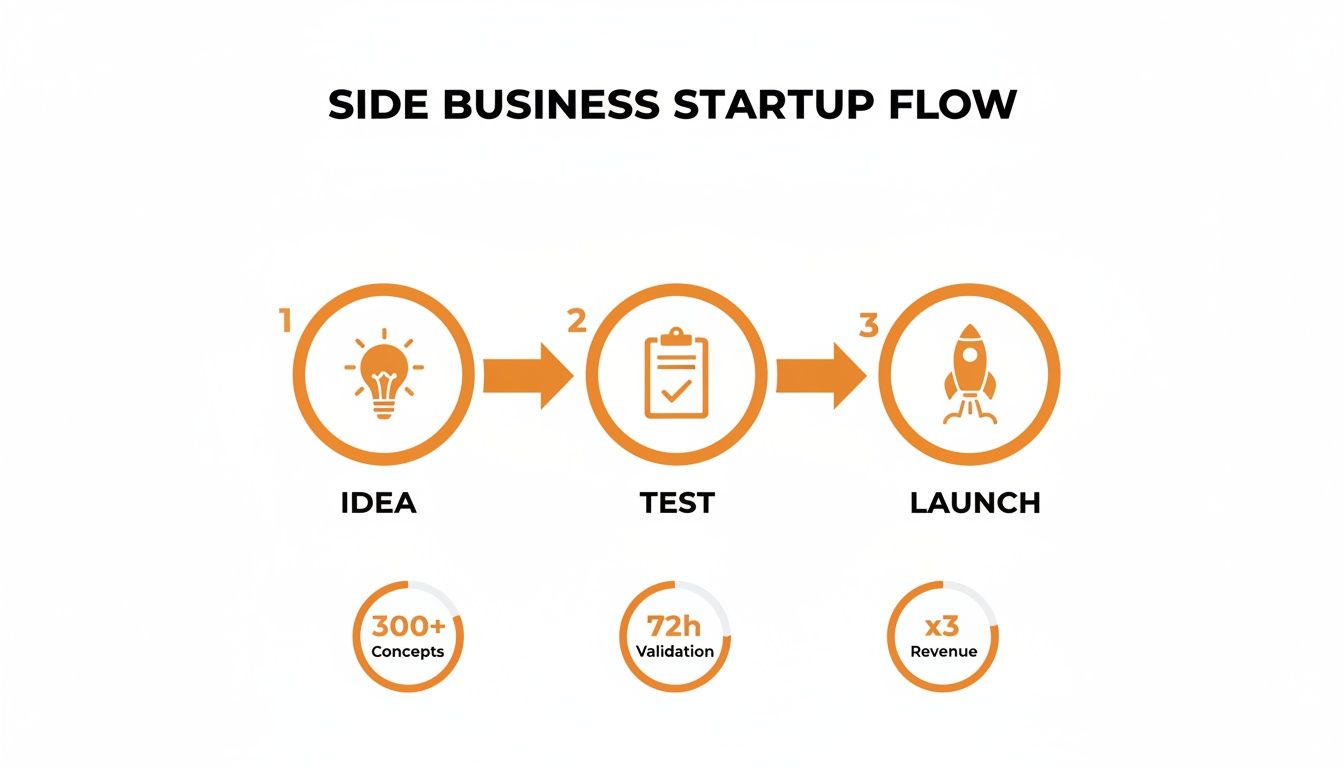
    This simple flow is key. It’s a cycle of coming up with an idea, testing it, and then launching. This is so much smarter than just building something and hoping you show up.

    An infographic showing the side business startup flow, detailing steps like Idea, Test, and Launch with associated metrics.

    This process makes it clear: testing is the critical bridge between your raw idea and a real business. It'll save you a ton of time and money.

    Running Tiny Tests to Validate Demand

    Okay, once you have a few ideas, it's time to put on your lab coat. Your job is to test your hypothesis ("People will pay me for X") with quick, cheap experiments. I’m talking about tests that cost less than a nice dinner out. The whole point is to get a clear signal from the real world—a "yes" or a "no"—before you sink any real time or cash into it.

    Here are a few of my favorite tiny tests:

    1. The Five-Conversation Test: Find five people you think are your ideal customers. But don't pitch them. Instead, ask about their struggles related to the problem you want to solve. Your job is to listen 90% of the time. If they bring up the exact problem you're trying to fix without you prompting them, you're onto something big.
    2. The $50 Ad Test: Whip up a simple landing page—just a single webpage describing what you're offering. Then, run a small social media ad campaign targeting your ideal customer. Your goal isn't to make sales; it's just to see if anyone clicks the "I'm Interested" button.
    3. The Pre-Sale Offer: This is the ultimate validation. Describe your service or product to a small audience (maybe in a relevant online group or just to your personal network) and ask for a deposit to pre-order. If someone gives you actual money for something that doesn't even exist yet, you have a winner.

    Validating an idea isn't about being right; it's about finding the truth as fast as you can. For a deeper dive into this crucial step, you can learn more about how to validate a business idea in our detailed guide. These small experiments give you the data you need to either move forward with confidence or pivot to a better idea without losing your shirt.

    Let's talk about something that trips up almost every new founder. I need you to hear this loud and clear: you absolutely do not need a finished product to make your first sale.

    In fact, building everything out before you've sold a single thing is one of the biggest, most expensive mistakes you can make. It's a fast track to wasting the two things you can't afford to lose: your time and your money.

    We're going to avoid that trap completely. This is all about creating what I call a Minimum Viable Offer (MVO). Think of it as the simplest, most direct version of your idea that someone can buy from you right now. You're essentially selling the architect's blueprint before you even break ground on the building.

    I’ve seen founders launch wildly successful companies with nothing more than a Google Doc outlining a service, a single coaching session, or a simple pre-order page. This gets you paid validation, which means cash in your pocket and priceless feedback from real, paying customers. It's how you figure out what people actually want, not just what you think they want.

    Overhead view of hands tapping a tablet showing 'SeLL The Blueprint' on a white desk.

    Service First, Product Later

    One of the smartest moves you can make is to start with a service, even if your grand vision is a physical or digital product. A service is nimble, costs almost nothing to start, and immediately puts you in conversation with the people you want to serve.

    Let’s say you want to sell gorgeous, custom-designed Canva templates for small business owners. The old way would be to spend a month cranking out dozens of templates, hoping they're what people want.

    The smart way? You start with a service.

    • Your MVO: A "Done-For-You Social Media Graphics Package." For a flat fee, you personally design a week's worth of custom graphics for one client.
    • The Payoff: You get paid right away. More importantly, by working directly with that client, you learn exactly what styles, formats, and messages they need. After doing this for just three to five clients, you'll have a mountain of real-world data to build templates you know people will buy.

    This "service-first" model works for almost anything. You want to build an online course? You start by offering one-on-one coaching. You want to build a software tool? You start by doing the task manually for a handful of clients as a concierge service.

    Selling a service is like getting paid to do market research. Your customers are literally funding your product development while telling you exactly what to build.

    Pricing Your First Offer

    Pricing can feel like pulling a number out of thin air, but it doesn't have to be. For your first MVO, your goal isn't to squeeze every last dollar of profit. It's just to get your first paying customers.

    The price just has to be high enough for people to take it seriously. I've learned people value what they pay for.

    The freelance and side hustle world is absolutely booming, proving people are more than willing to pay for expertise. The freelancing economy has exploded, with projections showing over 70 million Americans will be freelancing by 2025. And the money is there: I've seen reports of a 57% jump in freelancers earning over $100,000 since 2020. Digital-first gigs are hot, and AI-powered services have pushed rates even higher—some AI content creators now charge up to $200 per hour. You can dig into more stats about the state of freelancing on dubsado.com.

    So, you can start with a simple back-of-the-napkin calculation. Pick a fair hourly rate for yourself (even if you don't show it to the client) and estimate how long your MVO will take. Don't be afraid to set a price that feels a little uncomfortable; it often signals quality. For a deeper dive, check out our guide on how to price a new product.

    Delivering an Unforgettable Experience

    For your first few customers, your absolute mission is to over-deliver. These aren't just sales. They're the foundation of your reputation. You want to turn these early adopters into raving fans who will go out and sell for you.

    Here’s how I'd nail it:

    • Communicate Proactively: Keep them in the loop. A quick email saying, "Just wanted to let you know I've started on your project and I'm really excited about it!" works wonders.
    • Add a Small, Unexpected Bonus: If you designed a client's social graphics, toss in a matching email header for free. It costs you next to nothing but creates a massive amount of goodwill.
    • Ask for Honest Feedback: When you're done, ask them, "What was one thing you really loved, and what's one thing I could have done better?" This shows you care and gives you gold for improving your offer.

    This early stage is all about building relationships, not just a customer list. The trust you build and the lessons you learn will be infinitely more valuable than the initial cash you bring in. This is the bedrock you'll build your entire business on.

    Making Your Business Official the Simple Way

    Let's be honest, the legal and financial stuff can sound terrifying. I get it.

    Words like "entity formation" and "tax liability" are enough to make you want to ditch your laptop for a Netflix binge. But I promise, for a side hustle, this is way simpler than you think. You aren't building some complex corporate empire here; you're just putting a simple, protective fence around your new income stream.

    Let’s cut through the noise and talk about the only two options you really need to consider right now.

    Your Business Structure: A Simple Choice

    Think of your personal finances like your wallet. Everything you earn and spend comes out of that one spot. When you first start making money from your side project, you're automatically operating as a sole proprietorship.

    This is the simplest setup. The business is you. The money you make is just personal income, and you’re personally on the hook for everything. The good news? It requires zero paperwork to get started.

    The next step up is a Limited Liability Company (LLC). This is like giving your business its own separate, protected piggy bank. An LLC creates a legal wall between your personal assets (your car, your home) and your business assets. If something goes wrong—say, a client sues you—they can only go after what’s in the business's piggy bank, not your personal wallet.

    An LLC is your financial armor. You might not need it for your very first sale, but as soon as you start generating consistent income or taking on any real risk, it’s the single smartest way to protect yourself and your family.

    So, when do you pull the trigger on an LLC?

    • If your business has real risk: Are you a personal trainer? A consultant giving advice? Are you selling a physical product that could potentially break or cause harm? An LLC is non-negotiable for you.
    • When you start making real money: Once you're consistently clearing a few thousand dollars a month, the cost of an LLC (usually a few hundred bucks) is just cheap insurance.
    • If you plan to have partners: An LLC clearly defines ownership and responsibilities from day one, which will save you from massive headaches down the road.

    You don’t need to do this on day one. But keep it on your radar as your first big milestone after you’ve proven your idea actually works.

    Managing Your Money Without the Headache

    Regardless of your legal setup, you absolutely must take these three financial steps. These aren't just suggestions; they are the bedrock of running a clean, stress-free side business. Get this right, and you'll save yourself from a world of pain come tax season.

    • Open a Separate Business Bank Account: This is the most important financial move you can make. Do not mix your business income with your personal grocery money. A dedicated account creates a crystal-clear record of what’s coming in and going out. Most banks offer free business checking accounts, so you have no excuse.

    • Track Everything Simply: Forget complicated accounting software for now. A simple Google Sheet with two tabs—one for "Income" and one for "Expenses"—is all you need. Every time you get paid, log it. Every time you buy something for the business (software, shipping supplies, a course), log it. This habit takes me five minutes a week and makes tax time a complete breeze.

    • The Golden Rule: Set Aside for Taxes: When you get paid, that money isn’t all yours. The government will want its piece. A safe bet is to immediately move 30% of every single payment you receive into a separate savings account labeled "Taxes." Just do it. This way, you’re never caught off guard with a huge tax bill you can't pay.

    That’s it. Nail these three things, and you’re already ahead of 90% of new side business owners. You'll be organized, protected, and in full control of your finances.

    Getting Your First Customers (While Still Working Full-Time)

    So, you've got a job, a life, and now a side business. Trying to manage all three can feel like spinning plates. The secret isn't finding more hours in the day; it's being incredibly smart with the slivers of time you actually have.

    Forget the generic productivity hacks. You're a part-time founder, and that demands a different playbook. Your most valuable asset isn't cash—it's focused, uninterrupted time. The single best strategy I've found for this is Time Blocking.

    This is more than a to-do list. It's making non-negotiable appointments with your business. Block out specific times in your calendar—say, Tuesday and Thursday from 8 PM to 10 PM, and Saturday morning from 7 AM to 10 AM. During these blocks, you silence your phone, close every other browser tab, and dedicate your full attention to one single business task.

    Desk setup with laptop displaying a calendar with '1st' highlighted, coffee, and a calculator. Text reads 'GET FIRST CUSTOMERS'.

    From Time Blocks to Paying Customers

    Once you’ve carved out the time, what do you actually do? You hunt for your first customers. At this stage, absolutely nothing else matters. Your first sales are the hardest to get, but they provide the most crucial validation you could ever ask for.

    The good news is that the digital marketplace makes this hunt easier than ever. In the US, 52% of side hustlers use e-commerce to earn money. Freelancing is another solid path, with 21% of Americans building side businesses that way. For us here in Chicago and the Midwest, this shows you can build something local that still connects to a worldwide market. (You can dig into more of these side hustle trends on resumly.ai).

    Here are three proven methods to turn your time blocks into real revenue.

    Tap Into Your Existing Network (The Right Way)

    Your first customers are probably hiding in plain sight—in your phone contacts, LinkedIn connections, or email list. But there's a world of difference between leveraging your network and being an annoying pest. Please don't just blast a generic message asking people to buy your stuff.

    Instead, try this:

    • Identify 10 people in your network who you genuinely believe could benefit from what you offer or who might know people that could.
    • Send a personal, low-pressure message. Something like, "Hey [Name], I've started a little side project helping [your target customer] with [the problem you solve]. You came to mind because of [a specific, genuine reason]. No pressure at all, but I'd love to get your quick thoughts on it if you have a moment."
    • Ask for feedback, not a sale. This simple shift turns a sales pitch into a conversation. People love giving their opinion, and if they're actually interested, they will ask you how they can buy.

    Find Where Your Customers Already Gather

    Your ideal customers are already hanging out somewhere online. Your job is to find that digital water cooler and become a helpful, respected voice there. This could be a specific subreddit, a niche Facebook group, a professional Slack community, or even the comments section of an industry blog.

    Don't just jump in and start pitching. That’s a fast track to getting ignored or booted. For your first time block, just listen. Then, you start adding real value. Answer questions, share your expertise freely, and offer help with absolutely no strings attached.

    For instance, if you're a freelance writer for tech startups, find a group for early-stage founders. When someone asks about writing a compelling landing page, give them a detailed, actionable answer right there in the comments. After you've built that trust, people will naturally start checking out your profile and reaching out for paid work.

    Don't sell your product; solve their problem. When you consistently provide value for free, people will assume your paid work is exponentially more valuable and will seek you out.

    Build Trust Through Local Connections

    Never, ever underestimate the power of your local community, especially in a place like Chicago where we value genuine connection. While the internet gives you global reach, you can build local trust much faster.

    You could offer to run a free workshop at a local co-working space, connect with other small business owners at a neighborhood farmer's market, or join a local Meetup group related to your field. In-person interactions build a level of rapport that's tough to replicate online.

    A friend of mine who started a meal prep service got her first 20 customers by handing out free samples at her local gym. She built a loyal base of clients who trusted her because they knew her face-to-face. That local foundation gave her the momentum she needed to expand online. These strategies work best when you have a clear focus, which is why I always recommend creating a simple one-page marketing plan to keep you on track.

    Finding Your Community of Fellow Founders

    Building a side business can be a strange, lonely journey. Your coworkers at your 9-to-5 probably won't get it. Your friends might wonder why you're grinding away on a Friday night instead of grabbing drinks. It’s a classic story I hear all the time.

    That feeling of isolation is a silent killer for so many great ideas. I learned this the hard way, trying to figure everything out on my own. It felt like I was fumbling around in the dark, where every tiny setback felt like a massive failure.

    But everything shifted when I found my people.

    More Than Just Networking

    Let’s be clear: a real community isn't about collecting business cards or making transactional connections. It’s about finding a small, trusted circle where you can be brutally honest.

    It's a place to celebrate the small wins that no one else understands. More importantly, it’s where you can talk about the struggles—those moments when you’re thinking, "What on earth am I even doing?"

    Your peer group is your sanity check. They're the ones who've been where you are, who can call you out when you're making a mistake, and who can offer a specific piece of advice that saves you months of trial and error.

    This is the entire reason I started Chicago Brandstarters. I wanted to create a space for hardworking, kind people in Chicago and the Midwest to come together, share real stories, and genuinely support one another. We're not about performative positivity; we're about the honest, messy reality of building something from scratch.

    What to Look for in a Community

    Finding the right group can accelerate your growth more than any course or book. It’s like having a personal board of directors who are just as invested in your success as you are in theirs.

    When you're looking for a group, keep an eye out for these key ingredients:

    • A Culture of Giving: Is the group focused on helping each other, or is everyone just there to promote their own stuff? You want givers, not takers.
    • Real Operator Experience: Are the members actually in the trenches building businesses? Advice from someone who has actually done it is worth its weight in gold.
    • Psychological Safety: Do you feel safe enough to share your biggest fears and failures? A great community is built on trust and confidentiality.

    When you find this, hold onto it. Problem-solving becomes a team sport. The lonely moments feel less daunting. The entire journey of starting your side business becomes richer and, frankly, a lot more fun.

    Your Top Questions, Answered

    You’ve got questions. I’ve got answers—the real, honest kind, based on what I see people struggle with every single day when they're trying to get a side business off the ground. My only goal here is to give you the clarity to finally move forward.

    How Much Money Do I Really Need to Start?

    Honestly? Way less than you think.

    For a service business—think freelance writing, consulting, design work—you can genuinely get started for under $100. That usually just covers a professional domain name and an email address. You're not buying the whole building; you're just getting the key to the front door.

    If you’re selling physical products, you'll need a bit more for that first batch of inventory. But platforms like Shopify are built for starting small. The golden rule here is to prove your idea with a tiny investment before you even think about putting serious cash on the line.

    Your goal isn't to launch a perfect, fully-stocked store from day one. It's to prove one thing and one thing only: that someone out there will pay you for what you're offering. Start there. Let the revenue you bring in fund your growth.

    Should I Tell My Current Employer?

    This is a tricky one. The answer lives in your employment contract.

    Before you do anything else, you need to dig that document up and look for non-compete clauses or any policies about outside work. And this is non-negotiable: never, ever use company time or company equipment for your side business. Seriously.

    If your new venture is in a totally different field and there’s zero conflict of interest, you often don't have to say a word. But if it’s a gray area at all, spending a few bucks for a quick chat with an employment lawyer is one of the smartest investments you can make.

    When Is It Time to Quit My Day Job?

    I've seen it happen dozens of times, and there are almost always two clear signals that it’s time for you to think about going all-in.

    1. The Financial Signal: Your side hustle is consistently bringing in 75-100% of your day job's income. And I mean consistently—for at least three to six months in a row.
    2. The Mental Signal: You start to feel like your 9-to-5 is actively holding your business back. The thought of working on your own thing energizes you more than the thought of juggling both drains you.

    When both of those signals are flashing bright green, you’re ready to make the leap.


    Ready to stop figuring this all out on your own? Join Chicago Brandstarters, a free community of kind, hardworking founders in Chicago and the Midwest who are building something real. Find your people and grow your business faster at https://www.chicagobrandstarters.com.

  • The 12 Best Side Businesses to Start in 2026 (Even With a Full-Time Job)

    The 12 Best Side Businesses to Start in 2026 (Even With a Full-Time Job)

    You're here because your 9-to-5 feels like a cage. You know you can do more. That itch you feel? It's the founder’s itch, and I know it well. You have the drive, but the path from your desk to your own business seems foggy. Good news: you don’t have to leap without a net. The best side business to start is one you can build right now, in the evenings and on weekends.

    Think of this as your blueprint, not just another list. We're skipping the "follow your passion" fluff. Instead, I'm giving you a real breakdown of 12 business models, from e-commerce brands to tiny software products. For each one, I’ll tell you:

    • Startup Costs: What you’ll actually spend.
    • Time Commitment: The honest weekly hour count.
    • Revenue Potential: A realistic look at your first-year earnings.
    • Action Plans: Your exact steps for the first 30 and 90 days.

    This isn’t about dreaming; it's about building. We'll explore real paths for hardworking people like you who want to create something that matters. Let's find the business that won’t just add to your income but will make you feel alive again. It’s time to stop wondering "what if" and start building.

    1. E-commerce Brand (Shopify/Print-on-Demand)

    Launching an e-commerce brand is one of the easiest and most scalable ways to start a side business. You create a brand and sell physical products online, usually on a platform like Shopify. You don’t need a warehouse full of stuff to start. Models like print-on-demand (for shirts, mugs, posters) let you sell products without ever touching them yourself.

    A white box, folded t-shirt, blue package with a smartphone, and 'BUILD YOUR BRAND' sign on a wooden table.

    This works because you can start small, test ideas cheaply, and talk directly to your customers. Think of it like a band starting in a garage. They play for a small, passionate crowd first. You do the same. Maybe your brand becomes the go-to for sustainable pet toys or witty t-shirts for Chicago coders. The key is to find your people and serve them well.

    Actionable Tips for Success

    • Niche Down: Don't sell "coffee." Sell "organic, single-origin coffee for cold brew lovers." Being specific makes marketing way easier.
    • Build an Email List Immediately: Your email list is yours forever. Offer a small discount for a signup on day one.
    • Master Organic Social: Use TikTok and Instagram Reels to tell your story. Show your products. Be real. Do this before you spend a dime on ads.
    • Focus on the Post-Purchase Experience: A handwritten thank-you note can turn a one-time buyer into a fan for life.

    For a deeper dive, my guide on how to start an e-commerce business gives you a step-by-step roadmap. This is a great side business to start if you have a creative spark and want to build a brand people love.

    2. Content Creator/Personal Brand (YouTube, TikTok, Newsletter)

    Being a content creator means you build an audience around your expertise or personality. Instead of selling a product, you are the product. You build a community on YouTube, TikTok, or a newsletter by sharing valuable stuff. You make money later through sponsorships, affiliate links, or by launching another business to your audience.

    This is a powerful side business because your effort compounds over time with almost no startup cost. It's like planting a tree. Your first few posts or videos might feel like they do nothing. But over time, they grow into a huge asset. You could be the go-to YouTube channel for Midwest gardeners or the must-read newsletter for Chicago's tech scene. Your unique view is the whole business.

    Actionable Tips for Success

    • Pick Your Platform: Don't try to be everywhere. If you write well, start a newsletter. If you're good on camera, do YouTube or TikTok. Play to your strengths.
    • Document, Don't Create: Don't pretend to be a polished expert. Just document your journey. Share what you learn, your mistakes, and your wins. It’s authentic and builds a strong community.
    • Engage with Your First 100: Treat your first 100 followers like gold. Reply to every comment. These people will become your biggest fans.
    • Repurpose Everything: One long YouTube video can become 10 TikTok clips, five Instagram posts, and a newsletter. Work smart, not hard.

    If you want to build a real audience, this is the best side business to start. It’s a marathon, not a sprint, but the payoff is huge.

    3. Freelance Services (Design, Writing, Development, Marketing)

    If you have a skill people will pay for, freelancing is the fastest way to make side money. You offer your expertise in things like design, writing, or marketing directly to clients. You can start on sites like Upwork, but your real goal is to build direct relationships.

    A modern desk setup with a laptop, coffee, and documents, ideal for freelance work and services.

    This model works because you invest your time, not your money. You’re just selling the skills you already have. It’s like being a talented chef who starts by cooking for private parties before opening a restaurant. Your first few projects are your "tasting menu"—they prove what you can do and help you land bigger clients. The key is to stop selling hours and start selling results.

    Actionable Tips for Success

    • Specialize Ruthlessly: Don't be a generic "writer." Be a "B2B SaaS copywriter for email onboarding sequences." This focus gets you better clients and lets you charge more.
    • Build Case Studies, Not Just a Portfolio: A portfolio shows what you did. A case study shows the value you created, like "I increased their lead conversions by 35%."
    • Create Productized Services: Offer a fixed-price package, like a "$2,500 Website SEO Audit." This makes your services easy to buy and avoids endless back-and-forth.
    • Focus on Building Direct Relationships: Use platforms to get started, but aim to move clients off them. This builds long-term partnerships and avoids fees.

    For a deeper look, my guide on how to quit your job for your business shows you how to plan the leap. Freelancing is the best side business to start if you want to use your skills for fast cash and build a foundation for something bigger.

    4. Digital Product/Course Creation

    If you're an expert at something, you can package that knowledge into a digital product and sell it forever. Think online courses, e-books, or design templates. This is the ultimate "create once, sell forever" model. Platforms like Gumroad or Podia make it simple to upload your product and start selling.

    This is like writing a hit song. You do the hard work of writing and recording it once, and then it can earn you money for years while you sleep, work, or vacation. Your product could be a course on "Excel for Chicago Real Estate Analysts" or Lightroom presets for Midwest wedding photographers. You’re just solving a painful problem for a specific group of people.

    Actionable Tips for Success

    • Solve a Niche Problem: Don't create a course on "marketing." Create one on "LinkedIn Content Strategy for B2B Tech Sales Reps." Specificity sells.
    • Validate Before You Build: Pre-sell your course to see if anyone cares. Don't spend months building something nobody wants.
    • Start with a 'Tripwire' Product: Create a low-cost, high-value product like a checklist. This builds trust and makes it easier to sell your big course later.
    • Leverage Testimonials: Social proof is everything. Show off success stories from your first few customers to build credibility.

    If you have valuable skills and want a scalable, low-overhead business, creating a digital product is one of the best side business ideas to start. You build a real asset that generates passive income.

    5. Niche Affiliate Marketing (Content + Recommendations)

    Instead of making your own product, you can become the most trusted guide in a specific niche. This is affiliate marketing. You create helpful content (blog posts, YouTube videos) that solves a problem, and you earn a commission when your audience buys products you genuinely recommend. You're not a salesperson; you're a trusted advisor.

    This works because you focus on building trust, not managing inventory. Think of it like being the one friend everyone asks for movie recommendations. You've seen everything, you know their taste, and you give honest reviews. Your credibility is your most valuable asset. A Chicago blogger could become the expert on "the best running gear for the lakefront trail in winter" and earn income from those recommendations.

    Actionable Tips for Success

    • Solve Problems, Don't Push Products: Your content should answer specific questions like "What's the best podcasting mic under $100?" instead of just listing features.
    • Be Radically Transparent: Always tell people you're using affiliate links. Trust disappears the second your audience feels tricked.
    • Test Everything You Recommend: The best recommendations come from your own experience. People can spot generic advice from a mile away.
    • Create Comparison Content: "Best Of" lists and "X vs. Y" articles work incredibly well because they help people make a final decision.

    If you love teaching and helping people make smart choices, this is an excellent side business to start. It rewards your expertise and the trust you build.

    6. Local Service Business (Coaching, Consulting, Tutoring)

    You can turn your expertise into a powerful side business by selling it as a service. This means offering one-on-one coaching, consulting, or tutoring. You can work with local Chicago clients or serve people anywhere online. Your brain is the product. No inventory needed.

    This model is a rocket ship powered by your reputation. You start by solving problems for a few people, and their success becomes your marketing. Think of it like a personal trainer. They help one client get amazing results, and suddenly, everyone wants to train with them. You could be a career coach for tech professionals or a GMAT tutor for MBA hopefuls. Your value is tied to the results you deliver, making it one of the most fulfilling side businesses you can start.

    Actionable Tips for Success

    • Specialize Intensely: Don't be a generic "life coach." Be a "productivity coach for first-time founders juggling a day job." This specificity makes you a magnet for the right clients.
    • Document Every Win: Your first clients are your best marketing. Track their progress and turn their success into powerful case studies.
    • Price for Commitment: Charge premium rates. This attracts serious clients who will do the work and get results.
    • Scale to a Group Model: Once you're fully booked one-on-one, launch a group program. You can help more people and increase your income without working more hours.

    If you’re ready to turn what you know into a high-impact business, my guide on how to build a personal brand is the perfect place to start.

    7. Software as a Service (SaaS) Product

    Building a Software as a Service (SaaS) product is one of the most scalable side businesses you can start. You create a software solution for a specific problem and sell access through a recurring subscription. Think of it less like building a skyscraper and more like designing a single, perfect key that unlocks a big frustration for a small group of people.

    You don't have to be a coding genius. Many successful SaaS companies started because the founder just wanted to solve their own problem. The real power here is recurring revenue. It’s like getting paid rent every month instead of selling a house once. This creates predictable income that grows over time, making it a powerful engine for building real wealth.

    Actionable Tips for Success

    • Solve a Micro-Problem: Don't try to build the next Slack. Build a tool that helps freelance designers in Chicago manage client feedback. A narrow focus is your superpower.
    • Validate Before You Build: Use no-code tools to create a simple version first. See if people will pay for it before you write a single line of code.
    • Talk to 20+ Potential Users: Before you build anything, interview people. Understand their pain points. Ask them what they're using now.
    • Charge From Day One: Even a small price proves you're solving a real problem. Your first paying customer is a bigger deal than your first 1,000 free users.

    For more on this, check out my guide on how to start a product business. If you love solving problems with tech and want to build a business with massive potential, a SaaS product is the best side business to start.

    8. Amazon FBA (Fulfillment by Amazon) Business

    An Amazon FBA business is when you find and brand a physical product, then let Amazon handle all the storage, shipping, and customer service. You find a product people want, put your brand on it, and send it to Amazon. When someone buys it, Amazon does the rest. It's like having an e-commerce store where your warehouse is run by one of the biggest companies in the world.

    This model lets you tap into Amazon’s millions of customers and Prime shipping without needing your own warehouse. Your job is to be a smart detective. You hunt for an underserved product category, find a way to make it better, and then create the perfect Amazon listing to attract buyers. This is the best side business to start if you love market research and want to use a massive existing platform to your advantage.

    Actionable Tips for Success

    • Master Market Research: Use tools like Jungle Scout to find products with high demand but low competition. Don't guess; use data.
    • Target 40%+ Gross Margins: After all the costs and Amazon fees, you need a healthy margin to afford advertising and actually make a profit.
    • Optimize Your Product Listing: Your title, bullet points, and images are your digital storefront. Obsess over every detail to get more sales.
    • Learn Amazon PPC: Paid ads on Amazon are how you get your first sales and start ranking. Start with a small daily budget to learn the ropes.

    For a detailed walkthrough, Jungle Scout's Million Dollar Case Study is a fantastic free resource that shows you the entire process.

    9. Membership Site / Community Platform

    Building a membership community means creating a digital space where people pay a recurring fee for exclusive access to content, networking, or you. This isn't just a Facebook group. It's a private club built on platforms like Circle or Mighty Networks where members connect around a common goal.

    Think of it like building the ultimate clubhouse for a specific niche. You're not selling a one-time product; you're providing ongoing value and connection. Maybe you create a community for Chicago founders navigating their first year, or one for Midwest woodworkers to share techniques. The goal is to make the community so valuable that the members themselves become the main attraction. This is an incredible side business to start if you love connecting people.

    Actionable Tips for Success

    • Build the Audience First: Don't build a community and then look for people. Start a newsletter, podcast, or social media account to gather your future members first.
    • Start Free, Then Go Paid: Launch a free version to prove your idea. Once you have a core group of active members, introduce a paid tier with premium benefits.
    • Facilitate Member-to-Member Connections: Your job is to be the host of the party, not the center of attention. Create events and spaces that encourage members to connect with each other.
    • Charge a Price That Attracts Commitment: A low price attracts lurkers. Charge enough to ensure everyone in the room is serious about being there.

    For inspiration, look at how local groups like Chicago Brandstarters build trust. A strong community is a long-term asset that can become the core of a thriving business.

    10. Content Agency / Productized Content Services

    Starting a content agency means you turn your creative skills—writing, video, design—into a scalable business. Instead of trading hours for dollars, you create "productized" services. This means you offer fixed-scope packages with clear prices, like "Four Blog Posts Per Month for SaaS Companies." This gives you predictable revenue and your clients get clear results.

    This is one of the best side business to start because you're building a machine, not just a job for yourself. It’s like a restaurant that offers a set menu instead of a custom dish for every guest. It’s more efficient and can serve more people. You can start solo, prove your process with a few clients, and then hire other creatives to do the work while you focus on growing the business.

    Actionable Tips for Success

    • Productize One Core Offer: Don't sell everything. Start with one specific, high-value package, like a "Monthly SEO Article Pack," and master it.
    • Document Your Process: Create a step-by-step checklist for everything. This is your playbook for hiring people and keeping quality high.
    • Focus on Retainers: Prioritize clients who need ongoing monthly work. Recurring revenue is the key to stability.
    • Build Case Studies: Show the business impact of your work. Don't say "we wrote four blogs." Say "we increased their organic traffic by 40% in three months."

    This side business is perfect for you if you're a skilled creator who wants to build a real business with systems, not just another freelance gig.

    11. Reselling/Arbitrage (Thrift Flipping, Dropshipping Variation)

    Reselling is the art of buying low and selling high. You find undervalued stuff at thrift stores or online and resell it for a profit on platforms like eBay or Facebook Marketplace. This is one of the fastest ways to generate cash with very little upfront money.

    A flat lay featuring various items and a sign that reads 'THRIFT FLIPPING,' along with clothing, a phone, camera, sunglasses, and shoes.

    Think of yourself as a modern-day treasure hunter. The thrill is finding a vintage Coach bag for $10 and reselling it online for $150. You need to develop an eye for a specific niche, whether it's vintage band tees, first-edition books, or mid-century furniture. This is a fantastic side business to start if you love the hunt and have a knack for spotting hidden value.

    Actionable Tips for Success

    • Specialize in One Category: Start with what you know. If you love fashion, focus on designer denim. If you're a gamer, hunt for retro video games. Specializing helps you spot gems faster.
    • Systematize Your Process: Batch your tasks. Have a sourcing day, a photography day, and a listing day. Efficiency is how you scale.
    • Master Photography and Listings: Your photos are everything. Use good light and write detailed, keyword-rich descriptions.
    • Track Your Margins Religiously: Use a spreadsheet to track your costs, selling price, fees, and shipping for every item. Profit is the only thing that matters.

    If you want to build a brand around your finds, check out my guide on how to build a brand on social media. You can turn this hustle into a recognized name.

    12. Micro-Influencer Marketing / Brand Partnerships

    Instead of chasing millions of followers, you can build a profitable side business by becoming a trusted voice for a small, engaged audience. This is micro-influencer marketing. You build a community (usually 10k-100k followers) in a niche and partner with brands for sponsored posts and affiliate deals.

    Think of it as being the most trusted foodie friend in your group, but on a bigger scale. Brands will pay you a premium to reach your audience because your recommendation carries more weight than a celebrity's. A Chicago creator with 50,000 TikTok followers who reviews local breweries can charge more than a general influencer with 500,000 followers. You’re selling trust, not just eyeballs. This is a powerful side business because your authenticity is your greatest asset.

    Actionable Tips for Success

    • Pick a Niche with Buyers: Focus on a topic where brands already spend money, like personal finance, B2B software, or beauty.
    • Obsess Over Engagement Rate: Your engagement rate (likes, comments, shares) matters more than your follower count. It proves your audience is real.
    • Create a Media Kit: Build a simple PDF showcasing your stats and past work. This makes you look professional.
    • Pitch Brands Directly: Don't wait for brands to find you. Find companies you love and send them a pitch explaining how you can help them.

    For a great example of how you can monetize your influence, check out the tools offered by platforms like Kajabi, which helps creators build entire businesses around their audiences.

    Top 12 Side-Business Ideas Comparison

    Business Type Implementation (🔄) Resources & Efficiency (⚡) Expected Outcomes / Impact (📊) Ideal Use Cases (💡) Key Advantages / Quality (⭐)
    E-commerce Brand (Shopify / Print-on-Demand) 🔄🔄 Medium — store, branding, supply chain setup ⚡ Low–Medium capital (POD low; inventory raises costs); marketing-intensive 📊 Scalable revenue over months → years; variable margins Makers, product designers, consumer goods with brand focus ⭐ Direct brand control; omnichannel sales; passive potential after automation
    Content Creator / Personal Brand (YouTube, TikTok, Newsletter) 🔄 Low — content process + consistency required ⚡ Very low capital, high time commitment; platform-dependent efficiency 📊 Compound audience growth (6–18+ months to monetize meaningfully) Storytellers, educators, niche experts building audience-first businesses ⭐ Defensible personal moat; multiple monetization paths
    Freelance Services (Design, Writing, Dev, Marketing) 🔄🔄 Low–Medium — client workflows and delivery systems ⚡ Low capital; high time/skill; quick to start, harder to scale without team 📊 Immediate income potential; scalable via price increases or outsourcing Skilled professionals selling time/skill to clients ⭐ Fastest path to revenue; direct client feedback builds reputation
    Digital Product / Course Creation 🔄🔄🔄 Medium — course creation + funnel setup ⚡ Low capital, high upfront time; highly efficient after launch 📊 Passive, high-margin sales possible; weeks→months to first sales Subject-matter experts wanting scalable digital offerings ⭐ High margins and authority-building; evergreen revenue when marketed well
    Niche Affiliate Marketing (Content + Recommendations) 🔄🔄 Low–Medium — content + SEO/placement systems ⚡ Low capital; time to build content and audience; efficient once indexed 📊 Passive commissions from past content; 3–6+ months to traction Reviewers, niche bloggers, product-focused creators ⭐ No inventory; low operational overhead; easy to combine with other streams
    Local Service Business (Coaching, Consulting, Tutoring) 🔄 Low — direct client delivery and scheduling ⚡ Low capital, high time; premium hourly or package rates 📊 Fast revenue (days→weeks); limited scale without group products Coaches, consultants, tutors serving local/remote clients ⭐ High per-client pricing; quick validation and referrals
    SaaS Product 🔄🔄🔄🔄 High — product dev, infra, compliance ⚡ High technical & capital requirements; long build cycles 📊 Predictable, recurring revenue; large upside but months→years to product-market fit Technical founders solving repeatable workflow problems ⭐ Most scalable and defensible model; strong exit potential
    Amazon FBA (Fulfillment by Amazon) Business 🔄🔄🔄 Medium–High — sourcing, listing, PPC, inventory ops ⚡ Significant capital ($10K–$50K+); logistics efficiency via Amazon 📊 Potential high revenue quickly with right product; margins compressed by fees Private-label sellers targeting Amazon demand channels ⭐ Amazon traffic + outsourced fulfillment; proven exit markets
    Membership Site / Community Platform 🔄🔄 Medium — community design & moderation systems ⚡ Medium resources (audience or heavy upfront effort); recurring efficiency with retention 📊 Recurring revenue; high lifetime value if engagement maintained Creators/organizations with engaged followings ⭐ Strong retention via network effects; diversified monetization
    Content Agency / Productized Content Services 🔄🔄 Medium — processization, hiring, client ops ⚡ Moderate resources (team/time); scalable with documented systems 📊 Reliable retainer revenue; scales with hires and productization Freelancers scaling to agency; niche content providers ⭐ Predictable delivery; easier to delegate and grow margins
    Reselling / Arbitrage (Thrift Flipping, Dropshipping Variation) 🔄🔄 Low–Medium — sourcing, listing, fulfillment routines ⚡ Very low capital to start (<$100); labor-intensive but fast turnaround 📊 Immediate cashflow; volume-dependent scaling (weeks→months) Thrifts, flippers, bargain-sourcing entrepreneurs ⭐ Lowest barrier to entry; fastest path to cash
    Micro-Influencer / Brand Partnerships 🔄🔄 Low–Medium — content + partnership ops ⚡ Low capital; time to grow to 10K+ followers; efficient per-campaign 📊 Sponsorship revenue once engaged audience (10K–50K); variable per post Niche creators aiming for brand deals ⭐ High engagement value; premium CPMs for niche, loyal audiences

    The Hardest Step Is the First One. Let's Take It Together.

    We’ve just walked through twelve different paths. You’ve seen everything from launching a Shopify brand to building a tiny software product. Each idea has its own mix of startup costs, time, and skills.

    It's normal to feel both excited and overwhelmed right now. This is where "analysis paralysis" kicks in—that tricky state where you feel productive researching, but you never actually build anything. You might be stuck weighing the pros and cons, trying to find the one perfect, risk-free option.

    Here’s the truth: the real best side business to start isn't the one with the highest potential on paper. It’s the one you actually start.

    From Idea to Action: Your Next Move

    The journey from a 9-to-5 to a side business isn't one giant leap. It’s a series of small steps. Your goal right now is not to build an empire by next year. Your only goal is to create momentum.

    Think of it like pushing a stalled car. The first push takes the most effort. You have to overcome inertia. But once the wheels start turning, it gets much easier to keep it moving. That's what you need to do now.

    Forget about a 50-page business plan. Pick the one idea from this list that sparked something in you. Not the one your friend thinks is cool. The one you can’t stop thinking about.

    Your next action should be so small it’s almost silly:

    • Interested in E-commerce? Buy the domain name.
    • Thinking of Content Creation? Create the TikTok account.
    • Considering Freelancing? Email one person you know and tell them what you're offering.
    • Dreaming of a Digital Product? Outline the first three parts of your course.

    This isn’t about being perfect; it’s about proving to yourself that you're serious. You're turning a dream into a real project, no matter how small.

    You Don't Have to Build Alone

    Starting a business is lonely. You're working late nights, wrestling with problems none of your friends understand. The best asset you can have isn't another course. It's a community of people who are in the trenches with you. People who get the struggle of finding your first customer and the thrill of your first sale.

    You've done the hard work of exploring the ideas. You've found a path that feels right. Now, the hardest step is the first one. Go do that one small thing today.


    If you're a kind, hardworking builder in Chicago looking for a community that values collaboration over competition, then Chicago Brandstarters was built for you. We are a supportive network of founders helping each other grow from idea to seven figures, without the ego and gatekeeping of traditional networking. Join us and surround yourself with people who will help you take that first step and every one after.

    Learn more and join the community at Chicago Brandstarters