Pricing your new product feels like a mix of dark art and hard science. Nail it, and you're golden. Get it wrong, and you could cripple your launch before it even starts.
Here's the truth: you need to know your costs to stay afloat. You have to understand what customers actually value to make the price stick. And you must keep an eye on your competitors to find your sweet spot. Get these three things working together, and you’ll have a price that works.
Foundations of Smart Product Pricing

Let's be honest, pricing a new product can feel like walking a tightrope in the dark. Price it too high, and you scare off your first customers. Go too low, and you leave money on the table, signaling your product is cheap. It’s one of the biggest decisions you'll make.
But you don't have to guess. The trick is to see price not as a number you pull from thin air, but as the result of a thoughtful process. It’s built on three core ideas.
The Three Pricing Pillars
Think of pricing like a three-legged stool. If one leg is wobbly, the whole thing falls over. You need all three for a price that feels right for your customer and works for your business.
- Cost-Plus Pricing: This is your floor. It’s simple math: figure out your costs, then add a markup. It ensures you make money on every sale.
- Value-Based Pricing: This is your ceiling. It’s all about what your product is worth to the customer. What big, expensive problem does it solve for them?
- Competitor-Based Pricing: This is your reality check. Look at what similar products sell for to understand what the market expects to pay.
Each one gives you a piece of the puzzle. Cost-plus tells you the minimum you must charge to survive. Value-based shows you the maximum you could possibly charge. And competitor-based tells you where you fit in. If you're just starting, this framework is a must-have first step in figuring out how to start a product business.
To make this clearer, here’s a quick breakdown.
Three Core Pricing Strategies At-a-Glance
| Strategy | Focus | Best For |
|---|---|---|
| Cost-Plus | Your internal costs & profit margin | Ensuring every sale is profitable, especially for physical goods. |
| Value-Based | Customer's perceived value & ROI | Innovative products where the value delivered is much higher than the production cost. |
| Competitor-Based | The existing market landscape & prices | Crowded markets where you need to position yourself against known alternatives. |
Seeing them side-by-side, it’s clear why you can’t just pick one and call it a day. They each offer a totally different perspective.
Why You Can't Just Pick One
This is a classic rookie mistake. Relying on just one of these is a recipe for trouble.
If you only look at costs, you might price game-changing software at $20 when it saves a company $2,000 a month. Focus only on value, and you might set a price your ideal customer can't afford. And if you just copy your competitors? You're assuming their business is exactly like yours—same costs, same goals, same audience. It never is.
Pricing is the exchange rate you set for your value. It’s not just a number on a tag; it’s the most direct way you communicate your product's worth.
A durable pricing strategy blends these ideas. Today, this is more important than ever. Studies show that 64% of consumers are more price-sensitive now. In this climate, you need a price that's both defensible from a cost perspective and justified by real value.
A balanced approach helps you find a price that is:
- Profitable: It covers your costs and then some.
- Justifiable: You can confidently explain why it costs what it does.
- Competitive: It makes sense within your market.
Mastering this blend isn't just about picking a number; it's about building a core piece of your business strategy.
Know Your Costs Cold, Or Don't Bother Pricing
Trying to price a new product without knowing your costs is like flying blind. You might get lucky, but you’re setting yourself up for a crash. Before you can even think about profit, you need a rock-solid understanding of every dollar that goes into making and selling your product.
This isn’t just about the big expenses like materials. It’s about digging into the details. Small, forgotten costs are the silent killers that can bleed a new business dry.
COGS vs. Operating Expenses
Let's break your costs into two simple buckets. First is your Cost of Goods Sold (COGS). These are the direct costs tied to producing one unit of your product.
Imagine you're launching a line of handmade leather wallets. Your COGS would be:
- The cost of the leather.
- The thread, snaps, and zippers.
- The labor cost to assemble one wallet.
If you're building software, COGS might be server costs per user or API fees.
Everything else goes into the second bucket: Operating Expenses (OpEx). These are the fixed costs of keeping the lights on, whether you sell one unit or a thousand. Think rent, marketing, and salaries. Getting this right is fundamental. For a deeper look, check out our guide on how to start an ecommerce business.
The Magic of Unit Economics
Once you’ve sorted your costs, you can figure out your unit economics. Don't let the jargon scare you. It’s just the revenue and costs tied to one single sale. This puts your business under a microscope to see if it's healthy.
Investopedia has a great visual that nails the basic formula for unit cost.
This image shows that unit cost is your fixed and variable costs divided by total units produced. This is the foundational math for pricing a new product.
From here, you can find your break-even point. This isn't just an abstract number; it's your survival number. It tells you the exact number of wallets you must sell to cover all your costs (COGS and OpEx). Sell less, you're losing money. Sell more, you're finally profitable.
Your break-even point is your line in the sand. It turns pricing from a guessing game into a calculated decision about what your business needs to survive.
Set a Real-World Profit Margin
Survival is great, but we’re here to thrive. That’s where your target profit margin comes in. A profit margin is the percentage of revenue you keep after all costs are paid.
Don't just pull a number from thin air. Look at your industry. A solid margin for an ecommerce brand might be 30-40%, while a software company could shoot for 70-80%.
Let’s go back to our leather wallet example.
- Total Cost Per Unit: Let's say COGS are $15. You allocate $5 of OpEx to each wallet. Your total cost is $20.
- Target Profit Margin: You want a healthy 40% profit margin.
- Calculate Your Price: The formula is simple:
Price = Total Cost / (1 - Target Margin). So,$20 / (1 - 0.40)is$20 / 0.60. That gives you $33.33.
Boom. Pricing your wallet at $33.33 hits your 40% margin goal. This isn’t a guess; it’s a data-backed starting point. Now you can move forward with confidence.
Choosing the Right Pricing Model for Your Product
You've done the hard work on costs. Now for the fun part: deciding how to charge people. This choice is just as important as the price itself. It's like deciding to sell a car or lease it—the customer experience and your cash flow change completely.
How you package your price sends a huge signal about your product. Is this a one-time transaction, or are you building a long-term relationship? Your pricing model is the answer.
Before you choose a model, your costs must be dialed in. This decision tree is a great way to see that process.
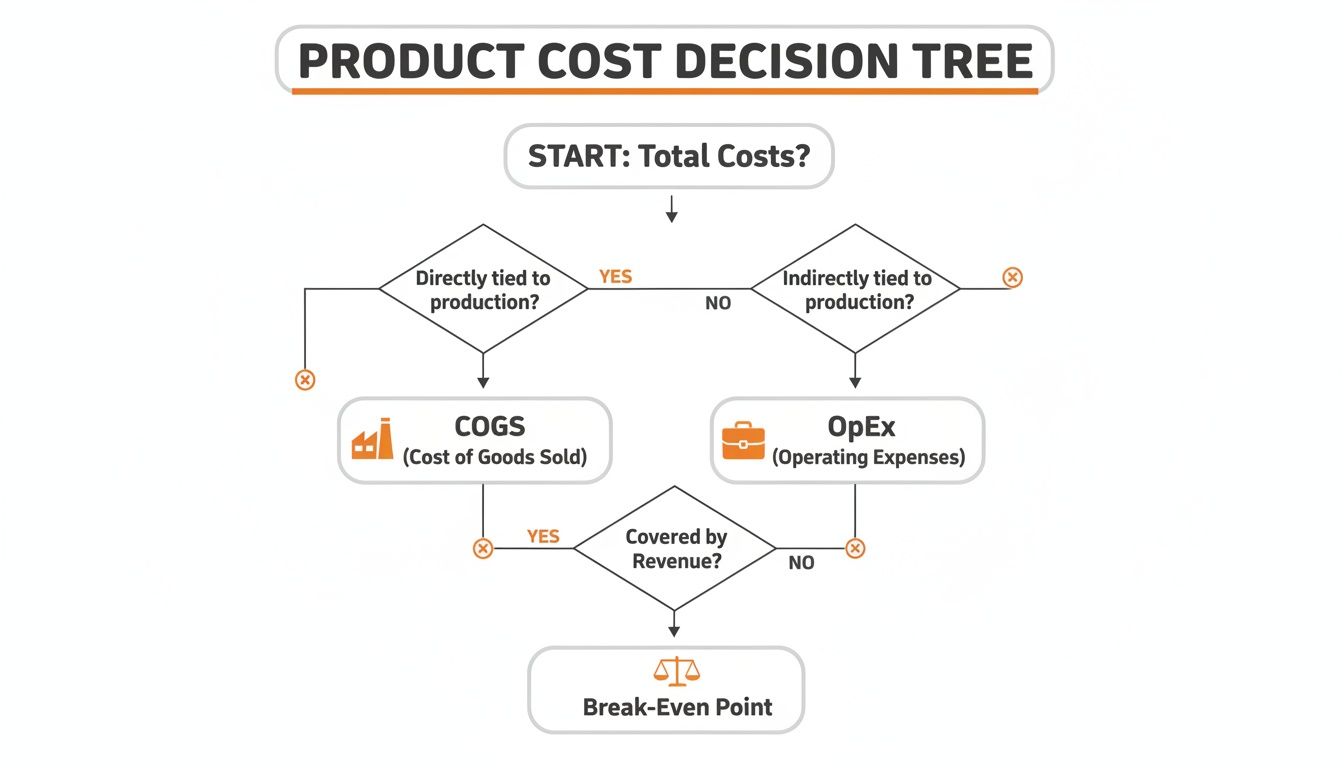
It maps the journey from total expenses to your break-even point, separating production costs (COGS) from overhead (OpEx).
The One-Time Purchase Model
This is the classic approach. A customer pays you once, they get the product, and that's it. It's simple to understand and works well for physical goods (like our wallet), digital downloads, or lifetime software licenses.
The biggest upside is immediate cash. You make a sale, you get paid. The downside? You're always hunting for new customers because there’s no recurring revenue. The pressure is always on.
The Power of Subscription Pricing
Subscriptions have taken over, especially in software, for good reason. Instead of one big upfront payment, customers pay a smaller amount regularly, usually monthly or yearly. This turns a transaction into a relationship.
Think about the sales pitch. What’s an easier sell? A $1,200 software license, or a $100 per month fee? The lower barrier to entry makes it easier for customers to say "yes." For your business, this creates predictable revenue—which is gold for forecasting and growth.
A one-time sale earns you a customer; a subscription earns you an audience. It shifts your focus from hunting for new sales to keeping current customers happy.
This model also keeps you honest. It forces you to deliver value month after month. If you don't, customers will cancel. It aligns your success with their needs.
Tiered Pricing for Different Customer Needs
You'll quickly realize that one size never fits all. This is where tiered pricing becomes your best friend. You create different packages at different price points, each offering more features, usage, or support.
It's the standard playbook for most software companies. You'll often see tiers like this:
- Basic: For individuals or small teams just starting out.
- Pro: For growing businesses that need more power.
- Enterprise: A custom solution for large organizations.
This approach is powerful because it lets you serve a wide range of customers. A tiny startup can afford your basic plan, while a Fortune 500 company pays a price that reflects the massive value they get. It lets your product grow with your customers.
For example, a new food startup could use this strategy. The USDA's food price outlook findings show that while food prices are rising, fresh vegetable prices are flat. This insight could lead them to price a new veggie-based snack defensively in a "Basic" tier to attract budget-conscious shoppers.
Ultimately, the best model aligns with how your customers use your product and the value they get over time. Don't be afraid to start simple and evolve as you learn.
How to Test and Validate Your Price Before Launch
You’ve crunched the numbers, checked the competition, and have a good gut feeling about your product's worth. That’s a great start, but it's still just a hypothesis. The real test is when you ask someone to actually pay for it.
Launching without testing your price is a huge gamble. You need to gather real-world data first. This isn't about finding a magical number. It's about collecting enough evidence to make a confident decision and reduce the risk of your launch.
Just Ask Them: The Power of a Good Survey
One of the most direct ways to start is to simply ask. Price sensitivity surveys can paint a clear picture of what people are willing to pay. The gold standard here is the Van Westendorp Price Sensitivity Meter.
Instead of a blunt "What would you pay?" it asks four specific questions:
- At what price would this be so expensive you wouldn't consider it?
- At what price would this be so cheap you'd question the quality?
- At what price would this be a bargain?
- At what price is this getting pricey, but you'd still consider it?
When you plot the answers, you find a pricing range that shows you the sweet spot. It’s a practical way to ground your theory in real human perception.
Get Early Feedback with Beta Pricing
Another great strategy is offering beta pricing. The idea is simple: you launch to a small, hand-picked group of early adopters at a serious discount. In return, you get brutally honest feedback and your first testimonials.
This is a total win-win. Your first users get a great deal and feel like insiders. You get priceless insights into how people use your product and what they truly value. Even better, you build a community of champions who are invested in your success. It's a low-stakes way to test the waters and build buzz.
Validating your price shrinks the zone of uncertainty. Every conversation, survey, and beta user adds confidence to your launch strategy.
This whole process is a core part of confirming your business concept. To see how this fits into the bigger picture, check out our full guide on how to validate a business idea.
Let the Data Decide: A/B Testing on a Landing Page
If you have an ad budget, A/B testing can be incredibly powerful. You set up two identical landing pages with just one difference: the price. Then, you drive traffic to both and see which one converts better.
You could test a $49/month plan versus a $59/month plan. What if you find the $59 price converts almost as well? Boom. You just learned you can charge more without scaring people away. This direct market feedback is priceless.
And this agility matters. The ability to actually get the price you ask for has dropped by 5 percentage points to just 43%. Why? The biggest reasons are 23% customer resistance and 22% competitive pressure. Running small tests helps you launch with a price the market has already accepted. For more details, check out the full report on global pricing strategy findings.
Time to Talk Money: How to Frame Your Price and Launch with Confidence
Okay, you've done the math. You've landed on a price that feels right. Now comes the part that makes most founders nervous: telling the world what it costs.
Let's be clear: this isn't just about putting a dollar sign on your website. It's about storytelling. How you frame your price can make the difference between a customer seeing it as an expense or as a smart investment.
You're not selling features; you're selling an outcome. Your price is the ticket to get there. If you've done the work, this part shouldn't be scary. It's your chance to show people exactly how you’ll solve their problem.
It's Not a Cost, It's an Investment
First rule: never apologize for your price. If you believe in the value you're offering, communicate that with confidence.
Think of it this way. You don't pay a great personal trainer for an hour of their time. You invest in your health and energy. Your product does the same for your customer's business or life.
So, frame your pricing page around that transformation. Ditch feature lists and focus on benefits. A project management tool doesn't just "offer Gantt charts." It "saves your team 10 hours a week on pointless meetings."
See the difference? One is a line item. The other is a clear return on investment.
People don't buy products; they buy better versions of themselves. Your pricing page should tell a clear story about how your product helps them get there.
This shift changes everything. It moves the customer's thought from "How much is this?" to "What will this do for me?" When you get that right, the price itself becomes a smaller part of the decision.
Your Pricing Page Is Your Best Salesperson
Your pricing page is one of the most critical pages on your website. It needs to be simple, persuasive, and clear. Any confusion is a guaranteed lost sale.
A great pricing page does three things:
- Explain What They Get: Spell out what’s included in each plan. No jargon.
- Make the Choice Easy: Guide people to the right plan. Highlighting a "Most Popular" option works wonders.
- Build Trust: Use testimonials, case studies, or logos of companies they recognize. This quiets the doubt in their head.
Think about who is landing on this page. A solo founder has different needs than a 50-person team. Your page should speak to each of them directly, making it obvious which path is theirs. A well-designed page makes buying feel like a no-brainer.
Handling Launch-Day Jitters and Special Offers
When you launch, get ready for questions about your price. Don't see these as objections—they're buying signals! A question means someone is seriously considering your offer. Have your value-focused answers ready, always bringing the conversation back to the problem you solve.
A great way to build early momentum is to create an introductory offer. Maybe it's a discount for the first 100 customers or an extended free trial. This creates urgency and rewards the early believers taking a chance on you. Make it feel special and time-sensitive to drive action now without cheapening your product long-term.
Wait, I Still Have a Few Questions…
You've done the hard work, but even the best plans come with a few nagging "what ifs." It's totally normal. Let's walk through some common questions founders have after setting their price.
How Often Should I Mess With My Price?
This is a big one. The honest answer? It depends.
If you raise your price a month after launch, you’ll annoy your first supporters. But if you set it once and never touch it again, you're leaving money on the table.
Pricing isn’t a "set it and forget it" task. Think of it like tuning a guitar. It might sound perfect today, but it needs small adjustments to stay in tune. Your pricing works the same way.
A good rule of thumb is to review your pricing every six to twelve months. This doesn't mean you have to change it, but it forces you to ask the right questions.
Look for these signals:
- You've added serious value. If your product is much better than it was six months ago, your price should reflect that.
- Your own costs have changed. Have your material costs gone up? Did you hire more support staff? If your unit economics have shifted, your price might need to as well.
- The market has shifted. Did a major competitor go out of business? Did a new one appear? Big market moves can create new opportunities.
Look at a company like Microsoft. They regularly update their Microsoft 365 pricing, but they don’t do it randomly. When they add new features, they announce price changes well in advance. This shows that price adjustments tied to real value are a normal part of a product’s life.
How Do I Run a Sale Without Looking Cheap?
Discounts are a powerful tool, but they're also a dangerous one. Use them too often, and you train customers to never pay full price. It cheapens your brand and hurts your margins.
The key is to make discounts feel like a special event, not business as usual.
A discount should be a celebration, not a compromise. Use it to reward loyalty or create urgency, not to apologize for your price.
Here's how to do it right:
- Tie them to a moment. Use discounts for holidays like Black Friday, your product's anniversary, or a company milestone. This gives the sale a clear reason and a clear end date.
- Reward specific people. Offer a special price to your first 100 customers, loyal subscribers, or community members. This makes them feel valued.
- Bundle instead of cutting. Instead of slashing the price of your main product, bundle it with something complementary. This keeps the perceived value of your core offer high while still creating a great deal.
What if I Get the Price Completely Wrong?
First, take a deep breath. It happens to everyone. Realizing your launch price isn't working isn't a failure—it's just new data. The worst thing you can do is panic. The best thing is to learn from it.
If your price is too high…
You'll know this quickly. Sales will be slow, and you'll get feedback like, "I love it, but I can't afford it."
The fix isn't always to lower the price. First, ask if you're communicating the value properly. Could you offer a lower-tier version? Or a monthly payment plan? Dropping the price should be your last resort.
If your price is too low…
Honestly, this is a much better problem to have. The signs are clear: you're selling out instantly, you get no pushback, or customers tell you, "I would have paid more for this!"
The solution is simple: raise the price for all new customers moving forward.
But—and this is critical—you absolutely must let your early adopters keep their original price. Always. They took a gamble on you. Rewarding that loyalty will turn them into your biggest fans for years to come.
Remember, your first price is just your best-educated guess. The market will always have the final say. Your job is to listen carefully and have the courage to adjust.
Building a brand is tough, especially when you feel like you're going it alone. At Chicago Brandstarters, we connect kind, hardworking founders in the Midwest so you can skip the guesswork and build lasting relationships with people who get it. Join our free community and find your people.