
Forget the dense, corporate sales manuals. As a founder, your first B2B sales process shouldn't be a beast. Think of it like a simple recipe for turning curious strangers into your first paying customers—and eventually, your biggest fans.
It’s a repeatable map that guides you from a promising idea to real, sustainable revenue. It transforms chaos into clarity.
Your First B2B Sales Process Blueprint
Your sales process isn't a rigid flowchart; it's a living framework. Imagine it as a bridge, designed to move a conversation from "who are you?" to "where do I sign?" with purpose. For a founder, especially here in Chicago or the Midwest where relationships are currency, this isn't just about closing deals. It's about learning, adapting, and building something that matters.
The goal is to create a predictable system that generates cash. It strips away the guesswork, giving you the confidence to sell even if "sales" has never been your title. Every step is a chance to peer into your customer's world, refine your message, and make your product indispensable.
The Five Core Stages of Founder-Led Sales
At its core, any solid B2B sales process breaks down into five fundamental stages. Each one has a distinct goal that builds on the last, creating a current that pulls a prospect forward.
This is your playbook. Run it with every new opportunity.
This visual breaks down the simple, five-step flow every founder can follow.

This flow maps the entire journey, from finding the right people to making them successful customers. It's a clear path you can follow every time.
To get a quick overview, here’s how the five core stages break down for a founder just getting started.
The Founder's B2B Sales Stages at a Glance
| Stage | Main Goal | Founder's Key Action |
|---|---|---|
| Find | Identify potential customers who fit your ideal profile. | Create a "dream 100" list of companies you want to work with. |
| Qualify | Confirm they have a real need and the ability to buy. | Ask direct questions about their current problems and budget. |
| Present | Show them exactly how your solution solves their problem. | Run a personalized demo focused only on their pain points. |
| Close | Guide them to a confident "yes" and finalize the deal. | Send a simple, clear proposal and follow up decisively. |
| Onboard | Welcome them and ensure they get their first "win" ASAP. | Personally walk them through setup and check in after week one. |
This table simplifies the entire journey, giving you a clear objective and a single, critical action for each step of the way.
Why You Can't Just "Wing It"
It’s tempting to skip documenting your process, especially when juggling a million other tasks. I get it. But an undefined process is a recipe for wasted time and lost deals. A simple, written-down approach keeps you focused and effective.
Having a process means you’re not reinventing the wheel with every new prospect. It lets you measure what’s working, fix what isn’t, and build a system that someone else can eventually run for you.
The B2B world is also changing fast. Research from Gartner predicts that by 2025, a staggering 80% of B2B sales interactions will happen on digital channels. Buyers want to do their own research, and they want to do it without talking to a salesperson.
This seismic shift makes a clear, customer-centric process more critical than ever. Your process is the backbone of your revenue goals. It’s the connective tissue between your marketing and your bottom line.
Ultimately, this is about building a machine, not just chasing individual deals.
Finding Your First Believers
Prospecting can feel like a cold numbers game. But what if you flipped the script? Instead of hunting for customers, think of it as a search for the first people who will believe in what you're building.
It’s not about casting a wide, impersonal net. It’s about finding a small, specific group of people you can genuinely help solve a painful problem.
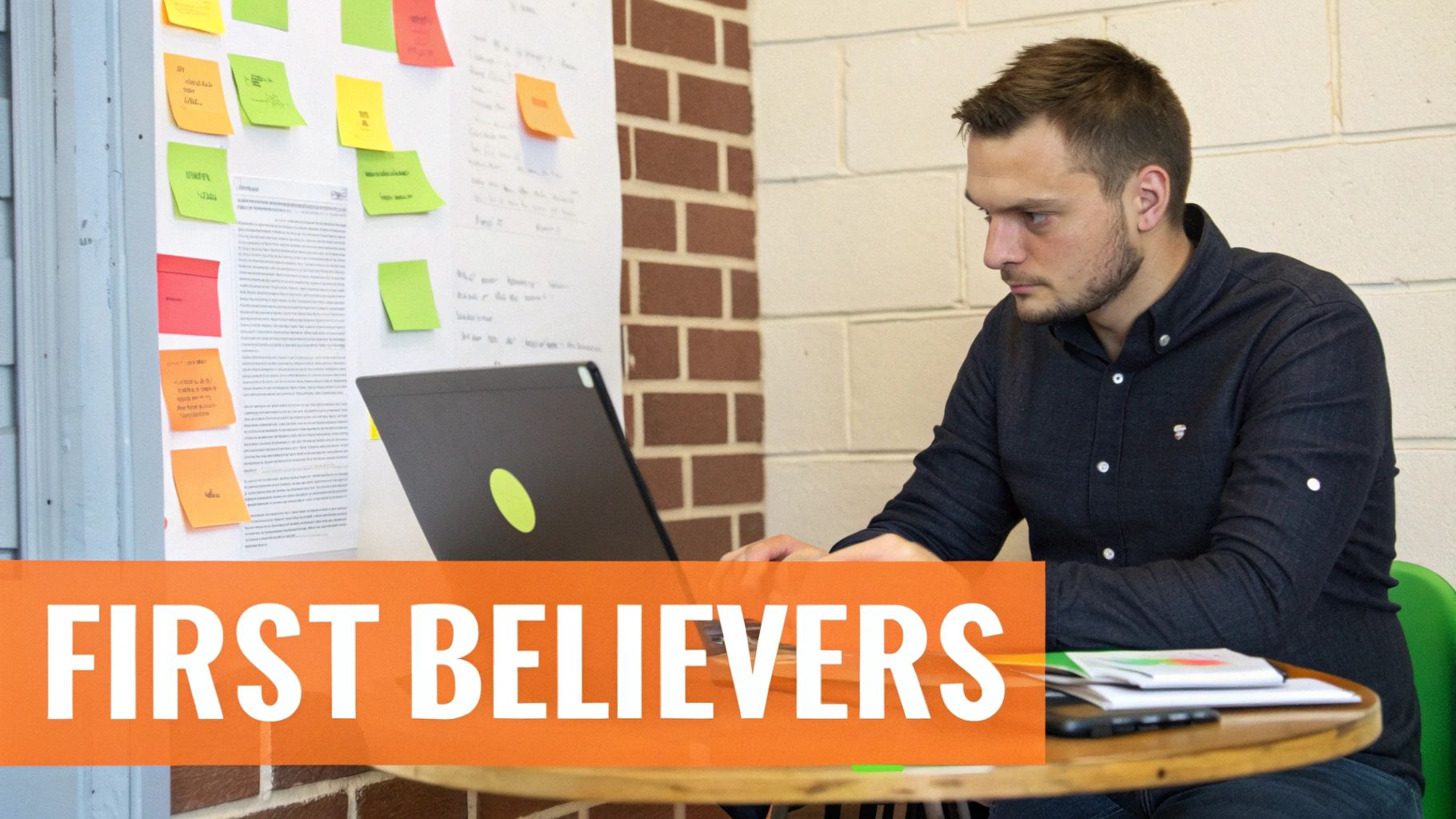
This first step in your b2b sales process is everything. You're building a highly targeted list of potential partners who are living the exact problem your product solves. Forget the expensive databases for now. Your best tools are your own curiosity and a real desire to connect with other humans.
Who Are You Actually Looking For? Defining Your ICP
Before you can find your believers, you must know who they are. This is your Ideal Customer Profile (ICP). Think of it as a ridiculously specific description of the perfect company that would get massive value from your solution.
Your ICP is a powerful filter. It stops you from burning precious energy on conversations that are dead on arrival. Don't be vague. Get granular.
Ask yourself these kinds of questions to sharpen your focus:
- What's their industry? (e.g., Midwest-based CPG food brands, not just "food companies")
- How big are they? (e.g., between 10-50 employees)
- Who specifically feels the pain? (e.g., The Director of Operations, not the CEO who is too far removed from the problem)
- What broken tools are they using now? (e.g., They’re trying to manage inventory on a mess of spreadsheets)
This isn’t a theoretical exercise you do once and forget. Your ICP is the compass for your entire outreach strategy. It ensures every email is aimed at someone you can truly serve. If you're still fuzzy on this, our guide on how to validate a business idea will help you get clarity by gathering crucial early feedback.
Building Your "Dream 25" List
Once you’ve nailed your ICP, fight the urge to build a list of hundreds. Start small. I mean really small. Create a "Dream 25" list—a hyper-focused group of companies that are a perfect match.
This forces you to choose quality over quantity. Finding them is simpler than you think:
- LinkedIn Sales Navigator: Use its advanced filters to zero in on the exact companies and job titles from your ICP.
- Industry Associations: Look up the member directories for local chapters in Chicago or the greater Midwest.
- Local Business Journals: Publications like Crain's Chicago Business are goldmines for finding growing companies that fit your profile.
Your goal isn't just to get their names. It's to know these 25 companies inside and out. Who are the key players? What are they talking about on LinkedIn? This deep research is the secret sauce for writing outreach that people actually reply to.
The Give Before You Ask Method
Okay, you have your list. Time to reach out. But please, don't just ask for a meeting. The single most effective way for a founder to build trust is what I call the "Give Before You Ask" method. You lead with value, not a sales pitch.
Your first touchpoint should never be an ask for their time. It should be a genuine offer of help, an interesting insight, or a valuable connection. You're building a relationship, not just trying to book a demo.
Let's say your prospect is that Director of Operations at a CPG company. A LinkedIn message could look like this:
"Hi [Name], I saw your post about supply chain headaches. I just read a great article on how some local CPG brands are using [specific tactic] to improve inventory turnover and thought you'd find it useful. No pitch, just wanted to share."
This simple act builds goodwill. It shows you've done your homework and are genuinely curious about their world, not just your own quota. This human-centric approach is the heart of a solid b2b sales process.
And yes, tools can make this smarter. Sales teams using AI for prospecting have seen incredible results—cutting call time by up to 60% and boosting revenue by 50%. Even simple tools can help a lean startup identify who to focus on, freeing you up to do the human work of building real relationships.
Finding your first believers is the art of turning a thoughtful search into a meaningful conversation.
Nailing the First Conversation and Demo
You did the hard work and got the meeting. Awesome. Now, the biggest temptation is to jump in and show them every single bell and whistle you've spent months building.
Fight that urge. Seriously.
The point of this first real conversation isn't to present; it's to connect. They agreed to talk because they have a problem. Your only job is to understand that problem better than anyone else, then show them a glimmer of a better way.
The best demos are collaborative sessions. Think of it as a working meeting, not a performance.

This moment is a massive pivot in the B2B sales process. You're switching hats from investigator to guide, and their pain points are the only map you need.
Frame the Demo Around Their Problem
Your product is like a key. A key is useless until you find the lock it opens. So your first job on the demo call is to find their specific lock—the painful, frustrating thing they're desperate to fix.
Forget the generic slide deck. Start by restating what you think you know about their challenges. Then, be quiet and listen.
You need to ask open-ended questions that get them to tell you the real story.
Questions that get to the heart of it:
- "Can you walk me through what happens today when you try to [do the thing your product helps with]? What does that actually look like?"
- "What's the most frustrating piece of that whole process?"
- "If you had a magic wand and could fix one thing about that workflow, what would it be?"
Their answers are gold. You’re not just collecting data; you're hearing the exact words you need to frame your solution. This is how you build trust. It shows you're not just another vendor pitching a product. You're a partner who gets it.
A Simple Three-Act Demo Structure
Once you have a rock-solid grasp of their pain, you can guide them to the solution. Don't show them everything. Just show what's relevant to the exact problem they just described.
A truly effective demo follows a simple, three-act structure. It keeps the conversation tight and helps the prospect arrive at their own conclusion: that your solution is the one they need.
The Three-Act Demo
| Act | Goal | Your Key Action |
|---|---|---|
| Act 1: Confirm the Pain | Make them feel deeply understood. | Summarize their problem in their own words. Ask, "Did I get that right?" before you show a single screen. |
| Act 2: Reveal the 'Aha!' Moment | Show them the one feature that kills their biggest pain point. | Jump straight to the most relevant part of your product. Say, "Okay, based on what you just said, let me show you how you can solve that." |
| Act 3: Map the Path Forward | Connect your solution to a real business outcome. | Show the result (a report, saved time, etc.) and ask, "How would having this change things for you?" |
This structure turns a boring feature tour into a story where they are the hero. Your product is just the tool that helps them win.
Reading the Room on a Video Call
It’s tough to gauge reactions when you're not physically in the room. But even over video, the clues are there if you look for them. Pay attention to the "digital body language."
Are they leaning in, or are their eyes darting around? Did they just unmute to jump in, or are they quietly checking email? These signals tell you when to slow down, speed up, or ask a question.
The most important skill in a demo isn't talking; it's noticing. Pause more than you think you need to. Ask, "Does that make sense?" or "Is this what you were hoping to see?" Give them space to react.
When you see them get visibly excited about a feature, that's your cue to dig in. If they look confused, don't just power through. Stop. Say, "I feel like I went a bit fast there. What questions do you have?"
This empathetic approach shows you care more about them understanding than you do about finishing your pitch. Especially in the Chicago and Midwest business world, this authentic, human-first interaction is what builds relationships that last. You want them to leave feeling heard and excited, not just "informed."
Navigating from Interest to a Closed Deal
That amazing demo call is over. They loved it. You feel the momentum. But this next phase—the journey from "wow, that's cool" to a signed contract—is where many early deals go to die a slow, silent death.
Closing isn't about high-pressure tactics. It's about creating clarity and removing friction. You're not forcing a decision; you're guiding them to a confident "yes" by making it the easiest, most logical next step.
Think of yourself as a guide leading a hiker through a tricky patch of trail. Your job is to point out the clear path, reinforce their confidence, and help them navigate any obstacles.
The One-Page Proposal
Forget the 30-page, jargon-filled proposals from big corporations. As a founder, your proposal should be a simple, one-page document that reinforces the value you just demonstrated. Its only job is to make signing up feel like a victory for them.
It acts as a summary and a clear call to action, arming your champion with everything they need to get internal buy-in.
Your one-page proposal should have just three parts:
- The Problem We're Solving: In their own words, restate the core pain point. (e.g., "Managing your CPG inventory with messy spreadsheets is costing you 10+ hours a week and leading to stockouts.")
- The Agreed-Upon Solution: Clearly outline what you're providing and the specific outcome. (e.g., "Our platform will centralize your inventory, cut down on manual data entry, and give you real-time stock alerts.")
- Simple Next Steps: List the price, terms, and a crystal-clear path to getting started. (e.g., "Investment: $500/month. To begin, just sign below and we'll schedule our kickoff call for next week.")
This isn't just a document; it's a momentum-keeper. It makes the decision feel small and manageable, not big and scary.
Handling Objections with Empathy
Sooner or later, you'll hear it: "It costs too much," or "Now isn't the right time." Don't panic. An objection isn't a "no." It's a request for more information or reassurance.
The worst thing you can do is get defensive. The best thing you can do is get curious.
When a prospect raises an objection, they're giving you a gift. They're telling you exactly what's standing in the way of a "yes." Your job is to listen, understand, and help them see the value in a new light.
For example, if they say, "It's a bit more than we budgeted," try this approach:
- Acknowledge and Validate: "I completely understand. It's smart to be careful with your budget."
- Isolate the Real Issue: "Just so I'm clear, if the price were a perfect fit, is this the solution you'd want to move forward with?"
- Reframe the Value: "I hear you. Could we quickly revisit the 10 hours a week you mentioned your team is losing to manual work? What's the cost of that inefficiency over a few months?"
By connecting the price directly back to the pain, you shift the conversation from cost to investment. If pricing is a consistent hurdle, it might be a signal to revisit your strategy; our guide on how to price a new product can help you think through that challenge.
The Helpful Follow-Up Cadence
This is where patience becomes your superpower. The average B2B sales cycle is now 4-8 months and often requires approval from 6-10 decision-makers. It also takes an average of 8 touches just to get an initial meeting.
Giving up after one or two follow-ups is like planting a seed and walking away before it sprouts.
The key is to follow up without being annoying. Every touchpoint should offer new value, not just ask for an update.
A Value-First Follow-Up Cadence
| Touchpoint | Timing | Message Focus |
|---|---|---|
| Email 1 | 2 days post-proposal | Send a link to a relevant case study or blog post. "Hi [Name], thought you might find this story about how a similar company solved [their problem] interesting. No reply needed!" |
| Email 2 | 1 week post-proposal | Offer a small piece of advice or a helpful resource. "Hi [Name], I remembered you mentioned [a specific challenge]. Here's a quick video that explains a neat trick for that. Hope it helps!" |
| Email 3 | 2 weeks post-proposal | The direct check-in. "Hi [Name], just wanted to gently follow up on the proposal. Is there any new information I can provide to help with your decision?" |
This approach positions you as a helpful expert, not a desperate salesperson. You're building trust with every interaction, leading the dance and gently guiding them toward a confident, enthusiastic "yes."
Welcoming Your New Customer Aboard
The signed contract isn't the finish line. It's the starting gun. Seriously. The work you do in the first few weeks sets the tone for the entire relationship. This is where you turn a transaction into a loyal partnership.
Your job title just changed. You're no longer "salesperson"—you're their "success guide." The goal is simple but critical: help your new customer get their first big win with your product as fast as humanly possible. That early success is the bedrock of a lasting relationship.

This jump from closing a deal to delivering on its promise is the final, crucial stage of the b2b sales process.
The Seamless Handoff From Sales to Success
Even if you're a one-person show, you need to mentally switch hats. The handoff from your "sales" self to your "support" self has to feel seamless to the customer. They should never feel passed off. Instead, they should feel like the person who deeply understood their problems is now the one personally guiding them to the solution.
This is about keeping momentum going and delivering an experience that blows their expectations out of the water. It’s a powerful way to kill buyer's remorse and build immediate trust.
Your Kickoff Call Checklist
The kickoff call is your first official meeting as partners. This is not another demo; it's an alignment session. You're there to confirm their goals, set clear expectations, and map out the first 30 days.
Keep the agenda simple but effective:
- Reconfirm Goals: Kick things off with, "Just to make sure we're on the same page, the main goal we're solving for is [restate their primary pain point]. Is that still the number one priority?"
- Define Success: Then ask, "What does a successful first month look like to you? What one thing needs to happen for you to feel like this was a great decision?"
- Map Next Steps: Be crystal clear about what happens next. "Okay, so the next steps are: I'll get your account set up, and you'll send over the data we discussed. We'll plan to check in next Tuesday to review progress."
This call gets everyone rowing in the same direction and sets the stage for everything that comes next.
The 30-Day Check-in Cadence
Don't wait for your new customer to run into trouble. Proactive check-ins show you're invested in their success. A simple schedule keeps you top of mind and lets you spot potential issues before they blow up.
The post-sale experience is where you earn the right to future business—renewals, upsells, and especially referrals. It's a massive investment, not a cost. Acquiring a new customer is 5 to 25 times more expensive than keeping an existing one, and a tiny 5% increase in retention can boost profits by a staggering 75%. You can dig into more of this data from research by Bain & Company.
A simple follow-up schedule reinforces your commitment:
- Day 3 Check-in: A quick email asking, "Any initial questions as you're getting started?"
- Week 1 Check-in: A brief call to review how things are going and tackle any early roadblocks.
- Week 4 "Win" Review: A scheduled meeting to review their progress against the goals you both set in the kickoff call.
This structured communication ensures your customer feels supported, heard, and on a clear path to getting the value they paid for. It's the final—and perhaps most important—step in building a business that lasts.
Common Sales Mistakes Founders Make
Look, every founder will stumble on their sales journey. That’s part of the game. The smart ones learn from those stumbles quickly and just keep moving.
Think of this section as a friendly heads-up on the most common traps—advice from someone who’s already stepped on all the landmines for you. This isn’t about perfection. It’s about building resilience and constantly dialing in your B2B sales process.
Selling to Everyone, Helping No One
The first mistake is the most tempting: trying to be everything to everyone. When you're just starting out, any flicker of interest feels like a win, so you chase it. The problem is, casting a wide net means your message becomes so generic it connects with nobody.
It's like trying to cook a masterpiece with every ingredient in the kitchen. You don't get a gourmet dish; you get a confusing mess. Your goal isn't to find any customer. It's to find the right customer whose problem you can solve spectacularly well. A laser-focused approach is always more powerful.
Talking More Than You Listen
You’re passionate about what you’ve built. It’s natural to want to show off every feature. But a sales conversation isn't a monologue; it's a diagnostic session. The prospect’s pain points should be the star of the show, not your product.
When you talk more than you listen, you tell the prospect that your agenda is more important than their problem.
You have two ears and one mouth for a reason. Use them in that proportion. The best insights—the ones that unlock deals—come straight from the prospect’s own words. Let them talk, and they’ll tell you exactly how to sell to them.
Obsessing Over the Perfect CRM
It’s easy to get lost in sales technology. You can burn days comparing CRMs and setting up complex automations. This is a classic form of productive procrastination. It feels like you’re working on sales, but you’re really avoiding the hard, human work of actually talking to potential customers.
Don’t get bogged down. In the early days, a simple spreadsheet is more than enough. The time lost to admin tasks is a real threat. It's shocking, but salespeople spend only about one-third of their day actually talking to prospects. They spend a massive 21% writing emails and another 17% on data entry. Your time is your most valuable asset—don't let it get eaten by busywork. You can find out more about how founders can optimize their sales time on trykondo.com.
The right tool won’t save a broken process. Focus on mastering the conversations first, then find a tool that supports what already works.
Burning Questions About Your First Sales Process
Let's tackle the big questions that pop up for every founder trying to build a B2B sales motion from the ground up. These are the things that keep you up at night.
When Is It Time to Hire My First Salesperson?
This is the big one, and I see founders get it wrong all the time. The answer is simple: you should only hire your first salesperson after you, the founder, have personally sold the product over and over again.
You have to be the first one in the trenches.
This isn't just about saving cash. It's about getting your hands dirty so you can genuinely understand what your customers are struggling with, what language resonates, and what objections pop up. A new hire can't sell a product you haven't figured out how to sell yourself.
You need to hand them a map, not ask them to find buried treasure with no clues. Once you have a clear, documented process that consistently closes deals, that’s your signal. That's when you hire someone to run with your proven system.
How Do I Know If My Sales Process Is Actually Working?
Think of your sales process like a recipe. You know it’s working when you follow the steps and reliably get the same result—a closed deal. The magic word here is predictability.
Can you confidently move a qualified prospect from one stage to the next without it feeling like a roll of the dice?
Start looking at your conversion rates between stages. What percentage of your demos turn into proposals? If that number is consistent (and hopefully, improving), your process has integrity. It’s not just a string of happy accidents.
A working sales process isn't just about closing deals. It's about knowing why you're closing them. When it becomes a predictable engine instead of a series of lucky breaks, you know you're on the right track.
At Chicago Brandstarters, we believe in building these engines together, surrounded by peers who get the founder journey. Join our free community of kind, bold builders who share real war stories and tactics to help you grow. Learn more and apply here.