
Tag: entrepreneurship

  • What Is Entrepreneurial Mindset: A Guide for Builders and Doers

    What Is Entrepreneurial Mindset: A Guide for Builders and Doers

    Let's cut the jargon. The entrepreneurial mindset isn't some magic trait you're born with. It's a way of seeing the world—a lens that helps you turn problems into opportunities.

    Think of it like being a chef versus a line cook. A line cook follows the recipe. A chef sees a handful of ingredients and imagines a new dish. That's the mindset in action. It’s about creating, not just executing.

    So, What Is the Entrepreneurial Mindset?

    At its core, the entrepreneurial mindset is about viewing challenges as puzzles and resources as possibilities, not limits. You don't need to be launching a company to have it. I've met incredible artists, project managers, and teachers who live and breathe this way.

    You toss out the "I can't because…" excuse. You replace it with a single, powerful question: "How could I…?"

    This shift changes everything. It puts you in the driver's seat of your own life. You start looking for ways to add value, fix what's broken, or build something new. It’s a skill you can develop, no matter where you are. This isn't just for tech founders; it's for anyone who wants to take control and make an impact.

    The Three Pillars of the Mindset

    To make this real, I break the mindset down into three pillars. They aren't separate traits. They feed each other.

    • Resourcefulness: Your superpower for making something from nothing. You find clever, scrappy ways to hit your goals without waiting for the perfect team, budget, or timing.
    • Resilience: You will get knocked down. That's a guarantee. Resilience is the muscle that gets you back up, forces you to learn from the hit, and helps you try again without losing your fire.
    • Bias for Action: Ideas are worthless without execution. This is your commitment to doing over endless planning. You make smart, quick decisions and just get moving, even when you don't have all the answers.

    The entrepreneurial mindset is less about what you have and more about what you do with it. It’s the engine that turns scarcity into opportunity.

    This diagram shows you how these pillars work together.

    Diagram illustrating the entrepreneurial mindset, featuring resourcefulness, resilience, and action as core components.

    As you see, resourcefulness, resilience, and a bias for action are interconnected. They support the mindset at the core.

    The Seven Core Traits of a Powerful Founder Mindset

    Flat lay of office supplies, including a 'FOUNDER TRAITS' sign, compass, notebook, and plant, on a white desk.

    Okay, theory's done. Let's look at what the entrepreneurial mindset looks like in the real world.

    These seven core traits aren't gifts from the universe. They’re muscles. You can build them. I can build them. Anyone can.

    • Resilience: You get knocked down and bounce back smarter.
    • Adaptability: You know when to pivot because the world just changed under your feet.
    • Resourcefulness: You can MacGyver a solution when you have no budget.
    • Decisiveness: You make the tough call, even with only half the information.
    • Deep Curiosity: You keep asking "why not?" until you find a new angle.
    • Customer Obsession: You have a laser focus on solving a real problem for a real person.
    • Radical Ownership: You take credit for the wins and the mistakes.

    “Bold action and tough lessons go hand in hand. Growth lives in that overlap.”

    That's the preview. Now, let’s dig into each one with real stories.

    Resilience in Action

    Resilience is what you do after getting punched in the mouth.

    I watched a founder I know lose a $50k launch because her vendor completely failed her. A total disaster.

    Instead of quitting, she grabbed a journal. She documented every single thing that went wrong.

    She rebuilt her supply chain and re-launched in just three weeks. That second launch broke even, then made a small profit. Her secret? She treated the failure as expensive data, not a stop sign.

    Adaptability When Plans Change

    Pivoting fast can be the one thing that saves your business from hitting zero.

    I remember a guy who built an app for fitness junkies. It was a ghost town. No one used it.

    But he noticed that the few people who did sign up kept posting pictures of their meals.

    He made a few tweaks, rebranded the app as a recipe-sharing community, and boom. Within a few months, engagement shot up 120%. You have to listen to the market, not just your original script.

    Resourcefulness on a Shoestring

    When your bank account is empty, your creativity has to fill the gap.

    I knew this solo founder who needed a prototype but had zero capital. None.

    So, she borrowed her roommate's 3D printer. She spent a weekend on YouTube teaching herself the basics of CAD.

    That scrappy, rough prototype was enough to land her first pitch meeting with a local investor. Sometimes, your best resources are sitting right in front of you.

    Decisiveness with Imperfect Data

    If you wait for perfect information, you'll wait forever. Your idea will die.

    I was following an e-commerce startup that saw its ad performance suddenly tank by 30%.

    Instead of getting stuck in "analysis paralysis," the founder made a quick call. She killed the worst-performing ad and dumped the entire budget into the best one.

    Sales recovered in 48 hours. Decisiveness isn't about being right 100% of the time. It's about moving fast with confidence.

    • Find your most important data point.
    • Set a clear trigger for action.
    • Pull the trigger and measure what happens.

    Deep Curiosity Unleashed

    Curiosity is where all the good ideas come from.

    I know a designer who treats every coffee meeting like a secret research mission. She sketches ideas on napkins and asks total strangers for brutally honest feedback.

    This little habit turned into a side hustle selling artisan mug designs. It now brings her an extra $3k a month. You have to challenge every assumption. A good rule of thumb is to ask "What if?" at least three times.

    Customer Obsession Wins

    Being obsessed with your customers means you go way beyond just sending a survey.

    I once sat down and interviewed twenty of my users, one-on-one, just to hear them complain. I recorded everything.

    Buried in those transcripts, I found a feature idea none of our competitors were even thinking about. We built it. Our product's retention rate jumped from 25% to a staggering 67%. Your biggest opportunities are hiding in your customers' frustrations.

    Radical Ownership and Accountability

    Taking full ownership means the blame game stops with you. Period.

    A co-founder I worked with totally missed a deadline for a critical pitch deck.

    Instead of making excuses, he told our team immediately, re-shuffled everyone's priorities, and stayed late to get it done. That transparency built a ton of trust. And that pitch? It landed us a $250k seed round.

    When you own your mistakes, you also own the power to fix them. You can read more about this in our article on vulnerability in leadership practices.

    Practicing these traits is like training for a marathon. You build one muscle at a time. Eventually, they all work together.

    I want you to try keeping a simple journal. Each week, reflect on how you handled a setback, made a quick decision, or listened to a customer. This simple act of reflection is what strengthens your confidence and adaptability.

    Over time, those small insights stack up and lead to massive breakthroughs.

    Your community is your secret weapon here.

    At a Chicago Brandstarters dinner, you see these traits in action everywhere. Our members share their war stories, trade real-world tactics, and keep each other on track.

    You never have to build this thing alone.

    If you feel like you’re on an island with your big ideas, I get it. The late nights, the constant puzzle-solving, the feeling that nobody really gets what you’re trying to build—it can feel incredibly lonely.

    But here’s the truth: you are not alone. Not even close.

    That ambition buzzing inside you isn't a weird quirk. It’s a signal that you’re part of a massive, global movement of builders and doers who see the world not for what it is, but for what it could be.

    You're in Good Company—Globally

    Let's ground this in reality. That entrepreneurial itch is now a major force in the global economy. As of 2024, there are over 600 million of us worldwide.

    That’s a huge jump from 582 million just four years ago. That means entrepreneurs make up more than 8% of the world's population. What's crazier? A recent survey found 60% of people want to start their own business. If you want to dive deeper, you can explore more entrepreneurship statistics on whop.com.

    So, that drive you feel? It's not just valid; it's shared by millions. Even on the days it feels like you against the world, you're part of something much bigger.

    The drive to build, create, and solve is a fundamental human instinct. Your entrepreneurial spirit doesn't make you an outsider; it makes you part of a global tribe.

    The Real Reason You Want to Be Your Own Boss

    So, what’s really fueling this? It's not always about chasing billions or getting on a magazine cover. When you actually talk to founders and dig into the data, one motivation stands out above all the rest.

    The number one driver for entrepreneurs is the desire for autonomy.

    It’s that deep, unshakable need to be your own boss. To call the shots. To have direct control over your own destiny. You want to build a life on your own terms, where your hard work translates into your own success, not just a line item on someone else’s balance sheet.

    Think of it as being the captain of your own ship instead of just a passenger. As a passenger, you go where the ship is headed. As the captain? You set the course. You face the storms, sure, but you also get to discover new islands.

    This desire for autonomy connects a software founder in Chicago with a shop owner in Tokyo. It's the core of what makes this mindset so powerful. You're not just chasing an idea; you're claiming ownership over your life and your work. Your journey might feel unique, but you're on a path walked by millions who, just like you, wanted to hold the map.

    How to Tackle the Biggest Mindset Killer: Fear of Failure

    A student with glasses writes on documents at a table with components and a 'Fail Forward' sign.

    Alright, let's talk about the elephant in the room: fear. It’s the invisible anchor holding back countless brilliant ideas. Forget ego or a lack of capital for a second. The fear of falling flat on your face is the #1 reason incredible ventures die before they start.

    If you feel it, you’re normal. This fear is a universal part of the journey. Every founder I know has to learn how to clear this hurdle. The crucial first step? Stop pretending it doesn't exist.

    When you acknowledge your fear, you rob it of its power. Once you name it, you can start to dismantle it.

    From Endpoint to Data Point

    The single biggest mental shift you can make is to reframe what "failure" even means. We're trained to see it as a final verdict on our idea, our skills, and our worth.

    But what if you treated it like a scientist running an experiment? A scientist doesn't see a failed experiment as a personal flaw. Not at all. They see a data point. It's just valuable information telling them what not to do next time, inching them closer to a breakthrough.

    This is exactly how you need to approach your work. A product launch that flops isn't an endpoint; it's market feedback. A pitch meeting that goes nowhere isn't a rejection; it's a lesson in how to tighten your story.

    This perspective flips fear into curiosity. Instead of worrying, “What if I fail?” you start asking, “What will I learn?”

    This shift is everything for building a resilient mindset. Every "failure" becomes tuition you pay for your own real-world MBA. Your setbacks don't define you. Your ability to pull lessons from them and get back in the game does.

    The Rising Tide of Fear

    And listen, it's not just in your head—this fear is a growing global challenge. According to a massive study by the Global Entrepreneurship Monitor, the number of people who see great opportunities but are frozen by fear is on the rise.

    That figure jumped from 44% in 2019 to a staggering 49% in 2024. Think about it. Nearly half of all potential founders globally let fear stop them before they even start. You can dive into the latest findings on global entrepreneurship to see the full picture.

    Your fear of failure is real. It’s also a shared experience. The most successful founders aren't fearless; they just act despite the fear.

    Fail Small, Learn Fast

    So, how do you actually practice this? You start small. You don’t bet the farm on one massive launch. Instead, you create a series of small, low-stakes experiments.

    • Test one marketing channel with a tiny budget before you go all-in.
    • Build a simple landing page to gauge interest before you write a single line of code.
    • Sell your product to ten friends before ordering a thousand units from a factory.

    Each of these is a chance to fail small. If an experiment doesn't work, the damage is minimal. You lose a little time, maybe a few bucks, but you gain a mountain of priceless data.

    This approach of failing forward, in small steps, is the perfect antidote to analysis paralysis. It builds your resilience muscle and proves to you, over and over, that you can survive the bumps in the road.

    This is where a community like Chicago Brandstarters becomes your greatest asset. It’s a safe space to share these small experiments—the wins and the losses. When you're surrounded by peers who get it, you realize stumbling is just part of the process. You get tactical advice, honest feedback, and the encouragement you need to dust yourself off and run the next experiment. You learn to fail forward, together.

    Why the Modern Entrepreneurial Mindset Is Smart, Not Reckless

    Let's kill a myth right now.

    That image of the wild-eyed founder betting the company on a gut-wrenching whim? That’s mostly Hollywood fiction. Forget the reckless gambler stereotype.

    The modern entrepreneurial mindset, especially as we head into 2026, is defined by something far more powerful: smart, calculated risk.

    It’s about being a chess master, not a poker player. You're not hoping for a lucky hand; you're thinking three moves ahead, anticipating challenges, and making deliberate decisions to maximize your chances of a long-term win.

    Optimism Grounded in Realism

    This new approach blends bold optimism with sharp, clear-eyed realism. Today’s best founders are incredibly confident, but they aren’t naive. They build contingency plans. They obsess over their cash flow. They know that sustainable, profitable growth is infinitely more valuable than a flashy headline about a massive valuation.

    This isn’t about being less ambitious. It’s about being smarter with your ambition.

    You can see this pragmatic mentality in how today's leaders view the landscape. Recent data shows that while a strong 74% are optimistic about their own company's future, they are also keenly aware of the hurdles. Their concerns are practical: 49% watch economic uncertainty, 33% focus on revenue growth, and 31% track challenges like tariffs and labor. You can find more on the 2026 Business Leaders Outlook if you want to dig in.

    This balance of confidence and caution is the signature of a mature entrepreneurial mindset. Being thoughtful doesn't make you less of an entrepreneur. It makes you a more effective one.

    The old mantra was "growth at all costs." The new, smarter mantra is "growth at the right cost." You're building a real, durable business that can weather storms, not just a rocket ship that might explode on the launchpad.

    Making Calculated Bets

    So how do you actually do this? You turn big, scary risks into a series of smaller, manageable experiments. You don’t bet the farm; you plant a few test crops in different corners of the field to see which one grows best.

    This disciplined approach allows you to gather real-world data without catastrophic consequences. It turns decision-making from a leap of faith into an evidence-based process. For a deeper dive, our guide to building a solid framework for making decisions is a great next step.

    Here’s what this looks like in the real world:

    • Instead of: Quitting your job to build an app for a year.

    • You do this: Spend a weekend creating a simple landing page to see if anyone will actually sign up for your idea.

    • Instead of: Ordering $20,000 worth of inventory from a factory.

    • You do this: Create a small batch of your product by hand and sell it at a local market to get direct customer feedback.

    This isn't about thinking small. It’s about starting smart. Each small bet you place provides critical intelligence for your next, slightly bigger bet. This methodical process of testing, learning, and iterating is the engine of modern entrepreneurship. It’s less about one heroic leap and more about a thousand smart steps forward.

    Time to Actually Build Your Mindset. Right Now.

    Overhead view of hands writing in a notebook, with an alarm clock and 'START SMALL' text.

    Look, you can't just read about an entrepreneurial mindset and expect things to change. That's not how it works. It’s a muscle. Like any muscle, you have to work it out, consistently and deliberately, to make it stronger.

    The good news? You don't need to quit your job or drain your savings to start. I'm going to give you a few simple exercises you can start doing this week. These aren't just theories; they're practical habits that will literally rewire how you see the world.

    The whole point is to prove to yourself that you can start building this mindset by adopting a few small habits.

    Start a Problem-Spotting Journal

    Your brain is wired to avoid problems. This first exercise trains it to hunt for them because every frustration is a potential opportunity.

    Think of yourself as a detective for a week. Your mission is to notice and write down the everyday annoyances you see.

    1. Grab a notebook or open a notes app. Title it "Problem Journal."
    2. Each day, jot down 3-5 frustrations. Seriously, anything goes. The line at the coffee shop is a mess. A feature in your favorite software is clunky.
    3. Next to each problem, ask one simple question: "What's one tiny thing that could make this 1% better?"

    You’re not trying to invent the next big thing. You're just sharpening your observation skills. This habit pulls you out of being a passive consumer and turns you into an active problem-solver—the foundation of the entrepreneurial mindset.

    Master the Five-Minute Pitch

    An idea stuck in your head is useless. You have to learn how to articulate it clearly and quickly. This exercise forces you to boil down a complex thought into a short, compelling story.

    Next time an idea pops into your head (maybe from your Problem Journal!), give yourself just five minutes to explain it out loud. Pitch it to a friend, your dog, or the voice recorder on your phone.

    Your pitch only needs to cover three things:

    • The Problem: What specific frustration is this about?
    • The Solution: In one sentence, what’s your idea to fix it?
    • The Value: Who benefits, and why should they care?

    This has nothing to do with raising money. It’s about building the muscle of clear communication. The more you do it, the more natural and confident you'll sound when you share your vision with people who can help.

    Take on a Resourcefulness Challenge

    Entrepreneurs are masters of making something out of nothing. This challenge forces you to get creative by setting hard limits.

    Here’s the task: Pick one small, real problem and solve it in the next 24 hours using only the resources you have right now. No spending money. No buying new stuff.

    A couple of examples:

    • Problem: Your desk is a total mess and you can't focus.

    • Challenge: Organize it using only things you already own (old jars, cardboard boxes, binder clips).

    • Problem: You want to learn a new skill for a side project.

    • Challenge: Learn the basics using only free videos on YouTube and free articles online.

    This exercise is designed to kill the "I can't because…" excuse. It proves to you that you almost always have what you need to take the first step. That, right there, is the heart of resourcefulness.

    Here’s a simple workout plan to keep you on track. Think of it as your weekly trip to the mindset gym.

    Your Weekly Mindset-Building Workout

    Exercise Objective Time Commitment
    Problem-Spotting Journal Train your brain to see opportunities in everyday frustrations. 5 minutes daily
    The Five-Minute Pitch Practice articulating an idea clearly and concisely. 5 minutes, 2-3 times a week
    Resourcefulness Challenge Prove you can make progress with what you already have. 1 hour, once a week

    Just like a physical workout, the key is consistency. Do these small exercises week after week. You’ll be amazed at how quickly your perspective starts to shift. You'll stop seeing roadblocks and start seeing possibilities everywhere.

    Why Community Is Your Greatest Mindset Accelerator

    Trying to build an entrepreneurial mindset by yourself is like trying to learn guitar from a book. You can learn the theory—the chords, the scales, the timing—but you’ll never really get it until you jam with other musicians.

    You simply can’t do this alone. A strong mindset isn't forged in a vacuum. It’s hammered into shape inside a community of people who push you, have your back, and keep you honest.

    Being surrounded by a hand-picked group of ambitious peers is what turns all the abstract ideas we've talked about into something real. It’s the difference between knowing the path and walking it.

    From Theory to Reality

    In the right group, you stop thinking about resilience and start living it. When you share a recent screw-up with founders who have been there, you don't get pity—you get tactical advice. They’ve already walked through the maze you're stuck in.

    This is where you share the real war stories, not the polished reels you see on social media. It’s where you can admit you're terrified of a big decision and get immediate, unfiltered feedback from people who want to see you win.

    Think of it as your personal board of directors. A 2021 study found that entrepreneurs with strong peer networks reported higher confidence and were 38% more likely to pivot successfully when the market changed. Your community becomes your gut check, your brainstorming partner, and your safety net.

    A great community doesn’t just offer you answers. It helps you ask better questions and gives you the courage to act on them.

    Your Unfair Advantage

    Building something from scratch is full of lonely moments. During those tough days, the right friendships become your most valuable asset. These aren't just networking contacts; they're the people who text you at 10 PM to see how that difficult client call went.

    This is how you fast-track your growth. You get to skip common pitfalls because someone in your circle already made that mistake and can warn you. You learn faster, build smarter, and turn a powerful mindset into a profitable reality. Finding the right circle is crucial, and understanding the dynamics of mastermind groups for entrepreneurs can give you a massive edge. This support system is your true unfair advantage.


    At Chicago Brandstarters, we built the community we wish we had when we were starting out. It's a place for kind, ambitious builders to share the real story, get tactical help, and form lasting friendships. If you're ready to stop building alone, we're here for you. Join our community.

  • How to Start a Side Business: Your Practical Guide to Launching

    How to Start a Side Business: Your Practical Guide to Launching

    So, you want to start a side business. Let's kill the overwhelming vision of building a massive empire overnight. That's not how I see it work, and it's not how you should either.

    Starting a business is just taking one small, practical step. Then another. You find a real problem people have, you create a dead-simple offer to solve it, and then you find one person willing to pay you for it. Everything else—the LLC, the fancy website, the perfect logo—can wait.

    Why Now Is the Perfect Time for Your Side Business

    If you've got that itch to build something of your own, you're not alone. That pull you feel to create something, to get a little more control over your own financial destiny… that’s a huge shift in how we're thinking about work. Relying on a single 9-to-5 just feels a lot riskier than it used to.

    Think of it like building with LEGOs. You don't dump the whole box on the floor and try to build the finished castle in one go. You start with a solid baseplate—your stable foundation—and connect a few essential bricks. I wrote this guide to help you find that solid ground.

    The Rise of the Side Hustle Economy

    This isn’t just a feeling; the numbers back it up. The "side hustle" isn't some tiny trend anymore. It's a core part of how our modern economy works.

    To put it in perspective, let’s look at a few key numbers.

    The Modern Side Hustle Landscape at a Glance

    This quick summary shows you just how much momentum is behind the independent business movement. It’s not a niche community; it's a massive economic force you can join.

    Statistic What It Means for You
    Global gig economy projected to hit $2.15 trillion by 2033. You're entering a massive, growing market. Your potential customer base isn't just local; it's global.
    Over 400,000 new businesses started each month in the U.S. You're not alone. There's a huge ecosystem of tools, communities, and resources built to help you succeed.
    Over half of these new businesses are side hustles. This is the new normal. Starting small while you work a full-time job is the proven path for countless successful founders.

    The takeaway here is simple: The wind is at your back. You can dig deeper into these side hustle statistics to see the full picture, but the story they tell is clear.

    This whole thing is exploding for a few simple reasons:

    • The Barriers Are Gone: Technology has made starting a business incredibly cheap and easy. From my Chicago apartment, I can build a website, take payments, and find customers worldwide using tools that cost less than a few cups of coffee a month. You can too.
    • You Want Ownership: More and more, we crave a sense of control over our work. A side business is your space to call the shots, test your own ideas, and see the direct results of your hustle.
    • A Financial Safety Net: Let's be real, having another income stream is just smart. It eases the pressure from your main job and gives you the freedom to save, invest, or just breathe a little easier.

    Your goal isn’t to immediately replace your full-time salary. The real goal is to build an asset—something that creates value for others and income for you, even when you’re not actively working on it. Your side business can be that asset.

    It All Starts With a Simple Idea

    Forget trying to invent the next Facebook. The best side businesses I've seen almost always start by solving a small, annoying problem.

    Seriously, look at your own life. What frustrates you? What skills do you have that friends always ask for help with? What service do you wish existed that would make your own day-to-day easier? That's where the gold is hiding.

    Your unique experience is your biggest advantage. You’re not trying to build for everyone. You’re trying to build something for someone just like you.

    Finding and Validating Your Business Idea

    Every great business starts with an idea, but let's be real—not every idea becomes a great business. How do you spot the difference? You don’t need a crystal ball. You just need a simple framework and the guts to run a few tiny tests.

    I've seen too many founders fall in love with a concept, spend months building it in secret, and then launch to absolute silence. We're not doing that. Instead, you'll use a practical approach I call the ‘Passion, Problem, Profit’ triangle.

    The Passion, Problem, Profit Framework

    Your best business idea lives where these three things intersect. It's that sweet spot where something you genuinely enjoy (Passion) solves a real, nagging issue for a specific group of people (Problem) who are actually willing to pay for a solution (Profit).

    Think of it like a three-legged stool. If you only have passion, it’s a hobby. If you only solve a problem you don't care about, you'll burn out. And if you have passion and a problem but no one will pay? You've got a charity, not a business. You need all three legs to stand.

    Instead of dreaming up a hundred random ideas, let’s focus on finding just three to five solid concepts rooted in your unique skills and interests.

    • Passion: What topics could you talk about for hours? What do your friends always ask you for help with? This could be anything from decluttering closets to baking incredible sourdough or even building simple websites.
    • Problem: Where do people get stuck in this area? For the closet organizer, the problem is that busy professionals are overwhelmed by their own clutter. For the sourdough baker, maybe local families can't find fresh, preservative-free bread.
    • Profit: Would someone actually pay to have this problem solved? That busy professional almost certainly values their time and would gladly pay to have their closet organized. The health-conscious family would probably pay a premium for artisanal bread.

    The goal isn't to find some revolutionary, world-changing idea. The most successful side businesses often just solve a simple, annoying problem in a slightly better way. Don't overthink it—look for the obvious frustrations around you.

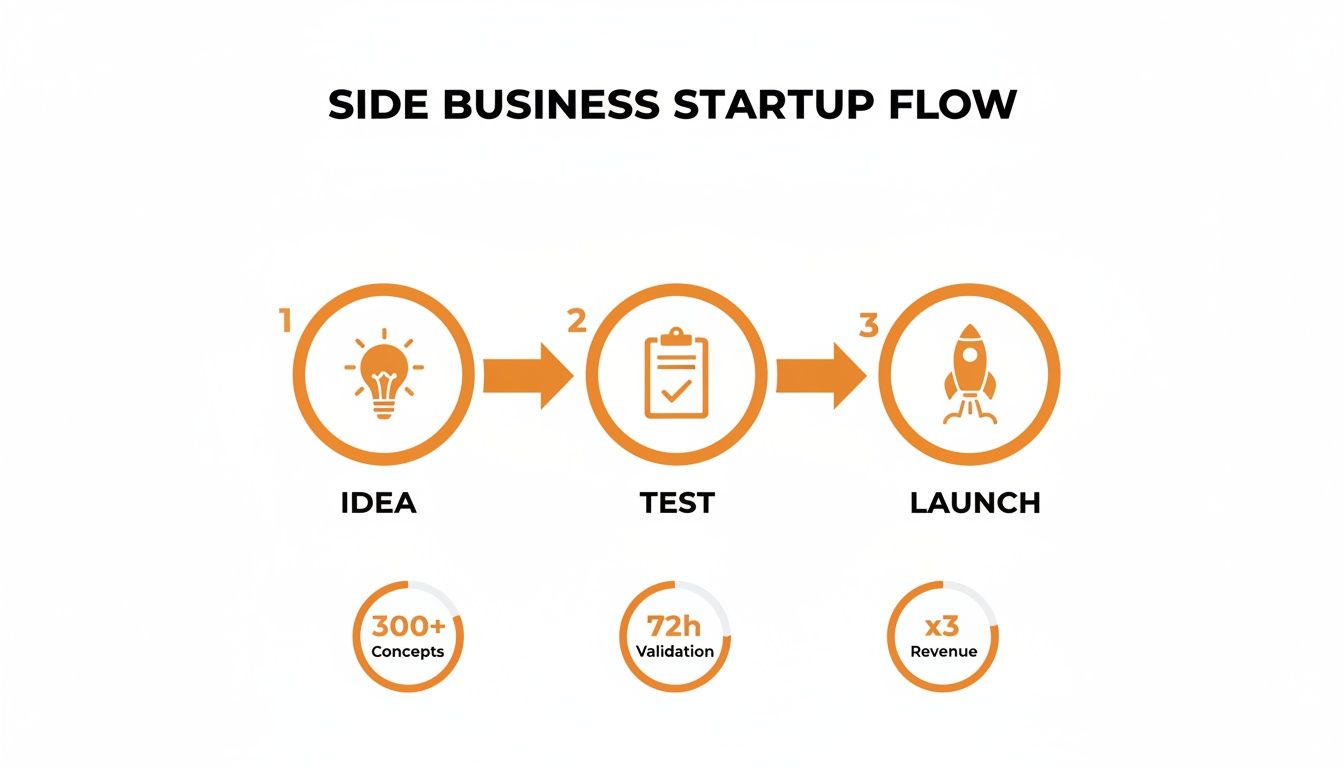
    This simple flow is key. It’s a cycle of coming up with an idea, testing it, and then launching. This is so much smarter than just building something and hoping you show up.

    An infographic showing the side business startup flow, detailing steps like Idea, Test, and Launch with associated metrics.

    This process makes it clear: testing is the critical bridge between your raw idea and a real business. It'll save you a ton of time and money.

    Running Tiny Tests to Validate Demand

    Okay, once you have a few ideas, it's time to put on your lab coat. Your job is to test your hypothesis ("People will pay me for X") with quick, cheap experiments. I’m talking about tests that cost less than a nice dinner out. The whole point is to get a clear signal from the real world—a "yes" or a "no"—before you sink any real time or cash into it.

    Here are a few of my favorite tiny tests:

    1. The Five-Conversation Test: Find five people you think are your ideal customers. But don't pitch them. Instead, ask about their struggles related to the problem you want to solve. Your job is to listen 90% of the time. If they bring up the exact problem you're trying to fix without you prompting them, you're onto something big.
    2. The $50 Ad Test: Whip up a simple landing page—just a single webpage describing what you're offering. Then, run a small social media ad campaign targeting your ideal customer. Your goal isn't to make sales; it's just to see if anyone clicks the "I'm Interested" button.
    3. The Pre-Sale Offer: This is the ultimate validation. Describe your service or product to a small audience (maybe in a relevant online group or just to your personal network) and ask for a deposit to pre-order. If someone gives you actual money for something that doesn't even exist yet, you have a winner.

    Validating an idea isn't about being right; it's about finding the truth as fast as you can. For a deeper dive into this crucial step, you can learn more about how to validate a business idea in our detailed guide. These small experiments give you the data you need to either move forward with confidence or pivot to a better idea without losing your shirt.

    Let's talk about something that trips up almost every new founder. I need you to hear this loud and clear: you absolutely do not need a finished product to make your first sale.

    In fact, building everything out before you've sold a single thing is one of the biggest, most expensive mistakes you can make. It's a fast track to wasting the two things you can't afford to lose: your time and your money.

    We're going to avoid that trap completely. This is all about creating what I call a Minimum Viable Offer (MVO). Think of it as the simplest, most direct version of your idea that someone can buy from you right now. You're essentially selling the architect's blueprint before you even break ground on the building.

    I’ve seen founders launch wildly successful companies with nothing more than a Google Doc outlining a service, a single coaching session, or a simple pre-order page. This gets you paid validation, which means cash in your pocket and priceless feedback from real, paying customers. It's how you figure out what people actually want, not just what you think they want.

    Overhead view of hands tapping a tablet showing 'SeLL The Blueprint' on a white desk.

    Service First, Product Later

    One of the smartest moves you can make is to start with a service, even if your grand vision is a physical or digital product. A service is nimble, costs almost nothing to start, and immediately puts you in conversation with the people you want to serve.

    Let’s say you want to sell gorgeous, custom-designed Canva templates for small business owners. The old way would be to spend a month cranking out dozens of templates, hoping they're what people want.

    The smart way? You start with a service.

    • Your MVO: A "Done-For-You Social Media Graphics Package." For a flat fee, you personally design a week's worth of custom graphics for one client.
    • The Payoff: You get paid right away. More importantly, by working directly with that client, you learn exactly what styles, formats, and messages they need. After doing this for just three to five clients, you'll have a mountain of real-world data to build templates you know people will buy.

    This "service-first" model works for almost anything. You want to build an online course? You start by offering one-on-one coaching. You want to build a software tool? You start by doing the task manually for a handful of clients as a concierge service.

    Selling a service is like getting paid to do market research. Your customers are literally funding your product development while telling you exactly what to build.

    Pricing Your First Offer

    Pricing can feel like pulling a number out of thin air, but it doesn't have to be. For your first MVO, your goal isn't to squeeze every last dollar of profit. It's just to get your first paying customers.

    The price just has to be high enough for people to take it seriously. I've learned people value what they pay for.

    The freelance and side hustle world is absolutely booming, proving people are more than willing to pay for expertise. The freelancing economy has exploded, with projections showing over 70 million Americans will be freelancing by 2025. And the money is there: I've seen reports of a 57% jump in freelancers earning over $100,000 since 2020. Digital-first gigs are hot, and AI-powered services have pushed rates even higher—some AI content creators now charge up to $200 per hour. You can dig into more stats about the state of freelancing on dubsado.com.

    So, you can start with a simple back-of-the-napkin calculation. Pick a fair hourly rate for yourself (even if you don't show it to the client) and estimate how long your MVO will take. Don't be afraid to set a price that feels a little uncomfortable; it often signals quality. For a deeper dive, check out our guide on how to price a new product.

    Delivering an Unforgettable Experience

    For your first few customers, your absolute mission is to over-deliver. These aren't just sales. They're the foundation of your reputation. You want to turn these early adopters into raving fans who will go out and sell for you.

    Here’s how I'd nail it:

    • Communicate Proactively: Keep them in the loop. A quick email saying, "Just wanted to let you know I've started on your project and I'm really excited about it!" works wonders.
    • Add a Small, Unexpected Bonus: If you designed a client's social graphics, toss in a matching email header for free. It costs you next to nothing but creates a massive amount of goodwill.
    • Ask for Honest Feedback: When you're done, ask them, "What was one thing you really loved, and what's one thing I could have done better?" This shows you care and gives you gold for improving your offer.

    This early stage is all about building relationships, not just a customer list. The trust you build and the lessons you learn will be infinitely more valuable than the initial cash you bring in. This is the bedrock you'll build your entire business on.

    Making Your Business Official the Simple Way

    Let's be honest, the legal and financial stuff can sound terrifying. I get it.

    Words like "entity formation" and "tax liability" are enough to make you want to ditch your laptop for a Netflix binge. But I promise, for a side hustle, this is way simpler than you think. You aren't building some complex corporate empire here; you're just putting a simple, protective fence around your new income stream.

    Let’s cut through the noise and talk about the only two options you really need to consider right now.

    Your Business Structure: A Simple Choice

    Think of your personal finances like your wallet. Everything you earn and spend comes out of that one spot. When you first start making money from your side project, you're automatically operating as a sole proprietorship.

    This is the simplest setup. The business is you. The money you make is just personal income, and you’re personally on the hook for everything. The good news? It requires zero paperwork to get started.

    The next step up is a Limited Liability Company (LLC). This is like giving your business its own separate, protected piggy bank. An LLC creates a legal wall between your personal assets (your car, your home) and your business assets. If something goes wrong—say, a client sues you—they can only go after what’s in the business's piggy bank, not your personal wallet.

    An LLC is your financial armor. You might not need it for your very first sale, but as soon as you start generating consistent income or taking on any real risk, it’s the single smartest way to protect yourself and your family.

    So, when do you pull the trigger on an LLC?

    • If your business has real risk: Are you a personal trainer? A consultant giving advice? Are you selling a physical product that could potentially break or cause harm? An LLC is non-negotiable for you.
    • When you start making real money: Once you're consistently clearing a few thousand dollars a month, the cost of an LLC (usually a few hundred bucks) is just cheap insurance.
    • If you plan to have partners: An LLC clearly defines ownership and responsibilities from day one, which will save you from massive headaches down the road.

    You don’t need to do this on day one. But keep it on your radar as your first big milestone after you’ve proven your idea actually works.

    Managing Your Money Without the Headache

    Regardless of your legal setup, you absolutely must take these three financial steps. These aren't just suggestions; they are the bedrock of running a clean, stress-free side business. Get this right, and you'll save yourself from a world of pain come tax season.

    • Open a Separate Business Bank Account: This is the most important financial move you can make. Do not mix your business income with your personal grocery money. A dedicated account creates a crystal-clear record of what’s coming in and going out. Most banks offer free business checking accounts, so you have no excuse.

    • Track Everything Simply: Forget complicated accounting software for now. A simple Google Sheet with two tabs—one for "Income" and one for "Expenses"—is all you need. Every time you get paid, log it. Every time you buy something for the business (software, shipping supplies, a course), log it. This habit takes me five minutes a week and makes tax time a complete breeze.

    • The Golden Rule: Set Aside for Taxes: When you get paid, that money isn’t all yours. The government will want its piece. A safe bet is to immediately move 30% of every single payment you receive into a separate savings account labeled "Taxes." Just do it. This way, you’re never caught off guard with a huge tax bill you can't pay.

    That’s it. Nail these three things, and you’re already ahead of 90% of new side business owners. You'll be organized, protected, and in full control of your finances.

    Getting Your First Customers (While Still Working Full-Time)

    So, you've got a job, a life, and now a side business. Trying to manage all three can feel like spinning plates. The secret isn't finding more hours in the day; it's being incredibly smart with the slivers of time you actually have.

    Forget the generic productivity hacks. You're a part-time founder, and that demands a different playbook. Your most valuable asset isn't cash—it's focused, uninterrupted time. The single best strategy I've found for this is Time Blocking.

    This is more than a to-do list. It's making non-negotiable appointments with your business. Block out specific times in your calendar—say, Tuesday and Thursday from 8 PM to 10 PM, and Saturday morning from 7 AM to 10 AM. During these blocks, you silence your phone, close every other browser tab, and dedicate your full attention to one single business task.

    Desk setup with laptop displaying a calendar with '1st' highlighted, coffee, and a calculator. Text reads 'GET FIRST CUSTOMERS'.

    From Time Blocks to Paying Customers

    Once you’ve carved out the time, what do you actually do? You hunt for your first customers. At this stage, absolutely nothing else matters. Your first sales are the hardest to get, but they provide the most crucial validation you could ever ask for.

    The good news is that the digital marketplace makes this hunt easier than ever. In the US, 52% of side hustlers use e-commerce to earn money. Freelancing is another solid path, with 21% of Americans building side businesses that way. For us here in Chicago and the Midwest, this shows you can build something local that still connects to a worldwide market. (You can dig into more of these side hustle trends on resumly.ai).

    Here are three proven methods to turn your time blocks into real revenue.

    Tap Into Your Existing Network (The Right Way)

    Your first customers are probably hiding in plain sight—in your phone contacts, LinkedIn connections, or email list. But there's a world of difference between leveraging your network and being an annoying pest. Please don't just blast a generic message asking people to buy your stuff.

    Instead, try this:

    • Identify 10 people in your network who you genuinely believe could benefit from what you offer or who might know people that could.
    • Send a personal, low-pressure message. Something like, "Hey [Name], I've started a little side project helping [your target customer] with [the problem you solve]. You came to mind because of [a specific, genuine reason]. No pressure at all, but I'd love to get your quick thoughts on it if you have a moment."
    • Ask for feedback, not a sale. This simple shift turns a sales pitch into a conversation. People love giving their opinion, and if they're actually interested, they will ask you how they can buy.

    Find Where Your Customers Already Gather

    Your ideal customers are already hanging out somewhere online. Your job is to find that digital water cooler and become a helpful, respected voice there. This could be a specific subreddit, a niche Facebook group, a professional Slack community, or even the comments section of an industry blog.

    Don't just jump in and start pitching. That’s a fast track to getting ignored or booted. For your first time block, just listen. Then, you start adding real value. Answer questions, share your expertise freely, and offer help with absolutely no strings attached.

    For instance, if you're a freelance writer for tech startups, find a group for early-stage founders. When someone asks about writing a compelling landing page, give them a detailed, actionable answer right there in the comments. After you've built that trust, people will naturally start checking out your profile and reaching out for paid work.

    Don't sell your product; solve their problem. When you consistently provide value for free, people will assume your paid work is exponentially more valuable and will seek you out.

    Build Trust Through Local Connections

    Never, ever underestimate the power of your local community, especially in a place like Chicago where we value genuine connection. While the internet gives you global reach, you can build local trust much faster.

    You could offer to run a free workshop at a local co-working space, connect with other small business owners at a neighborhood farmer's market, or join a local Meetup group related to your field. In-person interactions build a level of rapport that's tough to replicate online.

    A friend of mine who started a meal prep service got her first 20 customers by handing out free samples at her local gym. She built a loyal base of clients who trusted her because they knew her face-to-face. That local foundation gave her the momentum she needed to expand online. These strategies work best when you have a clear focus, which is why I always recommend creating a simple one-page marketing plan to keep you on track.

    Finding Your Community of Fellow Founders

    Building a side business can be a strange, lonely journey. Your coworkers at your 9-to-5 probably won't get it. Your friends might wonder why you're grinding away on a Friday night instead of grabbing drinks. It’s a classic story I hear all the time.

    That feeling of isolation is a silent killer for so many great ideas. I learned this the hard way, trying to figure everything out on my own. It felt like I was fumbling around in the dark, where every tiny setback felt like a massive failure.

    But everything shifted when I found my people.

    More Than Just Networking

    Let’s be clear: a real community isn't about collecting business cards or making transactional connections. It’s about finding a small, trusted circle where you can be brutally honest.

    It's a place to celebrate the small wins that no one else understands. More importantly, it’s where you can talk about the struggles—those moments when you’re thinking, "What on earth am I even doing?"

    Your peer group is your sanity check. They're the ones who've been where you are, who can call you out when you're making a mistake, and who can offer a specific piece of advice that saves you months of trial and error.

    This is the entire reason I started Chicago Brandstarters. I wanted to create a space for hardworking, kind people in Chicago and the Midwest to come together, share real stories, and genuinely support one another. We're not about performative positivity; we're about the honest, messy reality of building something from scratch.

    What to Look for in a Community

    Finding the right group can accelerate your growth more than any course or book. It’s like having a personal board of directors who are just as invested in your success as you are in theirs.

    When you're looking for a group, keep an eye out for these key ingredients:

    • A Culture of Giving: Is the group focused on helping each other, or is everyone just there to promote their own stuff? You want givers, not takers.
    • Real Operator Experience: Are the members actually in the trenches building businesses? Advice from someone who has actually done it is worth its weight in gold.
    • Psychological Safety: Do you feel safe enough to share your biggest fears and failures? A great community is built on trust and confidentiality.

    When you find this, hold onto it. Problem-solving becomes a team sport. The lonely moments feel less daunting. The entire journey of starting your side business becomes richer and, frankly, a lot more fun.

    Your Top Questions, Answered

    You’ve got questions. I’ve got answers—the real, honest kind, based on what I see people struggle with every single day when they're trying to get a side business off the ground. My only goal here is to give you the clarity to finally move forward.

    How Much Money Do I Really Need to Start?

    Honestly? Way less than you think.

    For a service business—think freelance writing, consulting, design work—you can genuinely get started for under $100. That usually just covers a professional domain name and an email address. You're not buying the whole building; you're just getting the key to the front door.

    If you’re selling physical products, you'll need a bit more for that first batch of inventory. But platforms like Shopify are built for starting small. The golden rule here is to prove your idea with a tiny investment before you even think about putting serious cash on the line.

    Your goal isn't to launch a perfect, fully-stocked store from day one. It's to prove one thing and one thing only: that someone out there will pay you for what you're offering. Start there. Let the revenue you bring in fund your growth.

    Should I Tell My Current Employer?

    This is a tricky one. The answer lives in your employment contract.

    Before you do anything else, you need to dig that document up and look for non-compete clauses or any policies about outside work. And this is non-negotiable: never, ever use company time or company equipment for your side business. Seriously.

    If your new venture is in a totally different field and there’s zero conflict of interest, you often don't have to say a word. But if it’s a gray area at all, spending a few bucks for a quick chat with an employment lawyer is one of the smartest investments you can make.

    When Is It Time to Quit My Day Job?

    I've seen it happen dozens of times, and there are almost always two clear signals that it’s time for you to think about going all-in.

    1. The Financial Signal: Your side hustle is consistently bringing in 75-100% of your day job's income. And I mean consistently—for at least three to six months in a row.
    2. The Mental Signal: You start to feel like your 9-to-5 is actively holding your business back. The thought of working on your own thing energizes you more than the thought of juggling both drains you.

    When both of those signals are flashing bright green, you’re ready to make the leap.


    Ready to stop figuring this all out on your own? Join Chicago Brandstarters, a free community of kind, hardworking founders in Chicago and the Midwest who are building something real. Find your people and grow your business faster at https://www.chicagobrandstarters.com.