
Tag: chicago business

  • 10 Vetted Chicago-Based Million Dollar Business Idea Frameworks For 2026

    10 Vetted Chicago-Based Million Dollar Business Idea Frameworks For 2026

    I get it. You're scrolling, searching, maybe a little frustrated, looking for that one "million dollar business idea" that clicks. The internet is a firehose of generic lists promising fast cash, but they miss the Chicago spirit—our unique blend of kindness and grit. Let's cut through the noise together.

    This isn't just another list. It's my collection of 10 proven frameworks, tweaked for founders like you here in Chicago and the Midwest. I've personally seen these models work, time and again, in our community.

    Think of this guide as a playbook. It's like having a map of a city you already know. You know the main streets, but this map shows you the hidden alleys and shortcuts to get where you want to go, faster. We won't talk about abstract theories. We'll dive into actionable steps, real-world numbers, and local resources to help you build something that matters. I’ve done the homework for you. Each idea here is a potential path to a seven-figure business, complete with a 90-day roadmap. Let's find the one that fits you.

    1. Direct-to-Consumer (D2C) E-commerce Brands

    Building a Direct-to-Consumer (D2C) brand is one of the clearest paths to a million dollar business idea. Instead of selling through big-box stores, you create your own products and sell them straight to customers from your website. This approach is like running your own farm-to-table restaurant instead of selling produce to a grocery chain. You cut out the middleman, which means your profit margins can be much higher, often between 50-80%. More importantly, you build a direct line to your customers, getting priceless feedback to make your products better and build a loyal tribe.

    A smartphone displaying an e-commerce app with clothes, next to two branded delivery boxes and a plant.

    Think about brands like Warby Parker or Allbirds. They didn't debut on Target's shelves; they started online, telling their own story. You can do the exact same thing right here from the Midwest.

    Your Action Plan

    To start, don't try to be the next Amazon. I want you to focus on a micro-niche you genuinely love, whether it's sustainable pet toys or artisanal hot sauce for a specific palate.

    • Quick Launch: Use a platform like Shopify to get your store online in a weekend.
    • Test Demand: Before ordering 1,000 units, test your idea with a pre-sale campaign.
    • Build Your List: Start collecting emails from day one. An email list is an asset you own, unlike social media followers.
    • Price for Profit: I recommend a 3-4x markup on your product cost to cover marketing and operations.

    For a deeper look at scaling your online store, check out these ecommerce growth strategies for Chicago founders. This model works because it puts you in control of your brand and customer relationships from the start.

    2. SaaS (Software as a Service) for Niche Industries

    Creating a Software as a Service (SaaS) business for a specific, ignored industry is a fantastic million dollar business idea. You build subscription-based software for niche pros like contractors, salon owners, or local manufacturers who are stuck with clunky, outdated tools. This model is like owning an apartment building; it generates predictable, recurring rent (revenue) and has some of the highest profit margins out there, often 70-90%. You can find unglamorous problems that big tech overlooks and solve them brilliantly.

    A laptop displaying business graphs, with 'Saas Growth' text in an orange box, coffee and supplies on a desk.

    Think of a company like Jobber, which built a massive business helping home service companies run their operations. They found a specific pain point and built a custom solution. As a Midwest founder, you have a unique edge in understanding these practical, main-street industries.

    Your Action Plan

    Your goal isn't to build the next HubSpot overnight. Instead, find one painful problem for a niche audience and solve it better than anyone else.

    • Validate Manually: Before you write a line of code, offer the service by hand to a few clients to confirm they'll pay for a fix.
    • Build a No-Code MVP: Use tools like Airtable, Zapier, and Webflow to launch your first product quickly. You can check out a real-world minimal viable product example to see how I'd approach this.
    • Price on Value: Start by charging what feels a bit too high, maybe $50-300 per month. You are selling a solution, not just software.
    • Obsess Over Churn: I want you to track how many customers cancel each week. Keeping customers is the key to SaaS growth.

    3. High-Ticket Digital Courses and Coaching Programs

    Creating and selling high-ticket digital courses is a powerful million dollar business idea that turns your brain into a scalable asset. Instead of trading hours for dollars, you package your knowledge into a premium educational product ($997-$5,000+) that solves a specific, painful problem. This model is like writing a bestselling book instead of giving one-off speeches. You do the work once, and it pays you over and over. It has minimal overhead, no inventory, and you can scale it globally from your desk in the Midwest. Your authenticity is your greatest asset here.

    I look at experts like Ramit Sethi or Amy Porterfield. They built multimillion-dollar businesses by teaching skills they mastered. You can do the same. Document your journey and show others how to get similar results, using your unique experience.

    Your Action Plan

    Your goal isn't to sell information; it's to sell a transformation. People pay top dollar for clear outcomes, not for more data to google. Focus on building a small, dedicated audience before you ever create the product.

    • Build Your Audience First: Start an email list and aim for your first 1,000 true fans. I want you to share valuable stuff for free to build trust.
    • Focus on Transformation: Clearly define the result your students will get. Frame your course around that promise, like "Land your first web design client in 90 days."
    • Use a Cohort Model: Launch your program in groups (50-100 people) to create urgency and a strong community vibe. This lets you charge more.
    • Presell Your Course: Validate your idea by selling it before you build it. Create an outline and offer an early-bird discount to your email list.

    This model lets you build a business around what you already know. For guidance on building a community around your expertise, you should connect with other creators at the Chicago Brandstarters community.

    4. Niche Content and Creator Monetization Platforms

    Building a platform for creators to get paid is a huge million dollar business idea. Instead of relying on ads, you create a system where creators sell subscriptions directly to their audience, and your platform takes a small cut. You’re essentially building the digital stage for podcasters, writers, and artists to connect with their truest fans. This is like being the concert promoter for a thousand small, passionate bands; you provide the venue, they bring the crowd, and you both win.

    Think of giants like Patreon or Substack. They empower individual creators to build careers by giving them the tools for payments, content delivery, and community. Many talented creators right here in the Midwest have passionate audiences but lack the tech skills to monetize them. You can build that bridge.

    Your Action Plan

    Your first step is not to build a platform for everyone. Instead, I want you to focus on a specific, underserved creator vertical like local chefs, technical writers, or yoga instructors.

    • Solve a Specific Problem: Start by building features that a niche group desperately needs. For example, a platform for musicians could include tools for selling exclusive merch or virtual concert tickets.
    • Onboard Manually: Find 2-3 creators in your niche and work closely with them to build successful case studies. Their success becomes your best marketing.
    • Educate Your Creators: Don’t just give them tools; teach them how to use them. Offer resources on pricing, audience growth, and retention to make them stick around.
    • Smart Pricing Model: I recommend starting with a low take rate, maybe 2-5%, to attract early adopters. As you add more valuable features, you can justify a higher rate of 5-10%.

    This model puts you at the center of the creator economy. By helping others build their dreams, you build your own.

    5. B2B Marketplace or Aggregation Platform

    Creating a Business-to-Business (B2B) marketplace is a powerful million dollar business idea because you're not selling a product; you're building a digital bridge. You connect specific business buyers with sellers and take a small piece of each transaction. This is like building the Chicago Board of Trade for a niche industry. You don't own the corn; you own the place where the corn gets traded. The Midwest's strong manufacturing and service sectors are perfect ground for this.

    Think of platforms like Faire, which connects independent retailers with unique wholesale goods. You can build a similar platform right here in Chicago, focusing on a specific local need.

    Your Action Plan

    Your first step isn't to build a complex platform. It's to become a trusted, manual matchmaker in a niche you know deeply.

    • Pick Your Niche: Focus on a fractured market, like connecting local food producers with restaurants or matching specialized manufacturers with suppliers.
    • Build Supply First: It's easier to find 10 great suppliers than 1,000 buyers. I want you to focus on recruiting the seller side first using trade groups and your network.
    • Match Manually: Start by taking requests via email or a simple form and personally connecting the buyer and seller. You become the platform before you build it.
    • Charge on Success: Your revenue model should be commission-based. You only make money when a deal happens, which aligns your goals with your users'.

    To succeed, you need to master connecting businesses. For a deeper look into this world, explore my guide on the B2B sales process. This approach lets you prove your concept and make money before writing a single line of code.

    6. Agency or Service Business with Productized Offerings

    Shifting from a custom service business to one with productized offerings is a proven million dollar business idea. You start by providing a high-value service, like consulting, and then you systematize your process into a repeatable, fixed-scope package. This is like a master chef going from catering unique dinners to selling a signature meal kit. The recipe is set, the process is efficient, and it can scale. This hybrid model gives you the immediate cash flow of a service business with the scalability of a product.

    This path is well-traveled. Basecamp famously started as a web design agency before turning its internal project management tool into a massive SaaS company. This model is perfect for you if you excel at building efficient, repeatable systems.

    Your Action Plan

    Your goal is to turn your expertise into a scalable asset. After a handful of custom projects, you’ll see patterns. That's your signal to productize.

    • Document Everything: After each project, I want you to meticulously document your process, templates, and checklists.
    • Identify the Core Framework: Find the 80% of work that is the same for every client. That becomes your productized service.
    • Create Standard Packages: Offer 3-5 packages with a fixed price, a clear scope, and defined deliverables. This kills the need for custom proposals.
    • Price for Value: Your productized service should be priced based on the outcome it delivers, not the hours it takes you. Aim for a price that feels like a stretch but is easily justified by the results.

    This approach gives you predictable revenue and operational leverage. For a playbook on this move, I highly recommend you dive into the work of Blair Enns and his book on Winning Without Pitching.

    7. Vertical-Specific Supply Chain or Distribution Business

    The Midwest is built on making and moving things. Tapping into this strength by becoming a specialized supplier is a classic million dollar business idea. You find a specific industry, like craft brewing or specialty electronics, and become the go-to source for the parts or ingredients they need. This isn't about inventing a new widget; it's about being the most reliable person in the supply chain that gets widgets from the factory to the business. You become the essential link.

    Look at Chicago legends like Grainger. They didn't start by making everything; they started by expertly distributing industrial supplies, building a huge business by being the most reliable source. You can build a modern version of this right here.

    Your Action Plan

    Your goal is to become indispensable to a niche B2B market. The key is to start as a distributor, not a manufacturer. This lets you build cash flow and relationships before you take on the heavy costs of production.

    • Find Your Niche: Identify a fragmented industry. Are local medical device startups struggling to source a specific component? That’s your opening.
    • Build Supplier Relationships: The Midwest business culture is built on trust. Get out there and meet manufacturers who need better ways to reach customers. Secure exclusive distribution rights if you can.
    • Differentiate with Service: Don't just compete on price. You can offer faster delivery, expert advice, or flexible payment terms. Your service is your brand.
    • Start Small: You don't need a huge warehouse. Begin by focusing on a few key products for a handful of local customers and prove your model.

    This is a business with real moats. The relationships and logistics you build are hard for newcomers to copy. For more on building a strong local B2B network, I suggest you check out these insights on Chicago's B2B ecosystem.

    8. Community-Based or Membership Platform for Professionals or Creatives

    Building a paid community for professionals or creatives is a potent million dollar business idea that monetizes connection. You create a private space where members pay for access to peer networks, exclusive resources, and curated opportunities. This model builds a powerful moat because you can't easily copy a genuine community. It's like building a private club for driven people. The Midwest's no-nonsense, collaborative culture gives you a natural advantage.

    Organizations like Reforge have shown this model can generate millions by focusing on specific professional outcomes. The key is that people will pay a premium for access to the right people and conversations, especially when those chats lead to tangible growth.

    Your Action Plan

    Start by building the community first, then introduce the paid component. I want you to focus on creating a space people genuinely want to be a part of before you ask for their money.

    • Build the Free Core: Start a free community (like a Slack group) to build trust and gather your first 200-300 engaged members.
    • Curate Ruthlessly: Vet every member to maintain high-quality interactions. One bad actor can spoil the experience for everyone.
    • Host Small Gatherings: I've found that small, in-person dinners or virtual roundtables create deep connections and get you direct feedback.
    • Launch a Paid Tier: Offer a premium tier with exclusive access—a private mastermind, direct intros, or advanced workshops—for $200-$500 per month.

    This model thrives on trust and results. Once your members see their peers landing deals or solving problems through the community, the value becomes a no-brainer. For a great local example of this community-first approach, look at the principles behind Chicago Brandstarters.

    9. Brand Building and Licensing (IP-Based Business)

    This is a powerful million dollar business idea where you build an asset first, then monetize it. Instead of selling a product, you create a recognizable brand, a unique philosophy, or a memorable character. Once you have an engaged audience, you can license this intellectual property (IP) to other companies or create your own merchandise. This business model is like writing a hit song; you create it once, and then you earn royalties for years as others perform it or use it in movies.

    A desk setup featuring branding materials like an orange cap, laptop, mug, and logo sketches for brand building.

    Think of James Clear’s Atomic Habits. It started as a philosophy shared through content and grew into a massive ecosystem of books, courses, and licensed products. Your authentic Midwest perspective is a huge advantage in building a brand people trust.

    Your Action Plan

    Your primary goal is to build an audience that believes in your message before you ever try to sell a product. Focus on giving value consistently.

    • Build Your Platform: I want you to choose one channel (a blog, podcast, or YouTube) and create consistent, high-quality content for at least two years.
    • Focus on Philosophy: Create a brand around a core idea or worldview, not just your personality. This makes your IP more licensable.
    • Grow Your Email List: This is non-negotiable. Your email list is proof of your audience and your most direct line to them.
    • Protect Your IP: Once you get traction, file trademarks for your brand name and logos. This is your most valuable asset.

    This approach takes patience, but it builds a durable business that can generate revenue from multiple streams without your direct involvement in every transaction.

    10. Aggregation and Roll-Up Strategy (Buy Small, Build Big)

    Instead of building a million dollar business idea from scratch, you can assemble one by acquiring smaller, profitable companies. This is a private equity model perfectly sized for you as a founder. You find a fragmented industry—think landscaping, accounting, or local service businesses—and buy up several small owner-operated shops. By rolling them into one entity, you create efficiencies and build a much larger, more valuable enterprise. This is like building a powerful team by recruiting all-star players from smaller leagues.

    Midwest operators are naturals at this because of our strong community focus and deep understanding of legacy businesses. Success stories like Andrew Wilkinson's Tiny Capital show how acquiring small, solid digital businesses can create an empire.

    Your Action Plan

    Your goal is to become a skilled buyer and operator, not just an inventor. I want you to start with a single, manageable acquisition in an industry you understand, using it as a platform for future growth.

    • Find Your Niche: Focus on fragmented industries with retiring owners and proven cash flow. Services with recurring revenue are ideal.
    • Smart Financing: Use SBA loans and seller financing to reduce the upfront cash you need. Many owners will finance part of the sale to ensure a smooth transition.
    • Create a Playbook: Build a shared back-office for accounting, HR, and marketing to cut costs across all your acquired businesses. Document every step so your next acquisition is even smoother.
    • Incentivize Talent: Keep the acquired founder on with an earnout incentive. Their expertise is an asset, and this ensures they’re invested in the company’s success.

    10 Million-Dollar Business Ideas Comparison

    Option Implementation Complexity 🔄 Resource Requirements 💡 Expected Outcomes 📊 Ideal Use Cases ⚡ Key Advantages ⭐
    Direct-to-Consumer (D2C) E-commerce Brands Moderate — marketing, ops, inventory management Low–moderate capital; marketing spend ($1k–5k/month); possible inventory Faster revenue scale; margins 50–80%; repeat purchases; $10K MRR in 6–12m Consumer products, repeat-purchase niches, founders strong in digital marketing High margins; direct customer data; rapid scale via ads
    SaaS for Niche Industries High — product development, support, PMF effort Dev team or technical cofounder; time to build; ongoing R&D Predictable MRR/ARR; gross margins 75–90%; high valuation multiples Vertical B2B problems with poor tooling (contractors, clinics, studios) High LTV; strong moat via data & integrations; attractive to investors
    High-Ticket Digital Courses & Coaching Low–medium — content production and delivery systems Time and expertise; existing audience preferred; minimal capital High profit margins (70–90%); quick revenue if audience exists; $1K MRR in 3–6m Experts, coaches, creators selling transformation-based programs Scalable with low inventory risk; leverages personal brand
    Niche Content & Creator Monetization Platforms High — platform build, payments, creator onboarding Engineering, payments compliance, creator acquisition, support Recurring platform revenue; network effects; potential large TAM Niche creator communities, fan subscriptions, membership models High retention for creators' audiences; diversified revenue per creator
    B2B Marketplace / Aggregation Platform High — two-sided liquidity, trust systems, compliance Sales team, onboarding resources, tech; initial subsidies or manual ops Transaction fees; strong network effects; high margins at scale Manufacturing suppliers, local services, used equipment markets Large scale potential; multiple revenue streams (commissions, fintech)
    Agency / Service Business (Productized) Low–medium — systematize delivery, documentation Talent and operations; low capital; subcontractors possible Immediate cashflow; can productize for recurring revenue; $10K MRR in 6–12m Agencies, consultants, local service providers seeking scale Low startup risk; fast to revenue; convertable into sellable asset
    Vertical Supply Chain / Distribution Medium–high — logistics, compliance, inventory systems Significant capital ($250K–1M+); warehouses, supplier contracts Stable B2B revenue; margins 20–40%; high switching costs Manufacturing distribution, specialty regional supply, logistics Durable customer relationships; moat via capital and service reliability
    Community-Based Membership Platform Medium — curation, engagement, community ops Founder time, events/content budget, platform tooling Predictable recurring revenue; high retention if engaged; network effects Professionals, creatives, local/regional peer networks High LTV; diversified income (events, job boards, education); defensible network
    Brand Building & Licensing (IP-Based) Medium — long-term content strategy, IP protection Time (1–3+ years), marketing, legal for trademarks/IP Passive/licensing revenue over time; high margins on licensed goods Thought leaders, creators with distinct philosophy or IP Scalable passive income; multiple licensing streams; strong margins
    Aggregation & Roll-Up Strategy High — M&A, integration, cultural alignment Significant capital ($500K–5M+), financial & legal teams, integration ops Rapid consolidated revenue; efficiency gains; higher exit multiples Fragmented industries with many small owner-ops, recurring revenue targets Immediate cashflow from acquisitions; scale and valuation uplift

    Stop Searching, Start Building

    You just walked through 10 blueprints, each a path to a seven-figure business right here in the Midwest. We dissected everything from D2C e-commerce to brand licensing. My goal wasn't to give you a list; it was to hand you a set of keys. Each idea came with a business model, demand signals, and your first 90-day steps.

    But the most valuable million dollar business idea isn't some secret number 11. It's the one from this article that you decide to act on. The real gap isn't a lack of ideas; it's the canyon between a great concept and your first real action.

    The Myth of the Perfect Idea

    I see many aspiring founders get stuck in an endless loop of research. You read articles, listen to podcasts, and tell yourself you're looking for the "perfect" opportunity. Let me be direct: that’s just a fancy word for procrastination. The perfect idea doesn't exist.

    Every business is a series of corrections. Think of a potter at a wheel. You don't start with a perfect vase. You start with a lump of clay, get it centered, and then apply pressure, constantly adjusting as it spins. Your first concept is just that lump of clay. The real art is in the shaping, the adjusting, and the building.

    From Blueprint to Reality

    So, what’s next? Don't just close this tab. The real work starts now, and it’s simpler than you think.

    • Pick One Framework: Which of the 10 models resonated with you? Choose one. Not two, not three. Just one.
    • Execute the 90-Day Plan: I gave you the first steps for a reason. Your mission for the next three months is to validate the core assumption of your chosen idea. Can you get one paying customer? Can you build a landing page that gets 100 email sign-ups?
    • Embrace the Mess: It won't be clean. Your first MVP might be ugly. Your first sales pitch might be awkward. That's not failure; it’s progress. The path to a million dollars is paved with imperfect action.

    The journey you're about to start can feel lonely. Your friends and family might not get the risks you're taking. That's why having a community of peers on the same path isn't a nice-to-have; it's a necessity. You need people who get it.


    Building a business is tough, but you don't have to do it alone. Chicago Brandstarters is my private community for kind, ambitious Midwest founders who are tired of the performative grind and want real support from people who get the journey. If you're ready to stop searching and start building alongside genuine peers, this is your place.

    Join the waitlist for Chicago Brandstarters

  • Grow Your Network: My Go-To Strategies of Business Networking for Real Partnerships

    Grow Your Network: My Go-To Strategies of Business Networking for Real Partnerships

    Let’s be honest. Most "business networking" feels fake. You walk into a room, swap a hundred flimsy business cards, and leave feeling more drained than connected. You’ve been told to "work the room," but what if the room itself is the problem? I believe there’s a better way. It’s not about collecting contacts; it's about curating real connections.

    Think of it like building a personal board of directors. But instead of stuffy executives, it’s a small crew of fellow founders who’ve got your back. These are the people who will celebrate your wins and help you troubleshoot your losses, no strings attached. In this guide, I’m going to walk you through 10 powerful strategies of business networking that ditch the fake hustle. We'll focus on what actually moves the needle: genuine relationships, honest talks, and growing together.

    These aren't vague theories. They are the exact, actionable frameworks I use at Chicago Brandstarters to build a community that supports real founders. Get ready to learn how to build a network that feels less like a chore and more like coming home. You'll see concrete examples and learn how to use these ideas immediately, so you can stop collecting contacts and start building your founder family.

    1. Intimate Peer Cohort Dinners

    Forget collecting business cards in a loud, crowded room. The most powerful strategies of business networking often happen in smaller, more intentional settings. Imagine a curated dinner with just 6-8 fellow founders, all navigating the same entrepreneurial rapids as you. This is the peer cohort dinner, a model that prioritizes deep connection over superficial contact collecting.

    People share a meal and conversation at a candlelit dinner table, fostering deep connections.

    Unlike a one-off event, these dinners happen regularly, building a foundation of trust that allows for real vulnerability. You’re not just sharing what you do; you’re sharing what’s breaking, what you’re scared of, and what you just figured out. This model is the cornerstone of how we operate at Chicago Brandstarters, where our bi-weekly dinners create a reliable support system.

    How I Implement This Strategy

    To make this work, you need more than just good food. You need structure and intention.

    • Set Ground Rules: Before anyone picks up a fork, establish a clear confidentiality agreement. This creates a safe space for open discussion.
    • Guide the Conversation: I use structured prompts to get things started. For instance, "What's your biggest business challenge this month?" or "Share a recent win and the specific tactic that got you there."
    • Send a Pre-Dinner Brief: I email attendees a short bio and the current focus of each person coming. This helps everyone arrive with context, ready to dive deep.
    • Follow Up with Action: After dinner, I send a recap with key takeaways or introductions I promised to make. This reinforces the value and keeps the momentum going.

    2. Community Chat-Based Knowledge Sharing

    The best networking strategies don’t just happen face-to-face; they thrive in the daily, quick conversations between founders. A curated group chat, like on Slack or WhatsApp, transforms occasional meetups into a constant source of support. It's your digital lifeline where you can ask for a last-minute contract review, share a sudden win, or find encouragement after a tough sales call.

    A laptop, smartphone, and notebook on a wooden desk with a 'FOUNDER CHAT' speech bubble.

    This model bridges the gap between formal events. It’s like having a living, searchable library of shared founder experiences. At Chicago Brandstarters, our Slack community is the connective tissue for our cohort, letting members tap into our collective wisdom anytime. A quick question about a new marketing tool at 10 PM gets three brilliant answers by morning. This continuous dialogue fosters a level of trust that scheduled meetings alone cannot build.

    How I Implement This Strategy

    A successful community chat is a well-tended garden, not just a group of people. Here’s how you can cultivate one.

    • Establish Clear Norms: From day one, I set guidelines for confidentiality, response times, and self-promotion. A "no-pitch" rule keeps the focus on mutual support.
    • Create Structured Channels: Organize conversations to prevent chaos. Use specific channels like #wins, #challenges, #ask-for-help, and #introductions so you can find what you need quickly.
    • Prompt Vulnerable Sharing: I actively encourage members to post their struggles, not just their successes. I might kickstart this by sharing a personal challenge or asking, "What's one thing keeping you up at night this week?"
    • Celebrate Generosity: I publicly thank members who offer exceptional advice or make helpful introductions. This reinforces the culture of giving that is essential for a thriving community.

    3. Identity Verification and Vetting for Community Quality

    Not all networking is good networking. One of the most critical strategies of business networking is curating the room itself. A high-quality community is built on trust, and that trust begins with a rigorous vetting process. You have to make sure every member is aligned, committed, and genuine. This isn't about being exclusive for its own sake; it's about creating safety by filtering out consultants, self-promoters, and anyone not truly in the trenches with you.

    This proactive gatekeeping maintains the integrity of the network. It's the bouncer at the door of your club, ensuring conversations are vulnerable and advice is freely given without fear of being sold to. At Chicago Brandstarters, our LinkedIn verification and multi-step application process are non-negotiable. I make sure that when you share a challenge, you’re sharing it with a fellow founder, not a salesperson in disguise. This approach protects the value of every connection you make.

    How I Implement This Strategy

    A strong vetting process acts as a quality filter, letting the right people in and respectfully guiding others elsewhere.

    • Establish Clear Criteria: I publicly share my standards. I let applicants know what I look for regarding founder stage, business model, and community values. Transparency manages expectations.
    • Ask Values-Alignment Questions: Go beyond metrics. I ask questions like, "How do you define generosity in a professional setting?" to gauge cultural fit.
    • Conduct a Brief Intro Call: For promising but uncertain candidates, a 15-minute call with me or a community leader can quickly reveal alignment and intent.
    • Communicate Rejections Kindly: If someone isn't a fit, I reject them with grace. I'll offer specific feedback or point them toward other resources that might be a better match.

    4. Values-Based Community Curation

    Effective networking isn’t just about who you know; it’s about what you stand for together. This is values-based community curation, one of the most powerful strategies of business networking for long-term success. It means you intentionally build a group around shared principles like kindness, generosity, and mutual support, rather than purely transactional goals. It’s a shift from a "what can I get?" mindset to a "what can we build?" culture.

    This approach attracts founders who prioritize impact and relationships. It’s like creating a garden where only certain plants thrive, naturally choking out the weeds of hyper-competitive, take-first networking. At Chicago Brandstarters, our community is built on the explicit value of being "kind givers." This simple filter ensures every member is here to contribute first, creating a safe, high-trust environment where real growth happens. It’s about building a network that feels less like a marketplace and more like a movement.

    How I Implement This Strategy

    A values-driven community doesn't happen by accident. It requires deliberate design and consistent reinforcement.

    • Define and Document Your Values: Be explicit. Write down your core principles. Is it "radical generosity," "brutal honesty with kindness," or "mission over ego"? I make them public.
    • Share Your Origin Story: I explain why these values matter to me personally. A story connects people to the mission far more than a simple rulebook.
    • Celebrate and Reward Value-Aligned Behavior: I feature members who exemplify our values. You can create an award like a "Giver of the Month" to publicly recognize and encourage selfless contributions.
    • Establish Clear Norms: I implement rules that protect our culture, such as a strict "no pitching" policy in community spaces. This guards against the transactional behavior you want to avoid.
    • Hold Members Accountable: You have to gently but firmly address actions that violate your shared values. Protecting the community's integrity is crucial for maintaining trust.

    5. Structured Problem-Solving Peer Advisory

    Conventional networking gives you contacts. This strategy gives you a board of directors for your biggest problems. Imagine presenting your most pressing business challenge to a trusted group of peers whose only agenda is to help you win. This is structured peer advisory, a facilitated format that transforms a group chat into a high-impact problem-solving session.

    Diverse group of young adults engaged in a peer advisory session, using a laptop and sticky notes.

    Unlike informal brainstorming, this model uses a strict protocol, like a well-run courtroom, to ensure the founder asking for help gets clear, unfiltered, and actionable feedback. It’s a core component of our dinners at Chicago Brandstarters, mirroring the focused "hot seat" format popularized by organizations like EO (Entrepreneurs' Organization) and Vistage. You're not just getting opinions; you're getting a dedicated brain trust focused entirely on your success.

    How I Implement This Strategy

    To turn advice into action, you need a disciplined process. A structured format prevents conversations from spiraling and keeps the focus tight.

    • Define Clear Roles: I assign a facilitator to guide the process and a timekeeper to enforce the agenda. The person presenting shares their issue uninterrupted first.
    • Establish Ground Rules: Before starting, everyone must agree to provide kind, honest, and specific feedback. The goal is to build up, not tear down.
    • Use a Timer: I allocate specific time blocks for each phase: problem presentation, clarifying questions, and feedback. This ensures the session stays on track.
    • Capture Action Items: I designate one person to document key insights and the specific next steps the presenter commits to. This creates accountability and a clear path forward.

    This approach is one of the most powerful strategies of business networking because it delivers immediate, tangible value. If you want to dive deeper into this framework, you can learn more about how mastermind groups for entrepreneurs use it to accelerate growth.

    6. Vulnerability-First Culture Over Performative Positivity

    Stop performing and start connecting. Many networking events pressure you to present a flawless highlight reel, but the most effective strategies of business networking do the opposite. They build a culture where sharing struggles is not just accepted but encouraged. This is about trading your polished mask for authentic vulnerability. It creates a space safe enough for real problem-solving and deep, supportive relationships.

    When you admit what’s keeping you up at night, you invite real help, not just a handshake. This approach transforms networking from a transactional chore into a transformational support system. At Chicago Brandstarters, I build our entire community around this principle, creating spaces where "honest war stories" are the currency of connection. It’s this shared struggle that forges the strongest bonds.

    How I Implement This Strategy

    Fostering vulnerability requires deliberate, consistent effort. You have to make people feel safe enough to lower their guard.

    • Lead by Example: As a leader or host, I am the first to share a genuine struggle or recent setback. My candor sets the tone for everyone else.
    • Prompt for Honesty: Instead of asking "How's business?", I ask "What's the hardest thing you're dealing with right now?" This explicitly invites real talk.
    • Respond with Empathy, Not Fixes: When someone shares a problem, you listen first. Offer support and understanding before you jump to solutions. Avoid toxic positivity like "Just stay positive!"
    • Establish Confidentiality Norms: I create a "what's shared here, stays here" rule. This is fundamental to building trust and encouraging openness. You can learn more about how we apply this concept in our guide to vulnerability in leadership.

    7. Strategic Referral and Connector Networks

    Effective business networking isn't just about who you know; it’s about who your network knows. Instead of building your connections one by one, you can tap into a curated ecosystem of experts. Think of this strategy as having a special forces team on call. You create a trusted, external circle of mentors, advisors, service providers, and investors who are aligned with your values and can offer high-level support when you need it.

    This isn’t about creating a public directory or a sales channel. The power is in the careful vetting and the warm, situational introductions. At Chicago Brandstarters, I partner with groups like Goldman Sachs 10KSB and EcomFuel, not to promote them, but to have them available as a resource for our members facing specific growth challenges. This approach ensures you get relevant, high-quality guidance without the noise of unsolicited pitches.

    How I Implement This Strategy

    Building a reliable external network requires diligence and a focus on mutual benefit, not just transactions.

    • Vet for Values, Not Just Skills: Before adding anyone to your trusted circle, you must ensure their values align with yours. A brilliant advisor with a cutthroat approach can damage your culture.
    • Make Introductions with Context: I only connect people when there's a clear, mutual win. A warm introduction should solve a specific problem for one person and offer a relevant opportunity for the other.
    • Maintain a Clear Boundary: You have to keep your community space sacred. Advisors and mentors should provide value through office hours or specific sessions, not by pitching their services in your primary communication channels.
    • Create Escalation Pathways: I guide my members to seek peer support first, then a mentor for broader advice, and finally an external advisor or investor for specialized needs. Properly finding the right people is crucial, and you can learn more about finding business partners to strengthen this process.

    8. Founder-Led Facilitation and Organic Leadership Development

    Instead of relying on a single, top-down leader, the most resilient communities empower their own members to lead. Founder-led facilitation turns participants into stewards of the group’s culture. It’s a powerful strategy that distributes ownership and prevents organizer burnout. This model is like a self-sustaining ecosystem; it ensures the community’s values are deeply embedded in its operations because the members themselves are upholding them.

    This model is the engine behind Chicago Brandstarters. I don't run every event. Instead, we have a documented system that allows different members to step up and facilitate, ensuring our gatherings remain authentic and founder-focused. This approach develops leadership skills within the group, making the entire community stronger and more self-sufficient. You move from a "hub and spoke" model to a true, interconnected web.

    How I Implement This Strategy

    To build a self-sustaining community, you need to create a clear path for members to take the lead. This requires trust, documentation, and a supportive framework.

    • Document Your Process: I created a simple playbook for facilitators. It outlines the event format, key values, and prompts for guiding conversation. This empowers new leaders to step in confidently.
    • Rotate Roles Clearly: Define and rotate responsibilities like sending invites, facilitating the discussion, and handling follow-ups. This prevents any single person from becoming a bottleneck.
    • Provide Mentorship: I've established "facilitator office hours" and pair new facilitators with experienced ones. A little guidance goes a long way in building comfort.
    • Gather Constant Feedback: After each event, I ask attendees for feedback specifically on the facilitation. I use this input to help our member-facilitators grow and refine their approach.

    9. Free Membership Model with Graduated Pathways

    Effective business networking shouldn't be about exclusive, high-cost clubs; it should be about accessibility and genuine value. A free membership model with graduated pathways flips the script by removing the financial barrier to entry. This strategy invites you, an early-stage founder, into a high-value community for free. It nurtures you with resources and connections, while providing clear, optional routes to paid programs as your business scales and your needs evolve.

    Think of it like an open-door policy that builds a massive, engaged ecosystem. You offer immense value upfront, building trust and loyalty. This approach is central to my model at Chicago Brandstarters, where our free community provides foundational support, while partnerships offer pathways to specialized, paid programs when a founder is ready. It’s a sustainable model that grows with you, seen in communities like Y Combinator’s free resources that lead to their core accelerator.

    How I Implement This Strategy

    Success hinges on transparency and delivering real value at the free tier. Your community should never feel like a bait-and-switch.

    • Be Transparent: I clearly explain my business model. I let members know how the free community is sustained and how paid programs fit into the ecosystem. This builds trust.
    • Create Clear Pathways: You should visibly map out the journey. For instance, a founder might start with your free peer meetups, then access a paid workshop, and eventually graduate to a high-touch mastermind.
    • Deliver Genuine Free Value: Your free offering must be valuable on its own. Provide access to strong peer connections, foundational resources, or expert-led Q&A sessions.
    • Make Aligned Recommendations: I only guide members toward paid offerings when it directly addresses their current stage and challenges. A personalized, needs-based approach is crucial.

    10. Confidentiality-Protected Knowledge Exchange

    True strategic growth comes from sharing the unshareable: your actual numbers, your biggest fears, and your half-baked ideas. Most networking environments don't allow for this level of candor. A confidentiality-protected knowledge exchange creates a vault of trust. In this vault, you can discuss sensitive business information without fear of it leaving the room. This safety transforms generic talk into high-value strategic sessions.

    This isn’t just a handshake agreement; it’s a foundational rule that enables real talk about unit economics, pricing strategies, or investor feedback. It's the cone of silence you need to get real. At Chicago Brandstarters, our confidentiality-first approach is non-negotiable, allowing you to openly dissect challenges. It’s a core principle behind effective executive peer boards and mastermind groups, where the value is directly tied to the vulnerability of the participants.

    How I Implement This Strategy

    Creating a secure space for sharing requires clear and consistent reinforcement of the rules.

    • Establish the Mantra: I start every meeting by repeating the core principle: "What's shared here stays here; what's learned here leaves here." This separates confidential details from universal lessons.
    • Use a Simple Agreement: Have members sign a straightforward, one-page confidentiality agreement. It’s less about legal threats and more about formalizing a shared commitment to privacy.
    • Define the Boundaries Clearly: During onboarding, I explain what is confidential (e.g., your name, company, specific numbers) versus what is shareable (e.g., a general business framework or a new marketing tactic).
    • Get Explicit Permission: Before I ever share a member’s story or win publicly, even for marketing, I always get their explicit written consent. This builds lasting trust and shows respect for their privacy.

    10-Strategy Business Networking Comparison

    Strategy Implementation Complexity 🔄 Resource Requirements ⚡ Expected Outcomes ⭐ / 📊 Ideal Use Cases 💡
    Intimate Peer Cohort Dinners High 🔄 — recurring coordination, skilled facilitation Moderate ⚡ — venues, catering, facilitator time High ⭐📊 — deep trust, durable relationships, rich peer mentoring Founders seeking depth over breadth; early-stage builders needing peer validation
    Community Chat-Based Knowledge Sharing Low–Medium 🔄 — setup + ongoing moderation and norms Low ⚡ — platform subscription, moderators, time to archive Medium ⭐📊 — fast tactical help, continuous connection, searchable knowledge Geographically dispersed or very busy founders; maintain momentum between events
    Identity Verification & Vetting for Community Quality Medium–High 🔄 — applications, checks, re-evaluation process Medium ⚡ — admin time, LinkedIn/reference checks, possible background checks High ⭐📊 — higher trust, fewer bad actors, safer sharing environment Communities prioritizing psychological safety and cultural fit; exclusive cohorts
    Values-Based Community Curation Medium 🔄 — define values, model behavior, enforce norms Low–Medium ⚡ — leader commitment, content & recognition systems Medium–High ⭐📊 — loyal membership, reduced toxicity, distinct brand identity Impact-driven founders; regions or groups seeking a counterculture to aggressive networking
    Structured Problem-Solving Peer Advisory High 🔄 — structured agendas, prep, facilitation and follow-up Medium–High ⚡ — facilitator training, meeting time, documentation High ⭐📊 — actionable solutions, accountability, measurable member wins Founders with specific solvable problems; groups valuing peer board-style feedback
    Vulnerability-First Culture Over Performative Positivity Medium 🔄 — culture building, leader modeling, safety norms Low–Medium ⚡ — leader time, small-group spaces, mental-health resources High ⭐📊 — reduced isolation, authentic connections, healthier founder wellbeing Founders facing burnout/loneliness; communities valuing authenticity over hustle
    Strategic Referral & Connector Networks Medium 🔄 — curate partners, manage introductions, transparency rules Medium ⚡ — partner management, vetting, coordination for warm intros Medium–High ⭐📊 — access to mentors/advisors, smoother scaling pathways, network effects Communities preparing members to scale; markets lacking local resources
    Founder-Led Facilitation & Organic Leadership Development Medium 🔄 — role rotation, documentation, facilitator mentoring Low–Medium ⚡ — training time, playbooks, feedback loops Medium ⭐📊 — sustainability, distributed ownership, leadership growth Groups planning for long-term sustainability and founder succession
    Free Membership Model with Graduated Pathways Medium 🔄 — design clear graduation funnels and partner integrations Low ⚡ — partnership coordination, tracking member progression Medium ⭐📊 — broad reach, trust-building, referral funnel to paid programs Early-stage, cash‑strained founders; mission-led communities building pipelines
    Confidentiality-Protected Knowledge Exchange Medium–High 🔄 — craft agreements, enforce violations, clear norms Medium ⚡ — legal review, onboarding, enforcement mechanisms High ⭐📊 — candid strategic discussion, safe sharing of sensitive metrics Communities discussing pricing, unit economics, investor terms where secrecy matters

    Your Turn: Choose Connection Over Contacts

    I've just unpacked ten powerful strategies of business networking that turn the old, transactional approach on its head. From intimate peer dinners to building a culture of vulnerability, each strategy shares one thing: putting authentic human connection over a long list of contacts. This isn't just a feel-good philosophy; it's a fundamentally better way to build your business and your support system.

    Think of it like building a bridge. Old-school networking is like throwing a single, flimsy rope across a canyon and hoping it holds. The strategies I discussed are about meticulously laying a foundation, placing sturdy pillars of trust, and constructing a robust bridge that can bear the weight of your real challenges and opportunities. A network built on shared values, mutual support, and genuine vulnerability will not only withstand storms but will actively help you navigate them.

    From Theory to Action: Your Next Steps

    The shift from a "contact collector" to a "community builder" is a conscious choice. You don't need a thousand LinkedIn connections; you need a handful of people you can call at 10 PM when a server crashes or when you close a huge deal. The real magic happens not in the crowded conference hall but in the quiet, confidential conversations where you can be fully yourself.

    Here's how you can start putting these ideas into practice today:

    • Audit Your Network: Instead of asking "Who can help me?", ask "Who can I help?". Identify three people in your existing circle you can support this week with an introduction, a resource, or a simple check-in. This is the foundation of a giving-first ecosystem.
    • Initiate One Deep Connection: Forget the mass outreach. Identify one person you admire and craft a thoughtful, personal message focused on a specific, shared interest. Your goal isn't to get something from them; it's to start a genuine dialogue.
    • Find Your Cohort: Seek out a community that aligns with the principles we've discussed, one built on vetting, trust, and shared values. Stop trying to build your support structure from scratch, alone.

    Mastering these modern strategies of business networking isn't about becoming a better schmoozer. It's about becoming a better leader, a more resilient founder, and a more fulfilled human being. It’s about building a professional life so intertwined with real relationships that your "network" becomes indistinguishable from your community of trusted friends. This is where your most meaningful growth will come from.


    Tired of navigating the founder journey alone? The principles in this article are the very foundation of Chicago Brandstarters. If you're a kind, ambitious builder in the Midwest looking for a vetted community of peers to solve problems with, I invite you to learn more and see if you're a fit for our founder cohort at Chicago Brandstarters.

  • How to Start a Side Business: Your Practical Guide to Launching

    How to Start a Side Business: Your Practical Guide to Launching

    So, you want to start a side business. Let's kill the overwhelming vision of building a massive empire overnight. That's not how I see it work, and it's not how you should either.

    Starting a business is just taking one small, practical step. Then another. You find a real problem people have, you create a dead-simple offer to solve it, and then you find one person willing to pay you for it. Everything else—the LLC, the fancy website, the perfect logo—can wait.

    Why Now Is the Perfect Time for Your Side Business

    If you've got that itch to build something of your own, you're not alone. That pull you feel to create something, to get a little more control over your own financial destiny… that’s a huge shift in how we're thinking about work. Relying on a single 9-to-5 just feels a lot riskier than it used to.

    Think of it like building with LEGOs. You don't dump the whole box on the floor and try to build the finished castle in one go. You start with a solid baseplate—your stable foundation—and connect a few essential bricks. I wrote this guide to help you find that solid ground.

    The Rise of the Side Hustle Economy

    This isn’t just a feeling; the numbers back it up. The "side hustle" isn't some tiny trend anymore. It's a core part of how our modern economy works.

    To put it in perspective, let’s look at a few key numbers.

    The Modern Side Hustle Landscape at a Glance

    This quick summary shows you just how much momentum is behind the independent business movement. It’s not a niche community; it's a massive economic force you can join.

    Statistic What It Means for You
    Global gig economy projected to hit $2.15 trillion by 2033. You're entering a massive, growing market. Your potential customer base isn't just local; it's global.
    Over 400,000 new businesses started each month in the U.S. You're not alone. There's a huge ecosystem of tools, communities, and resources built to help you succeed.
    Over half of these new businesses are side hustles. This is the new normal. Starting small while you work a full-time job is the proven path for countless successful founders.

    The takeaway here is simple: The wind is at your back. You can dig deeper into these side hustle statistics to see the full picture, but the story they tell is clear.

    This whole thing is exploding for a few simple reasons:

    • The Barriers Are Gone: Technology has made starting a business incredibly cheap and easy. From my Chicago apartment, I can build a website, take payments, and find customers worldwide using tools that cost less than a few cups of coffee a month. You can too.
    • You Want Ownership: More and more, we crave a sense of control over our work. A side business is your space to call the shots, test your own ideas, and see the direct results of your hustle.
    • A Financial Safety Net: Let's be real, having another income stream is just smart. It eases the pressure from your main job and gives you the freedom to save, invest, or just breathe a little easier.

    Your goal isn’t to immediately replace your full-time salary. The real goal is to build an asset—something that creates value for others and income for you, even when you’re not actively working on it. Your side business can be that asset.

    It All Starts With a Simple Idea

    Forget trying to invent the next Facebook. The best side businesses I've seen almost always start by solving a small, annoying problem.

    Seriously, look at your own life. What frustrates you? What skills do you have that friends always ask for help with? What service do you wish existed that would make your own day-to-day easier? That's where the gold is hiding.

    Your unique experience is your biggest advantage. You’re not trying to build for everyone. You’re trying to build something for someone just like you.

    Finding and Validating Your Business Idea

    Every great business starts with an idea, but let's be real—not every idea becomes a great business. How do you spot the difference? You don’t need a crystal ball. You just need a simple framework and the guts to run a few tiny tests.

    I've seen too many founders fall in love with a concept, spend months building it in secret, and then launch to absolute silence. We're not doing that. Instead, you'll use a practical approach I call the ‘Passion, Problem, Profit’ triangle.

    The Passion, Problem, Profit Framework

    Your best business idea lives where these three things intersect. It's that sweet spot where something you genuinely enjoy (Passion) solves a real, nagging issue for a specific group of people (Problem) who are actually willing to pay for a solution (Profit).

    Think of it like a three-legged stool. If you only have passion, it’s a hobby. If you only solve a problem you don't care about, you'll burn out. And if you have passion and a problem but no one will pay? You've got a charity, not a business. You need all three legs to stand.

    Instead of dreaming up a hundred random ideas, let’s focus on finding just three to five solid concepts rooted in your unique skills and interests.

    • Passion: What topics could you talk about for hours? What do your friends always ask you for help with? This could be anything from decluttering closets to baking incredible sourdough or even building simple websites.
    • Problem: Where do people get stuck in this area? For the closet organizer, the problem is that busy professionals are overwhelmed by their own clutter. For the sourdough baker, maybe local families can't find fresh, preservative-free bread.
    • Profit: Would someone actually pay to have this problem solved? That busy professional almost certainly values their time and would gladly pay to have their closet organized. The health-conscious family would probably pay a premium for artisanal bread.

    The goal isn't to find some revolutionary, world-changing idea. The most successful side businesses often just solve a simple, annoying problem in a slightly better way. Don't overthink it—look for the obvious frustrations around you.

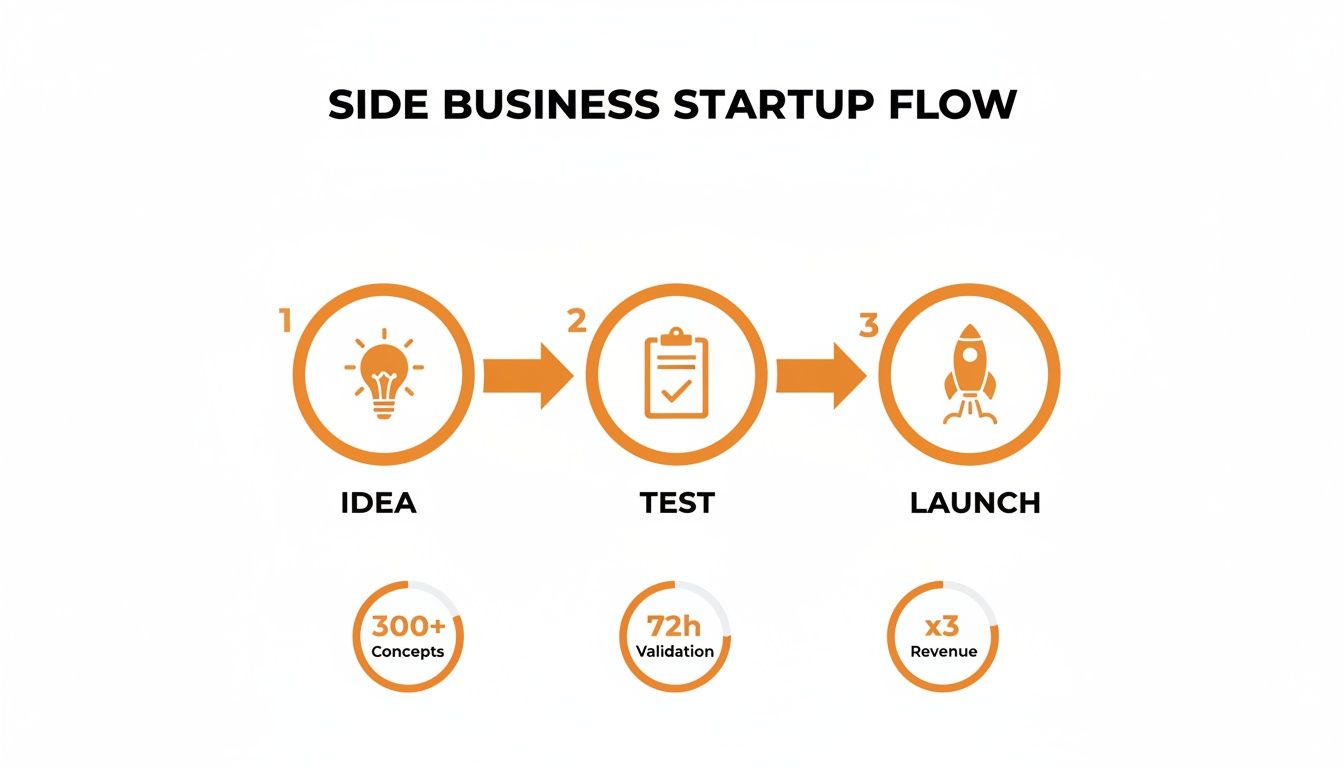
    This simple flow is key. It’s a cycle of coming up with an idea, testing it, and then launching. This is so much smarter than just building something and hoping you show up.

    An infographic showing the side business startup flow, detailing steps like Idea, Test, and Launch with associated metrics.

    This process makes it clear: testing is the critical bridge between your raw idea and a real business. It'll save you a ton of time and money.

    Running Tiny Tests to Validate Demand

    Okay, once you have a few ideas, it's time to put on your lab coat. Your job is to test your hypothesis ("People will pay me for X") with quick, cheap experiments. I’m talking about tests that cost less than a nice dinner out. The whole point is to get a clear signal from the real world—a "yes" or a "no"—before you sink any real time or cash into it.

    Here are a few of my favorite tiny tests:

    1. The Five-Conversation Test: Find five people you think are your ideal customers. But don't pitch them. Instead, ask about their struggles related to the problem you want to solve. Your job is to listen 90% of the time. If they bring up the exact problem you're trying to fix without you prompting them, you're onto something big.
    2. The $50 Ad Test: Whip up a simple landing page—just a single webpage describing what you're offering. Then, run a small social media ad campaign targeting your ideal customer. Your goal isn't to make sales; it's just to see if anyone clicks the "I'm Interested" button.
    3. The Pre-Sale Offer: This is the ultimate validation. Describe your service or product to a small audience (maybe in a relevant online group or just to your personal network) and ask for a deposit to pre-order. If someone gives you actual money for something that doesn't even exist yet, you have a winner.

    Validating an idea isn't about being right; it's about finding the truth as fast as you can. For a deeper dive into this crucial step, you can learn more about how to validate a business idea in our detailed guide. These small experiments give you the data you need to either move forward with confidence or pivot to a better idea without losing your shirt.

    Let's talk about something that trips up almost every new founder. I need you to hear this loud and clear: you absolutely do not need a finished product to make your first sale.

    In fact, building everything out before you've sold a single thing is one of the biggest, most expensive mistakes you can make. It's a fast track to wasting the two things you can't afford to lose: your time and your money.

    We're going to avoid that trap completely. This is all about creating what I call a Minimum Viable Offer (MVO). Think of it as the simplest, most direct version of your idea that someone can buy from you right now. You're essentially selling the architect's blueprint before you even break ground on the building.

    I’ve seen founders launch wildly successful companies with nothing more than a Google Doc outlining a service, a single coaching session, or a simple pre-order page. This gets you paid validation, which means cash in your pocket and priceless feedback from real, paying customers. It's how you figure out what people actually want, not just what you think they want.

    Overhead view of hands tapping a tablet showing 'SeLL The Blueprint' on a white desk.

    Service First, Product Later

    One of the smartest moves you can make is to start with a service, even if your grand vision is a physical or digital product. A service is nimble, costs almost nothing to start, and immediately puts you in conversation with the people you want to serve.

    Let’s say you want to sell gorgeous, custom-designed Canva templates for small business owners. The old way would be to spend a month cranking out dozens of templates, hoping they're what people want.

    The smart way? You start with a service.

    • Your MVO: A "Done-For-You Social Media Graphics Package." For a flat fee, you personally design a week's worth of custom graphics for one client.
    • The Payoff: You get paid right away. More importantly, by working directly with that client, you learn exactly what styles, formats, and messages they need. After doing this for just three to five clients, you'll have a mountain of real-world data to build templates you know people will buy.

    This "service-first" model works for almost anything. You want to build an online course? You start by offering one-on-one coaching. You want to build a software tool? You start by doing the task manually for a handful of clients as a concierge service.

    Selling a service is like getting paid to do market research. Your customers are literally funding your product development while telling you exactly what to build.

    Pricing Your First Offer

    Pricing can feel like pulling a number out of thin air, but it doesn't have to be. For your first MVO, your goal isn't to squeeze every last dollar of profit. It's just to get your first paying customers.

    The price just has to be high enough for people to take it seriously. I've learned people value what they pay for.

    The freelance and side hustle world is absolutely booming, proving people are more than willing to pay for expertise. The freelancing economy has exploded, with projections showing over 70 million Americans will be freelancing by 2025. And the money is there: I've seen reports of a 57% jump in freelancers earning over $100,000 since 2020. Digital-first gigs are hot, and AI-powered services have pushed rates even higher—some AI content creators now charge up to $200 per hour. You can dig into more stats about the state of freelancing on dubsado.com.

    So, you can start with a simple back-of-the-napkin calculation. Pick a fair hourly rate for yourself (even if you don't show it to the client) and estimate how long your MVO will take. Don't be afraid to set a price that feels a little uncomfortable; it often signals quality. For a deeper dive, check out our guide on how to price a new product.

    Delivering an Unforgettable Experience

    For your first few customers, your absolute mission is to over-deliver. These aren't just sales. They're the foundation of your reputation. You want to turn these early adopters into raving fans who will go out and sell for you.

    Here’s how I'd nail it:

    • Communicate Proactively: Keep them in the loop. A quick email saying, "Just wanted to let you know I've started on your project and I'm really excited about it!" works wonders.
    • Add a Small, Unexpected Bonus: If you designed a client's social graphics, toss in a matching email header for free. It costs you next to nothing but creates a massive amount of goodwill.
    • Ask for Honest Feedback: When you're done, ask them, "What was one thing you really loved, and what's one thing I could have done better?" This shows you care and gives you gold for improving your offer.

    This early stage is all about building relationships, not just a customer list. The trust you build and the lessons you learn will be infinitely more valuable than the initial cash you bring in. This is the bedrock you'll build your entire business on.

    Making Your Business Official the Simple Way

    Let's be honest, the legal and financial stuff can sound terrifying. I get it.

    Words like "entity formation" and "tax liability" are enough to make you want to ditch your laptop for a Netflix binge. But I promise, for a side hustle, this is way simpler than you think. You aren't building some complex corporate empire here; you're just putting a simple, protective fence around your new income stream.

    Let’s cut through the noise and talk about the only two options you really need to consider right now.

    Your Business Structure: A Simple Choice

    Think of your personal finances like your wallet. Everything you earn and spend comes out of that one spot. When you first start making money from your side project, you're automatically operating as a sole proprietorship.

    This is the simplest setup. The business is you. The money you make is just personal income, and you’re personally on the hook for everything. The good news? It requires zero paperwork to get started.

    The next step up is a Limited Liability Company (LLC). This is like giving your business its own separate, protected piggy bank. An LLC creates a legal wall between your personal assets (your car, your home) and your business assets. If something goes wrong—say, a client sues you—they can only go after what’s in the business's piggy bank, not your personal wallet.

    An LLC is your financial armor. You might not need it for your very first sale, but as soon as you start generating consistent income or taking on any real risk, it’s the single smartest way to protect yourself and your family.

    So, when do you pull the trigger on an LLC?

    • If your business has real risk: Are you a personal trainer? A consultant giving advice? Are you selling a physical product that could potentially break or cause harm? An LLC is non-negotiable for you.
    • When you start making real money: Once you're consistently clearing a few thousand dollars a month, the cost of an LLC (usually a few hundred bucks) is just cheap insurance.
    • If you plan to have partners: An LLC clearly defines ownership and responsibilities from day one, which will save you from massive headaches down the road.

    You don’t need to do this on day one. But keep it on your radar as your first big milestone after you’ve proven your idea actually works.

    Managing Your Money Without the Headache

    Regardless of your legal setup, you absolutely must take these three financial steps. These aren't just suggestions; they are the bedrock of running a clean, stress-free side business. Get this right, and you'll save yourself from a world of pain come tax season.

    • Open a Separate Business Bank Account: This is the most important financial move you can make. Do not mix your business income with your personal grocery money. A dedicated account creates a crystal-clear record of what’s coming in and going out. Most banks offer free business checking accounts, so you have no excuse.

    • Track Everything Simply: Forget complicated accounting software for now. A simple Google Sheet with two tabs—one for "Income" and one for "Expenses"—is all you need. Every time you get paid, log it. Every time you buy something for the business (software, shipping supplies, a course), log it. This habit takes me five minutes a week and makes tax time a complete breeze.

    • The Golden Rule: Set Aside for Taxes: When you get paid, that money isn’t all yours. The government will want its piece. A safe bet is to immediately move 30% of every single payment you receive into a separate savings account labeled "Taxes." Just do it. This way, you’re never caught off guard with a huge tax bill you can't pay.

    That’s it. Nail these three things, and you’re already ahead of 90% of new side business owners. You'll be organized, protected, and in full control of your finances.

    Getting Your First Customers (While Still Working Full-Time)

    So, you've got a job, a life, and now a side business. Trying to manage all three can feel like spinning plates. The secret isn't finding more hours in the day; it's being incredibly smart with the slivers of time you actually have.

    Forget the generic productivity hacks. You're a part-time founder, and that demands a different playbook. Your most valuable asset isn't cash—it's focused, uninterrupted time. The single best strategy I've found for this is Time Blocking.

    This is more than a to-do list. It's making non-negotiable appointments with your business. Block out specific times in your calendar—say, Tuesday and Thursday from 8 PM to 10 PM, and Saturday morning from 7 AM to 10 AM. During these blocks, you silence your phone, close every other browser tab, and dedicate your full attention to one single business task.

    Desk setup with laptop displaying a calendar with '1st' highlighted, coffee, and a calculator. Text reads 'GET FIRST CUSTOMERS'.

    From Time Blocks to Paying Customers

    Once you’ve carved out the time, what do you actually do? You hunt for your first customers. At this stage, absolutely nothing else matters. Your first sales are the hardest to get, but they provide the most crucial validation you could ever ask for.

    The good news is that the digital marketplace makes this hunt easier than ever. In the US, 52% of side hustlers use e-commerce to earn money. Freelancing is another solid path, with 21% of Americans building side businesses that way. For us here in Chicago and the Midwest, this shows you can build something local that still connects to a worldwide market. (You can dig into more of these side hustle trends on resumly.ai).

    Here are three proven methods to turn your time blocks into real revenue.

    Tap Into Your Existing Network (The Right Way)

    Your first customers are probably hiding in plain sight—in your phone contacts, LinkedIn connections, or email list. But there's a world of difference between leveraging your network and being an annoying pest. Please don't just blast a generic message asking people to buy your stuff.

    Instead, try this:

    • Identify 10 people in your network who you genuinely believe could benefit from what you offer or who might know people that could.
    • Send a personal, low-pressure message. Something like, "Hey [Name], I've started a little side project helping [your target customer] with [the problem you solve]. You came to mind because of [a specific, genuine reason]. No pressure at all, but I'd love to get your quick thoughts on it if you have a moment."
    • Ask for feedback, not a sale. This simple shift turns a sales pitch into a conversation. People love giving their opinion, and if they're actually interested, they will ask you how they can buy.

    Find Where Your Customers Already Gather

    Your ideal customers are already hanging out somewhere online. Your job is to find that digital water cooler and become a helpful, respected voice there. This could be a specific subreddit, a niche Facebook group, a professional Slack community, or even the comments section of an industry blog.

    Don't just jump in and start pitching. That’s a fast track to getting ignored or booted. For your first time block, just listen. Then, you start adding real value. Answer questions, share your expertise freely, and offer help with absolutely no strings attached.

    For instance, if you're a freelance writer for tech startups, find a group for early-stage founders. When someone asks about writing a compelling landing page, give them a detailed, actionable answer right there in the comments. After you've built that trust, people will naturally start checking out your profile and reaching out for paid work.

    Don't sell your product; solve their problem. When you consistently provide value for free, people will assume your paid work is exponentially more valuable and will seek you out.

    Build Trust Through Local Connections

    Never, ever underestimate the power of your local community, especially in a place like Chicago where we value genuine connection. While the internet gives you global reach, you can build local trust much faster.

    You could offer to run a free workshop at a local co-working space, connect with other small business owners at a neighborhood farmer's market, or join a local Meetup group related to your field. In-person interactions build a level of rapport that's tough to replicate online.

    A friend of mine who started a meal prep service got her first 20 customers by handing out free samples at her local gym. She built a loyal base of clients who trusted her because they knew her face-to-face. That local foundation gave her the momentum she needed to expand online. These strategies work best when you have a clear focus, which is why I always recommend creating a simple one-page marketing plan to keep you on track.

    Finding Your Community of Fellow Founders

    Building a side business can be a strange, lonely journey. Your coworkers at your 9-to-5 probably won't get it. Your friends might wonder why you're grinding away on a Friday night instead of grabbing drinks. It’s a classic story I hear all the time.

    That feeling of isolation is a silent killer for so many great ideas. I learned this the hard way, trying to figure everything out on my own. It felt like I was fumbling around in the dark, where every tiny setback felt like a massive failure.

    But everything shifted when I found my people.

    More Than Just Networking

    Let’s be clear: a real community isn't about collecting business cards or making transactional connections. It’s about finding a small, trusted circle where you can be brutally honest.

    It's a place to celebrate the small wins that no one else understands. More importantly, it’s where you can talk about the struggles—those moments when you’re thinking, "What on earth am I even doing?"

    Your peer group is your sanity check. They're the ones who've been where you are, who can call you out when you're making a mistake, and who can offer a specific piece of advice that saves you months of trial and error.

    This is the entire reason I started Chicago Brandstarters. I wanted to create a space for hardworking, kind people in Chicago and the Midwest to come together, share real stories, and genuinely support one another. We're not about performative positivity; we're about the honest, messy reality of building something from scratch.

    What to Look for in a Community

    Finding the right group can accelerate your growth more than any course or book. It’s like having a personal board of directors who are just as invested in your success as you are in theirs.

    When you're looking for a group, keep an eye out for these key ingredients:

    • A Culture of Giving: Is the group focused on helping each other, or is everyone just there to promote their own stuff? You want givers, not takers.
    • Real Operator Experience: Are the members actually in the trenches building businesses? Advice from someone who has actually done it is worth its weight in gold.
    • Psychological Safety: Do you feel safe enough to share your biggest fears and failures? A great community is built on trust and confidentiality.

    When you find this, hold onto it. Problem-solving becomes a team sport. The lonely moments feel less daunting. The entire journey of starting your side business becomes richer and, frankly, a lot more fun.

    Your Top Questions, Answered

    You’ve got questions. I’ve got answers—the real, honest kind, based on what I see people struggle with every single day when they're trying to get a side business off the ground. My only goal here is to give you the clarity to finally move forward.

    How Much Money Do I Really Need to Start?

    Honestly? Way less than you think.

    For a service business—think freelance writing, consulting, design work—you can genuinely get started for under $100. That usually just covers a professional domain name and an email address. You're not buying the whole building; you're just getting the key to the front door.

    If you’re selling physical products, you'll need a bit more for that first batch of inventory. But platforms like Shopify are built for starting small. The golden rule here is to prove your idea with a tiny investment before you even think about putting serious cash on the line.

    Your goal isn't to launch a perfect, fully-stocked store from day one. It's to prove one thing and one thing only: that someone out there will pay you for what you're offering. Start there. Let the revenue you bring in fund your growth.

    Should I Tell My Current Employer?

    This is a tricky one. The answer lives in your employment contract.

    Before you do anything else, you need to dig that document up and look for non-compete clauses or any policies about outside work. And this is non-negotiable: never, ever use company time or company equipment for your side business. Seriously.

    If your new venture is in a totally different field and there’s zero conflict of interest, you often don't have to say a word. But if it’s a gray area at all, spending a few bucks for a quick chat with an employment lawyer is one of the smartest investments you can make.

    When Is It Time to Quit My Day Job?

    I've seen it happen dozens of times, and there are almost always two clear signals that it’s time for you to think about going all-in.

    1. The Financial Signal: Your side hustle is consistently bringing in 75-100% of your day job's income. And I mean consistently—for at least three to six months in a row.
    2. The Mental Signal: You start to feel like your 9-to-5 is actively holding your business back. The thought of working on your own thing energizes you more than the thought of juggling both drains you.

    When both of those signals are flashing bright green, you’re ready to make the leap.


    Ready to stop figuring this all out on your own? Join Chicago Brandstarters, a free community of kind, hardworking founders in Chicago and the Midwest who are building something real. Find your people and grow your business faster at https://www.chicagobrandstarters.com.

  • The 12 Best Side Businesses to Start in 2026 (Even With a Full-Time Job)

    The 12 Best Side Businesses to Start in 2026 (Even With a Full-Time Job)

    You're here because your 9-to-5 feels like a cage. You know you can do more. That itch you feel? It's the founder’s itch, and I know it well. You have the drive, but the path from your desk to your own business seems foggy. Good news: you don’t have to leap without a net. The best side business to start is one you can build right now, in the evenings and on weekends.

    Think of this as your blueprint, not just another list. We're skipping the "follow your passion" fluff. Instead, I'm giving you a real breakdown of 12 business models, from e-commerce brands to tiny software products. For each one, I’ll tell you:

    • Startup Costs: What you’ll actually spend.
    • Time Commitment: The honest weekly hour count.
    • Revenue Potential: A realistic look at your first-year earnings.
    • Action Plans: Your exact steps for the first 30 and 90 days.

    This isn’t about dreaming; it's about building. We'll explore real paths for hardworking people like you who want to create something that matters. Let's find the business that won’t just add to your income but will make you feel alive again. It’s time to stop wondering "what if" and start building.

    1. E-commerce Brand (Shopify/Print-on-Demand)

    Launching an e-commerce brand is one of the easiest and most scalable ways to start a side business. You create a brand and sell physical products online, usually on a platform like Shopify. You don’t need a warehouse full of stuff to start. Models like print-on-demand (for shirts, mugs, posters) let you sell products without ever touching them yourself.

    A white box, folded t-shirt, blue package with a smartphone, and 'BUILD YOUR BRAND' sign on a wooden table.

    This works because you can start small, test ideas cheaply, and talk directly to your customers. Think of it like a band starting in a garage. They play for a small, passionate crowd first. You do the same. Maybe your brand becomes the go-to for sustainable pet toys or witty t-shirts for Chicago coders. The key is to find your people and serve them well.

    Actionable Tips for Success

    • Niche Down: Don't sell "coffee." Sell "organic, single-origin coffee for cold brew lovers." Being specific makes marketing way easier.
    • Build an Email List Immediately: Your email list is yours forever. Offer a small discount for a signup on day one.
    • Master Organic Social: Use TikTok and Instagram Reels to tell your story. Show your products. Be real. Do this before you spend a dime on ads.
    • Focus on the Post-Purchase Experience: A handwritten thank-you note can turn a one-time buyer into a fan for life.

    For a deeper dive, my guide on how to start an e-commerce business gives you a step-by-step roadmap. This is a great side business to start if you have a creative spark and want to build a brand people love.

    2. Content Creator/Personal Brand (YouTube, TikTok, Newsletter)

    Being a content creator means you build an audience around your expertise or personality. Instead of selling a product, you are the product. You build a community on YouTube, TikTok, or a newsletter by sharing valuable stuff. You make money later through sponsorships, affiliate links, or by launching another business to your audience.

    This is a powerful side business because your effort compounds over time with almost no startup cost. It's like planting a tree. Your first few posts or videos might feel like they do nothing. But over time, they grow into a huge asset. You could be the go-to YouTube channel for Midwest gardeners or the must-read newsletter for Chicago's tech scene. Your unique view is the whole business.

    Actionable Tips for Success

    • Pick Your Platform: Don't try to be everywhere. If you write well, start a newsletter. If you're good on camera, do YouTube or TikTok. Play to your strengths.
    • Document, Don't Create: Don't pretend to be a polished expert. Just document your journey. Share what you learn, your mistakes, and your wins. It’s authentic and builds a strong community.
    • Engage with Your First 100: Treat your first 100 followers like gold. Reply to every comment. These people will become your biggest fans.
    • Repurpose Everything: One long YouTube video can become 10 TikTok clips, five Instagram posts, and a newsletter. Work smart, not hard.

    If you want to build a real audience, this is the best side business to start. It’s a marathon, not a sprint, but the payoff is huge.

    3. Freelance Services (Design, Writing, Development, Marketing)

    If you have a skill people will pay for, freelancing is the fastest way to make side money. You offer your expertise in things like design, writing, or marketing directly to clients. You can start on sites like Upwork, but your real goal is to build direct relationships.

    A modern desk setup with a laptop, coffee, and documents, ideal for freelance work and services.

    This model works because you invest your time, not your money. You’re just selling the skills you already have. It’s like being a talented chef who starts by cooking for private parties before opening a restaurant. Your first few projects are your "tasting menu"—they prove what you can do and help you land bigger clients. The key is to stop selling hours and start selling results.

    Actionable Tips for Success

    • Specialize Ruthlessly: Don't be a generic "writer." Be a "B2B SaaS copywriter for email onboarding sequences." This focus gets you better clients and lets you charge more.
    • Build Case Studies, Not Just a Portfolio: A portfolio shows what you did. A case study shows the value you created, like "I increased their lead conversions by 35%."
    • Create Productized Services: Offer a fixed-price package, like a "$2,500 Website SEO Audit." This makes your services easy to buy and avoids endless back-and-forth.
    • Focus on Building Direct Relationships: Use platforms to get started, but aim to move clients off them. This builds long-term partnerships and avoids fees.

    For a deeper look, my guide on how to quit your job for your business shows you how to plan the leap. Freelancing is the best side business to start if you want to use your skills for fast cash and build a foundation for something bigger.

    4. Digital Product/Course Creation

    If you're an expert at something, you can package that knowledge into a digital product and sell it forever. Think online courses, e-books, or design templates. This is the ultimate "create once, sell forever" model. Platforms like Gumroad or Podia make it simple to upload your product and start selling.

    This is like writing a hit song. You do the hard work of writing and recording it once, and then it can earn you money for years while you sleep, work, or vacation. Your product could be a course on "Excel for Chicago Real Estate Analysts" or Lightroom presets for Midwest wedding photographers. You’re just solving a painful problem for a specific group of people.

    Actionable Tips for Success

    • Solve a Niche Problem: Don't create a course on "marketing." Create one on "LinkedIn Content Strategy for B2B Tech Sales Reps." Specificity sells.
    • Validate Before You Build: Pre-sell your course to see if anyone cares. Don't spend months building something nobody wants.
    • Start with a 'Tripwire' Product: Create a low-cost, high-value product like a checklist. This builds trust and makes it easier to sell your big course later.
    • Leverage Testimonials: Social proof is everything. Show off success stories from your first few customers to build credibility.

    If you have valuable skills and want a scalable, low-overhead business, creating a digital product is one of the best side business ideas to start. You build a real asset that generates passive income.

    5. Niche Affiliate Marketing (Content + Recommendations)

    Instead of making your own product, you can become the most trusted guide in a specific niche. This is affiliate marketing. You create helpful content (blog posts, YouTube videos) that solves a problem, and you earn a commission when your audience buys products you genuinely recommend. You're not a salesperson; you're a trusted advisor.

    This works because you focus on building trust, not managing inventory. Think of it like being the one friend everyone asks for movie recommendations. You've seen everything, you know their taste, and you give honest reviews. Your credibility is your most valuable asset. A Chicago blogger could become the expert on "the best running gear for the lakefront trail in winter" and earn income from those recommendations.

    Actionable Tips for Success

    • Solve Problems, Don't Push Products: Your content should answer specific questions like "What's the best podcasting mic under $100?" instead of just listing features.
    • Be Radically Transparent: Always tell people you're using affiliate links. Trust disappears the second your audience feels tricked.
    • Test Everything You Recommend: The best recommendations come from your own experience. People can spot generic advice from a mile away.
    • Create Comparison Content: "Best Of" lists and "X vs. Y" articles work incredibly well because they help people make a final decision.

    If you love teaching and helping people make smart choices, this is an excellent side business to start. It rewards your expertise and the trust you build.

    6. Local Service Business (Coaching, Consulting, Tutoring)

    You can turn your expertise into a powerful side business by selling it as a service. This means offering one-on-one coaching, consulting, or tutoring. You can work with local Chicago clients or serve people anywhere online. Your brain is the product. No inventory needed.

    This model is a rocket ship powered by your reputation. You start by solving problems for a few people, and their success becomes your marketing. Think of it like a personal trainer. They help one client get amazing results, and suddenly, everyone wants to train with them. You could be a career coach for tech professionals or a GMAT tutor for MBA hopefuls. Your value is tied to the results you deliver, making it one of the most fulfilling side businesses you can start.

    Actionable Tips for Success

    • Specialize Intensely: Don't be a generic "life coach." Be a "productivity coach for first-time founders juggling a day job." This specificity makes you a magnet for the right clients.
    • Document Every Win: Your first clients are your best marketing. Track their progress and turn their success into powerful case studies.
    • Price for Commitment: Charge premium rates. This attracts serious clients who will do the work and get results.
    • Scale to a Group Model: Once you're fully booked one-on-one, launch a group program. You can help more people and increase your income without working more hours.

    If you’re ready to turn what you know into a high-impact business, my guide on how to build a personal brand is the perfect place to start.

    7. Software as a Service (SaaS) Product

    Building a Software as a Service (SaaS) product is one of the most scalable side businesses you can start. You create a software solution for a specific problem and sell access through a recurring subscription. Think of it less like building a skyscraper and more like designing a single, perfect key that unlocks a big frustration for a small group of people.

    You don't have to be a coding genius. Many successful SaaS companies started because the founder just wanted to solve their own problem. The real power here is recurring revenue. It’s like getting paid rent every month instead of selling a house once. This creates predictable income that grows over time, making it a powerful engine for building real wealth.

    Actionable Tips for Success

    • Solve a Micro-Problem: Don't try to build the next Slack. Build a tool that helps freelance designers in Chicago manage client feedback. A narrow focus is your superpower.
    • Validate Before You Build: Use no-code tools to create a simple version first. See if people will pay for it before you write a single line of code.
    • Talk to 20+ Potential Users: Before you build anything, interview people. Understand their pain points. Ask them what they're using now.
    • Charge From Day One: Even a small price proves you're solving a real problem. Your first paying customer is a bigger deal than your first 1,000 free users.

    For more on this, check out my guide on how to start a product business. If you love solving problems with tech and want to build a business with massive potential, a SaaS product is the best side business to start.

    8. Amazon FBA (Fulfillment by Amazon) Business

    An Amazon FBA business is when you find and brand a physical product, then let Amazon handle all the storage, shipping, and customer service. You find a product people want, put your brand on it, and send it to Amazon. When someone buys it, Amazon does the rest. It's like having an e-commerce store where your warehouse is run by one of the biggest companies in the world.

    This model lets you tap into Amazon’s millions of customers and Prime shipping without needing your own warehouse. Your job is to be a smart detective. You hunt for an underserved product category, find a way to make it better, and then create the perfect Amazon listing to attract buyers. This is the best side business to start if you love market research and want to use a massive existing platform to your advantage.

    Actionable Tips for Success

    • Master Market Research: Use tools like Jungle Scout to find products with high demand but low competition. Don't guess; use data.
    • Target 40%+ Gross Margins: After all the costs and Amazon fees, you need a healthy margin to afford advertising and actually make a profit.
    • Optimize Your Product Listing: Your title, bullet points, and images are your digital storefront. Obsess over every detail to get more sales.
    • Learn Amazon PPC: Paid ads on Amazon are how you get your first sales and start ranking. Start with a small daily budget to learn the ropes.

    For a detailed walkthrough, Jungle Scout's Million Dollar Case Study is a fantastic free resource that shows you the entire process.

    9. Membership Site / Community Platform

    Building a membership community means creating a digital space where people pay a recurring fee for exclusive access to content, networking, or you. This isn't just a Facebook group. It's a private club built on platforms like Circle or Mighty Networks where members connect around a common goal.

    Think of it like building the ultimate clubhouse for a specific niche. You're not selling a one-time product; you're providing ongoing value and connection. Maybe you create a community for Chicago founders navigating their first year, or one for Midwest woodworkers to share techniques. The goal is to make the community so valuable that the members themselves become the main attraction. This is an incredible side business to start if you love connecting people.

    Actionable Tips for Success

    • Build the Audience First: Don't build a community and then look for people. Start a newsletter, podcast, or social media account to gather your future members first.
    • Start Free, Then Go Paid: Launch a free version to prove your idea. Once you have a core group of active members, introduce a paid tier with premium benefits.
    • Facilitate Member-to-Member Connections: Your job is to be the host of the party, not the center of attention. Create events and spaces that encourage members to connect with each other.
    • Charge a Price That Attracts Commitment: A low price attracts lurkers. Charge enough to ensure everyone in the room is serious about being there.

    For inspiration, look at how local groups like Chicago Brandstarters build trust. A strong community is a long-term asset that can become the core of a thriving business.

    10. Content Agency / Productized Content Services

    Starting a content agency means you turn your creative skills—writing, video, design—into a scalable business. Instead of trading hours for dollars, you create "productized" services. This means you offer fixed-scope packages with clear prices, like "Four Blog Posts Per Month for SaaS Companies." This gives you predictable revenue and your clients get clear results.

    This is one of the best side business to start because you're building a machine, not just a job for yourself. It’s like a restaurant that offers a set menu instead of a custom dish for every guest. It’s more efficient and can serve more people. You can start solo, prove your process with a few clients, and then hire other creatives to do the work while you focus on growing the business.

    Actionable Tips for Success

    • Productize One Core Offer: Don't sell everything. Start with one specific, high-value package, like a "Monthly SEO Article Pack," and master it.
    • Document Your Process: Create a step-by-step checklist for everything. This is your playbook for hiring people and keeping quality high.
    • Focus on Retainers: Prioritize clients who need ongoing monthly work. Recurring revenue is the key to stability.
    • Build Case Studies: Show the business impact of your work. Don't say "we wrote four blogs." Say "we increased their organic traffic by 40% in three months."

    This side business is perfect for you if you're a skilled creator who wants to build a real business with systems, not just another freelance gig.

    11. Reselling/Arbitrage (Thrift Flipping, Dropshipping Variation)

    Reselling is the art of buying low and selling high. You find undervalued stuff at thrift stores or online and resell it for a profit on platforms like eBay or Facebook Marketplace. This is one of the fastest ways to generate cash with very little upfront money.

    A flat lay featuring various items and a sign that reads 'THRIFT FLIPPING,' along with clothing, a phone, camera, sunglasses, and shoes.

    Think of yourself as a modern-day treasure hunter. The thrill is finding a vintage Coach bag for $10 and reselling it online for $150. You need to develop an eye for a specific niche, whether it's vintage band tees, first-edition books, or mid-century furniture. This is a fantastic side business to start if you love the hunt and have a knack for spotting hidden value.

    Actionable Tips for Success

    • Specialize in One Category: Start with what you know. If you love fashion, focus on designer denim. If you're a gamer, hunt for retro video games. Specializing helps you spot gems faster.
    • Systematize Your Process: Batch your tasks. Have a sourcing day, a photography day, and a listing day. Efficiency is how you scale.
    • Master Photography and Listings: Your photos are everything. Use good light and write detailed, keyword-rich descriptions.
    • Track Your Margins Religiously: Use a spreadsheet to track your costs, selling price, fees, and shipping for every item. Profit is the only thing that matters.

    If you want to build a brand around your finds, check out my guide on how to build a brand on social media. You can turn this hustle into a recognized name.

    12. Micro-Influencer Marketing / Brand Partnerships

    Instead of chasing millions of followers, you can build a profitable side business by becoming a trusted voice for a small, engaged audience. This is micro-influencer marketing. You build a community (usually 10k-100k followers) in a niche and partner with brands for sponsored posts and affiliate deals.

    Think of it as being the most trusted foodie friend in your group, but on a bigger scale. Brands will pay you a premium to reach your audience because your recommendation carries more weight than a celebrity's. A Chicago creator with 50,000 TikTok followers who reviews local breweries can charge more than a general influencer with 500,000 followers. You’re selling trust, not just eyeballs. This is a powerful side business because your authenticity is your greatest asset.

    Actionable Tips for Success

    • Pick a Niche with Buyers: Focus on a topic where brands already spend money, like personal finance, B2B software, or beauty.
    • Obsess Over Engagement Rate: Your engagement rate (likes, comments, shares) matters more than your follower count. It proves your audience is real.
    • Create a Media Kit: Build a simple PDF showcasing your stats and past work. This makes you look professional.
    • Pitch Brands Directly: Don't wait for brands to find you. Find companies you love and send them a pitch explaining how you can help them.

    For a great example of how you can monetize your influence, check out the tools offered by platforms like Kajabi, which helps creators build entire businesses around their audiences.

    Top 12 Side-Business Ideas Comparison

    Business Type Implementation (🔄) Resources & Efficiency (⚡) Expected Outcomes / Impact (📊) Ideal Use Cases (💡) Key Advantages / Quality (⭐)
    E-commerce Brand (Shopify / Print-on-Demand) 🔄🔄 Medium — store, branding, supply chain setup ⚡ Low–Medium capital (POD low; inventory raises costs); marketing-intensive 📊 Scalable revenue over months → years; variable margins Makers, product designers, consumer goods with brand focus ⭐ Direct brand control; omnichannel sales; passive potential after automation
    Content Creator / Personal Brand (YouTube, TikTok, Newsletter) 🔄 Low — content process + consistency required ⚡ Very low capital, high time commitment; platform-dependent efficiency 📊 Compound audience growth (6–18+ months to monetize meaningfully) Storytellers, educators, niche experts building audience-first businesses ⭐ Defensible personal moat; multiple monetization paths
    Freelance Services (Design, Writing, Dev, Marketing) 🔄🔄 Low–Medium — client workflows and delivery systems ⚡ Low capital; high time/skill; quick to start, harder to scale without team 📊 Immediate income potential; scalable via price increases or outsourcing Skilled professionals selling time/skill to clients ⭐ Fastest path to revenue; direct client feedback builds reputation
    Digital Product / Course Creation 🔄🔄🔄 Medium — course creation + funnel setup ⚡ Low capital, high upfront time; highly efficient after launch 📊 Passive, high-margin sales possible; weeks→months to first sales Subject-matter experts wanting scalable digital offerings ⭐ High margins and authority-building; evergreen revenue when marketed well
    Niche Affiliate Marketing (Content + Recommendations) 🔄🔄 Low–Medium — content + SEO/placement systems ⚡ Low capital; time to build content and audience; efficient once indexed 📊 Passive commissions from past content; 3–6+ months to traction Reviewers, niche bloggers, product-focused creators ⭐ No inventory; low operational overhead; easy to combine with other streams
    Local Service Business (Coaching, Consulting, Tutoring) 🔄 Low — direct client delivery and scheduling ⚡ Low capital, high time; premium hourly or package rates 📊 Fast revenue (days→weeks); limited scale without group products Coaches, consultants, tutors serving local/remote clients ⭐ High per-client pricing; quick validation and referrals
    SaaS Product 🔄🔄🔄🔄 High — product dev, infra, compliance ⚡ High technical & capital requirements; long build cycles 📊 Predictable, recurring revenue; large upside but months→years to product-market fit Technical founders solving repeatable workflow problems ⭐ Most scalable and defensible model; strong exit potential
    Amazon FBA (Fulfillment by Amazon) Business 🔄🔄🔄 Medium–High — sourcing, listing, PPC, inventory ops ⚡ Significant capital ($10K–$50K+); logistics efficiency via Amazon 📊 Potential high revenue quickly with right product; margins compressed by fees Private-label sellers targeting Amazon demand channels ⭐ Amazon traffic + outsourced fulfillment; proven exit markets
    Membership Site / Community Platform 🔄🔄 Medium — community design & moderation systems ⚡ Medium resources (audience or heavy upfront effort); recurring efficiency with retention 📊 Recurring revenue; high lifetime value if engagement maintained Creators/organizations with engaged followings ⭐ Strong retention via network effects; diversified monetization
    Content Agency / Productized Content Services 🔄🔄 Medium — processization, hiring, client ops ⚡ Moderate resources (team/time); scalable with documented systems 📊 Reliable retainer revenue; scales with hires and productization Freelancers scaling to agency; niche content providers ⭐ Predictable delivery; easier to delegate and grow margins
    Reselling / Arbitrage (Thrift Flipping, Dropshipping Variation) 🔄🔄 Low–Medium — sourcing, listing, fulfillment routines ⚡ Very low capital to start (<$100); labor-intensive but fast turnaround 📊 Immediate cashflow; volume-dependent scaling (weeks→months) Thrifts, flippers, bargain-sourcing entrepreneurs ⭐ Lowest barrier to entry; fastest path to cash
    Micro-Influencer / Brand Partnerships 🔄🔄 Low–Medium — content + partnership ops ⚡ Low capital; time to grow to 10K+ followers; efficient per-campaign 📊 Sponsorship revenue once engaged audience (10K–50K); variable per post Niche creators aiming for brand deals ⭐ High engagement value; premium CPMs for niche, loyal audiences

    The Hardest Step Is the First One. Let's Take It Together.

    We’ve just walked through twelve different paths. You’ve seen everything from launching a Shopify brand to building a tiny software product. Each idea has its own mix of startup costs, time, and skills.

    It's normal to feel both excited and overwhelmed right now. This is where "analysis paralysis" kicks in—that tricky state where you feel productive researching, but you never actually build anything. You might be stuck weighing the pros and cons, trying to find the one perfect, risk-free option.

    Here’s the truth: the real best side business to start isn't the one with the highest potential on paper. It’s the one you actually start.

    From Idea to Action: Your Next Move

    The journey from a 9-to-5 to a side business isn't one giant leap. It’s a series of small steps. Your goal right now is not to build an empire by next year. Your only goal is to create momentum.

    Think of it like pushing a stalled car. The first push takes the most effort. You have to overcome inertia. But once the wheels start turning, it gets much easier to keep it moving. That's what you need to do now.

    Forget about a 50-page business plan. Pick the one idea from this list that sparked something in you. Not the one your friend thinks is cool. The one you can’t stop thinking about.

    Your next action should be so small it’s almost silly:

    • Interested in E-commerce? Buy the domain name.
    • Thinking of Content Creation? Create the TikTok account.
    • Considering Freelancing? Email one person you know and tell them what you're offering.
    • Dreaming of a Digital Product? Outline the first three parts of your course.

    This isn’t about being perfect; it’s about proving to yourself that you're serious. You're turning a dream into a real project, no matter how small.

    You Don't Have to Build Alone

    Starting a business is lonely. You're working late nights, wrestling with problems none of your friends understand. The best asset you can have isn't another course. It's a community of people who are in the trenches with you. People who get the struggle of finding your first customer and the thrill of your first sale.

    You've done the hard work of exploring the ideas. You've found a path that feels right. Now, the hardest step is the first one. Go do that one small thing today.


    If you're a kind, hardworking builder in Chicago looking for a community that values collaboration over competition, then Chicago Brandstarters was built for you. We are a supportive network of founders helping each other grow from idea to seven figures, without the ego and gatekeeping of traditional networking. Join us and surround yourself with people who will help you take that first step and every one after.

    Learn more and join the community at Chicago Brandstarters

  • 7 Places to Find the Best Seller Business Books in 2026

    7 Places to Find the Best Seller Business Books in 2026

    You're building a brand from scratch. Time is your most precious asset. I know you can't afford to waste it on generic "must-read" lists that lead nowhere. You need real wisdom for today's problems, not abstract theories. I've been in your shoes, drowning in a sea of best seller business books, trying to figure out which ones actually hold the keys.

    Think of this guide as your shortcut. Instead of just giving you a list of books, I'm showing you exactly where to find them and which place fits where you are right now. I'll walk you through the 7 best spots that successful founders—especially those I know in our Chicago and Midwest communities—use to find their next game-changing read.

    This isn't fluff. It's a map. It's built to help you find insights you can use immediately, whether you're sketching an idea on a napkin, scaling an online store, or growing a side hustle. Every recommendation has a direct link and a simple reason why it's worth your time. Let's cut through the noise and get straight to the tools that will help you build something that lasts.

    1. Amazon

    As the biggest bookseller out there, Amazon is the obvious first stop. You can find almost any business book ever written. Whether you have a title in mind or you're just browsing the best seller business books, its huge catalog and sharp search tools make it easy. From classics to brand-new releases, you can get it in any format you want.

    A screenshot of the Amazon homepage, a prominent source for best seller business books.

    The platform nails it when it comes to choice. You can grab a hardcover for your desk, download a Kindle eBook for your commute, or listen to an audiobook on Audible while you're at the gym. It’s like a Swiss Army knife for readers. Throw in fast Prime delivery, and you’ve got unbeatable convenience.

    Key Features for Founders

    Amazon's whole system is designed to help you decide fast. The "Look Inside" feature is like flipping through a book in a store; you can read the first few pages and get a feel for the author’s voice before you buy. Then you have the customer reviews, which are a goldmine of real-world feedback on what works and what doesn't.

    Here's a pro-tip I use: keep an eye on the live Kindle Store Bestseller Ranks in the "Business & Investing" category. It’s like having a direct line to what other founders are reading right now. This helps you stay on top of the ideas shaping your industry.

    Pros and Cons

    Pros Cons
    Widest selection of formats and titles Crowded marketplace with varying seller quality
    Fast and reliable delivery with Prime Pricing and stock can fluctuate unexpectedly
    Robust customer reviews and previews Can be overwhelming without a specific title in mind

    Why It Makes the List

    Amazon’s massive scale, format options, and pricing make it a must-have for any founder building a business library. Its discovery tools and customer reviews mean you can find the exact knowledge you need, right when you need it. Since many of us also sell on Amazon, it's vital to know the rules. I've covered how to deal with problems in my guide on handling Amazon account suspensions.

    Website: https://www.amazon.com

    2. Barnes & Noble

    As a bookstore veteran, Barnes & Noble gives you a more curated, classic way to find best seller business books. It's the perfect middle ground between the chaos of a huge online marketplace and the focused feel of a real bookstore. You can easily browse its well-organized business section, which highlights new releases, staff picks, and top sellers.

    This platform gives you the best of both worlds. You can order a hardcover online and have it shipped to your door, or you can use in-store pickup to grab it today. If you're a digital reader, the NOOK eBook format lets you dive into a new strategy guide instantly.

    Key Features for Founders

    The "Business" category hub is where Barnes & Noble really shines. Unlike sprawling sites, it's neatly organized into practical subgenres like "Management," "Finance," and "Small Business & Entrepreneurship." This helps you find what you need much faster. It's like having a librarian who's already sorted the shelves for you.

    Here's a tip I recommend: check out the "Staff Picks" in the business section. This is where I often find hidden gems that haven't hit the mainstream bestseller lists yet. Think of it as getting a personal recommendation from someone who reads for a living, which can introduce you to ideas you wouldn't find otherwise.

    Pros and Cons

    Pros Cons
    Clean category navigation for focused browsing eBook ecosystem is smaller than Amazon/Google
    In-store pickup option combines online and physical shopping Some pages require JavaScript, which may lag on older browsers
    Clear shipping perks for members and non-members Selection, while large, is not as exhaustive as Amazon's

    Why It Makes the List

    Barnes & Noble earns its spot by offering a more intentional shopping experience. If you get overwhelmed by endless choices, its curated approach is a breath of fresh air. The mix of a solid online store and reliable physical locations gives you the flexibility to get the business insights you need, how you need them.

    Website: https://www.barnesandnoble.com/b/books/business/_/N-29Z8q8Zt82

    3. Bookshop.org

    If you like shopping online but want your money to support local businesses, Bookshop.org is for you. This platform is an online marketplace built to help independent bookstores thrive. When you buy a book, a big slice of the profit goes into a pool that's split among participating indie shops. It’s a way to find the best seller business books that feels good.

    Bookshop.org

    The site is clean and simple, making it easy to discover both print and digital books. While it's not as massive as Amazon, you'll find almost every major business title. You can even choose a specific local bookstore to support with your purchase. You’re not just buying a book; you’re investing in other small business owners like you.

    Key Features for Founders

    Bookshop.org is all about curation. It feels more like a boutique than a big-box store. You can browse lists created by specific bookstores, authors, and publications, which often unearth amazing books you'd otherwise miss. These collections in the "Business & Economics" category can lead you to niche topics that are incredibly relevant.

    Since they've added eBooks, you can learn on the go with their app. Here's a tip: look for affiliate pages from your favorite business podcasts or thinkers. Many create curated lists on Bookshop.org, so you can see what they recommend while supporting them and local stores at the same time.

    Pros and Cons

    Pros Cons
    Purchases directly support independent bookstores Print shipping is currently limited to the US
    Clean, curated browsing experience Bookshop eBooks do not support Kindle devices
    Simple 30-day return policy for print books In-app eBook purchasing can be limited by app store rules

    Why It Makes the List

    Bookshop.org makes the list because it’s a powerful, mission-driven choice for founders who care about community. You can build your business library while directly investing in the small business ecosystem. If you believe how you spend your money matters, this platform aligns your purchases with your values, without giving up convenience.

    Website: https://bookshop.org

    4. Porchlight Book Company

    When you need more than just one book, you need a specialist. That's Porchlight Book Company (you might remember them as 800-CEO-READ). This isn't your typical bookstore. It's a service for bulk orders and corporate gifts. If you're planning a team-wide read for your startup or sending a thank-you to investors, this is your place to find best seller business books with a professional touch.

    Their entire business is built to serve teams, not just individuals. This means they offer customization you won't find anywhere else. Think of Porchlight less like a store and more like a partner who helps you spread knowledge across your entire company.

    Key Features for Founders

    Porchlight makes big orders simple. Their bulk fulfillment service gives you custom quotes, handles all the logistics, and makes sure every book gets where it needs to go. You can even add custom stickers or signed bookplates to turn a book into a memorable gift.

    A great way to find your next team read is to check out their editorial picks and the annual Porchlight Business Book Awards. These lists cut through the noise and highlight innovative books you might have missed. Their customer service is run by actual people, which is a huge help when you need to track down a specific edition.

    Pros and Cons

    Pros Cons
    Streamlined process for bulk and corporate orders Limited selection of eBooks and audiobooks
    Unique customization options (e.g., signed bookplates) Shipping costs and timelines vary by project
    Expert editorial curation helps with discovery Some bulk discounts may be non-returnable

    Why It Makes the List

    Porchlight makes the list because it's laser-focused on what organizations need. When you have to get the same knowledge into the hands of your whole team, their service is unbeatable. They’re the bridge between an author’s ideas and your entire company, making it easy to share the best business insights at scale.

    Website: https://www.porchlightbooks.com

    5. Harvard Business Review (HBR) Store

    If you're after serious, research-backed business knowledge, the Harvard Business Review (HBR) Store is your destination. This isn't a massive marketplace. It's a direct line to some of the most respected thinking in the business world. Here, you'll find HBR Press books, individual articles, and deep-dive case studies to sharpen your strategic mind.

    A screenshot of the Harvard Business Review (HBR) Store, a source for best seller business books.

    The platform is great at packaging wisdom. Collections like HBR's 10 Must Reads bundle the most powerful articles on topics from leadership to strategy. It's like getting a masterclass in a box. Buying straight from the publisher ensures you're getting the real deal, perfect for building a professional library for you or your team.

    Key Features for Founders

    The HBR Store’s power is in its focused catalog. Instead of just browsing titles, you can filter by critical topics like innovation or marketing to find targeted solutions. Being able to buy single articles or case studies is a game-changer. It lets you get powerful ideas for a specific problem without having to read an entire book.

    Here's a tip I give to founders: use their curated collections to get your leadership team on the same page. Buying a set of books on management, for example, means everyone is working from the same playbook. Aligning your team on core ideas is a key part of the small business growth strategies I recommend.

    Pros and Cons

    Pros Cons
    Direct publisher access guarantees authenticity Shipping isn't typically free and has set tiers
    Curated collections simplify learning on key topics Digital items are usually non-returnable
    Offers individual articles and case studies Selection is limited to HBR-published materials

    Why It Makes the List

    The HBR Store earns its spot by providing access to authoritative, research-backed business insights you can't get just anywhere. It’s the perfect place for founders who want to build their business on proven principles, not just trends. For creating a team reading list or diving deep into a strategic challenge, HBR delivers depth and credibility.

    Website: https://store.hbr.org

    6. Audible

    For busy founders, I know sitting down to read can feel like a luxury you don't have. Audible fixes that. It turns your commute, workout, or chores into learning time. As the top audiobook platform, it has a massive library of best seller business books, often narrated by the authors themselves and available on launch day.

    A person listening to audiobooks, a great way to consume best seller business books.

    The platform runs on a membership. The premium plan gives you monthly credits to buy any title you want, which you then own forever. This is great for those core books you'll listen to again and again. A cheaper plan gives you unlimited listening to a huge, rotating catalog of audiobooks and podcasts. It’s like a Netflix for your ears.

    Key Features for Founders

    Audible's biggest win is accessibility. The power to absorb dense business ideas while you do other things is a game-changer for me. When the author narrates, you often get an extra layer of meaning and emphasis that helps the lessons stick.

    A tip I use all the time is the clipping feature. You can save key moments or advice and revisit them later without having to search through hours of audio. Also, keep an eye out for member-only sales. You can often grab top-tier business books for a steep discount, making your learning budget go further.

    Pros and Cons

    Pros Cons
    Huge catalog with day-one availability for new releases Top bestsellers often require a paid credit
    Audio format is ideal for multitasking and busy schedules The Plus Catalog selection can be hit-or-miss
    Keep your purchased audiobooks forever with a credit Navigating different membership tiers can be confusing

    Why It Makes the List

    Audible makes professional growth possible, no matter how jammed your schedule is. It turns downtime into growth time, letting you absorb the latest strategies without needing to block off hours to read. For founders building a knowledge base, I've curated a list of essential business strategy books on our blog, and they're all on Audible.

    Website: https://www.audible.com

    7. Google Play Books

    If you're plugged into the Android and Google world like I am, Google Play Books is a seamless alternative to Kindle. It offers a huge catalog of digital books, making it a great spot to find the best seller business books without ever leaving Google's familiar space. You can access your library from anywhere—your web browser, Android phone, or even an iPhone.

    A screenshot of the Google Play Books interface showcasing best seller business books.

    The platform focuses on ebooks and audiobooks with a clean, easy-to-use experience. What I love most is how it syncs across my devices. I can read a chapter on my laptop, then pick up right where I left off on my phone during my commute. It just works.

    Key Features for Founders

    Google Play Books is all about convenience. A key feature for me is the ability to download some books as DRM-managed EPUB or PDF files for offline reading on different e-readers. This is a big plus if you don't use a Kindle. The platform also runs frequent sales, so you can often grab popular business titles for less.

    A huge benefit for founders is the clear, 7-day refund policy on most ebooks. If you buy a book and it's not what you hoped for, you can get your money back easily. This removes the risk of spending money on a book that doesn't help your business, making it easier for you to explore new ideas.

    Pros and Cons

    Pros Cons
    Excellent for readers outside the Kindle ecosystem Kindle-exclusive titles will not be available
    Strong cross-device compatibility with cloud sync Some publishers enforce strict DRM on downloads
    Clear and user-friendly 7-day refund policy Audiobooks and certain titles have stricter refund rules

    Why It Makes the List

    Google Play Books makes the list because it's a strong, user-friendly digital option, especially for those of us using Android and Google. Its simple interface, frequent deals, and straightforward refund policy make building your digital business library both cheap and risk-free. It’s a solid choice for getting the knowledge you need on any device.

    Website: https://play.google.com/books

    Best-Seller Business Books: 7-Store Comparison

    Retailer Implementation complexity 🔄 Resources & Formats ⚡ Expected outcomes 📊 Ideal use cases ⭐ Key advantages / tips 💡
    Amazon 🔄 Low — streamlined checkout, multiple sellers and account features ⚡ Broad: hardcover, paperback, Kindle, Audible; Prime fast delivery 📊 High discoverability and dynamic pricing; quality varies by seller ⭐ Finding bestsellers quickly, price/promotions, fast delivery 💡 Use Kindle previews, bestseller rankings and watch seller listings
    Barnes & Noble 🔄 Medium — online + in-store flows; some JS-dependent pages ⚡ Print + NOOK eBooks; in-store pickup and member shipping perks 📊 Curated business navigation with predictable shipping terms ⭐ Buyers who want brick-and-mortar support and curated lists 💡 Leverage member shipping thresholds and staff picks for discovery
    Bookshop.org 🔄 Low — simple checkout focused on independent stores ⚡ Print shipping (US); eBooks via iOS/Android/web (no Kindle) 📊 Supports indie bookstores; curated lists but limited device reach ⭐ Ethical buying to support independent bookstores 💡 Choose to fund local stores; confirm eBook device compatibility
    Porchlight Book Company 🔄 High — custom quotes, bulk workflows, human-managed logistics ⚡ Print-focused with customization (signed plates, bundles, inserts) 📊 Tailored corporate orders and event-ready fulfillment ⭐ Bulk corporate orders, custom gifting, team reads 💡 Best for customization and bulk discounts; expect variable shipping terms
    Harvard Business Review Store 🔄 Medium — publisher-direct purchase with curated collections ⚡ Books, articles, case studies in print and digital; team sets 📊 Reliable access to HBR titles and professional collections ⭐ Building professional reading sets or purchasing case studies 💡 Buy direct for HBR content; check shipping fees and final-sale digital rules
    Audible 🔄 Low — subscription/credit model via app and web ⚡ Audiobooks with day-one releases; Premium Plus credits and Plus Catalog 📊 Excellent audio access and retention for busy listeners ⭐ Commuting, multitasking, consuming business books by audio 💡 Use credits for major releases and watch member-only sales/trials
    Google Play Books 🔄 Low–Medium — cross-platform purchase and sync ⚡ eBooks and audiobooks on web, Android, iOS; cloud sync; some DRM 📊 Good cross-device compatibility outside Kindle ecosystem ⭐ Readers who want non-Kindle ecosystem and cross-device access 💡 Use cloud sync and 7-day refunds; check DRM and lending limits

    Your Next Move: Turn Reading into Doing

    You've just walked through my guide to the best places for finding best seller business books. You now have a map to the world's most powerful business knowledge, from Amazon's giant marketplace to Bookshop.org's community-focused shelves. We've seen how each tool—from HBR's academic rigor to Audible's convenience—serves you at different stages of your journey.

    Here's the real lesson: knowledge isn't a trophy for your shelf. It’s a tool. And like any tool, it’s only valuable when you use it. Reading "The Lean Startup" is one thing; actually building and testing a Minimum Viable Product is another. The gap between knowing and doing is where most of us get stuck.

    From Passive Learner to Active Builder

    So how do you cross that gap? The answer isn't to read more. It's to act on what you read. You have to test the theories and, most importantly, connect with other people on the same path. I’ve found the best insights don't come from the page, but from the conversation you have about it with another founder.

    Think of it like learning to cook. You can read every cookbook ever written, but you won't be a chef until you get in the kitchen and risk burning a few things. Each book is a recipe. Your business is the kitchen. It’s time to start cooking.

    Choosing Your First Action Step

    To beat analysis paralysis, don't try to do everything at once. Pick one key idea from one book and commit to applying it this week.

    Here’s a simple way to choose:

    • If you're at the idea stage: Use Amazon's reviews to find a book on validation, like The Mom Test. Your action step: conduct five customer interviews using the book's techniques.
    • If you're building a product: Head to the HBR Store for an article on product-market fit. Your action step: create a one-page strategy doc based on a framework you find.
    • If you're scaling: Grab a book on Audible about systems, like Traction. Your action step: implement one meeting rhythm or accountability tool with your team.

    The goal is momentum. One small action builds confidence and gives you real-world data, which is worth more than a dozen unread books. You're not just reading about the best seller business books; you're turning their wisdom into your success.


    A book is just paper until you put its ideas to work with people who can help you. At Chicago Brandstarters, I connect kind, hard-working founders to talk about what's actually working, turning book smarts into street smarts. If you're ready to move from reading to doing with a community you can trust, apply to join our next founder dinner at Chicago Brandstarters.