
Tag: business scaling

  • What Is Scaling a Business Explained for Founders

    What Is Scaling a Business Explained for Founders

    So, what is scaling a business, really? It's simple: you make your revenue grow much faster than your costs. You handle a massive flood of new customers without needing a massive flood of new expenses.

    The result? Your profitability explodes. It's the secret sauce that turns your scrappy startup into an industry giant.

    The Real Difference Between Scaling and Growing

    Let's get this straight: growing and scaling are not the same thing. I see founders mix these up constantly, and the difference is critical. Get it wrong, and you'll burn yourself out chasing revenue that never actually becomes profit.

    Think of it this way. Growing a business is like being a baker who wants to sell more cakes. To sell more, you have to buy more flour, more sugar, and hire more bakers. Your revenue goes up, but your costs go up right with it. You work harder and make more, but your effort is directly tied to your reward. It’s a one-for-one deal.

    Scaling, however, is like you invented a cake recipe that magically duplicates itself. You bake one cake, and it can suddenly serve 100 people with no extra ingredients or effort from you. Your revenue skyrockets, but your costs barely move. That’s the entire game—decoupling your revenue from your resources.

    Scaling vs Growing a Business at a Glance

    To make this dead simple, here’s a table breaking down the difference between scaling your business and just growing it.

    Aspect Growing Scaling
    Resources You add resources (people, money, equipment) directly in line with revenue. To make more, you spend more. You add revenue without a big jump in resources. Your systems and processes handle the extra load.
    Revenue Model Revenue increases at a similar rate as your costs. Profit margins stay about the same. Revenue increases exponentially while costs only creep up. Profit margins expand like crazy.
    Strategy Focus Focused on getting the next customer and filling that order, usually through manual work. "More in, more out." Focused on building repeatable systems, automation, and infrastructure that can handle more volume without breaking.

    This shows you it's not just about numbers; it's your entire approach to building your company.

    Your goal isn't just to get bigger; it's to get better and more efficient as you expand. Growth adds, but scaling multiplies.

    This change in mindset is everything. When you focus on growth, you ask, "How do I get the next customer?" But when you focus on scaling, you ask, "How do I build a system that gets the next 1,000 customers?"

    This requires a completely different way of thinking and a solid framework for making decisions that puts long-term efficiency over short-term wins. Getting this right is your first, most vital step toward building something that lasts.

    A Brutally Honest Checklist to See if You Are Ready to Scale

    Jumping into scaling before you're ready is like trying to build a skyscraper on a foundation of sand. It might look impressive for a second, but it will come crashing down.

    So, before you slam your foot on the gas, let's have a brutally honest chat about your business's foundation. Are you actually ready?

    This isn't about gut feelings or how many likes your last post got. This is about knowing your numbers, cold. Think of this checklist as a stress test for your business, so you can scale with confidence, not just blind hope.

    This decision tree nails the choice you face: do you just add more people and money to grow, or do you build smart systems to scale?

    A flowchart illustrating a business decision path for growth and scaling, from concept to revenue.

    The big takeaway here is that scaling isn't about throwing more resources at a problem. It’s a conscious shift toward creating a system where your revenue grows way faster than your costs.

    Know Your Unit Economics Cold

    First, you have to master unit economics. This is the DNA of your business model. It answers one simple question: do you make a profit on every single thing you sell?

    If you sell a physical product, you take the revenue from one item and subtract all the direct costs to make and sell it—materials, shipping, transaction fees, everything. For a software subscription, it's the monthly fee minus the cost of serving that one user.

    If you don't know this number, you're flying blind.

    Is Your LTV/CAC Ratio Healthy?

    Next up are two acronyms you need to love: LTV and CAC. They sound complex, but the idea is simple.

    • Customer Acquisition Cost (CAC): How much do you spend, on average, to get one new customer? If you spend $1,000 on ads and get 10 new customers, your CAC is $100. Simple.
    • Lifetime Value (LTV): This is the total profit you expect to make from an average customer over the entire time they do business with you.

    Here's the deal: your LTV needs to be much, much higher than your CAC. A healthy ratio is at least 3:1. That means for every dollar you spend to get a customer, you make at least three dollars back in profit.

    If your ratio is 1:1, you're just buying customers at cost. Trying to scale that model is a guaranteed way to burn through cash with nothing to show for it.

    What Is Your Gross Margin Telling You?

    Your gross margin is the oxygen for your business. It's the percentage of revenue you have left after subtracting the cost of goods sold (COGS).

    A high gross margin gives you the cash to pour back into marketing, hiring, and R&D—all the things you need to fuel your scaling engine.

    A weak gross margin is like trying to run a marathon while breathing through a straw. You can only go so far before you run out of air. Improving it is non-negotiable before you try to scale.

    And don't think scaling is just for tech startups. The truth is, many businesses that scale successfully are mature small or medium-sized companies. Data shows that firms of any size can scale, with around 60% holding onto their new size over time. Even more impressive, 26%-35% manage to scale up again, proving they’ve truly figured out how to operate more efficiently.

    Getting these numbers right is your first step. It shows you what levers you can pull and proves you're building on solid ground. It's a critical part of learning how to set business goals that are both ambitious and achievable.

    Alright, let's get into the nitty-gritty. Knowing you're ready to scale is one thing; actually pulling it off is a whole different beast. Scaling isn't one giant project. Think of it as a series of smart, connected upgrades you make across every part of your business.

    Let's walk through the playbook for turning your scrappy operation into a well-oiled machine, piece by piece.

    A person's hands building structures with colorful modular blocks, symbolizing scalable systems and growth.

    This image nails it. You’re not just piling on more blocks. You’re building a stronger, more efficient structure that can handle more weight and reach new heights.

    Fortify Your Product and Sales Systems

    Your product is your foundation. If every sale requires a ton of custom, one-off work, you're dead in the water. You can't scale that. Your goal is to "productize" what you do—turn it into a repeatable solution that a thousand customers can buy just as easily as one.

    I always think of it like a restaurant. A chef making a unique, custom meal for every diner can only serve a handful of people a night. But a chef who perfects a signature dish and creates a solid process to nail it every time? That chef can serve hundreds.

    Your job is to build a system that sells, not just a product.

    • Standardize Your Offering: Package your services or products into clear, simple tiers. This makes it easier for people to buy and makes your sales process more predictable.
    • Create a Repeatable Sales Process: Write down every single step, from how you find a lead to how you close the deal. This document becomes the training manual for your new hires, keeping everything consistent as you bring on more people.

    Streamline Your Operations with Automation

    Operations are the gears that keep your machine running. As you get bigger, all those manual tasks you used to do yourself become bottlenecks that grind everything to a halt. The fix? Automate or outsource anything that isn't your absolute core strength.

    Let's be real—you didn't start a business to spend half your day wrestling with invoices or doing mind-numbing data entry. Automation frees you from that low-value work so you can focus on the big-picture stuff that actually moves your business forward.

    Automation isn't about replacing people; it's about empowering them. You're giving your team—and yourself—the leverage to achieve more without just working more hours.

    An easy place to start is customer service. Using simple tools to auto-reply to common questions can save hundreds of hours, freeing up your team to handle only the most complex, high-touch issues.

    Build Your Team for the Future

    This is a huge mental shift. When you're scaling, you have to stop hiring for the problems you have today. You need to start hiring for the challenges you’ll face six to twelve months from now.

    Instead of hiring someone to put out today's fire, you're hiring someone who can build the fire department. Look for people who've already been through the stage of growth you're about to hit. They should be excited by building systems, not just checking off tasks.

    The right people won't just do the work; they'll constantly look for ways to improve the process. They are force multipliers for your entire business. These are a few of the small business growth strategies that truly make the biggest difference.

    Leverage Technology That Grows with You

    Your tech stack can either be your launchpad or your anchor. Going with cheap, limited tools might feel like a win now, but it will cost you dearly when it's time to scale and everything breaks.

    Invest in platforms that can grow with you. This is especially true for your core systems—think CRM, accounting software, and project management tools.

    The Software-as-a-Service (SaaS) industry is a masterclass in this. The global SaaS market is expected to hit $408.21 billion in 2025, and it’s a perfect model for scaling. Companies can start on a small plan and just upgrade as they grow. This is why nearly half of companies with over $5 billion in revenue are scaling AI across their operations—scalable tech is what fuels big-time growth. You can dive deeper into these SaaS trends at Zylo.

    Develop Scalable Marketing Channels

    Finally, your marketing can't just be a series of one-off tactics or rely on your personal hustle. You have to build acquisition channels that are repeatable, predictable, and don't require you to be "on" 24/7.

    For example, creating amazing content that ranks on search engines is a scalable strategy. You do the work once, and that article or video can bring you new customers for years. Contrast that with attending a networking event, which only generates leads from that single night.

    Here are a few channels built for scaling:

    • Content Marketing & SEO: Writing valuable articles, guides, or shooting videos that pull in your ideal customer through search.
    • Paid Advertising: Using platforms like Google Ads or social media ads where you have proven numbers. If you know that every dollar you put in spits out two, you can scale that predictably.
    • Referral Programs: Building a system that actually encourages your happy customers to tell their friends about you.

    Building these channels takes time, but they create a reliable engine for new customers that doesn't depend on your daily grind. And that, right there, is what scaling is all about—moving from manual effort to automated, systematic growth.

    How to Use Data as Your Scaling Engine

    Your gut instinct got you this far, but it won’t get you to the next level. If you're trying to figure out what scaling a business really means, the answer is almost always hiding in your data. It's the only way to make smart, repeatable decisions without just throwing stuff at the wall and hoping it sticks.

    Think of your data as the dashboard of a race car. You wouldn't try to win a race by "feeling" how fast you're going or guessing how much fuel is left, would you? Of course not. You rely on precise instruments to tell you when to push the engine, when to pit, and when to hold back. That’s what data does for your business.

    Your goal isn't to track every single number under the sun. That's a classic rookie mistake that leads to drowning in information. Instead, you need to find the few key metrics that act as your compass, guiding every big move you make.

    Turning Customer Feedback into a Better Product

    One of the most valuable—and often ignored—data sources you have is what your customers are telling you directly. Are you really listening? Scaling isn't just about selling more of what you already have; it's about constantly refining your product based on what people actually want and need.

    You need a system to collect, organize, and act on this feedback. Don't just let it rot in your inbox or DMs.

    • Surveys: Keep them short and sweet. Send them after a purchase or interaction to get a quick pulse on satisfaction.
    • Reviews: Pay close attention to your product reviews. Look for recurring themes, both good and bad. Those patterns are gold.
    • Direct Conversations: Seriously, just make time to talk to your customers. A single 15-minute phone call can reveal more than a thousand rows on a spreadsheet.

    When you see a pattern—a feature request that keeps popping up or a complaint that multiple people mention—that's not noise. That's your product roadmap, handed to you on a silver platter.

    Using Marketing Analytics to Double Down

    Marketing without data is like throwing darts in a dark room. You might hit the board eventually, but it’s pure, dumb luck. When you're trying to scale, you can't afford to waste a single dollar on channels that don’t work.

    Dive into your analytics and find your winners. Where are your most profitable customers coming from? Is it that blog post you wrote six months ago? Your paid ads on Instagram? Your email list?

    Once you identify a channel that delivers a strong return, your job is simple: double down. Pour more resources—time, money, attention—into what's already proven to work. This turns your marketing from a guessing game into a predictable, scalable revenue machine.

    Eliminating Bottlenecks with Operational Data

    As you grow, your internal processes will start to creak. The way you did things with 10 customers will fall apart with 1,000. Operational data helps you spot these weak points before they snap.

    Keep an eye on things like:

    • Order Fulfillment Time: How long does it take to get a product out the door? Is that number creeping up?
    • Customer Support Tickets: Are response times getting slower? Is one particular issue clogging up the queue?
    • Team Capacity: Is one person or department consistently overloaded? Burnout is a silent killer of scale.

    Using data is like giving your business a regular health check-up. It reveals the hidden problems so you can fix them before they become emergencies. This is how you build a resilient company that doesn't just grow, but gets stronger with scale.

    Getting good at this isn't just a nice-to-have; it's a massive competitive advantage. Organizations that get a handle on big data analytics see an average 8% revenue boost and a 10% cost reduction. In a world where 97.2% of companies are investing in Big Data and AI, being data-informed is the price of admission. You can discover more insights about big data's impact on businesses and learn how to navigate the challenges of collecting quality data.

    The Common Pitfalls That Wreck Scaling Attempts

    I’ve seen it happen more times than I can count. You have a great product, solid numbers, and a clear path forward. You hit the gas to scale, and within a year, everything has imploded. Scaling a business is like walking through a minefield, and the traps are surprisingly predictable.

    Learning what they are ahead of time is like getting a map of the danger zones. Let me walk you through the most common killers so you can sidestep the mistakes that have sunk countless promising companies.

    An orange construction barrier and ladder on a road, with a blue box overlay stating 'AVOID PITFALLS'.

    This image says it all. You have to be intentional and watch your step. The path is there, but so are the hazards.

    The Siren Song of Premature Scaling

    This is, without a doubt, the number one reason startups die. You get a little traction, a bit of buzz, and suddenly you feel this immense pressure to go big or go home. You start pouring money into marketing you can't measure and hiring people you don't need yet.

    It’s like trying to build the second floor of a house when the foundation is still wet cement. You’re building on instability, and it’s destined to crumble. Before you even think about scaling, you must have a proven, repeatable system for acquiring happy, profitable customers. Anything less is just gambling.

    Hiring Too Fast or Hiring the Wrong People

    When demand spikes, the panic sets in. Your immediate reaction is to just throw bodies at the problem. "We need more salespeople! More support reps! More engineers!" This reactive hiring is a massive trap.

    Hiring too quickly almost always leads to hiring the wrong people. You lower your standards just to fill a seat, and a bad hire is incredibly costly—not just in salary, but in lost momentum and team morale. A single C-player can drain the energy of five A-players.

    A small team of the right people will always outperform a large team of the wrong people. Don't hire to solve today's capacity problem; hire to build tomorrow's capabilities.

    Your hiring process needs to be just as scalable as your sales or operations. It should be a deliberate, thoughtful system designed to find people who fit your future, not just patch a leak in the present.

    Losing Touch with Your Customers

    Here’s a painful truth: the very things that made you successful early on are the first things to break when you scale. As the founder, you used to talk to every customer. You knew their names, their problems, their feedback.

    But as you grow, layers of management and process wedge themselves between you and the people who actually pay your bills. You start looking at dashboards instead of talking to humans. The moment you lose that direct connection, you start making assumptions. And in business, assumptions are expensive.

    You have to intentionally build systems to keep that feedback loop wide open.

    • Schedule regular customer calls. Put them on your calendar like any other critical meeting.
    • Read every single support ticket. Or at least a daily digest. This is the raw, unfiltered voice of your customer.
    • Empower your team to be customer advocates. Make it everyone's job to bring customer insights back into the business.

    Losing this connection is how you get blindsided by a competitor who is still hungry and still listening.

    Letting Your Company Culture Evaporate

    In the early days, your culture is just… you. It’s the way you and your first few hires work together, the values you live by, and the shared mission that gets you through the tough times. It happens naturally.

    But culture by osmosis doesn't work past about 15 people. When you’re hiring rapidly, new people bring their old habits and assumptions. If you haven’t explicitly defined what your culture is, it will get diluted into a generic, uninspired mess.

    Your culture is your company’s immune system. A strong one repels people who aren't a good fit and attracts those who will thrive. But you have to be its fiercest protector. Write down your values. Talk about them constantly. Hire, fire, and promote based on them. Because once a great culture is gone, it's almost impossible to get back.

    Don't Try to Scale Your Business Alone

    The founder's journey can be brutally lonely. As the pressure to scale builds, you start to feel like every fire—from a broken process to a key person quitting—is your problem and yours alone. It’s a heavy weight, and it's tempting to think you have to carry it all by yourself.

    You don't.

    This is where finding a community of peers becomes your single greatest advantage. I’m not talking about those transactional networking events where everyone is just pushing business cards and trying to sell you something. I mean finding a real, vetted group of people who are on the exact same rollercoaster you are.

    Finding Your Real-Life Support System

    Imagine having a safe place where you can ask the questions you’re afraid to ask anywhere else. A room where you can share your screw-ups and get brutally honest feedback from people who get it because they’re living it, too.

    That’s the magic of a true peer group. It’s not about fake positivity for LinkedIn; it’s about real relationships built on trust and shared struggle. You're surrounded by founders who know the anxiety of making payroll, the 2 AM cold sweats, and that constant feeling that you're just making it all up as you go.

    The biggest breakthroughs I've ever had didn't come from a stuffy boardroom. They happened over a beer with another founder who just said, "Oh yeah, I hit that wall last year. Here’s how I got through it."

    This is how you move from theory to action. You stop guessing and start using proven tactics from people who are just a few steps ahead of you. It’s the ultimate shortcut, helping you sidestep expensive mistakes and dramatically speed up your learning.

    The Power of Shared War Stories

    Scaling a business is really just solving one problem after another. Having a trusted circle gives you a ton of different perspectives to tackle whatever comes your way.

    • Honest Feedback: You hear what’s actually working and what isn’t, cutting through all the public-facing success porn.
    • Practical Help: You might get a direct introduction to a game-changing supplier or learn about a software tool that saves you ten hours a week.
    • Staying Sane: Most importantly, you realize you're not the only one. That connection keeps you grounded and motivated when things get rough.

    Here in Chicago, we value kindness and hard work. A community like Chicago Brandstarters is built on those principles—it’s a place for givers who want to help each other win. Building in isolation is a recipe for burnout. Building with a community is how you create something that actually lasts.

    Your Top Scaling Questions, Answered

    Let's dig into the questions I hear all the time from founders who are just starting to wrap their heads around what it really means to scale. No fluff, just straight answers to help you move forward.

    How Long Does It Take to Scale a Business?

    Honestly, there's no magic number. Scaling isn't a race with a finish line; it’s a constant process of making your systems stronger. For some lucky founders who hit product-market fit early and have a solid model from day one, you might see rapid scaling in 1-2 years. But for most of us, it’s a slower, steadier climb over 3-5 years or even longer.

    Your timeline depends completely on your readiness. Rushing it before your unit economics are rock-solid is just asking for trouble. Get the foundation right first, and speed will come naturally.

    Can Any Business Be Scaled?

    Theoretically? Maybe. In reality? No. A business that runs entirely on one person's unique, one-of-a-kind skill—think of a world-famous artist painting custom portraits—is almost impossible to scale. True scaling is all about having a product or service that you can standardize and build a system around.

    If your business is built on tasks that can be documented, automated, or taught to someone else, you've got the raw ingredients. The whole game is about shifting from you doing the work to a system doing the work.

    What Is the First Thing I Should Focus on When Scaling?

    Your numbers. Period. Before you spend a single dollar on a new marketing campaign or hire another person, you need to know your key metrics inside and out. Specifically, get a death grip on your LTV to CAC ratio and your gross margin.

    These numbers are your business's ultimate truth-tellers. They’ll tell you if pouring more money in the top will spit out profits, or if you're just building a bigger bonfire to burn your cash.

    Scaling magnifies whatever you already have. If you have a profitable, efficient system, you'll get more of that. If you have a leaky, unprofitable model, you'll just leak cash faster.

    How Will AI Affect Scaling and Hiring?

    AI is becoming a massive advantage for scaling smart, especially for automating the grind in marketing, customer service, and data analysis. We're seeing a huge jump in its use, with 40% of service firms now on board.

    What's interesting is that it's not the job-killer many people feared. It's changing the game, not ending it. While about 12% of service firms hired fewer people because of AI, a similar number actually hired more people who had AI skills. The big picture is that companies are choosing to retrain their current teams to work with AI, not just replace them. It's becoming a tool for efficiency, not a pure job eliminator.


    If you’re a founder in Chicago building a brand and you're tired of going it alone, Chicago Brandstarters is for you. We are a free, vetted community of kind, hard-working builders who share real war stories and support—no transactional networking, just genuine connection. Join our community and build with people who get it.


  • What Is Business Scaling: Proven Steps to Grow Without Chaos

    What Is Business Scaling: Proven Steps to Grow Without Chaos

    You've probably heard people toss around "growth" and "scaling" like they're the same thing. They're not. They're worlds apart.

    Business scaling isn’t just about getting bigger. It’s about getting smarter. I mean blowing up your revenue while your costs barely budge. This is the crucial shift from scrambling to add more people and more resources for every new sale, to building a machine that handles massive demand with little extra effort.

    What Is Business Scaling Anyway

    Let's cut through the jargon. You hear the terms in meetings, on podcasts, everywhere. But what does "scaling" actually mean for you as a founder on the ground? It's a total mindset shift—the one that separates the businesses that just get by from the ones that completely own their market.

    Imagine you’ve got a killer Chicago-style hot dog stand. You're slammed, and you want to make more money.

    • Growing is hiring another person to sell one more hot dog. Your revenue goes up, but so do your costs. It's a straight, predictable line.
    • Scaling is you figuring out how to bottle your secret relish and get it into grocery stores nationwide. Suddenly, you're selling thousands of units without having to hire thousands of people.

    That’s the core of it. Scaling is designing your business to handle a flood of new revenue while your costs only inch up. It’s about building repeatable systems and a solid foundation that can take the pressure of explosive demand without cracking.

    A hot dog stand with a 'SCALE Vs GROW' sign, condiments, and a prepared hot dog in a store.

    From Hustle To System

    In the beginning, your hustle is everything. You’re the one making the sales calls, packing the orders, answering the emails. That kind of growth is tied directly to your effort. But you can't clone yourself. There are only 24 hours in a day.

    This is where the difference becomes so important. Scaling is the deliberate act of building a business that runs like a well-oiled machine, without you having to be hands-on with every single task. You have to shift from being the chief doer to the chief architect.

    “The amateur works until he can get it right. The professional works until he can’t get it wrong.” – Unknown

    This mindset is everything, because true scaling is incredibly rare. Plenty of businesses grow, but very few actually pull off scaling. An in-depth OECD study found that "scalers" make up just 8-14% of small and medium-sized businesses by employment growth and 12-24% by turnover. These are the companies punching way above their weight, driving job creation and real economic competition.

    Understanding this difference is that first 'aha!' moment. It shifts your whole perspective from just getting bigger to getting fundamentally better.

    Scaling vs Growing Your Business

    To really hammer this home, let's break down the fundamental differences between growing and scaling. Seeing it side-by-side helps clarify where your business is right now and where you want it to go.

    Aspect Business Growth (Linear) Business Scaling (Exponential)
    Revenue & Costs Revenue and costs increase at a similar rate. You add a customer, you add a cost. Revenue increases much faster than costs. You add 100 customers, maybe add one small cost.
    Strategy Adding resources (people, equipment) to meet demand. Investing in systems, tech, and processes to handle demand efficiently.
    Example A freelance designer takes on more clients by working longer hours. A designer creates a digital course and sells it to thousands without extra work per sale.
    Focus Short-term gains and immediate sales. Long-term sustainability and building a repeatable model.
    Predictability Easy to forecast. More input = more output. Can be unpredictable but has massive upside potential.

    Growth is tactical; it's about doing more of what works. Scaling is strategic; it's about building a foundation that can support something ten times bigger than you are today.

    Are You Genuinely Ready to Scale?

    Trying to scale before you're ready is like shoving a race car engine into a rusty pickup truck. Yeah, it sounds powerful, but the second you slam on the gas, the whole frame will shatter into a million pieces.

    So how do you know if your business is solid enough to handle that kind of torque?

    This is your pre-flight checklist. So many founders I talk to are itching to dump money into marketing or hire a sales team, but they haven't honestly stress-tested their core business. Pushing for growth on a shaky foundation isn't just a bad idea; it’s a fast track to burning out and burning through all your cash.

    Before you even think about hitting the accelerator, you need to check the vital signs. This isn't about wishful thinking. It’s about taking a hard, honest look at where your company stands right now.

    Your Unshakeable Foundation

    First question, and be honest: Do you have a product people consistently love? I'm not talking about your mom or your best friends. I mean real, paying customers who would be genuinely bummed out if you disappeared tomorrow. This is the holy grail: product-market fit.

    It’s the difference between pushing a boulder uphill and just guiding one that’s already rolling. If you’re constantly fighting to convince people your thing is valuable, you are not ready. But if your customers are coming back on their own, telling their friends, and sending you "I love this!" emails out of the blue, you’ve got the traction you need to scale.

    A business without a repeatable sales process is just a person with a hobby. If every sale depends entirely on your personal magic, your charm, or your relentless hustle, you can't scale it. The goal is to build a system someone else can run.

    Think about it this way: could you hand a playbook to a brand-new salesperson and have them get even 70% of your results? If you said no, then your first job is to get that process out of your head and onto paper. Map out everything, from how you find leads to the exact script you use on a discovery call. Building a reliable framework for making decisions is what turns your personal sales magic into a structured, scalable machine.

    Can Your Operations Handle the Pressure?

    Imagine your sales suddenly double overnight. Would your operations hum along, or would they grind to a screeching, catastrophic halt?

    Be brutally honest with yourself here.

    • Fulfillment: Can you actually get twice as many orders out the door without a total meltdown? Are your suppliers solid enough to handle a surprise surge in demand?
    • Customer Support: What happens when you have double the customer questions and complaints? If your "support system" is just your personal inbox, you're going to break.
    • Financials: Do you have positive cash flow? Scaling costs money before you see the revenue. You need cash for more inventory, bigger marketing spends, and new hires. You need a cushion to absorb those costs.

    A founder I know in Chicago learned this the hard way. He landed a massive retail order for his craft food product—a dream come true, right? But his co-packer couldn't handle the volume. It led to huge delays, a canceled contract, and a devastating financial hit. He tried to scale before his operational engine was ready for the load.

    Your goal is to have systems that are solid but flexible. You don't need a perfect, enterprise-level setup from day one. But you do need a plan for how each part of your business will handle 2x, 5x, and even 10x the current volume. Scaling is all about preparing for success so that when it finally hits, you're not crushed by it.

    Building Your Operational Scaling Engine

    Scaling a business isn't about you, the founder, working harder. It’s about building an engine that runs smoothly, even when you step away for a week. If your business is still just you doing everything, you don't have a business—you have a high-stress job.

    The engine you need has three core components: your people, your processes, and your technology.

    Think of it like building a race car. Your processes are the chassis and the drivetrain—the core structure ensuring everything moves together reliably. Your people are the skilled drivers and mechanics who operate and maintain the vehicle. Finally, your technology is the turbocharger, giving you a massive boost of power and efficiency without needing a bigger engine block.

    When these three parts work in harmony, you create an operational machine that can handle a flood of new business without breaking a sweat. You stop being the engine and become the architect.

    But before you can even think about building this engine, you need the fundamentals locked down.

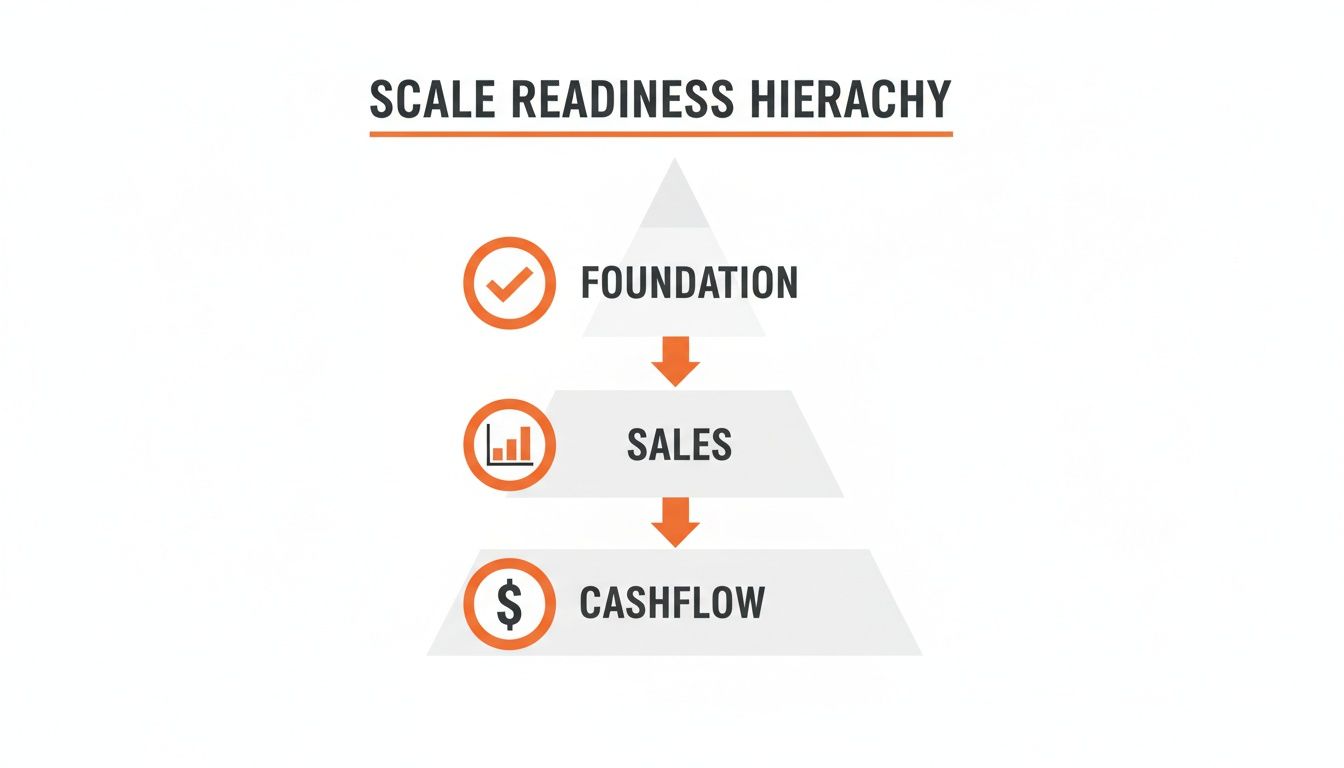
    A 'Scale Readiness Hierarchy' diagram showing Foundation, Sales, and Cashflow levels with icons.

    This diagram says it all. Without a solid foundation, repeatable sales, and healthy cash flow, any attempt you make to scale your operations is like building a skyscraper on sand.

    Codify Your Processes

    The first gear in your scaling engine is documenting your processes. If a key task lives only in your brain, it’s a bottleneck just waiting to happen. The solution? I want you to create simple Standard Operating Procedures (SOPs).

    This doesn't mean writing a 300-page corporate manual nobody will ever read. I'm talking about a simple, one-page checklist or a quick screen recording for any task that happens more than twice.

    • How to handle a customer refund: Write down the exact steps.
    • How to onboard a new client: Create a checklist.
    • How to post on social media: Document the workflow.

    The goal is for someone else to perform a task 80% as well as you on their first try. This simple act frees you from the tyranny of the day-to-day grind and ensures consistency, no matter who is doing the work.

    Hire and Delegate Effectively

    Once you have processes, you can bring in people to run them. Your first hires are absolutely critical. You're not just hiring for a task; you're hiring to buy back your most precious resource: time.

    Look for people who are proactive and can take ownership. Your first key hire—maybe a virtual assistant or a customer service specialist—should be someone you can trust to run the playbook you’ve created. This isn't just about offloading work; it's about entrusting parts of your business to others so it can grow beyond you.

    Delegation is the single most important skill a founder must learn to scale. If you can’t let go, you can’t grow. It’s a terrifying but necessary leap of faith you have to take.

    Learning to delegate is tough. You have to be okay with that 80% result at first. But by empowering your team, you create capacity. You move from being the player on the field to the coach on the sidelines, seeing the whole game and making strategic calls.

    Leverage Simple Technology

    Finally, let’s talk about the turbocharger: technology. You don't need a complex, expensive enterprise system. Simple, off-the-shelf tools can automate the repetitive work that drains your soul.

    Technology is your force multiplier. Studies show that AI adoption is surging, with 40% of service firms now using it for things like marketing and data management. You can do the same on a smaller scale, right now.

    Here’s where I recommend you start:

    1. Project Management: Use tools like Trello or Asana to manage workflows and see who is doing what, without constant check-ins.
    2. Customer Relationship Management (CRM): A simple CRM like HubSpot's free version can automate your follow-up emails and keep track of every customer interaction.
    3. Automation Tools: Use Zapier to connect different apps so they talk to each other. For example, you can automatically add a new customer from your payment processor to your email list.

    These tools handle the grunt work, freeing up you and your team to focus on the high-value activities that actually move the needle. By combining smart processes, capable people, and the right tech, you build an operational engine that doesn’t just grow—it scales.

    Proven Strategies to Fuel Your Scale

    Alright, you've built the operational engine for your business. Now it's time to add the high-octane fuel. This is the fun part, where you shift from just building the machine to actively flooring it for exponential growth.

    Real scaling isn't about working harder; it's about pulling specific, powerful levers that multiply your results without multiplying your effort. I’ll walk you through three of the most effective ways to do this. Think of them as different ways to hit the accelerator.

    Expand Your Offerings

    Who is the easiest person to sell to? Someone who already knows and trusts you. Hands down, one of the most direct paths to scaling your revenue is by getting each customer to spend more with you over their lifetime. This metric is called Customer Lifetime Value (LTV), and it's a game-changer.

    You can boost your LTV by strategically expanding what you offer. This isn't about throwing random new products at the wall; it’s about creating logical next steps for your loyal fans.

    • Create a premium version: Got a product or service people love? Offer a "pro" tier with advanced features. This lets your biggest fans pay you more for more value.
    • Add a complementary service: If you sell a physical product, could you offer an installation service? A maintenance plan? A subscription for refills?
    • Develop a new service tier: For your service business, this could mean going from one-on-one consulting to a group coaching program or a digital course. It allows you to serve many clients at once with the same amount of effort.

    This whole approach lets you grow revenue in a big way without the massive cost of acquiring brand-new customers for every single sale.

    Diversify Your Channels

    If you’re only selling through your own website, you're leaving a ton of money on the table. It's like building an amazing destination but only having one road leading to it. Diversifying your sales channels is all about opening up new highways for customers to find you.

    Business scaling is often about finding new ways to reach customers you couldn't access before. It’s about leveraging other people's audiences and platforms to amplify your own reach.

    I want you to consider these powerful channel strategies:

    1. Strategic Partnerships: Team up with a non-competing business that serves the same audience. A local Chicago coffee shop partnering with a nearby bakery is a classic example. You both get instant access to a warm, relevant audience.
    2. Wholesale or Retail: Getting your product into other stores—whether online or brick-and-mortar—can expose your brand to a massive new customer base overnight. The margins are different, but the volume can be huge.
    3. Affiliate Programs: Create a program where influencers or other businesses earn a commission for sending customers your way. You only pay for performance, making it a super low-risk way to scale your marketing.

    Exploring different small business growth strategies like these is critical. Don't put all your eggs in one basket. A multi-channel approach makes your business more resilient and much more scalable.

    Optimize Your Acquisition Funnel

    Finally, you have to make sure you're getting the absolute most out of every single person who shows interest in your brand. Pouring more money into ads without fixing a leaky sales funnel is like trying to fill a bucket with holes in it. It's just wasteful.

    The key is to convert more of the leads you already have, with less friction and lower cost.

    I want you to start by mapping out every single step a person takes, from first hearing about you to making a purchase. Where are they dropping off? Is your checkout process confusing? Is your landing page unclear? Even tiny tweaks here can lead to huge gains. A business that improves its conversion rate from 1% to 2% hasn't just seen a 1% improvement—you've literally doubled your sales without spending a dime more on ads.

    Test everything. Experiment with different headlines, offers, and calls to action. Use A/B testing tools to get real data on what works best. By relentlessly optimizing this process, you create a hyper-efficient customer acquisition machine that turns every marketing dollar into two, three, or even ten dollars in revenue. That's what scaling looks like in action.


    Your First Scaling Moves

    Feeling overwhelmed? Don't be. Here's a quick-reference guide to actionable scaling strategies you can start exploring today. Pick one area and dig in.

    Strategy Area Example Tactic Key Metric to Track
    Offer Expansion Bundle two existing products for a small discount. Average Order Value (AOV)
    Channel Diversification Find one local, non-competing business for a partnership. Referral Traffic/Sales
    Funnel Optimization Simplify your checkout process to have fewer steps. Conversion Rate

    Focusing on just one of these tactics can create real momentum. The goal is to start making small, smart moves that build on each other over time.

    The Critical Metrics That Actually Matter

    When you start to scale, it's dangerously easy to get lost in numbers that feel good but mean absolutely nothing. I'm talking about vanity metrics—things like your website traffic, social media likes, or new email subscribers. They give you a nice little ego boost, but they don't pay the bills or tell you if your business is actually healthy.

    When you're pouring fuel on the fire, you need to be watching the right gauges. Focusing on the wrong ones is like a pilot watching the cabin temperature instead of the altitude. To really get what scaling means in practice, you have to cut through the noise and lock in on the handful of Key Performance Indicators (KPIs) that signal the real health of your efforts.

    This isn't about becoming a data nerd. It's about learning to read your business's vital signs so you can make smart moves based on reality, not wishful thinking.

    The Two Most Important Numbers in Your Business

    If you only track two things, make it these. They tell a powerful story about whether your business model can actually last.

    First is your Customer Acquisition Cost (CAC). Simply put, how much are you spending in marketing and sales to get one new paying customer? If you drop $500 on ads and get 10 new customers, your CAC is $50. It’s your cost of entry.

    Second is the Lifetime Value (LTV) of a customer. This is the total profit you expect to bank from an average customer over the entire time they do business with you. It measures way more than their first purchase; it’s about their loyalty and repeat business.

    A business that doesn't know its CAC and LTV is flying blind. You're just spending money and hoping for the best, which is a recipe for disaster when you try to scale.

    The Magic Ratio That Unlocks Scaling

    Now, here’s where it gets powerful. The real insight comes when you smash these two numbers together. The LTV-to-CAC ratio is the ultimate health check for your scaling engine.

    Think of it as a simple investment. For every dollar you spend to get a customer (your CAC), how many dollars do you get back over their lifetime (your LTV)?

    A healthy, scalable business should be aiming for an LTV-to-CAC ratio of at least 3:1. For every $1 you spend on marketing, you should be getting $3 back in profit.

    • A 1:1 ratio? You’re losing money. Once you factor in all your other costs, every new customer is a net loss. Hit the brakes on spending and fix your model.
    • Less than 3:1? You’re profitable, but maybe not enough to scale aggressively. You might need to beef up your margins. This is where understanding the calculation of gross margin percentage becomes critical.
    • 3:1 or higher? This is your green light. It signals you've built a profitable, repeatable machine. Every dollar you feed into your marketing engine prints more money on the other side. Now you can confidently hit the accelerator.

    This one ratio tells the story of your business's efficiency. It strips out the emotion and ego from your decisions and replaces them with cold, hard math. When you know your LTV is triple your CAC, scaling stops being a gamble. It becomes a calculated, strategic investment in your future.

    Common Scaling Pitfalls and How to Dodge Them

    A woman wearing glasses and a jacket marks a map on a table at an outdoor event.

    The road to a scalable business is littered with predictable traps. They catch even the smartest founders off guard because scaling is exciting, and it’s way too easy to get swept up in the momentum. My goal here is to help you sidestep these traps completely.

    Think of this as your map of the minefield. I’ve seen these mistakes happen firsthand—to myself and to others—and they are almost always avoidable. Learning from other people's expensive missteps is the cheapest and most valuable education you can possibly get.

    The Siren Song of Premature Hiring

    When you finally get some real traction, the first impulse is almost always to hire. "We need a Head of Marketing!" "Let's get a full-time sales team!" This feels like progress, but it's often just a vanity metric in disguise.

    Hiring too fast, before you have crystal-clear roles and repeatable processes, just bloats your payroll and complicates everything. Suddenly, you have a massive fixed cost draining your bank account every single month, forcing you to chase revenue just to stay afloat. It puts you in a defensive, reactive position instead of an offensive, strategic one.

    How I want you to dodge it:
    Before you even think about a full-time employee, try to solve the problem with a process or a tool first. If that doesn't work, bring on a part-time contractor or a freelancer. This lets you test the role and refine what you actually need without the heavy commitment of a salary and benefits. Hire for a role only when the pain of not having that person is unbearable and you have a documented system for them to plug into on day one.

    The goal isn't to build a big team; it's to build a profitable business. A lean team executing on slick processes is far more powerful than a bloated team stumbling over each other.

    The Silent Killer of Company Culture

    In the early days, your culture is just… you. It’s the way you answer the phone, the extra care you put into an order, the inside jokes you share. As you start adding people, that culture can get diluted so fast you won't even notice until it’s already gone.

    Suddenly, you have team members who don't share your work ethic or your values. The "we're all in this together" vibe disappears, replaced by a more transactional, "it's just a job" attitude. This erosion is subtle but deadly, as it kills the very spirit that made your business special in the first place.

    How I want you to dodge it:
    Write down your core values. And I don’t mean corporate jargon, but real, gut-level statements about how you operate. For us at Chicago Brandstarters, it's about being kind and being bold. Then, hire and fire based on those values, relentlessly. During your interviews, ask questions that reveal a candidate's character, not just their skills. A talented person who doesn't fit your culture is a net negative. Protect your culture like it's your most valuable asset—because it is.

    Outrunning Your Cash Flow

    This is the cardinal sin of scaling, and it's the one that puts more businesses in the grave than anything else. You can be profitable on paper but still run completely out of money. How?

    Scaling requires upfront investment. You have to buy more inventory, spend more on marketing, and pay new salaries before the revenue from those investments comes in. This gap between spending money and making money is the cash flow gap. If that gap gets too wide, you run out of cash. Game over.

    How I want you to dodge it:
    Become absolutely obsessed with your cash flow statement. You must know, at all times, how much cash you have in the bank and what your monthly burn rate is. Create a simple 13-week cash flow forecast and update it every single week. This forces you to see a cash crunch coming months in advance, giving you time to secure a line of credit, slow down spending, or raise funds from a position of strength—not desperation. Don't let your own success kill you.

    Answering Your Top Scaling Questions

    You've made it this far, and your head is probably buzzing with ideas. That's a good thing. But when theory hits the pavement, real-world questions always pop up. Here are some quick, no-fluff answers to the questions I get all the time from founders like you who are ready to stop just growing and start truly scaling.

    What Is the Very First Step I Should Take to Scale?

    The absolute first step you should take is to document everything you do. I mean everything. Before you can hand off a task or build a system around it, you need a playbook. Start by creating simple Standard Operating Procedures (SOPs) for the things you do over and over again.

    This isn't about writing some huge, corporate manual that will collect dust on a shelf. Think simpler. A one-page checklist. A five-minute screen recording. The goal is to create instructions so clear that someone else can do the task 80% as well as you can on their first try. This is how you start buying back your time to work on the business, not just in it.

    How Much Money Do I Need to Start Scaling?

    There’s no magic number. It's less about a specific dollar amount and more about your financial stability. You need predictable revenue and healthy profit margins before you even think about it. Scaling costs money—for marketing, new hires, tech—and you have to pay for all of it before you see the return.

    A good rule of thumb I tell people is to have at least 3-6 months of operating expenses saved up as a cash cushion. Never, ever try to scale your business on financial fumes. It's a classic trap that sinks even fast-growing companies when they run out of cash.

    Scaling is an investment in your future, but you can't make that investment with money you don't have. Financial discipline isn't just important; it's the bedrock of sustainable scaling.

    Can a Service-Based Business Scale as Effectively?

    Absolutely, but you have to change your mindset. A traditional service business where you trade hours for dollars is almost impossible to scale. You can't clone yourself, after all.

    The secret is to "productize" your service. You have to decouple your revenue from your direct time and effort. Here are a few ways I've seen founders do this right now:

    • Tiered Packages: Stop creating custom quotes. Build defined service packages at different price points so your clients can self-select.
    • Group Programs: Instead of 1-on-1 consulting, launch a group coaching program or workshop where you can serve many clients at once.
    • Digital Products: Create a digital course, an ebook, or a subscription resource library that packages your expertise.

    The goal is the same whether you sell products or services: build a system that delivers massive value without you having to be personally involved in every single transaction. It’s about creating leverage so your business can serve hundreds, or even thousands, without you burning out.


    Building a business is tough, and the path from idea to scale can feel incredibly lonely. You don't have to walk it by yourself. At Chicago Brandstarters, we've built a free, vetted community for kind and bold founders right here in the Midwest who are tired of superficial networking. We connect over small dinners and an active group chat, sharing real war stories and practical advice to help each other win. If you're ready to build alongside people who genuinely want to see you succeed, learn more about joining us.

  • 10 Bold Small Business Growth Strategies for Founders

    10 Bold Small Business Growth Strategies for Founders

    Growing a small business can feel like trying to solve a puzzle in the dark. So many "proven" tactics, so little time. But real growth isn't about chasing every shiny object. It's about building a solid foundation.

    Think of your business like a skyscraper. To stand tall, it needs deep, strong footings. This guide is your blueprint for those footings.

    We'll cover 10 proven small business growth strategies. This isn't just a random checklist. These are interconnected pillars, designed to be clear, actionable, and authentic. You won't find vague advice here. We'll give you a simple roadmap for each one: what it is, why it works, and how to start.

    From building a trusted peer group to mastering your numbers, each section is a practical tool. We'll explore how to own a niche, build a powerful personal brand, and create smart partnerships. Let's move from frantic hustle to focused action. Let's get to work.

    1. Build a Peer Support Network

    One of the most powerful and overlooked small business growth strategies is creating a tight-knit peer group. This isn't about collecting contacts at a mixer. It’s about building a small, trusted community where you can be honest about your challenges and get real support from people who get it. It’s a space for confidential, collaborative problem-solving, not just networking.

    Why It Works

    Think of it as your personal board of directors. A good peer group gives you diverse perspectives to help you see your blind spots. Stuck on pricing? A member who just solved that problem can share their playbook. This collective brainpower helps you learn faster and avoid costly mistakes. The support from a group that understands the struggle is priceless, fighting the loneliness that often sinks founders.

    Quick Implementation Steps

    1. Start Small: Find 4-6 founders you respect. Look for different skills but shared values, like kindness and a desire to help.
    2. Set Ground Rules: From day one, establish clear rules for confidentiality. Trust is everything.
    3. Create Touchpoints: Schedule regular meetings (like monthly dinners) and a private chat for real-time help.
    4. Be Vulnerable First: As the one who starts it, be the first to share a real business struggle. This sets an authentic tone and helps others open up.

    "Your peer group is the cure for founder loneliness. It's where you can drop the 'everything is great' mask and solve real problems with people who are right there with you."

    Key Metrics to Track

    • Qualitative Feedback: Are members actively sharing wins and challenges?
    • Actionable Takeaways: How many concrete ideas from the group did you actually use this quarter?
    • Retention Rate: How many original members are still active after six months?

    Chicago-Specific Tip

    For local founders, Chicago Brandstarters is a perfect example of this model. They build small, curated dinner groups and private chats for kind, ambitious builders in the city. Joining a group like this can fast-track finding a trusted peer network.

    2. Engineer Word-of-Mouth Marketing

    One of the most cost-effective small business growth strategies is turning your customers into your best sales team. This isn't just about asking for referrals. It's about designing a system where happy customers feel excited and able to share their positive experiences. This organic growth engine is built on trust and is far more powerful than any ad.

    Why It Works

    A recommendation from a friend cuts through the noise. It comes with built-in credibility, instantly bypassing skepticism and shortening the sales process. We trust people far more than we trust brands. By focusing on creating an experience worth talking about, you build a self-powering flywheel of high-quality leads that are eager to buy.

    Quick Implementation Steps

    1. Create a "Sharable" Experience: First, your product or service must be so good that people want to talk about it. This is non-negotiable.
    2. Make It Easy: Create a simple, easy way to refer. A shareable link, a pre-written email, or a clear button in your app works great. Remove all friction.
    3. Recognize and Reward: Acknowledge every referral. While money can work, a sincere thank you, a small gift, or a public shout-out often feels more authentic and meaningful.
    4. Nurture Your Champions: Find your biggest fans and build real relationships with them. Let them know the impact of their referrals.

    "Your best marketing doesn't feel like marketing. It's a real conversation between two people, and your business happens to be the topic."

    Key Metrics to Track

    • Referral Rate: What percentage of new customers come from referrals?
    • Conversion Rate of Referred Leads: How do leads from referrals convert compared to other sources?
    • Customer Lifetime Value (CLV): Compare the CLV of referred customers to others.
    • Net Promoter Score (NPS): A simple way to measure how willing customers are to recommend you.

    Chicago-Specific Tip

    The Chicago founder community runs on trusted relationships. Groups like Chicago Brandstarters have grown almost entirely through founder-to-founder referrals. To tap into this, give immense value to a few key connectors. Their authentic endorsement in these tight-knit circles is more powerful than any ad campaign.

    3. Find Product-Market Fit Through Customer Discovery

    Before you scale, the most crucial of all small business growth strategies is achieving product-market fit. This isn't a single moment. It's a process of deeply understanding customer problems, testing solutions, and changing your approach based on real feedback. It ensures you're building something people desperately need, not just something you think is cool. Skipping this step is like building a house on sand.

    Why It Works

    Product-market fit is when customers start pulling the product out of your hands, instead of you pushing it on them. When you solve a real, painful problem, growth becomes effortless. Customers become fans, marketing feels natural, and your product roadmap writes itself based on clear user needs. This obsessive customer focus prevents you from wasting time and money on features nobody wants and tells you exactly when to step on the gas.

    Quick Implementation Steps

    1. Get Out of the Building: Before you build anything, talk to at least 20-30 potential customers. Understand their world. For more, see this guide on how to validate your business idea.
    2. Ask 'Why' Like a Child: Don't accept surface-level answers. Dig deep to uncover the real motivations and pain points behind their behavior.
    3. Test with an MVP: Create the simplest possible version of your solution to test your main idea and get feedback. It could even be a simple video, like Dropbox did.
    4. Watch, Don't Just Listen: Observe how people use your prototype. Their actions often tell you more than their words.

    "Product-market fit is when you've built something that creates so much value, the market can't ignore it. It's the only thing that matters."

    Key Metrics to Track

    • Retention Rate: Are users coming back? High retention is the best signal of product-market fit.
    • "How would you feel?" Score: Ask users, "How would you feel if you could no longer use our product?" If over 40% say "very disappointed," you're on to something.
    • Clarity Score: Can a new customer explain what you do in 30 seconds?
    • NPS (Net Promoter Score): How likely are users to recommend your product?

    Chicago-Specific Tip

    Use Chicago's diverse neighborhoods to find different customer types. Spend a weekend in Logan Square, the Loop, and Hyde Park with a prototype or survey. The feedback from these distinct communities can quickly confirm (or deny) your assumptions and speed up your path to finding a market that loves what you build.

    4. Grow Through Strategic Partnerships

    One of the smartest small business growth strategies is to leverage the audience and trust someone else has already built. Strategic partnerships let you tap into new markets by collaborating with businesses that serve the same customers but don't compete with you. This isn't about buying ads. It's about building a win-win relationship where both sides grow faster by sharing audiences and credibility.

    Why It Works

    A strategic partner is like a megaphone for your business. They’ve already done the hard work of building an audience that trusts them. By partnering with them, you get a warm introduction to potential customers who are much more likely to buy. Shopify’s app store is a great example. App developers get instant access to millions of merchants, and Shopify makes its platform more valuable. It’s a powerful, mutually beneficial growth machine.

    Quick Implementation Steps

    1. Identify Potential Partners: List 5-10 companies whose customers are your ideal customers, but who aren't direct competitors.
    2. Craft a "Win-Win" Pitch: Clearly explain what’s in it for them. This could be a share of the revenue, access to your audience, or a better offering for their customers.
    3. Start with a Pilot: Propose a small, low-risk test project to prove the idea works and build trust before going all-in.
    4. Create a Partner Toolkit: Make it incredibly easy for them to promote you. Give them marketing materials, copy, and support. For a deeper dive, learn more about how to find the right business partners on chicagobrandstarters.com.

    "Partnerships are about borrowing trust. You're using a partner's years of hard-earned credibility to fast-track your own customer relationships."

    Key Metrics to Track

    • Partner-Sourced Leads: How many new leads or customers come directly from each partner?
    • Conversion Rate: How do leads from partners convert compared to other channels?
    • Partnership ROI: Measure the revenue from a partnership against the time and resources you put in.

    Chicago-Specific Tip

    Many local B2B service firms in Chicago are looking for tech partners to improve what they offer clients. Reach out to marketing agencies or consultants at hubs like 1871 or mHUB that serve your target industry. Offering a referral fee or a joint webinar is a great way to start a valuable local partnership.

    5. Build Your Personal Brand for Visibility

    One of the most powerful small business growth strategies is to build the founder's personal brand as a trusted expert. This isn't about being a celebrity. It's about making your business synonymous with your expertise and authenticity. For service and B2B companies, trust is everything. A strong founder brand creates a competitive advantage that's hard to copy and attracts high-quality opportunities.

    A woman records a podcast at a desk with a laptop, plant, and 'FOUNDER VISIBILITY' text.

    Why It Works

    People connect with people, not logos. When a founder consistently shares valuable ideas, documents their journey, and engages with their community, they build trust at scale. This personal connection acts like a magnet, attracting clients, talent, and partners who already believe in the founder's mission. It’s marketing that doesn't feel like marketing. You're just sharing what you know, and people naturally want to work with you.

    Quick Implementation Steps

    1. Pick Your Platform: Choose one or two platforms where your ideal customers hang out (like LinkedIn or Twitter for B2B) and commit to mastering them.
    2. Share Your Story: Post consistently (2-3 times a week). Share honest lessons, industry insights, and behind-the-scenes struggles. Vulnerability builds connection.
    3. Engage Authentically: Don't just post and run. Respond to comments, ask questions, and be an active part of the conversation.
    4. Create Pillar Content: Once a month, create one big piece of content, like a blog post or podcast. Then, chop it up into smaller posts for your chosen platforms.

    "Your personal brand is the ultimate lead magnet. When people trust you, they're already sold on your business before they even see a sales page."

    Key Metrics to Track

    • Inbound Mentions: How often are you or your business mentioned organically in industry chats?
    • Profile Views & Engagement Rate: Are more people visiting your profile and interacting with your content each month?
    • Lead Source: How many new leads say they first heard about you from your personal content?

    Chicago-Specific Tip

    The spirit of Chicago Brandstarters is built on this idea: kind, ambitious builders helping each other succeed. Engage with other members by creating content together, sharing their work, and cheering them on. This creates a network effect, where the group's collective visibility lifts everyone up.

    6. Master Your Unit Economics and Retention

    One of the most vital small business growth strategies is to build your company on a profitable foundation from day one. This means obsessively tracking your unit economics, running lean, and focusing on keeping the customers you have. Instead of chasing growth at any cost, this approach ensures each customer is profitable and that you're not losing them out the back door. This is the playbook for smart, sustainable scaling.

    Tablet with bar charts, calculator, and notebook on a wooden desk, overlaid with 'UNIT ECONOMICS' banner.

    Why It Works

    Think of your business as a bucket. New customers are water you pour in, but poor retention is a hole in the bottom. This strategy is about plugging the hole (retention) and making sure every drop you add is valuable (unit economics). Profitable unit economics mean you make money on every sale. High retention creates compounding revenue from your existing customers. This creates a powerful, self-funding growth engine that doesn't need constant investment.

    Quick Implementation Steps

    1. Calculate LTV:CAC: Know your Customer Lifetime Value (LTV) and Customer Acquisition Cost (CAC). Aim for a ratio of at least 3:1. This means a customer is worth at least three times what it costs you to get them.
    2. Track Everything: Use a simple spreadsheet to monitor all expenses. Review it monthly to cut what you don't need.
    3. Obsess Over Churn: Calculate your monthly customer churn rate (the percentage of customers who leave). When a customer leaves, survey them to find out why.
    4. Automate Onboarding: Create an automated welcome series for new customers to guide them to success. This directly improves retention.

    "Growth without profitable numbers isn't growth; it's just a faster way to go out of business. The best founders know every number that drives their company."

    Key Metrics to Track

    • LTV:CAC Ratio: The core health metric of your business.
    • Monthly Churn Rate: The percentage of customers who cancel each month.
    • Net Revenue Retention (NRR): Measures revenue from existing customers, including upgrades and minus churn. Aim for over 100%.
    • Gross Margin: The percentage of revenue left after the cost of selling your product.

    Chicago-Specific Tip

    Getting your pricing right is the first step to healthy unit economics. For Chicago founders, understanding how to structure your pricing is key. Learn more about how to price a new product to build a profitable foundation from the start.

    7. Use Content Marketing to Build Trust

    Instead of chasing customers, attract them by creating genuinely helpful content. This is one of the most sustainable small business growth strategies because you're building a library of assets that solve your audience's problems. This inbound approach establishes trust, boosts your search engine visibility, and generates qualified leads for years to come. It positions you as an expert, not just a seller.

    Why It Works

    Think of your content as a magnet. Each blog post, guide, or video is a tiny salesperson working for you 24/7. It answers questions your ideal customers are already searching for online, building a relationship before they even think about buying. By giving value upfront, you create goodwill and become the go-to resource in your space. When it's time to buy, you're the natural choice.

    Quick Implementation Steps

    1. Identify Core Topics: Brainstorm 10 key problems or questions your target audience has. These are your content pillars.
    2. Create a Calendar: Plan to publish at least two pieces of long-form content (like blog posts) a month. Consistency is key.
    3. Optimize for Search: Make sure every piece targets a primary keyword. Use it in the title, headers, and body to help Google find you.
    4. Repurpose & Distribute: Turn one blog post into a short video, a few social media tips, or a podcast segment. Share it everywhere your audience is.
    5. Build Your List: In every piece of content, ask readers to subscribe to your email list. This turns casual readers into a loyal audience.

    "Great content marketing isn't about what you sell, it's about what you know. It's the art of teaching so well that people are naturally drawn to do business with you."

    Key Metrics to Track

    • Organic Website Traffic: Is traffic from search engines growing each month?
    • Keyword Rankings: Are you moving up in search results for your target keywords?
    • Email Subscribers: How many new subscribers are you getting from your content?
    • Leads Generated: How many visitors turn into leads through your content?

    Chicago-Specific Tip

    Local businesses can win by creating Chicago-focused content. A catering company could write "The Ultimate Guide to Office Lunch Catering in the Loop." A local marketing agency could publish an analysis of digital trends among River North businesses. This hyperlocal approach attracts a very relevant audience looking for local solutions.

    8. Dominate a Niche Market

    Instead of trying to be everything to everyone, one of the smartest small business growth strategies is to focus intensely on a single, underserved niche market. This means becoming the absolute best solution for a very specific group of people. This allows founders with limited resources to build deep expertise, create a powerful reputation, and often charge premium prices by solving a unique and painful problem.

    Why It Works

    Think of it as being a big fish in a small pond. In a narrow market, your marketing is super efficient because you know exactly who you're talking to and where to find them. Your product is more focused because you're solving a well-defined set of problems. This focus builds a strong defense. As the recognized expert, it becomes very hard for bigger, more general competitors to beat you.

    Quick Implementation Steps

    1. Find a Painful Niche: Look for a specific industry (like craft breweries or dental practices) with unique, unsolved problems that generic tools can't fix.
    2. Do Deep Discovery: Interview at least 20 people in your target niche. Understand their workflow, budget, and frustrations before you build anything.
    3. Immerse Yourself: Join their online groups, go to their conferences, and read their trade magazines. Speak their language to build real trust.
    4. Build Niche-Specific Solutions: Create content, features, and partnerships that only serve your target niche. Your message should be "we are built for you."

    "Going niche isn't about thinking small. It's about being laser-focused so you can win bigger. You become the only logical choice for your ideal customer."

    Key Metrics to Track

    • Market Penetration: What percentage of your target niche are you serving?
    • Customer Acquisition Cost (CAC): Is your focused marketing lowering the cost to get a new customer?
    • Customer Lifetime Value (LTV): Can you charge more and keep customers longer because of your specialized value?

    Chicago-Specific Tip

    The Midwest is full of legacy industries perfect for this strategy. Think about a niche like manufacturing logistics or agricultural tech. A great local example is Jobalign, a recruiting platform built just for hourly and manufacturing workers—a huge sector in the Chicago area. They've dominated by deeply understanding the hiring challenges of this specific group.

    9. Combine Team Building with Founder-Led Sales

    One of the most important small business growth strategies for scaling is to combine smart team building with founder-led sales. This isn't about hiring fast to delegate everything. It's about building a small, amazing team while the founder stays deeply involved in closing the first 50-100 customers. This bakes the company's DNA and customer insights into its foundation.

    Why It Works

    Think of your first hires as co-builders, not just employees. When a founder personally handles early sales, they get raw feedback that is priceless for product development. This direct knowledge ensures you're building something people actually want. At the same time, a small, elite team moves faster and feels a strong sense of ownership. This combination creates strong unit economics and a resilient, mission-driven culture.

    Quick Implementation Steps

    1. Own Early Sales: As the founder, commit to personally closing the first 50-100 customers. Don't hire a salesperson until you've created a sales process that works.
    2. Hire for Values, Train for Skills: Hire people who share your core values. A small team with misaligned values will fail. Hire slowly and carefully.
    3. Establish Clear Rhythms: Set up weekly 1-on-1 meetings with every team member. Create a transparent dashboard of key metrics that everyone can see.
    4. Delegate Decisions, Not Work: Give your team clear frameworks for making decisions. Focus on creating a sense of ownership rather than micromanaging tasks.

    "Your first ten hires will define your company's culture for the next hundred. Be the chief salesperson and the chief culture officer. Don't delegate that."

    Key Metrics to Track

    • Founder-Involved Close Rate: What percentage of deals are you closing personally?
    • New Hire Performance (90-Day): Are new team members meeting or exceeding goals in their first three months?
    • Team eNPS (Employee Net Promoter Score): How likely is your team to recommend your company as a great place to work?

    Chicago-Specific Tip

    For founders in the Midwest who want to build great teams, connecting with communities like 1871 Chicago can be a game-changer. Their mentorship programs and workshops feature experienced leaders who have mastered the art of scaling small, high-impact teams and can help you avoid common hiring mistakes.

    10. Expand Geographically with a Smart Strategy

    Once you've mastered your home market, one of the best small business growth strategies is systematic geographic expansion. Instead of chasing completely new types of customers, you replicate your proven model in a new city or region. It's like a band that sells out shows in their hometown before booking a tour. You take a successful show on the road, tweaking it for a new audience but keeping the core elements that made it a hit.

    Why It Works

    Geographic expansion is a lower-risk way to grow because you're using a playbook you've already perfected. You're not starting from scratch; you're running a known process in a new place. This lets you grow revenue and market share in a predictable way. Airbnb's city-by-city launch is a classic example. They didn't try to conquer the world at once. They dominated one market, documented what worked, and then repeated it with precision in the next city.

    Quick Implementation Steps

    1. Confirm Home Market Fit: Before you expand, make sure your home market is a well-oiled machine with loyal customers and predictable costs.
    2. Prioritize New Markets: Score potential new cities based on things like population size, competition, and local rules. Start with a city that's similar to your own.
    3. Launch a Lean Test: Use a small budget for targeted digital ads or local PR in the new market to see if there's interest before you invest heavily.
    4. Create an Expansion Playbook: Document every step of your launch process, from marketing to operations, so a new team can easily repeat it.

    "Don't try to boil the ocean. True scale comes from conquering one pond, then the next, then the next. Your expansion playbook is the map that shows you how."

    Key Metrics to Track

    • Cost Per Acquisition (CAC): How does the cost to get a customer in the new market compare to your home market?
    • Time to First 100 Customers: How quickly do you get traction? This shows if the market is receptive.
    • LTV to CAC Ratio: Aim for a 3:1 ratio within the first 6-12 months to prove the new market is viable.

    Chicago-Specific Tip

    For Chicago-based brands, the next logical step is often a nearby Midwest hub like Milwaukee, Indianapolis, or Detroit. These cities have similar cultures and media markets, which shortens the learning curve. Consider a weekend pop-up shop or a targeted partnership with a local business in one of these cities to test the waters with minimal risk.

    10-Point Small Business Growth Strategy Comparison

    Strategy Implementation Complexity (🔄) Resource Requirements (⚡) Expected Outcomes (📊⭐) Ideal Use Cases (💡) Key Advantages (⭐)
    Community-Based Peer Support Networks Medium 🔄🔄 (vetting & facilitation) Low–Medium ⚡⚡ (time, coordination) Deep trust, tactical wins; steady, relationship-driven growth 📊⭐ Early-stage founders seeking peer advice & accountability 💡 High-quality confidential support; low cost ⭐
    Strategic Referral & Word-of-Mouth Marketing Low–Medium 🔄🔄 (systematize referrals) Low ⚡ (relationship-driven) High-quality leads with low CAC; self-reinforcing growth 📊⭐ Service/community businesses with satisfied users 💡 Best lead quality; highly cost-efficient ⭐
    Product-Market Fit & Customer Discovery High 🔄🔄🔄 (rigorous testing & interviews) Medium ⚡⚡ (founder time, prototypes) Validated demand, higher retention; reduced failure risk 📊⭐ Early-stage product builders validating demand 💡 Prevents wasted builds; builds stickiness ⭐
    Strategic Partnerships & Channel Development High 🔄🔄🔄 (negotiation & management) Medium–High ⚡⚡⚡ (partnership ops, assets) Faster reach & penetration; shared costs, lower CAC 📊⭐ Products needing distribution or integrations 💡 Access to partner audiences; co-funded growth ⭐
    Personal Brand & Founder Visibility Medium 🔄🔄 (consistent content & risk) Low–Medium ⚡⚡ (time, tools) Inbound opportunities & durable trust; slow compounding 📊⭐ B2B/service founders seeking thought leadership 💡 Creates founder moat; attracts customers & talent ⭐
    Unit Economics, Lean Ops & Retention Optimization High 🔄🔄🔄 (analytics & ops discipline) Medium ⚡⚡ (data systems, CS) Sustainable, profitable growth; predictable revenue 📊⭐ Bootstrapped/SaaS businesses prioritizing profitability 💡 Maximizes margins; long-term sustainability ⭐
    Content Marketing & Thought Leadership Medium 🔄🔄 (strategy & production) Medium ⚡⚡ (writers, SEO, production) Compounding organic traffic & inbound leads over time 📊⭐ B2B SaaS, agencies, education businesses needing inbound 💡 Builds authority & long-term SEO value ⭐
    Vertical or Niche Market Domination Medium 🔄🔄 (deep specialization) Low–Medium ⚡⚡ (tailored solutions) High margins & market share in niche; limited TAM 📊⭐ Bootstrapped founders targeting specific industries 💡 Less competition; premium pricing & moat ⭐
    Team Building & Founder-Led Sales Medium–High 🔄🔄🔄 (hiring & culture) Medium ⚡⚡ (salaries, training) Faster growth with strong culture; risk of founder bottleneck 📊⭐ Founders scaling toward seven-figures, early sales-led growth 💡 Founder credibility in sales; strong internal alignment ⭐
    Geographic Expansion & Market Entry Strategy High 🔄🔄🔄 (localization & ops) High ⚡⚡⚡ (capital, hiring, marketing) Multiplied TAM & diversified revenue; higher complexity 📊⭐ Proven products ready to replicate success in new regions 💡 Scale TAM & reduce regional concentration risk ⭐

    Your Next Move: Choose One Thing and Go

    We’ve walked through ten powerful small business growth strategies. Each one is a different lever you can pull to move your business forward. It’s a lot to take in. You might feel overwhelmed, seeing a mountain of work ahead.

    Resist that feeling.

    Growth isn't about doing all ten things at once. Think of it like building a house. You don't build the walls, roof, and plumbing at the same time. You lay a solid foundation. Then you frame the walls, one section at a time. The best strategy is the one you actually commit to and do with focus.

    The Power of One Thing

    Your job now isn't to create a ten-point master plan. It’s to choose your one thing. Which of these strategies lit a fire in you? Was it the idea of owning a niche? Or building a personal brand that truly reflects who you are? The best place to start is often the strategy that feels both exciting and a little scary.

    That feeling is where opportunity and growth meet. It’s a sign that you're pushing past your comfort zone into a place where real progress happens.

    Key Takeaway: Action beats perfection. Choosing one focused strategy and doing it well will get you far better results than trying to do everything at once and succeeding at nothing.

    A Quick Recap to Guide Your Choice

    To help you decide, let's revisit the core ideas:

    • Human Connection: Finding your tribe through Peer Support Networks and using those relationships for Referral Marketing. We also saw how a Personal Brand and Founder-Led Sales make your business more authentic.
    • Customer Focus: It all begins with Product-Market Fit and truly knowing your customer. From there, you build loyalty by focusing on Retention and deliver value through Thought Leadership.
    • Strategic Levers: We looked at growth multipliers like Strategic Partnerships and the focused power of Niche Market Domination.
    • Operational Excellence: The foundation of lasting growth is knowing your Unit Economics and building a strong team.

    Making Your Move

    Which of these areas feels like the biggest need or opportunity for your business right now? Don't overthink it. Pick one. Commit to it for the next 90 days. Break it down into small, actionable steps, track your progress, and learn from what happens.

    This is what building is. It’s a cycle of focused action, learning, and trying again. You are building more than a business; you are building yourself as a founder. Be bold enough to choose. Be kind enough to yourself to learn as you go, even when you stumble. This is a marathon, and every focused step moves you forward. You have the map. Now it’s time to take the first step.


    If you’re a founder in the Midwest looking for a community that believes in kindness and collaboration, you don’t have to build alone. Chicago Brandstarters is a peer support network designed to help you use these small business growth strategies with support from others on the same journey. Learn more and find your people at Chicago Brandstarters.