
Most sales advice treats closing like a dramatic final move: deliver the pitch, handle a last objection, then ask, “Are you ready to buy?” That approach makes founders chase the perfect sentence while ignoring the work that determines whether a buyer can say yes.
Closing starts before the proposal. You close by qualifying the right opportunity, helping the buyer understand the problem, making risk visible, answering objections early, and giving every follow-up a clear next step. The final ask matters, but it rarely rescues a deal that you mishandled for weeks.
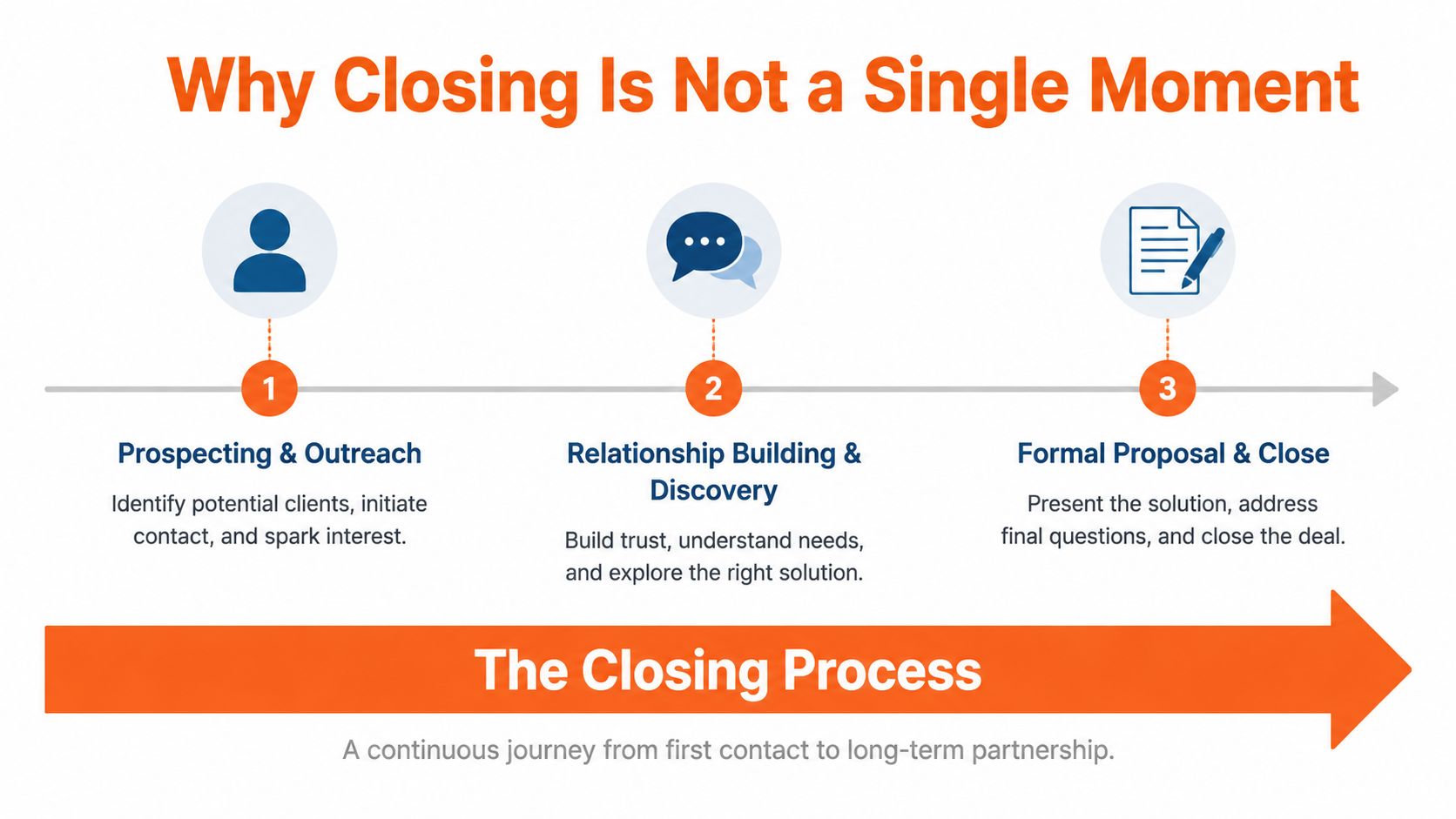
Why Closing Is Not a Single Moment
A close is a chain of buyer decisions, not a single exchange at the end of a call. Buyers collect information, compare options, involve colleagues, revisit priorities, and search for reasons to delay. Each conversation either reduces uncertainty or adds to it. Your role is to make the next decision easier, not to force a verdict before the buyer is ready.
The hidden mechanics sit between calls. A buyer may understand the problem but lack internal agreement. They may like the proposal but still need proof, budget approval, or a safer implementation plan. Strong sellers watch for those gaps, surface objections early, and tailor the next interaction to the missing piece.
Treat the pipeline as part of the close
Qualification is part of closing. Choose opportunities where the problem has consequences, confirm who is affected, and identify the decision process before investing heavily in a proposal. When those details remain vague, sellers often mistake polite interest for buying intent.
Sales cycles can last weeks or months. Industry data places one average B2B buying journey at about 211 days, while another reports an average deal-close time of 47 days overall, with 60 days for B2B and 35 days for B2C (Thunderbit's sales-closing data). The figures vary by market, but the operating lesson is consistent: your process must keep a deal useful and active throughout buyer evaluation.
Practical rule: Every sales interaction should answer one question, “What does the buyer need to understand or do next?”
Follow-up creates useful pressure
Industry benchmarks show that buyers often need several follow-ups, while many reps stop before the second attempt. That gap rewards discipline, not persistence without purpose. A follow-up should recap the decision, resolve an open concern, provide relevant evidence, or confirm the next person and date involved.
Use a simple test before sending: can the buyer take a clear action after reading this message? “Just checking in” creates work for the recipient and gives them no reason to respond. A sharper note might say, “You mentioned implementation risk was the main concern. I attached the rollout plan. If it answers that question, should we review approval steps on Thursday?”
Buyer education also follows a cycle. Early conversations establish the problem, later ones test the solution, and the final stage confirms risk, ownership, and timing. Match each touchpoint to that stage. A polished closing script cannot compensate for missing education, unclear decision ownership, or follow-up that arrives without a useful reason.
The Discovery to Commitment Sequence
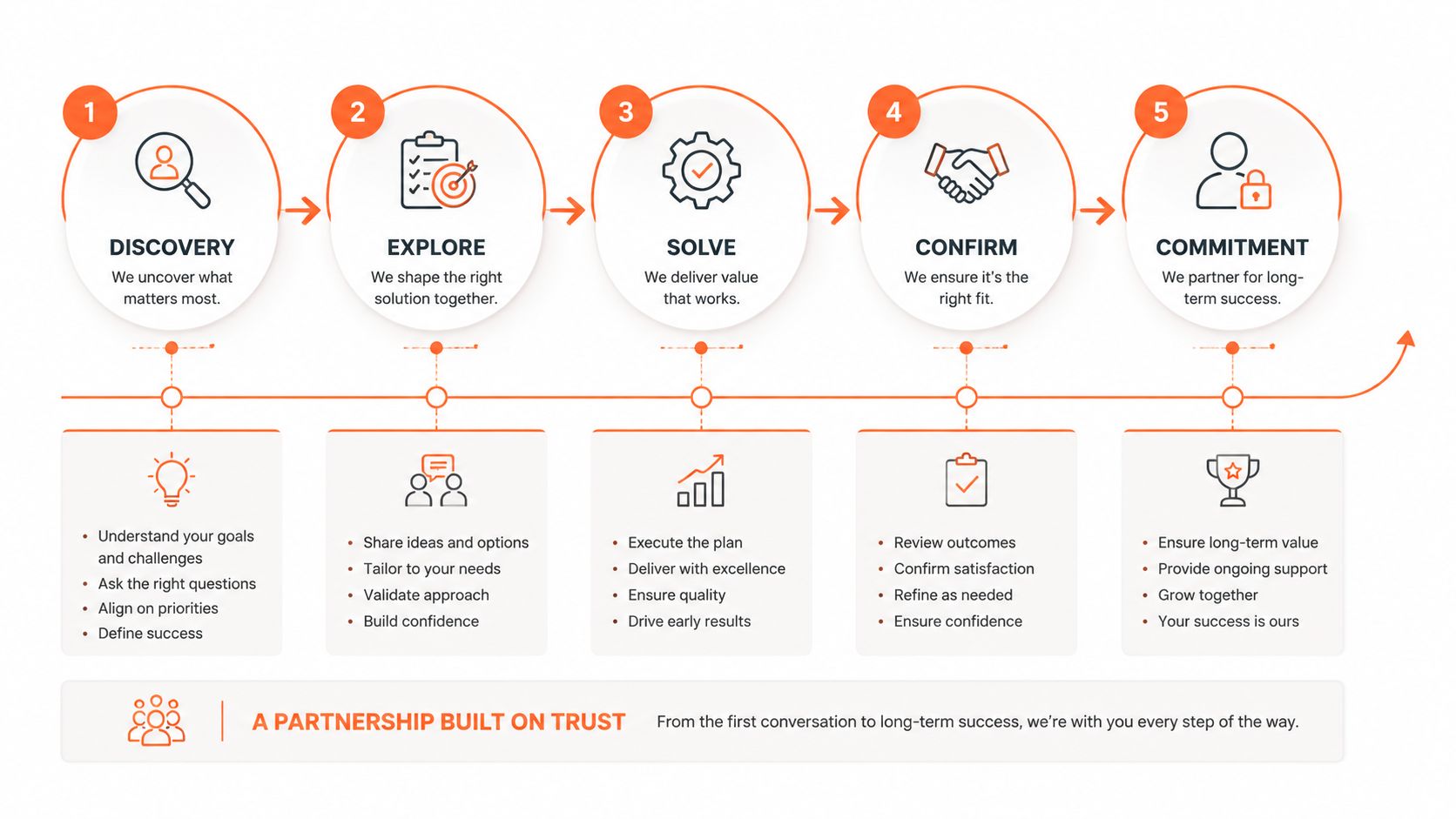
A reliable close follows a sequence. You can shorten or expand each stage, but don't skip the logic. Discovery creates clarity, the recommendation connects that clarity to an outcome, and the commitment ask gives the buyer a manageable next move.
Start with the problem, not your product
Open with a permission-based question:
“Before I show you anything, can I understand what you're trying to fix and why it matters now?”
Then ask questions that expose the cost, urgency, and decision process:
- Current state: “How are you handling this today?”
- Friction: “Where does that process slow your team down?”
- Consequence: “What happens if nothing changes?”
- Priority: “Why are you looking at this now?”
- Decision path: “Who else needs to feel confident before you move forward?”
Listen for the buyer's exact words. Use those words later in your recap and proposal. On a phone call, leave enough silence for a complete answer. In person, write the buyer's phrasing where they can see it. In email, ask one question at a time. In a DM, keep the request small and move to a call only after the person shows a real problem.
Connect your recommendation to their outcome
Don't give a feature tour. Say:
“You told me that [problem] is slowing down [business outcome]. We'd address that by [specific approach], so your team can [desired result].”
Then check the fit:
“Does that solve the problem you described, or am I missing something?”
This question gives the buyer room to correct you. That correction helps you sell more accurately than a polished monologue.
For a practical view of the stages and handoffs involved, review this B2B sales process guide. Use it as a checklist, then adapt the sequence to your deal size and buying group.
Ask for commitment in small increments
Commitment doesn't begin with the contract. It can mean agreeing to review a proposal, bringing in a technical stakeholder, confirming a target date, or sharing the procurement process.
Try:
- “If the proposal answers the implementation questions, are you comfortable reviewing terms this week?”
- “Would it make sense to include your operations lead in the next call?”
- “If we agree on scope, what would stop you from moving ahead?”
A face-to-face meeting may support a direct calendar commitment. A phone call needs a clear verbal next step. An email should end with one easy question, not three competing calls to action. A DM should earn the next conversation instead of trying to close the entire deal in a chat window.
Handling Objections Before They Kill the Deal
The objection you hear late is usually the objection you failed to surface early. Wait until the proposal, and the buyer forces you into defense while both sides wonder what remains unsaid.
Invite resistance during discovery. Gangly's objection statistics report that objections raised in the first 10 minutes convert 4.1 times higher than objections raised in the last 10 minutes. Deals that expose every major objection by the end of discovery close at nearly twice the rate of deals where concerns first appear during the proposal stage. Early pushback usually signals active evaluation, not rejection.
Ask before you answer
A 2026 objection-handling guide reports that reps who ask one clarifying question before responding close at 28% higher rates than reps who answer immediately (Gangly's objection-handling guide). Pause before defending the offer.
Use this sequence:
- Acknowledge the concern.
- Ask what sits underneath it.
- Confirm the actual issue.
- Respond with proof or a scope change.
- Check whether the concern remains.
For price:
“When you say the price feels high, compared with what are you measuring it?”
For timing:
“What would need to happen internally before this becomes a priority?”
For a competitor:
“Which part of their approach feels like the better fit?”
The answer may reveal a budget constraint, an internal approval problem, or a missing capability. Each requires a different response. Treating every objection as a request for more persuasion wastes the buyer's time.
Establish value before showing price
Price often represents uncertainty. A buyer may call the offer expensive because the connection to a measurable business result is still weak. An Apollo report says buyers cite price as the main reason for loss in 40–60% of deals, while separate buyer surveys in the same source indicate only 18% of those losses really come from price. Reps who establish ROI before presenting pricing close price-objection deals at 30% higher rates (Apollo's closing techniques report).
Set the context before naming the investment:
“Before we discuss the investment, let's agree on what a successful outcome would need to change.”
Then connect the proposal to the buyer's stated priorities. The same objection-handling research reports that a response built around customer ROI proof closes price-objection deals at 35% higher rates than a feature-only defense. For practical scripts and response patterns, review these proven sales objection strategies. Teams that need rehearsal can use Chicago Brandstarters' sales training videos on objection handling, demos, follow-up, and closing.
Follow-Up Cadences That Actually Convert
A follow-up cadence should reduce buyer effort. Each message needs a job, an owner, and a next action. “Checking in” gives the buyer none of those, so it deserves no reply.
After a discovery call, send a concise recap while the conversation remains fresh. Include the problem in the buyer's language, the agreed outcome, any open question, and one proposed next step. Then schedule the next touch in your CRM before you move to another task.
A five-touch sequence for an active opportunity
Use this structure when the buyer has engaged and the proposal needs movement:
- Recap: Summarize the problem, agreed scope, and next meeting.
- Proof: Send one relevant example, demonstration, or implementation note.
- Decision support: Answer an unresolved technical, financial, or operational question.
- Stakeholder prompt: Ask whether another decision-maker needs a separate review.
- Close-the-loop note: Invite a clear yes, no, or later decision.
The exact spacing depends on the buyer's deadline. Match your timing to the project rather than blindly following a calendar. A fast-moving purchase needs tighter coordination, while a complex B2B evaluation needs material the buyer can share internally.
An eight-touch sequence for a longer cycle
For a deal that needs more education, alternate channels and reasons to respond:
- Email with the call summary.
- Phone call focused on one open issue.
- Short product demonstration or customized walkthrough.
- Email answering the buyer's most common concern.
- Stakeholder call.
- Proposal review.
- Procurement or implementation check-in.
- Direct close-the-loop message.
Proposify's benchmark says buyers expect 2–4 follow-ups, so you should plan beyond the first message while keeping every touch relevant. Automation can create reminders, change stages, and queue templates. You still need to personalize the problem, choose the right proof, and decide when a message would add noise.
Know when to stop
A silent buyer isn't always a lost buyer, but indefinite chasing damages your forecast. Send a respectful message:
“It sounds like this may have moved down the priority list. Should I close this out for now, or is there a better date to revisit it?”
If they choose later, record the reason and the revisit date. If they don't respond, close the active opportunity and place it in a lighter nurture track. A clean pipeline gives your attention back to buyers who can move.
Choosing the Right Closing Framework
Closing frameworks work as conversation structures, not magic phrases. Choose based on buyer readiness, complexity, and the amount of trust you have earned. A direct close can help a ready buyer, while the same approach can make an uncertain buyer retreat.
Compare the common approaches
| Framework | Use it when | Example | Where it fails |
|---|---|---|---|
| Assumptive close | The buyer has confirmed fit and next steps | “I'll send the agreement for your legal review today.” | You assume readiness the buyer hasn't shown |
| Summary close | The buyer needs a clear recap of value | “You want faster onboarding, fewer manual steps, and a simple rollout. Shall we finalize that scope?” | You summarize features instead of outcomes |
| Urgency close | A real deadline affects the decision | “If you need the new process running by that date, we should settle scope this week.” | You manufacture scarcity or pressure |
| Question close | You need to uncover the final blocker | “What would keep you from approving this?” | You ask vaguely and accept a surface answer |
| Soft close | The buyer is still learning or comparing | “Would it help to review a sample plan together?” | You keep softening after the buyer is ready |
Start with the soft close during discovery. Use a question close when you sense hesitation. Move to a summary or assumptive close after the buyer confirms the problem, fit, stakeholders, and decision path.
“The right closing question makes the next step easy to answer.”
Don't use urgency unless the buyer has supplied the deadline. Don't use an assumptive close to hide missing qualification. If you want more examples across deal types, this Grou guide to closing deals gives you another reference point for comparing techniques.
You can blend methods in one conversation. Ask a soft question to test interest, summarize the agreed outcome, then make an assumptive request for the contract or implementation step. The buyer should feel that your ask follows from their own stated priorities.
Tracking the Metrics That Predict Wins
Founders often track calls, emails, and open opportunities because activity feels measurable. Those counts rarely show where a deal breaks. Track movement between stages, buyer actions, and the time lost between commitments.
A practical dashboard can include:
| Metric | What it tells you | Review rhythm |
|---|---|---|
| Close rate by lead source | Which channels create qualified opportunities | Monthly |
| Average deal cycle | Where buyers spend time before commitment | Weekly for active deals, monthly for trends |
| Objection-to-close ratio | Whether early concerns lead to productive decisions | Monthly |
| Follow-up conversion rate | Which messages create meetings or decisions | Weekly |
| Proposal close rate | Whether scope and value survive formal review | Monthly |
Use HubSpot's benchmark as context, not as a quota. Your baseline needs separate views for deal type, lead source, buyer role, and sales cycle. A blended close rate can hide a weak channel or an unusually long buying process.
Diagnose the broken stage
A low close rate alongside healthy proposal activity can indicate weak qualification or unclear value framing. A strong discovery-to-proposal rate with stalled signatures often points to missing stakeholders, unclear procurement steps, or objections raised too late. A long cycle can signal that your content is answering buyer research questions only after the sales conversation has already slowed.
One buyer report links repeated demo viewing with stronger close outcomes, while Outreach's sales data analysis connects shorter opportunity cycles with higher win rates. Treat both findings as directional context, not a forecast. Inspect your own CRM records for the buyer actions that precede a decision.
Review active deals weekly. Review source quality, cycle length, and objection patterns monthly. To cut through KPI noise, give each metric an owner and a decision it should change. If a number does not alter qualification, follow-up, or deal strategy, remove it from the dashboard. A structured sales data analysis process can turn raw pipeline records into those decisions.
Chicago Brandstarters connects founders with practical peer support, private dinners, and an active group chat where members share sales problems, experiments, and hard-won lessons. Visit Chicago Brandstarters to meet other kind, hardworking builders and strengthen the systems behind your next close.
Leave a Reply