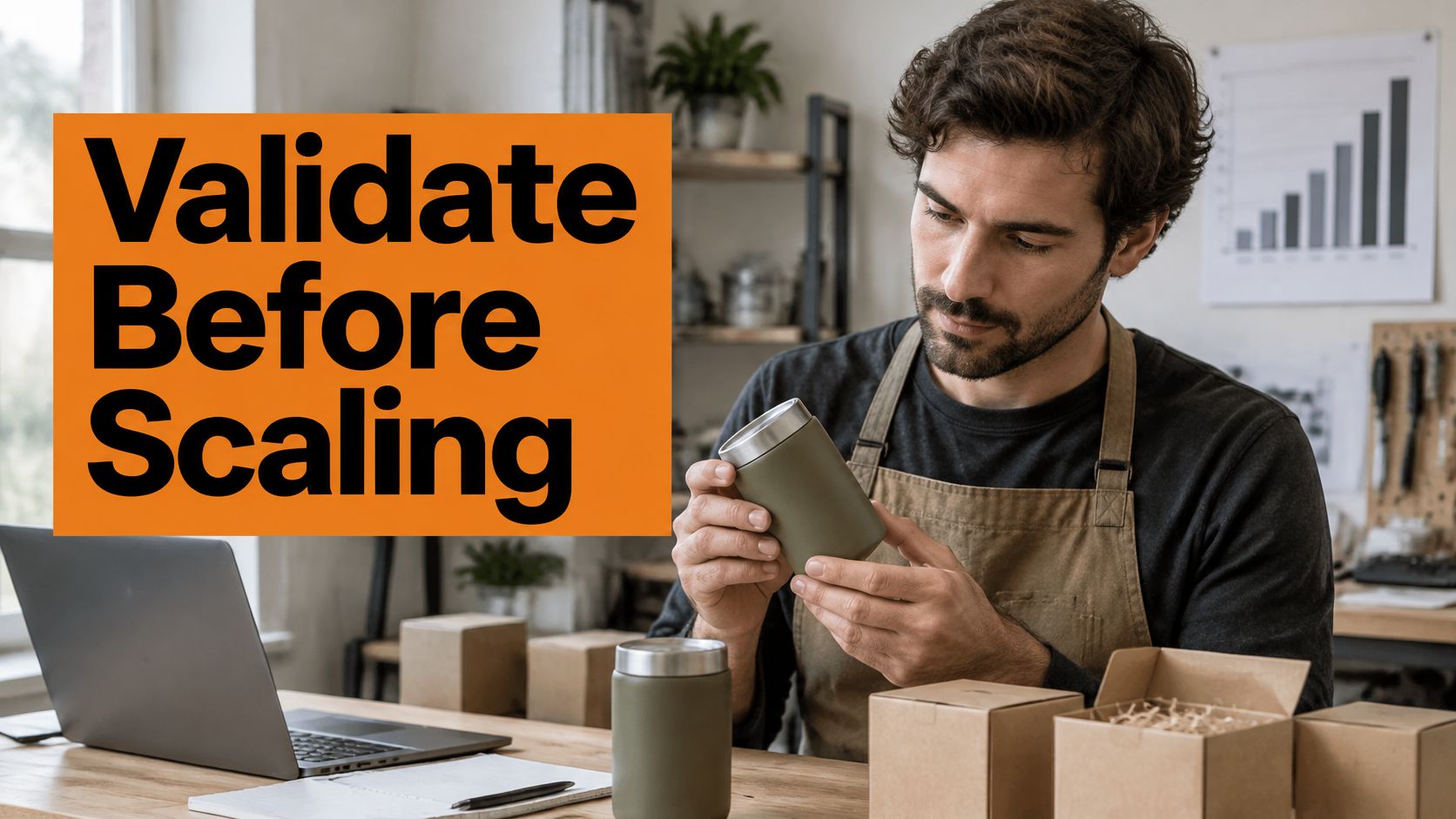
You've got a sketch, a promising prototype, and a factory asking how many units you want. Friends like the idea. You're opening spreadsheets, comparing packaging, and wondering whether you should place the order before someone else launches something similar.
Slow down at the purchase order. Learning how to launch a physical product means deciding what you need to prove before you spend the next chunk of cash. Treat demand, manufacturing, safety, returns, and tax as launch gates, with written tests that tell you when to proceed and when to stop.
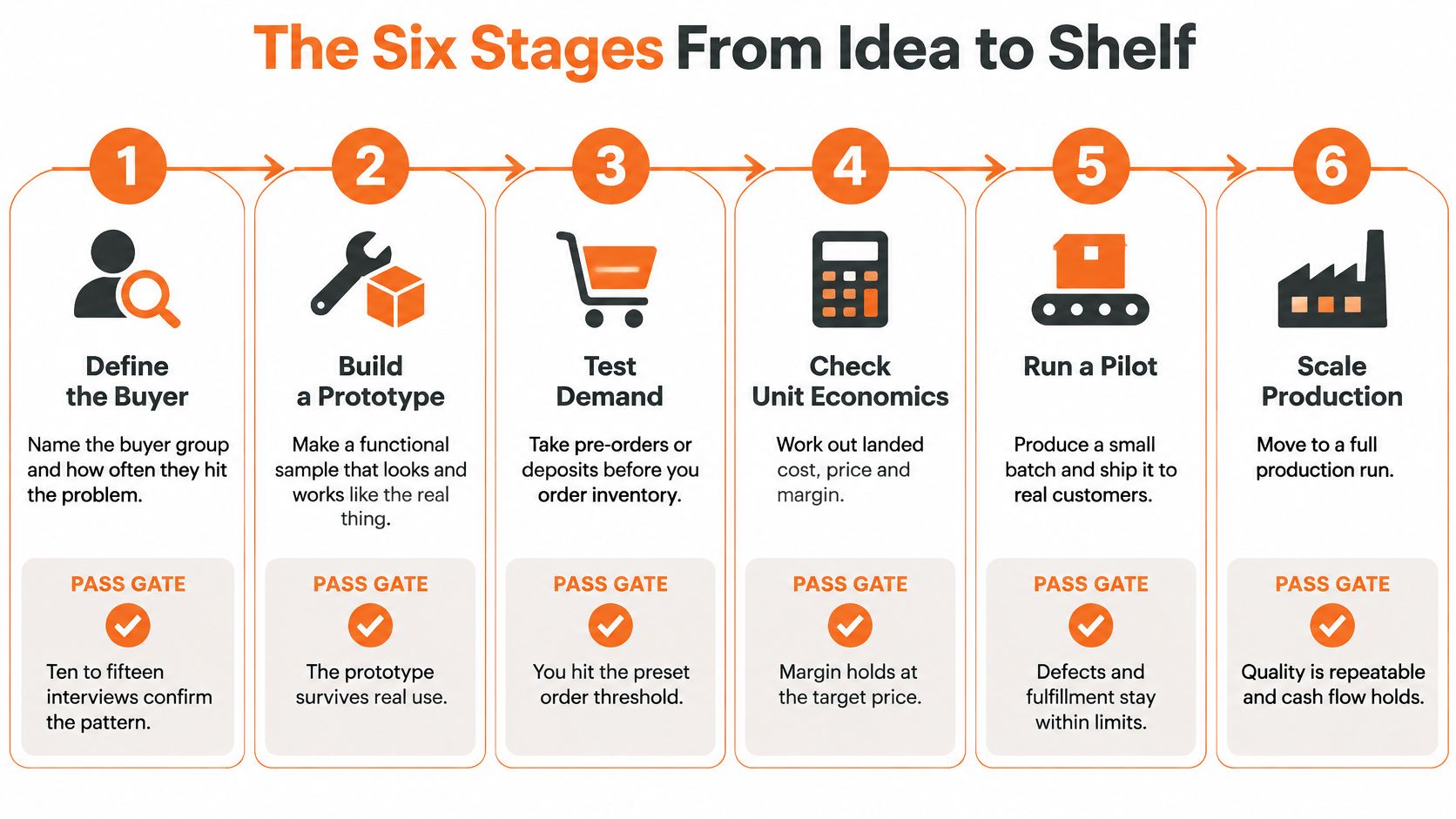
The Six Stages From Idea to Shelf
Launch stages, pass gates and cash at risk
| Stage | Goal | Pass gate | Cash at risk |
|---|---|---|---|
| 1. Define the buyer | Name one customer group and one problem | The same problem comes up in most buyer interviews | Near zero |
| 2. Build a prototype | Prove the core use works | Test users finish the core task without help | Low |
| 3. Test demand | Prove people will pay | Deposits or preorders from the target group | Low to medium |
| 4. Check unit economics | Confirm the margin holds | Contribution margin stays positive after fees, shipping and expected returns | Medium |
| 5. Run a pilot | Test in real use | Defect and return rates stay within limits set in advance | Medium |
| 6. Scale production | Commit to a larger run | Repeat orders and sell-through justify the volume | High |
Think of each gate as permission to expose more cash, rather than a box you tick because you've finished a task. You can complete a beautiful prototype and still fail the demand gate.
Use the roadmap to separate progress from spending.
Write the Test Before You Run It
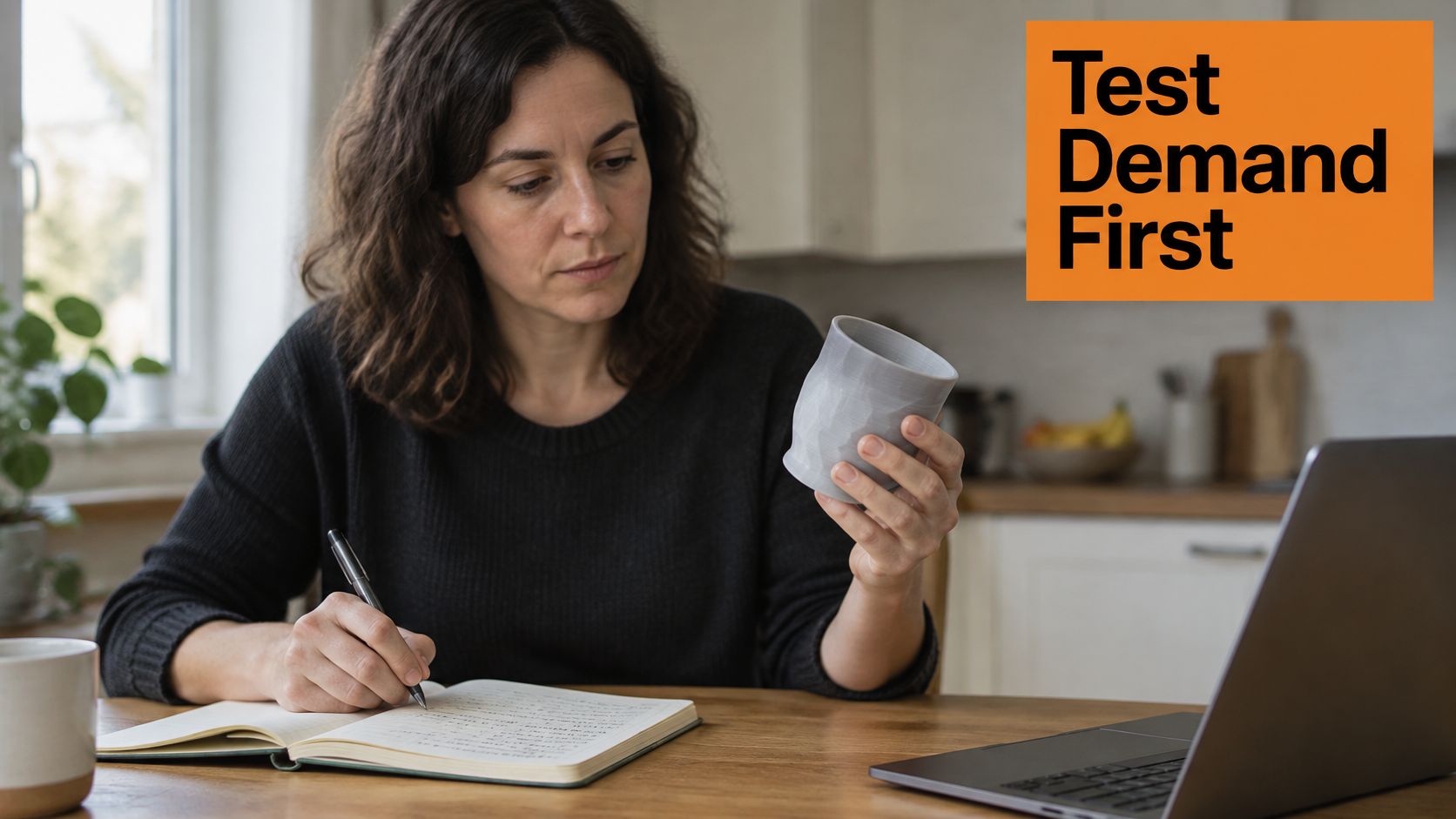
For the buyer gate, look for a recurring problem rather than general interest. For the prototype gate, watch people complete the task without coaching. For demand, ask buyers to make a financial commitment.
Then check whether you can make money fulfilling those commitments. Use the pilot to test your actual production and shipping process, and authorize more inventory only when customer purchases justify it.
The downside deserves that discipline. An analysis published in Marketing Letters examined 83,719 consumer packaged-goods SKUs across 31 U.S. categories and found that consumers no longer purchased 25% one year after launch, while approximately 40% had disappeared by year two.
Practical rule: Write the evidence you'll accept before you see the results. Otherwise, you'll keep moving the finish line.
Say you design a travel cup that impresses your friends. Target buyers try it, compliment the shape, and decline to preorder at your intended price. Stopping there saves you from financing a production run based on applause.
Write your buyer-stage pass gate before buying anything. Keep tooling money out of reach until you pass the demand gate.
How to Test Demand Before You Order Inventory
Start with the test, not the factory. Write a problem statement that names the buyer, the situation, and how often they encounter the problem: “Bike commuters spill coffee when they put ordinary travel cups inside crowded work bags.”
You now have something you can investigate. “People need a better cup” gives you almost nothing to test.
Keep your early prototype simple enough to change after each conversation.
Ask About the Last Time It Happened
Recruit people who fit your buyer definition, rather than whoever answers your social post. You might start with a hypothetical interview plan of ten to fifteen conversations, then continue if you still hear conflicting accounts.
Ask questions that uncover behavior:
- The last incident: When did you last have this problem, and what happened?
- The current workaround: What do you use now? Ask them to show you.
- The cost: What did the problem cost in money, time, cleanup, or frustration?
- The purchase history: What have you already bought to solve it?
- The remaining complaint: Why didn't that purchase solve the problem?
Don't begin with a product pitch. Once you show your design, people may start helping you feel good instead of describing what they do.
In its analysis of startup post-mortems, CB Insights found that founders cited solving an interesting problem without serving a genuine market need in 42% of cases, the most frequently reported reason for failure in that dataset. Use that finding as a reason to investigate need before you pay for polish.
Put a Price in Front of Buyers
Build a landing page with a clear product image, a specific explanation, your intended price, and a preorder button. Show what buyers will receive and explain the expected delivery conditions.
If you can't responsibly accept payment yet, track purchase-intent clicks separately from actual orders. A button click isn't a sale. Don't describe an email signup as a customer.
Write your demand gate before you send traffic. Specify the qualified audience, the behavior you'll count, the acquisition-spend ceiling, and the deadline for making a decision.
For a crowdfunding route, PledgeBox explains ways to measure Kickstarter demand before launch. Use that preparation to distinguish people who enjoy following a project from people willing to fund it.
A deposit tells you more than a compliment. It still doesn't prove that you can acquire customers profitably at scale.
When you accept deposits, state refund terms and delivery uncertainties clearly. Keep a record of what each buyer agreed to, and preserve enough cash to honor refunds if you cancel the batch.
Use our guide on how to pre-sell a product to work through the commitment you're asking buyers to make. Don't promise a production date just because a supplier gave you an optimistic estimate.
Watch Buyers Use It in Person
Take a functional sample to a Chicago pop-up, maker space, or independent shop where your intended buyers already spend time. Ask the venue for permission and make the purchase process straightforward.
Track demonstrations, purchase attempts, completed purchases, objections, and requests for refunds separately. If you explain the product repeatedly before anyone understands it, record that too. You may need clearer instructions, different packaging, or a simpler design.
Try the same price you intend to charge after launch. A steep event discount can test interest in a bargain while telling you little about demand at your required margin.
For another perspective on product development, watch the discussion below while you review your own assumptions.
Turn the Results Into a Spending Decision
Keep a short decision log rather than a folder full of encouraging screenshots. Record who you reached, what they did, what they paid, and what you'll change.
Your opening work should produce:
- Interview evidence: Notes about actual incidents and current workarounds.
- A priced proposition: A page or demonstration that makes the buying decision clear.
- A demand result: Payments, deposits, or a documented failure to reach your preset gate.
- A spending boundary: The maximum cash you'll expose during the next experiment.
If buyers hesitate, change the smallest plausible cause first. Test a clearer explanation before redesigning the whole product. If buyers understand it but won't pay enough, confront that result rather than hiding it behind more branding.
At Chicago Brandstarters, we welcome kind, bold, hard-working Chicagoans and Midwesterners, including people at the idea stage with no prototype. You can apply to join our free community, with membership at $0, and bring your interview notes and gate numbers to small private dinners and our group chat for candid peer feedback.
Make the decisions in order: Is the problem real? Will the intended buyer pay to solve it? Don't let enthusiasm answer either question for you.
How to Lock the Design and Source a Factory
Manufacturing readiness needs its own engineering work. A prototype shows what you want to make; a production specification tells a factory how to make it repeatedly.
Peer-reviewed literature summarized in this product-development paper commonly places commercial new-product failure around 30–49%. Don't finance a large opening order with your most optimistic forecast.
Build a Quote Package You Can Compare
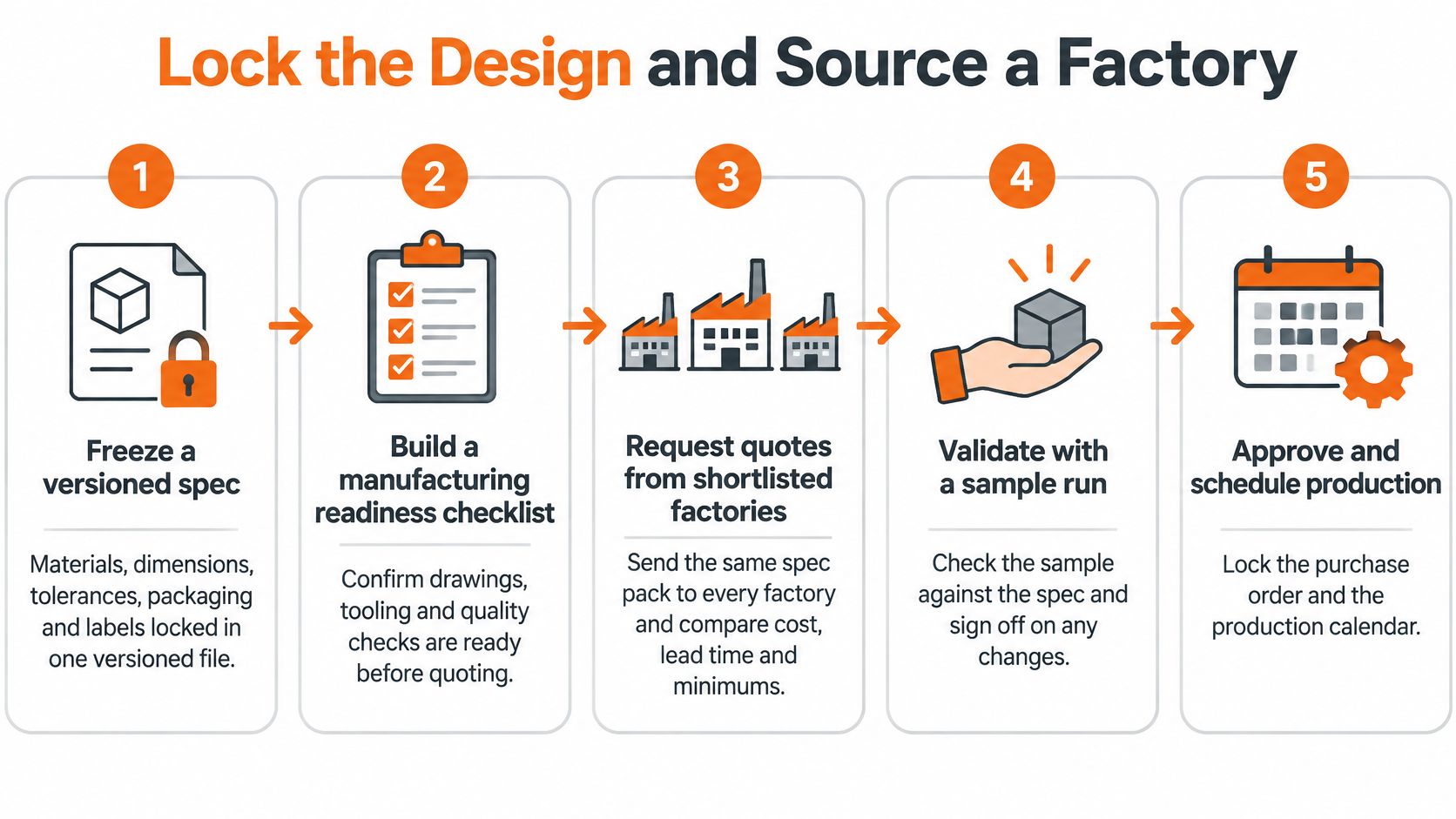
Freeze a versioned specification. Include approved materials, dimensions, tolerances, packaging, labels, inspection methods, and acceptance limits. Run a design-for-manufacture review before tooling, using Genpire on design for manufacturing to prepare questions about assembly and production constraints; don't assume a factory can reproduce every prototype detail economically.
Send the identical bill of materials and specification pack to shortlisted factories. Require the same Incoterms, the delivery rules that allocate transport responsibilities, so you don't mistake a narrower quote for a cheaper supplier.
Calculate landed cost at different order volumes. Include tooling amortization, freight, duties, inspections, warranty replacements, and the cash you'll tie up in stock. A lower unit price can still require more cash than you can afford to lock away.
Use this sequence to keep drawings, samples, and purchase approvals connected.
Approve the Process Before the Volume
Check a production sample against the specification. Record every deviation and approve changes in writing. Don't accept a different material because the sample looks similar; ask what the substitution changes about performance, testing, and labeling.
Run a pilot under production-like conditions and inspect it with a written sampling plan. Classify defects as critical, major, or minor, define your acceptance rules beforehand, and keep the records rather than accepting a verbal quality assurance.
Order the smallest run that can test sell-through and operational reliability. Negotiate milestone payments where possible, and reserve cash for rework. Agree on remedies, tooling ownership, and change approval before sending the purchase order; use our manufacturing partnerships guide to prepare those conversations.
Don't skip packaging-drop tests because the product itself feels sturdy. Don't change materials after tooling without reviewing the consequences. Compare factory inspection results with customer return reasons so you catch failures that your inspection method misses.
Clear the Final Commercial Checks
If you intend to protect a novel design, discuss filing strategy before public disclosure. The USPTO's provisional application guidance explains that a provisional application gives you a 12-month filing window, doesn't become a patent, and receives no examination; you must file the corresponding nonprovisional application within that period to preserve the earlier filing date, and you normally can't extend the window.
Don't file automatically just because you have a new product. Decide whether patent protection fits the invention and your budget, then put any filing deadline on the launch calendar.
Calculate contribution margin per unit before approving the order:
Target price minus landed unit cost, payment fees, shipping, expected returns cost, and any customer-acquisition cost you incur per order.
If you get a negative number at your target price, you fail the economics gate. More volume won't repair a loss on each sale unless you can identify and verify the specific cost reduction.
Safety and Compliance Checks Before First Shipment
A recall can force you to fund refunds, replacements, disposal, and reverse shipping while you try to repair retailer trust. The U.S. Consumer Product Safety Commission reported 369 recalls and safety warnings in 2024 and 376 in 2025 with more than three months still remaining in the year.
Treat compliance as a design constraint. If you wait until cartons sit beside the loading dock, you may have few affordable ways to correct a problem.
Build a Release File
- Identify category requirements. Check applicable rules before finalizing the design, particularly for children's products, batteries, electronics, cosmetics, food-contact materials, and health claims. Confirm which regulator governs your product and each intended market.
- Commission appropriate testing. Give the laboratory your actual materials, intended use, age grading, and production configuration. Keep complete reports and check whether changes require further testing.
- Collect supplier evidence. Retain material certificates, component information, and manufacturing records. Match each document to the product revision you intend to ship.
- Create traceability. Put lot or batch codes on the product or packaging as appropriate, and connect those codes to production dates, materials, inspections, and customer shipments.
- Review labels and packaging. Compare warnings, instructions, age recommendations, and claims with your test results and applicable requirements.
- Assign recall responsibilities. Name who decides to stop sales, who contacts retailers and customers, who handles regulatory reporting, and who controls the response budget.
For a concrete packaging-review exercise, browse Ruby the Red Panda plush from Snugglebug and consider the questions you'd need to answer for your own plush product: intended age group, component attachment, care instructions, and appropriate warnings. A storefront page can help you think through presentation; it can't establish your product's compliance.
Say your packaging designer copies a younger age recommendation from an early mockup, while your final safety assessment requires a different age grade. Catch that mismatch during artwork approval, before you print and pack inventory.
Collect International Documentation During Design
If you plan to sell into the European Union, check the Ecodesign for Sustainable Products Regulation. SGS's explanation of the ESPR and digital product passports describes a framework covering nearly all physical products, with limited exceptions, and product-passport expectations that include materials, substances of concern, durability, repairability, recyclability, compliance records, warnings, and end-of-life instructions.
Check the applicable product-specific measures and implementation timing rather than assuming every obligation already applies to every product. Ask suppliers for the underlying evidence during design, and preserve it when you change factories or components.
Don't release the shipment until the responsible people approve the test reports, supplier documents, and final labels in writing. Keep that approval with the exact product revision you ship.
Returns and Sales Tax Costs to Plan For
U.S. retailers expected 19.3% of online sales to come back in 2025, while projected merchandise returns across all retail channels totaled approximately $849.9 billion, according to the National Retail Federation. Use those figures as context, not as your product's assumed return rate.
When a customer returns an item, you need more than a shipping label. Someone must inspect it, issue the refund, decide whether to repackage or discard it, and update inventory without accidentally reselling a damaged unit.
Run a Returnability Test
Before your purchase order, work through the likely return journey:
- List failure reasons. Separate defects, fit problems, shipping damage, and buyer preference.
- Assign costs. Decide who pays for each return type, and check your policy against applicable consumer requirements.
- Model the cash gap. Test whether you can issue refunds while you still owe suppliers and wait for replacement stock.
- Choose a recovery path. Define which items you can resell, repair, liquidate, recycle, or dispose of safely.
- Test the packaging twice. Send the parcel outward, then repack it as a customer reasonably would and test the return journey.
Write pass criteria for packaging damage, inspection time, recoverable inventory, and refund cash needs. If you can't handle the result, change the packaging, product, or policy before launch.
A generous policy can help buyers feel comfortable, but you still need to pay for it. Compare any conversion improvement with contribution margin after returns, especially when reverse shipping costs a lot or you can't resell opened goods.
Track Sales Tax From the First Order
You can trigger sales-tax registration duties through sales into a state even without an office there. Shopify's remote-seller sales-tax guide describes Illinois's $100,000 sales threshold over a 12-month period and Texas's $500,000 revenue threshold for shipments to customers there.
Its ecommerce sales-tax overview lists Connecticut's $100,000 plus 200 transactions, Nevada's $100,000 or 200 transactions, and Colorado's $100,000 sales threshold. Check current state guidance before making a registration decision.
Sales tax economic nexus thresholds by state
| State | Threshold | How it counts |
|---|---|---|
| Illinois | $100,000 in sales | Sales to Illinois customers in a 12-month period |
| Texas | $500,000 in revenue | Sales shipped to Texas customers |
| Connecticut | $100,000 in sales plus 200 transactions | Both tests in the relevant 12-month period |
| Nevada | $100,000 in sales or 200 transactions | Either test can trigger nexus |
| Colorado | $100,000 in sales | Sales volume only |
Tag every order by ship-to state, order count, and revenue from the first sale. Assign someone to review approaching thresholds and confirm registration, collection, and filing requirements; our guide to taxation of electronic commerce can help you organize those tasks.
Your tax-readiness pass test should stay concrete: you can produce destination-level sales records, identify where you need to register, and name who handles filings. A tax setting in your store doesn't replace that operating process.
At Chicago Brandstarters, we bring kind, hard-working founders together through small private dinners and a private group chat to pressure-test decisions before they become expensive. Bring your demand gate, factory quote, and returns assumptions, even if you don't have a prototype yet. Visit Chicago Brandstarters to apply to our free community and get candid feedback on your next launch decision.
Leave a Reply