
You're carrying a decision you can't run past anyone. Your co-founder is buried in the product, your partner's eyes glaze over when you talk shop, and the group chat is mostly memes. So the note on your phone titled "questions I can't answer" gets a new line every week.
A mastermind addresses that narrow problem: a small room of peers who know your stage, meet on a schedule, and remember what you said you'd do last time. Here's how I'd sort through groups if I were choosing one now. Which questions get real answers, which numbers matter, and when to walk.
Decide If a Mastermind Group Fits Your Problem
Start with one question. Can a small group of peers help you solve one live problem in eight weeks? Write that problem in a single sentence.
Say you sell skincare online and trial customers stop reordering after the second jar. That sentence gives a group something to work with. You can show the drop-off, share the follow-up emails, and ask what worked when they hit the same wall. "I need to grow my brand" gives them nothing, so they'll answer with nothing.

Three criteria tell you whether a room can help.
- A stated purpose. The group should say what it exists for and who it serves. Napoleon Hill introduced the "Master Mind" principle in The Law of Success in 1928 and gave it a full chapter in Think and Grow Rich in 1937, describing at least two people in a friendly alliance around a shared plan, purpose, and mutual encouragement, as this history of Napoleon Hill and mastermind groups explains. Nearly a century later the structure still holds: small numbers, common goals, reciprocal support.
- Reciprocity in both directions. Members offer advice, introductions, and follow-through, not only take them.
- A schedule with teeth. Regular meetings where someone asks what you did.
Peer groups work through specific mechanisms, and a 2020 study of an entrepreneurship education and peer-mentoring program for women engineering and computer-science students names them. Student mentors reported higher entrepreneurial self-efficacy, a changed view of problem-solving, and greater awareness of diversity and gender issues, according to the peer-mentoring study in the International Entrepreneurship and Management Journal. The design was qualitative, so you won't get a clean percentage lift out of it. What you get is the list of what does the work: repeated interaction, reciprocal mentoring, exposure to different perspectives, structured reflection.
You fit if you hold an idea, a prototype, or a first customer, and you can admit a setback out loud. Look elsewhere for leads, for an investor pitch room, or for help with the personal stress of running a company. Those needs want different tools, and a mastermind used for any of them wastes your money and everyone's Tuesday.
If you want the mechanics of how peers learn from each other, peer learning tips from Fluidwave walks through the feedback loop better than most group landing pages do.
Compare Groups on Eight Criteria
Before comparing size or fees, look for evidence that members are safe to be honest with. A group can have a clean website and still punish candor: people hedge their numbers, wait for the host to rescue them, or leave with action items nobody expects to complete.
Use the same grid for every candidate, because hosts get vague when you ask open questions and specific when you hand them a form.
| Criterion | Good fit | Warning sign |
|---|---|---|
| Group size | 5 to 8 members, with time for each person to present | 15 or more people with no fixed time per member |
| Meeting cadence | Monthly, with a few weeks in between to act | Quarterly meetings, or weekly meetings that become status updates |
| Member stage | Peers working on a similar problem, even at different revenue levels | Members far ahead of you, or direct competitors only |
| Member mix | Different functions, such as sales, supply, hiring, or customer research | Every member in one narrow niche with the same blind spots |
| Format | Fixed agenda with timed slots and written follow-up | Open chat with no time limits or follow-up |
| Confidentiality | Written rules, a nondisclosure agreement, and stated consequences for leaks | Verbal promises only, or members repeating each other's numbers outside the room |
| Selling | A no-pitch rule and a stated exit process | Members pitch services in every meeting |
| Cost | Fees and terms stated in writing before you join | Upgrades or fees pushed before the first meeting |
How to find candidates worth comparing
Spend one afternoon assembling a shortlist. Ask two founders you trust which groups they joined and which they quit, search for local founder meetups, and ask each host how they screen for honesty, handle leaks, and remove a member who keeps pitching. Three groups is enough to compare. Fill the grid for each one and read down the columns instead of across the rows.
Size decides how much airtime you get. A guide to self-organized founder groups puts the practical range at 5 to 8 members, which is enough viewpoints to be useful and few enough that everyone presents a problem. Larger formats run on a different model: big rooms usually depend on a chair who enforces strict timing and keeps direct competitors apart. If you join one, ask how the clock gets divided.
Cadence decides whether you act between meetings. A month gives you time to test a move and return with evidence, which is the logic behind this monthly peer-advisory group framework. Quarterly leaves a live problem untouched for too long. Weekly drifts into status updates you could post in Slack.
Practical rule: A host who won't put size, cadence, confidentiality, and terms in writing has already answered your question.
Cost sits last because price explains less than the other seven rows. A free group with written rules and a fixed agenda beats an expensive room that never follows up on commitments.
Check Fit If You Are Early or Outside a Hub
Most joining advice assumes you can compare groups by revenue and business model. That works once you have revenue. If you're pre-launch, compare stage and problem instead.
Say you're in a Chicago apartment, three months into a candle brand, still working a day job. A room of founders doing $2M a year will give you sharper feedback than your friends can, and they will also fill every minute of airtime. That's the tradeoff: experience buys you better answers and costs you the floor.
Six people at your stage on a video call beat forty people in a hotel ballroom, and the travel budget stays at zero.
Three checks protect you.
- Ask for the agenda and the clock. Confirm that every member gets timed airtime, including the person with no revenue yet.
- Ask for anonymized profiles before you apply. You want to see the stage mix, not guess it from a website.
- Ask how remote members get equal time. If the group meets in person only, and you're outside a startup hub, ask whether video attendance counts or whether you'll always be the voice on speaker.
I'd also weigh problem similarity over revenue parity. A consumer brand before its first prototype often needs peers who've handled distribution, manufacturing, or customer validation, even when those peers earn far more than you do. A room of identical pre-launch founders feels comfortable and teaches you little.
At your trial meeting, count the minutes you speak against the minutes the most experienced member speaks. Three versus twenty-five is your answer, whatever the group says about equal time.
Geography still matters for trust and introductions. If you're in the Midwest and want peers at a table instead of on a screen, a Chicago business network group solves a different part of the problem than a national video call does. Use both if you can.
You can also start earlier than most advice suggests. We admit members at the idea stage with no prototype yet, because early decisions are mostly about customer validation, not revenue.
Seven Steps to Join a Mastermind Group
The sequence below is the one I'd follow, in order, without skipping.
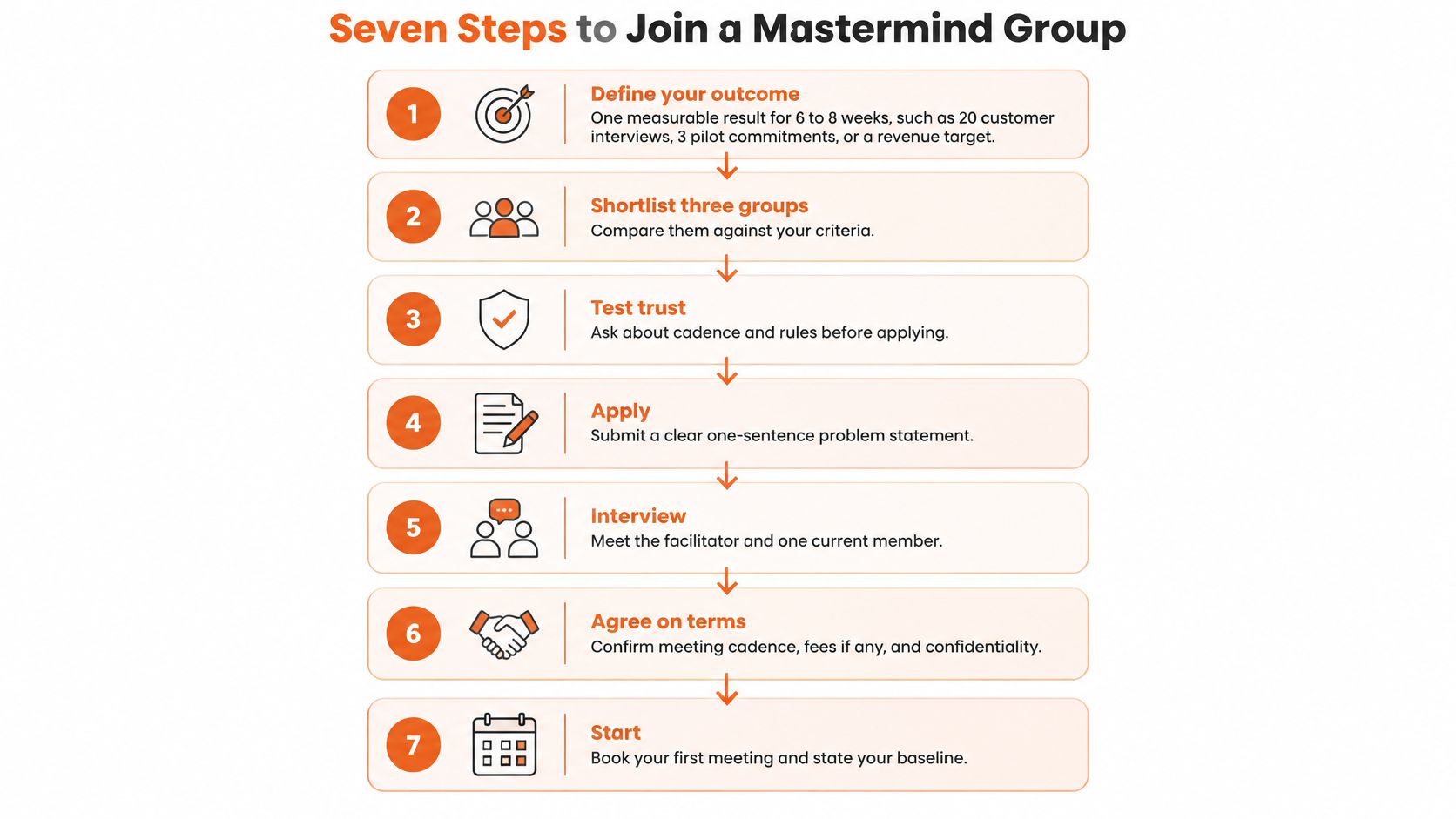
- Turn your goal into one measurable outcome. One result, one deadline inside two months. A short window keeps the pressure on and still leaves room for a real result.
- Shortlist three groups against the grid. Drop any group that can't state its purpose in one sentence.
- Ask for the rules in writing. Meeting cadence, member criteria, confidentiality terms, and how meetings run. Get the answer before you share sensitive numbers.
- Attend one meeting as a guest. Watch whether the group follows a written agenda or improvises.
- Bring one narrow problem with real data. One decision and the numbers behind it, not a tour of your entire business.
- Apply when three checks pass. The group matches your stage, it answered in writing, and its trial meeting followed an agenda. Then commit to an eight-week trial and show up.
- Review at eight weeks. Write down the actions you took, the results you saw, and whether the group caused any of them. Stay if the list is real. Leave if it's empty.
Step three is where momentum often fades. Ask whether the group runs a repeatable problem-solving process, and listen for a sequence: an honest check-in, one or two issues picked from the pile, clarifying questions, options pressure-tested, a specific commitment named by the member who owns the problem, and a review of the last commitment at the next meeting. This guide to choosing a peer advisory board lays out that loop, and it's the difference between a meeting and a conversation.
If you're in Chicago, our application is open, membership costs nothing, and the community runs small private dinner events of 6 to 8 people every two weeks. That's a real room with real airtime, which is what the steps above are trying to find.
Here's the short version of the whole sequence, from definition to first meeting.
Test Trust Before You Apply
Logistics get all the questions. Safety decides whether you get anything out of the room. So start with the boring list, then test the human part.
Here's the checklist I'd bring to that first conversation.
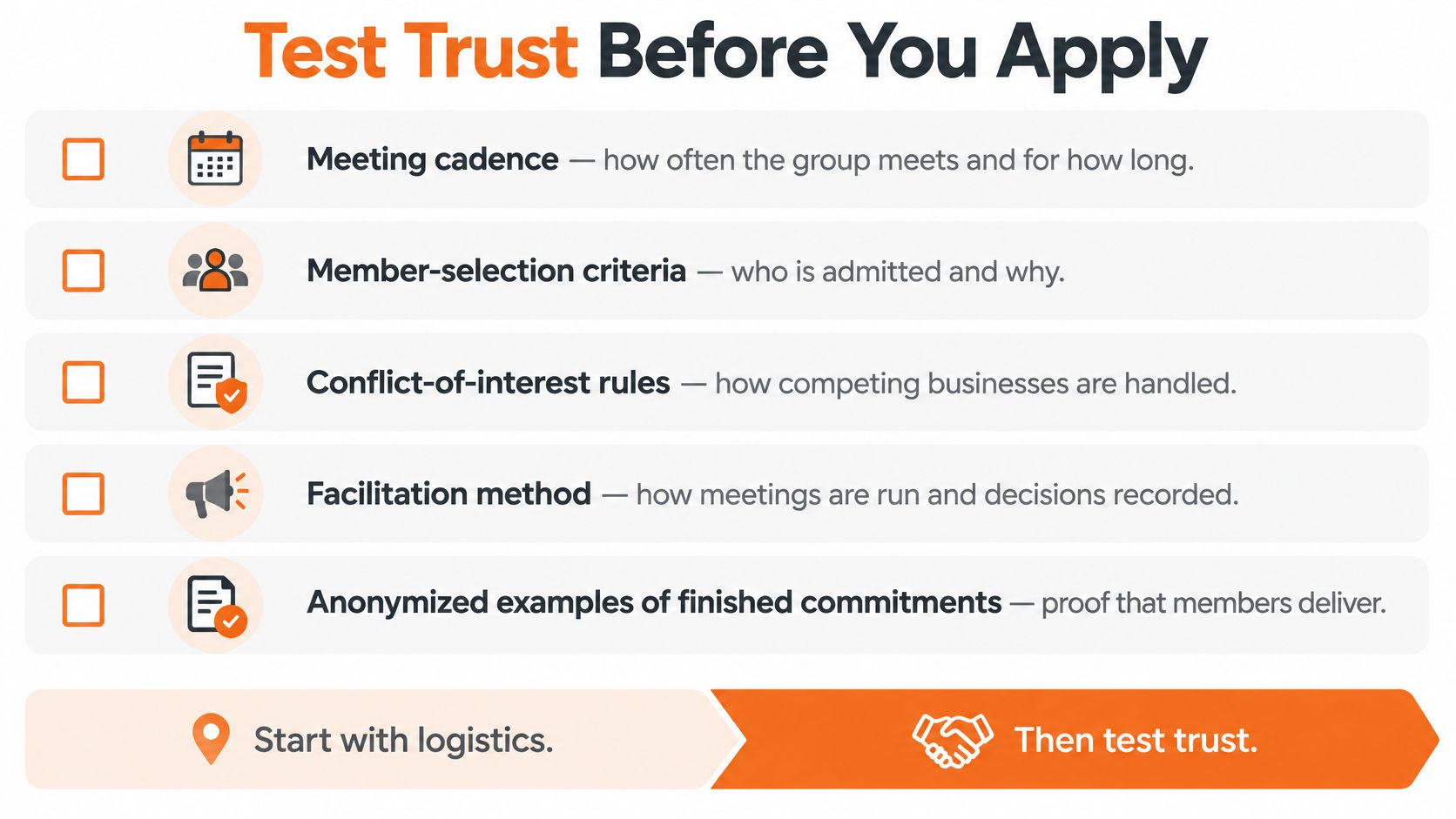
Ask the host for the meeting cadence, member-selection criteria, conflict-of-interest rules, confidentiality expectations, facilitation method, and anonymized examples of completed commitments. That last one matters most. A group that can show you three commitments members finished in the last quarter is doing something right.
Safety isn't goodwill, and it can be measured. A peer-mentoring intervention reported in BMC Public Health found psychological-safety scores averaging 5.6 out of 7 at baseline and 6.1 out of 7 after completion, and its qualitative findings tied that safety to group structure, composition, setting, facilitation, and curriculum rather than personality. Read that as a design checklist, not a personality test.
The trial conversation, in order
Ask a current member three questions before you commit.
- "Tell me about a recent mistake." A specific answer with a cost attached means the group handles failure. A polished story about a lesson learned means it doesn't.
- "Does anyone here take help without giving any back?" Listen for a name or a rule. A nervous laugh tells you the group has an unspoken freeloader problem.
- "How do you handle a confidentiality breach or someone who sells in every meeting?" You want a procedure, not a promise.
What to listen for: "Let me think about how to answer that" is a good sign. A smooth non-answer is not.
Then use a two-meeting trial to watch behavior. Members should challenge your assumptions without humiliating you, admit their own failures without someone weaponizing them later, and offer introductions only where they're relevant. Controlled diversity helps here: founders at different stages and with different functional expertise can tell you things your close friends cannot.
Before you share a single customer number, read how the group treats confidentiality in a peer group and check that your group's rules match that standard in writing.
One more test, and it's the one nobody runs. Kerry George's approach to networking the right way starts from the same premise I'd apply to a trial meeting: watch how people behave when they have nothing to gain from you, then decide whether you want them in your corner.
Run the First Two Meetings and Spot Red Flags
Your first meeting sets the pattern, so arrive with five things written down: baseline, target, deadline, the indicators you'll track, and the specific help you want.

Then book a weekly check-in with evidence attached. That combination of goal setting, monitoring, feedback, and barrier-solving beats general encouragement, and the study on supportive accountability in peer mentoring recommends SMART goals plus motivational-interviewing techniques to lift follow-through. Twenty validated customer interviews, three pilot commitments, or a defined revenue target are concrete enough for a room to help with.
The meeting format that respects everyone's time
Give each presenter a fixed slot. Two minutes for the scorecard. Five minutes to name the bottleneck. Ten minutes of questions before anyone offers advice. Ten minutes for suggestions that members have tested. Three minutes to lock the next action and the owner.
Notice the order. Questions come before solutions, because a group that jumps to advice is guessing about your business.
One narrow problem beats a tour of your whole business, every time.
Framing matters more than effort. "Why do trial customers drop off after week two" is a problem five people can attack. "Here's my whole company" gets you sympathy and nothing else.
Paperwork comes first, too. SCORE's advisory-board guidance says every member should agree to a nondisclosure agreement, that confidentiality should be defined clearly in writing, and that groups should set expectations for time commitment and use an agenda at every meeting. Think of it as the group's operating system.
Five red flags and the rule for leaving
Watch for missing written confidentiality rules, hidden selling, one dominant talker, advice offered before questions, and no follow-up on last month's actions.
Raise the problem once, with the facilitator, plainly. If it shows up again in the next meeting, leave. Two consecutive appearances is a pattern, not a bad night.
Keep a page of notes after each meeting: what you asked for, what you got, what you did, what happened. Judge the group on that page. If you want a closer look at how a structured room runs, this mastermind group format breaks down the mechanics of airtime, agendas, and accountability.
Chicago Brandstarters is a free, vetted community for Chicagoans and Midwesterners building brands from the idea stage to seven figures. Members meet in small private dinners of six to eight people every two weeks and swap honest war stories in an active group chat, which is the closest thing to a standing mastermind I know how to run without a fee. Apply at Chicago Brandstarters and bring one real problem to your first dinner.
Leave a Reply