
You're at your kitchen table at midnight. You have a store open in one tab, an ad account in another, and a spreadsheet you no longer trust. You make every call alone, from which product to reorder to whether you should raise a price by two dollars.
You don't need more videos. You need a person who has sold online, looks at your numbers with you, and helps you pick the next test. That's e commerce mentoring when it works.
What E-Commerce Mentoring Is and Who Needs It
You wake up, check overnight orders, answer a supplier, rewrite a product title, and stare at your ad spend before coffee. Nobody checks your work. Nobody tells you when you chase the wrong problem.
I define e commerce mentoring in plain terms. You meet on a steady schedule with an operator who has sold online. That person reviews your product choice, ads, pricing, fulfillment, returns, and cash flow, and you leave each session with a decision you own.
Think about learning to drive. A course gives you the textbook. A mentor sits in the passenger seat while you drive real roads and corrects you before you miss the turn.
Who Gets the Most From It
You benefit at three common points. You have an idea and no sales yet, and you need help picking a first product and a first channel. You have first revenue and erratic months, and you can't tell which lever moves profit. You run sourcing, marketing, and shipping alone, and you have no second set of eyes.
In 2024, the 2024 Gallup survey found that 29% of U.S. business owners identified personal or community networks, including mentors and chambers of commerce, as helpful resources when starting their businesses. You don't need a huge network. You need one or two people who understand your exact stage.
If nobody can check your numbers and push back on your decisions this week, you need a mentor or a peer group.
Run a quick self-test. You repeat the same ad test without a clear metric. You hold inventory you can't explain. You delay a price change for a month because you fear a drop in sales. Any one answer points you toward help.
Pick Your Starting Point Now
- You need hands-on help: You have one problem that costs you money now, and you want an operator to review it with you.
- You need peers: You feel alone with decisions, and you want founders at your stage to compare notes.
- You need a course: You lack basic knowledge on a topic, and you want lessons you can finish on your own time.
If you sell a physical product, you can also use resources for independent CPG brands to check basics on packaging, pricing, and retail readiness before you ask a mentor to review your plan. I recommend you bring that homework to your first session. You will get sharper answers because you show your work.
One-on-One, Group and Cohort Mentoring Compared
Start with the format, because format shapes what you get. A wrong format wastes your time even when the people mean well.
| Format | Group size | Typical rhythm | Best for |
|---|---|---|---|
| One-on-one mentoring | One mentor and one founder | Weekly or biweekly calls | Fixing one bottleneck, such as ad payback or supplier terms |
| Peer group | 6-8 founders | Every two weeks, plus a group chat | Shared problems, honest feedback and emotional support |
| Cohort program | A fixed roster of founders | Fixed term with set milestones | Founders who need structure and a deadline |
How Each Format Feels in Practice
Say your ad account stalls. In one-on-one mentoring, you spend an hour each week with an operator. You review spend together, kill weak ads, and set one test for the next seven days. You pay for speed and focus, and you get direct answers on your store.
A peer group works in a different way. You meet with 6-8 founders every two weeks. You bring a supplier problem, and three peers share fixes they used with freight, minimums, or quality checks. You also hear plain talk about slow weeks, and that honesty helps you keep going.
A cohort program gives you a fixed roster, shared lessons, set milestones, and an end date. You move at the group's pace. That pace helps you if you drift without a deadline, and it frustrates you if your bottleneck sits outside the syllabus.
You can read more about how peer formats work in practice in this guide to mastermind groups for entrepreneurs, and you can compare that structure with a solo mentor before you commit.
Chicago Brandstarters fits the peer model. Every 2 weeks, we run small private dinner events of 6-8 people, and we keep an active groupchat where members share thoughts, advice, strategies, and support. You get face time and fast help between meetings.
Practical rule: Pick the smallest format that solves your current problem. You can change formats when the problem changes.
Match Your Problem in One Minute
- Choose one-on-one: One bottleneck costs you money now, and you need a diagnosis this week.
- Choose a peer group: You feel isolated, and you want regular feedback from people who share your stage.
- Choose a cohort: You need lessons in order, plus a deadline that forces action.
Check cost before you book. Formats range from free peer circles to paid one-on-one help, and prices change by mentor and term. I want you to ask for the full price, session length, and cancellation terms in writing before you pay anything.
Results to Expect and Where Mentoring Stops
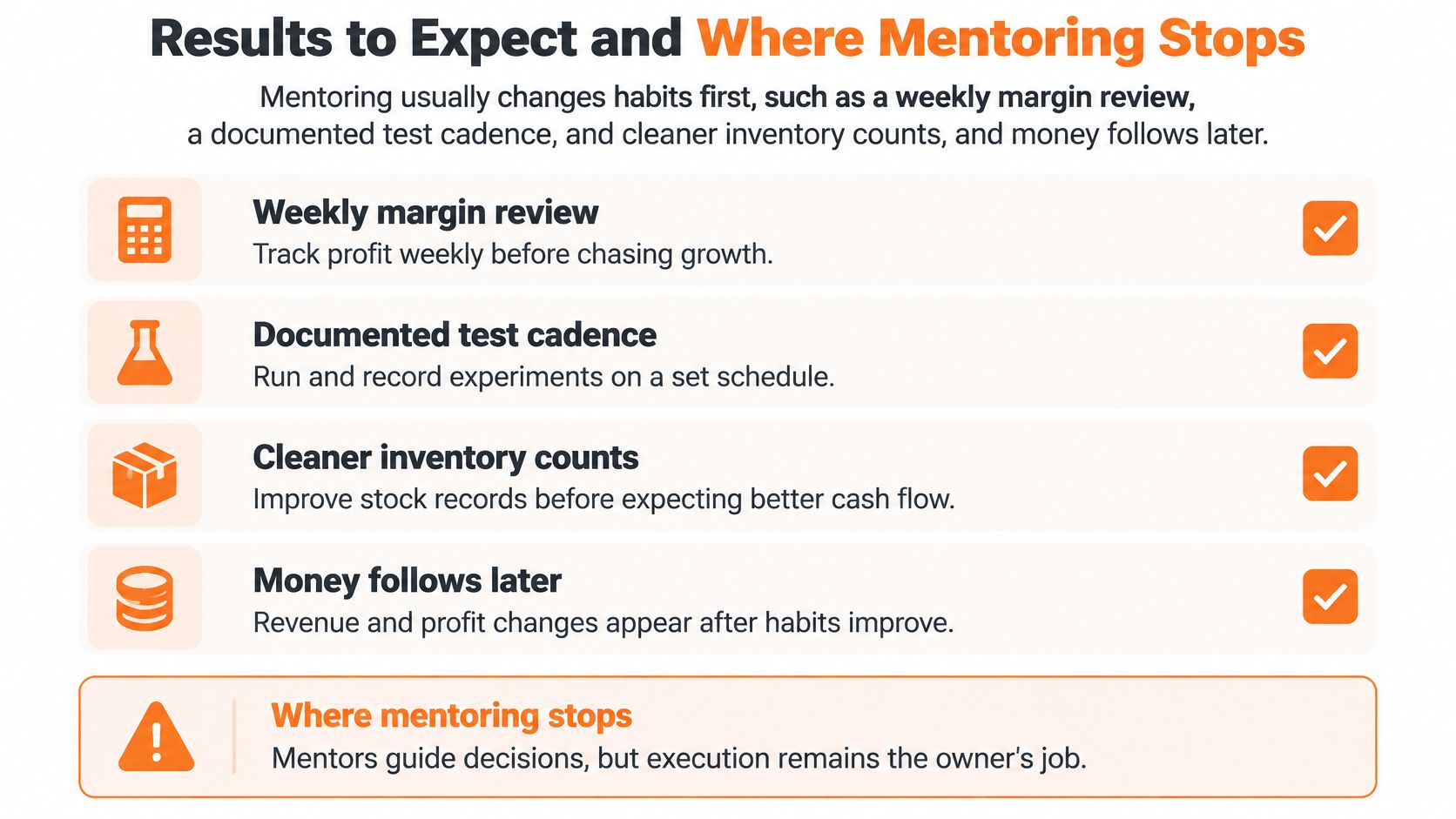
Mentoring changes your habits first. Money follows later. I want you to expect that order, because you will quit too early if you chase revenue in week one.
You start with a weekly margin review. You clean your inventory counts. You write down each test and its result. Those habits sound dull, and they give you control.
Use this checklist to see the habits a good mentor builds with you before either of you talks about growth.
Metrics You Track Before Profit
- Inventory accuracy: Good means your system count matches your shelf count. Count your top sellers this week and log every gap.
- Contribution margin per order: Good means you know profit after product, shipping, fees, and ads. Build one order-level sheet and update it weekly.
- Repeat-purchase rate: Good means past buyers return without a heavy discount. Tag first-time and returning buyers in your store reports today.
- Advertising payback period: Good means you know how many days you need to recover ad spend. Track spend against gross profit by week, and you can use Arlo's framework for profitable growth to sanity-check how you link spend to margin.
- On-time delivery rate: Good means orders arrive inside the window you promise. Pull carrier scans for your last batch of orders and note late arrivals.
- Documented tests per month: Good means you run tests on a schedule and record results. Open a simple log with date, change, metric, and decision.
The U.S. Small Business Administration mentoring summary reports that 87% of entrepreneurs with a mentor remain in business after one year, compared with 75% of those without one. I read that as a survival signal. Mentoring doesn't automatically raise your profit.
Delivery and returns belong on your checklist too, because the DHL e-commerce trends report found that 76% of U.S. shoppers may abandon a purchase when their preferred delivery option is unavailable, while 71% may leave when the return process fails to meet expectations.
Where Mentoring Stops
A mentor can't fix a product nobody wants. A mentor can't create margin in a market that has none. A mentor can't rescue a store that ships late every week while you ignore the cause.
Think of a coach and an athlete. The coach sets the plan and corrects form. You still train.
Say you log every return by reason for two weeks. You find most returns trace to one wrong size chart. You fix the chart, and that fix beats a new ad. Your mentor helps you spot the pattern, and you do the work.
Start a 30-day plan today. Pick one metric, set a weekly target, and review the result on day 30 with your mentor.
Finding Local and Community Mentors
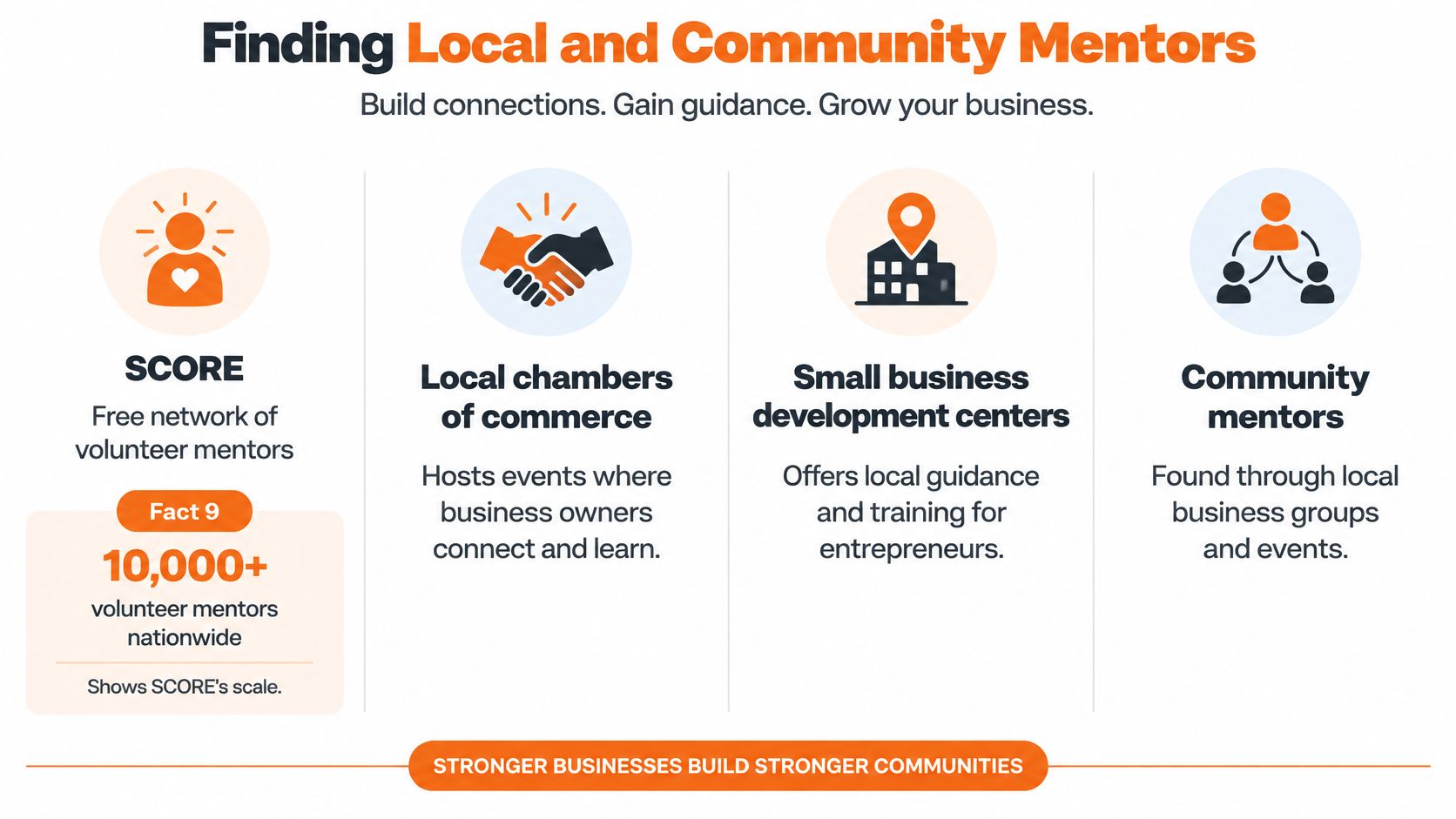
You have four routes, and each route trades cost, travel, and depth in a different way. Start free when you can. Pay only when you need speed or a specialist.
This comparison shows the four routes side by side so you can pick one without weeks of searching.
| Route | Cost | Geography | Format |
|---|---|---|---|
| SCORE | Free volunteer mentoring | U.S. and territories | Volunteer mentoring sessions |
| Chambers of commerce and small business development centers | Free events or low-cost membership and classes | Local | In-person events |
| Chicago Brandstarters | Free to join | Chicago and Midwest | Peer community with small dinners and a group chat |
| Online matching platforms | Check fees before signing up | Online, any location | One-to-one matching |
SCORE gives you free volunteer mentors across the country. According to SCORE reported impact figures, SCORE volunteers provided 300,740 mentoring sessions and helped launch 59,447 new businesses in 2024 across the United States and its territories. You get breadth and experience, and you may need to try more than one mentor to find e-commerce depth.
Your chamber of commerce and your small business development center host events where you meet operators face to face. You build trust faster in person. You also learn local rules on permits, taxes, and hiring that online advice often skips.
Watch this short video before you attend your first local session, and note the questions you want to bring with you.
Chicago Brandstarters gives you a free, vetted peer route. Membership is free, at $0, you can apply to join, and you can join at the idea stage or with no prototype yet. We vet members to keep out self-promoters and service-sellers, and we serve Chicagoans and Midwesterners who build brands from idea stage to seven figures. If you want local peers first, start with our Chicago startup community page and check fit before you apply.
Online matching platforms connect you with mentors by topic and schedule. Check fees, vetting, and refund terms before you sign up. If you plan to mentor others later, this guide on choosing a coaching website builder helps you judge how a mentor presents services, booking, and proof online.
Skip anyone who asks for payment before a single call. You deserve a first meeting that lets you judge fit.
Filter by location, ask for a first meeting, and bring one problem. Then ask yourself one fit question. Do you live in the Midwest and want peers who share honest stories, or do you need a single expert for one problem? Your answer picks your route.
How to Vet a Mentor Before You Commit
Ask hard questions before you share your numbers or your money. A good mentor welcomes those questions and answers with specifics.
| Question to ask | Strong answer | Red flag |
|---|---|---|
| What did you sell, and what did it earn? | Specific revenue, margin and platform history | Vague wins with no numbers |
| How do you test a change? | Names a hypothesis, a metric and a decision threshold | Copies what worked for someone else |
| Where would you test first? | Matches the fix to the funnel stage, such as listing pages or checkout | The same tactic for every problem |
| What happens in the first 30 days? | One bottleneck and a weekly target | A long plan with no owner |
| Can I speak with two past mentees? | Gives names or references and accepts follow-up calls | Refuses references |
| How do you handle money and confidentiality? | Clear written terms before the first session | Pressure to pay or sign upfront |
Judge the Mentor as a Test Partner
I judge every mentor by one standard. That person turns advice into a test with a metric and a decision point. Vague encouragement feels good for a day and changes nothing in your store.
The Wharton meta-analysis of e-commerce A/B testing examined 2,732 website A/B tests from 252 e-commerce companies across seven industries over three years. It found price promotions had the largest effects early in the funnel, especially on category or product-listing pages, while shipping-related promotions performed better later on product and checkout pages.
Use that finding as a vetting tool. Ask where the mentor tests first. A strong mentor diagnoses your funnel, uses price framing on listing pages, and saves shipping offers for high-intent shoppers near checkout. A weak mentor copies a tactic without asking about page context or intent.
Each session should end with a hypothesis, a primary metric such as conversion rate or revenue per visitor, a test audience, and a threshold for your decision. You can also use our guide on how to give and receive feedback to set clear rules for honest pushback in those sessions.
Check track record in a direct way. Ask for the last result the mentor produced and how that person measured it. Listen for baselines, time frames, and trade-offs.
Watch for red flags. Guaranteed income claims, pressure to pay before a first call, no references, and the same advice for every problem tell you to walk away.
Run a Short Trial
- Ask for two references: Call both people and ask what changed in 30 days.
- Book a one-hour trial: Bring one problem and your current numbers.
- Write one goal: State the result you want before the call starts.
- Score the session: Rate clarity, specificity, and follow-up in writing.
- Check day 30: Compare your metric with your baseline and decide with data.
Close with a one-page written agreement. Cover goals, session length, confidentiality, price, and how either side ends the arrangement.
Pick Your First Mentor This Week
You don't need a perfect match. You need a first session, one metric, and a review date. Momentum beats a long search.
Your Seven-Day Plan
- Write three goals: Pick outcomes you want in the next 90 days, and rank them by profit impact.
- Pick one format: Choose one-on-one, peer group, or cohort based on your current bottleneck.
- Shortlist two options: Use the vetting questions and cut anyone who gives vague answers.
- Book or apply: Schedule a trial session or apply to a community this week.
- Set your review: Choose one metric and put a review date 30 days out on your calendar.
Keep each step small. You can write goals in twenty minutes. You can send two short messages today that state your stage, your problem, and your request for a first call.
Start with one question you cannot answer alone, then find the person who has already answered it.
If no option fits, join a free peer group first. You build momentum, hear how peers solve supplier and ad problems, and learn which specialist you need. Revisit one-on-one help in a month with a sharper question and a baseline in hand.
For Chicago and Midwest readers, we give you a free place to start. Free membership includes joining the small dinner parties and other events, plus the group chat. Members who have experienced early-stage mistakes are happy to share their experiences with other members, so you hear what failed and what fixed it.
I recommend you act before your next reorder or ad budget increase. A mentor earns trust when that person helps you avoid one expensive mistake and design one clean test. You keep control of decisions, and you stop guessing alone.
If you build a brand in Chicago or the Midwest, Chicago Brandstarters gives you free small dinners, an active group chat, and peers who share honest tactics on products, ads, and fulfillment. Apply this week, bring one question you can't answer alone, and leave with a test you can run in the next seven days.
Leave a Reply