
Your brand starts before you feel ready. You don't need a large budget or a team to build one. You already have a brand, whether you planned it or not. Every sales call, direct message, product choice, refund, delivery update, and customer reply tells people what you stand for.
That makes brand building less mysterious. You aren't decorating a business. You're teaching people what to expect from you, then proving that expectation through repeated action. Trust grows through evidence, especially when customers face risk around payment, quality, delivery, privacy, or support. Edelman's research found that trust in institutions had become a “buy or boycott” factor for 71% of global consumers, while 63% said they would buy from or advocate for brands based on their positions on societal issues, even when those brands cost more than competitors. The 2024 Edelman Trust Barometer findings give founders a practical warning. Your values only help when your operations can prove them.
In this list, I walk you through ten brand building strategies you can run yourself on a small budget. Each one has a clear angle, a real trade-off, and a first move for the coming week. Pick the gap that hurts most and start there.
1. Community-Driven Brand Building
A founder group can replace a surprising amount of guesswork. You bring a problem to people who understand your stage, hear how they handled similar situations, and leave with a decision you can test. You also learn which parts of your story sound clear to outsiders and which parts need work.
Chicago Brandstarters uses small, private dinner events every two weeks and an active group chat for founders who share tactics, mistakes, and support. Members can discuss a product launch, a difficult customer, a supplier issue, or a positioning question without turning every conversation into a sales pitch. Saucial can help you discover events where people share information more openly.
The trade-off is time. A community won't fix your business if you only appear when you need an introduction. You need to contribute, protect confidentiality, and choose people who take the work seriously.
Build a useful founder circle
Look for groups with:
- Identity checks: Verification and LinkedIn vetting can reduce self-promoters and service sellers.
- Confidentiality rules: People share more candid details when they know private matters remain confidential.
- Stage-specific discussion: A pre-launch founder needs different advice from a company preparing to scale.
- Regular contact: Repeated conversations create context, so members can give sharper feedback.
A Chicago or Midwest setting can help you test whether your brand feels practical and human, rather than polished for its own sake.
Practical rule: Give useful context before asking for help. People can respond to a real problem, not a vague request for “thoughts.”
Your first move this week is simple. Attend one founder event or join one serious group chat, then bring a specific question about your customer promise. Ask members what they think you sell, who they think needs it, and what would make them trust you.

2. Authentic Brand Storytelling
Your story should explain the decision behind the business, not recite a polished pitch. Tell people what you noticed, what frustrated you, what you tried, and what you still need to learn. A founder who admits an early mistake can sound more believable than one who claims to have understood everything from the beginning.
That doesn't mean you should publish every private struggle. Share details that help customers understand your product choices and your standards. If you say you care about accessibility, show how that affects the product. If you value careful service, explain what you do when an order goes wrong.
Trust becomes harder to earn when your public values and customer experience disagree. The 2024 Edelman report found that 60% of people make buying or avoiding decisions based on a company's stance on societal issues, and fully trusting a brand made people more likely to purchase, advocate, or stay loyal after a mistake. The Edelman Trust Barometer Special Report gives you a useful test. Don't announce a belief you can't support through behavior.
Use the founder voice while it's still yours
Write the first version yourself. Record a short voice note about why you started. Then turn that note into an About page, an onboarding email, or a customer message. Examples from founders such as Sara Blakely, Yvon Chouinard, and Warby Parker show how personal conviction can become part of a company story, but your version should stay grounded in your own decisions.
Read how to write a brand story before you draft. Avoid manufactured vulnerability. One honest detail beats a dramatic origin story that customers can't verify.
Your first move this week is to write three short paragraphs: the problem you saw, the failed or imperfect attempts that came before your product, and the promise you now make to customers. Ask one customer whether the story sounds like you.

3. Strategic Positioning and Differentiation
Clear positioning makes your business easier to remember. It also tells you which customers to ignore for now. A small Chicago food brand might focus on busy families who want dependable weekday meals, while another might focus on regional ingredients and slower weekend cooking. Both can sell food, but they shouldn't make the same promise.
You don't need to sound louder than a national competitor. You need to answer three questions plainly:
- Who do you help? Name the buyer by situation, not only by age or location.
- What problem do you solve? Describe the costly, frustrating, or repeated problem.
- Why should people choose you? Point to a difference you can defend through product, service, expertise, access, or process.
Use the sentence, “I help [customer] solve [problem] because [reason I'm different].” Then test it in real conversations. If people repeat a different benefit back to you, pay attention. Their language may reveal a stronger position than your original idea.
Choose a position you can keep
Dollar Shave Club challenged expensive razor shopping with a direct, irreverent proposition. Allbirds connected footwear with comfort and sustainability. Glossier built around everyday makeup rather than magazine-style perfection. You don't need to copy those brands. You need to decide what your company will make easier, clearer, or more dependable.
Brand positioning for startups can help you work through the target buyer, category, alternatives, and value proposition.
Your first move this week is to write three positioning statements for the same offer. Send them to five people who fit your audience and ask what each statement makes them think you sell. Keep the version that creates the clearest understanding, not the one that sounds smartest.
4. Consistent Brand Identity Across Touchpoints
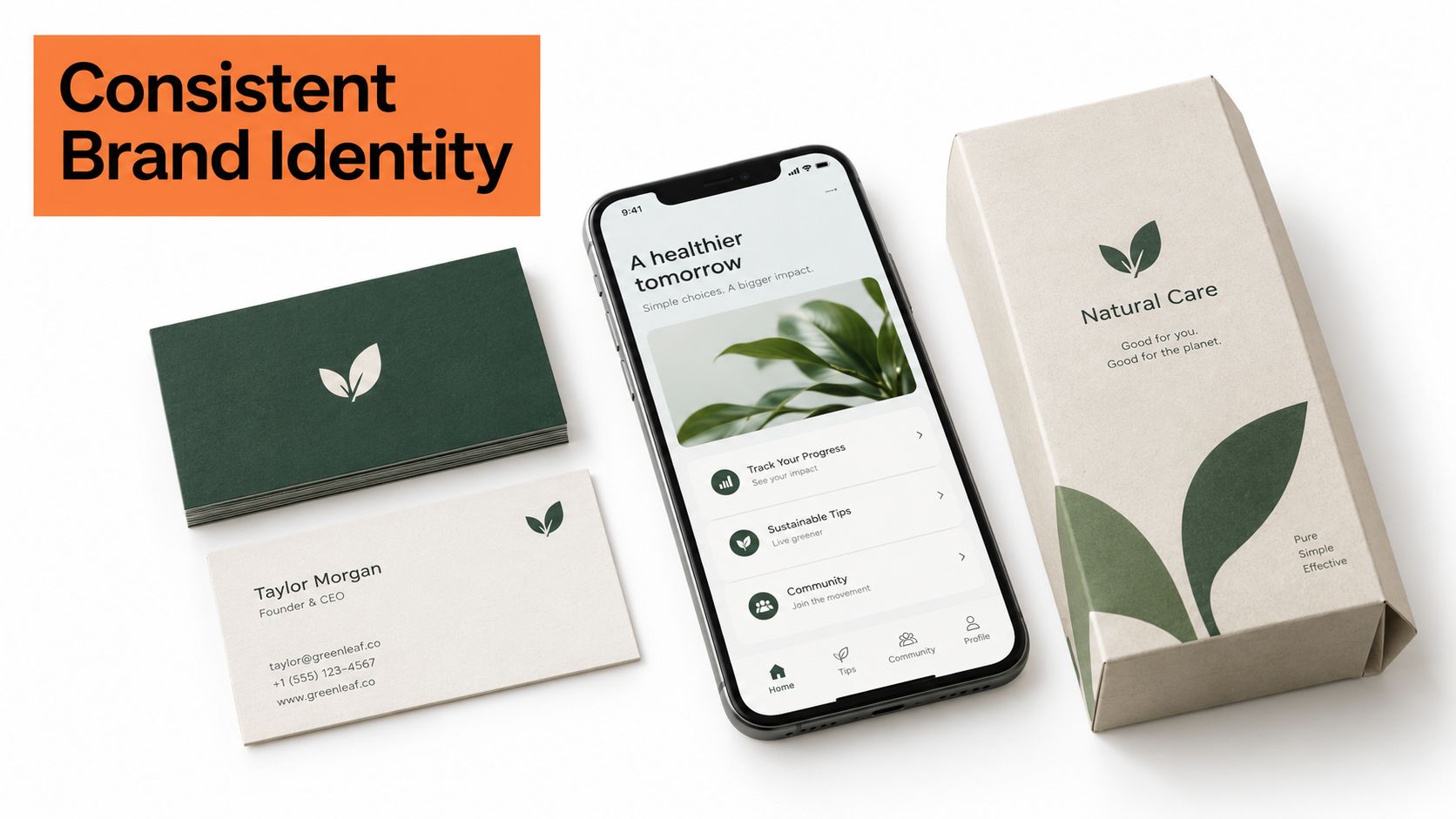
A customer shouldn't need to re-learn your company each time they meet it. Your website, Instagram account, packaging, order emails, sales calls, and support messages should carry the same promise. They don't need identical words or designs. They need the same personality, standards, and explanation of value.
Consistency also helps you learn. When your promise stays stable, you can better judge whether a change in conversion or repeat purchase came from your offer, price, channel, or product. Lucidpress research found that consistent brand presentation was associated with revenue increases ranging from approximately 10% to 20%, with later research reporting an upper estimate of 33%. The historical Lucidpress findings don't mean consistency guarantees a result. They do show why founders should treat it as an operating discipline rather than a design preference.
Write rules you can actually follow
Create a short document with:
- Your promise: One sentence that every team member can repeat.
- Your voice: List words you use often and phrases you avoid.
- Your visual system: Choose two or three colors, one type style, and a small set of image rules.
- Your service standard: Explain how you handle delays, refunds, questions, and mistakes.
- Your proof: Keep testimonials, product evidence, policies, and results in one place.
Apple, Nike, and Mailchimp each use recognizable combinations of visual cues and language. A solo founder can apply the same principle with a simple shared document. If you need more ideas, find brand awareness strategies.
Your first move this week is to collect your website homepage, latest email, product page, social profile, and support reply. Read them side by side. Circle every difference in promise, tone, and customer expectation. Fix the largest contradiction first.
5. Direct Customer Feedback and Iteration
A Chicago founder may hear “I like it” at a market stall, then see few repeat purchases. A Midwest software founder may receive positive interview answers while users abandon onboarding. Feedback becomes useful when it connects words to behavior.
Ask what customers tried before, what caused hesitation, what happened after purchase, and what they would change first. Record the exact language they use. Separate observed actions from opinions, then choose one decision to test.
The U.S. Small Business Administration recommends surveys, questionnaires, focus groups, and in-depth interviews for direct research. Its guidance also covers using customer conversations to test a logo, improve the buying experience, and identify alternatives. The SBA's market research guidance supports narrowing each research round to one question rather than asking people to judge the whole business.
Turn comments into a small test
Use calls, short surveys, support conversations, and product reviews. Ask “why” again when an answer stays vague. A short record keeps the work practical:
- Customer language: Copy exact phrases from calls and messages.
- Observed problem: Note what people do, not only what they claim.
- Decision: State the change or hypothesis you will test.
- Follow-up: Tell participants what changed and what you left alone.
Slack grew by listening closely to early users. Notion's community has also shaped product discussion through direct engagement. A small founder can build the same habit without a large audience.
Your first move this week is to schedule five customer conversations or send five personal feedback requests. Ask what each person expected before buying, where the experience differed, and what would make them recommend you. Make one small change, then report the result to participants.
For a practical process, use this guide to organize customer feedback collection.
6. Strategic Partnerships and Co-Branding
A Chicago coffee company can reach new customers through a weekend bundle with a local bakery. A Midwest software founder might work with an accountant serving the same small-business audience. The strongest pairings solve a related problem: one partner contributes access or expertise, while the other adds a useful product or service.
The trade-off is shared reputation. Customers may judge your company by your partner's delivery, support, and policies. Before announcing a collaboration, agree on ownership, quality standards, refunds, customer data, and complaint handling.
Test the partnership before expanding it
Start by comparing potential partners on five practical points:
- Customer standards: A friendly brand cannot offset unreliable delivery.
- Complementary offers: Each product should make the other more useful.
- Clear exchange: Define the contribution from each side, such as audience access, content, fulfillment, leads, or revenue.
- Simple exit: Decide what happens to unsold stock, customer data, and unresolved complaints.
- Immediate reason to try: Give customers a clear proof point, such as a limited bundle or useful event.
Glossier's collaborations and Shopify's work with payments, apps, and logistics providers represent different partnership models. An early founder can begin with a joint workshop, referral arrangement, limited bundle, or customer education event. A small test limits exposure while showing whether the audiences respond.
Make participation easy for the other founder. Provide copy, images, dates, tracking links, and one support contact. Share the promotional work instead of asking your partner to create demand while you collect the attention.
Your first move this week is to list three complementary businesses in Chicago or the Midwest. Choose one and send a short proposal for a limited test. State what you contribute, what the partner contributes, the customer offer, and the result both sides will use to decide whether to continue.
7. Data-Driven Brand Metrics and Measurement
A founder in Chicago can spend a week polishing ads while customers still cannot explain the brand. Measurement should expose that gap early. Choose signals tied to three questions: do people understand the offer, trust the company, and return? An ecommerce brand might track repeat purchase, referrals, review sentiment, branded search, and conversion rate. A service business may learn more from qualified inquiries, proposal acceptance, referral source, and retention.
Nielsen's annual report found that only 36% of channels globally performed above average for both sales and brand building. The finding supports a practical rule: give each channel enough time to show its job. Search and retargeting often capture existing demand. Founder content, partnerships, video, public relations, and community work may create demand that appears later through direct visits or branded searches. Nielsen's annual report
Build a small measurement plan
Create a one-page scorecard rather than a crowded dashboard. Assign each channel one primary role:
- Demand capture: Search, retargeting, and marketplace ads.
- Demand creation: Founder content, video, partnerships, and public relations.
- Trust formation: Reviews, demonstrations, customer stories, and transparent policies.
- Retention: Product education, support, follow-up, and community.
Record a baseline before changing the campaign. Compare people who saw the work with a similar group that did not, using geography, audience segment, or time period when practical. Last-click reporting can over-credit the final interaction and hide earlier brand activity.
Your first move this week is to record current levels for three metrics. Test one channel while keeping another steady. Review both after a defined period, then change the message, offer, channel, or customer experience based on the evidence. A small Chicago or Midwest founder can run this from a spreadsheet.
8. Content Creation and Thought Leadership
A customer asks why your product costs more than a competitor's. Your answer could become a useful post, a short video, or a podcast episode. Content earns attention when it explains a real decision, not when it repeats generic motivation.
Choose one format you can sustain. Share supplier choices, product tests, pricing decisions, failed experiments, or lessons from serving customers. A Chicago founder might publish a weekly teardown of local ecommerce pages. A Midwest maker could film a short sourcing update. A service business could interview another founder about a difficult operating decision.
The strongest topics come from work already happening inside the company. Use this sequence:
- Start with one question customers ask before buying.
- Give one specific example from your business, a customer conversation, or a local setting.
- Offer one action the reader can try.
- End with a clear invitation to reply, test, visit, or talk.
This approach builds authority through evidence. Label what you know, what you are testing, and where the trade-offs remain. A detailed lesson may attract fewer immediate sales than a product announcement, but it can give prospects a reason to remember and trust your brand. Avoid jargon and sales language that obscures the lesson. Use fresh post ideas for prompts, then rewrite each idea in your own voice.

Repurpose the insight, not the wording. One customer question can support a blog post, a short video, an email, and a discussion prompt. Change the example and opening to fit each channel.
This week, ask three customers which question they wish someone had answered before buying. Choose one response, publish a useful answer in your preferred format, and invite one person to challenge or clarify it.
9. Customer-Centric Brand Values and Purpose
A founder in Chicago can claim to support local business, then lose trust when a customer struggles to get a refund. A Midwest maker can promise care, yet ship late without explanation. Purpose earns credibility through decisions customers can see.
Trust influences both buying and willingness to pay. A 2025 global branding analysis reported that 68% of consumers were willing to pay more for products from a trusted brand name, while 88% tended to buy from brands they trusted. The analysis of global brand trust supports a practical lesson: connect your values to the customer's actual experience, not a polished mission statement.
Turn values into commitments
Choose two or three behaviors you can prove this week:
- Plain data practices: Collect only what you need and explain why.
- Predictable problem solving: State how customers receive refunds, replacements, or help.
- Dependable service: Set a response expectation and meet it.
- Community accountability: Name the Chicago or Midwest partners and groups you support.
- Product honesty: Explain limitations before customers discover them.
Customer trust remains fragile. 15% of consumers say they absolutely trust brands with their data, while 61% believe brands do not have their best interests at heart, according to Twilio's customer engagement research. The same research reports that responsive service and easy returns or refunds ranked ahead of data protection as trust drivers in 2025.
That trade-off gives a small company a workable advantage. You may not match a larger competitor's reach, but you can explain one policy clearly, answer a customer directly, and fix a failure without passing the issue between departments.
Your first move this week: choose one value and trace it through checkout, delivery, support, and returns. Rewrite one policy in plain language. Ask two customers whether it sounds believable, then change the policy if their questions reveal a gap.
10. Strategic Mentorship and Advisor Networks
A founder in Chicago may spend weeks refining a broad brand promise, while a local operator spots the problem in one conversation. The right mentor can show where your offer, pricing, or support process creates expectations your business cannot meet.
Start with a decision, not a title. Send a one-page brief covering your customer, offer, current evidence, and the choice in front of you. Ask for a focused conversation. Specific questions make it easier for a busy advisor to give useful criticism, and they help you judge whether the relationship is worth continuing.
Give the relationship a defined job
Choose someone who has solved the problem you expect to face. A Chicago consumer-brand operator may help with positioning. A Midwest manufacturer may understand fulfillment constraints. An ecommerce founder may have practical retention lessons. Startup programs such as Y Combinator, Techstars, Goldman Sachs 10KSB, EcomFuel, and Million Dollar Sellers can provide access to experienced people. Warm introductions from customers, peers, suppliers, and former colleagues often work just as well.
A formal board adds structure, but it also adds time and obligations. For an early founder, one or two advisors with clear boundaries may be more useful. Agree on the meeting rhythm, the questions they will address, and what information stays confidential.
Bring a small set of evidence to each conversation:
- Customer evidence: What people buy, ask about, reject, and repeat.
- Brand promise: Where the message matches, or conflicts with, the actual experience.
- Current constraint: The issue slowing progress now.
- Next test: The change you will make and the result that would support it.
Your first move this week: identify one Chicago or Midwest operator ahead of you in the area where the brand feels weak. Send a concise note with one question and request a short conversation. If the advice changes your next decision, propose a repeat check-in with a defined purpose.
Top 10 Brand Building Strategies Comparison
| Strategy | 🔄 Implementation Complexity | ⚡ Resource Requirements | 📊 Expected Outcomes | 💡 Ideal Use Cases | ⭐ Key Advantages |
|---|---|---|---|---|---|
| Community-Driven Brand Building | Medium, set up and curate peer groups | Low–Medium, time, events, facilitation | Faster learning, practical feedback, accountability | Early-stage founders, bootstrapped brands seeking peer input | High trust, low cash cost, rapid experiential learning |
| Authentic Brand Storytelling | Low, introspection and messaging craft | Low, founder time; optional copy support | Strong loyalty and trust; word-of-mouth growth | Founder-led businesses, consumer brands needing differentiation | Unique, hard-to-copy positioning; emotional connection |
| Strategic Positioning and Differentiation | Medium–High, research, testing, discipline | Medium, market research and messaging work | Clear target fit, better conversions, focused growth | Competitive markets, limited-budget startups | Memorable clarity; efficient use of resources |
| Consistent Brand Identity Across Touchpoints | Medium, create and enforce guidelines | Medium, design, training, governance | Faster recognition, reduced confusion, cohesive experience | Scaling teams, multi-channel brands | Professionalism, faster internal decisions, trust |
| Direct Customer Feedback and Iteration | Medium, ongoing processes and analysis | Medium, tools, staff time for interviews/analysis | Improved product-market fit, higher retention | Product-driven startups, SaaS, iterative products | Aligns product to real needs; reduces wasted effort |
| Strategic Partnerships and Co-Branding | Medium, partner selection and coordination | Low–Medium, shared resources; coordination time | Expanded reach, borrowed credibility, cost sharing | Brands needing audience expansion without heavy ad spend | Rapid audience access and credibility leverage |
| Data-Driven Brand Metrics and Measurement | High, tracking, attribution, analysis | Medium–High, analytics tools and expertise | Measurable ROI, informed optimization, trend spotting | Growth-stage companies, investor-facing teams | Rigor in decisions; demonstrable impact on results |
| Content Creation and Thought Leadership | Medium, consistent production and planning | Medium, creator time or team, distribution effort | Organic authority, search visibility, audience growth | Experts wanting organic acquisition and influence | Long-term authority and scalable organic traffic |
| Customer-Centric Brand Values and Purpose | Medium, align decisions and operations | Low–Medium, policy changes, program investment | Deep loyalty, resilient brand reputation | Mission-driven brands, those building employee/customer affinity | Strong emotional bonds; media and word-of-mouth appeal |
| Strategic Mentorship and Advisor Networks | Medium, sourcing and managing advisors | Low, time, equity or small retainers | Faster learning, better decisions, access to opportunities | Founders needing experience, fundraising, or introductions | Shortcut to expertise, credibility, and network access |
Choose One Strategy and Run It This Month
You don't need to run all ten strategies at once. Choose the one that fits your current gap, not the one that sounds most impressive. If customers don't understand your offer, start with positioning. If they buy once and disappear, inspect the post-purchase experience. If your message changes across channels, write the simplest identity guide you can follow.
Give one strategy 30 days. Track one metric from the list and write down what you expected before you started. That small record matters because founders often remember the activity but forget the original hypothesis. A community may produce sharper decisions, customer interviews may change your promise, and a partnership may reveal a new audience. Measure the behavior, not only the feeling.
Trust gives you a useful standard for each decision. Edelman's 2019 survey found that 81% of people said trusting a brand to do what is right matters when they decide what to buy. The same research found that 82% considered ethical behavior important to trust, compared with 87% for user experience. Edelman's trust and brands research points to a practical order of operations. Make the customer experience easy, then prove that your company behaves as promised.
Treat the first purchase as the beginning of a relationship. Edelman's 2023 Brand Trust report says people expect ongoing engagement after purchase, especially when they feel vulnerable, and that buying behavior doesn't always follow a simple linear funnel. The Edelman Brand Trust report supports a simple routine: send usage guidance, ask for feedback after the customer has time with the product, answer complaints clearly, and give people a reason to return.
Chicago and the Midwest give you useful settings for these tests. A local event can reveal whether your story sounds human. A regional partner can test whether your offer travels beyond your immediate circle. A customer conversation can show whether “practical,” “kind,” or “hard-working” describes your business through action or only through copy. One 2025 survey found that customer acquisition was the top expected challenge for early-stage owners at 48%, followed by retention at 28% and learning new marketing technology at 27%. Only 24% identified branding elements such as websites, logos, and colors as a priority. The Constant Contact small business report fits what many founders feel. They need customers, not another abstract branding exercise.
If you want peers who have made the same mistakes, Chicago Brandstarters is a free, vetted community of Chicagoans and Midwesterners building brands. Join the dinners and group chat, and start with one honest conversation this week.
Chicago Brandstarters gives early founders a free, vetted place to discuss positioning, customer feedback, partnerships, and the operational details that shape trust. Visit Chicago Brandstarters to learn about the private dinners and founder group chat, then bring one real brand problem to the community this week.
Leave a Reply