
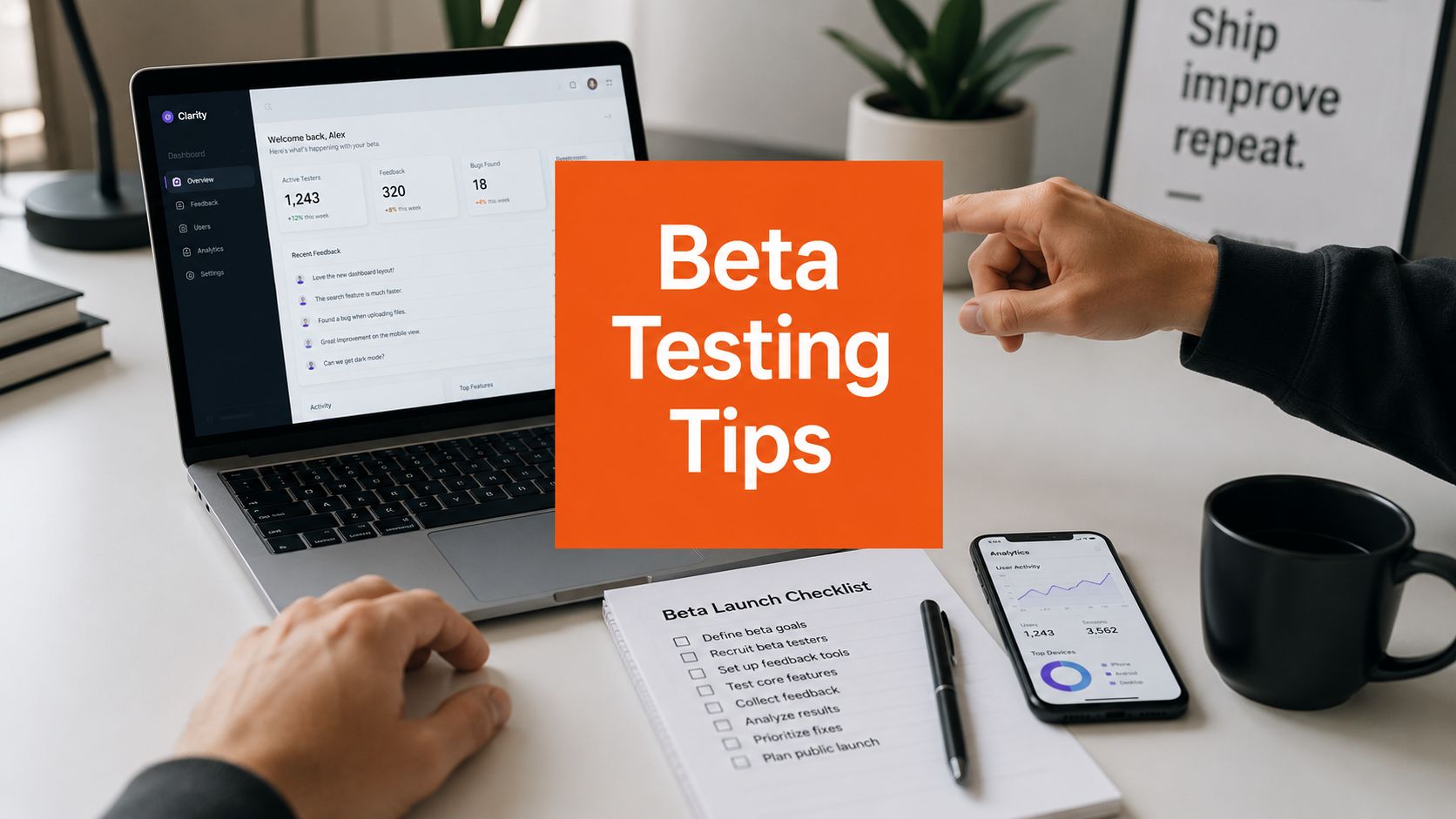
Stop calling every early user a beta tester. A beta only helps when you know which decision it should inform. If you invite friendly people, ask broad questions, and collect scattered opinions, you may get encouragement, but you won't learn whether real customers can use, value, and buy the product.
A founder-run beta works more like a learning system than a one-time product test. Start with a few hypotheses. Recruit people who resemble the buyer. Give them realistic tasks. Watch what they do, organize what you learn, and move through small waves toward release.
These beta testing best practices cover the full operating loop. You'll find copy-ready questions, tester invitations, feedback fields, prioritization rules, wave plans, and a release scorecard. Use only the practices that match your product, but don't skip the decision behind the test.
1. Define Your Beta Goals Before You Start
Write the decision before you recruit anyone. A beta can test demand, usability, operations, pricing, fit, or technical reliability, but one round rarely handles every question well. Pick a small set of hypotheses and connect each one to an observable action.
An apparel founder might ask whether buyers prefer a specific fabric weight, whether they'll purchase at the planned price, and whether the sizing chart matches real bodies. A SaaS founder might ask whether users can complete onboarding without training, whether the pricing feels acceptable, and whether a workflow needs feature X or feature Y.
Keep the list short. The business goal planning guidance from Chicago Brandstarters can help you turn broad ambitions into decisions you can track.
Write questions testers can answer
Share the questions with testers so they understand what matters. Don't ask, “What do you think?” Ask questions tied to a task:
- Demand: “After using the product, would you pay for it or place an order?”
- Usability: “Can you complete this task without a call or tutorial?”
- Fit: “Which part of the sizing chart made you hesitate?”
- Value: “What would make you choose this over your current option?”
- Operations: “What happened from checkout through delivery?”
For ecommerce, separate liking from buying. Someone may praise a shirt and still abandon the cart, question shipping, or avoid a second purchase. For software, separate feature requests from workflow failure. A requested feature may matter less than a confusing screen that blocks the core task.
Review your goals each week. If early evidence changes the risk, update the questions rather than forcing testers through an outdated script. Your beta should answer a decision, not fill a feedback archive.

2. Recruit Testers Who Match Your Real Customers
Friends make recruitment easy, but they often soften criticism and lack the problem you need to test. Recruit people who could realistically buy, renew, recommend, or rely on your product. The right tester doesn't need to love your idea. They need to recognize the situation your product addresses.
A meal-prep company might recruit from local CrossFit gyms and running groups. A project-management tool for freelancers could look in freelancer-focused Slack communities and Facebook groups. A Chicago ecommerce brand might invite email subscribers and Instagram followers who already engage with its content.
A large comparative study found that beta testers should represent regular users. It also found that companies with fewer testers should select them more carefully, and international products should check country differences between testers and regular users to reduce localization conflicts. The ACM study explains the comparison.
Build the first wave from places buyers already use
Use your network as a path to qualified referrals, not as the final audience. Ask contacts, “Who do you know that regularly faces this problem and already pays for a solution?” For B2B, search LinkedIn by job title and send a personal note that names the workflow you want to test.
Give people a clear exchange for their time. You might provide the product, a discount, a raffle entry, or reciprocal feedback. State the commitment clearly, including the tasks, dates, and communication channel.
For a first beta wave, recruit 10 to 20 testers as a practical starting point. The number belongs to the plan, not the ego. If your product serves several user types, cover those types deliberately rather than filling the group with convenient but irrelevant participants.

Use customer discovery interviews before invitations if you still can't describe the buyer's current behavior. A short conversation can reveal whether your proposed tester has the problem or merely likes the concept.
3. Use a Mix of Testing Methods to Catch Different Problems
One method gives you one angle. Combine methods so you can see friction, understand its cause, and identify repeated patterns.
Start with three to five moderated sessions to understand the core problems. Sit with each tester, give a specific task, and ask them to narrate their decisions without rescuing them too quickly. Once you understand the common trouble spots, move to unmoderated sessions that show how people behave without a founder watching.
Unmoderated testing needs a task, not a vague request. “Use the app and tell us what you think” produces thin feedback. “Find a black jacket in your size, add it to the cart, and explain whether you'd complete checkout” gives you a sequence you can observe.
Match the method to the question
- Moderated sessions: Use these when you need to understand why someone hesitates or chooses an unexpected path.
- Unmoderated sessions: Use these for natural friction, especially when founder presence might change behavior.
- Surveys: Use these after a task to capture an overall reaction and compare responses across testers.
- One-on-one interviews: Use these when a surprising result needs context, history, or a deeper explanation.
Record sessions only with permission. A mobile app founder might review screen recordings to see where users get stuck, then schedule calls to understand the cause. An ecommerce founder might watch a tester find and buy a product, then ask about the experience afterward.
For Android products or other distribution paths, beta testing without TestFlight can help you think through access outside Apple's testing flow. Choose the simplest method that lets testers complete the main task with little setup.
A survey should take no longer than 10 minutes, and you should focus on the top 5 to 7 questions, according to beta survey guidance from Zonka Feedback. Send it 24 to 48 hours after the session when you need fresh but considered feedback. Embedding the first question in an email can raise completion rates by 15% to 20%, according to the same guidance.
4. Watch What People Do, Not Just What They Say
People often describe the experience they wish they had. Their actions reveal the experience they had. Watch where they click, pause, backtrack, ask for help, abandon a task, or repeat the same failed action.
An ecommerce team might hear that shipping feels fine in a survey, then watch shoppers stall at the shipping selector. A mobile app tester might repeatedly swipe left when the interface expects a tap. Someone assembling a physical product might call the instructions clear, then hold the parts upside down while working alone.
Turn observation into evidence
For moderated sessions, record the screen with a tool such as Loom or Hotjar, with permission. Watch each recording once without taking a position. Then revisit the moments where the tester paused, changed direction, or asked a question. Count task time when it matters, but treat hesitation as evidence even when the person eventually succeeds.
Practical rule: Debrief behavior before opinion. Start with “The tester opened the wrong menu twice,” then ask what the tester said about the menu.
For physical products, film unboxing and use in the tester's normal setting. A kitchen, office, or bedroom can expose lighting, storage, noise, reach, and cleanup problems that a polished studio misses. For software, compare the intended path with the path users take.
Behavior analytics can help you reduce churn with behavior analytics, but don't let a dashboard replace observation. Telemetry can show a drop-off point. A session or interview can explain the decision behind it.
Create a simple observation log with the task, the exact action, the point of friction, and the result. Avoid writing “user disliked checkout” when you can write “user opened shipping details, returned to the cart, and stopped.” Specific records help your team fix the interface instead of debating a mood.
5. Create a Structured Feedback System So You Actually Use the Data
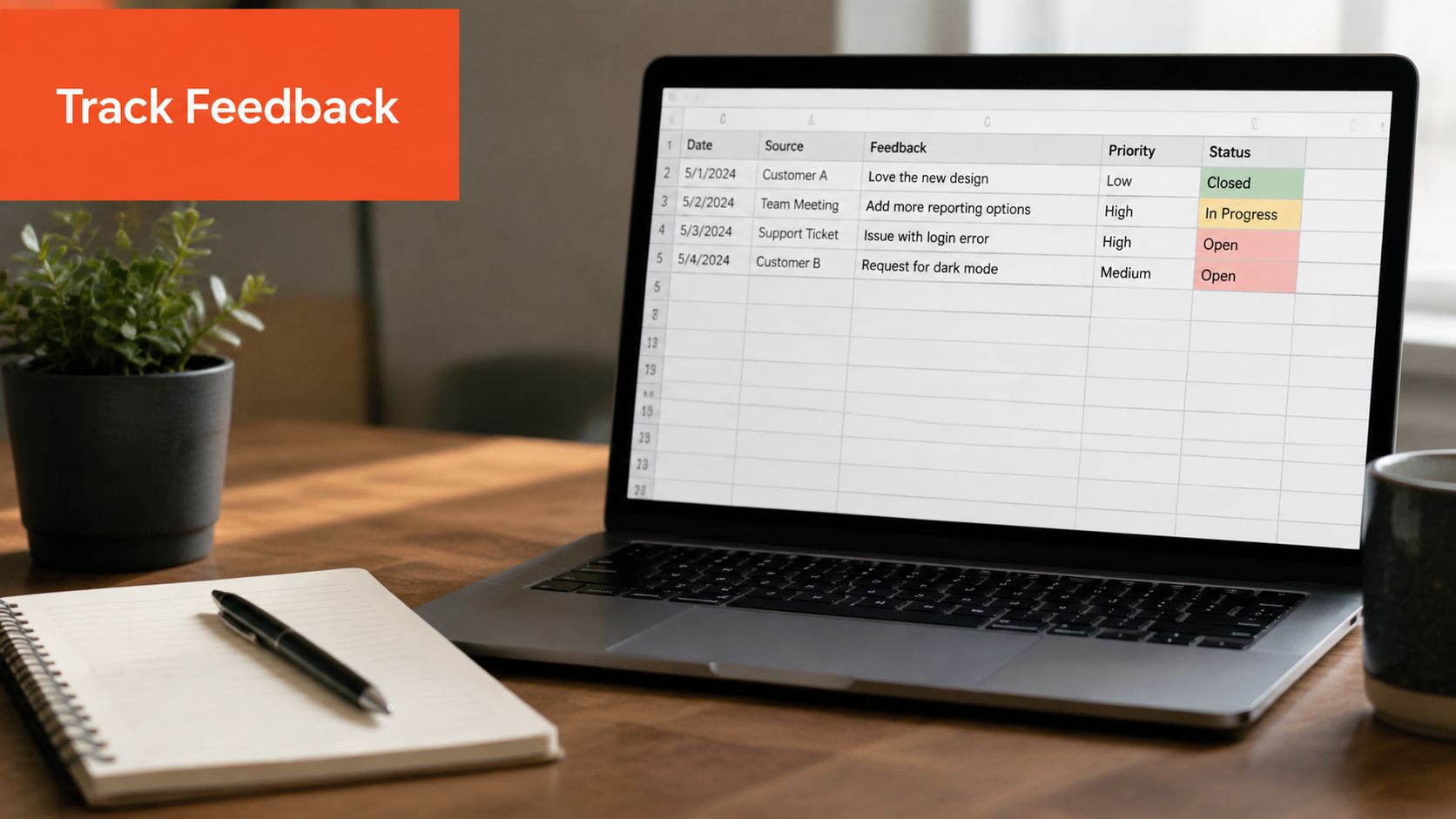
Feedback without a system becomes a pile of complaints. Put every useful observation in one spreadsheet or database, then give each record enough context for someone else to understand it.
Use columns for feedback, tester, customer segment, theme, frequency, severity, evidence, action taken, and status. A Chicago apparel founder might sort themes into sizing, fit, color, and shipping. A SaaS founder might tag onboarding, navigation, permissions, and billing.
Frequency matters, but it doesn't decide everything. A one-off suggestion may be a preference. A single report about lost data, a blocked checkout, or a safety problem may deserve immediate attention. Ask whether the issue blocks the core promise, affects a whole segment, or creates a serious trust problem.
Use a decision score, not a popularity contest
You can score each item from 1 to 5 for urgency and frequency, then focus on items that reach a combined threshold your team can handle. The score doesn't create truth. It forces you to explain why an issue deserves work now.
Hold a weekly review with the people who can act. Assign each accepted item to a fix, a follow-up question, a later experiment, or a deliberate rejection. Keep the record of rejected ideas too, because founders often revisit the same request under pressure.
The customer feedback collection process from Chicago Brandstarters gives founders a place to start when raw comments arrive through email, social media, and support. For deeper interpretation, customer feedback analysis can help you think about themes and context rather than counting comments alone.
Close the loop with testers. Tell them what you changed, what you postponed, and why. A short note such as “We changed the size guide after repeated fit confusion, but we postponed the color request until the next product run” builds trust and gives testers a reason to keep reporting clearly.
6. Test in Small Waves and Ship Improvements Between Waves
Large, simultaneous betas create noise before you know whether the product works. Small waves let you learn, fix, and test the fix while the evidence stays fresh.
A practical wave plan starts with 5 to 10 people who can expose obvious problems. A second wave of 20 to 30 people can test the changes and reveal issues that the first group didn't encounter. Later waves can refine details, operations, or less common workflows.
These numbers describe a possible operating plan, not a universal formula. Match the size to your team's ability to support testers and process feedback.
Give each wave a job
- First wave: Test the core hypothesis and expose basic failures.
- Second wave: Test whether the fixes solved the observed problems.
- Third wave: Refine packaging, onboarding, support, edge cases, or secondary workflows.
An apparel brand might discover sizing problems in wave one, change the size range, and test returns in wave three. A software founder might fix confusing navigation before asking a new group to test onboarding. An ecommerce brand might test product quality first, then packaging and shipping, then customer service.
Tell the first group that the product is rough and explain how you'll use their input. Before wave two, commit to specific changes and show testers what changed. Don't open the next wave while known blockers still distort the test.
Beta cycles need time for real use. A widely cited beta guide recommends allowing at least eight to ten weeks for a full cycle and avoiding new builds more often than once every two weeks. A separate beta program guide recommends updated builds every one to two weeks so testers can report issues from the previous round before a new build arrives.
Planning also needs room for onboarding, bug triage, and iteration. A 2026 product-testing guide reported that 50% of tests spend between 40 and 150 days in initialization, with a mean of 109 days, while 86% finish within 12 weeks or less. The beta testing metrics guide provides those figures. Treat beta as a managed phase, not a quick checkbox.
7. Keep Testing Close to Home When You Can
Remote testing gives you reach. In-person testing gives you context. If you can visit users in their homes or offices, you'll see interruptions, workarounds, physical constraints, and environmental conditions that a scheduled video call can hide.
A coffee-equipment founder might test with home baristas in their kitchens and notice lighting problems that never appeared in studio footage. A productivity-tool founder might visit small offices and see how people switch between paper notes, email, and software. A local founder can recruit through community connections, travel less, and build relationships while collecting candid feedback.
Visit the real setting
Recruit people within 30 minutes of where you live or work when local testing fits the product. Ask to meet at the place where they normally use it, not a neutral conference room. Bring coffee or snacks as thanks, and send a handwritten note afterward if the session deserves a personal follow-up.
For a physical product, observe storage, setup, cleanup, and reuse. For software, ask the tester to use their own computer, browser, files, and workflow. A founder may learn that the product works perfectly in a clean demo account but fails when the user brings real permissions, naming habits, or shared documents.
Don't turn a home visit into a sales pitch. Let the tester work. Ask short questions only when the behavior needs clarification. Take notes on the setting as well as the screen, including interruptions, missing equipment, background noise, and anything that changes how the person completes the task.
Local events can help you recruit people with shared interests. A running group may provide better meal-prep testers than a general meetup. A neighborhood business event may produce more relevant B2B conversations than a broad startup gathering.
8. Build a Feedback Loop So Testing Never Really Stops
Beta ends as a program. It doesn't end as a relationship with early customers. Keep the strongest testers close, ask for input when new risks appear, and feed repeated problems into the roadmap.
Create a private Slack channel, email list, or community group where testers can report issues without hunting for the form. An ecommerce brand might use a private Facebook group for product feedback and behind-the-scenes updates. A SaaS founder might hold quarterly video calls with trusted testers to discuss changing workflows and feature needs.
Give early users a reason to stay involved
Send a monthly update that names what you changed because of tester input. When you add a new feature, ask selected beta testers to try it before public release. Give helpful contributors early access, discounts, recognition, or another status that feels specific rather than automatic.
Avoid turning the group into an unpaid support desk. Set clear channels for bugs, questions, ideas, and urgent problems. Respond often enough that testers know someone reads their messages, but don't ask for a survey every time they open the product.
Survey fatigue can damage participation. Centercode recommends short, frequent pulses and keeping check-ins to about five questions when you survey more than once a week. The same source recommends capping in-app forms at 5 to 10 questions and using a smaller group of highly engaged testers rather than a larger anonymous pool.
Use different feedback rhythms for different needs. A short pulse can capture a recent release. A feature-specific form can test a new workflow. A live call can uncover a problem nobody knows how to describe in a form. Rotate the format, respect attention, and remove testers who no longer fit the product or the commitment.
9. Set Incentives, Confidentiality, and Release Criteria Up Front
Your invitation should answer four questions before a tester accepts: what they'll do, what they'll receive, what they may share, and what happens to their information. Clear terms prevent confusion when feedback includes recordings, private business details, or sharp criticism.
A SaaS invitation might say:
Please complete three tasks this week, report blockers in the shared form, and don't share screenshots outside the group. You'll keep access during the beta period.
An ecommerce release checklist might cover product condition, checkout completion, shipping questions, delivery handling, and returns. A recording consent line could read: “May I record this session for product research? I won't publish your name or comments without asking first.”
Turn release readiness into observable checks
Write the release criteria beside your hypotheses. If you tested whether users can complete onboarding without training, define what counts as acceptable behavior. If you tested whether shoppers will buy, inspect the complete path from product page to payment, shipping, and returns.
Separate must-fix blockers from improvements and preferences. A crash, missing order, privacy issue, or blocked core workflow belongs in the first group. A color request or optional feature may wait if it doesn't affect the promise you tested.
Tell testers the access dates, incentive, communication channel, recording policy, confidentiality limits, and support process. Ask for explicit permission before recording or publishing a quote. At closing, explain what you fixed, what you postponed, and whether the tester keeps access.
One industry survey found that 57% of companies running beta tests had no defined process, 69% struggled to obtain tester participation, 56% struggled to find time to manage tests, and 44% said they weren't collecting enough useful information. Productside reports those operating problems and notes that 7 out of 10 companies view beta testing as the most effective pre-release product-improvement method. A written invitation and release scorecard won't solve every problem, but they give your team a shared operating rule.
Beta Testing: 9 Best-Practices Comparison
| Practice | Implementation Complexity 🔄 | Resource Requirements ⚡ | Expected Outcomes 📊 | Effectiveness ⭐ | Ideal Use Cases 💡 |
|---|---|---|---|---|---|
| Define Your Beta Goals Before You Start | Medium 🔄, requires honest hypothesis setting | Low ⚡, time to document goals and metrics | 📊 Clear, testable hypotheses; focused feedback | ⭐⭐⭐⭐ | Early-stage validation; deciding core metrics |
| Recruit Testers Who Match Your Real Customers | Medium–High 🔄, targeted recruitment effort | Medium ⚡, outreach, incentives, screening | 📊 Customer-relevant feedback and conversion signals | ⭐⭐⭐⭐⭐ | Product-market fit, pricing, niche markets |
| Use a Mix of Testing Methods to Catch Different Problems | High 🔄, coordinate multiple approaches | High ⚡, tools, recordings, transcription, analysis | 📊 Complementary quantitative + qualitative insights | ⭐⭐⭐⭐⭐ | Complex UX, feature validation, broad research |
| Watch What People Do, Not Just What They Say | Medium 🔄, setup and unbiased observation | Medium ⚡, recording tools and review time | 📊 Reveals real behavior and hidden friction | ⭐⭐⭐⭐ | Usability, checkout flows, onboarding issues |
| Create a Structured Feedback System So You Actually Use the Data | Medium 🔄, process + discipline to maintain | Low–Medium ⚡, spreadsheet/DB and weekly reviews | 📊 Prioritized, actionable backlog with owners | ⭐⭐⭐⭐ | Ongoing betas, product roadmap planning |
| Test in Small Waves and Ship Improvements Between Waves | Medium 🔄, coordinate cohorts and iterations | Medium ⚡, iteration time, dev resources | 📊 Faster learning; fewer wasted tester hours | ⭐⭐⭐⭐ | Early releases, iterative rollout, bug fixes |
| Keep Testing Close to Home When You Can | Medium 🔄, scheduling and travel logistics | Low–Medium ⚡, local recruitment and travel time | 📊 Context-rich insights and stronger tester relationships | ⭐⭐⭐ | Physical products; environment-dependent features |
| Build a Feedback Loop So Testing Never Really Stops | Medium–High 🔄, ongoing management and cadence | Medium ⚡, channels, regular touchpoints, admin | 📊 Continuous improvement and higher retention | ⭐⭐⭐⭐ | Post-launch roadmap; long-term customer engagement |
| Set Incentives, Confidentiality, and Release Criteria Up Front | Medium 🔄, policy, checklist, consent setup | Low ⚡, templates, clear communications (legal if needed) | 📊 Clear expectations, protected data, clean go/no-go decisions | ⭐⭐⭐ | Sensitive tests, paid testers, regulated products |
Turn Beta Feedback Into a Launch Decision
A beta shouldn't end with a folder of recordings and a hopeful feeling. End it with a decision that you can explain to your team, testers, investors, and first customers.
Start with the original hypothesis. Write it at the top of one page, then record whether the evidence supports it, weakens it, or leaves it unresolved. Don't rewrite the hypothesis after seeing the results. If you learned something new, write a second hypothesis and decide whether it needs another test.
Review behavior before comments. Look at completed tasks, drop-off points, repeated errors, support requests, and any telemetry you collected. Then review the themes in your feedback system. Separate frequent friction from loud preferences, but give serious attention to a rare blocker when it threatens trust, safety, payment, data, or the product's central promise.
Use this founder checklist:
- Restate the hypothesis: Write the decision your beta needed to inform.
- Review behavior: Identify where testers succeeded, hesitated, repeated actions, or quit.
- Group repeated themes: Sort feedback by workflow, segment, severity, and frequency.
- Assign fixes: Name an owner, a next action, and a test that can confirm the change.
- Rerun the riskiest tasks: Test the paths most likely to block adoption, purchase, renewal, or safe use.
- Confirm permissions: Check recording consent, confidentiality terms, access limits, and communication promises.
- Compare with release criteria: Mark each observable condition as met, unmet, or unresolved.
- Choose the next move: Release, run another wave, narrow the audience, change the product, or stop.
Telemetry and user comments can disagree. A small group may complain loudly about an edge case while most target users complete the core workflow. The opposite can also happen, a quiet drop-off can affect many people while only a few report it. Weigh frequency, severity, affected segment, behavior, and business risk together. Userpilot's guidance on beta feedback discusses mixed methods, segmentation, analytics, and the risk of letting over-segmentation weaken the signal.
Keep a small group of trusted testers after launch. Invite them to review meaningful changes, join occasional calls, or test a new workflow before public release. They can become informed advisors, but respect their time and never assume early enthusiasm creates an unlimited obligation.
Chicago Brandstarters is one relevant option for founders who want candid peer input. Its free, vetted community uses private small-group dinners for 6 to 8 people every two weeks, along with a group chat where members share product questions, operating problems, and practical support. The community describes confidentiality, identity verification, and LinkedIn vetting as part of its approach, which can help founders who want a private place to pressure-test a beta decision.
Write the launch decision in plain language. “We'll open sales to this audience because the core checkout task worked, the repeated shipping issue has a fix, and the remaining requests don't block the tested promise” is stronger than “The beta went well.” Founders don't need perfect evidence. They need a clear record of what they tested, what they changed, what still worries them, and why the next move makes sense.
If you're building a product in Chicago or the Midwest, Chicago Brandstarters offers a free, vetted founder community with private dinners and a group chat for candid product questions. Visit the community, bring your beta hypothesis or launch scorecard, and find peers who can challenge your assumptions before real customers do.
Leave a Reply