You're probably in one of these moments right now.
A customer emailed you because checkout felt broken. A buyer didn't understand your return process. Someone liked your product but got annoyed by the experience around it. And now you're sitting there thinking, “We're tiny. I can't build some giant CX department.”
Good. You don't need one.
I've learned that customer experience optimization for an early-stage founder is not a software shopping spree. It's not a glossy slide deck. It's you paying close attention to where people get confused, frustrated, or stuck, and then fixing those points one by one with whatever tools you can afford.
That's the whole game. Small repairs. Repeated often.
If you do this well, your brand feels bigger than it is. If you ignore it, your product has to work much harder than it should.
Your Wake-Up Call from an Unhappy Customer
The email usually lands at the worst time.
You've spent months building. You finally get a few orders, a few happy replies, maybe a little momentum. Then one customer writes in with that tone every founder knows. They're frustrated. They're confused. They feel ignored, even if that wasn't your intent.
My first instinct used to be defense. I'd look for the part where the customer misunderstood something. I'd want to explain why the process made sense on our side.
That instinct is expensive.
A bad customer message is often the clearest audit you'll ever get. It tells you where your business made a normal person work too hard. It tells you where your copy failed, your process broke, or your follow-up didn't do its job.
Practical rule: When a customer sounds emotional, don't ask whether they were right. Ask what part of your experience made that emotion possible.
This is why customer experience optimization matters so much for a small brand. You don't have the luxury of wasting trust. 32% of customers will stop buying from a brand they once loved after just one negative interaction, according to customer experience statistics from Wavetec.
You don't get many second chances.
Stop calling it customer service
If you treat this as “support,” you'll respond to tickets and move on. If you treat it as customer experience optimization, you'll ask a better question: how do I stop this problem from happening again?
That shift changes everything.
Maybe your order confirmation email is too vague. Maybe your shipping page creates anxiety because it says nothing about timing. Maybe your chatbot answers simple questions well but traps upset customers in a loop. If you want a practical look at AI tools for CX optimization, that resource is worth scanning because it helps you think about where automation helps and where it gets in the way.
For hard conversations, I also like this guide on dealing with difficult customers. It's useful because it keeps you focused on response quality instead of ego.
Your advantage is care, not scale
Big brands win with budget. You win with attention.
You can notice patterns faster. You can rewrite the clunky email today. You can change the FAQ tonight. You can record three support calls this week and hear exactly where people hesitate.
That's your edge. Use it.
Map Your Customer's Journey on a Napkin
You don't need Miro licenses, consultants, or a wall full of color-coded jargon. Start with a napkin, sticky notes, or a blank Google Doc.
I think about journey mapping like retracing my steps when I lose my keys. I don't ask, “Why are the keys gone?” I walk backward through what happened. Customer experience optimization works the same way. You retrace what the buyer saw, clicked, felt, and expected.
A formal approach starts with journey mapping and auditing to find drop-off points. Businesses that invest in this get better retention because they stop guessing where the problems are, as explained by the CX Foundation on customer experience optimization.
Here's the simple version.
Draw the path people actually take
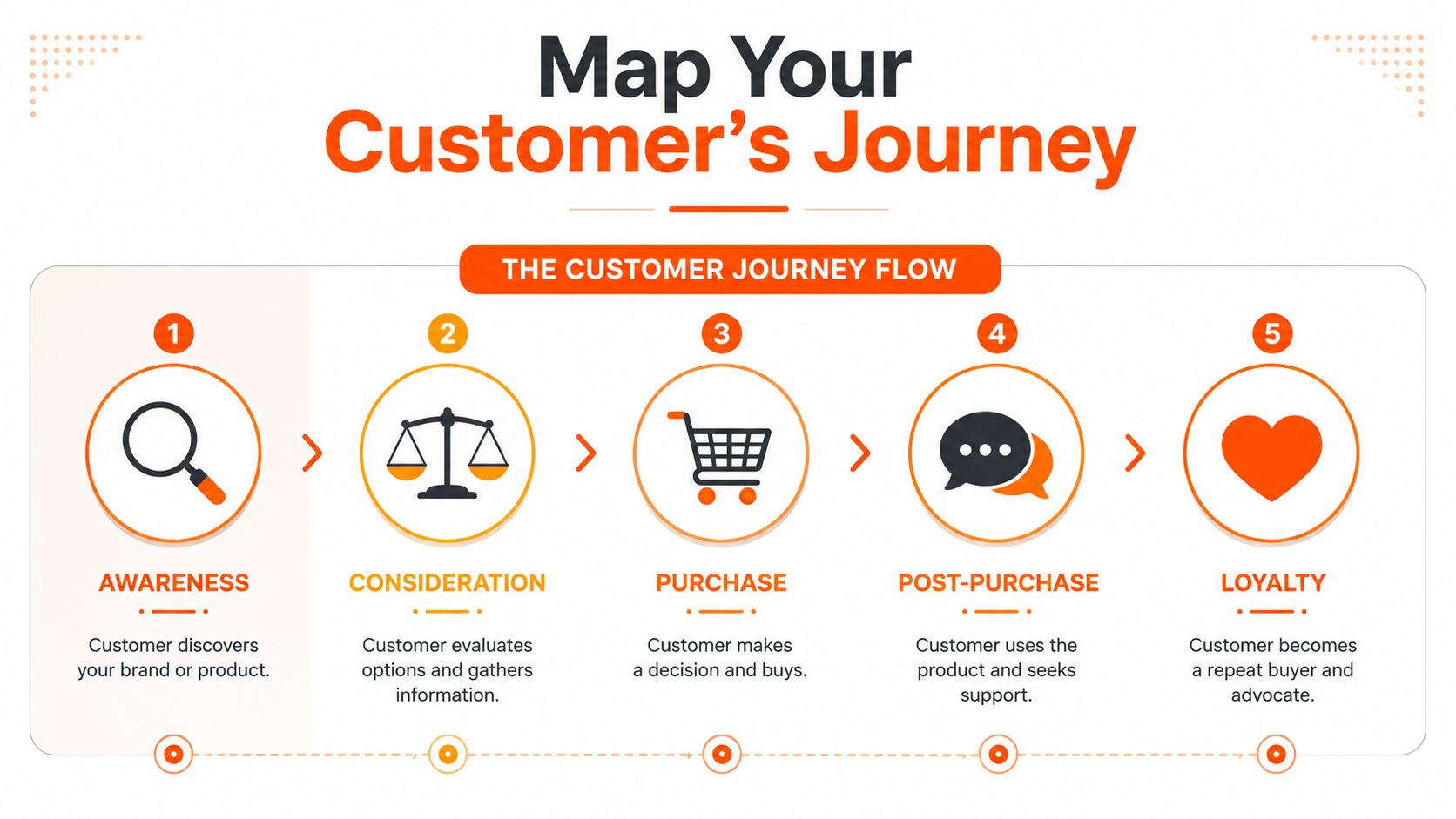
Write down the five basic stages:
- Awareness: How people first hear about you.
- Consideration: What they read, compare, or question before buying.
- Purchase: The moment they commit money.
- Post-purchase: What happens after the order.
- Loyalty: What brings them back, or pushes them away.
Now fill in the touchpoints under each stage.
That might include an Instagram post, a product page, your shipping policy, checkout, order confirmation, delivery update, packaging, follow-up email, and support reply. Be specific. “Website” is too vague. “Product page FAQ on sizing” is useful.
If you want a stronger way to ask buyers what happened before they purchased, use customer discovery interviews. They'll help you hear the journey in the customer's own words instead of your internal version of it.
Look for friction, not perfection
You are not trying to create a museum exhibit. You are trying to find where people stumble.
Ask these questions as you map:
Where do people hesitate?
Think unclear pricing, confusing bundles, weak reviews, or missing FAQs.Where do people abandon?
Cart drop-off, a long return form, or support that takes too long to answer.Where does trust dip?
Generic emails, missing shipping updates, or copy that sounds more polished than honest.Where does effort rise?
Any point where the customer has to click around, search, guess, or ask for help.
If a customer has to stop and think, “What am I supposed to do next?” your journey map just found a leak.
This short video is a good primer if you want to see the process visually.
Keep the first map ugly
Your first map should be rough. That's a good sign.
I'd rather see a messy page with “customers get nervous here” scribbled next to checkout than a polished diagram nobody uses. Founders lose time when they over-design the artifact instead of studying the path.
You're building game tape. Watch it closely.
Pick the Right Scoreboard Not Just Vanity Metrics
Once you've mapped the journey, you need a scoreboard. Most founders pick the wrong one.
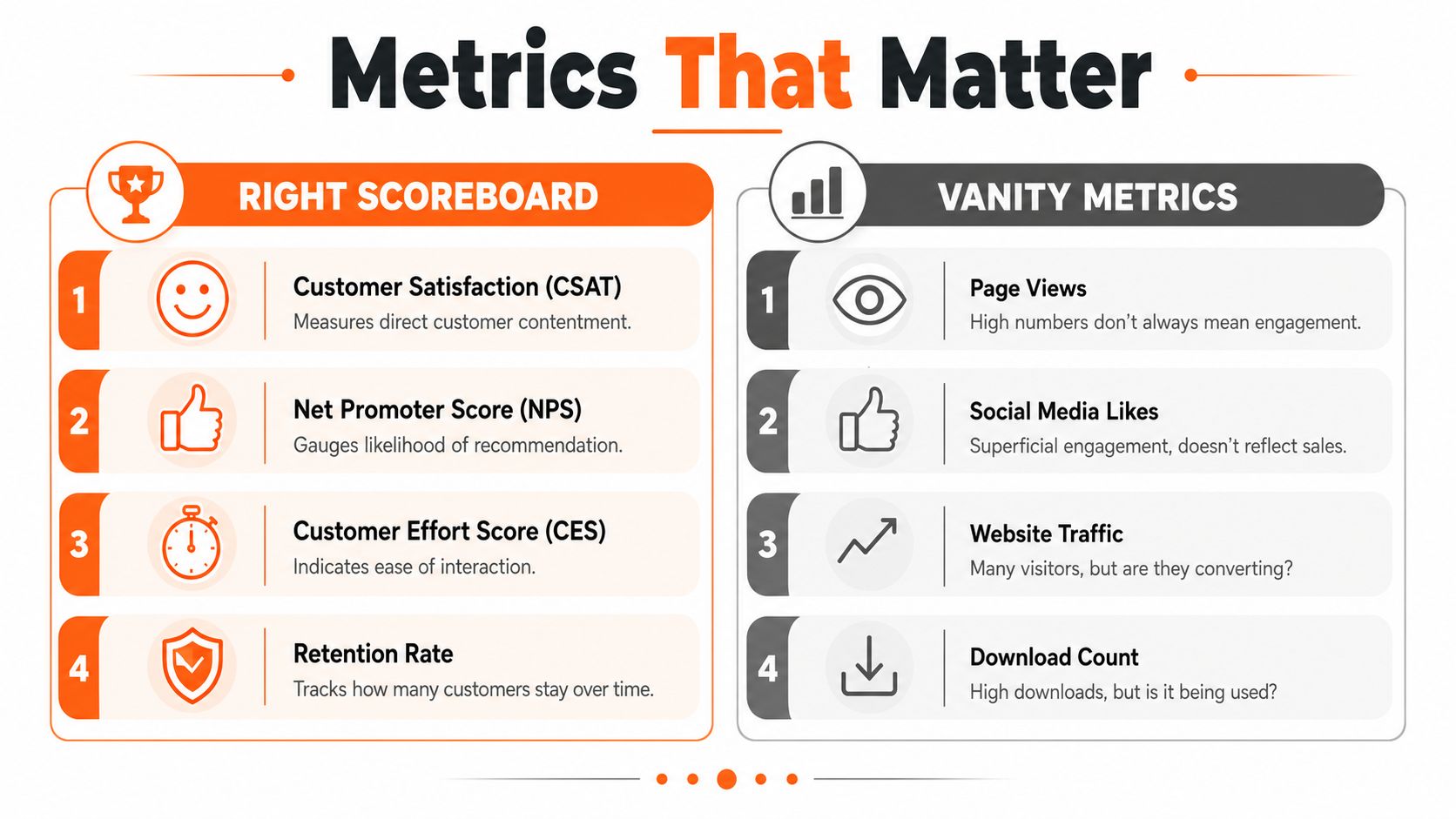
They stare at page views, likes, traffic spikes, and open rates. Those numbers can be useful, but they often act like a speedometer on a parked car. They move your attention without telling you whether the customer experience is getting better.
For customer experience optimization, I care more about four signals: NPS, CSAT, CES, and retention. Those tell me if people trust the brand, liked a specific interaction, struggled through a task, or stayed around.
Think like a pilot, not a hype machine
A cockpit has different gauges for different jobs. Your metrics should work the same way.
| Metric | What it tells you | Best moment to ask | What I use it for |
|---|---|---|---|
| NPS | Overall loyalty and likelihood to recommend | Monthly or quarterly | Brand health over time |
| CSAT | Satisfaction with a specific interaction | Right after support or another touchpoint | Spot-checking service quality |
| CES | How hard a task felt | Right after a purchase, return, or support event | Finding friction in workflows |
| Retention | Whether customers come back | Weekly or monthly review | Reality check on long-term experience |
NPS is broad. CSAT is immediate. CES is surgical.
That last one matters more than many founders realize. You must track Customer Effort Score right after a specific task, like a purchase or return. That timing captures the exact moment of friction, according to Rightpoint's explanation of CES timing. If you ask later, the signal gets muddy.
Use CES where friction actually happens
Think of CES like checking for pain when someone twists an ankle. You don't ask three days later while they're sitting on the couch. You ask when they try to walk.
So place CES after moments like:
- A return request: Was the process easy or annoying?
- A support interaction: Did the customer get resolution fast?
- A purchase flow: Did checkout feel smooth or confusing?
That's where founders get real answers like, “I couldn't tell whether my payment went through,” or “I had to open three tabs to figure out your return policy.”
Those comments beat vanity metrics every time.
Quick test: If a metric makes you feel busy but doesn't tell you what to fix on Monday, it's probably a vanity metric.
Keep your survey stack light
You do not need enterprise software to start. A scrappy setup works fine.
Use a short form, a post-purchase email, or a lightweight tool. If you want a simple place to start with loyalty measurement, these NPS survey features are worth a look because they show how to collect and organize responses without turning the process into a full-time job.
I'd run it like this:
- NPS once a month or once a quarter for active customers.
- CSAT after support conversations.
- CES right after high-friction actions.
- Retention in a weekly spreadsheet review.
Don't chase “good scores” in a vacuum
A small brand can fool itself fast. You'll get a handful of positive survey replies and think things are fine. Then refunds rise, or repeat purchases stall, or your inbox fills with the same question again and again.
Scores need context.
Read the comments next to the ratings. Compare them against support themes. If CSAT is fine but CES comments say the return flow is clunky, believe the comments. If NPS is decent but customers keep asking where to find sizing info, fix the sizing info.
The right scoreboard should make your next move obvious.
How to Ask for Feedback Without Being Annoying
Most founders overdo feedback collection. They send long surveys, ask too often, and write questions like they're applying for a grant.
Your customers don't want homework. They want to be heard quickly.
I've had better luck treating feedback like a conversation. Short, timely, human. If you ask the right person at the right moment, a single sentence can tell you more than a giant form.
Use one-question check-ins
Start with one question, not ten.
After purchase, ask something like: “Was anything confusing before you checked out?” After support, ask: “Did we make this easy to solve?” Keep the wording plain. Don't sound like a dashboard.
Three low-friction ways to do this:
- Personal email follow-up: Add a short note after the main message. “If anything felt confusing, reply and tell me.”
- Thank-you page question: Put one small prompt right after checkout.
- Support close-out message: End with a direct question about ease, not a bloated satisfaction survey.
Each one feels like a real person asking, not a machine chasing response rates.
Talk to a few customers every month
I know. You're busy.
Still, talking to a few customers directly is one of the most effective things you can do. A short phone call or voice note exchange can reveal what no form ever will. You hear hesitation, tone, and the words people naturally use.
Ask things like:
- “What almost stopped you from buying?”
- “What part felt easier than expected?”
- “What annoyed you after the order?”
If you want a clean way to handle these conversations on both sides, this piece on how to give and receive feedback is useful. Founders often need help hearing feedback without turning it into a debate.
The goal is not more data. The goal is fewer blind spots.
Keep a crude feedback bank
Don't overbuild this. A spreadsheet is enough.
Make columns for:
| Date | Customer stage | Channel | What happened | Exact words | Theme | Owner | Next action |
|---|
The “exact words” column matters most. Copy the customer's language there. Don't clean it up. Their wording often tells you what your site copy should say, what your FAQ is missing, and where your process feels unnatural.
Then tag each item with a theme like shipping confusion, size uncertainty, return friction, slow support, or checkout trust.
After a few weeks, patterns start yelling at you.
Don't ask everyone everything
At this point, founders burn goodwill.
If someone just got a refund resolved, don't send them a broad brand survey. If someone bought yesterday, don't ask them whether they'd recommend you for life. Match the question to the moment.
When feedback feels relevant, people answer. When it feels lazy, they ignore you.
Run Small Smart Experiments to Find What Works
Most founders change customer experience the same way gamblers place bets. They follow instinct, swap copy, redesign a page, and hope.
That's sloppy.
Customer experience optimization works better when you treat every change like a test. You spot a problem, form a hypothesis, try a small fix, and measure what happened. Successful optimization is hypothesis-driven and uses A/B testing before a full rollout, as explained in AB Tasty's guide to CX challenges.
Start with a root problem, not an idea
A weak approach sounds like this: “Let's redesign the returns page.”
A stronger approach sounds like this: “Customers abandon the returns flow because the language feels legal and cold. If we rewrite the headline and reduce confusion in the first step, more people will complete the process and fewer will contact support.”
That's testable.
Use this framework:
Problem
What friction are customers facing?Hypothesis
What do you believe will reduce that friction?Change
What small edit can you make without rebuilding the whole system?Metric
Which score or behavior will tell you if it worked?
A simple founder-level A/B test
Say you run a small e-commerce brand. Customers reach the returns page and freeze. Support emails pile up because people don't know whether returns are easy, costly, or even allowed.
You test two headlines.
- Version A says: “Return Policy”
- Version B says: “Need to make a return? We'll walk you through it.”
That's not a flashy test. Good. Flashy is overrated.
Version B might reduce anxiety because it sounds like a person is helping. Pair that with one cleaner sentence about the first step and a simple button label. Then watch what happens in support complaints, CES feedback after the return flow, and completed return submissions.
If you want a practical walkthrough of A/B testing for marketing agencies, the process is useful even if you're a solo founder. The logic transfers well.
Run smaller tests than your ego wants. Small tests teach faster.
Low-Cost CX Tools for Founders
You can do a lot with free and low-cost tools.
| Tool | What It Does | Good For | Free Plan? |
|---|---|---|---|
| Google Forms | Collects simple survey responses | CSAT, CES, post-purchase questions | Yes |
| Google Sheets | Tracks feedback themes and weekly metrics | Manual dashboard, pattern spotting | Yes |
| Tally | Builds clean forms fast | Lightweight customer surveys | Yes |
| Hotjar | Session recordings, heatmaps, on-page feedback | Seeing where customers get stuck | Yes |
| Microsoft Clarity | Session recordings and click behavior | Friction review on a budget | Yes |
| Shopify Forms | Captures simple responses and leads | Store-based feedback collection | Depends on setup |
| Typeform | More polished surveys | Nicer customer-facing forms | Yes |
| Gmail templates | Standardized follow-ups | Consistent support and feedback requests | Yes |
I'd rather see a founder use Google Forms every week than buy expensive software they never open.
Protect yourself from fake progress
Testing has a trap. You can end up measuring activity instead of outcomes.
You changed five emails. Great. Did customer confusion go down?
You rebuilt the FAQ. Fine. Did support become easier?
You launched a chatbot. Okay. Did angry customers reach a human faster when they needed one?
Automation helps with routine questions. It hurts when it blocks people who already feel stuck. Keep humans available for messy cases, emotional situations, and edge cases. That's where trust is won or lost.
Make It a Team Habit Even If Your Team Is You
A lot of founders read advice like this, nod, and then go back to reactive mode by Tuesday.
Don't do that. Build a rhythm.
Customer experience optimization isn't a project you complete. It's a loop you run. Map the journey. Measure the right moments. Listen to direct feedback. Test one change. Repeat next week.

My favorite lightweight cadence
If you're solo, block one hour a week. I like Friday because the week's customer friction is still fresh.
In that hour:
- Read every complaint and praise note from the week.
- Update one sheet with NPS, CSAT, CES, retention notes, and recurring themes.
- Pick one friction point to address next.
- Write one hypothesis for a small test.
That's enough. Seriously.
If you have a tiny team, run a short standing review. Don't make it a dramatic meeting. Just answer four questions:
| Question | Why it matters |
|---|---|
| What frustrated customers this week? | Finds immediate leaks |
| What delighted them? | Shows what to repeat |
| What pattern kept coming up? | Reveals system problems |
| What single test will we run next? | Forces action |
Keep the loop boring
Boring is good here. Boring means repeatable.
The founders I trust most aren't the ones with the prettiest dashboards. They're the ones who keep a calm routine. They read the same inbox. They tag the same themes. They test one clear change at a time. Over months, that compounds into a brand people describe as easy, thoughtful, and reliable.
That's what you want.
You do not need a team of fifty to create a customer experience that feels considered. You need a habit that catches friction before it becomes reputation.
If you're building in Chicago or the Midwest and want a room full of kind, serious founders who will tell you the truth about what's working and what's not, Chicago Brandstarters is a strong place to start. It's a free, vetted community where builders share honest lessons, trade tactics, and help each other grow without the usual networking nonsense.
Leave a Reply