A target audience is the specific group of people you've identified as most likely to buy your product, defined by demographic data, customer behavior, and consumer motivations. It's about focus.
You're probably here because you've built something real, or you're close, and you can feel the temptation to say it's for “anyone who needs this.” I get it. That answer feels safe. It also burns time, money, and morale faster than almost anything else an early founder can do.
I've watched smart people spend months polishing offers, logos, websites, and content for a customer they never chose. Then they wonder why the message lands like wet cardboard. The problem usually isn't the product. It's that the product is speaking in a voice so broad that nobody hears their own problem in it.
Target audience definition fixes that. Done right, it helps you pick your people, shape your message, and build a business for customers you want to serve. If you care about building with some backbone and some heart, that matters.
Why Talking to Everyone Means No One Hears You
A founder I know launched a thoughtful product for “busy people.” That was the audience. Busy people.
You can already see the problem. A burned-out agency owner is a busy person. A dad with three kids is a busy person. A med student is a busy person. A restaurant manager is a busy person. Those people don't buy for the same reasons, don't use the same words, and don't hang out in the same places. One message for all of them is mush.
Generic messaging sounds polite and dies quietly
When you talk to everyone, you strip the sharp edges off your message. You stop saying anything specific enough to make a buyer feel seen. Your homepage fills up with vague sludge like “helping you save time and live better.” Fine. For whom? Why now? Compared to what?
That's why launches go quiet. You post. Friends clap. Strangers scroll.
If a customer can't tell you built this for someone like them, they assume you didn't.
Early-stage founders can't afford broad bets
You don't have infinite cash. You don't have a giant team. You probably don't even have enough hours in the week to chase ten customer types at once.
So pick. That's the job.
A tight audience definition helps you decide:
- What to say: You can use the words your buyers already use.
- Where to show up: You stop spraying content across channels that don't matter.
- What to ignore: You save yourself from building side features for people who were never a fit.
This is also where niche strategy gets practical. If you want a clean way to think about that, read what niching means for your brand. It's the same muscle. You're choosing where to concentrate your effort so the market can remember you.
You need edges
Good brands have edges. They know who they help. They also know who they don't.
That second part matters more than most founders admit. Saying “this isn't for everyone” feels risky at first. In reality, it's how you finally become clear enough for the right people to say yes.
What a Target Audience Really Is
Target audience definition often sounds academic. It isn't. It's practical.
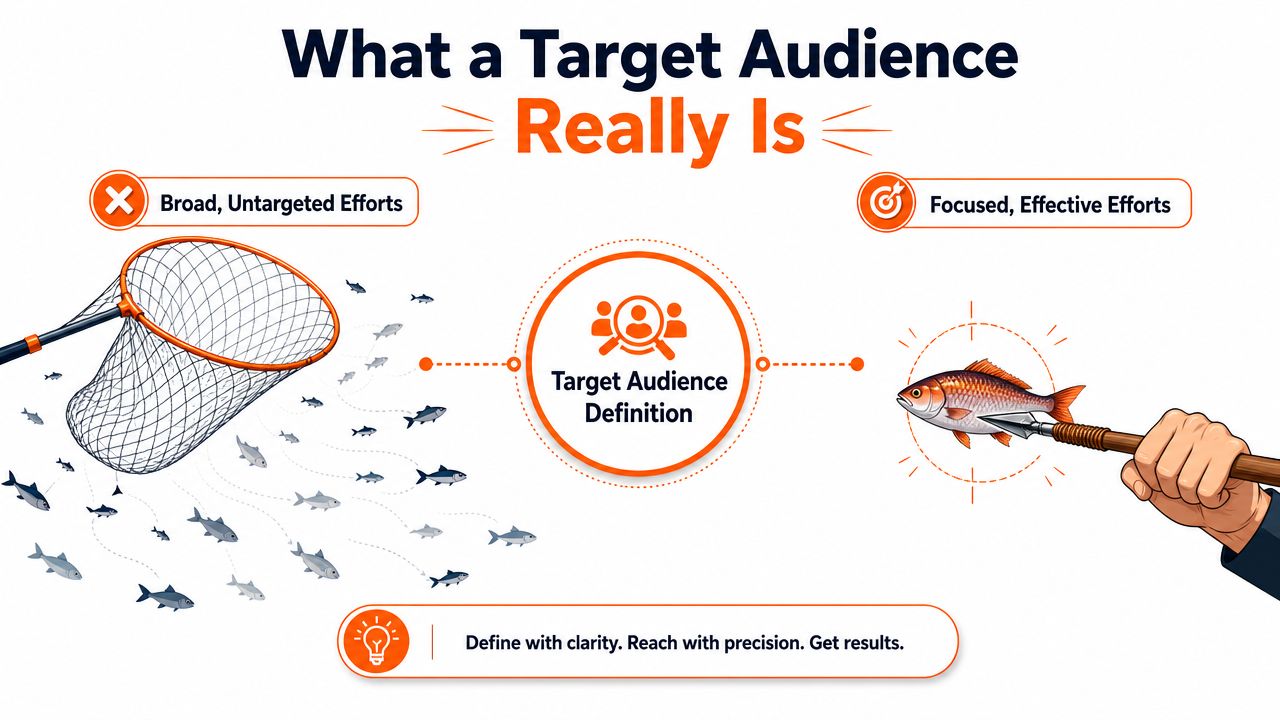
Compare it to fishing with a giant net versus a spear. The giant net looks ambitious, but it's heavy, sloppy, and full of junk. The spear forces you to aim. That's why it works.
The simple working definition
A target audience is the narrower group inside a broader market that is most likely to respond to a specific message, offer, or brand promise. This idea came out of market segmentation, where you divide a large market into smaller groups based on shared needs, traits, and behaviors so you can market with precision instead of shouting into the void. Harvard Business School Online explains that to define an audience, you gather demographic data, customer behavior, and consumer motivations in order to move from one-message broadcasting to more specific messaging for the people most likely to respond (Harvard Business School Online on target audience in marketing).
That's the backbone. Now let's make it useful.
The three parts that actually matter
Demographics are the who
This is the basic surface layer.
Age. Location. Job. Income range. Family stage. If you're B2B, it might be company type, team size, or role.
Demographics matter because they narrow the field. They just don't finish the job.
Behavior is the how
Behavior tells you what people do.
What do they click? What do they buy? What content do they save? What channels do they use before they make a decision? Do they compare obsessively, or buy fast once trust is there?
Behavior is where fantasy starts to die. People say a lot of things. Their actions tell the truth.
Motivations are the why
This is the engine.
What are they trying to get? What are they trying to avoid? What fear is sitting under the purchase? What identity are they protecting or building?
- A skincare buyer may not want “clean ingredients.” She may want to stop feeling embarrassed without spending her whole morning on a routine.
- A founder buying software may not want “automation.” He may want fewer mistakes so his tiny team stops dropping balls.
Practical rule: If your audience description only lists age, gender, and city, you don't have a target audience. You have a census fragment.
Build a real person, not a cardboard cutout
I like to write audience notes as if I'm describing one person I'd want to help.
Ask yourself:
- What problem wakes them up at night
- What have they already tried
- What do they believe that gets in their way
- What would make them trust you faster
- What kind of language feels natural to them
That's target audience definition in practice. Clear enough to guide decisions. Human enough to write good marketing.
Audience vs Market vs Persona
Founders mix these up all the time. Then they make bad decisions with total confidence.
Your market is big. Your audience is narrower. Your persona is a detailed sketch of one example person inside that audience. If you blur those together, your strategy gets foggy fast.
The lake, the fish, and the portrait
Use this mental model:
- The market is the whole lake.
- The target audience is the type of fish you want to catch.
- The persona is the portrait of one fish with habits, preferences, and tells.
That's it. Keep it that plain.
Audience vs Market vs Persona Explained
| Term | Scope | Purpose |
|---|---|---|
| Market | Broad category of potential buyers | Helps you understand the big commercial space you're operating in |
| Target audience | Specific segment most likely to respond to your message or offer | Helps you focus product, messaging, channels, and spend |
| Persona | Detailed profile of one representative buyer inside your audience | Helps you write, design, and sell in a way that feels human |
Where founders get tripped up
A lot of people say, “My target audience is small business owners.” That's usually still a market-level answer.
Small business owners who do what? Selling what? At what stage? Under what pressure? Buying for speed, status, savings, or sanity?
And personas get abused too. A persona isn't a creative writing exercise where you invent a favorite coffee order and call it strategy. A persona only helps if it grows out of a real audience definition.
If you're also tightening your message, a marketing positioning statement template can help you connect audience choice to what you say in the market.
Use the right tool for the right decision
I approach it this way:
- Use the market when deciding where to play.
- Use the audience when deciding who gets your limited attention.
- Use the persona when writing copy, creative, onboarding, emails, and sales material.
A fuzzy market can still produce a good business. A fuzzy audience usually produces weak marketing.
That distinction saves a lot of wheel-spinning.
Why This Is Your First Most Important Job
If you're early, this is not a branding side quest. This is survival.
You need a filter for decisions. Without one, every idea looks plausible. Every feature request feels urgent. Every marketing channel feels worth trying. That chaos gets expensive fast.
This is a segmentation problem
The cleanest way to think about audience work is this: it's a segmentation problem, not a branding exercise. The strongest definitions combine demographic, psychographic, behavioral, and needs-based variables, then focus on the groups where revenue already concentrates and where buying triggers are shared (Fusepoint Insights on target audience analysis).
That's one of the most useful truths in marketing. Don't start with “Who do I want my brand to appeal to?” Start with “Who is already showing signs that they need this, value this, and will pay for this?”
Your audience becomes your decision filter
When your audience is clear, a lot of messy choices get easier.
Product
You stop building for random opinions. You build for the people you chose.
If your audience values speed, remove friction. If they value confidence, add hand-holding. If they value status, presentation matters more.
Pricing
Pricing isn't abstract. It's emotional and contextual.
A customer who buys to save time will judge price differently than a customer who buys to save money. Same product. Different lens.
Marketing channels
You do not need to be everywhere.
If your audience is hanging out in Instagram comments, niche Slack groups, local meetups, email newsletters, or search results, go there. Ignore the channels that flatter your ego and produce nothing.
You're looking for your first true fans
Early momentum rarely comes from reaching a broad audience. It comes from reaching the right people in a way that truly engages them.
Those early buyers forgive rough edges. They answer your questions. They tell you what almost stopped them from buying. They become the raw material for better messaging, sharper offers, and stronger referrals.
That's also why I like founder communities with honest feedback loops. Chicago Brandstarters has brand strategy workshops that include target audience definition, which is useful if you want to pressure-test your assumptions with other operators instead of guessing alone.
A 5 Step Framework to Find Your People
Most founders wait too long to do this because they think they need fancy research. You don't. You need curiosity, pattern recognition, and a little courage.
Start here.
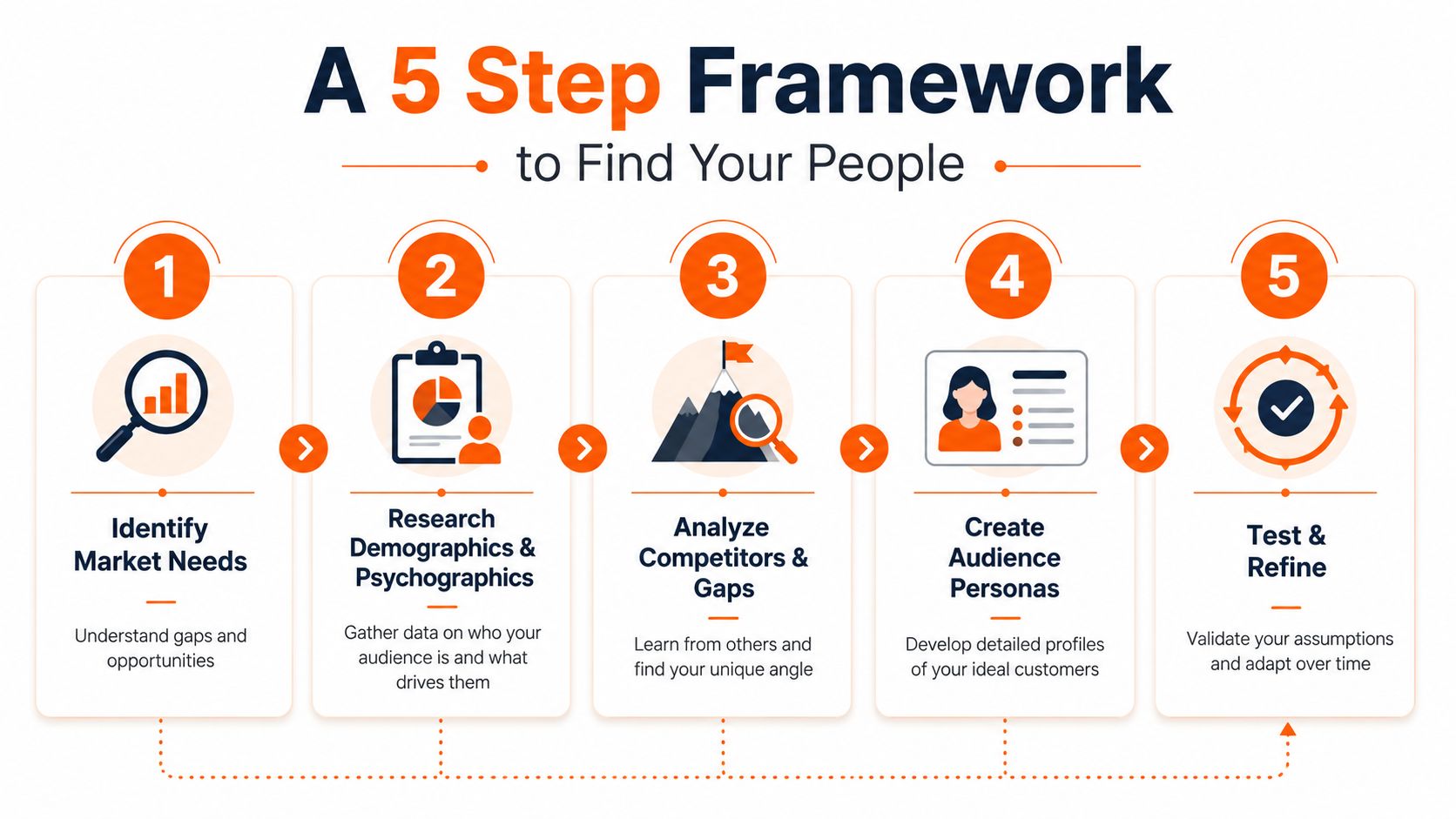
Step 1 starts closer than you think
Look at yourself, your friends, former coworkers, and people already in your orbit.
Who do you know that has this problem? Who complains about it in plain language? Who has already hacked together a bad solution because the problem is annoying enough?
Don't over-romanticize strangers and ignore the evidence right in front of you.
Step 2 spy on competitors like a grown-up
I don't mean copying their branding. I mean studying who they attract.
Go read:
- Comments on social posts
- Reviews on products or software pages
- Reddit threads and community discussions
- Questions people ask before buying
You're looking for repeated phrases, objections, and moments of frustration. Those are gold.
Step 3 use the free data sitting in your tools
The American Marketing Association says marketers use social media analytics and Google Analytics to spot patterns in age, location, interests, and behavior, which gives much finer audience detail than traditional media ever could (American Marketing Association on target audience analysis).
That means you should open the dashboards you already have.
Check platform insights from Instagram, TikTok, LinkedIn, YouTube, or Meta. Check website behavior in Google Analytics if you've got traffic. You're looking for clusters, not perfection.
- Notice repeated locations: You may find one city or region responds harder than others.
- Watch content behavior: One topic may pull attention from a very specific type of buyer.
- Track conversion paths: The audience that likes your posts may be different from the audience that buys.
Step 4 talk to five humans
This is the scary part because there's nowhere to hide. Good. You need reality.
Ask five people who look like likely buyers:
- What are you trying to get done?
- What's annoying about how you do it now?
- What have you tried already?
- What made those options disappointing?
- If something solved this well, what would matter most?
Don't pitch. Don't defend your idea. Take notes.
If you want a practical way to force learning through action, a 30-day audience experiment is a smart model. It keeps you moving instead of sitting in theory.
A useful companion to this work is how to find your tribe, especially if your challenge isn't just defining buyers but also finding the rooms where they already gather.
Step 5 write a one-page audience sheet
Put it all on one page. If you need ten pages, you're hiding from clarity.
Include:
- Who they are: basic demographic or role details
- What they want: the outcome they're chasing
- What they fear: cost, wasted time, embarrassment, complexity
- What they've tried: current alternatives and bad workarounds
- Where they pay attention: channels, creators, communities, search habits
- Why they buy: the trigger that finally pushes action
Later, you can deepen this into personas. For now, one page is enough.
This short video is a good prompt if you want another angle on organizing your thinking before you finalize your audience notes.
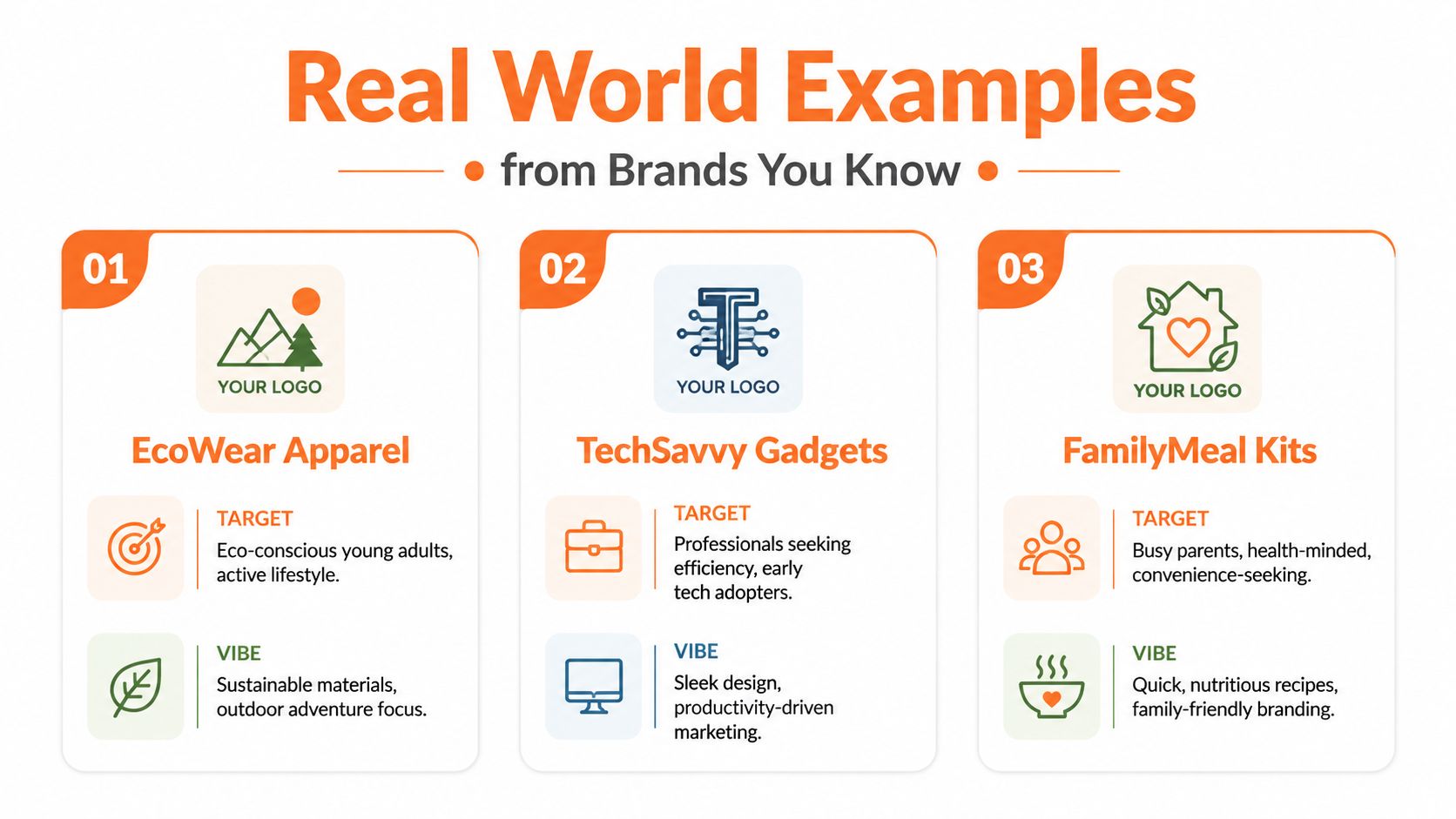
Real World Examples from Brands You Know
A good audience definition leaves fingerprints. You can see it in the product, the copy, the pricing, and the tone.
A direct-to-consumer brand
Take a hydration brand like Liquid I.V.
I'd describe the likely audience as people who care about wellness and convenience, including busy adults, travelers, fitness-minded buyers, and anyone who wants a fast, simple routine. You can feel that audience choice in the packaging, the functional product story, and the way the brand talks about daily performance instead of turning hydration into a chemistry lecture.
That's what clarity looks like. They don't try to persuade every person who drinks water. They frame the product for people who want an easy upgrade.
A software tool
Now think about Notion.
Its broad market is huge. Its active audience is narrower: knowledge workers, startup teams, organized creators, and people who want one flexible place to manage work and thinking. That's why the product has templates, use-case pages, and a tone that speaks to productivity-minded people who like systems.
The product itself mirrors the audience. It rewards people who enjoy customizing their workflow instead of people who want a rigid plug-and-play tool.
A local service business
A neighborhood meal prep company usually isn't targeting “people who eat food.” It's targeting overloaded professionals, health-conscious parents, and busy households that want convenience without the guilt of takeout every night.
That audience choice shapes everything. The website leads with weekly ease. The photos show normal home life, not chef theatrics. The offers reduce planning stress first and sell taste second.
What to steal from this
Look for the match between audience and execution.
- Tone: Formal, playful, reassuring, expert
- Offer structure: Subscription, premium bundle, starter package
- Creative style: Clean and efficient, cozy and familiar, edgy and expressive
If you're making ads for a narrow audience, tools like the ShortGenius AI ad generator can help you quickly test different angles and hooks once your audience definition is solid. The important part is the order. Audience first, creative second.
If you're translating this into packaging, messaging, and product story, how to brand a product gives you a useful next layer.
Common Mistakes That Burn Cash and Confidence
Founders often bleed money. The mistakes are common because they feel reasonable in the moment.
They aren't.
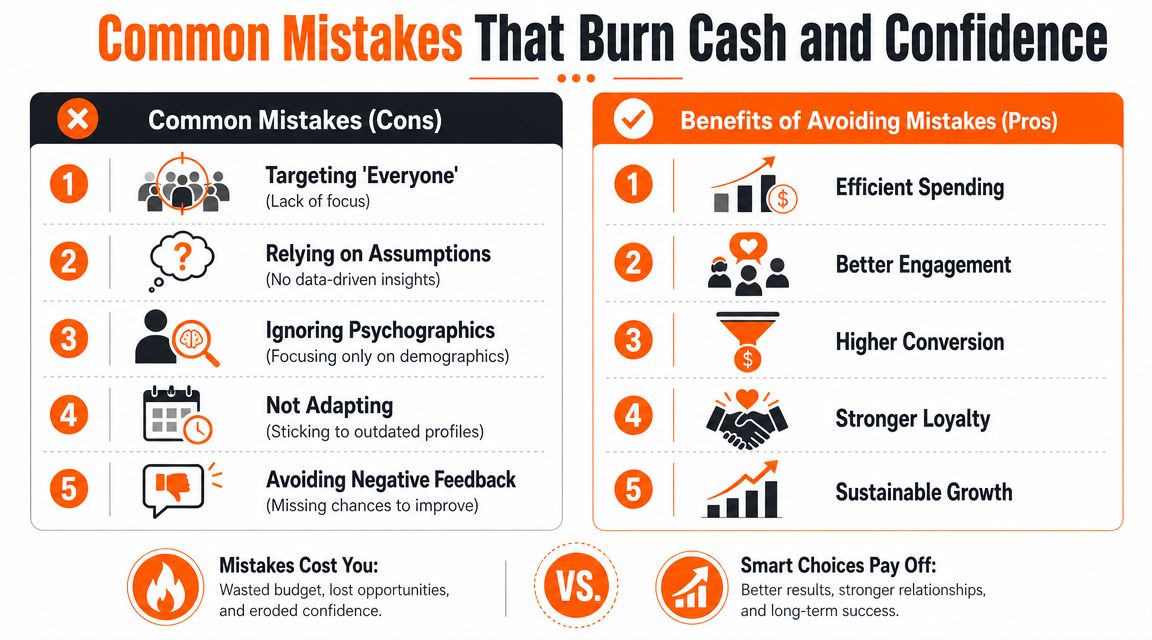
Mistake one is targeting everyone
“Men and women, ages 18 to 65” is not a target audience. It's what you write when you don't want to make a choice.
The fix is simple. Narrow by problem, situation, and motivation. Start with the people most likely to buy soon, not the people who could theoretically buy someday.
Mistake two is trusting your own imagination too much
Founders love their own theories. I do too. But assumptions get expensive when you mistake them for evidence.
Talk to buyers. Read comments. Check analytics. Watch what people do, not what you hope they do.
The audience in your head is usually cleaner, richer, and easier to sell than the audience in real life.
Mistake three is stopping at demographics
Age and location won't tell you why someone pulls out a credit card.
You need the emotional layer. Are they stressed, ambitious, embarrassed, impatient, skeptical, tired of wasting time, trying to look competent, trying to feel in control?
That's the layer that sharpens copy and offers.
Mistake four is chasing the audience you wish you had
Some founders want premium customers, trendsetters, or polished professionals because it flatters the brand they want to build. Meanwhile, the people buying are more practical, more budget-aware, or more DIY than expected.
Go with reality. You can reposition later. You cannot scale self-deception.
Mistake five is freezing the audience forever
Your first audience definition is a draft. A useful draft, but still a draft.
As you get feedback, sales conversations, and buyer behavior, refine it. Keep the core. Update the edges. Markets change. Buyers learn. Your product gets better.
A clean way to sanity-check yourself is this short list:
- Am I describing buyers I've observed
- Do I know their trigger to act
- Can I name where they pay attention
- Does my message use words they'd say themselves
- Have I updated this since learning from real customers
If you can't answer yes to most of that, go back and tighten the work.
If you're building in Chicago or the Midwest and want a room full of founders who will pressure-test your audience thinking without the fake networking energy, take a look at Chicago Brandstarters. It's a vetted community built around small dinners, honest feedback, and helping kind, hard-working builders get sharper faster.
Leave a Reply