

You're probably in the same spot I see over and over.
Sales are coming in. Orders are moving. Your store looks healthy from the outside. But behind the scenes, you're answering support tickets at night, fixing product listings on weekends, chasing a warehouse for updates, and checking ad accounts before breakfast. You don't have a growth problem. You have a bandwidth problem.
That's when founders start searching how to outsource e commerce. Most of the advice out there is junk. It treats outsourcing like a bargain bin. Hire cheap help, hand off tasks, save money. That's how you end up with a stranger mangling your brand voice, breaking your systems, and giving your customers canned replies that sound like they were written by a robot with a head cold.
I've learned to treat outsourcing differently. I use it to protect founder time, tighten operations, and keep strategic control where it belongs. If you do it right, outsourcing gives you an edge. If you do it wrong, it gives you another mess to manage.
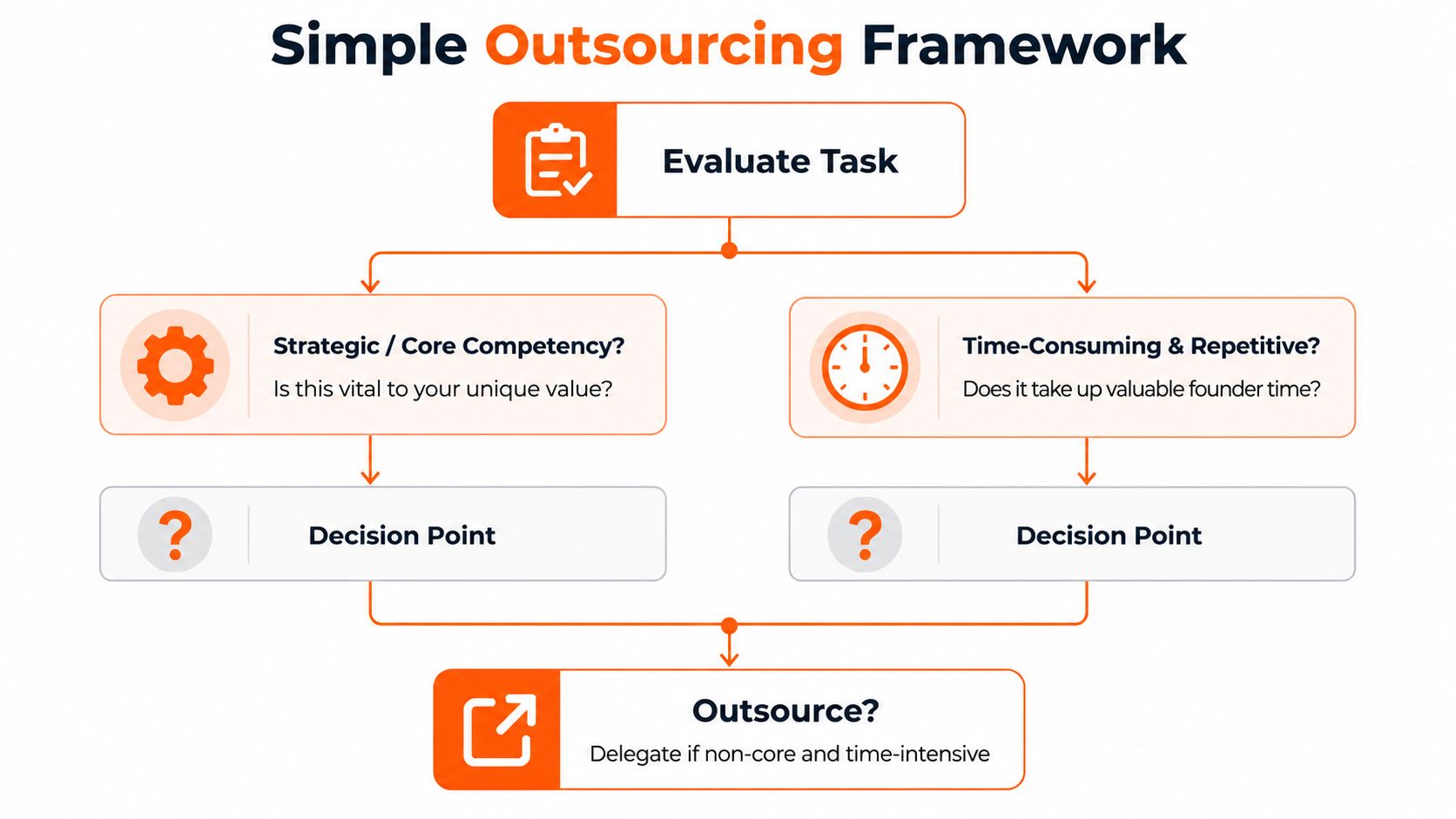
A Simple Framework for When to Outsource
Your time budget works like a bank account. If small operational tasks keep auto-withdrawing all week, you hit Friday overdrawn. You feel busy, but the work that drives business growth never gets done.
That's the moment to stop asking, “What can I dump on someone else?” Ask a better question. “What should only I own?”
Use three buckets
I sort every task in an e-commerce business into three buckets.
| Bucket | What belongs here | My rule |
|---|---|---|
| Core | Brand voice, product strategy, pricing, customer insight, creative direction | Keep in-house |
| Support | Paid media execution, bookkeeping, email calendar builds, reporting | Outsource with oversight |
| Routine | Data entry, order tracking replies, listing updates, returns processing | Outsource fast |
Core work is your recipe. Don't hand the recipe to someone who doesn't eat at your table. If a task shapes your positioning, your margins, or your relationship with customers, keep it close.
Support work matters, but it follows a playbook. A good operator can run it if you give them clear targets. For this, agencies, freelancers, and specialized firms often prove very useful.
Routine work is where founders waste absurd amounts of energy. It's necessary. It also drains your best attention.
Watch for the real triggers
Don't wait until the business feels chaotic. Use hard triggers.
A practical benchmark from Enshored's e-commerce outsourcing guide says you should review outsourcing when support messages regularly take more than four hours to answer, or when your core team spends more than 30% of its time on routine tasks. The same guide says some operator scorecards treat a pain-point score above 30 as a signal that outsourcing is warranted.
Practical rule: If you keep postponing growth work because “operations got crazy this week,” you're already late.
I also look for repeated founder touchpoints. If your name is attached to every refund exception, every product upload, every PPC tweak, and every vendor follow-up, your company has no operating system. It has a dependency.
What I'd outsource first
Start with work that is easy to define, easy to review, and expensive for you to keep doing.
- Ticket triage and routine support replies so you only handle escalations
- Catalog cleanup and listing updates if your SKUs keep changing
- Reconciliation, bookkeeping, and admin follow-up that steals half-days
- Execution-heavy ad work after you decide strategy
If you sell on marketplaces, channel complexity changes the math fast. Amazon, Walmart, Shopify, and your own fulfillment setup all have different failure points. If you're deciding where in-house control matters most, compare operational models first with this guide on Amazon FBA vs FBM.
And if Walmart ads are eating time you should spend on assortment or pricing, this breakdown on best Walmart ad management is worth your time because it frames the agency-versus-in-house tradeoff clearly.
The Menu of E-commerce Functions to Outsource
Once a store gets bigger, complexity doesn't rise in a neat line. It piles on. Global e-commerce sales are projected to hit $6.88 trillion in 2026 and account for 21.1% of all retail commerce worldwide, while stores that pass roughly 10,000 monthly orders hit real operational bottlenecks. That's one reason about 35% of e-commerce businesses use virtual assistants, inside an outsourcing market worth more than $1 trillion, according to VAMasters' outsourcing statistics roundup.
That tells you something simple. Outsourcing isn't fringe behavior. It's normal operating behavior for stores that don't want to choke on their own success.
Marketing tasks that travel well
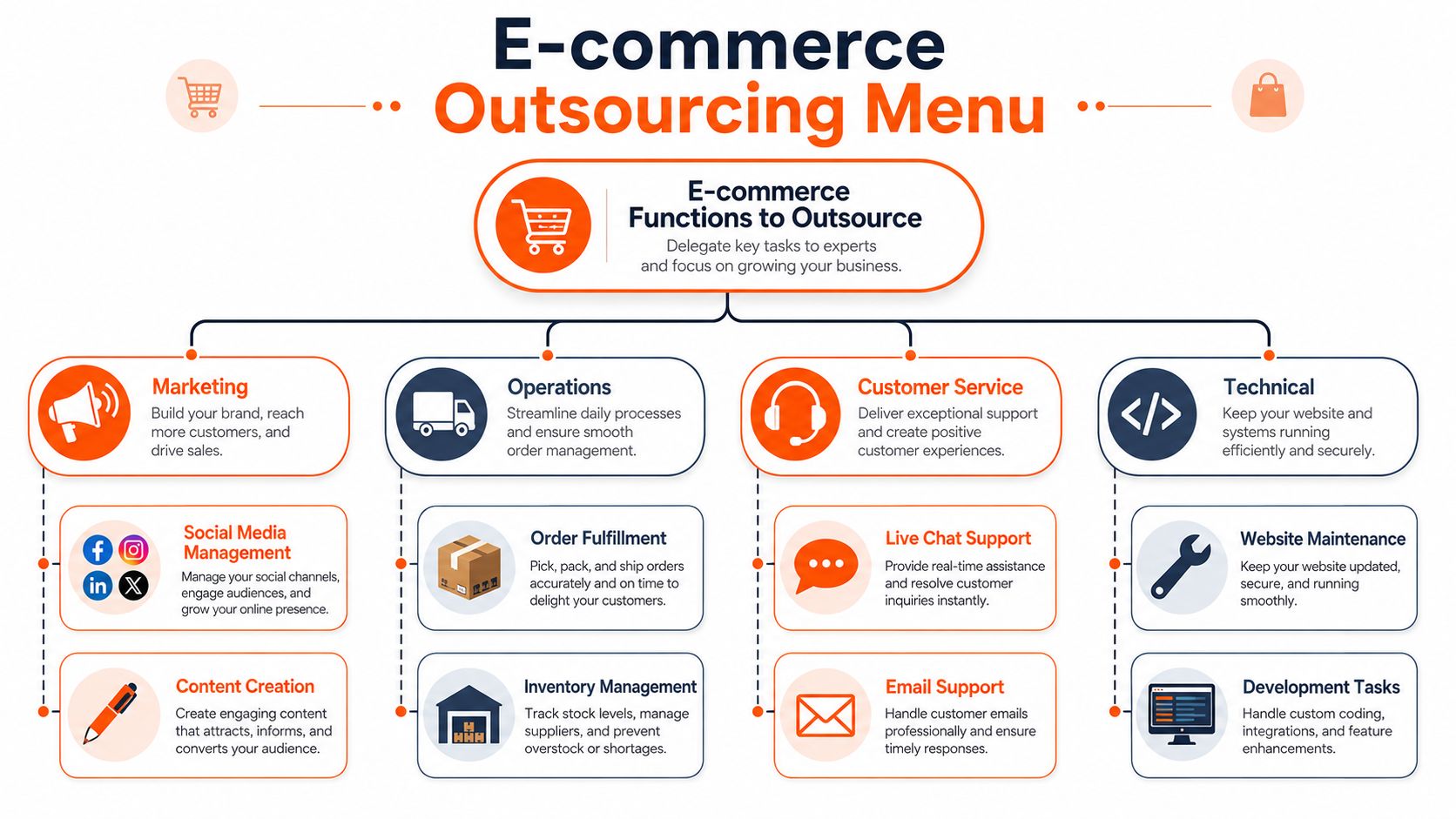
Marketing is full of work that looks strategic but is often execution-heavy.
- Content production. Blog drafts, product descriptions, image resizing, short-form edits, and email builds can move out of your hands.
- Social scheduling and community management. Good for outsourced help if you set tone rules and escalation rules.
- PPC execution. Bid adjustments, search term cleanup, negative keyword maintenance, and reporting can be outsourced. Positioning and offer decisions should stay with you.
Good outsourced marketing work feels crisp, on-brand, and boring in the best way. You shouldn't have to rewrite everything.
Operations and fulfillment work
Operations is where many founders crack. Orders, inventory, supplier follow-up, and returns create constant interruptions.
A lot of this work can move outside your core team:
| Function | Good tasks to outsource | What good looks like |
|---|---|---|
| Inventory ops | Stock updates, reorder tracking, discrepancy logs | Clean counts, clear alerts |
| Order management | Exception handling, tracking updates, split-order follow-up | Fast resolution, fewer surprises |
| Returns | RMA processing, status emails, inspection workflows | Consistent policy use |
| Supplier coordination | Status checks, document collection, production follow-up | Tight communication |
If fulfillment is your headache, compare specialist options before you commit. This list of shipping and fulfillment companies is a practical starting point.
Here's a useful walk-through on the operational side of delegation:
Customer experience and technical work
Customer support is usually the easiest first outsource, but only if you separate basic from nuanced work.
Keep VIP complaints, sensitive refunds, and public brand moments close to you. Hand off repetitive volume, not judgment.
Good tasks to delegate:
- Email support and live chat
- Order status replies
- Return request intake
- FAQ maintenance
- Review monitoring
- Basic site QA
- Theme updates and bug ticket coordination
- App setup and routine website maintenance
I'd also outsource plenty of admin work. Bookkeeping cleanup, reporting packs, spreadsheet updates, invoice chasing, and file organization don't need founder DNA.
How to Find and Vet Great Outsourcing Partners
Most founders shop for outsourced help the way exhausted people shop for takeout. They're hungry, rushed, and too willing to believe the photos.
That's a mistake. A partner who touches your store, customers, or data is closer to a hire than a vendor. You should vet them like one.

Start with where you look
Upwork can work. So can LinkedIn. But broad marketplaces reward polished profiles, not always real operating skill.
I get better leads from:
- Founder referrals from people with similar margins, channels, and headaches
- Niche operator communities where people share who solved a problem
- Specialist firms that do one thing well, like feed management or support staffing
- Peer groups where founders talk openly about misses and wins
If you want a simple framework for evaluating service firms, I like Wand Websites' guide to web agencies. It's about web agencies, but the vetting logic applies to almost any outsourced partner.
One useful place for referrals and operator feedback is vendor relationship management best practices, especially if you're trying to avoid the usual salesy nonsense and hear from people who've managed outside partners.
Run a paid test, not a trust fall
I never hire from a proposal deck alone. I want a small paid project.
Ask for something real:
- A support agent handles a set of actual tickets
- A media buyer audits your account and rebuilds one campaign set
- A listing specialist cleans up a limited SKU batch
- A developer fixes one scoped bug in a staging environment
You're looking at more than output. You're watching how they think.
Do they ask smart questions? Do they catch missing inputs? Do they flag risks before they become problems? Cheap people who need constant steering are expensive.
I trust partners who push back for the right reasons. If they nod at every bad idea, they're not helping.
Interview for ownership
I don't care much about polished agency language. I care about how someone behaves when the playbook breaks.
Ask direct questions:
- Tell me about a time a client gave you bad inputs. What did you do?
- What metrics do you watch first in your area of work?
- What work should stay in-house for a brand like mine?
- How do you report issues early?
- What would frustrate you about working with a founder like me?
That third question matters a lot. Serious partners know where their lane ends. Wannabes claim they can do everything.
Communication is the final screen. If their emails are vague, delayed, and fluffy during sales, they'll be worse after you sign.
Structuring Contracts and Managing Costs
A bad outsourcing contract is like buying a used car with no inspection. It may run fine for a week. Then the wheel falls off and everybody acts surprised.
You don't need a fancy legal masterpiece to start. You need clean business terms, written in plain English, with enough detail that both sides know what success and failure look like.
According to Away Digital Teams' e-commerce outsourcing guide, the broader e-commerce outsourcing market is growing at roughly 12% to 15% CAGR through 2030, and companies that outsource e-commerce operations often report 15% to 30% reductions in operating costs compared with fully in-house models. The same source says 80% of global businesses outsource in some form, and 30% of retailers delegate fulfillment. Cost matters. Sloppy contracts erase those gains fast.
Pick the right pricing model
Don't use one payment model for everything.
| Pricing model | Use it for | Avoid it for |
|---|---|---|
| Hourly or retainer | Ongoing support, account management, recurring ops | Projects with fuzzy scope and no cap |
| Fixed price | Site builds, audits, migrations, one-time setup work | Work that changes weekly |
| Performance-based | Very narrow cases with clear attribution | Anything with messy channel overlap |
I like retainers for customer support, ongoing creative production, or marketplace management. You need continuity, not renegotiation every Tuesday.
I like fixed price for contained projects like a Shopify theme cleanup, returns SOP buildout, or feed mapping project.
I'm cautious with performance pay. It sounds founder-friendly, but people start gaming the metric. If someone gets paid only on one visible output, they may ignore the rest of the system.
My non-negotiable contract terms
These go in writing every time.
- Scope of work. Spell out tasks, channels, tools, and what is out of scope.
- Service levels. Define response times, turnaround expectations, escalation rules, and quality standards.
- Ownership. You own accounts, files, creative, SOPs, and data generated for your business.
- Confidentiality. Customer data, supplier terms, and internal numbers stay protected.
- Access control. State which systems they can use and how access ends.
- Reporting cadence. Weekly, biweekly, or monthly. Pick one.
- Exit terms. Include transition help, file return, and offboarding steps.
Keep the budget honest
The cheapest option often has hidden fees. You pay in rewrites, missed deadlines, customer complaints, and founder cleanup.
A simple rule helps. If you can't describe the deliverable in one sentence, don't agree to a price yet. Tight scope first. Money second.
The invoice is never the full cost. Management drag is a cost too.
Onboarding and Governing Your Outsourced Team
Hiring the partner is the easy part. Making them effective is the actual job.
Most outsourced relationships fail for a boring reason. The founder assumes the partner will “figure it out.” That's like handing someone your car keys without telling them where the brakes are touchy, which door sticks, and where you keep the insurance card.
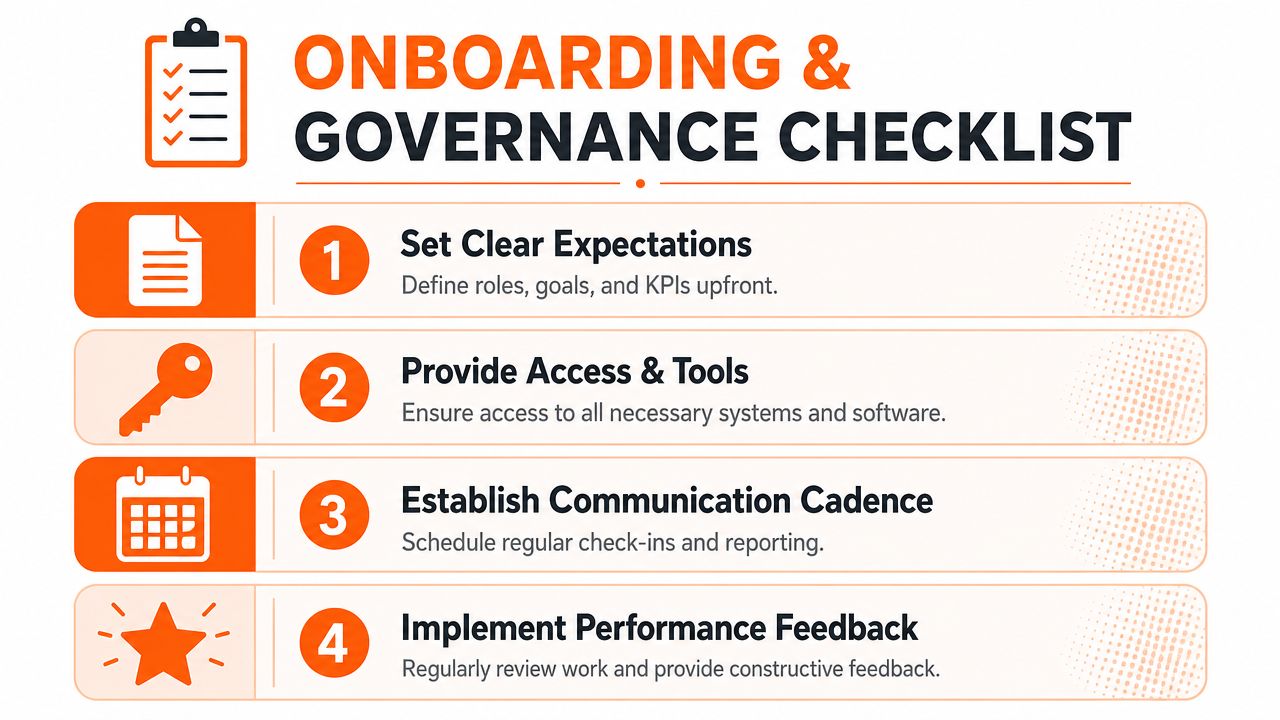
Give them the map
I use a four-part onboarding system.
System access
Set permissions with intention. Use Shopify staff roles, ad account permissions, shared drives, project tools like ClickUp or Asana, and support tools like Gorgias or Zendesk.
Give enough access to do the job. Don't give the keys to the vault by accident.
Documentation
If the work lives only in your head, it is not ready to outsource.
Build simple docs for:
- Brand voice rules
- Refund and return policies
- Escalation paths
- Common customer scenarios
- Naming conventions
- Platform-specific steps
The docs don't need to be pretty. They need to be usable.
Communication rhythm
Pick one main channel. Slack, Basecamp, email, whatever. Don't let updates scatter across text, DMs, voice notes, and random comment threads.
Then set a cadence:
| Cadence | Best use |
|---|---|
| Daily check-ins | New relationships, fast-moving support, launch weeks |
| Weekly reviews | Stable ongoing work |
| Monthly business reviews | Strategy, resets, vendor health |
If you manage remote talent, I like this practical piece on improving remote employee onboarding experience. It maps well to outsourced teams because the friction points are similar.
Define wins before work starts
A partner can't hit a target you never named.
The best implementation guides recommend documenting workflows, setting explicit service-level targets, and running a limited pilot before scaling. One guide suggests a 2 to 4 week pilot for representative work, while tracking accuracy, turnaround time, communication quality, and problem resolution from day one, followed by repeated quality audits and quarterly reviews after launch, according to ConnectMKD's outsourcing implementation guide.
That pilot period matters. It's where you catch misunderstandings cheaply.
Founder move: Start with one lane, one owner, one scorecard. Don't dump five functions on a new partner at once.
Don't ignore cross-border risk
This part gets missed all the time. If an offshore or multi-country vendor touches fulfillment, returns, or customer data, you still own the customer experience.
Anchanto notes in its guide on in-house versus outsourced operations that outsourcing changes your liability around customs delays, data privacy, and returns handling. It also points to a 2025 U.S. policy change that removed the de minimis exemption for shipments from China and Hong Kong, which can affect fulfillment economics and delivery promises in cross-border setups.
That means you need written answers to ugly questions:
- Who owns customs communication?
- Who handles delayed shipment exceptions?
- Where is customer data stored?
- Who approves refund exceptions?
- What happens when the vendor misses service quality standards?
If you want founder-to-founder feedback while building systems and hiring outside help, Chicago Brandstarters is a vetted founder community where operators trade practical advice in small-group settings and private chat, which is useful when you need real-world input instead of another sales call.
The New Rules for Outsourcing in the AI Era
The old outsource e commerce playbook said this: hand off repetitive work to the cheapest competent labor you can find.
That playbook is aging badly.
AI has changed the bottom layer of execution. Drafting replies, summarizing tickets, clustering reviews, cleaning spreadsheets, generating first-pass descriptions, and organizing knowledge docs all got faster. So the question isn't “What tasks are repetitive enough to outsource?” The question is “What work creates strategic value when done close to the brand?”
Microsourcing points out that most guides still miss this shift. Its analysis says global AI spending is projected to reach $1.5 trillion in 2025 and $2 trillion in 2026, which makes the keep-versus-delegate decision more urgent than ever in e-commerce operations.
What I would never fully outsource now
AI makes routine execution cheaper. That raises the value of control.
Keep these in-house:
- Core brand messaging
- Offer strategy and pricing
- Product roadmap decisions
- Customer insight analysis
- VIP and sensitive customer interactions
- First-party data interpretation
- Creative direction
Why? Because these functions shape how your brand learns. If you hand off the learning loop, you slowly become a manager of vendors instead of the builder of a business.
A support team can tag customer issues. An AI tool can summarize them. But you should still decide what those patterns mean for packaging, product quality, merchandising, and retention.
What I would outsource now
I'd outsource the layers where human oversight matters more than pure manual labor.
That includes:
| Keep close | Delegate |
|---|---|
| Brand voice decisions | AI-assisted support operations |
| Pricing and offer design | Feed management and catalog formatting |
| Customer insight synthesis | Reporting workflows and dashboard maintenance |
| Strategic retention planning | Campaign production and QA |
| Product positioning | Tool administration and process ops |
The best outside partners now act like pilots for your AI co-pilots. They know how to run the systems, check the outputs, and catch mistakes before those mistakes hit customers.
The new founder rule
Don't outsource your judgment.
Outsource throughput. Outsource monitoring. Outsource structured execution. But keep the parts where nuance, trust, and first-party learning compound.
If a task teaches you what your customer wants, think twice before you give it away.
That's the new line. Not because outsourcing stopped working. Because the cheap part of execution got cheaper, while the strategic part of control got more important.
If you're sorting out what to keep in-house, what to hand off, and who to trust, Chicago Brandstarters has a free vetted community for Midwest founders building brands from idea stage to seven figures. It's a place to trade war stories, get honest feedback, and pressure-test decisions with other operators who are in the same position.
Leave a Reply