You launch your first Facebook campaign. You pick interests, write a decent ad, and wait for sales.
Then nothing happens. Or worse, clicks come in, spend goes out, and your dashboard gives you just enough hope to keep burning money.
I've watched founders do this over and over. They try to win strangers before they've learned how to close warm traffic. That's backwards. If you already have website visitors, video viewers, email subscribers, or people who engaged with your page, your first facebook retargeting ad is usually the smarter move.
Why Your First Ad Should Be a Facebook Retargeting Ad
Cold traffic is hard mode. You're asking a stranger to notice you, trust you, and act, all in one shot. That's expensive in money and attention.
Retargeting is different. You're not introducing yourself at a loud party. You're following up with someone who already knows your name. That one change makes everything easier.
A widely cited benchmark reported that Facebook retargeting ads can achieve click-through rates 76% higher than standard display ads, and another analysis found retargeting ads were 76% more likely to get clicks than regular display ads according to this retargeting benchmark roundup. I don't treat any single benchmark like gospel, but directionally this matches what I've seen for years. Warm audiences respond better because they already raised their hand.
Don't start by renting attention from strangers if you haven't learned how to convert the people who already visited.
That's why I tell founders to begin with a simple stack:
- Past site visitors: People who checked you out and left.
- Engagers: People who liked, commented, saved, or clicked.
- Video viewers: People who spent time with your message.
- Cart or form abandoners: People who got close, then drifted.
If you need the mechanical steps, this guide on Meta retargeting setup is a solid walkthrough of the build. I'd pair that with a sharper retention mindset, because this isn't only about ad buying. It's about following up well, which is why I also like this set of customer retention tactics for founders thinking beyond the click.
Why this works when budgets are tight
Most early founders don't have the luxury of wasting spend to “learn.” Every dollar needs a job.
Retargeting gives your budget a shorter path to proof. If your product, offer, or landing page has a pulse at all, a facebook retargeting ad will usually show it faster than broad prospecting. Start where intent already exists. Earn the right to scale later.
Build Your Foundation with the Pixel and CAPI
Before you run anything, fix your tracking.
If you skip this, you're driving at night with one headlight out. You'll still move, but you won't trust what you're seeing. For a facebook retargeting ad, that's a bad place to be, because audience quality depends on clean event data.
What Pixel and CAPI actually do
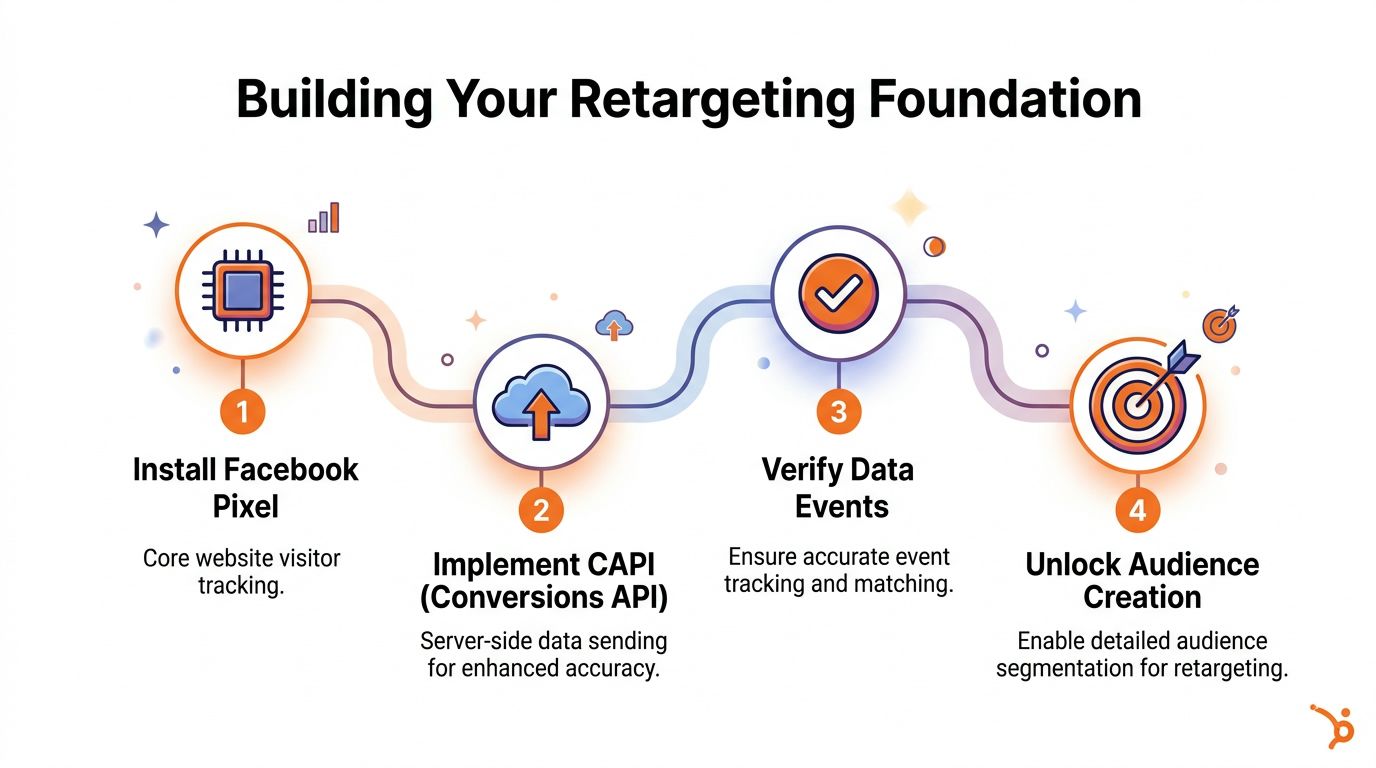
Think of the Meta Pixel as your scout. It sits on your site and watches what people do. Page views, product views, adds to cart, form submissions, purchases. That scout is useful, but it misses things.
Privacy changes, browser limits, and blocked scripts mean browser-side tracking can break. That's where Conversions API, or CAPI, comes in. CAPI sends event data from your server or commerce platform to Meta more directly.
You want both. Pixel catches what the browser sees. CAPI fills in gaps and gives Meta a better shot at matching activity back to real users.
Practical rule: If Pixel is your scout, CAPI is your radio. You need the person in the field and the direct line back to base.
The setup I'd use
I keep this simple:
Install the Meta Pixel
Put it on every page of your site. If you're on Shopify, WooCommerce, or another mainstream platform, use the native integration first before reaching for custom work.Set up standard events
Track the actions that matter to your business. Don't get cute. Use the obvious events tied to your funnel, like page view, view content, add to cart, lead, initiate checkout, or purchase.Turn on CAPI
If your platform has a native CAPI integration, use it. If not, use Google Tag Manager server-side or a connector app your stack supports. Clean and boring beats clever and fragile.Verify in Events Manager
Check whether events are firing, whether duplicates are being handled correctly, and whether the right pages trigger the right actions.
A good technical companion for this is Trackingplan's piece on mastering Facebook ad tracking. It's useful when you want to catch broken events before they poison your reporting.
What to check before spend goes live
Use this short checklist:
- Event accuracy: Your pricing page shouldn't fire a purchase event. Sounds obvious. I've seen worse.
- Consistent naming: Keep your event labels tidy so your audiences don't become a junk drawer.
- Deduplication: If Pixel and CAPI both send the same conversion, Meta needs the right signals to count it once.
- Test journeys: Walk through your own funnel on desktop and mobile. Don't trust setup screens. Trigger the actions yourself.
The payoff is simple. Once Pixel and CAPI are clean, you can build audiences that reflect real behavior instead of random noise.
How to Build Your First Retargeting Audiences
You install the Pixel, connect CAPI, launch retargeting, and Meta starts reporting conversions. Great. Then the hard question hits. Would those people have bought anyway?
That question should shape how you build audiences from day one.
Audience building is not just about getting ads live. It is how you separate weak intent from real buying signals, control spend, and give yourself a shot at measuring incremental lift later. If you dump every visitor into one audience, you make reporting worse and decision-making slower.

I build retargeting audiences around behavior and recency. A person who read one article 20 days ago should not get the same ad as someone who hit your pricing page yesterday and started checkout.
The first four audiences I'd build
Go into Ads Manager and create these first.
All website visitors
Use this as your broad warm pool. Keep the window tight enough to stay relevant. If your sales cycle is short, start with 7 to 30 days, not 180.High-intent page visitors
Build separate audiences for pricing, product, booking, checkout, demo, or application pages. These are the people I care about most because their behavior signals commercial intent, not casual curiosity.Engagers and video viewers
Create audiences from Instagram engagement, Facebook engagement, and meaningful video consumption. This catches people who know your brand but may not have reached your site yet.Customer list or past buyers
Upload your customer list for upsells, renewals, referrals, and exclusions. I usually exclude recent buyers from core retargeting so I do not pay to chase conversions I already won.
My rule for windows and intent
Do not build one audience per page and call it strategy. Build around buying momentum.
Here's a simple model I trust:
| Audience | What they did | Window | What ad they should see |
|---|---|---|---|
| Light intent | Visited blog or homepage | 14 to 30 days | Reminder, education, social proof |
| Mid intent | Viewed service or product page | 7 to 21 days | Objection handling, testimonials, use cases |
| High intent | Visited pricing, started checkout, opened lead form | 3 to 14 days | Direct CTA, friction reducer, offer, demo |
| Existing customer | Purchased already | Based on repeat cycle | Cross-sell, upgrade, referral ask |
This structure does two jobs. It improves relevance, and it gives you cleaner buckets for analysis later. If your high-intent audience outperforms your broad visitor pool, that tells you something useful. If everything is blended together, you learn nothing.
I also like to keep one exclusion-based holdout audience in mind from the start. For example, if budget allows, you can leave a slice of high-intent users unexposed for a short test window and compare outcomes. That is one of the few practical ways to get closer to true incremental value instead of crediting Meta for conversions your brand would have captured anyway.
Segment by behavior, not platform trivia
A page view matters if the page means something. A pricing visit matters more than a random scroll. A return visit matters more than a bounced session. Start there.
If your offer needs explanation, message match matters too. Someone who read your positioning page should see a sharper promise, not generic brand copy. If you need help tightening that message, study examples of how to write a value proposition that actually says something.
How to keep retargeting from feeling creepy
Retargeting feels creepy when the ad ignores context.
If somebody visited your pricing page, talk about proof, risk reversal, setup help, or the one objection that usually stalls the sale. If they only read a blog post, give them a softer next step.
Use this filter before you launch any audience-specific ad:
- What did they already see?
- What question probably remains?
- What small push would move the decision?
That is the whole job.
This walkthrough is worth watching if you want to see the audience-building flow in action:
My rule for founders with low traffic
Small traffic changes the setup.
Start with one broad warm audience and one high-intent audience. Then exclude buyers and keep your windows short. You need enough volume to deliver and enough separation to learn. Tiny fragmented audiences kill both.
I would rather see you run two clear audiences well than eight thin ones badly.
Creating Ad Creative and Copy That Reconnects
Most bad retargeting creative has one problem. It acts like the customer is a stranger.
That's a mistake. Warm audiences don't need a grand introduction. They need a useful nudge.
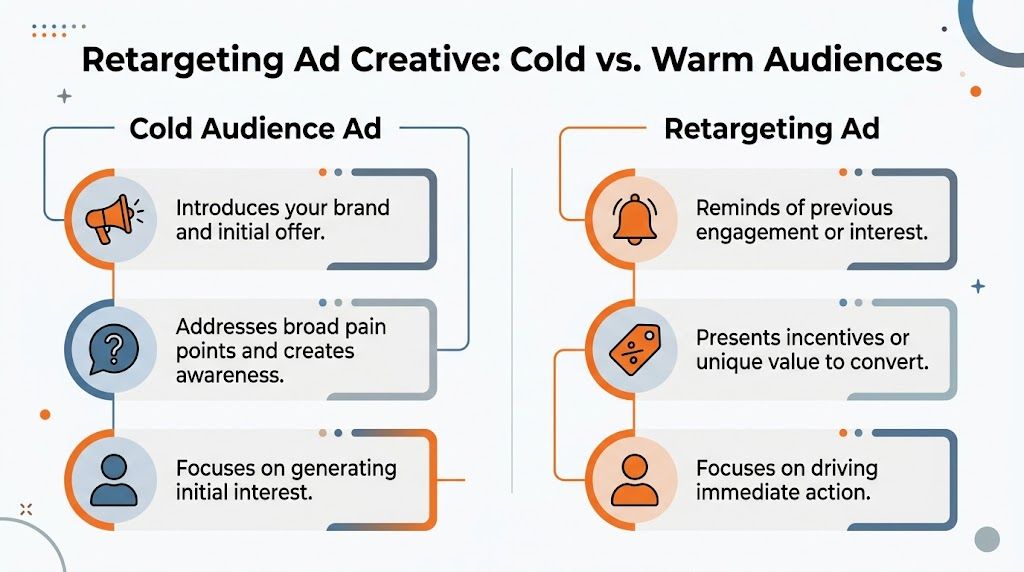
A 2026 summary reported that retargeting campaigns can produce 10x better conversion rates than prospecting campaigns, and that Facebook retargeting ads can increase a site's conversion rates by 20% to 30% on their own according to this Facebook ads statistics roundup. If the audience is warmer, your ad should act warmer too.
Before and after copy
Here's the shift I want you to make.
Cold ad thinking:
“Meet our brand. Here's our mission. Here's the problem. Here's why we're different.”
Retargeting ad thinking:
“You checked this out. Here's the one reason to come back and finish.”
That change trims the fat. It respects context. It also usually improves response because you stop making people re-learn what they already know.
Creative by audience type
I'd match creative to the last meaningful action.
Blog reader
Don't shove a hard sell in front of them. Use a short ad that connects the topic they read to your product. Teach one thing. Then give them one next step.Product page visitor
This person needs belief. Show the product in use, answer a common objection, and give a crisp CTA.Cart abandoner
This ad should feel like a checkout rescue. Remind them what they left behind. Address shipping, setup, trust, or risk.Lead form abandoner
Reduce friction. “Still thinking it over?” beats “Book now.” Short copy wins here.
Here's a fast reference:
| Audience | Weak ad | Better ad |
|---|---|---|
| Blog visitor | Generic brand story | Specific pain point tied to the article they read |
| Product viewer | Broad awareness copy | Demo, testimonial, or objection crusher |
| Cart abandoner | Same old product image | Reminder plus trust signal or simple incentive |
| Existing customer | Repeat first purchase pitch | Upgrade, bundle, referral, or next step |
What I actually put in the ad
I use three ingredients over and over:
Memory trigger
Mention what they likely did. Viewed the product. Started checkout. Read about the problem.One persuasive angle
Pick one. Social proof, speed, simplicity, risk reduction, or value.Clear next action
Don't make people interpret your ad. Tell them exactly what to do.
If your facebook retargeting ad needs five arguments, your offer or page probably has the real problem.
If you need help tightening the message itself, this set of posts on how to write a value proposition is useful. Retargeting works best when your promise is obvious in one glance.
My creative rules
I keep these rules taped to the wall, mentally speaking:
- Short wins: Warm audiences don't need essays.
- Specific beats clever: “Finish your order” is better than a cute slogan.
- Show the product: Screenshots, packaging, demos, before-and-after visuals.
- Rotate often: If the same ad keeps showing, people stop seeing it.
A facebook retargeting ad should feel like a smart follow-up text. Brief. Relevant. Easy to act on.
Smart Budgeting Bidding and Frequency
You launch retargeting, see easy conversions, and your first instinct is to raise budget. That is how founders end up paying to stalk people who were already on their way back.
I budget retargeting with one rule. Respect the size and temperature of the audience. A tiny pool cannot absorb big spend without wasted impressions, rising frequency, and fake-looking efficiency inside Ads Manager.
Budget like someone who wants real lift
Start smaller than feels comfortable.
I want room to see whether the campaign is adding sales, or just claiming credit for people who would have converted anyway. If you force spend into a cramped audience, Meta usually solves the problem by showing the same ad too often. You get more attributed conversions, but not always more business.
A few rules keep this clean:
- Split audience intent: Keep product viewers, cart abandoners, and existing customers in separate ad sets if you want useful readouts.
- Match budget to audience volume: Low traffic means low budget. Don't argue with the math.
- Protect freshness: If your retargeting pool is replenishing slowly, shorten windows carefully or reduce spend.
- Cut clutter: Extra ad sets and tiny tests make learning slower, not smarter.
If you want the bigger system around this, these PPC advertising strategies for managing paid traffic by funnel stage will help.
Bidding
I usually start with Meta's default bidding and focus my energy somewhere more useful. Tracking quality, event prioritization, offer strength, and audience separation matter more than trying to outsmart the auction on day one.
What I watch is simple. Am I getting incremental purchases, qualified leads, or returning customers I want more of? Cheap conversions are not the goal. Profitable conversions that would not have happened without the ad are the goal.
If the campaign starts spending but quality drops, I do not keep feeding it. I tighten the audience, shorten the window for high-intent segments, or reduce budget before I touch anything fancy in bidding.
Frequency
Frequency is where sloppy retargeting shows up fast.
You do need repetition. People are busy, distracted, and comparing options. But repeated exposure only helps until the ad stops feeling relevant and starts feeling lazy. Once that happens, you are paying for irritation.
My defaults are practical:
- High-intent audiences: Allow more exposure, but watch for fatigue quickly.
- Mid-intent audiences: Stay lighter. They need reminders, not pressure.
- Small audiences: Rotate creative sooner because frequency climbs fast.
- Existing customers: Be extra careful. Seeing the wrong ad too often hurts trust.
I do not use one magic number across every account. I watch frequency alongside click-through rate, conversion rate, first-time customer mix, and comment quality. If frequency rises while response weakens, I refresh creative or cut spend. If frequency is modest and conversion lag is normal for your sales cycle, I let it run.
A good facebook retargeting ad shows up often enough to help someone decide, not so often that you pay to follow them around the internet.
That discipline matters more now because privacy loss and platform automation make retargeting look cleaner than it really is. Budgeting and frequency control are not just efficiency tactics. They are how you reduce wasted spend on conversions that were going to happen anyway.
Measuring What Actually Matters Not Vanity Metrics
This is the part most founders avoid because it ruins a lot of pretty dashboards.
A facebook retargeting ad can look fantastic inside Ads Manager and still be a mediocre business decision. High click-through rate. Cheap conversions. Decent return on paper. Great. Would those people have bought anyway?
That question matters more than any dashboard screenshot.

One analysis of Facebook ads found purchases up 142% and revenue up 251%, but first-time orders fell 18%, which suggests the campaign may have been capturing people already likely to buy rather than creating new demand, as discussed in this analysis of retargeting incrementality. That's the trap. Platform reporting can reward you for claiming credit, not for creating lift.
What fake performance looks like
Retargeting gets weird because it often targets people already near the finish line.
That means these results can fool you:
- Brand search rises but new customer growth doesn't
- Attributed purchases climb while first-time buyers soften
- Repeat buyers keep seeing ads they didn't need to see
None of that means retargeting is bad. It means you need to separate captured demand from created demand.
The questions I ask every week
I don't obsess over every metric. I ask a few hard ones.
Are first-time customers growing?
If not, your retargeting may be feasting on existing intent.Am I excluding recent buyers?
If you aren't, you may be paying to reacquire people who were already coming back.What happens if I reduce spend?
If sales barely move, your campaign may be less incremental than it looks.Which audience likely has the highest lift?
Usually this is high-intent non-converters, not recent purchasers.
The best retargeting audience isn't the one with the prettiest dashboard. It's the one that changes behavior.
A simple incrementality test
You don't need a giant brand budget to think clearly.
Try this:
- Pick one high-intent audience
- Hold back a slice from retargeting
- Run the campaign long enough to compare behavior
- Watch conversion rate, first-time orders, and overall business trend
Even a rough control is better than blind faith. The point is not academic perfection. The point is to stop congratulating yourself for sales your email list, direct traffic, or branded search would have delivered anyway.
Troubleshooting and Adapting for 2026
Founders keep asking the wrong question. They ask, “What audience hack still works?” I think that's outdated.
As Meta moves toward broader automation like Advantage+, the edge from hyper-granular retargeting is shrinking. This analysis of Meta retargeting best practices argues that results depend more on creative, offer, and incrementality testing than on audience micromanagement. I agree.
What to do when things get messy
If your results slip, I'd check these first:
- Audience overlap: If multiple ad sets chase the same people, you create internal competition.
- Creative fatigue: If response fades, your message may be old before your targeting is wrong.
- Tiny audience pools: If traffic is low, simplify. Broader warm pools beat overbuilt structures.
- Bad exclusions: Recent buyers and irrelevant users should not soak up spend meant for non-converters.
The new job of the advertiser
Your job is less about hand-building tiny boxes and more about feeding Meta better ingredients.
That means:
- Better first-party data
- Cleaner Pixel and CAPI setup
- Stronger offers
- Sharper creative
- Honest testing for lift
If your audience is small, don't panic. A small warm pool can still work if the message is direct and the offer is clear. If your ads stop working, don't instantly rebuild the account. Refresh creative, check exclusions, and ask whether the campaign is still incremental.
A facebook retargeting ad is still worth using. I just wouldn't worship it. Use it as a disciplined follow-up tool, not a magic trick.
If you want honest feedback from founders who are in the trenches, join Chicago Brandstarters. It's a free community for kind, serious builders who want real conversations, sharp tactics, and fewer expensive mistakes.
Leave a Reply