
You're probably doing what most Chicago founders do at the start. You have six tabs open, three city pages that seem written for lawyers, and one very specific question nobody answers plainly: what do I need to do first?
I've been through that loop. The mistake is treating the city of chicago small business process like a research project. It isn't. It's an execution problem. You need the right order, the right offices, and a short list of programs that are worth your time.
Chicago can reward builders who stay organized and move fast. It can also chew up a month of your life if you start with the wrong portal, chase the wrong grant, or apply for permits before you know what your business model really is.
Use this like a field guide. Skip the jargon. Get legal. Get funded if it fits. Sell into procurement if your business can handle contracts. Use the neighborhood help that shortens the path.
Your Practical Guide to Chicago's Small Business Resources
Most founders hit the same wall first. You search for “city of chicago small business,” land on a maze of pages, then bounce between licensing, zoning, grants, and workshops without knowing which one matters today versus six months from now.
That confusion isn't in your head. A 2024 survey of 206 local businesses found that 57% are optimistic about future performance, while 28% said the city should improve its licensing and permitting processes. In plain English, people still want to build here, but they're frustrated by the paperwork.
What matters first
If you're early stage, don't try to master every city program at once. It's similar to navigating O'Hare. You don't need the full airport map. You need the next gate.
Start with this order:
- Clarify your business model. Home-based service business, retail storefront, food business, product brand, contractor, and ecommerce seller all trigger different city questions.
- Use one central intake point first. That's the Small Business Center, not random hunting.
- Handle legal basics before funding apps. Many founders waste time chasing money before they're clean on licenses and permits.
- Treat procurement as sales, not paperwork. If you fit that channel, it can matter more than a small grant.
Practical rule: If a city program doesn't help you get legal, get revenue, or get financing soon, move it down the list.
If you also want the federal contracting side later, the SamSearch guide to SBA contracting is useful because it connects counseling, capital, and contracting in one path instead of treating them like separate worlds.
And if you're still at idea stage, this future founders resource for Chicago builders is a better starting point than trying to force yourself through city paperwork before you even know what you're building.
Start Here The Small Business Center
If you ignore everything else for a minute, remember this. Your first stop should be the Small Business Center.
I call it Grand Central Station for a Chicago founder. Not because it does everything, but because it routes you to the right track before you burn time on the wrong one.
Illinois has 1.3 million small businesses, which make up 99.6% of all businesses in the state and employ 44.1% of the workforce. With that many businesses in the mix, a central intake point matters. You need someone to tell you which forms, licenses, and city conversations apply to your setup.
What the Small Business Center is good for
Use the Small Business Center when you need direction, not when you want to browse. Go in with specific questions.
Good reasons to contact them:
- You don't know which city license applies to your exact business.
- You're deciding between home-based and commercial space and need to know how that changes permits.
- You need referrals to workshops, business consultants, or neighborhood support.
- You want someone to sanity-check your next step before you file paperwork.
The strongest founders use the Center like triage. They don't ask vague questions like “How do I start a business?” They ask things like, “I sell packaged products online from home. Do I need a city business license, and what changes if I move into a shared commercial kitchen?”
How to show up prepared
Don't contact the Center empty-handed. Bring a one-page summary for yourself, even if nobody asks for it.
Include:
- What you sell
- Where you'll operate
- How you'll get paid
- Whether customers visit your location
- Whether you handle food, employees, or inventory
That short prep saves back-and-forth.
Walk into city support with a business model, not a dream cloud. The city can help a blurry plan, but it moves much faster with a concrete one.
My advice on timing
Use the Small Business Center before you do any of these:
- filing city applications you don't understand
- signing a lease
- paying a permit expediter
- applying for grants tied to a location or business type
A lot of founders do those in reverse order and create expensive problems for themselves. The city of chicago small business path gets simpler when you start with one informed conversation and build outward from there.
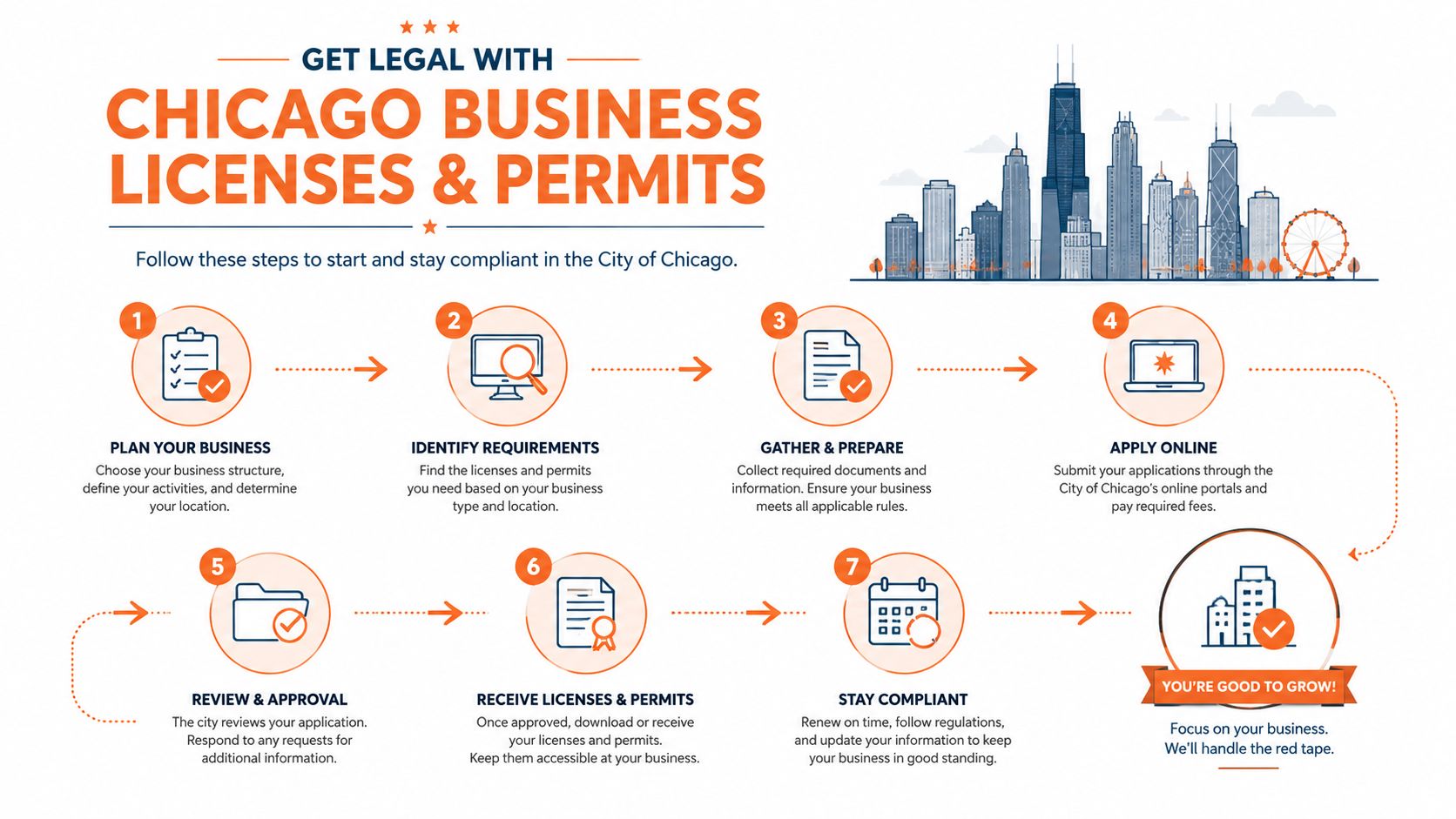
Get Legal With Chicago Business Licenses and Permits
Licenses and permits in Chicago are a choose-your-own-adventure book. The problem is that many individuals begin reading from the middle.
A coffee shop, a hair braider, a home-based ecommerce seller, and a contractor might all think they're just “small businesses.” The city doesn't see them that way. The city sees activity type, location, customer interaction, safety issues, and whether your business changes the use of a space.
That's why legal setup feels messy. You're not filling out one form. You're matching your business to the right path.
The clean way to approach it
Use this sequence.
Define the business activity clearly
“I sell candles online” is better than “I'm starting a brand.” “I run a meal prep business from a shared kitchen” is better than “I'm in food.”Confirm where the business happens
Home, shared commercial space, storefront, mobile setup, or client site all lead to different permit questions.Check city license requirements
Don't guess from Reddit threads or what your friend did in another neighborhood.Check state-level requirements too
City approval and Illinois requirements are not the same thing. For a broad starting point, this Illinois license directory from OnBiz is useful for spotting categories you might miss.Ask whether zoning or build-out changes apply
This matters a lot when you're signing for physical space. Landlords often act casual about this. Don't copy their confidence.
What founders usually get wrong
The biggest mistake is filing too early with incomplete facts. The second biggest mistake is assuming a home-based business has no city issues.
Common misses include:
- Signing a lease before permit clarity
- Assuming ecommerce means no license questions
- Treating contractor advice like legal truth
- Ignoring customer foot traffic rules
- Starting renovations before city confirmation
Watch this: A cheap lease becomes expensive fast if your use doesn't match what the space can legally support.
A simple decision filter
Ask these four questions:
| Question | Why it matters |
|---|---|
| Do customers visit me? | This changes safety, use, and site expectations |
| Do I prepare or store regulated goods? | Food and certain products trigger extra review |
| Am I changing a physical space? | Build-out adds another layer |
| Am I operating from home? | Home-based rules are not the same as “no rules” |
If you can't answer those cleanly, pause before filing anything.
My blunt take is this. Founders overcomplicate branding and underprepare legal setup. Your LLC name, logo, and packaging can wait a week. Your permit path should not.
Find Funding With Chicago Grants and Loans
Most founders look at Chicago funding the wrong way. They search “small business grants,” make a giant spreadsheet, then apply to everything with the word “entrepreneur” in it. That approach wastes time.
You need to separate money for operating, money for build-out, and money tied to a place or public goal. Those are different buckets. If you mix them up, you'll chase programs that were never meant for your stage.
The strongest shortcut is this: start with support organizations that help you become finance-ready. Data from the 2019 Chicago SMB Report shows that delegate agencies in the Neighborhood Business Development Centers program can raise loan approval rates for minority-owned firms by 20-30%, and Chicago Business Centers can cut launch times by 40% from 90 to 54 days. That tells me something important. Process help often matters before capital itself.
What each funding path is really for
Here's the founder version, not the brochure version.
| Program Name | Best For | Funding Type | Typical Amount |
|---|---|---|---|
| SBIF | Businesses improving a commercial property | Grant or reimbursement-style support | Varies |
| NOF | Place-based projects in targeted areas | Grant | Varies |
| CDFI loan | Founders who need startup or working capital and want a mission-driven lender | Loan | Varies |
| Bank loan | More established businesses with stronger financials | Loan | Varies |
| Family, savings, revenue | Earliest stage testing | Self-funding | Varies |
I'm keeping the amount column qualitative on purpose. Program terms change, and if you don't fit the use case, the amount doesn't matter anyway.
My opinion on grants
Founders love grants because grants feel like free money. Most of the time, that's the wrong instinct.
A lot of city-linked grant programs fit one of these situations:
- You're improving a commercial site
- You're opening in a targeted corridor
- You're part of a neighborhood redevelopment push
- Your project has a strong public-facing component
If you're a solo founder testing an ecommerce brand from your apartment, many grant programs are a distraction. You're usually better off getting legal, validating demand, and building clean books.
Why CDFIs and neighborhood channels matter
For many early founders, especially if traditional banks feel out of reach, CDFIs are often more practical than big-bank fantasies. But don't go in cold if you can avoid it.
Use:
- Neighborhood Business Development Centers for prep and referral
- Chicago Business Centers for launch support and city process help
- A basic lender packet with your use of funds, simple projections, and clean business description
If you're bootstrapping first, this guide on how to bootstrap a business is the right counterweight to grant-chasing. Sometimes the smartest funding move is to avoid outside money until you've proven people will buy.
Money doesn't fix a fuzzy business. It just gives the fuzz more runway.
Where I'd focus if I were starting today
I'd split founders into three groups.
If you're home-based and early, skip the grant hunt. Get legal, sell, and keep your burn low.
If you're opening a physical location, spend real time on property-linked programs and local support organizations.
If you're seeking a loan, get neighborhood guidance before you apply. A cleaner application beats a wider application.
That's what matters in city of chicago small business funding. Pick the lane that matches your stage. Stop applying sideways.
Sell to the City Through Procurement
Most founders ignore procurement because they think it's for giant vendors, not small operators. That's a mistake.
The city, county, and related public systems buy things every day. Services, products, maintenance, marketing support, supplies, tech, catering, professional help. If your business can deliver reliably and handle paperwork, procurement is a sales channel.
Chicagoland's economy is huge. The NHS Chicago small business resource guide says the region has an $886B economy and ranks as the 21st largest in the world, and that procurement advice from Cook County Small Business Source can boost contract wins by 35% for certified businesses. I read that as a very simple signal. Getting certified and coached is worth it if procurement fits your model.
Who should care about this
Procurement is a fit if you run a business that can handle repeatable delivery.
Good candidates include:
- Professional services firms with clear scopes and timelines
- Suppliers and product businesses that can fulfill orders consistently
- Construction and trades businesses used to compliance and documentation
- Specialized service providers that can meet vendor requirements
If you make one-off art pieces with no production rhythm, this may not be your first move. If you already know how to quote work, manage timelines, and invoice cleanly, pay attention.
What to do first
Don't begin with bidding. Begin with readiness.
Start here:
- Register as a vendor where needed
- Look at certification options like MBE or WBE if you qualify
- Get procurement advising before you chase contracts
- Prepare standard company docs and capability statements
- Bid small before you bid big
Procurement rewards the founder who acts boring in the best way. Clear docs. Clear pricing. Clear delivery.
My blunt take on certification
Some founders treat certification like optional admin. If you qualify, I think that's lazy. Certification can change which doors open and how seriously buyers take your outreach.
It also forces discipline. You tighten your records, define your ownership structure, and present your business in a way institutional buyers can understand. That discipline helps outside procurement too.
The city of chicago small business crowd talks a lot about grants. I'd rather see more founders build a repeatable revenue base through contract work when their business model fits it.
Access Free Training and Neighborhood Support
You do not need to pay a coach to learn the basics of running a Chicago business. In many cases, you need a local guide who knows the forms, the timing, and the neighborhood players.
That's where workshops and Neighborhood Business Development Centers come in. I like them for one reason. They turn vague ambition into a sequence of tasks.
Build your own no-cost learning track
I'd use free support in this order:
- Start with compliance help so you understand licenses, permits, and setup.
- Move to business planning help once your model is concrete.
- Use marketing or bookkeeping workshops after you've defined what you sell.
- Bring sharper questions each time instead of reintroducing your whole idea from scratch.
That order matters. A founder who asks for Instagram tips before they know whether they can legally operate is working backwards.
What neighborhood support is good at
Neighborhood centers are often strongest when the problem is practical, not theoretical.
They can help with things like:
- sorting through local process confusion
- reviewing your business plan
- pointing you toward lenders or city programs
- helping you prepare for meetings and applications
They also help reduce founder isolation. That matters more than people admit. Most early businesses stall because the owner gets stuck, embarrassed, and quiet.
If you want peer learning on top of city and neighborhood resources, Chicago Brandstarters has private small-group founder dinners and a group chat for Chicago builders. That's a peer support option, not a city program, and it fits people who want honest operator feedback instead of polished networking.
Free help works best when you treat it like office hours. Bring your numbers, your draft, your questions, and your roadblock.
The right mindset
Don't collect workshops like merit badges. Use them to solve the next problem in front of you.
One good session that helps you fix your licensing path or tighten a lender packet is worth more than ten generic webinars you barely remember.
Common Questions for New Chicago Founders
City or Cook County resources
Use both, but for different jobs.
City resources are usually where you start for licenses, permits, and business setup tied to Chicago rules. County resources can be very useful for procurement advice and broader business support. Don't turn this into a loyalty test. Use whichever office solves the problem in front of you faster.
Do I need a lawyer right away
Usually, no. You need clarity more than you need a fancy bill.
You may need a lawyer if you're signing a lease, bringing on partners, dealing with regulated products, or cleaning up a messy ownership issue. For a lot of early founders, the better first move is a city or neighborhood advisor plus a short paid legal consult when a real decision appears.
Do I need an accountant right away
You need clean bookkeeping earlier than typically assumed. That doesn't always mean a full-time accountant.
If money is moving, set up a real system fast. Separate business and personal spending. Track revenue and expenses from day one. The founder who waits until tax season usually pays twice. Once in stress, once in cleanup.
Should I start from home or get space
Start from home if your business model allows it and you don't need customer traffic, special equipment, or regulated build-out. Physical space adds complexity fast.
Get space when the business needs it, not because it feels more official. A lease can trap a weak model. Home-based operations can buy you time to learn cheaply.
What if I still feel lost
Shrink the problem.
Ask only these questions next:
- What am I selling?
- Where will I operate?
- Do customers visit me?
- What legal step must happen before I can sell?
- Which support office can answer that today?
That's enough to move.
If you're building in Chicago and want a smarter room around you, take a look at Chicago Brandstarters. It's a free vetted community for Chicago and Midwest founders building from idea stage to seven figures, with small private dinners and an active group chat where people share real tactics, hard lessons, and honest support.
Leave a Reply