Let's be honest. You've sat through enough webinars to know they usually miss the mark. They're often just a one-way lecture, and frankly, you're probably tired of being talked at.
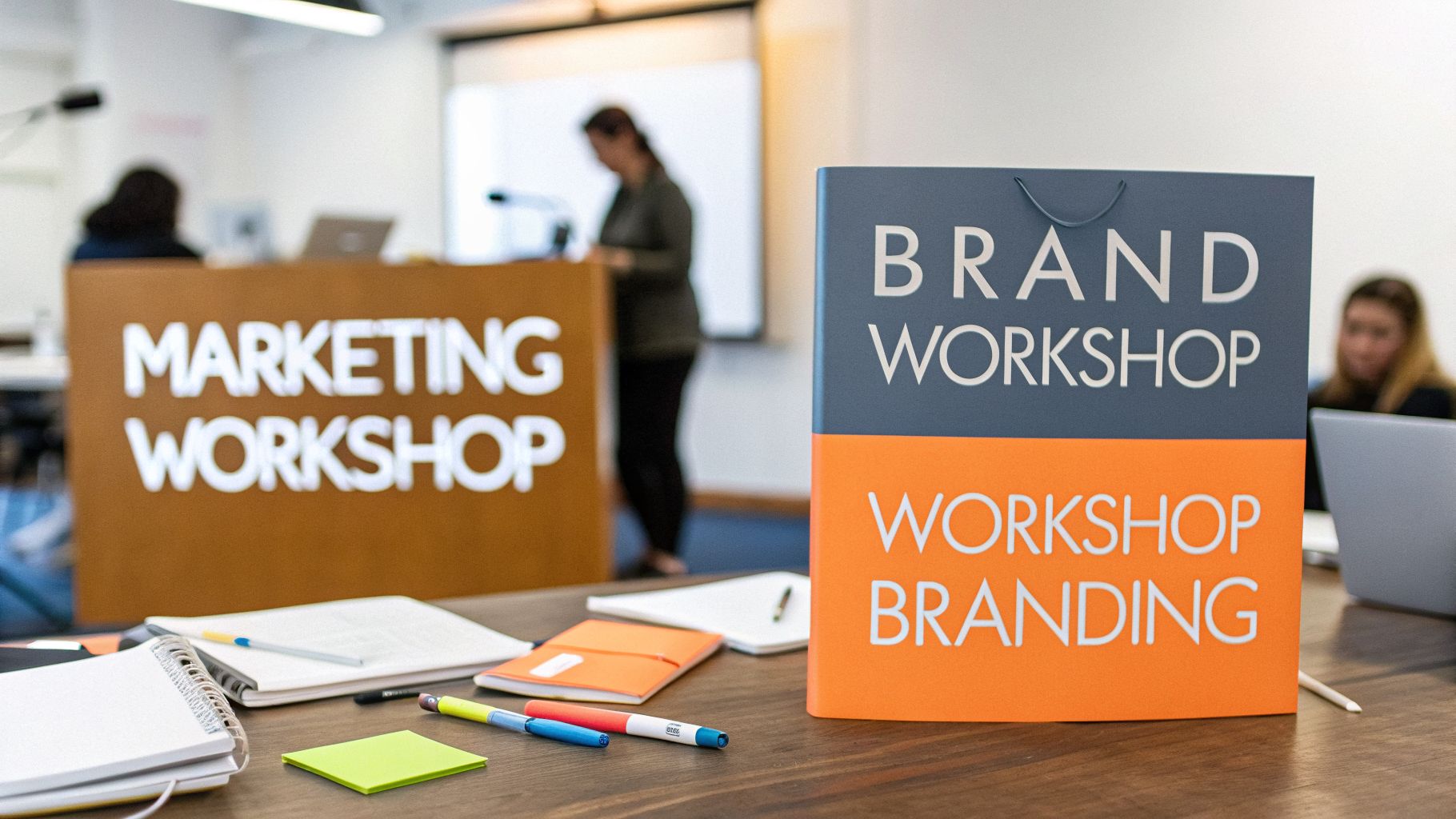
A marketing workshop is a completely different beast. I'm talking about getting your hands dirty and actually doing the work, not just watching someone else do it.
Why a Workshop Beats a Webinar Every Time
I’ve seen it again and again with founders here at Chicago Brandstarters: they're craving real connection and practical help, not another passive presentation.
Think of it like this: a webinar is like watching a cooking show. You see a pro chef whip up something incredible, but you're still on your couch, hungry. A workshop is like me inviting you into my kitchen to cook with me. You learn the techniques, you make the meal yourself, and you leave with something tangible you created.
This isn't just about me sharing information. It's about me creating an experience for you. When I guide you from feeling totally overwhelmed to having a clear, actionable plan in a couple of hours, you and I build a level of trust that a webinar just can't touch.
Your goal isn't to be a lecturer on a stage. It’s to be the host of a great dinner party—you're creating a space where everyone feels comfortable enough to share, learn, and work together.
To put it plainly, a workshop is all about active engagement, while a webinar is a passive broadcast. The differences are stark, especially when you're trying to build a real community.
Workshop Vs Webinar At a Glance
| Attribute | Marketing Workshop | Standard Webinar |
|---|---|---|
| Engagement | Active & collaborative | Passive & one-way |
| Format | Hands-on activities | Lecture or presentation |
| Outcomes | Tangible results (plans, drafts) | Notes and information |
| Connection | Builds deep relationships | Creates brand awareness |
| Community | Fosters a sense of belonging | Gathers a list of leads |
As you can see, if your goal is just to broadcast a message, a webinar might work for you. But if you want to create real impact and build a loyal following, I believe the workshop is where the magic happens.
The Power of Doing Over Watching
This shift from watching to doing is more important than ever. The marketing world runs on data now. Back in 2010, maybe 20% of marketing decisions were rooted in analytics. By 2026, I expect that number to jump past 80%.
That's exactly why a hands-on marketing workshop is so powerful. It gives you the actual skills you need to navigate this shift, not just the theory.
Of course, a single workshop is just one piece of a much larger puzzle. Building a brand that lasts requires a solid foundation from you. If you're starting from square one, you might want to check out our guide on how to build a brand from scratch.
Real Connections and Tangible Results
The benefits of a good workshop stick around long after the event is over. I've found a webinar just can't compete with what a workshop delivers for you:
- Deeper Relationships: When you roll up your sleeves and solve problems together with others, you build real connections—with me and with each other. It’s the start of a genuine community.
- Tangible Outcomes: You don't just leave with a head full of ideas. You walk away with a completed worksheet, a drafted marketing message, or a clear content plan you built right there.
- Community Building: A great workshop is the seed for your community. You're not just collecting email addresses; you're gathering your people, the ones who are truly invested.
By running a workshop, you stop being just another talking head on the internet and become a trusted guide. You create a space where people can make real progress, and in the process, you build a stronger, more engaged audience for your own brand.
Designing an Unforgettable Workshop Agenda
A great marketing workshop should feel spontaneous, but I create that magic with a rock-solid plan. Imagine you're hosting a great dinner party—you want your guests to feel relaxed and engaged, not like they're being marched through a rigid schedule.
So, how do you build an agenda that delivers massive value without feeling like a lecture? The secret is to design a journey. You're not just presenting information; you're guiding people from a place of uncertainty to a real "aha!" moment. I make sure every single piece of my agenda supports that transformation.
This is the big difference between me just broadcasting information and actually facilitating an experience. It's why workshops build way stronger communities than passive webinars ever will.
This visual breaks it down. The shift from a one-way webinar to an interactive workshop is simple, but it’s everything.
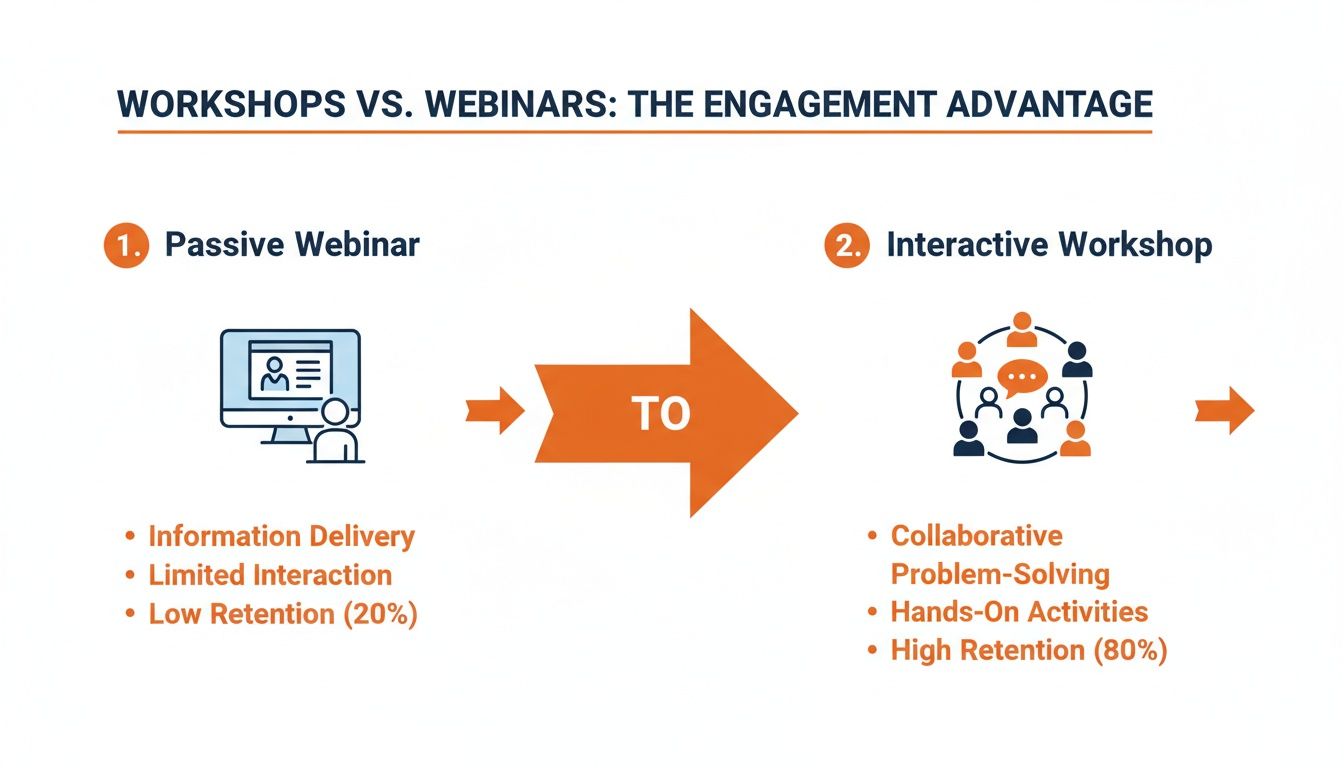
When you move from a monologue to a dialogue, you create real connection. That’s where the good stuff happens.
Start with One Clear Goal
Before you even think about activities, you need to define your workshop's one big thing.
What’s the single most important outcome you want for your attendees? Will they leave with a perfect one-sentence brand pitch? A drafted customer persona? A clear marketing positioning statement?
I believe everything in your workshop—every activity, every discussion, every break—must serve this single goal. If it doesn't, you should cut it.
This sharp focus is your filter. It keeps you from trying to cram in too much, which is a classic mistake. You’re aiming for one deep, tangible win, not a shallow overview of a dozen different topics.
Sequence Your Sessions for Maximum Impact
The flow of your agenda is critical. It needs a beginning, a middle, and an end, just like a good story. You have to build momentum and keep the energy up.
Here’s a sequence that I’ve found works wonders time and time again:
- The Icebreaker: I start with an activity that builds trust right away. I skip the boring "name and what you do." Instead, I'll ask you something like, "What’s one brand you absolutely love, and why?" This gets people talking about marketing from a personal, positive place from the very start.
- Hands-On Activities: This is the heart of the workshop. These are the "doing" parts where you actually work on your own brand. A couple of my favorites are the 'One-Sentence Brand Pitch' and the 'Customer Persona Sketch.' These exercises force clarity and give you something concrete to walk away with.
- Group Share & Feedback: After a hands-on activity, you have to create a safe space for people to share what they came up with. I find this is where the magic happens. Hearing other people's ideas sparks new insights, and the supportive feedback builds incredible confidence.
Weave in What’s Working Now
Your job is to build a conversation, not just a presentation. For foundational exercises like crafting a brand's position, giving attendees a solid template makes a huge difference. I find it helps them turn abstract ideas into concrete language they can use for their own brand.
I put together a guide for exactly this, which you can find here: creating a marketing positioning statement template. It's a great blueprint for you to share.
My Secrets to Confident Workshop Facilitation
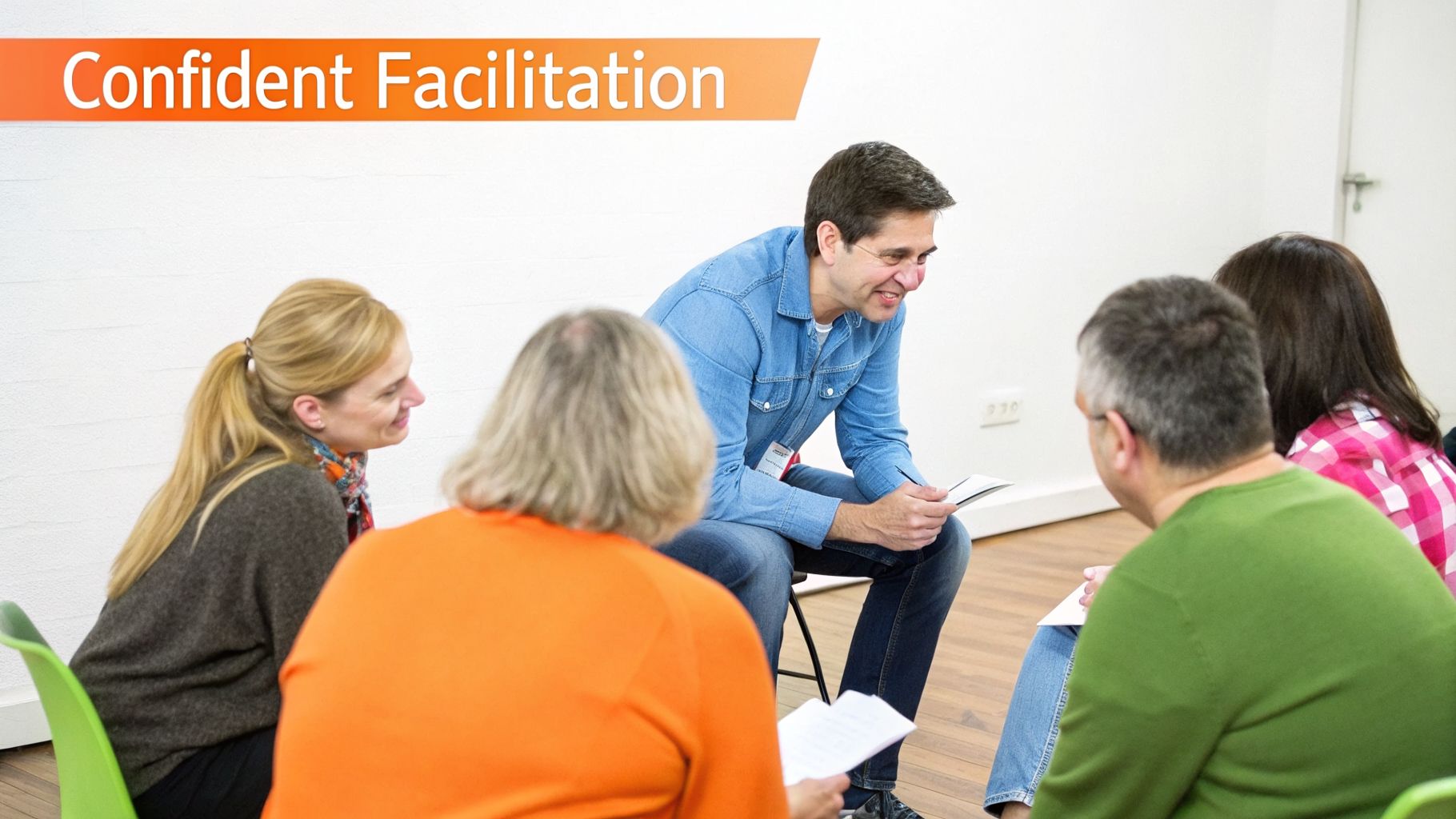
I've seen it a hundred times: a brilliant agenda falls completely flat because the facilitation was… well, robotic. All the planning in the world doesn't matter if you can't create a real human connection in the room. This is where the magic of a workshop for marketing actually happens.
Your job isn't to be the smartest person there. It's to be the best host.
Think of it like you're throwing a party at your house. You make people feel welcome, you introduce them to each other, and you make sure the conversation is flowing. You’re creating a space where you and other founders feel safe enough to be vulnerable and talk about the real stuff that’s keeping you up at night.
When you feel seen and supported, you'll tackle challenges and surprise yourself with what you can accomplish. I believe the right environment is everything.
Set the Tone from Minute One
Your energy is contagious. If you're nervous and stiff, the whole room will clam up. But if you’re warm, calm, and open, everyone else will follow your lead.
I kick off every single workshop by laying down the ground rules. I literally say it out loud: "This is a safe space. There are no dumb questions, and we're all here to help each other win." It's a simple line, but it gives everyone permission to drop the facade and just be real.
You are not a teacher lecturing a class. You are a guide creating a container for discovery. Your primary job is to make every single person feel seen, heard, and valued.
This mindset shift is a game-changer for me. It takes the focus off of your "performance" and puts it on serving the people in the room. Your confidence will naturally follow because it’s not about you anymore—it’s about them.
Managing the Room Dynamics
In any group, you'll get a mix of personalities. You'll have the eager talkers and the quiet observers. Your job is to balance that energy so everyone gets a turn to speak.
Here are a few moves I use all the time to manage the room:
- For the Quiet Ones: Never, ever put them on the spot. Instead, I create a low-pressure opening. I'll say something like, "I'd love to hear from someone who hasn't shared yet. What's bubbling up for you?" This is an invitation, not a demand.
- For the Talkative Ones: You have to gently but firmly make space for others. I use phrases like, "That's a fantastic point, thank you! To keep us on track, let's pause there and move to the next activity." It validates their idea while keeping the train on the tracks.
- For Tough Questions: You're going to get a question you can't answer. It's totally okay. In fact, honesty is your best friend here. My go-to response is: "That is a fantastic question, and I don't have the perfect answer right now. Let me do some digging and I’ll follow up with the whole group."
Facilitation is a dance. It’s about being present, listening more than you talk, and guiding the energy with a soft touch. When you focus on creating a kind, supportive container, you empower people to find their own answers and build connections that last long after the workshop is over.
Essential Tools and Materials for Your Workshop
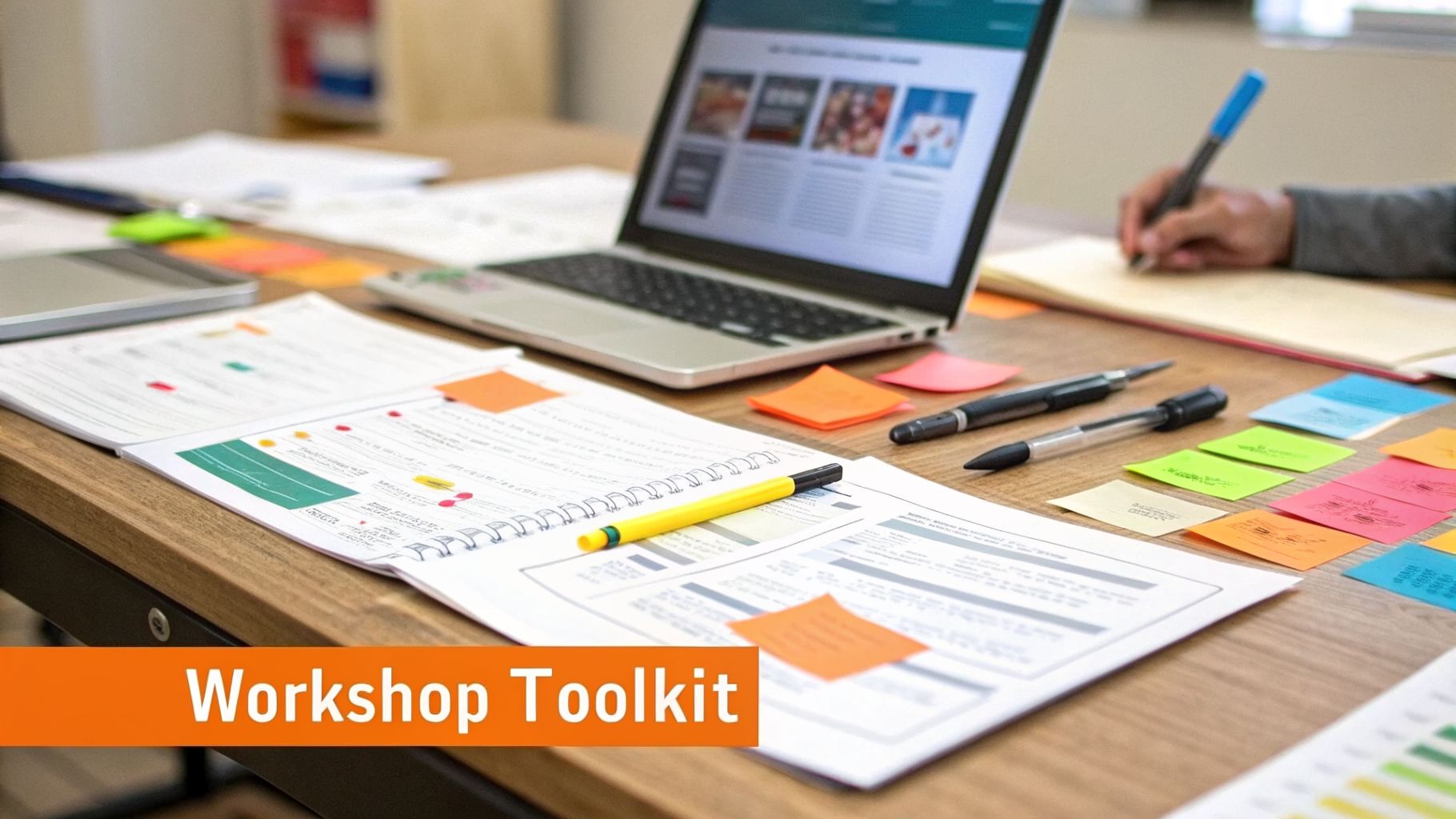
You don't need a massive budget to pull off a killer marketing workshop. In fact, I've run some of my most impactful sessions on a shoestring. What really matters is showing up prepared with the right tools—both physical and digital.
Think of your workshop materials as the ingredients for a great meal. When you have everything prepped and ready, you can forget about the logistics and just focus on being a great host for your attendees.
I’ve learned that the best tools are the ones that get you thinking with your hands and collaborating without friction. The goal is to make the technology and materials disappear, so the ideas can come forward.
This isn’t about flashy gadgets. It’s about creating an environment that sparks real creativity and connection, which you can do with some surprisingly simple things. Let me break down the toolkit I never run a workshop without.
My Go-To Analog Toolkit
There’s a certain magic that happens when you put down your laptop and start using your hands. It slows us down in a good way, making our ideas more intentional. Here’s what’s always in my bag:
- Sticky Notes: I buy these in bulk and in a ton of different colors. They are the currency of brainstorming. Every idea gets its own note, making it easy for you to move, group, and prioritize thoughts visually.
- Good Markers: Don’t cheap out on these. Faded, flimsy markers are an energy-killer. I get myself some bold, dark markers like Sharpies that everyone can easily read from across the room.
- Well-Designed Worksheets: I always create simple, clean worksheets for my core activities. A good worksheet isn't a test; it's a guide. It gives you structure for an exercise, like my 'Customer Persona Sketch,' so you can organize your thoughts without feeling lost.
Essential Digital Tools I Swear By
As much as I love analog tools, digital ones are a must for me to stay organized and collaborate with you if you can't be in the room. My whole approach is to keep it simple with platforms that are intuitive for everyone, no matter how tech-savvy you are.
For slide decks, I use Canva. It’s incredibly easy for me to make professional-looking presentations that match my brand, and their templates are a huge time-saver.
When I’m brainstorming with a virtual or hybrid group, my top pick is Miro. It’s basically a digital whiteboard that acts like an infinite wall of sticky notes. It's perfect for me to capture your ideas in real-time.
Keep The Momentum Going After Your Workshop
The workshop's over. The room was buzzing, you had those "aha!" moments, and you're feeling that good kind of tired that comes from pouring your all into something. But here’s the thing I see most people miss: the real work starts now.
This is where you turn that one-day spark into a lasting community flame.
Think of your workshop as a great first date. Now what? You have to follow up with intention if you want to build a real relationship. A generic "thanks for coming" email is the equivalent of a one-word text message. It’s a dead end. Your attendees gave you their time and shared their struggles; now it's on you to honor that trust.
This is how you separate a forgettable event from the beginning of a real support network.
Go Way Beyond A Generic Thank You
Your first message after the workshop is your most important play. It needs to be packed with value and remind everyone of the energy you created together. I have a simple, three-part follow-up email that I use every time. Feel free to steal it.
My post-workshop email always has:
- A real, personal thank you. I’ll reference a specific moment from the day. Something like, "I'm still buzzing from the energy in the room yesterday when we all tackled our brand pitches." It shows you I was present, not just presenting.
- A quick summary of the big wins. I boil down the core lessons into a few powerful bullet points. This gives you an instant refresher on the value you got and a concrete list to review.
- A link to all the goods. I put the slide deck, worksheet templates, and links to any tools we mentioned into one easy-to-find place for you. No hunting around.
This isn't just an email; it's a toolkit. You're giving them everything they need to keep the momentum going. I consider this a non-negotiable part of running a successful workshop for marketing.
Create A Private Space For The Conversation
The connections you made with each other are just as valuable as the content I delivered. But those new relationships will fizzle out fast if you don't give them a place to live.
The workshop ends, but the conversation shouldn't. Your next move is to get the community out of the physical or virtual room and into a dedicated, private space.
This doesn't have to be some complex platform. I find a simple group chat in WhatsApp or a private Slack channel works wonders. The goal is for you to create a trusted spot where you and other founders can keep sharing wins, asking for advice, and cheering each other on. This is how you build a real peer support system.
If you're looking for more ways to spark these kinds of bonds, our guide on the strategies of business networking has some solid ideas.
And the impact of these experiences is huge. Since 2020, enrollment in analytics-focused marketing programs has jumped by 150%. One program helped over 10,000 non-technical folks master analytics, leading to what they reported as 40% better decision-making in their roles. You can dig into more of these marketing statistics from Salesforce.com.
When you follow up with purpose and give your new community a home, you prove your workshop wasn't just a one-off event. It was the start of something real.
I get asked about workshops all the time. After you’ve run a few, you start to see the same questions pop up from founders trying to get their first one off the ground.
Here are my honest answers to the most common questions about the nitty-gritty of running a workshop that actually makes an impact for you.
How Long Should My Marketing Workshop Be?
This is the classic "how long is a piece of string?" question, but I have a strong opinion here. For a session that goes deep and creates real change, you absolutely need 3 to 4 hours. Don't forget a solid break right in the middle.
That block of time is the sweet spot. It gives you enough runway for a proper icebreaker, one or two meaty hands-on activities, group feedback, and a wrap-up Q&A without completely frying your brain. It's long enough for you to have real "aha!" moments.
Now, if you're just starting out, a 90-minute "power session" can work. The trick is to be hyper-focused. You'd zero in on solving one very specific problem, like nailing an elevator pitch or mapping a single customer journey. Think of it as a focused sprint, not a marathon.
What Is the Ideal Number of Attendees?
My magic number is between 8 and 15 people. This is the absolute sweet spot for real connection and collaboration.
When you keep the group small, you create an environment of trust. It’s intimate enough that you feel safe sharing your real struggles, but big enough to get a mix of different ideas flowing during the activities.
Once you get more than 20 people in the room, that intimacy is gone. It just disappears. I can't give individual attention, and it starts to feel more like a lecture than a hands-on session. The goal is connection, and a smaller group makes that happen automatically.
How Much Should I Charge for My Workshop?
Pricing feels tricky, but I believe it really just comes down to your goals and the value you're providing. You don't always have to charge for your workshop.
Here’s how I think about it:
- Free Workshops: A free event is a killer way for me to get new people to know my brand. It’s a lead-gen tool where I give away massive value upfront, building trust and goodwill with you.
- Paid Workshops: For a paid event, I suggest you start by looking at what similar workshops in your niche charge. Prices can be all over the place, from $50 for a short online session to a few hundred bucks for a full-day, in-person thing with a ton of materials.
Your price sends a signal. It tells people how much value to expect. Don't be afraid to charge what your expertise is worth, but you damn well better make sure your experience over-delivers on whatever you promise.
At Chicago Brandstarters, we believe in building brands through real connections, not that transactional networking crap. If you're a kind, ambitious founder in Chicago looking for a community where you can share war stories and get real support, you've found your people. Learn more and see if you're a fit at https://www.chicagobrandstarters.com.
Leave a Reply