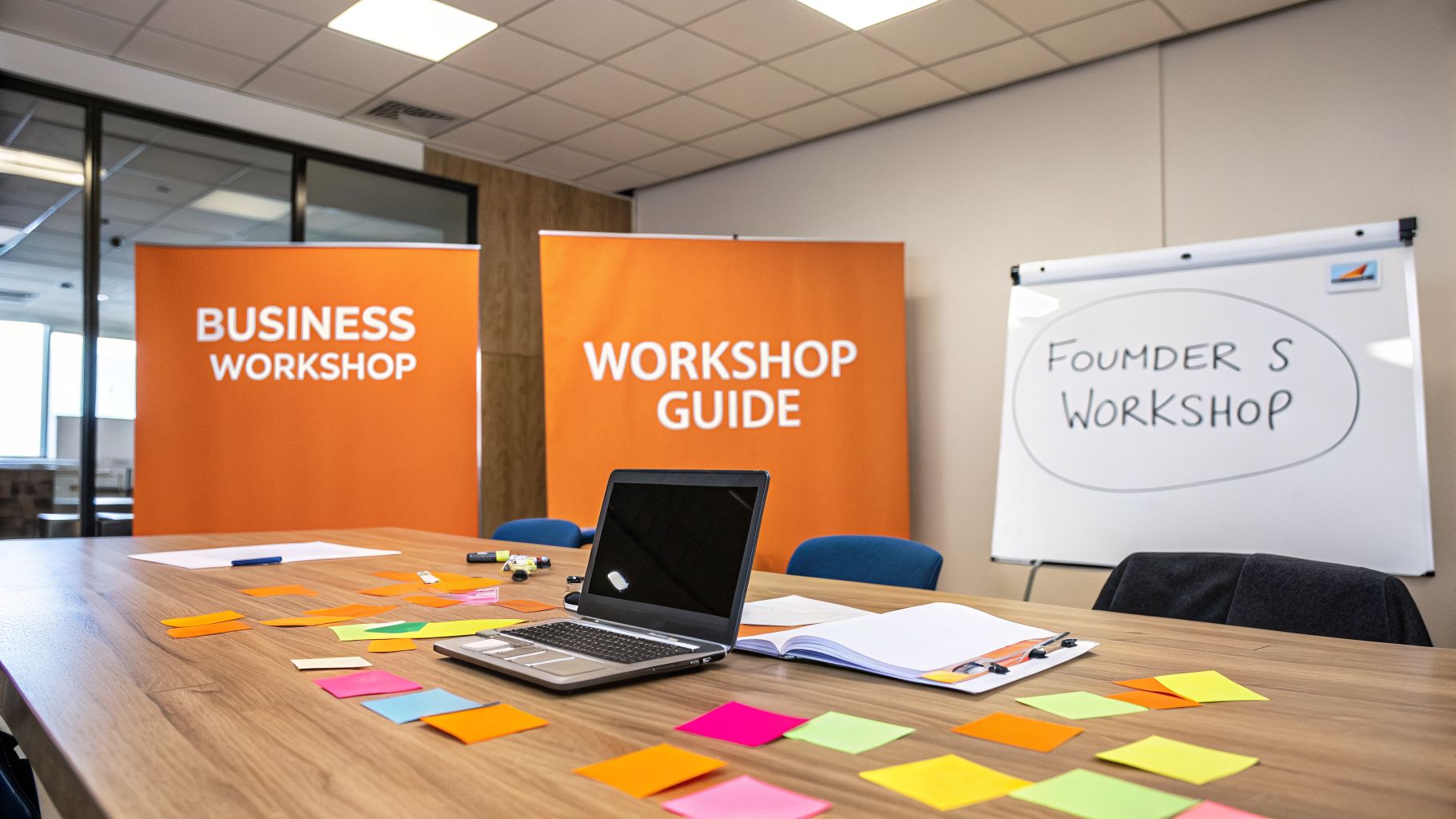
A business workshop isn’t another boring conference where you collect business cards and listen to someone drone on from a stage. I think of it as a confidential command center. It’s a focused, small-group session where you and a handful of trusted founders solve stubborn problems, get brutally honest feedback, and find real support.
It's where you finally get to work on your business, not just get buried in it.
Why Business Workshops Are Your Secret Weapon
Let's cut right to it. I know building a business often feels like you're riding a rollercoaster, by yourself, in the dark. A great workshop isn't some stuffy seminar; it's the moment you get to turn the lights on.
I like to think of it as a master mechanic's garage for your company. You bring in your engine—that big idea, that nagging problem—and a small group of fellow builders helps you tune it up. They offer tools and perspectives you never would have found on your own.
Crush the Isolation, Find Your People
Imagine the difference between a chef's intimate tasting kitchen and a chaotic food court. That’s the gap between a focused workshop and a huge, generic networking event. This is where you destroy the isolation that sinks so many of your great ideas before they even have a chance.
The real magic of a good workshop isn't just about finding answers. It's about finding a confidential space to share your war stories, not just your highlight reel. It's a room where I find vulnerability is more valuable than a polished pitch.
You get to skip the painful trial-and-error and learn directly from people who genuinely want to see you win. This isn't just a hunch I have; the data backs it up.
As the startup world grew, I saw these small-group sessions become a game-changer. Research from the early 2000s showed that entrepreneurs in structured peer workshops were 63% more likely to survive their first five years. Here in Chicago, between 2010 and 2015, over 1,200 founders who joined these kinds of intimate sessions saw their average revenue grow by 45%. Turning isolation into an alliance works. You can dig into more of the data in this introduction to statistical workshops.
Here's a quick comparison of what you can expect from a small-group workshop versus a standard networking event.
Workshop Impact vs. Traditional Networking
| Attribute | Small-Group Workshop | Traditional Networking Event |
|---|---|---|
| Primary Goal | Solving a specific, shared problem. | Making a high volume of new contacts. |
| Atmosphere | Collaborative, confidential, and vulnerable. | Transactional, loud, and often superficial. |
| Key Outcome | Actionable next steps and deeper relationships. | A stack of business cards and surface-level intros. |
| Who You Meet | A curated group with relevant experience. | A random mix of attendees with varied motives. |
| Follow-Up | Built-in accountability with peers. | Relies entirely on your own initiative. |
The difference is clear to me. One is about depth and real progress; the other is often just a numbers game.
The Real-World Impact on Your Business
The benefits go way beyond just feeling less alone. I know a well-run workshop delivers tangible results that hit your bottom line and restore your sanity.
Here’s what you actually walk away with:
- Solve Problems Faster: Instead of banging your head against a wall for weeks, you can often crack a problem in a single 90-minute session just by borrowing from someone else's playbook.
- Get Honest Feedback: You get direct, unfiltered feedback on your ideas from people who have skin in the game—not from a consultant who’s trying to sell you something.
- Built-in Accountability: When you state your next step out loud in front of your peers, you're way more likely to actually do it. I've found it's a powerful weapon against procrastination and self-doubt.
Choosing the Right Workshop for Your Problem
Picking the right workshop is everything. Using the wrong one is like trying to use a wrench to hammer a nail—you’ll make a lot of noise, create a huge mess, and get absolutely nowhere. You have to match the workshop to the problem you're actually trying to solve.
I think about it like this: a carpenter doesn’t just have one tool; they have a whole toolbox. You wouldn’t use a sledgehammer for delicate trim work. In the same way, a Strategy workshop is for figuring out your big-picture direction, while something like a Growth workshop is for hitting the gas on something that’s already moving.
Strategy and Vision Workshops
This is your "North Star" workshop. I recommend you pull this one out when your team feels like it's drifting, when arguments over priorities are constant, or when the future just feels like a big, foggy question mark. The only goal here is to lock in your company’s purpose, your long-term vision, and the core strategies that will actually get you there.
A Strategy workshop is not the time to debate button colors or tiny product features. It’s for tackling the huge, existential questions:
- Why are we even doing this? This is about you digging past "making money" to find your real mission.
- Where do we want to be in 3-5 years? This forces you to paint a clear, compelling picture of the future you're building.
- What are our non-negotiables? These are your core values, the principles that guide every single decision when things get tough.
This workshop gives your team a shared compass. Months later, when you’re facing a hard choice, you can just ask, "Does this move us closer to our North Star?" If the answer is no, the path forward becomes obvious.
Ideation and Brainstorming Workshops
You run an Ideation workshop when you need a breakthrough, not a detailed plan. This is your creative sandbox. The entire point is to generate a massive number of raw, unfiltered ideas for a specific challenge. This could be anything from finding a new angle for a product, dreaming up a marketing campaign, or solving a nagging customer problem.
The golden rule here is dead simple: quantity over quality. You're looking for diamonds in the rough, which means you have to be willing to sift through a lot of dirt first. In my experience, no idea is too crazy or too dumb at this stage.
I know a Chicago e-commerce founder who was completely stuck. Sales had flatlined. They ran an Ideation workshop with one simple prompt: "What are the craziest ways we could get our product in front of 1,000 new people?" The ideas were all over the place, from "sponsor a local hot dog eating contest" to "partner with dog walkers." That dog walker idea, once they refined it, ended up becoming a massive new channel for them.
Customer Discovery Workshops
Honestly, I think this might be the most important workshop for any new business. Its entire purpose is to drag you out of your own head and force you to live in your customer's world for a while. You run this to make sure the problem you think you're solving is a problem people actually have—and more importantly, a problem they're willing to pay you to fix.
This is not a sales pitch. You aren't selling anything. You are a detective, hunting for clues.
Here’s what that looks like in practice:
- Writing interview questions that uncover pain points without leading the witness.
- Role-playing customer interviews with your team so you don't sound like a robot.
- Actually getting out there and talking to real people—at a coffee shop, a trade show, or wherever your potential customers spend their time.
A local tech founder I know did this perfectly. He went to a Starbucks in the Loop and just offered to buy people coffee in exchange for 15 minutes of their time. The insights he got completely flipped his product roadmap on its head and probably saved him a year of building something nobody wanted.
Product and Growth Workshops
Once you've validated your idea, you can move on to Product and Growth workshops. They sound similar, but they do very different jobs.
A Product workshop is all about brutal prioritization. It’s where you decide which features to build next, weighing customer impact against the time and effort it takes to build them. With limited resources, it's about making smart, ruthless choices.
A Growth workshop, on the other hand, is about scaling what’s already working. You look at your wins—your best marketing channels, your highest-converting funnels—and you brainstorm how to double down. This is where you find the leverage to pour gasoline on the fire and really accelerate your business.
How I Design a Workshop That Actually Works
So, you want to run a workshop for your business. Good. Let me give you a blueprint that actually gets results.
I think of designing a great workshop like planning a multi-course dinner party for friends. You can’t just toss random ingredients on the table and hope for the best. Every detail, from who you invite to what you talk about, needs to be intentional.
I'm going to walk you through my exact process, step-by-step. We'll go from nailing down one crystal-clear goal to building an agenda that flows naturally without being a total snooze-fest.
Start With One Sharp Objective
First things first: what is the one single, most important thing you need to walk away with? You can only have one. If you try to solve three different problems, you'll end up solving zero.
You have to be specific. "Improve our marketing" is a useless objective. "Decide on our top three marketing channels for next quarter" is perfect. It's measurable, it's focused, and it gives everyone a target to aim for.
Your objective is your compass. It keeps everyone pointed in the same direction. Without it, you're just a bunch of people talking in a room.
This focus is how a killer 90-minute session can be more productive than an entire day of unfocused meetings. I believe constraints force you to cut the fluff and get right to what matters.
This graphic shows how different goals lead to completely different kinds of workshops.
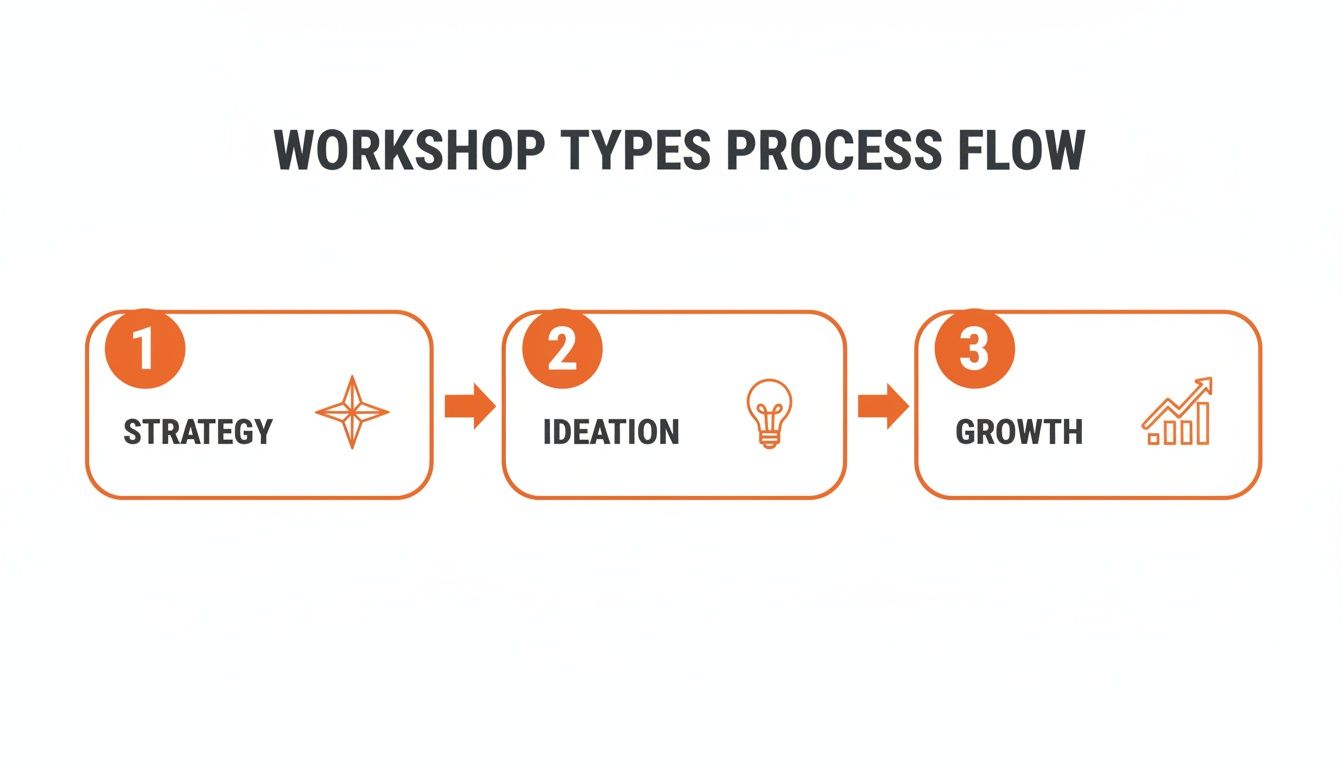
As you can see, the path from big-picture Strategy to creative Ideation and then focused Growth is all determined by what you're trying to achieve. Your objective sets the entire game plan.
My Non-Negotiables For Success
Once you’ve got your objective locked in, you need to set some ground rules. These aren't just polite suggestions; they're the foundation for a session that gets real results, not just good vibes. I know that a workshop where people don't feel safe to speak up is a total waste of time.
Here are my three non-negotiables:
- Set Clear Ground Rules: Say the rules out loud at the beginning. My favorite is "no self-promoters." This isn't a networking event. We're here to solve a problem together, not pitch each other.
- Choose Participants Wisely: The people in the room are everything. I only invite kind givers—people who show up to help, not just to take. A room full of givers creates an incredible upward spiral of generosity and brilliant ideas.
- Prepare Amazing Prompts: Don't just walk in and ask, "So, what does everyone think?" Your job is to craft questions that spark real, honest conversation. A great prompt is open-ended and actually makes people think.
For example, instead of asking, "What should our next product be?" try asking, "If we could solve one nagging problem for our absolute best customer, what would it be?" See the difference? That second question gets to the heart of what matters. For more on this, check out our guide on building a workshop for marketing that really delivers.
My Go-To Workshop Design Canvas
To make this dead simple, I use a basic canvas to map out every single workshop. It’s my checklist to make sure I don't miss anything critical. It’s not fancy, but it works every time.
Here's my breakdown:
- Objective (The ONE Thing): What will we have decided or created by the end of this?
- Participants (The Givers): Who has to be in this room? Who brings the right energy and knowledge?
- Agenda Flow (The Story): What are the 3-5 key steps we'll go through? I think of it as a story with a beginning (the problem), a middle (the ideas), and an end (the decision).
- Key Prompts (The Sparks): What are the 1-2 killer questions I’ll use for each part of the agenda?
- Deliverable (The Proof): What tangible thing will we have at the end? A prioritized list? A sketched-out plan? A clear "yes" or "no"?
I once ran a workshop that almost went completely off the rails because I forgot that last part. We had a fantastic discussion, but with 10 minutes left, I realized we hadn't actually decided anything. I had to scramble to force a decision.
Now, I always start with the deliverable in mind. If you follow this process, you’ll walk in confident, knowing you've designed a workshop that’s built to succeed.
The Art of Facilitation and Leading the Room
You’ve poured your heart into designing the perfect workshop. Now for the really hard part: actually leading the thing. I’m convinced that facilitation is one of the most underrated—and most powerful—skills you can develop.
A good facilitator is like an orchestra conductor. You’re not there to play an instrument yourself. Your job is to pull the best out of every single person in the room, guiding them to create something amazing together that none of them could have managed alone.
This isn’t about being the smartest person in the room. It’s about creating a space where everyone else’s smarts can come out to play. Let me get into the real-world skills you need to lead a business workshop that people will actually remember.
Becoming a Warm Demander
The facilitators I admire most are what I call “warm demanders.” They’re incredibly kind and create a space where everyone feels safe to speak up, but they also refuse to let the group settle for mediocrity. You’re there to get a result, not just to make friends.
This means you have to get comfortable being both the supportive coach and the firm referee. You are the friendly guardian of the workshop’s purpose, and it's your job to keep everything on track, even when it gets a little awkward.
You’re a shepherd, not a sheep. Your role is to gently guide the conversation toward its destination, protecting it from distractions and detours along the way.
It’s a balancing act. If you're too demanding, people will clam up. If you're too warm and let the conversation meander, you’ve just wasted everyone’s afternoon.
Managing the Cast of Characters
Every workshop has the same cast of characters. It’s almost predictable. If you learn to spot them early, you can manage their energy and make sure the whole room gets a chance to contribute.
You’ll almost always run into these three personality types. Here’s how I handle them:
- The Dominant Talker: This person usually has good intentions but sucks all the oxygen out of the room. You have to learn how to gracefully cut them off. I try something like, "That's a fantastic point, Alex. I want to build on that and hear from someone who hasn't spoken yet. Maria, what are your thoughts?" It works wonders.
- The Quiet Observer: This person is often sitting on a pile of brilliant ideas but is too hesitant to jump in. Your job is to create a safe entry point for them. I find a simple, "John, I know you have a lot of experience in this area. I'd love to get your perspective on what we're discussing," can be all they need.
- The Off-Topic Storyteller: This person loves sharing anecdotes that are, at best, loosely related to the goal. You need to redirect them kindly but firmly. I try this: "That’s an interesting story, and it reminds me—let’s bring it back to our main goal of deciding on X. What’s our next step on that?"
Your ability to manage these dynamics is what separates a good session from a great one. You ensure the group’s collective brainpower is on display, not just the loudest person’s opinion.
My Go-To Facilitation Toolkit
Leading a killer workshop for business isn't about memorizing some textbook theory. It's about having a few solid moves you can pull out of your back pocket to control the room's energy and focus.
I keep these three tools ready to go in every single session I lead:
- Use Silence as a Tool: After you ask a really good question, just stop talking. The silence will feel a bit awkward for a second—that's the point. That's when the real thinking is happening. Don't be the first person to break it. Let someone else step in with a thoughtful answer.
- Capture Everything Visibly: If an idea isn't written down, it might as well have never happened. It’ll just vanish into thin air. I use a whiteboard, flip chart, or sticky notes to capture key ideas and decisions as they come up. This creates a shared map of your progress and proves to the group that they’re getting somewhere.
- Gracefully Redirect Conversations: You absolutely need a few go-to phrases for when things get sidetracked. My personal favorite is, "I'm going to put that in the 'parking lot' for now." This tells the person their point is valid without letting it derail the whole agenda. I just create a spot on the whiteboard for these "parking lot" ideas and promise to come back to them if time allows.
Getting good at this stuff takes practice, but these are the skills that turn a chaotic meeting into a workshop that actually gets things done. You become the person who can walk into any room and lead a group toward clarity and action.
After the Workshop: From Ideas to Action
Alright, the workshop's over. The sticky notes are coming down, the coffee pot is empty, and everyone’s buzzing with new ideas. It feels great, right? But here's the hard truth I’ve learned from running dozens of these: the real work hasn’t even started yet.
The magic of a workshop for business isn't what happens in the room. It’s what you do with that energy in the days and weeks that follow. Think of it like charging a battery. A fully charged battery is useless if you just leave it on the shelf to slowly die. You have to plug it into something to make it work.
Turning Good Vibes Into Actual Results
So how do you make sure that post-workshop buzz turns into real progress? Forget measuring "good vibes." The only thing that truly matters to me is action. Forward motion.
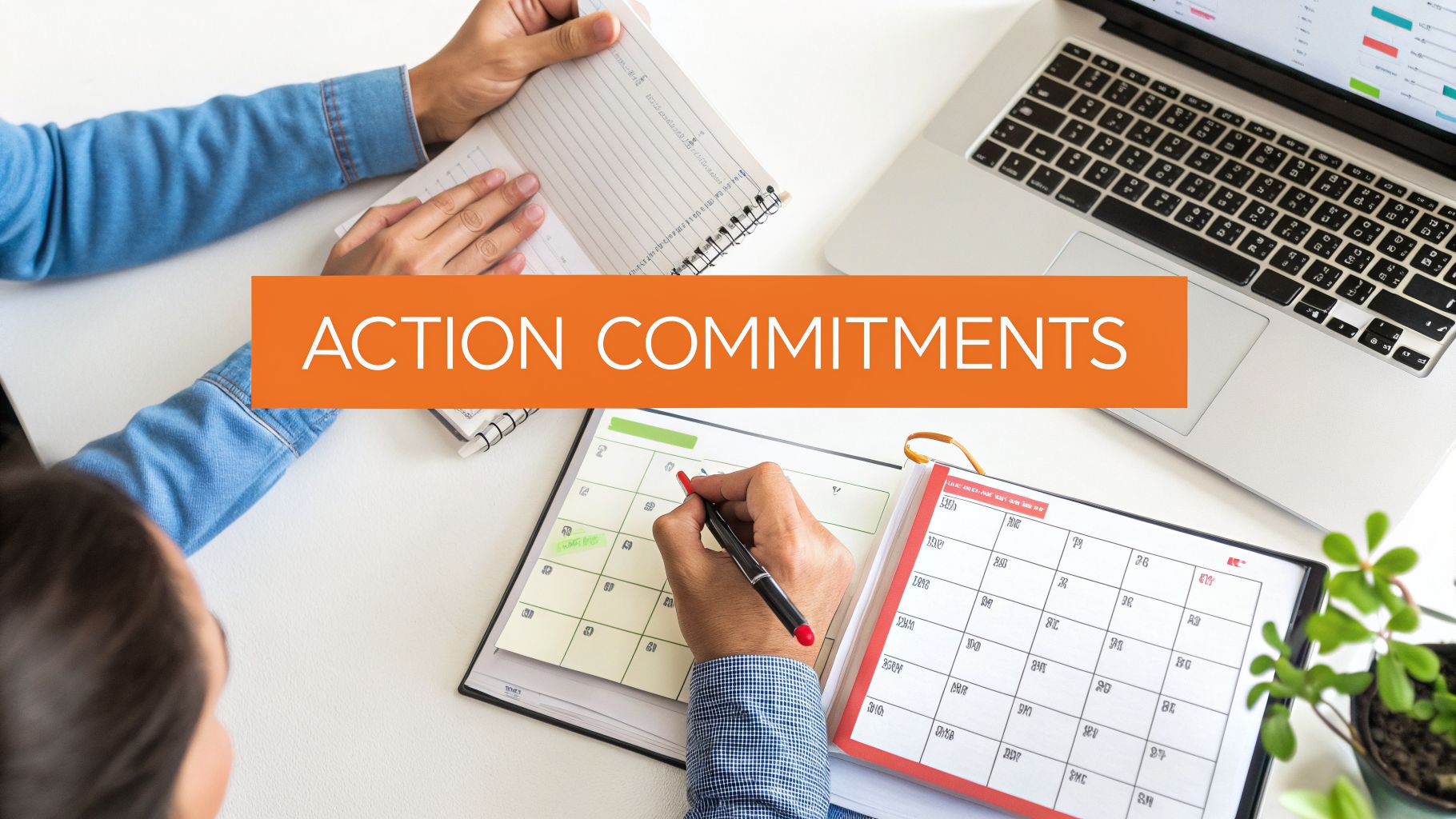
The secret I've found is tracking "Actionable Commitments." These aren't wishy-washy goals like, "I'll try to improve our marketing." No. They are specific, public promises. Think: "I will call three new potential distributors by next Friday."
An idea without a deadline is just a dream. An Actionable Commitment is a promise with a person's name and a date attached. It’s the bridge between a great conversation and a real business outcome.
Something powerful happens when you say what you're going to do out loud, in front of your peers. It's not just another item on your to-do list anymore; it’s a standard you've set for yourself. That's how you get real results.
A Simple System for Accountability
That initial momentum is fragile. You have to protect it with a simple system for accountability. This isn’t about you being a drill sergeant; it's about building a structure that helps everyone win.
Here’s the simple rhythm I use:
- The 24-Hour Follow-Up: Within a day, I send out a short email. It’s not long or formal. It just recaps the energy and, most importantly, lists out every single Actionable Commitment with the person's name next to it.
- The Public Tracker: I create a dead-simple Google Sheet with three columns: Who, What, and When. Everyone gets the link. It’s a shared, visible record of the promises we all made. No hiding.
- The Gentle Nudge: A week or two later, a quick check-in can work wonders. I find a simple, "Hey, how's it going with that thing you were working on?" is often all it takes to get someone unstuck.
This process builds a culture of actually getting things done. It shows the workshop wasn't just a fun day away from the office—it was the starting line. For more on this, our guide on how to set business goals will help you make those commitments even sharper.
Why This Works: The Hard Numbers
This isn't just my opinion—the data is overwhelming. Since the lean startup movement took hold, I've seen collaborative workshops become a massive growth hack. Founders in peer-led workshops scale 3.2x faster. We're talking about hitting $1M in annual revenue in just 18 months, compared to the 48 months it takes for those going it alone.
Here in the Midwest, Chicago's workshop scene—driven by groups like ours—has helped 41% of participating ventures blast past the seven-figure mark. Even better, a massive 84% of participants solve a major 'stubborn problem' that was holding them back, usually within weeks of a single session.
If you want to geek out on the data, these advanced industry reports show the full picture. A well-run workshop for business isn't an expense; it’s a launchpad.
Finding Your People, The Chicago Brandstarters Way
All this talk about workshops is great, but where do you actually find them? More importantly, where do you find your people? This is where I bring it all home to Chicago.
I started Chicago Brandstarters for one reason: I know how to help kind people build million-dollar brands, and I’m a huge believer in the Midwest values of hard work and giving back. This isn’t a sales pitch. It’s a look behind the curtain at a totally different way to do business workshops—one that’s about building a real tribe, not just another contact list.
Our Model: The Anti-Networking Group
I got sick of the fake positivity and what-can-you-do-for-me vibe of most networking events. So I just built the opposite.
Chicago Brandstarters runs on a few simple rules:
- It's Free, But Vetted. Membership doesn't cost a dime, but you have to be the right fit. We vet every single person to make sure they’re kind, bold, and actually building something. No tire-kickers.
- Small and Consistent. Forget giant, one-off events. We meet in small groups of 6-8 founders for dinner every two weeks. It’s a steady rhythm of real support.
- Confidential and Raw. What's said in the group, stays in the group. This is the place for your war stories, not just your highlight reels.
We screen out the self-promoters and the service-sellers from the get-go. I’m looking for the givers—the people who show up asking, "How can I help?" When you fill a room with givers, the energy is incredible.
How We Build Real Connections
The goal here is durable friendships, not a stack of business cards. We’ve created a space where you can be brutally honest about your screw-ups and get real, practical advice from people who’ve been in your exact situation.
It’s a confidential place for you to grow, ask the "dumb" questions, and finally find your people.
This is for you if you're tired of putting on a show. We’re building a community where your real-world problems get real-world help, not just another empty platitude from someone on LinkedIn.
I’ve seen some insane wins come out of these connections. One founder was pulling her hair out over a complex manufacturing problem. Another member made one phone call, and she got a personal intro and a private factory tour that solved the entire issue in a week. That could have taken you months of cold calls.
That’s the power of a true tribe. You can see more on how we set up our mastermind groups for entrepreneurs to get these kinds of results.
An Invitation to Chicago's Givers
The whole point of Chicago Brandstarters is simple: we believe the kindest people should be the next millionaires. We’re all about that uniquely Midwestern mix of grit and genuine kindness you find in Chicago. It’s the total opposite of the sharp-elbowed culture in other big cities.
If you’re a kind, bold, hard-working person building a brand—or even just dreaming about it—this is your invitation. This is how you find your people, skip the painful mistakes, and get the support you need to build something that lasts.
This is your command center.
Answering Your Top Workshop Questions
Founders ask me all the time about how to get the most out of a business workshop. I've heard every question in the book, so let's just get right to it and tackle the big ones.
My goal here is to cut through the noise and give you the confidence you need to jump in.
How Much Should a Workshop Cost?
This is always the first question, and my answer is pretty simple: it really depends on what you're trying to get out of it.
If you’re paying for a super-specialized skill, like a one-day masterclass on intellectual property law, expect to shell out some cash. These can run anywhere from a few hundred to over a thousand dollars. You're not just paying for a seat; you're buying concentrated expertise that could save you ten times that in future legal bills.
But if your goal is to find real peer support and solve tough problems together, I believe the best workshops should be free. That's exactly why our Chicago Brandstarters sessions don't cost a dime. We're not selling you a ticket; we're building a community of givers. The only "cost" is your commitment to show up, be real, and genuinely help the other people in the room.
Is a Virtual Workshop as Good as In-Person?
I have a very strong opinion on this. For the kind of deep, vulnerable, problem-solving work we do, absolutely nothing beats being in the same room.
A virtual workshop can be fine for learning a specific technical skill or watching a lecture. Think of it like watching a cooking show versus actually being in the kitchen cooking a meal with friends. One is passive, the other is an experience.
When you're in person, especially at our small dinner events, a different kind of energy takes over. You can read body language, you break bread together, and you build a level of trust that just doesn't translate over a screen. One study I read on team dynamics found that in-person teams come up with ideas that are 20% more creative and valuable than remote teams. For building relationships and getting into the nitty-gritty of your business challenges, I think face-to-face is the only way to go.
A Zoom call is for exchanging information. A workshop is for creating a shared experience. They are two different tools for two different jobs.
What if I Don't Have a Business Yet?
Then you are exactly the person who needs to be in a workshop. Seriously. This is the perfect place to pressure-test your idea before you sink your life savings and a year of your life into it. Think of it as the ultimate low-stakes simulator for your startup.
You get to "borrow" the brains and hard-won experiences of 6-8 other founders. They'll poke holes in your concept, ask the tough questions you haven't even thought of yet, and help you see around corners.
Getting yourself into a workshop when you're still at the idea stage is one of the smartest and most efficient things you can possibly do. I believe it’s the ultimate shortcut.
Ready to find your people and build your brand with a community that has your back? At Chicago Brandstarters, we host free, vetted workshops for kind, bold builders in the Midwest. Apply to join our community today at https://www.chicagobrandstarters.com.
Leave a Reply