
You've probably heard people toss around "growth" and "scaling" like they're the same thing. They're not. They're worlds apart.
Business scaling isn’t just about getting bigger. It’s about getting smarter. I mean blowing up your revenue while your costs barely budge. This is the crucial shift from scrambling to add more people and more resources for every new sale, to building a machine that handles massive demand with little extra effort.
What Is Business Scaling Anyway
Let's cut through the jargon. You hear the terms in meetings, on podcasts, everywhere. But what does "scaling" actually mean for you as a founder on the ground? It's a total mindset shift—the one that separates the businesses that just get by from the ones that completely own their market.
Imagine you’ve got a killer Chicago-style hot dog stand. You're slammed, and you want to make more money.
- Growing is hiring another person to sell one more hot dog. Your revenue goes up, but so do your costs. It's a straight, predictable line.
- Scaling is you figuring out how to bottle your secret relish and get it into grocery stores nationwide. Suddenly, you're selling thousands of units without having to hire thousands of people.
That’s the core of it. Scaling is designing your business to handle a flood of new revenue while your costs only inch up. It’s about building repeatable systems and a solid foundation that can take the pressure of explosive demand without cracking.

From Hustle To System
In the beginning, your hustle is everything. You’re the one making the sales calls, packing the orders, answering the emails. That kind of growth is tied directly to your effort. But you can't clone yourself. There are only 24 hours in a day.
This is where the difference becomes so important. Scaling is the deliberate act of building a business that runs like a well-oiled machine, without you having to be hands-on with every single task. You have to shift from being the chief doer to the chief architect.
“The amateur works until he can get it right. The professional works until he can’t get it wrong.” – Unknown
This mindset is everything, because true scaling is incredibly rare. Plenty of businesses grow, but very few actually pull off scaling. An in-depth OECD study found that "scalers" make up just 8-14% of small and medium-sized businesses by employment growth and 12-24% by turnover. These are the companies punching way above their weight, driving job creation and real economic competition.
Understanding this difference is that first 'aha!' moment. It shifts your whole perspective from just getting bigger to getting fundamentally better.
Scaling vs Growing Your Business
To really hammer this home, let's break down the fundamental differences between growing and scaling. Seeing it side-by-side helps clarify where your business is right now and where you want it to go.
| Aspect | Business Growth (Linear) | Business Scaling (Exponential) |
|---|---|---|
| Revenue & Costs | Revenue and costs increase at a similar rate. You add a customer, you add a cost. | Revenue increases much faster than costs. You add 100 customers, maybe add one small cost. |
| Strategy | Adding resources (people, equipment) to meet demand. | Investing in systems, tech, and processes to handle demand efficiently. |
| Example | A freelance designer takes on more clients by working longer hours. | A designer creates a digital course and sells it to thousands without extra work per sale. |
| Focus | Short-term gains and immediate sales. | Long-term sustainability and building a repeatable model. |
| Predictability | Easy to forecast. More input = more output. | Can be unpredictable but has massive upside potential. |
Growth is tactical; it's about doing more of what works. Scaling is strategic; it's about building a foundation that can support something ten times bigger than you are today.
Are You Genuinely Ready to Scale?
Trying to scale before you're ready is like shoving a race car engine into a rusty pickup truck. Yeah, it sounds powerful, but the second you slam on the gas, the whole frame will shatter into a million pieces.
So how do you know if your business is solid enough to handle that kind of torque?
This is your pre-flight checklist. So many founders I talk to are itching to dump money into marketing or hire a sales team, but they haven't honestly stress-tested their core business. Pushing for growth on a shaky foundation isn't just a bad idea; it’s a fast track to burning out and burning through all your cash.
Before you even think about hitting the accelerator, you need to check the vital signs. This isn't about wishful thinking. It’s about taking a hard, honest look at where your company stands right now.
Your Unshakeable Foundation
First question, and be honest: Do you have a product people consistently love? I'm not talking about your mom or your best friends. I mean real, paying customers who would be genuinely bummed out if you disappeared tomorrow. This is the holy grail: product-market fit.
It’s the difference between pushing a boulder uphill and just guiding one that’s already rolling. If you’re constantly fighting to convince people your thing is valuable, you are not ready. But if your customers are coming back on their own, telling their friends, and sending you "I love this!" emails out of the blue, you’ve got the traction you need to scale.
A business without a repeatable sales process is just a person with a hobby. If every sale depends entirely on your personal magic, your charm, or your relentless hustle, you can't scale it. The goal is to build a system someone else can run.
Think about it this way: could you hand a playbook to a brand-new salesperson and have them get even 70% of your results? If you said no, then your first job is to get that process out of your head and onto paper. Map out everything, from how you find leads to the exact script you use on a discovery call. Building a reliable framework for making decisions is what turns your personal sales magic into a structured, scalable machine.
Can Your Operations Handle the Pressure?
Imagine your sales suddenly double overnight. Would your operations hum along, or would they grind to a screeching, catastrophic halt?
Be brutally honest with yourself here.
- Fulfillment: Can you actually get twice as many orders out the door without a total meltdown? Are your suppliers solid enough to handle a surprise surge in demand?
- Customer Support: What happens when you have double the customer questions and complaints? If your "support system" is just your personal inbox, you're going to break.
- Financials: Do you have positive cash flow? Scaling costs money before you see the revenue. You need cash for more inventory, bigger marketing spends, and new hires. You need a cushion to absorb those costs.
A founder I know in Chicago learned this the hard way. He landed a massive retail order for his craft food product—a dream come true, right? But his co-packer couldn't handle the volume. It led to huge delays, a canceled contract, and a devastating financial hit. He tried to scale before his operational engine was ready for the load.
Your goal is to have systems that are solid but flexible. You don't need a perfect, enterprise-level setup from day one. But you do need a plan for how each part of your business will handle 2x, 5x, and even 10x the current volume. Scaling is all about preparing for success so that when it finally hits, you're not crushed by it.
Building Your Operational Scaling Engine
Scaling a business isn't about you, the founder, working harder. It’s about building an engine that runs smoothly, even when you step away for a week. If your business is still just you doing everything, you don't have a business—you have a high-stress job.
The engine you need has three core components: your people, your processes, and your technology.
Think of it like building a race car. Your processes are the chassis and the drivetrain—the core structure ensuring everything moves together reliably. Your people are the skilled drivers and mechanics who operate and maintain the vehicle. Finally, your technology is the turbocharger, giving you a massive boost of power and efficiency without needing a bigger engine block.
When these three parts work in harmony, you create an operational machine that can handle a flood of new business without breaking a sweat. You stop being the engine and become the architect.
But before you can even think about building this engine, you need the fundamentals locked down.
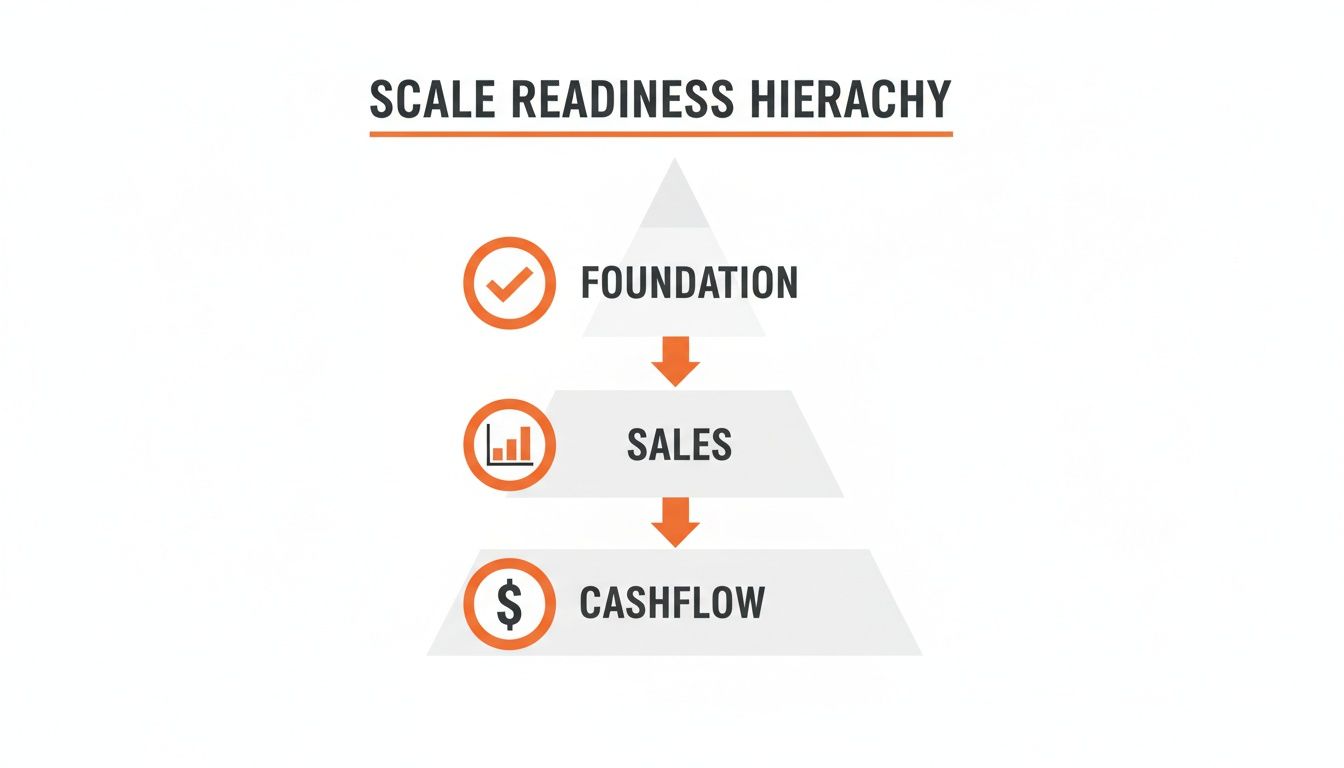
This diagram says it all. Without a solid foundation, repeatable sales, and healthy cash flow, any attempt you make to scale your operations is like building a skyscraper on sand.
Codify Your Processes
The first gear in your scaling engine is documenting your processes. If a key task lives only in your brain, it’s a bottleneck just waiting to happen. The solution? I want you to create simple Standard Operating Procedures (SOPs).
This doesn't mean writing a 300-page corporate manual nobody will ever read. I'm talking about a simple, one-page checklist or a quick screen recording for any task that happens more than twice.
- How to handle a customer refund: Write down the exact steps.
- How to onboard a new client: Create a checklist.
- How to post on social media: Document the workflow.
The goal is for someone else to perform a task 80% as well as you on their first try. This simple act frees you from the tyranny of the day-to-day grind and ensures consistency, no matter who is doing the work.
Hire and Delegate Effectively
Once you have processes, you can bring in people to run them. Your first hires are absolutely critical. You're not just hiring for a task; you're hiring to buy back your most precious resource: time.
Look for people who are proactive and can take ownership. Your first key hire—maybe a virtual assistant or a customer service specialist—should be someone you can trust to run the playbook you’ve created. This isn't just about offloading work; it's about entrusting parts of your business to others so it can grow beyond you.
Delegation is the single most important skill a founder must learn to scale. If you can’t let go, you can’t grow. It’s a terrifying but necessary leap of faith you have to take.
Learning to delegate is tough. You have to be okay with that 80% result at first. But by empowering your team, you create capacity. You move from being the player on the field to the coach on the sidelines, seeing the whole game and making strategic calls.
Leverage Simple Technology
Finally, let’s talk about the turbocharger: technology. You don't need a complex, expensive enterprise system. Simple, off-the-shelf tools can automate the repetitive work that drains your soul.
Technology is your force multiplier. Studies show that AI adoption is surging, with 40% of service firms now using it for things like marketing and data management. You can do the same on a smaller scale, right now.
Here’s where I recommend you start:
- Project Management: Use tools like Trello or Asana to manage workflows and see who is doing what, without constant check-ins.
- Customer Relationship Management (CRM): A simple CRM like HubSpot's free version can automate your follow-up emails and keep track of every customer interaction.
- Automation Tools: Use Zapier to connect different apps so they talk to each other. For example, you can automatically add a new customer from your payment processor to your email list.
These tools handle the grunt work, freeing up you and your team to focus on the high-value activities that actually move the needle. By combining smart processes, capable people, and the right tech, you build an operational engine that doesn’t just grow—it scales.
Proven Strategies to Fuel Your Scale
Alright, you've built the operational engine for your business. Now it's time to add the high-octane fuel. This is the fun part, where you shift from just building the machine to actively flooring it for exponential growth.
Real scaling isn't about working harder; it's about pulling specific, powerful levers that multiply your results without multiplying your effort. I’ll walk you through three of the most effective ways to do this. Think of them as different ways to hit the accelerator.
Expand Your Offerings
Who is the easiest person to sell to? Someone who already knows and trusts you. Hands down, one of the most direct paths to scaling your revenue is by getting each customer to spend more with you over their lifetime. This metric is called Customer Lifetime Value (LTV), and it's a game-changer.
You can boost your LTV by strategically expanding what you offer. This isn't about throwing random new products at the wall; it’s about creating logical next steps for your loyal fans.
- Create a premium version: Got a product or service people love? Offer a "pro" tier with advanced features. This lets your biggest fans pay you more for more value.
- Add a complementary service: If you sell a physical product, could you offer an installation service? A maintenance plan? A subscription for refills?
- Develop a new service tier: For your service business, this could mean going from one-on-one consulting to a group coaching program or a digital course. It allows you to serve many clients at once with the same amount of effort.
This whole approach lets you grow revenue in a big way without the massive cost of acquiring brand-new customers for every single sale.
Diversify Your Channels
If you’re only selling through your own website, you're leaving a ton of money on the table. It's like building an amazing destination but only having one road leading to it. Diversifying your sales channels is all about opening up new highways for customers to find you.
Business scaling is often about finding new ways to reach customers you couldn't access before. It’s about leveraging other people's audiences and platforms to amplify your own reach.
I want you to consider these powerful channel strategies:
- Strategic Partnerships: Team up with a non-competing business that serves the same audience. A local Chicago coffee shop partnering with a nearby bakery is a classic example. You both get instant access to a warm, relevant audience.
- Wholesale or Retail: Getting your product into other stores—whether online or brick-and-mortar—can expose your brand to a massive new customer base overnight. The margins are different, but the volume can be huge.
- Affiliate Programs: Create a program where influencers or other businesses earn a commission for sending customers your way. You only pay for performance, making it a super low-risk way to scale your marketing.
Exploring different small business growth strategies like these is critical. Don't put all your eggs in one basket. A multi-channel approach makes your business more resilient and much more scalable.
Optimize Your Acquisition Funnel
Finally, you have to make sure you're getting the absolute most out of every single person who shows interest in your brand. Pouring more money into ads without fixing a leaky sales funnel is like trying to fill a bucket with holes in it. It's just wasteful.
The key is to convert more of the leads you already have, with less friction and lower cost.
I want you to start by mapping out every single step a person takes, from first hearing about you to making a purchase. Where are they dropping off? Is your checkout process confusing? Is your landing page unclear? Even tiny tweaks here can lead to huge gains. A business that improves its conversion rate from 1% to 2% hasn't just seen a 1% improvement—you've literally doubled your sales without spending a dime more on ads.
Test everything. Experiment with different headlines, offers, and calls to action. Use A/B testing tools to get real data on what works best. By relentlessly optimizing this process, you create a hyper-efficient customer acquisition machine that turns every marketing dollar into two, three, or even ten dollars in revenue. That's what scaling looks like in action.
Your First Scaling Moves
Feeling overwhelmed? Don't be. Here's a quick-reference guide to actionable scaling strategies you can start exploring today. Pick one area and dig in.
| Strategy Area | Example Tactic | Key Metric to Track |
|---|---|---|
| Offer Expansion | Bundle two existing products for a small discount. | Average Order Value (AOV) |
| Channel Diversification | Find one local, non-competing business for a partnership. | Referral Traffic/Sales |
| Funnel Optimization | Simplify your checkout process to have fewer steps. | Conversion Rate |
Focusing on just one of these tactics can create real momentum. The goal is to start making small, smart moves that build on each other over time.
The Critical Metrics That Actually Matter
When you start to scale, it's dangerously easy to get lost in numbers that feel good but mean absolutely nothing. I'm talking about vanity metrics—things like your website traffic, social media likes, or new email subscribers. They give you a nice little ego boost, but they don't pay the bills or tell you if your business is actually healthy.
When you're pouring fuel on the fire, you need to be watching the right gauges. Focusing on the wrong ones is like a pilot watching the cabin temperature instead of the altitude. To really get what scaling means in practice, you have to cut through the noise and lock in on the handful of Key Performance Indicators (KPIs) that signal the real health of your efforts.
This isn't about becoming a data nerd. It's about learning to read your business's vital signs so you can make smart moves based on reality, not wishful thinking.
The Two Most Important Numbers in Your Business
If you only track two things, make it these. They tell a powerful story about whether your business model can actually last.
First is your Customer Acquisition Cost (CAC). Simply put, how much are you spending in marketing and sales to get one new paying customer? If you drop $500 on ads and get 10 new customers, your CAC is $50. It’s your cost of entry.
Second is the Lifetime Value (LTV) of a customer. This is the total profit you expect to bank from an average customer over the entire time they do business with you. It measures way more than their first purchase; it’s about their loyalty and repeat business.
A business that doesn't know its CAC and LTV is flying blind. You're just spending money and hoping for the best, which is a recipe for disaster when you try to scale.
The Magic Ratio That Unlocks Scaling
Now, here’s where it gets powerful. The real insight comes when you smash these two numbers together. The LTV-to-CAC ratio is the ultimate health check for your scaling engine.
Think of it as a simple investment. For every dollar you spend to get a customer (your CAC), how many dollars do you get back over their lifetime (your LTV)?
A healthy, scalable business should be aiming for an LTV-to-CAC ratio of at least 3:1. For every $1 you spend on marketing, you should be getting $3 back in profit.
- A 1:1 ratio? You’re losing money. Once you factor in all your other costs, every new customer is a net loss. Hit the brakes on spending and fix your model.
- Less than 3:1? You’re profitable, but maybe not enough to scale aggressively. You might need to beef up your margins. This is where understanding the calculation of gross margin percentage becomes critical.
- 3:1 or higher? This is your green light. It signals you've built a profitable, repeatable machine. Every dollar you feed into your marketing engine prints more money on the other side. Now you can confidently hit the accelerator.
This one ratio tells the story of your business's efficiency. It strips out the emotion and ego from your decisions and replaces them with cold, hard math. When you know your LTV is triple your CAC, scaling stops being a gamble. It becomes a calculated, strategic investment in your future.
Common Scaling Pitfalls and How to Dodge Them

The road to a scalable business is littered with predictable traps. They catch even the smartest founders off guard because scaling is exciting, and it’s way too easy to get swept up in the momentum. My goal here is to help you sidestep these traps completely.
Think of this as your map of the minefield. I’ve seen these mistakes happen firsthand—to myself and to others—and they are almost always avoidable. Learning from other people's expensive missteps is the cheapest and most valuable education you can possibly get.
The Siren Song of Premature Hiring
When you finally get some real traction, the first impulse is almost always to hire. "We need a Head of Marketing!" "Let's get a full-time sales team!" This feels like progress, but it's often just a vanity metric in disguise.
Hiring too fast, before you have crystal-clear roles and repeatable processes, just bloats your payroll and complicates everything. Suddenly, you have a massive fixed cost draining your bank account every single month, forcing you to chase revenue just to stay afloat. It puts you in a defensive, reactive position instead of an offensive, strategic one.
How I want you to dodge it:
Before you even think about a full-time employee, try to solve the problem with a process or a tool first. If that doesn't work, bring on a part-time contractor or a freelancer. This lets you test the role and refine what you actually need without the heavy commitment of a salary and benefits. Hire for a role only when the pain of not having that person is unbearable and you have a documented system for them to plug into on day one.
The goal isn't to build a big team; it's to build a profitable business. A lean team executing on slick processes is far more powerful than a bloated team stumbling over each other.
The Silent Killer of Company Culture
In the early days, your culture is just… you. It’s the way you answer the phone, the extra care you put into an order, the inside jokes you share. As you start adding people, that culture can get diluted so fast you won't even notice until it’s already gone.
Suddenly, you have team members who don't share your work ethic or your values. The "we're all in this together" vibe disappears, replaced by a more transactional, "it's just a job" attitude. This erosion is subtle but deadly, as it kills the very spirit that made your business special in the first place.
How I want you to dodge it:
Write down your core values. And I don’t mean corporate jargon, but real, gut-level statements about how you operate. For us at Chicago Brandstarters, it's about being kind and being bold. Then, hire and fire based on those values, relentlessly. During your interviews, ask questions that reveal a candidate's character, not just their skills. A talented person who doesn't fit your culture is a net negative. Protect your culture like it's your most valuable asset—because it is.
Outrunning Your Cash Flow
This is the cardinal sin of scaling, and it's the one that puts more businesses in the grave than anything else. You can be profitable on paper but still run completely out of money. How?
Scaling requires upfront investment. You have to buy more inventory, spend more on marketing, and pay new salaries before the revenue from those investments comes in. This gap between spending money and making money is the cash flow gap. If that gap gets too wide, you run out of cash. Game over.
How I want you to dodge it:
Become absolutely obsessed with your cash flow statement. You must know, at all times, how much cash you have in the bank and what your monthly burn rate is. Create a simple 13-week cash flow forecast and update it every single week. This forces you to see a cash crunch coming months in advance, giving you time to secure a line of credit, slow down spending, or raise funds from a position of strength—not desperation. Don't let your own success kill you.
Answering Your Top Scaling Questions
You've made it this far, and your head is probably buzzing with ideas. That's a good thing. But when theory hits the pavement, real-world questions always pop up. Here are some quick, no-fluff answers to the questions I get all the time from founders like you who are ready to stop just growing and start truly scaling.
What Is the Very First Step I Should Take to Scale?
The absolute first step you should take is to document everything you do. I mean everything. Before you can hand off a task or build a system around it, you need a playbook. Start by creating simple Standard Operating Procedures (SOPs) for the things you do over and over again.
This isn't about writing some huge, corporate manual that will collect dust on a shelf. Think simpler. A one-page checklist. A five-minute screen recording. The goal is to create instructions so clear that someone else can do the task 80% as well as you can on their first try. This is how you start buying back your time to work on the business, not just in it.
How Much Money Do I Need to Start Scaling?
There’s no magic number. It's less about a specific dollar amount and more about your financial stability. You need predictable revenue and healthy profit margins before you even think about it. Scaling costs money—for marketing, new hires, tech—and you have to pay for all of it before you see the return.
A good rule of thumb I tell people is to have at least 3-6 months of operating expenses saved up as a cash cushion. Never, ever try to scale your business on financial fumes. It's a classic trap that sinks even fast-growing companies when they run out of cash.
Scaling is an investment in your future, but you can't make that investment with money you don't have. Financial discipline isn't just important; it's the bedrock of sustainable scaling.
Can a Service-Based Business Scale as Effectively?
Absolutely, but you have to change your mindset. A traditional service business where you trade hours for dollars is almost impossible to scale. You can't clone yourself, after all.
The secret is to "productize" your service. You have to decouple your revenue from your direct time and effort. Here are a few ways I've seen founders do this right now:
- Tiered Packages: Stop creating custom quotes. Build defined service packages at different price points so your clients can self-select.
- Group Programs: Instead of 1-on-1 consulting, launch a group coaching program or workshop where you can serve many clients at once.
- Digital Products: Create a digital course, an ebook, or a subscription resource library that packages your expertise.
The goal is the same whether you sell products or services: build a system that delivers massive value without you having to be personally involved in every single transaction. It’s about creating leverage so your business can serve hundreds, or even thousands, without you burning out.
Building a business is tough, and the path from idea to scale can feel incredibly lonely. You don't have to walk it by yourself. At Chicago Brandstarters, we've built a free, vetted community for kind and bold founders right here in the Midwest who are tired of superficial networking. We connect over small dinners and an active group chat, sharing real war stories and practical advice to help each other win. If you're ready to build alongside people who genuinely want to see you succeed, learn more about joining us.
Leave a Reply