
Let's be honest, vulnerability in leadership isn't about being weak. It's a strategic choice—the choice to be open, honest, and fundamentally human with your team. It means you trade the heavy armor of perfection for the real power of genuine connection.
This shift is your greatest strength, not a liability.
Your Greatest Leadership Strength Is Vulnerability
I used to believe the old playbook. You know the one: you, the leader, must be bulletproof, always have the right answer, and project unshakeable confidence 24/7. It didn't take me long to learn that this approach is a direct path to burnout for you and a culture of fear for your team.
The whole "invincible boss" model is fundamentally broken. It creates a massive bottleneck where you become the only source of solutions, and your team is too afraid to admit when they don't know something. This kind of performative perfection absolutely kills innovation and engagement.

Trading Perfection for Power
Think of it like being a master chef. A performative chef pretends to know every single recipe by heart. This creates an intimidating kitchen where nobody dares to experiment. A truly great chef, on the other hand, admits when they’ve never tried a technique before and asks their team for ideas. That’s vulnerability in leadership—you trade your ego for collaborative power.
When you show your humanity, you give your team permission to show theirs. This one shift accomplishes several critical things for your business:
- It Builds Psychological Safety: Your team members will feel safe enough to take risks, ask questions, and admit mistakes without fearing punishment.
- It Encourages Innovation: When people aren't afraid to fail, they're far more willing to propose the bold, new ideas that actually move your business forward.
- It Deepens Trust: Authenticity is the bedrock of trust. People don’t follow perfection; they follow people they can relate to and believe in.
This isn't just a warm and fuzzy feeling; it’s backed by real-world data. There’s often a huge gap between how vulnerable we leaders think we are and how our teams actually perceive us. One study found that while 24% of senior leaders feel they are vulnerable at work, only 13% of their direct reports agree.
The impact is staggering: your employees are 5.3 times more likely to trust you when you show vulnerability and 7.5 times more likely when you own your failures. You can dive deeper into these leadership findings at DDI.com.
"People don’t follow perfection—they follow humanity."
Reframing the Fear of Weakness
I get it. The biggest hurdle is the fear of looking weak or incompetent. You're probably thinking, "If I admit I don't know something, won't my team lose confidence in me?"
The opposite is true. Admitting you don't have all the answers isn't a sign of weakness; it's an invitation. You're inviting your team to step up, innovate, and solve problems with you. You transform your role from the all-knowing hero to the skilled facilitator of your team's collective genius.
By embracing strategic vulnerability, you unlock your team's full potential and build a resilient, creative, and deeply engaged organization. It’s the single most powerful shift you can make.
What Vulnerable Leadership Actually Looks Like
Let's clear the air right now. Vulnerability in leadership isn’t about tearful confessions in your weekly sync or oversharing your personal life. That’s a damaging misconception. True vulnerability is about controlled, strategic honesty.
Imagine you're a sound engineer at a mixing board. You're not just cranking every fader to eleven, creating a wall of emotional noise. You're also not silencing every channel, leaving a cold, empty void. You're carefully adjusting each level to find the perfect balance for a clear, powerful mix. That’s vulnerability in action.

It’s about showing up as a real person without sacrificing your role as the stable, guiding force for your team. This isn’t performative weakness; it’s an intentional act of strength.
The Fear That Holds You Back
So why don't more of us do this? It's not because we don't want to be open. It's because of a deep-seated fear of looking incompetent.
A McKinsey study of over 500 global executives uncovered a strange paradox: the biggest vulnerability leaders face isn't a skills gap, but an ingrained fear of appearing vulnerable. One new CEO, for example, compulsively corrected a board director in meetings, driven by a childhood need to always be right. It just created awkwardness and hurt the business. That behavior comes from fear, not strength. You can dig into the full McKinsey vulnerability findings yourself.
To help you move past this fear, I want to show you exactly what this looks like day-to-day with some practical, real-world examples. These aren’t just theories; they're scripts you can use tomorrow to start building trust.
Real Scenarios: Performative vs. Vulnerable Leadership
Vulnerability lives in small, everyday moments. It's about how you respond when you’re put on the spot, when you screw up, or when you just need your team’s help.
The table below breaks down the difference between the old way of doing things—performative leadership—and a stronger, vulnerable approach. It's a simple shift, but it makes all the difference.
Performative Leadership vs Vulnerable Leadership
| Situation | Performative (Weak) Response | Vulnerable (Strong) Response |
|---|---|---|
| You don't know the answer | "I'll look into that and get back to you." (A classic deflection that creates distance.) | "That's a great question. I honestly don't have the answer right now, but I have some initial thoughts. Sarah, you have more experience in this area—what's your take?" |
| You need help with a project | "We need to figure out how to increase Q3 sales. Get me your ideas by Friday." (This is a directive, not a collaboration.) | "I’ve been struggling with our Q3 sales strategy and feel a bit stuck. I could really use your collective brainpower. Can we block an hour to brainstorm together? I need your perspective." |
| You make a mistake | "Mistakes were made with the product launch, but we're moving forward." (Passive voice, zero ownership.) | "I made a bad call on the product launch timeline, and I take full responsibility for the issues it caused. I apologize to the team. Here's what I learned, and here's my plan to fix it." |
See the difference? The vulnerable responses don't just solve the immediate problem; they pull people in, creating a sense of shared ownership and psychological safety. It makes you more relatable and invites your team into the problem-solving process.
Vulnerability isn’t about broadcasting your insecurities. It’s about being secure enough to be honest.
This is especially critical when you're building a new venture from the ground up. If you're at that starting stage, finding partners who share these values is everything. You might find my guide on how to find a co-founder helpful.
When you choose these vulnerable responses, you aren't just getting answers or help. You're building a culture where it's safe to be human, to learn, and to grow together. That’s the real power of vulnerability in leadership.
The Tangible ROI of Leading with Vulnerability
As a founder, you live and die by results. So let’s get past the fluffy stuff and talk about the real, measurable return on investment of vulnerability in leadership. This isn’t just about creating a nice culture; it’s about building a more resilient, innovative, and ultimately, more profitable business.
I’ll connect the dots for you between being open and hitting your most important business outcomes. It all boils down to one core concept: psychological safety.
Think of psychological safety as the soil your company’s best ideas grow in. When you, the leader, admit a mistake or have the guts to say "I don't know," you’re fertilizing that soil. You’re making it safe for your team to plant their own creative seeds without the fear of getting their hands slapped for a failed experiment.
And that safety translates directly to your bottom line.
How Vulnerability Creates Financial Value
When you consistently model vulnerability, you're not just being a good person—you're making a calculated business move. The culture of psychological safety that stems directly from your vulnerability has a powerful compounding effect on your key metrics.
This is where the rubber meets the road. Let’s look at the tangible benefits that actually show up on your P&L statement and in your team's performance.
- Higher Team Engagement: When people feel safe, they bring their full selves to work. Engagement isn’t just a buzzword; research shows that highly engaged teams can be 23% more profitable than their disengaged peers. Vulnerability is the key that unlocks that potential for you.
- Faster, More Creative Problem-Solving: A team that feels safe isn’t afraid to flag problems early or pitch a weird, unconventional solution. Imagine a developer feeling secure enough to say, "I think this project timeline is unrealistic, and here’s a potential flaw I see." That single moment of honesty could save you hundreds of thousands of dollars and months of wasted work.
- Lower Employee Turnover: Hiring is painfully expensive. Replacing an employee can cost you anywhere from half to double their annual salary. Vulnerable leaders build trust and loyalty, and that’s what makes people stick around. People don't leave companies where they feel seen, trusted, and valued.
Your vulnerability is an investment. It pays dividends in trust, innovation, and a team that will run through walls for a mission they believe in.
This isn't just my opinion. Study after study links this leadership behavior to concrete business outcomes. A culture where people feel safe to speak up is one of the biggest predictors of high-performing teams.
The Million-Dollar Mistake You Can Avoid
Think about this scenario. Your marketing team is about to launch a massive campaign you’ve sunk $50,000 into. A junior analyst spots a flaw in the data that suggests the whole thing will probably fail, but she's afraid to speak up. Why? Because the last person who challenged a major decision got subtly shut down in a team meeting.
So, she stays quiet. The campaign launches and tanks, wasting your initial investment and costing even more in lost opportunity.
Now, imagine that same situation, but in a culture you've built on vulnerability. The same junior analyst feels completely safe raising her hand and saying, "I might be wrong, but I'm seeing a red flag in our target audience data. Can we pause for an hour to double-check this?"
In this case, your vulnerability as a leader just directly saved your company $50,000. That's the real ROI.
It’s about creating an environment where the truth can surface before it becomes an expensive disaster. It transforms your team from passive order-takers into an active defense system for your business. This is the tangible, dollars-and-cents impact of genuine vulnerability in leadership.
A Practical Framework for Safe Vulnerability
Trying to be a vulnerable leader without a plan is like jumping out of a plane without a parachute. You know where you need to go, but without a clear process, things are going to get messy, fast. Think of this section as your parachute—a practical way for you to practice vulnerability that builds trust instead of panic.
The goal isn't for you to be an open book for everyone, all the time. That's not leadership; it's just emotional dumping. You need a structured approach to share challenges in a way that actually empowers your team and pulls them into the solution. It’s all about being intentional.
Start with the Right Context
First things first: you have to choose the right people and the right setting. This is the most important part of the whole process. You wouldn't share your biggest business fears at a crowded networking event, would you? Of course not. You share them with your trusted inner circle.
I like to think of it as concentric circles of trust.
- Your Innermost Circle: This could be your co-founder, a mentor, or a peer group like the ones we build at Chicago Brandstarters. This is your safe zone for the raw, unfiltered truth.
- Your Leadership Team: With your key reports, you can be more open about strategic hurdles and uncertainties. The idea here is to get their perspective and create collective ownership of the problem.
- The Full Company: When you talk to the whole team, your vulnerability needs to be more focused and framed. You share challenges that are relevant to everyone, and always, always pair them with a call to action or a clear path forward.
Picking the right context stops your vulnerability from being seen as instability. It makes sure your message lands with the people who can actually help you do something about it.
Frame the Challenge for Collaboration
Once you know who you're talking to, you have to figure out what to share and how to share it. Not every problem is productive to share. Just complaining about a tough client only spreads negativity. But admitting you're struggling to crack a new market and asking for ideas? That's strong leadership.
The key is to frame your vulnerability as an invitation to collaborate, not a declaration of defeat.
Vulnerability without a purpose can feel like a burden to your team. Vulnerability with an invitation becomes a rallying cry for collective problem-solving.
This is where my "Ask, Don't Announce" technique comes in. It’s a simple but powerful shift in how you talk about a problem. Instead of announcing "We have a problem," which just makes people anxious, you ask, "How can we solve this problem together?" This simple change transforms you from a stressed-out boss into a leader who trusts their team.
Use the Ask, Don't Announce Technique
This technique is all about turning your moments of uncertainty into opportunities for your team to step up. It has three simple steps you can use in your very next meeting.
- State the Challenge Clearly: Be direct and honest. Don't sugarcoat it, but don't be overly dramatic either. Just state the facts. For example: "Our customer acquisition cost has jumped 20% this quarter, and our current strategy isn't hitting the mark anymore."
- Admit Your Own Uncertainty: This is the core vulnerable moment. It shows you're human and that you don't have all the answers. For example: "Honestly, I've been wrestling with this and I'm not sure what the right next move is. I have a few ideas, but I feel like I'm too close to the problem."
- Make a Specific Ask: This is the most critical part. You have to invite your team into the solution with a clear, actionable request. For example: "I need your fresh perspectives. Can we brainstorm some new acquisition channels this afternoon? I want to hear your wildest ideas."
This method helps you build your vulnerability muscle safely over time. It shows you trust your team's expertise and turns a potential crisis into a moment of shared ownership and innovation. It's a key tool in your leadership toolkit, and having a solid framework for making decisions will make these conversations even more productive.
Common Vulnerability Pitfalls to Avoid
Trying to practice vulnerability as a leader can feel like you're walking a tightrope. When you nail the balance, it's an incredible display of strength that builds deep trust. But if you lean just a little too far in the wrong direction, you can fall right into a few common traps.
Knowing where these landmines are buried is half the battle. This isn't to scare you off from being open—it's to make sure that when you are, your efforts actually bring your team closer instead of pushing them away.
The Trap of Vulnerability Theater
The biggest mistake I see leaders make, time and time again, is falling into vulnerability theater. This is when you perform vulnerability to get something—to seem more relatable, to motivate people through guilt, or to manipulate an outcome. It’s calculated, it’s fake, and your team will sniff it out from a mile away.
Think of it like this: real vulnerability is you sharing the messy, hand-drawn map of a tough journey you're on and asking your team to help figure out the path. Vulnerability theater is just showing them a glossy photo of the map while pretending to look lost. One invites real connection; the other just creates cynics.
Your team has a finely tuned radar for authenticity. If your vulnerability feels like a tactic, you’ll lose the very trust you’re trying to build.
Authenticity isn't a switch you can flip. It comes from your genuine desire to connect and lead with honesty, especially when it’s hard.
Emotional Dumping vs. Strategic Sharing
Another huge pitfall is emotional dumping. This happens when you unload all your raw, unfiltered anxiety onto your team without thinking about whether they can handle it. You end up making your stress their problem instead of empowering them to help solve a business challenge.
Imagine you are a ship's captain in the middle of a nasty storm.
- The emotional dumper: You run out on deck yelling, "The waves are terrifying, the ship is groaning, and I'm scared we're all going to sink!" This just creates panic.
- The vulnerable leader: You gather the crew and say, "We're in a serious storm, and frankly, it's testing our limits. I need all hands on deck, laser-focused on your roles, so we can navigate this thing together."
The second captain is honest about the danger but frames it as a shared mission. It inspires action, not fear. Your job is to share the weight of the problem, not the weight of your personal anxiety.
To make sure your vulnerability is productive, it helps to have a simple framework. This three-step process keeps your sharing safe, focused, and effective.
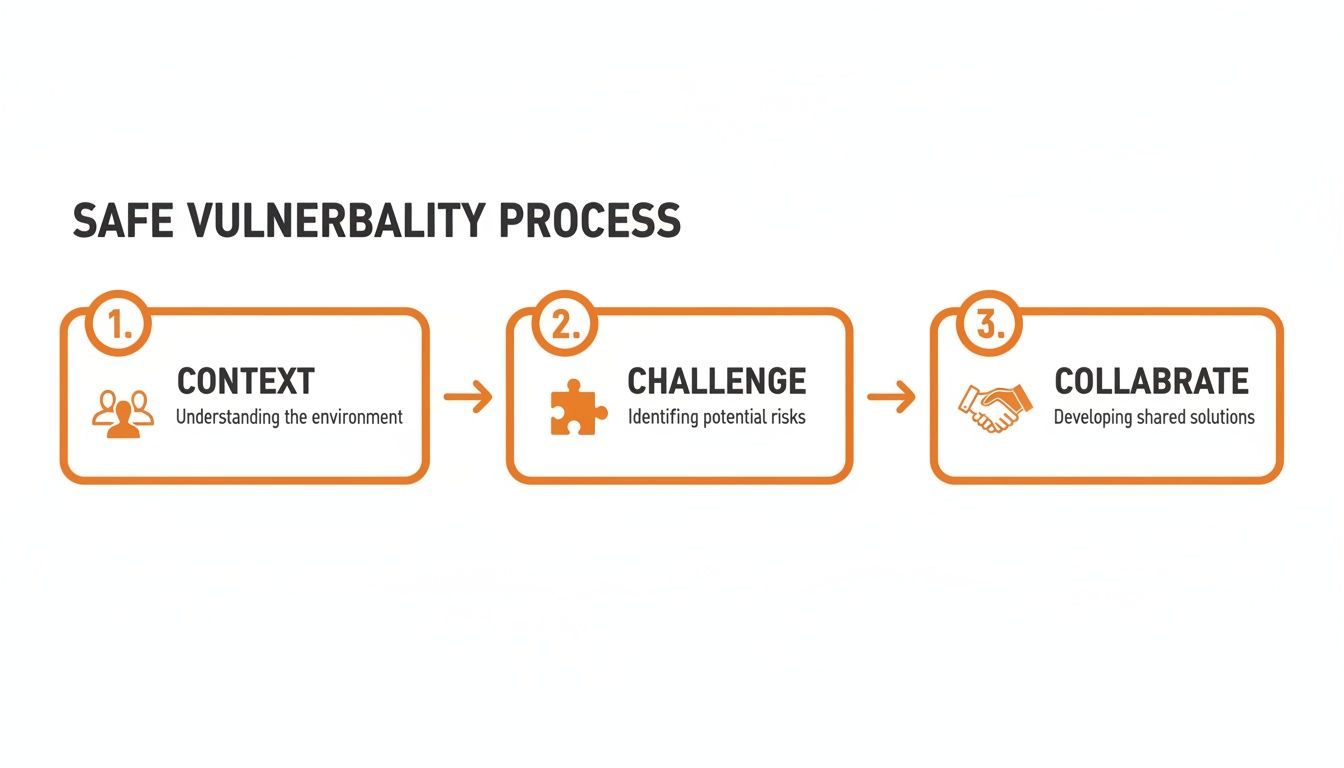
This flow—giving context, defining the challenge, and asking for collaboration—keeps you on the right side of the line.
Setting Boundaries to Avoid TMI
The final pitfall is a total lack of boundaries, which quickly leads to "Too Much Information" (TMI). Being a vulnerable leader doesn't mean you share every dark thought or personal struggle. You're still the leader, and your team needs you to be a source of stability.
Here’s how I think about setting healthy boundaries:
- Keep it professional. It's okay for you to say, "I'm feeling the pressure of this tight deadline." It's not okay to detail a personal financial issue that’s stressing you out.
- Share your thought process, not just your fear. Instead of "I'm terrified this whole project will fail," you could try "I'm weighing two different paths forward here. Can I walk you through my thinking and get your input?"
- Check your motive. I ask myself: "Am I sharing this to solve a problem and build trust, or am I looking for therapy from my team?" If it's the latter, that's a conversation for a co-founder, a mentor, or a peer group—not your direct reports.
To help you stay on track, here’s a quick guide to recognizing these traps and getting back to a healthier approach.
Vulnerability Pitfalls and Solutions
| The Pitfall | Why It Fails | The Solution |
|---|---|---|
| Vulnerability Theater | It feels manipulative and inauthentic because it is. Your team sees it as a performance, destroying trust. | Share to connect, not to gain. Check your motive. Are you being open to build a stronger team, or are you trying to get a specific reaction? Be honest with yourself. |
| Emotional Dumping | You make your personal anxiety the team's burden. It creates fear and instability instead of inspiring action. | Frame it as a shared challenge. Focus on the professional problem, not your personal feelings about it. Share the problem, not the panic. |
| TMI / No Boundaries | Oversharing personal details erodes your authority and makes people uncomfortable. It blurs the line between leader and friend. | Keep it relevant and professional. Ask yourself, "Does my team need to know this to do their job better?" If not, it's probably best you keep it to your inner circle. |
Steering clear of these common mistakes is what separates effective, respected leaders from those who just create confusion. When you get it right, vulnerability stops being a risk and becomes one of your greatest strengths.
How to Nurture a Culture of Vulnerability
Showing vulnerability yourself is a huge first step. But the real magic happens when it stops being just your thing and starts becoming part of your company's DNA. This is how you go from being a vulnerable leader to building a vulnerable culture—an environment where everyone feels safe enough to be real. The goal is to make honesty a reflex, not a calculated risk.
It all comes down to weaving vulnerability into your team's daily routines and rituals. Think of it like going to the gym. You don’t get strong by doing one massive workout and then taking a month off. You build muscle with consistent, daily effort. The same exact principle applies here. Small, repeated acts of vulnerability are what build a culture of real trust over time.
Weave Vulnerability into Your Daily Operations
You can start making this shift today with a few simple, concrete tactics. These aren't huge, earth-shattering changes. They're small tweaks to how you and your team interact, designed to make honesty the path of least resistance.
A simple place I like to start is meetings. Instead of jumping straight into the agenda, kick things off with a simple check-in. One of my favorites is the "yellow light" check-in. Just ask everyone, "What's one thing that’s giving you some caution or slowing you down this week?" It immediately gives people permission to share a struggle, not just a success story.
Here are a few other ways for you to embed this behavior:
- Celebrate Intelligent Failures: When a smart experiment doesn't pan out, don't just bury it. Hold a project "post-mortem" and publicly praise the team for taking a good risk. You can frame the failure as a tuition payment for a lesson you couldn't have learned any other way.
- Model It Consistently: Your team is always watching you. When you mess up, own it. Do it publicly, without excuses. When you don’t have the answer, just say so and ask for help. Your actions will always, always speak louder than your words.
- Reward Honest Feedback: When someone gives you tough feedback or points out a flaw in a plan, thank them for it. Make it obvious that you reward candor, not punish it. This reinforces the idea that telling the truth is an act of loyalty, not a career risk.
Create Rituals of Trust
Beyond the daily tactics, you need to create actual rituals that reinforce these values. These are structured times and places for the kind of open conversations that build deep, lasting trust. For founders, these spaces are life-or-death, because the journey is incredibly lonely.
Vulnerability isn't a one-time announcement. It's a thousand small moments where you choose honesty over image.
This is exactly why peer groups are so powerful. They create a dedicated space where you can be brutally honest without worrying about judgment. Having a support system of other entrepreneurs who just get it is critical. You can see how these work in my guide on mastermind groups for entrepreneurs.
By consistently modeling these behaviors and creating rituals that support them, you turn vulnerability from a personal trait into a core organizational strength. This is how you build a resilient, innovative team that truly trusts you and, more importantly, each other.
Your Questions About Vulnerability Answered
I get a lot of questions from founders trying to put this into practice. It’s one thing to read about vulnerable leadership on a blog; it’s another thing entirely to live it day-to-day.
Here are my straight-up, no-fluff answers to the questions that come up most often.
Is There a 'Right' Time to Be Vulnerable?
Yes and no. Vulnerability isn’t something you can just pencil into your calendar. It’s really about how you show up in the moment—when a launch doesn't go as planned, when you genuinely don't have the answer, or when you have to raise your hand and ask for help.
That said, context is everything. Sharing a nagging worry about a strategic pivot with your leadership team so you can all brainstorm is a perfect use of vulnerability. But unloading that exact same fear on a brand-new hire? That’s more likely to create anxiety than collaboration.
It’s about matching the right problem to the right audience.
How Do I Know if I'm Being Vulnerable vs. Just Complaining?
This is a huge one, and the line can feel blurry. It's a critical distinction for you to make. Complaining is a dead end; it just circles the problem and your own frustration. Vulnerability, on the other hand, is about finding a path forward.
Here’s a simple gut check I use: ask yourself, "Am I sharing this to invite people in, or just to vent?" If your statement naturally leads to a question like, "What do you all think?" or "How can we tackle this?", you're on the right track.
If it’s just a declaration of how bad things are, you’re probably just complaining.
Vulnerability is about moving forward together, even when the path is uncertain. Complaining is about staying stuck.
What if My Team Reacts Badly or Sees Me as Weak?
This is the big one. It's the fear that stops most leaders, and it’s a totally valid concern. If you’ve spent years building a culture of "performative perfection," you can't expect things to change overnight.
The key is for you to start small. Don't jump straight to baring your soul. Begin with low-stakes admissions, like saying, "Honestly, I'm not sure what the best approach is here. I'd love to hear what you all think."
When you do this, you aren't just showing weakness; you're showing you trust their intelligence. Over time, your team will learn that your honesty isn't a liability—it's an invitation for them to step up and own their expertise. They won't see you as weak; they'll see you as a leader who respects them enough to be real.
Your consistency is what builds that trust.
Navigating the founder's journey is tough, but you don't have to do it alone. At Chicago Brandstarters, we connect kind, hard-working builders in a free community built on real support, not performative networking. If you're ready to share war stories and grow with peers who get it, join us.
Leave a Reply