
Walking into a supplier negotiation unprepared is like showing up to an exam you didn't study for. You're basically guaranteeing you’ll leave money on the table.
The secret to a great negotiation isn't what you say in the moment. It's the thorough preparation you do before you ever make contact. This means I dig deep into my costs, know exactly what I can and can't live without, and have a crystal-clear walk-away point. You need to do the same.
Your Pre-Negotiation Playbook for Supplier Talks
You lock in the real win in any negotiation long before you send that first email. I learned this the hard way. Early on, I'd jump into conversations full of excitement, only to get backed into a corner on price or terms simply because I hadn't done my homework.
Think of this prep work as building your financial North Star. It’s the data-driven guide that keeps you grounded, preventing you from making emotional decisions. Trust me, you're just guessing without it, and experienced suppliers can smell that a mile away.
Know Your Numbers Inside and Out
First things first: you absolutely have to create a detailed cost breakdown sheet. This isn't optional. It’s the foundation of your entire strategy.
This exercise forces you to see beyond the sticker price and calculate your true landed cost—the final, all-in price you pay to get one single unit into your warehouse, ready to sell.
Your breakdown sheet needs to account for every little expense:
- Unit Cost: The base price per item from the supplier.
- Shipping & Freight: The cost to get your goods from their factory to your door.
- Customs & Duties: All the taxes and government fees you'll owe.
- Inspection Fees: The cost for a third party to check your products for quality.
- Payment Processing Fees: Any charges from your bank or payment platform.
Once you add all this up, you have the real number that dictates your profitability—not just the flashy unit price a supplier quotes you.
Define Your Target, Best, and Walk-Away Prices
With your landed cost figured out, you can now set your negotiation boundaries. This isn't about pulling numbers out of thin air; it's a strategic process.
- Your Target Price: This is your realistic goal. It should be competitive based on your market research but still fair enough for the supplier to make a profit.
- Your Best Price: This is your dream scenario. You might not hit it, but it gives you a confident, ambitious place to start the conversation.
- Your Walk-Away Price: This is your absolute limit. If the final landed cost creeps above this number, the deal is no longer profitable, and you have to be ready to walk. No exceptions.
Having a firm walk-away price is your ultimate source of power. It stops you from making emotional decisions under pressure and ensures you never get locked into a deal that kills your business.
Pinpoint Your Non-Negotiables
Price is a big deal, but it's rarely the only thing that matters. As a founder, your time, cash flow, and brand reputation are everything. You need to decide what else is make-or-break for you.
Before you talk to a single supplier, rank your priorities. Would you pay a bit more for a manufacturer known for impeccable quality? Or is getting flexible payment terms your top priority to manage cash flow?
Common non-negotiables might include:
- Quality Standards: A maximum defect rate you simply won't accept.
- Lead Times: A hard deadline for production and shipping to meet your launch date.
- Payment Terms: A refusal to pay 100% upfront to protect your cash.
- Communication: A need to work with a supplier who is responsive and transparent.
Knowing these priorities gives you incredible leverage. You can trade a "nice-to-have" to secure a "must-have." This framework gives you the confidence and the data to walk into any conversation from a position of strength, not desperation.
If you're still in the early stages of sourcing, our guide on how to find a manufacturer for your product can help you build a solid list of potential partners to start with.
Nailing Your First Conversation with a Supplier
That first call or email to a potential supplier? It’s a huge moment. It sets the tone for everything that comes after. This isn't just about blasting out a Request for Quotation (RFQ); it's your shot to go from being just another name in their inbox to a partner they actually want to see win.
Forget the stiff, corporate act. You're building a relationship with a real person, not a purchase order.
I used to think my first emails had to sound super formal to be taken seriously. The result? They treated me like a small-fry, transactional account. The game completely changed when I started leading with my story—showing them the person and the vision behind the brand.
It's a Partnership, Not a Purchase Order
Your first email is your brand’s first impression. You want to sound prepared, confident, and like you're building a business for the long haul. Suppliers get dozens, maybe hundreds, of generic "how much for 1,000 units?" emails a day. Yours has to be different.
Instead of just dropping a list of specs, tell them who you are. Share a short, compelling version of your brand’s story. Why did you start this thing? What problem are you solving for your customers? When a supplier gets invested in your mission, they'll be way more willing to help you succeed.
A supplier who believes in your vision is more likely to be flexible on terms, offer better service, and go the extra mile when you need it most. They become a partner in your growth, not just a vendor.
You're not just buying a product; you're inviting them to be part of the journey.
Your Opening Email (That Actually Gets a Reply)
A solid first email mixes the professional and personal. It proves you've done your homework but also shows there's a human behind the brand.
Here's a simple structure I’ve used that gets fantastic response rates:
- Subject Line: Keep it clear and professional. Something like, "Partnership Inquiry from [Your Brand Name] – [Product Type]."
- Introduction: Briefly introduce yourself and your brand. This is where you drop a sentence or two about your mission.
- The Ask: Clearly state what you're looking for, including key specs. This shows you know what you're doing.
- The Vision: Explain why you chose them. Did you see their work with another brand? Do you admire their commitment to sustainability? Get specific. This shows you're not just spamming every factory you can find.
- Next Steps: Propose a clear call to action, like scheduling a brief call to discuss.
This flips the script from a cold outreach to a warm introduction. You’re starting a strategic conversation, not just asking for a price list.
Figure Out What Makes Them Tick
Once you get them on a call, your main job is to listen. The 70/30 rule is golden here: spend 70% of your time listening and only 30% talking. Your mission is to figure out what really drives them. Every supplier has different priorities.
Ask smart, open-ended questions that go beyond just price:
- "From your side, what does a great client partnership look like?"
- "What are some of the biggest headaches you run into with new clients?"
- "Besides the final price, how do you measure success with a brand you work with?"
Their answers are pure gold. They’ll tell you exactly what they value. Are they a massive factory that just wants consistent, high-volume orders? Or are they a smaller, specialized shop that values clear communication and on-time payments more than massive order sizes?
I once worked with a supplier who seemed pricey at first glance. During our initial call, I learned their biggest frustration was clients who constantly changed designs and paid late. I made it crystal clear that my designs were locked and I always pay on time. Suddenly, they were willing to give me a better price and a lower MOQ. Why? Because I was offering them something more valuable than a huge order: peace of mind.
This is your secret weapon. When you understand what your supplier truly values—be it predictability, easy communication, or creative collaboration—you can frame your negotiation around that. You're no longer just haggling over price; you're trading value for value. And that’s how you build a partnership that lasts.
Tactics for Lowering Prices and MOQs
Alright, this is where you turn preparation into profit. Getting a better price or a lower Minimum Order Quantity (MOQ) is part art, part science. Honestly, it’s the skill that separates struggling brands from thriving ones.
This isn’t about being aggressive or trying to strong-arm anyone. It’s about creatively finding a win-win that actually works for your bottom line.
Think of this part of the negotiation like a dance. You can’t just stomp your feet and demand a lower price. You have to lead with value, show them your vision, and make them want to be your partner for the long haul.
Frame the Conversation Around Long-Term Value
Suppliers hear "can you do better on price?" all day, every day. That question alone makes you sound like a one-time, transactional buyer they'll never see again. You have to change the conversation from a single purchase to a long-term partnership.
One of the most effective ways I've done this is by bundling future orders. Instead of just asking for a quote on your first 1,000 units, present a bigger plan. Say something like this:
"Our forecast shows we'll need 5,000 units over the next twelve months. Can you base our unit pricing on that total volume, starting with a first order of 1,000?"
This instantly shifts their perspective. You’re not a small order anymore; you’re a 5,000-unit customer who’s just starting out. This gives them a real business reason to offer you a better price today. You're not asking for a favor; you're offering them predictable revenue.
This decision tree shows the two main paths you can take in your initial supplier outreach. You can either focus on building a long-term partnership or go for a short-term price win.
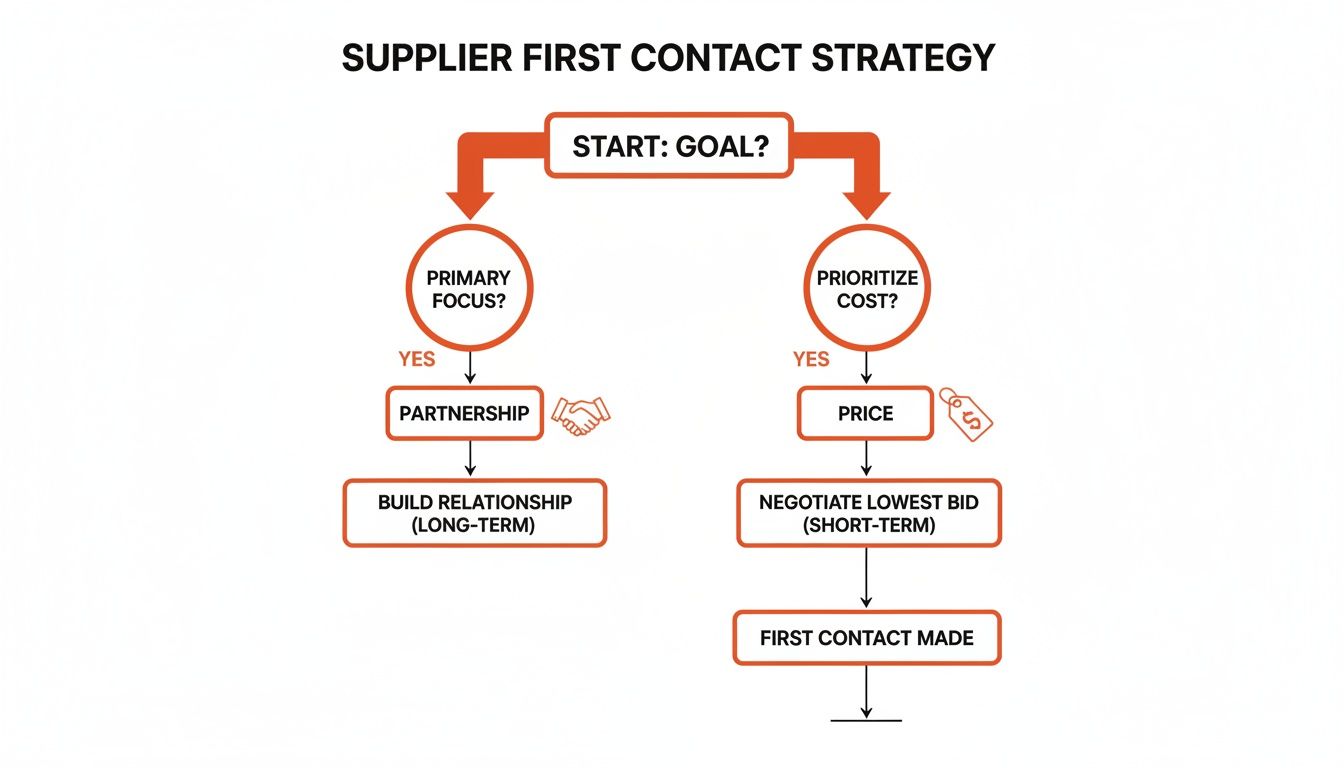
As you can see, prioritizing partnership builds a foundation for more flexible and creative negotiations. A price-first approach often leads to a more rigid, transactional dynamic that limits your options.
How to Tackle the Dreaded MOQ
For new brands, the MOQ can feel like an impossible wall to climb. You need to test your product, but suppliers need to run their machines efficiently. This is where reframing becomes your superpower.
Never just ask, "Can you lower your MOQ?" Instead, propose a solution. My favorite line is: "We'd like to place a paid, market-test order of 500 units before moving to your standard MOQ of 2,000."
This simple change in language is powerful. It tells the supplier you respect their standard process but need to validate your product in the market first. You're not asking for a discount; you're proposing a logical first step in a long-term relationship.
You can even offer a slightly higher per-unit cost for this initial, smaller run. The goal isn't to get the absolute rock-bottom price on your test order. The goal is to get your product made without taking on massive upfront inventory risk.
Getting your pricing strategy right is crucial, and a smaller initial order gives you the flexibility to adjust. You can find more details on this in our guide on how to price a new product.
Effective Tactics for Price and MOQ Reduction
To make this even more practical, here's a quick-reference guide comparing different negotiation tactics and when to use them for the best results.
| Tactic | Best For Lowering Price | Best For Lowering MOQ | Key Talking Point |
|---|---|---|---|
| Volume Forecasting | Yes, significantly. | Sometimes, but less directly. | "Our 12-month forecast is 5,000 units. Can you price this initial 1,000-unit order based on that larger annual volume?" |
| Paid Test Order | No, may slightly increase unit price. | Yes, highly effective. | "We'd like to place a paid, 500-unit market test order to validate the product before committing to your standard 2,000 MOQ." |
| Component Flexibility | Yes, if you choose lower-cost materials. | Yes, if components are easier to source in small batches. | "Are there alternative materials for the handle that could help us meet our target cost without compromising quality?" |
| Citing Competitors | Yes, if done respectfully. | Not very effective. | "We love your quality, but we have another quote that's 10% lower. Is there any flexibility on your end?" |
| External Factors | Yes, can create opportunities for risk-adjusted pricing. | Can be used to justify smaller test runs. | "With the current tariff uncertainty, a long-term contract with stable pricing would be very valuable for us." |
This table should help you pick the right tool for the job. Remember, the best negotiators have multiple approaches and know when to deploy each one.
Leverage Competing Quotes with Respect
Getting multiple quotes is standard business practice, and you absolutely should use that information. But how you use it matters. Don't treat it like a weapon.
Instead of saying, "Your competitor offered me a better price," try a more collaborative approach. You could say something like this:
"We’re really impressed with your quality, and you’re one of our top choices. We’re in the final stages of our review, and another quote came in about 10% lower. Is there any room for you to get closer to that number? We’d much rather work with you."
This makes it a problem you can solve together, not an ultimatum. It maintains respect, keeps the door open, and gives them a chance to win your business on fair terms.
Negotiating Terms Beyond the Price Tag
A fantastic per-unit price with terrible payment terms can sink your business faster than you can say "out of cash." For a startup, cash flow isn't just important; it's the air you breathe. This makes negotiating the terms just as critical as haggling over the price tag itself.
Think of your business as a car on a road trip. Your profit margin is the fuel efficiency, but your cash flow is the actual fuel in the tank. A great price (high MPG) doesn't help if a supplier demands all the fuel money upfront, leaving you stranded before you even get started.
You have to protect your cash.
Mastering the Art of Payment Terms
Most suppliers will initially ask for 100% payment upfront, especially with new, unproven brands. Don't just accept this as the only option. Your goal is to negotiate your way to a more sustainable model as you build trust.
The most common starting point for a new partnership is a 50/50 split: you pay 50% to begin production and the remaining 50% upon completion, right before the goods ship. This is a fair compromise that protects both sides. The supplier gets capital to buy raw materials, and you retain cash until the work is done.
As you build a track record of successful orders and on-time payments, you can start pushing for even better terms. The next level is typically Net 30, which means you pay the full amount within 30 days after the goods have shipped. This is a game-changer for cash flow, since it lets you sell some of your inventory before the bill is even due.
Don't be afraid to ask for better terms after your second or third successful order. You can frame it as a natural step in your growing partnership. Say something like, "Now that we've established a great working relationship, can we move to Net 30 terms for our next order to help us manage our growth?"
Locking Down Lead Times and Schedules
Vague production timelines are a silent business killer. A two-week delay can cause a stockout, derail a product launch, and damage your brand's reputation with customers. You must negotiate crystal-clear production schedules and get them in writing.
Don't just agree on a final ship date. Break it down into key milestones:
- Raw Material Sourcing: When will all materials be in the factory?
- Production Start: The date the first unit is officially in production.
- Mid-Production Inspection: A date for you or a third party to check for quality.
- Production Completion: The date the last unit comes off the line.
- Final Inspection & Packing: The window for final checks and boxing.
This level of detail creates accountability. If a deadline is missed, you know immediately and can address it, rather than discovering a massive delay just days before your expected ship date.
Your Non-Negotiable Quality Control Clauses
This is the part you absolutely cannot skip. You must agree, before production begins, on what happens when quality standards aren't met. Getting this in writing is your single greatest protection against losing thousands of dollars.
I know a founder who was so excited about a low price that he skipped this step. When his $20,000 shipment arrived, 40% of the units had a critical defect, making them unsellable. The supplier refused to take responsibility, and because nothing was in writing, the founder was stuck with the loss. It nearly bankrupted him.
Here's a simple checklist of quality clauses to get in your agreement:
- Define the Acceptable Quality Limit (AQL): This is the maximum percentage of defective units you're willing to accept in a batch (e.g., 2.5%).
- Assign Financial Responsibility: Clearly state who covers the costs for rework, repairs, or replacements if the defect rate exceeds the AQL. It should be the supplier.
- Specify Rework Timelines: How quickly must the supplier fix or replace defective units?
- Confirm Inspection Access: Ensure your contract gives you or your third-party inspector the right to access the factory for mid-production and final inspections.
Cost management continues to dominate supplier talks, with EY ranking value, performance, and resiliency as top procurement drivers for corporate leaders. This mindset isn't just for big corporations; one e-commerce builder I know recently cut factory prices by 12% by benchmarking AI insights against five different suppliers. For a deeper look at industry trends, you can explore more supply chain statistics.
Finally, getting these terms right also means coordinating with your logistics partners. Check out our guide on choosing freight forwarders for Amazon FBA to ensure your shipping process is as solid as your supplier agreement.
Building Long-Term Supplier Partnerships
Your first successful deal isn't the finish line; it’s the starting block.
Too many founders think negotiation ends when the first invoice is paid. Big mistake. The real win isn't just getting a good price on one order. It's building a durable partnership where your supplier basically operates like an extension of your own team.
Getting this mindset right changes everything. When your supplier sees you as a true partner, not just another customer, you become a priority. Your orders get more attention, your problems get solved faster, and you suddenly get access to their best ideas and resources.
Turn a Transaction into a Relationship
After the ink is dry on that first purchase order, your real work begins. You have to intentionally manage the relationship, especially when your order volume is still small.
Think of it like tending a garden. The negotiation plants the seed, but you need consistent effort—water and sunlight—for it to grow into something strong. This means proactive communication is your most important tool. You need to get into a rhythm that goes way beyond just placing new orders.
- Share Your Wins: Did your product get a killer review? Send them the link. Did you hit a sales milestone? Let them know they were a part of that success. It shows them their work matters.
- Give Real Feedback (Good and Bad): When a shipment is perfect, tell them. Seriously. Everyone loves hearing they did a good job. When there’s a minor issue, bring it up constructively and right away.
- Look Ahead: Give them a heads-up about what's coming. A simple, "Hey, just so you know, we're planning a big holiday promotion in Q4," helps them plan their production schedule. No one likes surprises.
This completely transforms your dynamic. You’re no longer just a customer placing an order; you're a collaborator working toward a shared goal. This consistent dialogue builds the trust you need to become a 'priority customer,' even if you're not their biggest one.
What to Do When Things Go Wrong
Even with the best suppliers, problems will pop up. A shipment will be late. A batch will have quality issues. It’s inevitable. How you handle these moments is what defines the strength of your partnership. Panicking, pointing fingers, and making threats just burns bridges.
Instead, you need a simple, constructive way to escalate things.
My approach is to always start by assuming positive intent. I reach out to my day-to-day contact with a clear, calm summary of the issue. I present the problem with evidence—like photos of a defect—and frame it as a shared challenge: "Here's what we're seeing. How can we work together to fix this?"
If you can't get a resolution, the next step is to respectfully ask to speak with their manager. This isn't about getting your contact in trouble; it’s about getting another set of eyes on the problem. Keep the tone collaborative. This approach solves 95% of issues without torching the relationship.
A crisis is a terrible thing to waste. Handling a problem with professionalism and grace can actually make your supplier partnership stronger. You're proving you can navigate challenges together.
Knowing When It's Time to Walk Away
But what about the other 5%? Sometimes, despite your best efforts, a partnership just turns sour. Recognizing the red flags that signal it's time to move on is one of the toughest—and most important—decisions you'll make.
Here are the warning signs I watch for:
- Consistent Quality Decline: One bad batch is a mistake. A few bad batches is a pattern.
- Communication Blackouts: If your contact starts ghosting you or responses get consistently delayed for days, that's a massive red flag.
- Unkept Promises: If they repeatedly miss deadlines or fail to implement fixes you both agreed on, the trust is gone.
- The Blame Game: A partner who constantly blames others (shipping, raw materials, you) for their own mistakes is not a partner you can build a business on.
Making the switch is a huge pain, I get it. But staying with an unreliable supplier is a far greater risk. It jeopardizes your inventory, your cash flow, and the trust you’ve worked so hard to build with your own customers. Knowing when to cut your losses protects your business in the long run.
After years of coaching founders through the trenches of building a brand, I’ve seen the same anxieties pop up over and over again. Negotiating with suppliers, especially for the first time, can feel incredibly intimidating.
Here are the questions I get asked most often, along with my straight-up, no-fluff answers based on years of doing this myself.
What's the Biggest Mistake Founders Make When They Negotiate?
Hands down, the single biggest mistake is not knowing your numbers. It's a classic case of wishful thinking killing a business before it even starts. So many founders get laser-focused on the per-unit price a supplier quotes them and completely ignore their actual landed cost.
The landed cost—that's the all-in price including shipping, customs, tariffs, and any inspection fees—is the only number that matters. You don't run your business on the factory's FOB price; you run it on the cost to get that product sitting in your warehouse, ready to sell.
A negotiation without a firm walk-away price is just a conversation, not a business deal. When you don't know the absolute maximum you can pay to stay profitable, you negotiate with emotion, not data, and that’s a dangerous game.
The flip side of this mistake is walking into talks without a non-negotiable walk-away point. If you haven’t done the math to know your absolute limit, you might agree to a price that feels good in the moment but slowly bleeds your margins dry. Always, always build a detailed cost sheet before you even think about sending that first email.
How Do I Negotiate a Lower MOQ with No Sales History?
Ah, the classic startup chicken-and-egg problem. Suppliers need volume to justify firing up their machines, but you need to keep your initial order small to minimize risk. You can't just ask for a smaller number; you have to reframe the conversation.
Stop asking for a favor and start making a business proposition. Propose a "paid trial order" or a "market testing run." This language completely changes the dynamic. You're not a nobody asking for a handout; you're a strategic partner proposing a logical first step in what you hope will be a long, profitable relationship for both of you. You can even sweeten the pot by offering a slightly higher per-unit price for this initial batch. It shows you're serious.
Back it up with proof. Show them your brand deck. Walk them through your marketing plan and your realistic growth projections. You want to get them excited about your vision and where you're headed. One of the most clever tactics I've seen work is asking if they can tack your small run onto a larger client's order that uses the same raw materials. It's about creative, collaborative problem-solving.
Should I Mention I'm Getting Quotes from Competitors?
Yes, you absolutely should. But how you do it is everything.
This isn't about threatening them or being sneaky; it's just smart business. Getting three to five quotes is standard operating procedure, and every good supplier knows it. The key is to bring it up with transparency, not as a weapon.
Don't use it as a blunt instrument to beat them down on price. Instead, use it to open a collaborative dialogue.
Try framing it something like this:
- "We're really impressed with your quality, and your factory is one of our top choices."
- "As we're finalizing our decision, we've received other quotes, and one came in at [X price]."
- "We'd genuinely prefer to work with you. Is there any flexibility on your end to help us bridge that gap?"
This approach turns what could be a confrontation into a shared problem. It signals that you've done your homework while also clearly and respectfully stating your business needs. You keep the relationship positive, which is exactly where you want it to be.
If you're building a brand and value the spirit of kindness and hard work, consider joining Chicago Brandstarters. We're a free, vetted community for founders who believe in sharing honest war stories and helping each other win. Learn more and connect with us at www.chicagobrandstarters.com.