Forget those forced brainstorming sessions with a wall of sticky notes and lukewarm coffee. Let me tell you a secret: finding a great startup idea isn't about some flash of creative genius. It's much simpler.
The best business concepts I've seen come from paying attention to the friction in your own life.
Stop Brainstorming and Start Observing

Let's kill a myth right now: you don't need to be a visionary to find a winning idea. You just need to become a professional problem-spotter. I've found that the best ideas aren't dreamed up; they're discovered hiding in plain sight in your daily routines, your job, and your hobbies.
Think of yourself as a detective. Your mission is to spot the clumsy workarounds, the annoying processes, and those moments that make you mutter, "There has to be a better way."
That feeling? That's your signal. That's the starting point for a business that solves a real problem for people just like you.
The Power of the Frustration Audit
I call this process the 'Frustration Audit.' It’s a simple but incredibly powerful way you can turn everyday annoyances into solid business concepts. Instead of hunting for a solution, you actively hunt for the problem first. This flips the whole creative process on its head.
Your real expertise isn't in some abstract market you've never touched. It's in the things you already know inside and out.
- At Your Job: What software do you absolutely dread using? Is there a manual task that eats up two hours of your week, every single week? Where does communication always seem to break down?
- In Your Hobbies: Is there a tool for your favorite activity that’s poorly designed or way overpriced? Is there a community that's underserved or badly organized? What key information is scattered all over the place and a pain to find?
- In Your Daily Life: What recurring chore is a constant headache? What service do you wish existed just to make your errands easier?
These aren't just complaints. This is raw, unfiltered market research pointing you directly toward unmet needs.
Key Takeaway: Stop trying to invent the next big thing from nothing. Instead, I want you to meticulously document the small, recurring frustrations you and the people around you face. The most valuable problems are often the ones you're so used to, you've stopped even noticing them.
From Personal Pet Peeve to Viable Business
So many successful founders didn't start with some grand vision. They just started by scratching their own itch. Think about Drew Houston, the founder of Dropbox. He was just tired of forgetting his USB drive. He didn’t set out to reinvent cloud storage; he just wanted to fix his own annoying problem. You'll see this common thread again and again.
This approach gives you a massive hidden advantage. When you solve a problem you personally have, you become your own first customer. You have an immediate, gut-level understanding of the user's pain points, which gives you a huge head start in building something people actually want. You can't fake that kind of authenticity.
This is especially true when you're just getting started. A whopping 78% of startups are self-funded, meaning founders like you often use their own savings to get off the ground. This stat, highlighted in Embroker's 2025 report, shows that the best ideas—especially here in Chicago and the Midwest—often come from your own life and expertise. You don't need a fancy VC pitch.
Capturing Your Fleeting Insights
Your brain will throw brilliant observations at you at the worst times—in the shower, on your commute, or right as you're falling asleep. The trick is having a dead-simple system to grab them before they disappear.
Don't overcomplicate it. A dedicated notebook or a simple app like Apple Notes or Google Keep is all you need. Your goal is to create a 'frustration log.' Whenever you hit a snag or feel that moment of annoyance, jot it down.
Don't judge the idea. Just capture the raw feeling and the context. Your log might look something like this: "Spent 45 minutes trying to reconcile receipts for my expense report again. The software is clunky, and I have to manually enter everything. What a total waste of time."
That one sentence is worth more than a hundred ideas from a brainstorming session because it's real, specific, and rooted in genuine pain. Over time, this log will become your personal goldmine of startup ideas.
Four Lenses for Finding Your Next Big Idea
Once you start really looking at the world like a founder, you'll see problems absolutely everywhere. And that's a good thing. But a long list of things that annoy you isn't a business plan. You need a filter—a way to separate the minor headaches from the major opportunities.
This is where I turn to what I call the "four lenses." Think of them as different pairs of glasses. Each one is built to bring a specific kind of business idea into sharp focus. These aren't just some textbook theories; they're my go-to, battle-tested ways of spotting gaps in the market that you are uniquely ready to fill.
The Unsexy Problem Lens
Let's be real: some industries are just boring. Logistics, construction, commercial cleaning… you get the idea. Most founders are too busy chasing the next shiny thing to even notice them, which is exactly why I see these sectors as goldmines.
The "Unsexy Problem" lens is all about you finding industries that are massive and essential, but painfully stuck in the past. You're hunting for sectors where people are still leaning on clunky spreadsheets, endless phone calls, and maybe even fax machines to get important stuff done.
Your goal here isn't to invent something from another planet. It's about bringing a simple, modern, easy-to-use solution to an industry that time forgot.
Example: A buddy of mine here in Chicago saw that local plumbing companies were managing their crews with this chaotic mix of whiteboards and a storm of text messages. He built a dead-simple mobile app just for scheduling and dispatching. It wasn't glamorous, but it solved a real, expensive problem for a bunch of people completely ignored by big tech.
The New Technology, Old Industry Lens
This one is all about you playing matchmaker. You take a powerful new technology—like AI, computer vision, or automation—and plug it into a traditional, non-tech industry. It’s like dropping a brand-new Tesla engine into a classic, reliable pickup truck.
The industry is already there. You don't have to create a new market from scratch. Your job is just to figure out how to use the new tech to make an existing process 10x faster, cheaper, or better.
This approach is unbelievably powerful right now. A total game-changer: AI now dominates venture deals, snatching 56% of total VC value in Q1 2025. That's a huge leap from just 20% right after ChatGPT came out. This isn't just hype; it’s a giant neon sign pointing to where the smart money is going. Hot sectors like healthcare (which grabbed 16.5% of global VC in Q1 2025) and climate tech are practically begging for this kind of shake-up. You can dig into the data in WIPO's Global Innovation Index 2025 report.
The Fragmented Market Lens
Put this lens on, and you'll start seeing industries that look like a shattered mirror. They're packed with hundreds, maybe thousands, of small, local players, but not a single company has any real market share. Think local breweries, independent dog walkers, or all those neighborhood nail salons.
That fragmentation is your opening.
When there's no clear leader, there's often no standard for quality, pricing, or your customer experience. You can come in and win by building a trusted brand, creating a better operational playbook, or making a platform that rolls up all these small businesses to offer a consistent, high-quality service.
- Ask Yourself: Is there a local service you use where the experience is a total crapshoot every single time?
- Look For: Industries with super low brand loyalty and really high customer frustration.
This is your chance to bring some order to the chaos and become the name everyone trusts in a space that desperately needs one.
The Personal Passion Lens
This last lens is different. It’s not about you spotting some inefficiency from 30,000 feet. It’s about you building something for a community you genuinely love and are a part of. Are you obsessed with competitive board games? Urban gardening? Do you spend your weekends restoring vintage motorcycles?
That deep, authentic passion is your unfair advantage.
You just get the culture, the language, and the unmet needs of your fellow enthusiasts in a way an outsider never could. You're not doing "customer research"; you're just chatting with your friends.
Building for a community you love also gives you the fuel to push through the tough times, and trust me, there will be tough times. When your motivation is shot, your connection to the mission and the people you're serving will drag you across the finish line. A business built on your passion feels less like work and more like a calling.
I’ve found that almost every great startup idea fits into one of these four categories. To make it easier for you to see which one resonates, I've broken them down into a simple table.
Four Lenses of Idea Generation
| Lens | Core Concept | Key Question to Ask Yourself |
|---|---|---|
| The Unsexy Problem | Solve a boring, overlooked problem in a legacy industry with a simple, modern solution. | Where are people still using spreadsheets and phone calls for critical work? |
| New Tech, Old Industry | Apply a powerful new technology (like AI) to make a traditional industry 10x better. | How could AI or automation completely change the way my local [industry] works? |
| The Fragmented Market | Unify a market full of small, inconsistent players under one trusted brand or platform. | What service do I use where the quality is a total gamble every single time? |
| The Personal Passion | Build a product for a niche community or hobby that you're already deeply a part of. | What problem does my own community complain about that nobody has solved yet? |
Use these questions as a starting point. Let your curiosity run wild and see what you discover. The best ideas are often hiding in plain sight, just waiting for someone like you with the right pair of glasses to spot them.
Validate Your Idea Without Wasting Time or Money
Having an idea feels great. But that feeling is cheap, and it can be dangerously misleading. Knowing if your idea is actually good is the only thing that matters, and it’s a whole lot harder to figure out.
I’m going to give you my simple, low-cost playbook to get a clear signal from the market before you waste a year of your life and thousands of dollars building something nobody wants. This process is your defense against the number one startup killer: making something nobody asked for.
This decision tree gives you a visual for how to filter your observations through the four lenses we talked about, helping you see where your best ideas might be hiding.
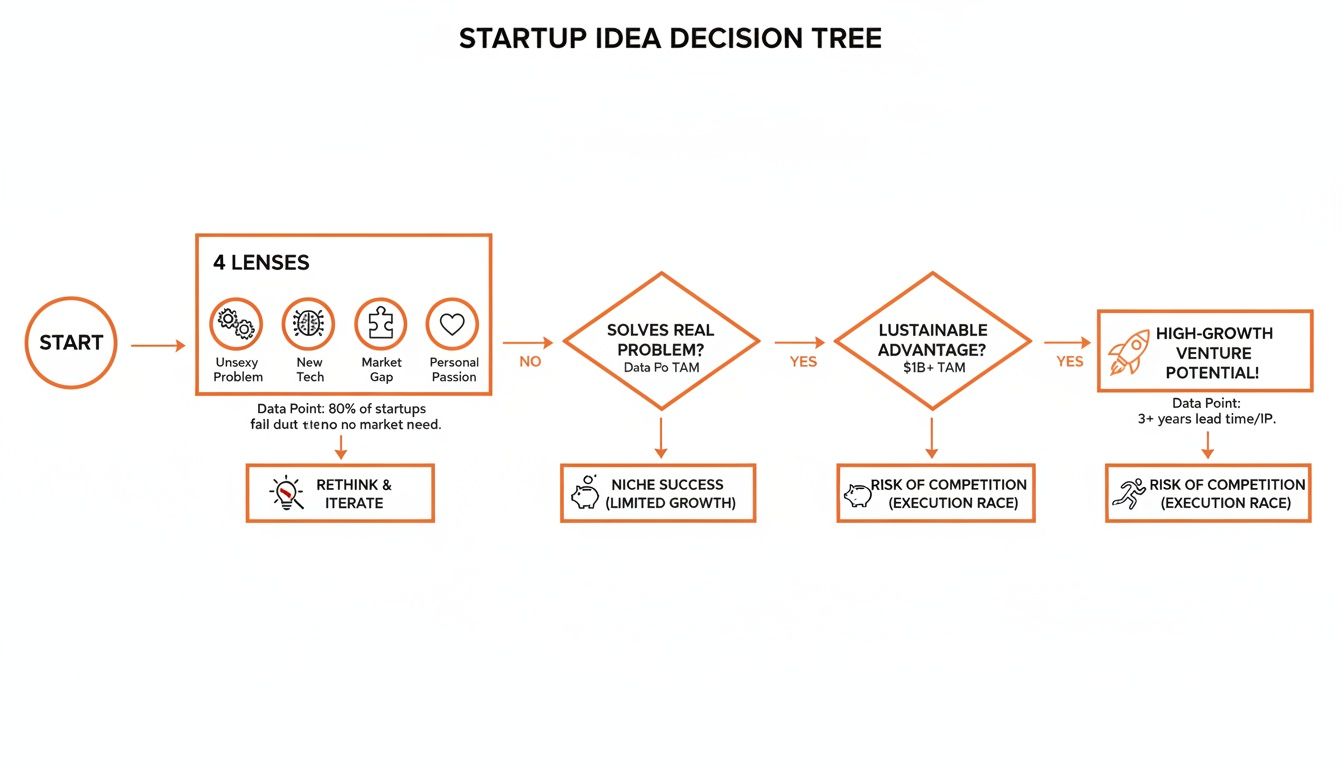
Notice how every single path starts with observation. You have to spot a real-world problem first, then you can apply a strategic filter to it.
The Five Conversations Method
Your first instinct might be to build a survey or ask your friends, "Would you use this?" Stop right there. That's the worst thing you can do. People are polite. They will lie to you to avoid hurting your feelings.
You need to become a detective, not a salesperson. I use a method I call the 'Five Conversations.' Your goal isn't to pitch your idea; it's to learn about your potential customer's life and problems. You talk to five people who you think are your target audience and follow a specific script designed to get the unfiltered truth.
You don't even mention your solution. You only ask about their past behavior.
- "Tell me about the last time you dealt with [the problem your idea solves]."
- "What was the hardest part of that?"
- "What have you tried to do to solve this?"
- "If you had a magic wand, what would the perfect solution look like?"
Listen more than you talk. You’re listening for emotion—frustration, anger, desperation. If they aren’t already trying to solve this problem, even with a clunky spreadsheet or a mix of different tools, it’s probably not a painful enough problem to build a business around.
Create a Smoke Test
After you've had those five conversations and you're hearing consistent pain points, it's time for the next step. A 'smoke test' is like sending a flare up into the sky to see who looks up. It's a simple, one-page website that clearly describes the value proposition of your idea.
This isn't about tricking people. It’s a powerful tool I use to measure genuine intent.
Your landing page needs just three things:
- A Killer Headline: Clearly state the problem you solve and for whom. Example: "The Easiest Way for Chicago Food Truck Owners to Manage Inventory."
- Three Bullet Points: Briefly explain the core benefits of your proposed solution.
- An Email Capture Form: A simple box that says, "Enter your email to get early access and a 50% discount at launch."
Then, you spend a tiny amount of money—maybe $50 to $100—on targeted ads aimed at your ideal customer. Or you share it in relevant online communities where those people hang out. The metric you care about is the conversion rate. If 5-10% of the people who visit your page give you their email, you're onto something. If it's less than 1%, your message isn't landing.
Key Takeaway: Your goal with a smoke test isn't to get thousands of sign-ups. It's to prove that a real, measurable group of strangers are interested enough in your promise to give you their contact information. That's a powerful, data-driven signal.
The hard truth is that most ideas don't survive this process. And that’s a good thing! It's far better for you to find out your idea is a dud after a week of conversations and a $100 ad spend than after a year of building and a drained bank account.
This validation phase is your ultimate filter. It protects you from your own biases and forces you to confront market reality. Buckle up: 90% of startups fail, with 29% from running out of cash and 19% from getting crushed by competition. Yet, you're not alone: a staggering 5.5 million new businesses were launched in the U.S. in 2023.
Being bold enough to test your assumptions early is what separates successful founders from the ones who burn out. This process gives you the data you need to confidently pivot, refine, or even kill a bad idea. For an even deeper dive, you might be interested in our guide on how to validate a business idea before you launch. It's the kindest thing you can do for your future self.
Find Your People to Refine Your Idea
Trying to build a startup all by yourself is a trap. The silence gets crushing, fast. And honestly, your own echo chamber is the single most dangerous place for a new idea. It's a classic mistake I see founders make all the time—they clutch their brilliant concept so tightly that they suffocate it before it ever gets a chance to breathe.
Let me be real with you: your idea, as it exists right now, is probably wrong.
That might sound harsh, but it’s the truth. Your initial concept is just a starting point. It’s a fragile little hypothesis that needs to get roughed up by reality. A great idea almost never survives its first contact with the real world, and a trusted group of peers is your secret weapon for getting through that process.
This isn’t about you going to another stale networking event to collect a pocketful of business cards. I'm talking about finding your real, honest-to-god support system.
The Power of a Founder Community
Picture this: you’ve got a half-baked idea for a new e-commerce brand, but you’re totally stuck on a manufacturing problem. Instead of burning weeks googling into the void, you bring it to a small, confidential group of 6-8 other hardworking founders.
Instead of getting polite nods, you get real advice. One person just went through the same sourcing nightmare and connects you with their agent. Another points out a fatal flaw in your unit economics that you completely missed. That one conversation just saved you six months of painful, expensive mistakes.
Your goal isn't to find people who will tell you your idea is brilliant. Your goal is to find people who care enough to tell you why it might fail—and then help you fix it.
This is exactly what I believe an operator-led community is all about. It’s an environment built on trust, where you can share your war stories—the wins, the losses, and the embarrassing screw-ups—without any judgment. That kind of raw, unfiltered feedback will accelerate your idea faster than anything else.
How to Find Your Inner Circle
So, where are these people? You have to be intentional about finding them.
- Look for Curation: The best groups are vetted. I've found they filter for people who are actually in the trenches building something, not just selling services or promoting themselves. This makes sure everyone in the room is an operator facing similar struggles.
- Prioritize Confidentiality: You need a safe space to be brutally honest about your numbers, your fears, and your biggest challenges. Look for groups that have explicit confidentiality rules or a strong culture of trust.
- Focus on Giving, Not Taking: The magic really happens when you show up to contribute. When you look for chances to help others, you’ll find that support comes back to you tenfold. Be the person you’d want to have in your corner.
Building these relationships takes time, but it's the most valuable thing you can do in the early days. A single conversation with the right person can change the entire path of your business.
If you're looking for this kind of support, you can learn more about how we structure mastermind groups for entrepreneurs right here in Chicago. The right community will sharpen your thinking faster than any book or online course ever could.
Your Next Steps from Idea to Action
Alright, you've done the real work. You've stopped just "brainstorming" and started observing, you’ve put your raw ideas through the four lenses, and you’ve had those first awkward-but-essential conversations to make sure you’re chasing a real problem.
So, now what?
This is where the rubber meets the road. Your momentum is everything. An idea, no matter how clever, is just a thought rattling around in your head. To give it a real shot, you have to take the next tangible step. Your goal isn’t to launch a flawless, massive company overnight. It’s much simpler: turn your validated concept into a real, live project.
Going from a solid idea to your first dollar in revenue feels like a chasm. It’s not. It’s just a series of small, concrete steps. Let’s walk through them.
Nail Down Your Minimum Viable Product
First things first: you need to define your Minimum Viable Product (MVP). Your MVP is the most stripped-down, bare-bones version of your product that still actually solves the core problem for a customer. It's not your grand vision with all the bells and whistles. It’s the core solution, and nothing more.
Think of it this way. Your dream might be a self-driving electric car. But your MVP isn't a clunky version of that car. It's a skateboard. Both get you from point A to B, but you can build the skateboard and get it into someone's hands this week.
Your MVP should make you a little uncomfortable. If you're not slightly embarrassed by your first version, you've probably launched too late. The point is to learn, not to be perfect.
I’ve seen way too many founders burn a year and a mountain of cash building the “perfect” product, only to discover their main assumption was totally wrong. The MVP is your shield against this common, fatal mistake. It forces you to test your biggest assumption as fast and as cheaply as possible.
Get Ruthless About Prioritizing Features
The minute you start sketching out your MVP, the temptation to add "just one more little feature" is overwhelming. This is feature creep, and it’s a startup killer. You need a simple, brutal system for deciding what makes the cut.
Here's a framework I use all the time. List out every single feature you can imagine. Then, for each one, ask yourself two simple questions:
- How much value does this give the user? (Scale of 1-10, how much pain does it solve?)
- How hard is this to actually build? (Scale of 1-10, with 1 being a breeze and 10 being a total nightmare)
Plot these on a simple chart. The features that are high-value and low-difficulty? That’s your starting lineup. That’s your MVP. Everything else goes on the back burner. It’s not about you tossing out good ideas; it's about sequencing them smartly so you can learn the most with the least amount of work.
Take on the First Ten Customers Challenge
With a tight MVP defined, your next job is to get your first ten paying customers. I’m stressing the word paying. Getting people to try a free tool is one thing; getting them to pull out a credit card is the ultimate form of validation.
Here’s the trick: you have to do it with zero marketing budget. This forces you to be scrappy and do things that don't scale.
- Circle back to your initial conversations. Those five people you interviewed? They’re your warmest leads. Shoot them a note: "Hey, remember that problem you told me about? I built something to fix it. Would you be willing to be my very first customer?"
- Do things by hand. Find your ideal customers on LinkedIn or hanging out in niche online communities. Send them personal, non-spammy messages.
- Lean on your local scene. Never underestimate the power of your own city. Talk to folks in communities like Chicago Brandstarters. I've found one warm introduction is worth a thousand cold emails.
This stage isn't about growth hacking or slick marketing funnels. It's about you building genuine relationships and getting raw, unfiltered feedback from the people actually paying for your product. Those first ten customers will teach you more than the next ten thousand ever will.
Taking these concrete steps is part of a larger journey, and you can learn more about creating a complete roadmap for your new business to guide you.
Got Questions? Let's Talk About Them.
Even with a solid plan, I know getting started can feel like staring up at a mountain. A ton of "what ifs" start creeping in, and before you know it, you're stuck thinking instead of doing. My goal here is to tackle the most common questions I hear, giving you some straight talk to help you get moving.
Let's clear the air on some of these persistent worries.
What If Someone Steals My Startup Idea?
This is the big one. Honestly, this fear paralyzes way too many would-be founders. Let me be blunt: your ideas are cheap. Your execution is everything.
The real magic isn't in your initial concept; it's in your unique insight, your grit, and your relentless ability to build and adapt. Being overly secretive hurts you more than it helps. You absolutely need feedback to sharpen your idea, and you can't get that hiding in a vacuum. Your energy is far better spent trying to out-execute everyone else, not hiding in the shadows.
Do I Need a Technical Co-Founder to Start?
Not at all, especially right at the beginning. You live in a golden age of no-code tools. You can build a surprisingly functional prototype or MVP using platforms like Bubble, Webflow, or Adalo without writing a single line of code.
Your first job isn’t to build flawless software. It’s to validate the problem you’re trying to solve.
Key Takeaway: Focus on proving that people actually want what you're building. Once you have that proof—real users, maybe even a little revenue—it becomes infinitely easier for you to attract a great technical co-founder or hire the right developers.
How Do I Know If My Idea Is Big Enough?
Stop trying to build a "unicorn" from day one. That kind of pressure is a creativity killer. The most durable, successful companies I've seen often start by solving a small, specific problem for a very niche audience, and they do it incredibly well.
Instead of asking, "Is this a billion-dollar idea?" I want you to ask a different question: "Can I solve a real, burning problem for 100 people who will absolutely love me for it?"
If you can nail that, you can figure out how to find the next 1,000. So many massive businesses—from Amazon just selling books to Facebook connecting college kids—started in a tiny, focused niche. Your job is to create intense value for a small group first. The rest comes later.
What If I Have Too Many Ideas?
First off, this is a fantastic problem for you to have. It means you’ve successfully trained your brain to see opportunities everywhere, which is a founder's superpower. The trick is to avoid getting stuck in "analysis paralysis," where you endlessly debate the merits of each idea without ever starting one.
Here’s your action plan:
- Quickly Sort Them: Run each idea through the Four Lenses framework we talked about earlier. Just a gut check is fine.
- Pick One: Choose the single idea you're most genuinely excited about, have a unique angle on, or that seems easiest to test quickly.
- Get it Out There: Immediately run a quick "smoke test" on your top choice. Get it out of your head and into the world.
The goal is for you to move from thinking to doing. You can always circle back to your other ideas later. For now, just pick one and take that next small step.
Finding a great startup idea is a skill, not a lightning strike. It’s about building a habit of curiosity, rigorously testing your assumptions, and finding a community to build alongside. If you're a kind, hardworking builder in Chicago who wants to find that community, we’d love to meet you.
At Chicago Brandstarters, we connect founders in small, private groups to share real stories and solve tough problems together. Learn more about joining our free community at https://www.chicagobrandstarters.com.