
Building a business isn’t a single, heroic leap. It’s a grind. It’s a thousand small, deliberate steps you take to solve a real problem for real people. Your journey doesn't start with a flashy product—it starts when you prove someone will actually pay for what you’re building.
The Unfiltered Truth About Starting Your First Business
So you’ve got the itch. Before you hand in that resignation letter, let's talk about what this life really demands. It’s more than a clever idea; it’s a test of your grit, your resilience, and your sanity. My goal is to arm you for the fight, not scare you off the field.
Think of it like training for a marathon. You wouldn't just show up on race day without putting in the miles, right? I wrote this guide to be your training plan.
Facing the Hard Numbers
Let's start with some tough love. The data from the Bureau of Labor Statistics is sobering: 21.5% of new businesses fail within their first year. By year ten, that number jumps to a staggering 65.1%.
And if you're dreaming of venture-backed, high-growth success? It gets even more brutal. A jaw-dropping 75% of those startups fail to return capital to their investors. You can dig into more of these startup statistics from Revenue Memo.
So why do so many smart, passionate founders like you end up closing their doors? The reasons are almost always predictable and, more importantly, you can avoid them.
The biggest killers aren’t a lack of passion or a bad idea. It’s building something nobody wants (42% of failures) or trying to grow too fast before you’re ready (74% of high-growth failures). Founders either solve a non-existent problem or burn through all their cash chasing scale.
This infographic lays out the stark realities you’ll be up against.
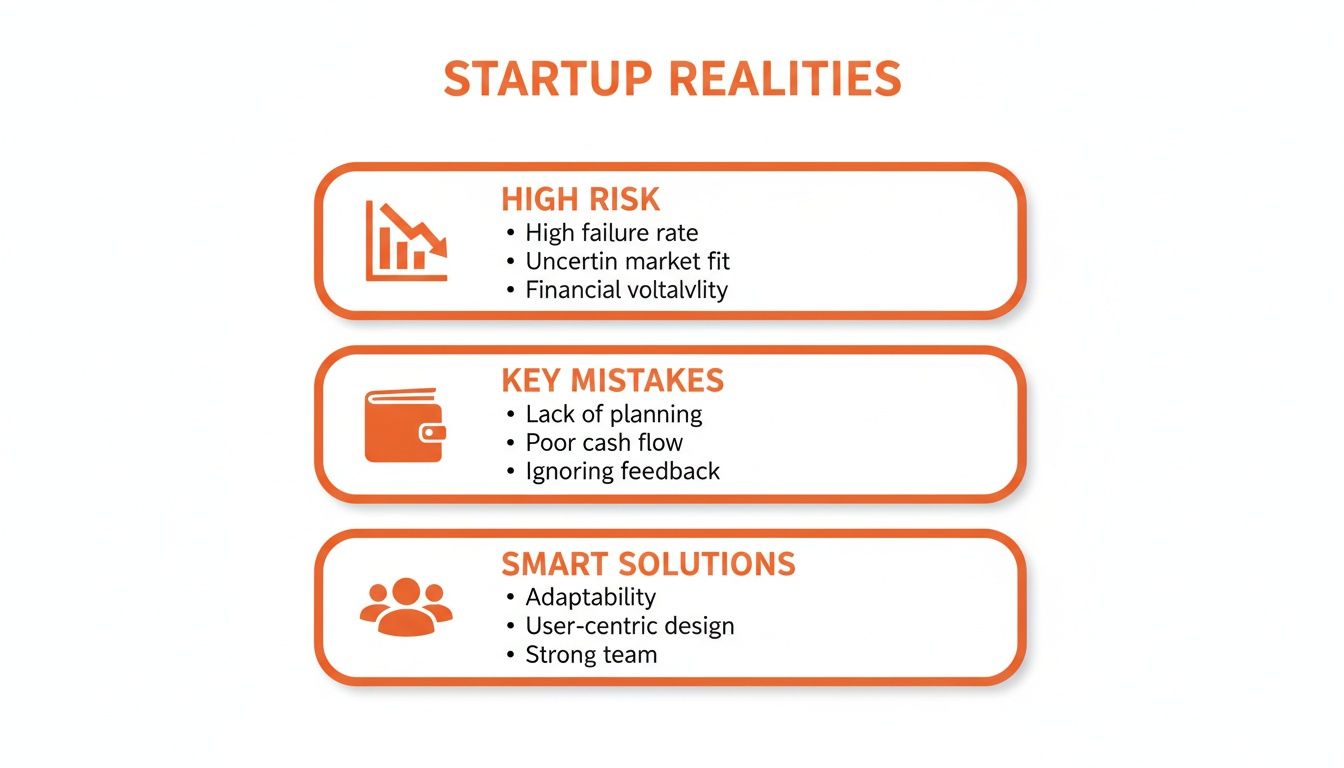
As you can see, big risks and common slip-ups are just part of the game. But the solution isn’t to just be smarter or work harder—it's to stop trying to do it all by yourself.
I see the same mistakes trip up founders again and again. Here’s a breakdown of the most common failure points and how having a community completely changes the game for you.
Top Reasons Startups Fail and How You Can Avoid Them
| Common Failure Point | The Solo Founder's Mistake | How You Solve It with a Community |
|---|---|---|
| No Market Need | You build in a vacuum, fall in love with your "perfect" idea, and assume people will want it. | You get blunt, honest feedback from peers who force you to validate your idea with actual paying customers before you build anything. |
| Running Out of Cash | You waste money on unproven marketing, premature hires, or expensive tools you don't need yet. | You learn scrappy, proven, low-cost tactics from other founders who have successfully bootstrapped past the same financial hurdles. |
| Weak Founding Team | You try to do everything alone or partner with the wrong people out of convenience, leading to skill gaps and conflict. | You find co-founders, advisors, or mentors with complementary skills and get vetted introductions from trusted sources in the community. |
| Getting Outcompeted | You get blindsided by competitors because you're too focused on your own product and not the market. | You hear about new competitors, market shifts, and emerging strategies in real-time from other founders in the trenches. |
| Burnout & Loneliness | You carry the immense weight of the startup alone, leading to isolation, bad decisions, and eventual burnout. | You have a support system of peers who have been there. They understand the late-night panic and can offer a crucial "you're not crazy" reality check. |
The pattern is clear: going it alone magnifies every risk. Being part of a trusted group gives you a built-in defense against the most common startup killers.
The Power of Your Peer Network
Here’s the good news: you can radically improve your odds of success. The single biggest, most avoidable risk you can take is trying to go it alone. The data proves it.
Joining a community of fellow founders, like an accelerator or a group like Chicago Brandstarters, can slash your risk of failure by 10-15%. Why such a big difference? Because you get direct access to:
- Brutal honesty from people who have been exactly where you are.
- Insider knowledge that helps you sidestep the expensive, time-wasting mistakes everyone else makes.
- A real support system for those lonely moments when you’re staring at the ceiling at 3 AM, questioning every decision you’ve ever made.
A strong network is a priceless advantage. It’s the difference between guessing your way through a problem and getting a text with the exact solution from someone who fixed that same issue six months ago. This is about finding your people—the ones who will call you out, lift you up, and help you win.
Validating Your Idea and Making Your First Dollar

You’ve got an idea. It feels like a lightning bolt, and you're buzzing. I get it. But before you drain your savings or quit your job, you have to prove one thing: that other people will actually pay for it.
This is the part everyone wants to skip. We fall in love with our own ideas and just want to start building.
But here’s the hard truth: most first-time founders build something nobody wants. They spend a fortune in secret, launch to the sound of crickets, and then wonder why it all came crashing down.
Your goal right now isn’t to build your grand vision. It’s to make your very first dollar. That single dollar is your proof.
The Fastest, Cheapest Way to Your First Customer
So, how do you get paid without building a whole company? You create a Minimum Viable Product (MVP).
Don't let the jargon fool you. An MVP isn't a fancy app. It’s the simplest version of your solution that someone will actually pull out their wallet for.
I learned this the hard way. For one of my first ventures, I spent six months and thousands of dollars building a complex platform I was sure would be a hit. When I finally launched, I heard nothing. Total silence. I’d built a brilliant solution to a problem that only existed in my own head.
You can avoid that pain by using a few scrappy tricks.
- The Landing Page Test: Throw up a simple one-page website using a tool like Carrd or Webflow. Clearly state the problem you solve and show your solution. Add a "Pre-Order" or "Join the Waitlist" button. This tests if people are willing to commit, even a little.
- The "Wizard of Oz" MVP: This is my favorite. To the customer, it looks like a slick, automated service. Behind the scenes, you are the machine. If you have a meal delivery idea, you’re literally cooking the meals in your kitchen and delivering them yourself. This tests real demand before you write a single line of code.
- Tiny Ad Campaigns: Spend just $50-$100 on targeted Facebook or Instagram ads aimed at your ideal customer. Send them to your landing page. You’re not trying to get rich; you’re buying data. Are they clicking? Are they signing up?
The odds are tough if you go it alone. The data is sobering: 49.4% of small businesses shut down within five years. A huge chunk of those failures are because of a flawed business model (17%) or having no real way to make money (28%). For first-time founders like us, the success rate is a humbling 18%. This is exactly why proving your idea works before you go all-in is everything.
How to Get Feedback That Isn't a Lie
Once you have a basic MVP, you need to talk to potential customers. And I don’t mean your mom or your best friend—they’ll lie to you because they love you. You need honest, even brutal, feedback from strangers.
I tell every founder I work with to do at least 15-20 customer interviews. These are not sales pitches. You’re a detective hunting for the truth.
Ask open-ended questions. Let them do the talking.
- "Tell me about the last time you struggled with [the problem you solve]."
- "What was the most frustrating part of that?"
- "What have you already tried or paid for to fix this?"
- "If you could wave a magic wand, what would the perfect solution do?"
If they don't describe a "hair on fire" problem—something they're actively and desperately trying to solve—your idea might be a "nice-to-have." People don't pay for nice-to-haves. We dive way deeper into this in our guide on how to properly validate your business idea.
This process is the bedrock of building a business that actually lasts. By earning that first dollar, you stop being just a person with an idea. You become a founder with a real business.
Getting Your House in Order: The Legal and Financial Stuff

Alright, let's get into the stuff nobody finds exciting but that will absolutely sink your business if you mess it up. I'm talking about the legal and financial wiring that runs through the walls of your company. Get this wrong, and the whole thing can burn down.
Think of it like building a house. You don't just start throwing up walls on an empty patch of dirt. You must pour a solid foundation first. This is how you pour that concrete.
Your Business Structure: A Simple Choice
Your first big decision is how to legally set up your company. For most of us starting out, it really boils down to two options: a sole proprietorship or a Limited Liability Company (LLC).
A sole proprietorship is the default. If you just start selling things and don't file any paperwork, congrats, you're a sole proprietor. It’s dead simple, but it also means there’s no legal difference between you and your business.
An LLC, on the other hand, builds a protective wall between your business and your personal life. It separates your personal assets (your house, your car) from your business debts. If someone sues your business, they can’t come after your personal nest egg. For most of us, that peace of mind is worth the small fee and paperwork.
My advice is to form an LLC as soon as you're making real money or taking on any risk. It's your first layer of armor. It tells the world you're serious and protects what you're working so hard to build.
Money Rules You Cannot Ignore
Once you're a legal entity, it's time to get your financial house in order. If you wing it here, you're setting yourself up for failure. It’s a painful truth that 82% of small businesses die from poor cash flow management.
On top of that, 29% of startups fail because they run out of cash, and another 18% get their pricing wrong. These aren't just numbers on a chart; they are the cracks in the foundation that bring businesses like ours down every day. You can see more on these common startup failure rates on Failory.
Here are the non-negotiables for managing your money from day one:
- Open a dedicated business bank account. Do not—I repeat, do not—mix your personal and business finances. This is Rule #1. It makes bookkeeping a thousand times easier and is critical for maintaining that LLC protection.
- Create a simple cash flow projection. This is just a basic spreadsheet guessing your money in and money out over the next few months. It helps you see shortfalls before they become emergencies. If you need a hand, I made a simple guide to cash flow management for small businesses that breaks it down.
- Track every single expense. Use a tool like QuickBooks Self-Employed or even a detailed spreadsheet. This isn't just for tax time; it shows you exactly where your money is going so you can stop the bleeding.
You don't need to be an accountant overnight. But you must develop the discipline to watch your cash like a hawk. Cash is the oxygen for your business; run out, and you’re done.
When to Call in the Pros
As a founder trying to make every penny count, you're probably trying to do everything yourself. So, do you really need to hire an expensive lawyer or accountant right away?
The short answer is usually no, but it depends.
For setting up a basic LLC, online services like LegalZoom or Stripe Atlas are often perfectly fine and way cheaper. They handle the basic filing and get you up and running without the scary hourly rates of a big law firm.
But here’s when you absolutely should pay for professional advice:
- When you bring on a co-founder. You need a lawyer to draft a real operating agreement. It must spell out ownership, roles, and what happens if one of you wants to leave. Don't rely on a handshake.
- When you're dealing with intellectual property. If you're building something unique that needs a patent or trademark, you need a specialized IP attorney. Don't mess around here.
- When your taxes get complicated. Once you have employees, sell across state lines, or start making real profit, a good accountant will save you way more money than they cost.
Think of it this way: use the DIY online tools for the simple, standard stuff. But for the complex, high-stakes decisions that could make or break your company, paying an expert isn't a cost—it's an investment.
Building a Lean Team Without Breaking the Bank
Every founder hits a wall. I've been there. You're grinding away, and you suddenly realize you physically can't do it all anymore. The stuff you're not good at is now dragging the whole business down.
But hiring? It’s terrifying. It’s a massive expense, feels permanent, and is loaded with risk.
So how do you get help without torpedoing your bank account? This is a classic founder crossroads. You have to start building your team, but you have to do it lean.
Employee vs. Freelancer: Your First Big Choice
This is your first major decision. Do you bring on a full-time employee or do you outsource to a freelancer or agency? They are two different tools for two very different jobs. I see founders pick the wrong one all the time.
Let's break it down.
Hiring an Employee:
- This is for the core, soul-of-the-business stuff. You need someone who lives and breathes your mission.
- The upside? They're 100% dedicated. You're building a culture and investing in someone for the long haul.
- The downside? It’s expensive. You're on the hook for salary, benefits, payroll taxes, and all the overhead. It's a huge commitment.
Outsourcing to a Freelancer:
- This is perfect for specialized projects with a clear start and finish. Think: building your first website, running a short-term marketing blitz, or getting your books in order.
- The upside? You only pay for the work you need. You can access world-class experts you could never afford to hire full-time.
- The downside? They aren’t really on your team. They’re juggling other clients, so you won’t have their undivided attention.
For most of us starting out, outsourcing is the way to go. It lets you tap into A-level talent for specific problems without the crushing financial weight of a full-time salary. You get expertise exactly when and where you need it.
What Should You Hand Off First?
Okay, so what do you actually delegate? It’s tempting to just offload the tasks you hate doing. That’s a trap.
You need to delegate the tasks that are holding back your growth.
I use a simple two-question filter. Look at everything on your plate and ask yourself:
- Does this task directly make us money?
- Am I the only person on earth who can do this?
If you answer "no" to both, it's time to delegate it. Things like bookkeeping, scheduling social media posts, or handling basic customer service emails are critical, but they don't need your specific founder magic. Handing them off buys you time for the big-picture work that only you can do.
Getting this right is a huge unlock. When you're ready to make that leap, our guide on how to hire your first employee walks you through the entire process.
Finding amazing freelancers is easier than you think. Start with local networks or specialized Slack groups in your industry. When you're ready for an employee, write a job description that bleeds your company's culture. Interview for hunger and grit just as much as you do for skills.
Ultimately, building a lean team isn't just about saving cash. It’s about buying back your most precious asset: your time. Every hour you reclaim from a low-impact task is another hour you can spend talking to customers, making your product better, and actually growing this thing.
Scrappy Go-To-Market Strategies That Actually Work
So you've built a great product. That’s amazing, but it’s only half the battle. If nobody knows your brand exists, you don’t have a business—you have a very expensive hobby. Now it's time for you to find your first customers.
Let's get one thing straight: your first marketing push will look nothing like the slick campaigns from venture-backed giants. Forget Super Bowl ads. We're not spending millions. We're going to be scrappy, smart, and relentless.
Think of yourself as a new band. You don't book a stadium right away. You play small clubs, hand out flyers, and talk to people after the show. You build a following one person at a time. That's our playbook.
Your Most Valuable Asset Isn't What You Think
Before you think about posting on social media or spending a dime on ads, I want you to focus on building one thing: your email list.
I’m serious. It’s the single most valuable asset you will build. It's your direct line to people who are actually interested in what you’re doing. You own this channel, unlike your social media following, which an algorithm change can wipe out overnight.
I know starting from zero is intimidating. But it’s simpler than you think. You just need to create one genuinely useful thing you can give away for free in exchange for an email. We call this a lead magnet.
- Selling high-end coffee? Offer a simple guide: "The 5 Biggest Mistakes People Make Brewing Coffee at Home."
- Launching a SaaS tool for project managers? Give away a free template: "The Ultimate Project Kickoff Checklist."
The idea is to offer something so helpful that your ideal customer is happy to make that trade. Once you have that, your only job is to get it in front of them.
Go Where Your Customers Already Hang Out
So, where do you find these people? You don't need a huge budget; you just need to be clever. Go to the places—online and offline—where your target customers are already gathered.
For founders, this is a massive advantage. We have a dense network of communities ready to be tapped into.
- Building a product for young professionals? Find the relevant neighborhood Facebook groups for places like Lincoln Park or the West Loop. But don't just spam your link. Join the conversation. Answer questions. Be a helpful human first.
- Is your audience other small business owners? Show up at local B2B meetups. Become a familiar, helpful face people recognize.
Your first 100 customers will almost certainly come from direct, personal outreach. This isn't scalable, and that's exactly the point. Right now, you're not looking for scale. You're looking for feedback and your first true believers.
A friend of mine launched a line of fancy dog treats. Instead of burning cash on ads, she spent three weekends at local Chicago dog parks. She didn't sell a thing. She just handed out free samples and asked dog owners what they thought. She built her starting email list of 50 people right there with a clipboard. Those 50 people became her first paying customers and her biggest advocates.
This is the core of a scrappy go-to-market plan. It’s about investing your time, not your money, to create real human connections.
Create Content That Actually Connects
Once you have that tiny bit of early traction, you can start creating content that pulls people toward you. This is your long-term engine for growth. The key here is to just be authentic and share the journey.
Seriously, don't just post polished marketing photos. Show people what's really going on behind the scenes.
- Share the messy process: I want you to document how you're making your product. Talk about the challenges you're hitting and the small wins you celebrate. People connect with stories, not just with products.
- Teach what you know: Create content that helps your audience, even if it has nothing to do with selling your product directly. If you’re a food founder, share your favorite recipes. If you’re building software, share your best productivity hacks.
- Talk to people: Don't just post and ghost. When someone comments, reply with a real answer. Ask questions. Turn your social feed into a genuine conversation.
This is how you build a loyal following that feels invested in your success. You provide so much value upfront that when it's finally time to ask for the sale, they're already rooting for you. This is how you turn followers into fans, and fans into your first customers.
Chicago Is Your Secret Weapon—Here's How to Use It
Everyone thinks you have to move to New York for finance or LA for entertainment to make it big. I see it differently. For founders like us building real, tangible brands, Chicago offers a powerful mix of Midwestern hustle and genuine support. It's not just a nice feeling; it's a strategic asset for you.
Too many of us get caught up in the idea of a cutthroat coastal hub. We think that's the only way. But our city has a different spirit—one where hard work earns respect and kindness isn't seen as a weakness. That spirit can become your unfair advantage.
Forget Networking. Build a Real Lifeline.
Imagine you’re stuck on a make-or-break problem. Maybe you're scrambling to find a reliable local factory or trying to untangle a nightmare supply chain issue. Now, what if you could drop that sensitive question in a private, confidential group chat and get honest answers from multiple seven-figure founders in minutes?
That’s not a fantasy. It’s what a vetted, non-transactional network actually looks like.
This is the core principle we built Chicago Brandstarters on. It’s not about exchanging business cards or making shallow connections. It’s about creating a safe space where kind, bold founders like you can share their war stories and get real help without the fear of being sold to.
The best breakthroughs I’ve ever had didn't happen at some stuffy conference. They happened over a beer or at a small dinner with other founders who were just a few steps ahead of me. Those are the connections that last.
Why Small and Curated Is Better Than Big and Loud
Forget those massive "networking" events where you get lost in a sea of suits. The real magic happens in smaller, curated groups. Think of it like seeing a band in a small club versus a stadium. In the club, you feel the energy, you see their faces, and you can actually talk to them after the show.
That’s what small, focused events do for your business. They build real relationships that lead to real results.
- You might meet someone who can give you a personal tour of their manufacturing facility, saving you months of cold calls.
- Someone else might make a warm introduction to an angel investor who only funds Chicago-based CPG brands.
- You could even find a future co-founder who actually shares your work ethic and values.
I’ve seen it happen again and again. A casual chat at a small dinner turns into a partnership that brings in six figures of new revenue. That’s not luck. It’s what happens when you’re in the right room with the right people.
Find Your Tribe of Givers
Building a business is incredibly lonely. You're the one carrying the weight of every decision, every failure, and every win. That isolation is a business killer.
Finding your people—other bold, kind givers who are on the same path—is your best defense against burnout. These are the people who will actually celebrate your wins because they want to see you succeed. And they're the ones who will pick you up when you're down, because they've been there, too.
In Chicago, we have a unique "pay it forward" culture. We're the City of Big Shoulders for a reason. The city is big enough for world-class resources but small enough that people still look out for each other. Your goal isn't to collect contacts; it's to find your tribe. That’s the real advantage of building here.
Answers to Your Toughest Founder Questions
When you're first starting out, a few questions will absolutely keep you up at night. I've heard them all because I've asked them all myself. My answers here come from my own time in the trenches, so you can skip some of the pain and get moving.
How Much Money Do I Need to Start My Business?
This is the first question everyone asks, but it's the wrong one. You should be asking, "What's the absolute bare minimum I can spend to prove my idea and land just one paying customer?"
That’s a small, but powerful, shift in thinking.
For most service or e-commerce brands, this could be less than $500. That gets you a simple landing page and a tiny budget to test some ads. Your first dollars aren't fuel for building a massive operation; they're tuition for learning what people actually want. Don't go dropping $20,000 on a "perfect" product before you know for a fact that someone will pull out their credit card for it.
When Is the Right Time to Quit My Day Job?
I’m a huge fan of starting your business as a side hustle. My advice is straightforward: don't quit your day job until your business has a clear, predictable stream of revenue coming in.
My favorite milestone? When your side-hustle income consistently covers your personal living expenses for three or four months straight. Quitting too early puts this suffocating financial pressure on you, and that pressure forces you into bad, short-term decisions. Use your 9-to-5 to fund your dream. It de-risks the whole process.
I Hate "Networking." How Do I Build Connections?
Good. Most founders I know feel this way because old-school networking feels fake and transactional. Forget the awkward happy hours and swapping business cards.
Your goal isn't to "network"—it's to build real relationships. Find small, curated groups where the point is to help each other out, not sell to each other. Focus on finding your "tribe" of fellow builders. The connections that actually matter, the ones that will change your trajectory, grow naturally from there.
If you’re a kind, bold builder in the Midwest looking for that tribe, Chicago Brandstarters was made for you. It’s a free, vetted community where you’ll find support, brutally honest advice, and real friendships to help you grow. Learn more and apply to join us at https://www.chicagobrandstarters.com.