
Finding the right business partner is like building an arch. You need two strong, perfectly aligned sides to hold real weight. It breaks down into three simple steps: define what you need, find people who fit, and then make it official. Get this blueprint right, and you'll build a partnership that multiplies your efforts, not drains them.
Your Blueprint for a Strong Partnership
Searching for a business partner feels huge. But it’s not about finding someone to grab a beer with; it’s about finding a counterpart who completes your business’s DNA. Think of it like casting a movie. You wouldn’t hire just any good actor. You’d hire the right actor for the role—someone whose skills make the whole production better. Your search needs that same clarity.
This is a deliberate process, not a lottery ticket. It starts with honest self-reflection before you even look. What are your weaknesses? Are you the product visionary who sweats at the sight of a spreadsheet? Or an operations wizard who hates sales calls? Be brutally honest. A partner should be your missing half, not your echo.
If you're starting from scratch, it’s vital to understand how to start a business with no money. This reality shapes the kind of partner you need.
This visual shows the simple, three-stage flow of a partner search. You move from internal strategy to external action, and finally, to a real commitment.
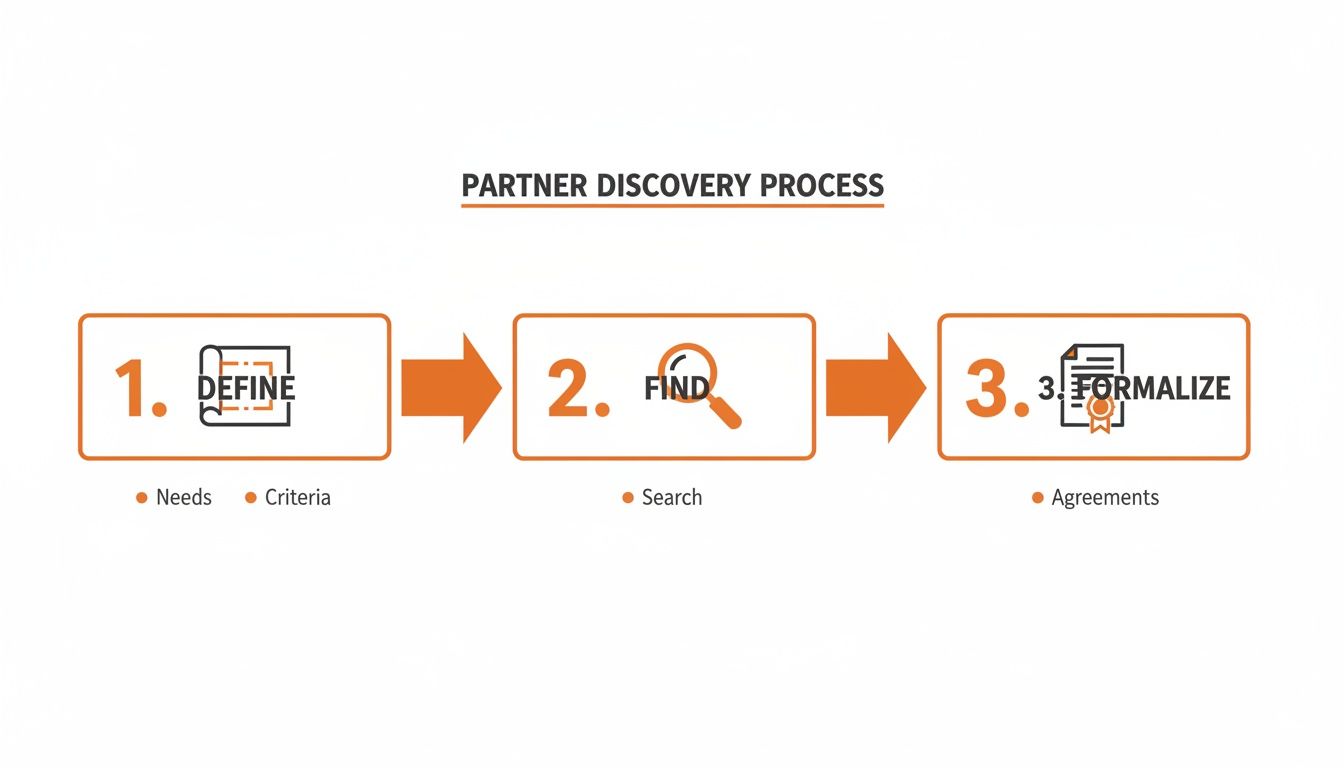
The key takeaway? Defining your needs is the foundation. Without it, your search is guesswork, and any agreement will be built on shaky ground.
Stages of the Partnership Journey
Each phase has a clear goal and a common trap. Rushing any step is a recipe for future disaster. The biggest mistake founders make is jumping straight to the "find" stage, driven by excitement or desperation, without mapping out what success looks like. This shoot-from-the-hip approach leads to partnerships based on surface-level chemistry instead of true strategic alignment.
The goal isn't to find a clone of yourself. It's to find someone whose strengths make your weaknesses irrelevant. A great partnership is like two different musical notes forming a powerful chord—stronger together than either could be alone.
To keep you focused, here is your strategic map. It will help you do the right things at the right time.
The Partnership Journey at a Glance
Finding a co-founder requires a clear head. This table summarizes the stages, their goals, and the common missteps that can derail your efforts.
| Stage | Primary Goal | Common Pitfall to Avoid |
|---|---|---|
| 1. Define | Create a crystal-clear profile of your ideal partner, focusing on complementary skills, shared values, and specific roles. | Assuming you know what you need without a thorough self-assessment of your own strengths and weaknesses. |
| 2. Find | Systematically search for and connect with potential candidates through targeted channels, online and offline. | Relying only on your immediate network or getting distracted by charisma instead of proven competence. |
| 3. Formalize | Vet candidates rigorously, define expectations legally, and establish a clear framework for working together. | Avoiding tough talks about equity, roles, and exit plans, leading to a weak or vague agreement. |
Use this framework to stay honest and methodical. A great partnership is built, not stumbled upon.
Where to Find Your Ideal Business Partner
Finding the right business partner isn't about luck. It’s about fishing in the right ponds. You can't just wander through networking events hoping for a chance encounter. You have to be strategic and go where high-quality candidates already gather.

Think of it this way: if you wanted to find an expert chef, you wouldn't hang out at McDonald's. You'd go to culinary schools, fine dining restaurants, and gourmet food festivals. The same logic applies here. Put yourself in environments where driven, vetted people already are.
Tap Into Established Tech Ecosystems
A powerful, often overlooked strategy is to dive into established tech ecosystems. They are like well-stocked lakes, full of potential partners already aligned with major players like Amazon, Salesforce, or Shopify.
Platforms like the AWS Partner Network, Salesforce AppExchange, or the Shopify Partner Program are more than just directories. They are active communities of vetted builders and experts looking to collaborate. They understand the value of growing together.
Here’s how to make these platforms work for you:
- Get Certified: Becoming certified in a relevant tech (like AWS or Salesforce) boosts your credibility and gives you insider access to their partner communities.
- Look for Co-Sell Opportunities: Many ecosystems have programs to help partners sell together. It’s a direct path to finding collaborators serious about making money.
- Jump into Forums: Participate in discussions. Answer questions, offer help, and become known as a useful expert. You'll build trust long before you ask for anything.
Finding a partner inside a pre-built ecosystem is like drafting a top player from a major league team. They've already been scouted, trained, and proven. You're starting with a massive advantage.
Go Beyond Obvious Networking Events
Traditional networking has its place, but the real magic happens in smaller, focused settings. Hunt down communities and events that align with your specific industry, values, and business stage.
A local, curated founder group is a perfect example. In these intimate settings, the focus is on genuine connection and problem-solving, not just swapping business cards. Members are often vetted to ensure they are active builders, creating an environment of trust. The connections you make in a small dinner group are often more durable than those from a crowded conference hall.
The data backs this up. Targeting established partner ecosystems is a proven path to finding high-impact collaborators. Leaders like AWS, Microsoft Azure, and Salesforce are masters at fostering this growth. It's no surprise that 73% of companies now align their partnership goals with their overall business strategies. With many organizations getting 30-60% of their total revenue from partnerships, it's clear these collaborations are central to business today.
And this isn't just for tech. If you're building a physical product, knowing how to find a manufacturer for your product is everything. Industry-specific trade shows for manufacturing can be a goldmine for finding partners with the operational expertise you're missing.
Find Your Partner on Specialized Online Platforms
Finally, don't overlook online platforms designed to connect founders. These digital matchmakers can dramatically expand your reach, connecting you with talent you would otherwise never meet.
Here are a few places to start:
- CoFoundersLab: Uses profile-based matching to help you find co-founders, advisors, and team members based on skills, experience, and goals.
- Wellfound (formerly AngelList): Known for hiring and fundraising, it's also a powerful tool for connecting with entrepreneurs looking to join or build new ventures.
- Niche Slack & Discord Communities: Find the digital watering holes for your industry (e.g., SaaS growth, e-commerce brands). Active, helpful participation can lead to organic connections with potential partners.
The key with any of these channels is to be a giver first. Share what you know, offer help, and build relationships without an immediate agenda. The right partner will be drawn to your competence and generosity.
Making a Genuine First Impression
Okay, you’ve found someone who looks like a perfect fit. Now for the tricky part.
That first message is your one shot to cut through the noise. We all get dozens of DMs and emails a day, and most are garbage. A generic, copy-paste template is the fastest way to get ignored. It's like showing up to a job interview in your pajamas—you won't be taken seriously.
A great first impression has nothing to do with flashy sales tactics. It’s about respecting the other person’s time and showing you’ve put thought into why you're reaching out. Be direct but thoughtful. Prove you’ve done your homework.
The Anatomy of a Standout Outreach Message
Think of your first message as a super-short, personalized business plan. It needs a clear structure to spark curiosity and build rapport. Any message that gets a reply usually has these four things:
- A Curious Subject Line: Ditch boring lines like "Partnership Opportunity." Try something that makes them want to click, like "Idea for your work with [Their Recent Project]" or "Connecting on [Shared Interest]."
- A Hyper-Personalized Opening: Start by mentioning something specific. Did you like their recent article? Admire a project they launched? Have a mutual connection? This shows you're not just blasting a list of names.
- A Clear Value Proposition: In one or two sentences, get to the point. What do you bring to the table, and why would it be valuable to them? Frame it as mutually beneficial, not a one-sided ask.
- A Low-Friction Call to Action (CTA): End with an easy next step. Instead of the high-commitment "Let's get on a call," try something softer like, "Would you be open to a 15-minute chat next week to see if there's a fit?"
A clean, focused workspace can help you get into the right headspace for this kind of thoughtful communication. It's all about clarity and intention.

Good vs. Bad Outreach Examples
Let’s see what this looks like. The difference between a thoughtful message and a lazy one is night and day. Imagine you're trying to connect with a successful e-commerce founder.
The Bad Example (Generic & Self-Serving)
Subject: Business Proposal
Hi Jane, I am the founder of a new SaaS company and I am looking for business partners. I think my product could help your business grow. Are you free for a call sometime? Thanks.
This is all about the sender. It's vague, offers no value, and screams "I sent this to 100 people." This gets deleted instantly.
The Good Example (Personalized & Value-Driven)
Subject: Your recent interview on the 'Ecom Masters' podcast
Hi Jane, I just listened to your interview on the 'Ecom Masters' podcast and loved your insights on sustainable supply chains—especially your point about last-mile delivery challenges.
*I'm the founder of a small logistics startup focused on exactly that problem. We've helped brands like [Similar, Non-Competing Brand] reduce their delivery emissions by 20%. Given your focus on sustainability, I thought there might be an interesting alignment.*
Would you be open to a brief 15-minute chat next week to explore this idea?
See the difference? This message is respectful and specific. It proves you did your research and frames the conversation around her known interests. This is how you start a real dialogue and find the right people to build with.
Vetting Partners to Ensure True Alignment
So you've found someone promising. The initial chats are exciting. It’s easy to get swept up in the momentum. But building a partnership on a gut feeling is like building a house on sand.
Now comes the most critical phase: due diligence. This isn't about being cynical. It's about being a professional.
You have to move past coffee chats and into a structured evaluation. This is where you find out if your potential partner’s values, work ethic, and communication style actually align with yours. Skipping this step is a gamble you can't afford to take.
Going Deeper Than a Coffee Chat
A casual conversation is great for checking chemistry, but it won’t reveal how someone handles pressure or conflict. For that, you need a methodical approach to uncover what makes them tick.
Think like a journalist investigating a story—ask the right questions to get past the easy answers.
This is where a structured interview becomes your best friend. Don't "wing it." Prepare thoughtful, open-ended questions to explore three core areas: their values, work habits, and past experiences (good and bad). The goal isn't to catch them in a lie, but to see how they think and what they prioritize when the chips are down.
A partnership is a business marriage. You wouldn't marry someone after one date. You’d want to know their dreams, fears, and how they react when things get tough. Apply that same curiosity to your business partner search.
This process is about collecting data, not just feelings. The more objective you can be now, the clearer your decision will be. You're building a foundation for a long-term relationship that will be tested by market shifts, financial stress, and personal challenges. A strong vetting process ensures that foundation is made of rock, not dust. This is also the perfect time to pressure-test the original concept, a key part of our guide on how to validate your business idea.
Key Questions to Uncover True Alignment
Your questions should pull out stories, not "yes" or "no" answers. Real-world examples reveal far more than hypotheticals ever will.
Here are a few powerful questions to start:
- Values & Motivation: "Tell me about a time you had to make a difficult ethical decision. What did you do, and what was the outcome?" This question gets to their moral compass under pressure.
- Work Ethic & Style: "Describe your ideal work week. Are you a 9-to-5 person with firm boundaries, or do you work until the job is done?" There's no right answer, only what aligns with your style. A mismatch can be a disaster.
- Conflict Resolution: "Walk me through a past disagreement with a colleague or partner. How did you handle it, and what did you learn?" This shows their ability to navigate tension without blowing things up.
- Resilience & Failure: "Tell me about a professional failure that taught you a significant lesson. What was it, and what was the lesson?" This uncovers their capacity for self-awareness, humility, and growth.
Your job is to listen more than you talk. Pay attention not just to what they say, but how they say it. Do they take ownership of past mistakes or blame others? This process is as much about observing character as it is about gathering information.
Using a Partnership Scorecard
To take some emotion out of the equation, use a simple 'Partnership Scorecard.' This tool helps you systematically assess each candidate against the criteria that matter most to you. It turns a subjective feeling into a more data-driven decision.
Just create a simple table and score each potential partner on a scale of 1-5 for the qualities you need.
| Compatibility Metric | Candidate A Score (1-5) | Candidate B Score (1-5) | Notes |
|---|---|---|---|
| Shared Vision & Goals | 4 | 5 | Candidate B has a clearer long-term vision. |
| Complementary Skills | 5 | 3 | Candidate A's technical skills are a perfect fit. |
| Work Ethic | 5 | 4 | Both are hard workers, but A is more aligned. |
| Communication Style | 3 | 5 | B is a much more direct communicator. |
| Financial Alignment | 4 | 4 | Both are on the same page with bootstrapping. |
| Total Score | 21 | 21 | A close call—decision depends on priorities. |
This systematic process matters. Data from the Association of Strategic Alliance Professionals (ASAP) reveals a massive difference in outcomes. While the average success rate for partnerships is just 53%, companies using structured vetting methods hit an 80% success rate. This "80% rule" is a world away from the dismal 20% success rate for partnerships thrown together on a whim.
This scorecard doesn't make the decision for you, but it forces you to clarify your thinking. It makes you define what's non-negotiable versus what's just "nice-to-have," helping you choose a partner set up for success from day one.
Structuring Your Partnership for Long-Term Success
A handshake and a good vibe are great starts, but they won't hold up when you hit your first major roadblock. And you will hit roadblocks. A lasting partnership needs a solid foundation built on clear agreements and honest communication. This is where you turn excitement into something that can withstand the pressure of business.

Think of it like this: you wouldn't build a house by just grabbing some wood and nails. You'd obsess over the blueprints, planning every detail before the first shovel hits the dirt. Your business partnership deserves the same meticulous planning.
Define Everything Before You Sign Anything
More partnerships crumble from misaligned expectations than from any single event. It's usually a slow burn of unspoken assumptions that eventually explodes. The only way to prevent this is to have the tough, awkward conversations before you're legally tied together.
Get brutally honest and specific about these things:
- Roles and Responsibilities: Who has the final say on marketing? Who’s managing the bank account? Fuzzy titles like "Co-CEO" are a recipe for stepping on each other's toes. Define clear domains of ownership.
- Time Commitment: Is this a 40-hour-a-week grind for both of you? What if one person wants to take a two-month sabbatical? Talk about it now, not when resentment is already building.
- Financial Contributions: Who's putting in cash? Is that a loan or an equity buy-in? How will you handle future funding needs?
This isn’t about a lack of trust; it's about building a shared rulebook. This clarity lets you both focus on the work instead of worrying about fairness.
The Equity Conversation Demystified
Talking about equity feels like a minefield, but it doesn't have to be. The goal is a split that fairly reflects each person's contribution—past, present, and future. A 50/50 split is almost never the right answer, because no two founders bring the exact same value.
Here's a simple framework to guide the discussion:
- Initial Capital: Hard cash is the easiest to quantify. Who is funding the launch?
- Intellectual Property: Is someone bringing a game-changing idea, a patent, or software they already built? That has immense value.
- Sweat Equity: This is all about the work. Who is grinding in those early, pre-revenue days to get this thing off the ground?
- Future Roles: The partner taking on the CEO title, with all its stress and responsibility, often warrants a larger share.
A partnership agreement isn't for when things are going great. It’s your emergency plan for when things go horribly wrong.
As businesses grow, formal structures become even more critical. A recent PwC outlook shows a major uptick in global M&A deal values, meaning more companies are forming large, structured partnerships. It's a clear signal that formal agreements are the backbone of high-value collaboration. You can see more of their deal-making trend analysis on PwC.com.
The Power of a Trial Project
Before you sign a legal document that binds you together for years, take the partnership for a test drive. A small, well-defined trial project is a brilliant, low-risk way to see how you actually work together under pressure.
Pick a project with a clear goal and a short timeline—like launching a landing page or running a small ad campaign. You'll learn more from this one experience than from a dozen coffee meetings. You'll see how they handle deadlines, how they communicate when something breaks, and if they pull their weight. It’s the ultimate compatibility test before you go all-in.
Common Questions About Finding a Partner
Trying to find a business partner opens up a lot of tough questions about money, friendship, and trust. It's normal to feel a bit lost. Let's tackle some of the most common questions head-on.
How Much Equity Should I Give a Business Partner?
Whatever you do, don't just default to 50/50. That's almost always the wrong answer. Equity isn't about being "equal"; it's a reflection of what each person brings to the table—past, present, and future.
Think of it like baking a cake. One person brings the expensive ingredients (capital). The other has the secret recipe and skill to bake it perfectly (the idea and execution). Both are essential, but their contributions aren't identical. A 50/50 split doesn't capture that nuance.
To get to a fair number, have an honest conversation about a few key things:
- Initial Capital: Who's putting in the cash?
- Intellectual Property (IP): Is someone bringing a patent, a unique algorithm, or a fully-baked brand? That’s worth a lot.
- Time Commitment: Is this a full-time gig for both of you, or is one person moonlighting?
- Experience & Network: Does one person have a golden rolodex or a track record that will open doors?
- Roles & Responsibilities: The CEO role, with all its pressure, often justifies a larger stake.
And please, whatever you decide, include vesting schedules. This is non-negotiable. It means equity is earned over time (usually four years). If someone leaves after six months, they don't walk away with a huge chunk of a company they barely helped build. It keeps everyone committed for the long haul.
What Are the Biggest Red Flags in a Potential Partner?
Spotting red flags early will save you from years of misery. Your gut is a powerful tool, but you also need to watch for specific behaviors.
Here are the warning signs I’ve learned to never ignore:
- Mismatched Core Values: If they're all about a quick buck and you're building a mission-driven brand, it's a ticking time bomb. You'll fight over every major decision.
- Awful Communication: Do they ghost important emails? Talk over you? Avoid difficult conversations? These little annoyances become giant, business-killing problems under pressure.
- No Accountability: Listen to how they talk about past failures. If it's always someone else's fault—a bad partner, bad market, bad luck—they won't take ownership when things go south with you, either.
- Hates Written Agreements: This is huge. If they say things like, "Let's just keep it simple," or "A handshake is good enough for me," run. They're either naive or trying to leave themselves an escape hatch. Get everything in writing.
- General Flakiness: If they're consistently late to meetings or miss deadlines now, imagine how they'll act when the real pressure is on. This won't magically get better.
Trust is built on consistent, reliable action. Pay attention to their patterns, not their promises. How someone handles small commitments tells you everything about how they'll handle the big ones.
Should I Partner With a Friend or Family Member?
This is the ultimate high-risk, high-reward move. On one hand, you have a foundation of trust that could take years to build with a stranger. On the other, a business failure could destroy a relationship you cherish.
If you're considering this, you must be more formal than you would be with a stranger. There's zero room for assumptions.
You absolutely must treat them like any other professional candidate:
- Do Your Due Diligence: Vet their actual skills and experience. Don't assume you know what they can do just because you've known them forever.
- Have the Money Talk: Talk about equity, salaries, and who's contributing what with brutal honesty. If you can't have this awkward conversation now, you have no business being in business together.
- Get a Legal Agreement: Hire a lawyer and draft a real partnership agreement. It needs to spell out roles, responsibilities, how decisions are made, and what happens if one of you wants out.
- Set Clear Boundaries: At Thanksgiving dinner, are you cousins or business partners? You have to be able to switch hats. Letting those lines blur is a recipe for resentment.
Here's the bottom line: if you're afraid to have these formal, tough conversations with a friend or family member because you don't want to offend them, that's your answer. Don't do it.
Finding the right people to build with is one of the hardest parts of the entrepreneurial journey. At Chicago Brandstarters, we believe you shouldn't have to do it alone. We are a free, vetted community for kind, bold founders in the Midwest, focused on building real relationships and sharing honest advice. If you're tired of transactional networking and want to connect with peers who truly get it, learn more at our website.