I know that feeling. You've got a killer idea for an ecommerce app, and you can't sleep. The urge to jump straight into designing and hiring developers is powerful.
But I’ve seen too many founders burn through their cash building something nobody wants. Before you spend a dime or write a line of code, you and I need to do the groundwork that separates successful apps from expensive hobbies.
Validating Your App Idea Before You Build

The single most important step happens before you build anything. It's called validation. Trust me, I get it. This isn't the sexy part. But skipping this is like setting sail without checking for holes in the boat. You might feel like you're moving fast, but you're actually sinking.
Validation isn't about getting people to tell you your idea is brilliant. It's about stress-testing your assumptions to find out where you're wrong before it costs you everything.
Start With a Problem, Not a Solution
I see so many founders fall in love with their solution—the app itself—and completely miss the customer's actual problem. You have to get obsessed with their pain point.
Let's say your idea is "an app for sustainable fashion." That's a solution. What's the real, burning problem you're solving for someone?
- Is it that shoppers can't find genuinely eco-friendly brands?
- Do they just not trust the "green" marketing claims they see?
- Or is it that awesome small brands are impossible to discover online?
Each of these is a different problem for a different person. Your job is to find one specific, painful problem and make it your mission to solve it. You can't be everything to everyone, especially at the start.
Talk to Real People (Not Your Mom)
Once you’ve zeroed in on a problem, go talk to your actual potential customers. And no, your friends and family don't count—they love you and will tell you what you want to hear. You need brutally honest feedback from strangers.
Don't ask, "Would you use this app?" It's a useless question. People are nice and will almost always say yes. Instead, dig into their past behavior. Ask something like, "Tell me about the last time you tried to buy a sustainable product online. What was frustrating about it?"
Listen for the emotion in their voice. When someone gets annoyed telling their story, you've hit a real nerve. Those are the problems people will actually pay you to solve. I’ve found that 10-15 of these conversations give you more insight than months of planning in a vacuum. For a deeper dive, check out my full guide on how to validate a business idea.
Scope Out the Market From Your Laptop
Market research doesn't need a big budget. You can learn a ton just by being a good detective. Look at your potential competitors. What are they doing right?
More importantly, what are customers complaining about in their app reviews, on Reddit, or on social media? Those complaints are pure gold. That's a ready-made list of what the market is begging for.
And the market is definitely there. The global ecommerce space is projected to hit $6.88 trillion in 2026, which is just insane. That’s about 21.5% of all retail sales on the planet. Even in the U.S. alone, ecommerce marketplace sales are expected to hit $536.1 billion by 2026. This massive ecosystem means that even for a niche brand, your customers are out there.
This isn't busywork. Validating your idea first turns a wild guess into a calculated move. It’s how you make sure you’re aiming at a real target from day one.
Defining Your Minimum Viable Product
You've validated your idea. The excitement is real. Now comes the part where I see so many founders get it wrong: the temptation to build everything at once. You’re already picturing AI recommendations, the integrated social feed, a dozen payment options…
Stop. Just pause right there.
The single biggest mistake you can make is trying to build your "forever app" on day one. It's the fastest way to burn through your money and push your launch date into a mythical future. All based on assumptions, not real-world data.
Instead, you and I need to talk about your Minimum Viable Product (MVP).
An MVP isn't some buggy, half-baked prototype. It's the most stripped-down, focused version of your product that solves the one core problem you already validated.
Think about it this way: your customer needs to get from point A to point B. Your MVP isn't a single tire from a brand-new Tesla. It's a skateboard. It does the job, gets them there, and lets you learn from how they actually use it. You can build the car later.
This approach gets you into the market, fast. That means you start learning from real customers, not just from what you think they want.
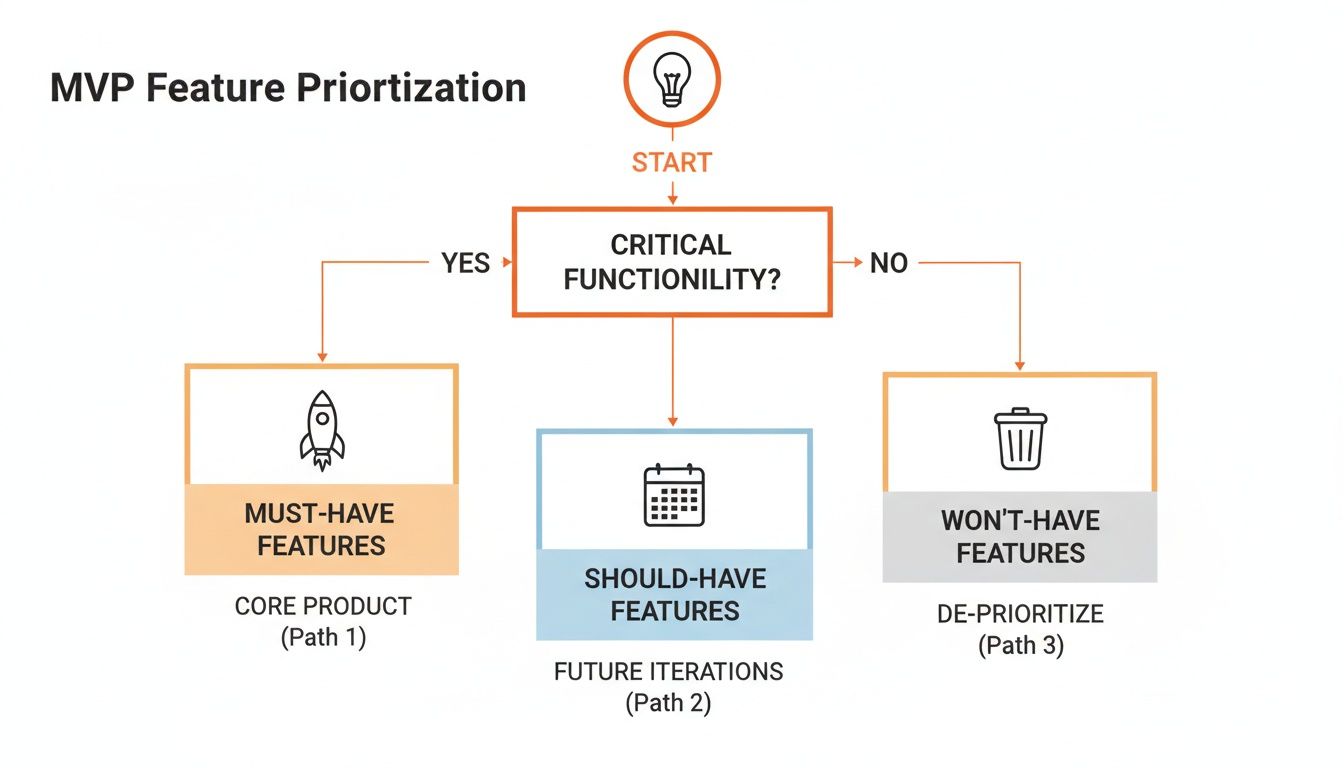
How to Prioritize Features (The MoSCoW Method)
Okay, so how do you decide what actually makes it into the skateboard version? To force those tough but necessary decisions, I always use a framework called the MoSCoW method. It brutally and beautifully sorts your wish list into four simple categories.
- Must-Have: These are your non-negotiables. Without them, the app is dead on arrival. For an ecommerce app, that’s viewing products, adding to a cart, and checking out. If a user can't do that, you don't have a business.
- Should-Have: These are important, but not critical for your first launch. Think wishlists or customer reviews. The app works without them, but they add a ton of value and are probably next on your list.
- Could-Have: These are the "nice-to-haves." The cool stuff you'd build if time and money were no object. This is where things like social sharing or advanced filtering sit.
- Won't-Have (For Now): This is the most important bucket. It’s a conscious decision to say "no" to features for this first version. A complex loyalty program or AI-powered personal stylist? Definitely belongs here.
Using this forces you to be honest about what is truly essential. If you want to see this in action, I have a whole article that breaks down what a product MVP example looks like with real-world scenarios.
What an MVP Actually Looks Like
Let's make this real. The "Must-Have" list for two different ecommerce apps will look completely different, even if they both sell things online. It all comes down to your core business model.
Fashion Discovery App MVP:
- Must-Haves: User accounts, a browsable catalog with great photos, a simple search function (maybe just by brand), and a secure checkout using one payment processor like Stripe.
Subscription Box Service MVP:
- Must-Haves: A crystal-clear explanation of the box, options for subscription plans (monthly vs. quarterly), secure recurring payments, and a simple user portal to pause or cancel.
See the difference? The fashion app is all about discovery and a one-time purchase. The subscription app is entirely focused on recurring billing and subscription management. Both are perfectly viable MVPs, but they solve different problems.
Why You Absolutely Must Build for Mobile First
As you’re making these lists, you have to think about where your customers are. The game has completely changed. Globally, mobile devices are projected to make up nearly 59% of all online retail sales in 2026.
On top of that, an estimated 1.65 billion people will shop on their smartphones this year.
If your app isn't built to work flawlessly on a small screen, you're willingly ignoring most of your customers. You can see more stats on these ecommerce trends that prove how vital this is. Your MVP has to be designed with a mobile-first mindset from the very beginning. It's not optional anymore.
Choosing Your Development Path and Tech Stack
Alright, let's get into the technical stuff. Don't worry, I’ll keep it simple. Picking your technology is a lot like deciding how you're going to build a house. You need to choose the right materials and the right crew for the job, all based on your budget, timeline, and how unique you want the final place to be.
Making the right call here is critical. I've seen founders get stuck for months because they picked a path that didn't fit their real needs. This decision sets the stage for how fast you can launch, how much you can change things later, and what your costs will look like long-term. There's no single "best" answer, only the best fit for you.
The Three Main Development Paths
Think of this as choosing your construction crew. You’ve really got three ways to go about it, and each one has its own trade-offs.
- Platform App Builders: This is like using prefabricated walls. Platforms like Shopify or BigCommerce give you tools to build on top of their proven systems. It’s fast and relatively cheap because the foundation is already solid.
- Hiring a Dev Agency: This is like hiring a general contractor who handles everything. They manage the architects (designers), the plumbers (backend devs), and everyone in between. It costs more, but you get expert guidance and a high-quality, custom result without managing the day-to-day chaos yourself.
- Building an In-house Team: This is you becoming the contractor and hiring your own specialized crew. It gives you absolute control and flexibility for the long haul, but it’s easily the most expensive and slowest path right out of the gate. You’re not just building a product; you’re building a company from scratch.
Your choice here boils down to a simple trade-off: speed, cost, and control. An app builder gets you speed and low cost. An in-house team gives you total control. An agency strikes a balance between expert execution and a custom build.
To help you decide, let's look at the three main ways to build your ecommerce app and who they're really for.
Ecommerce App Development Path Comparison
| Development Path | Best For | Speed to Market | Initial Cost | Flexibility |
|---|---|---|---|---|
| Platform Builders | Founders on a tight budget, testing an idea, or needing a fast launch. | Fastest (Weeks) | Low ($5k – $25k) | Low |
| Dev Agency | Founders with a validated idea and budget who need expert execution and a custom solution. | Medium (3-6 Months) | Medium ($50k – $150k+) | Medium-High |
| In-house Team | Well-funded startups with a long-term vision requiring deep, proprietary technology. | Slowest (6-12+ Months) | High ($200k+ annually) | Highest |
This table should give you a clear snapshot. If you're just starting out and need to prove your concept, a platform builder is almost always the smartest move.
The feature prioritization we talked about earlier feeds directly into this decision. A simple, focused MVP is a perfect match for an app builder.
If your vision is packed with "should-haves" or features that are totally unique, that’s when you need the custom work of an agency or an in-house team.
Demystifying the Tech Stack
Even if you’re not a coder, you have to be able to speak the language. Let’s quickly break down the core components of your "house."
The frontend is everything your customer sees and touches—the paint, the windows, the light fixtures. This is built with frameworks like React Native or Flutter that let you build one app for both iOS and Android.
The backend is the hidden stuff: the foundation, plumbing, and electrical wiring. It’s the engine running your app, handling user accounts, product data, orders, and all that crucial background work. You'll hear developers talk about languages like Node.js, Python, or Ruby on Rails here.
Finally, APIs (Application Programming Interfaces) are like universal power outlets. They are pre-built channels that let different systems talk to each other. When your app uses Stripe for payments or Shippo for shipping labels, it's using their APIs to pass information back and forth securely.
So, How Do You Choose?
The ecommerce world is dominated by a few giants. Shopify and Wix alone power 49% of all global ecommerce sites. Looking just at ecommerce-specific sites, Shopify's influence is massive, with a 27.3% adoption rate across nearly 7 million websites. For a founder like you, this means using a platform like Shopify can seriously cut down your time to market.
But there's also plenty of room for new players. The market is projected to grow from $13.92 billion in 2026 to a staggering $61.83 billion by 2034, proving that specialized, custom-built solutions have a huge runway. You can dig into more data on the ecommerce platform market to see these trends for yourself.
To make the right call, ask yourself these gut-check questions:
- What’s my real budget? If it’s under $20,000, a platform builder is your most realistic shot. A good agency will start around $50,000 for an MVP, and an in-house team is a whole different level of financial commitment.
- How fast do I need to launch? If you need to test your idea now, platform builders are the clear winner. A custom build will take at least 4-6 months, minimum.
- How unique is my secret sauce? If your app's magic lies in a truly novel feature that existing platforms just can't handle, you have to go custom with an agency or in-house team. No way around it.
Your goal isn't to become a developer overnight. It’s to understand these concepts well enough to have smart conversations and make the right strategic moves for your business.
Choose the path that gives you the best chance of getting your product into the hands of real customers, as quickly and efficiently as possible.
Time to Build: Payments, Integrations, and Not Messing It Up
Alright, you’ve done the planning and picked your tech. Now for the fun part: actually building the thing. This is when your idea stops being a bunch of documents and starts becoming a real app that customers can download.
While your developers are in the weeds coding, your job isn't to sit back and wait. You need to be obsessed with two things that will absolutely make or break your business: the customer experience and the integrations that run everything behind the scenes.
Think of it like this: the backend is your stockroom, the frontend is your beautiful storefront, but the integrations? That’s your cash register, your shipping department, and your security system all rolled into one. If they don't work flawlessly, you don't have a business.
Don't Make Your App Annoying to Use
User experience (UX) isn't just about making things look pretty. It's about how the app feels. Is it a joy to use, or does it feel like a chore?
You have literally 50 milliseconds before a new user decides if they like your app's design or not. If it’s confusing, they're gone. Just like that. That’s why a clean, simple, and almost boringly familiar layout is your best friend.
Here's my personal checklist for making a mobile shopping experience that actually works:
- The "Three-Tap Rule": Can someone find any product in your store in three taps or less? If not, your navigation is too complicated. Simplify it.
- Fat Finger Friendly: Apple says buttons should be at least 44 pixels tall. If people can't easily hit "Add to Cart" with their thumb, you are losing money. It's that simple.
- The Thumb Zone is Real: Most people scroll and tap with their thumb. Put your main navigation and buttons where their thumb can actually reach them, usually at the bottom of the screen.
A great user experience should be invisible. The customer shouldn't even notice the design; they should just feel like they’re effortlessly finding exactly what they want. Your goal is to remove every single piece of friction.
This is where having a plan saves you. If you’ve never done this before, following a detailed web site project plan can be a lifesaver, keeping you from forgetting these small but critical details.
Getting Paid and Connecting the Dots
An ecommerce app without a way to take money is just a pretty catalog. Integrating payments is obviously a must, but just throwing in a credit card form isn’t enough anymore. Getting your payment strategy right is one of the easiest ways to stop people from abandoning their carts.
Start with a solid, trusted gateway like Stripe. It’s the industry standard for a reason. But you have to go further.
- Apple Pay & Google Pay: These aren't optional. They are a requirement. Asking someone to type in 16 digits and an address on a phone is just begging them to give up. One-tap checkout is king.
- Buy Now, Pay Later (BNPL): For anything that's a bit pricey, services like Klarna or Afterpay are proven to boost sales by letting customers pay in installments.
Beyond getting paid, a few other integrations are non-negotiable. Trust me, trying to add these after you've launched is a nightmare. Do it now.
- Shipping: Use an API from a service like Shippo or EasyPost. This will automatically connect you to carriers, print shipping labels, and send tracking info to your customers. It’s magic.
- Email & SMS: You need to talk to your customers. A tool like Klaviyo lets you set up automated emails for abandoned carts, welcome messages, and shipping updates. This is how you turn a one-time buyer into a loyal fan.
- Analytics: You’re flying blind without analytics. A platform like Mixpanel or Amplitude shows you exactly what people are doing in your app—what they’re tapping, where they get stuck, and which features they love.
Getting these systems connected from day one means you'll have a real, functioning business engine the moment you go live, not just an empty storefront.
Crafting Your Go-To-Market Strategy
You’ve poured months of your life into this app. The code is finally done, the design looks amazing, and you're staring at the finish line. The urge to just smash that “publish” button and get it out there is overwhelming. I get it. But hold on.
A great launch is 90% preparation and 10% execution. What you do right now, before anyone sees your app, will make the difference between a huge splash and a quiet, unnoticed plop into the app store abyss. It's time to stop thinking like a builder and start thinking like a marketer.
This isn't about some massive, bank-breaking ad campaign. It's about a smart, scrappy plan that builds real momentum. The launch isn't the end; it's the very beginning.
The Last Line of Defense: Quality Assurance
Before you can even dream of marketing, you have to be brutally honest about your app. Does it actually work? I don't mean "it works on my phone." I mean it works for real people, on different devices, with clumsy thumbs and a talent for doing the exact opposite of what you expect. This is Quality Assurance (QA), and it's non-negotiable.
Think of QA as a paid dress rehearsal where the goal is to break things. You need to find every single bug before your customers do. Because a bug you find now is a one-star review you just avoided.
- Round Up Your Beta Testers: Find a small, diverse group of people who fit your target customer profile. A gift card or a small payment for their time is money well spent.
- Give Them a Mission: Create simple test scripts. Have them do everything a real user would: create an account, search for a product, add it to the cart, check out, and even try to process a return.
- Unleash the Chaos: This is the most important part. Ask them to try to break the app. Tell them to tap buttons like a maniac, use it on a spotty coffee shop Wi-Fi connection, and do anything they can think of to make it crash.
Their feedback is gold. It will expose all the frustrating dead ends and confusing flows you've become blind to after looking at it for months.
Polishing Your Digital Storefront
Your app store listing is your storefront. When someone lands on your page, you have seconds—literally—to convince them to hit "Install." Every word and every image has to count.
You have to optimize your page for both the Apple App Store and the Google Play Store. This isn't just about getting found; it's about turning a curious visitor into a user.
Your app's screenshots are your best sales pitch. Don't just show random screens. Tell a story. Show off the top 3-4 benefits and use text overlays to point out the killer features that solve your user's problem.
That app description is precious real estate. The first couple of lines are all most people will read, so don't bury the lead with jargon. Start with a crystal-clear sentence that explains the problem you solve. Then, work your main keywords into the rest of the description so people can actually find you.
Launching on a Budget
Okay, now it’s time to make some noise. A great launch isn't one big, expensive explosion. It’s a series of small, smart moves that build on each other and create momentum.
Here’s a simple, high-impact playbook to get you started:
- Call in Your Day One Army: Remember all those people you interviewed for validation? The ones who signed up for your email list? They're your first believers. Give them early access, a special launch-day discount, and ask them personally to help spread the word.
- Team Up with Micro-Influencers: Forget the huge stars with millions of followers. Find 5-10 micro-influencers (in the 10k-50k follower range) who are genuinely respected in your niche. Their audience trusts their recommendations. One authentic post from the right person is worth more than a dozen generic ads.
- Do Your Own PR: You don't need a pricey PR firm. Make a list of a few bloggers and journalists who cover your industry. Shoot them a personal, short email explaining what your app does. More importantly, tell them why you built it. Your founder story is often the most compelling thing you have.
I get these questions all the time from founders just like you. Building an ecommerce app is a massive undertaking, and it’s natural to feel uncertain. Let’s tackle some of the most common hurdles with clear, straightforward answers.
How Much Does It Cost to Build an Ecommerce App?
The honest answer? It varies wildly. Think of it like building a house—you could use a prefab kit for a few thousand bucks or commission an architectural masterpiece for a fortune. An app is no different.
Using a no-code builder on a platform like Shopify, you might get a simple version live for a few thousand dollars. But for a truly custom MVP built by a small agency or a few freelancers, you should budget somewhere in the $25,000 to $75,000 range.
The most critical factor for keeping that initial cost down is staying laser-focused on your core MVP features. Anything else is a distraction.
How Long Does It Take to Build the First Version?
This depends entirely on the path you take. If you’re using a platform’s app builder and have all your content ready, you could technically go live in just a few weeks. It's the fastest way to get your product in front of customers.
For a custom MVP, a more realistic timeline is 4 to 6 months. This covers the whole nine yards: initial design mockups, frontend and backend development, serious QA testing, and finally, wrestling with the app store submission process. Building from scratch just takes time to do right.
Should I Learn to Code to Build My App?
Absolutely not. As a founder, your time is your most valuable asset, and it’s far better spent on vision, strategy, and talking to your customers. Trying to become a coder while building a business is a recipe for burnout and doing both poorly.
Your job isn't to write the code. It’s to understand the language of development well enough to have intelligent conversations with the people you hire. Focus on learning the concepts, not the syntax.
Instead, learn just enough about technology to make smart, informed decisions. Understand what an API is, the difference between frontend and backend, and the pros and cons of different tech stacks. This empowers you to lead the project without getting lost in the weeds.
What Is the Biggest Mistake to Avoid?
The single biggest—and most expensive—mistake I see founders make is feature creep. It’s that slow, creeping temptation to add just one more cool feature before you launch. Then another. And another.
It starts with good intentions but quickly snowballs, blowing up your budget, delaying your launch by months, and bloating your app with unproven ideas. It distracts you and your team from the only thing that matters: solving a core problem for your first customers.
When you're starting out, be ruthless. Stick to your MVP. Get to market, get real feedback, and then you can build more.
At Chicago Brandstarters, we know how lonely and challenging this journey can be. That's why we've built a free, vetted community for founders just like you to share honest war stories, get real-world advice, and build lasting friendships that move your business forward. Learn more about joining our community.