
Let's get straight to it. You've got a killer idea, the grit to see it through, and you're building it right here in the heart of the Midwest. The short answer is a resounding 'yes'—venture capital in Chicago is deep, thriving, and has a flavor all its own. Forget the coastal noise for a minute; I want to show you how this city powers founders who value solid work and real relationships more than a flashy pitch deck.
So You Want to Raise Venture Capital in Chicago
I get it. When you hear "venture capital," your mind probably jumps straight to Silicon Valley or New York. But that picture is missing a huge piece of the puzzle. Chicago’s ecosystem isn't about hype; it's about substance.
Think of it like building a skyscraper here versus on the coasts. Out there, they might throw up flashy glass towers that look amazing on Instagram. Here, we build with solid foundations, steel beams, and a plan to withstand the brutal winters. That’s the exact ethos I've found in our local investment community—a deep focus on sustainable, resilient businesses built to last.
The Real Numbers Behind the Windy City's VC Scene
But don't mistake our practical, "show me the numbers" attitude for a lack of capital. The money is absolutely here, and it’s flowing to founders like you with real solutions to real problems. You just have to know where to find it and how to speak the language of Midwest investors, which I've learned is grounded in tangible metrics and a clear path to profitability.
To give you a sense of the scale we're talking about, let's look at some key stats from the 2023 Chicago venture ecosystem.
Chicago Venture Capital at a Glance
| Metric | Figure | What This Means for You |
|---|---|---|
| Total Capital Raised | $4.73 billion | A huge pool of capital is available for strong companies, from early-stage startups to growth-stage businesses. |
| Total Number of Deals | 587 | Deal activity is broad, not just concentrated in a few massive rounds. There's room for you. |
| Number of Unique Investors | 788 | You have a wide variety of investors to connect with—angels, seed funds, and VCs—not just a few gatekeepers. |
These numbers, pulled from World Business Chicago’s 2023 Year-in-Review, tell a powerful story. This isn't a small, sleepy market; it's a dynamic and active environment where hundreds of founders are getting funded.
The most encouraging part of all this for me? That 788 distinct investors participated in these deals. It means capital isn't just locked up with a handful of mega-funds. It’s spread across a wide network of angels, seed funds, and VCs who are actively writing checks.
It's About More Than Just the Money
Raising capital here feels different. It’s about joining a community. I find investors are often more accessible and genuinely willing to build relationships. They see themselves as your partners, not just another name on a cap table.
It’s a place where a strong team and a solid, well-thought-out plan can carry you just as far as a slick presentation. If you’re at the very beginning of that journey and still building your core team, you might want to check out my guide on how to find a co-founder.
This guide will give you the real lay of the land—my honest, no-fluff overview of what venture capital in Chicago is really like. I'll break down the key players, sectors, and strategies to show you that the capital you need is probably closer than you think.
You've probably heard the saying, "It's all about who you know." In a lot of cities, that’s code for transactional networking and climbing some invisible social ladder.
But in Chicago, I've found it means something completely different. Our city’s spirit is built on a genuine desire to see other people win. This isn't some fluffy, feel-good idea; it's a core piece of our DNA that directly shapes the venture capital scene.
The result is a fundraising ecosystem that’s more accessible and, honestly, more human. It's less about flashy presentations and more about real connection. I always think of it as a potluck dinner versus a fancy gala. At a gala, everyone is posturing, trying to look important. But at a potluck, people bring their best dish, share it openly, and make sure everyone gets a plate.
That’s Chicago. And it's a huge advantage for you.
An Ecosystem Built on Real Support
Here, a warm introduction isn't just a transaction. It's a personal vouch of confidence. I'm always shocked at how willing people are to connect you with someone in their network if they genuinely believe in what you're building. This collaborative spirit creates a much softer landing for first-time founders like you who might be put off by the sharp elbows found in other tech hubs.
Don’t get me wrong, this doesn’t mean investors are just handing out checks without asking tough questions. It's the opposite. Because the community is built on trust, they expect you to be honest and know your business inside and out. But the feedback you get is almost always constructive, aimed at making you and your company stronger.
The kindness isn't about being "soft." It's about being efficient. A connected, supportive community helps good ideas get to the right people faster, with less friction and wasted effort. It's a strategic advantage that fosters resilience and long-term growth.
A Tangible Advantage for Diverse Founders
This community-first mindset has created a landscape that is, by the numbers, more inclusive. The "potluck" approach means more people get a seat at the table, and what you bring is valued. The data backs this up in a big way.
A study from Chicago:Blend covering companies founded between 2018 and 2023 found some incredible trends. It showed that 36.5% of new venture-backed companies in Chicago had at least one woman founder—the highest rate among all major U.S. cities they looked at.
When it comes to racial and ethnic diversity, 24.4% of these companies had at least one founder of color, ranking Chicago second in the nation, just a hair behind Miami.
What this tells you is that Chicago's focus on inclusivity isn't just talk. It’s a real, measurable feature of our market that creates opportunities for founders from all walks of life. If you’re a woman or a person of color, the data shows you have a statistically better shot at getting funded right here than you do in almost any other major city. This environment—where kindness and inclusivity are just how we do things—is a superpower for the entire Chicago VC scene.
Alright, let's pull back the curtain and talk about who you're actually going to be sitting across the table from. The world of venture capital in Chicago isn't some faceless monolith. It's a living, breathing community of different types of investors, and each one has their own personality, focus, and appetite for risk.
Knowing who you're talking to is everything. You wouldn't give a highly technical engineering talk to a room full of artists, right? Pitching your hot new consumer product to a deep-tech fund that only touches B2B SaaS is just as pointless. You have to know your audience.
The Three Main Investor Archetypes in Chicago
In Chicago, the folks writing the checks generally fall into three main buckets. Figuring out their motivations and what they're looking for is your first step toward getting a meeting that actually goes somewhere.
- Angel Investors: These are usually successful former founders or other high-net-worth individuals who are investing their own cash. They're the ones writing the earliest, smallest checks and are often betting on you, the founder, just as much as your idea. Think of them as the experienced mentor who also puts some skin in the game.
- Seed and Early-Stage Funds: These are the professional funds that specialize in writing checks for companies just getting off the ground (pre-seed and seed) or those that have found some initial traction (Series A). Firms like M25, Hyde Park Venture Partners, and Jump Capital are major players here. They become your first institutional partners, helping you turn a raw idea into a real, repeatable business.
- Growth-Stage Firms: Investors like Bridge Investments step in later, once your business has a proven product, a solid customer base, and is ready to hit the gas. They provide the serious fuel to expand into new markets or just completely dominate your current one. Their focus is less on the idea and almost entirely on execution and growth metrics.
Here’s a look at how diversity within Chicago's VC leadership can influence the kinds of founders who get funded.
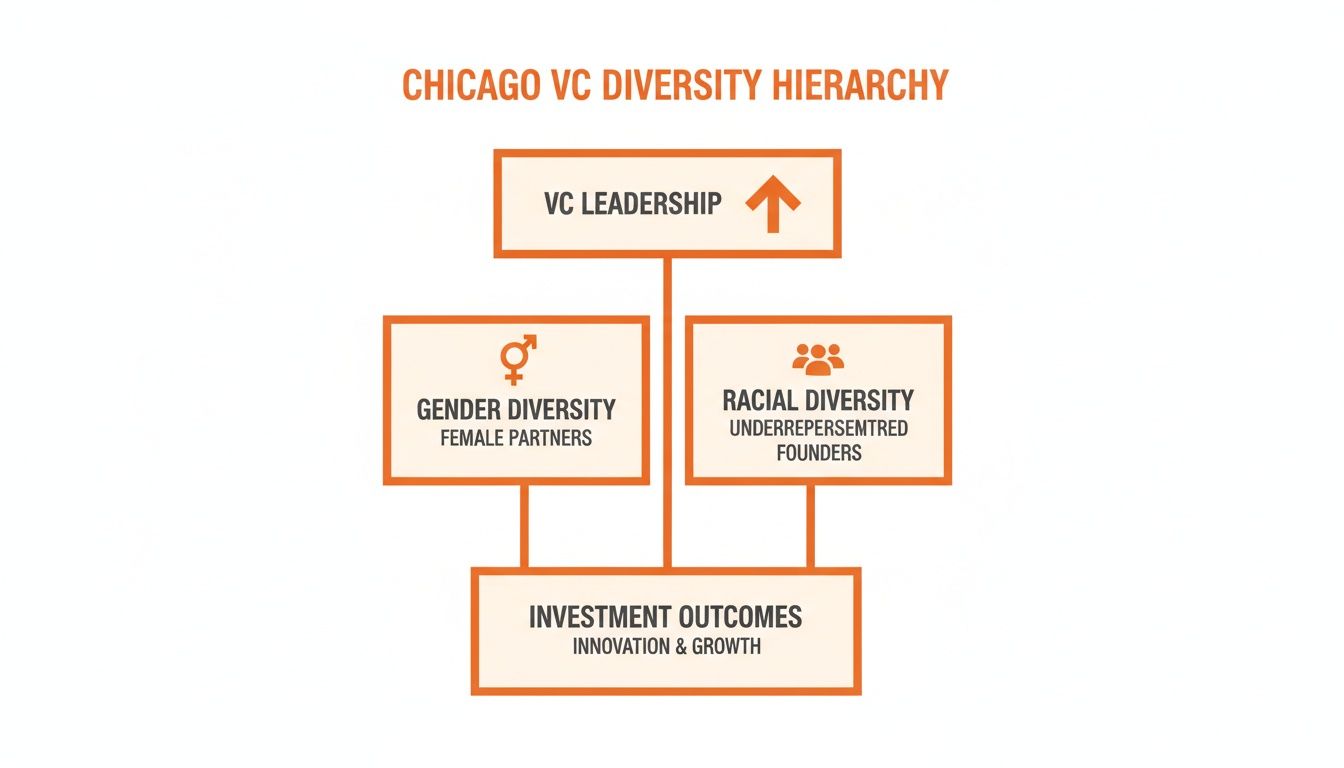
This really shows you how having diverse voices at the top of the Chicago VC ecosystem can lead to more equitable investment outcomes for founders from all backgrounds.
A Look at Some Specific Chicago VC Firms
While this is far from a complete list, knowing some of the key names gives you a solid starting point for your own research. Each firm has a totally different "flavor."
- Hyde Park Venture Partners (HPVP): A true powerhouse in the Midwest, HPVP focuses on B2B SaaS and marketplace startups. They are known for being incredibly hands-on with their portfolio companies and having a network that runs deep.
- M25: An extremely active seed-stage fund, M25 invests exclusively in startups based right here in the Midwest. They're very data-driven and have a reputation for making decisions quickly.
- Jump Capital: With a broader focus that includes FinTech, B2B SaaS, and IT infrastructure, Jump Capital brings a ton of deep operational expertise to the table. They aren't afraid to roll up their sleeves.
- Abundant Venture Partners: This firm often co-founds companies alongside entrepreneurs, taking a very direct role in building businesses from the ground up, especially in healthcare and media.
The key takeaway isn't to memorize firm names, but to understand that each has a specific thesis. Your job is to find the ones whose investment philosophy aligns perfectly with your company's stage, industry, and vision.
The Community Layer That Connects It All
Beyond the formal investors, there’s a powerful community layer that makes Chicago’s ecosystem truly unique. This is where groups like ours, Chicago Brandstarters, come in. We aren’t investors, but we create the trusted environment where the real connections are made.
Think of us as the friendly neighbor who knows everyone on the block. We can give you the real story on which investors are genuinely helpful and which ones you might want to steer clear of. More importantly, we can facilitate the warm introductions that get your email read instead of sent straight to the trash.
This human side of venture capital in Chicago is where the magic happens. It’s where you get the honest, unfiltered feedback you need to sharpen your pitch long before you ever step into a formal meeting. This isn't just a list of names; it's your field guide to the people who can help you build something great.
Getting Your House in Order Before You Pitch

Pitching an investor before you’re ready is like asking someone to marry you on a first date. It’s too much, way too soon, and you’re pretty much guaranteed to hear a "no." Before you even think about opening Canva to build a pitch deck, you need to get your own house in order.
This is your practical, no-fluff checklist for doing just that. I’ll walk you through the things you absolutely can’t skip: knowing your numbers, getting painfully clear on who your ideal customer is, and building a simple financial model that doesn't require a Wharton MBA.
But most importantly, we need to talk about traction. This is the secret sauce that turns a cool idea into a business someone will actually fund.
What Is Traction and Why Does It Matter So Much?
Traction is your proof of life. It’s the hard evidence that real, breathing humans actually want the thing you’re building. It's the polar opposite of a hypothetical business plan; it's a growing pile of facts.
Think of it like building a case for a jury. The more evidence you have that your business is a real thing, the easier it is for an investor to believe in you and write that check. Traction isn't just one single metric; it can show up in a bunch of different ways, especially in the early days.
Here’s how you can show it:
- Early Revenue: This is the gold standard. Even a tiny bit of revenue proves people will open their wallets for your solution. It validates everything.
- A Growing Waitlist: If you have hundreds (or thousands) of people lined up, eager to get their hands on your product, that’s a powerful signal of demand.
- Passionate User Engagement: If your product is free, you can show traction with things like daily active users, how long people stick around on your platform, or a super low churn rate.
- A Letter of Intent (LOI): In the B2B world, getting a signed LOI from a potential corporate client can be a massive green light for investors.
The more of this evidence you can gather, the stronger your story becomes. It shifts your pitch from, "I think this will work," to "Here’s the proof that it's already working."
Know Your Numbers Cold
You don’t need to be a spreadsheet genius, but you absolutely have to understand the basic numbers that make your business tick. An investor will spot a founder who doesn't know their metrics from a mile away.
At a bare minimum, you need a solid grasp on these three things:
- Customer Acquisition Cost (CAC): How much money does it cost you to get one new paying customer? Be painfully honest with yourself on this one.
- Lifetime Value (LTV): Over the entire time a customer uses your product, how much money do you expect to make from them?
- Gross Margin: After you pay for the direct costs of making your product or delivering your service, how much profit is left from each sale?
Having a simple, clear financial model is non-negotiable. It shows you’ve actually thought through how your business is going to make money. If you need a solid place to start, you can use a straightforward startup business plan template that guides you through these key pieces.
The goal isn’t to predict the future with perfect accuracy. It's to show investors you have a deep, thoughtful understanding of the levers that will make your business grow. Your model is just a story told with numbers.
The venture capital in Chicago scene really values this kind of prep work. Investors here have a deep respect for founders who have a realistic, clear-eyed view of their business fundamentals. A Next Street analysis found that Chicago closes over $1 billion in angel and venture deals every year, with a strong focus on early-stage investments under $5 million—a perfect zone for founders who have done their homework.
Define Your Customer with Extreme Clarity
Finally, you need to know exactly who you are building this for. "Everyone" is not an answer. You should be able to describe your ideal customer in such vivid detail that an investor could almost picture them sitting in the room.
Who are they? What are their biggest headaches? Where do they hang out online? Why on earth will they choose you over all the other options they have?
When you have this level of clarity, every other decision—from product features to marketing campaigns—gets way easier and more effective. You're not just building a product anymore; you're building a solution for a specific person with a specific problem. That's a story investors can actually understand and get excited about.
Crafting Your Story and Making the First Move
Okay, you’ve got your numbers straight and your business fundamentals are solid. Now it’s time to switch gears from spreadsheets to storytelling. Your pitch isn’t just data—it’s the story of the future you’re building. And that story begins long before you ever step into a meeting.
Let’s be brutally honest: cold emailing a partner at a top Chicago VC firm is like whispering your idea into a Category 5 hurricane. It’s just not going to work. Your message gets instantly buried under the hundreds of others they get every single week. The best way in—really, the only way in—is through a warm introduction. This is where your community stops being a support system and becomes your single greatest fundraising weapon.
Building Your One-Page Teaser
Before you even think about asking for an intro, you need a sharp, simple tool that makes it dead simple for someone to help you. I call this a one-page summary or a "teaser." Its only job is to get an investor excited enough to say, "Yes, I'll take that meeting," without wasting their time.
Think of it like a movie trailer. It doesn't spoil the whole plot, but it shows off the best action sequences and leaves you desperate to see more. It’s a powerful snapshot of your vision, designed to be digested in under 60 seconds.
Your teaser absolutely must include:
- The Problem: State the pain point you’re solving, and make it feel urgent.
- Your Solution: How your product or service kills that pain in a way no one else can.
- The Market Size: A realistic, believable look at the opportunity. No fantasy numbers.
- Your Traction: The hard proof you’re onto something real. Think revenue, users, waitlists.
- The Team: A quick who's who of the founders, focusing on why you’re the ones to win.
This little document is your calling card. It proves you’re prepared, professional, and you respect an investor’s most precious resource—their time.
The Art of the Warm Introduction
So you've got your teaser. Now, how do you get it into the right hands? You ask for help, but you have to do it the right way. Asking for an intro is a delicate dance, and in a relationship-driven town like Chicago, your approach says a lot about you.
First, do your homework. Pinpoint the specific firms and partners whose focus genuinely lines up with what you're building. Then, fire up LinkedIn and find a mutual connection—a fellow founder, an old colleague, a mentor. Anyone who can vouch for you.
When you reach out to that connection, your goal is to make their job effortless.
Your request for an introduction should be a "forwardable email." This is a tight, well-written message that your contact can simply forward to the investor with a quick "Hey, you should meet these folks" on top. You do the work for them.
Keep your forwardable email human, clear, and direct. You're not trying to close the deal here; you're just trying to start a conversation. But before you do any of this, you need to be sure your core assumptions are rock-solid. My guide on how to validate a business idea gives you a great framework for pressure-testing everything.
Leveraging the Chicago Community
This is where that Midwestern kindness I mentioned earlier becomes your superpower. Communities like ours, Chicago Brandstarters, exist for this exact reason—to help founders like you bridge these gaps. We've built a trusted network where you can get honest feedback and, when you’re ready, find those critical warm intros.
Instead of spending months trying to network your way into the right rooms, you can tap into a group of peers and mentors who actually want to see you succeed. They’ve walked in your shoes and can point you directly to the investors who will "get" what you're doing.
This is the real secret of the venture capital in Chicago scene. The path to funding here is paved with genuine relationships, not just transactional LinkedIn requests. Your goal isn't just to get a check; it's to build a partnership based on mutual respect.
Navigating the Pitch Process and Avoiding Common Pitfalls
You did it. You landed the meeting. So, what now?
A lot of founders treat the pitch like a high-stakes final exam. I want you to completely reframe that mindset. It’s not an interrogation. It’s a conversation—a first date, really—to see if you and an investor are a good fit for what could be a 10-year partnership.
Think of it as a joint mission to find the truth. The investor is just trying to understand three things: your vision, your market, and most importantly, you. They're asking themselves one simple question: "Is this someone I want to be in the trenches with when things get tough?"
This is where that famous Chicago "no-BS" attitude becomes your secret weapon. Be direct. Be honest. Show them you’re a builder who gets things done, not just someone with a slick deck.
From Coffee to Deep Dive
The process usually rolls out in stages, starting with a casual coffee meeting and hopefully leading to a formal partner presentation. Every single step is a filter.
The initial chat is all about the big picture and your connection to the problem you're solving. Can you tell a compelling story? Do you know your industry inside and out? If you pass that vibe check, you’ll move into the real diligence. This is where they start digging into your numbers, your go-to-market strategy, and your team.
Your goal here is to be prepared, but also coachable. Showing you can listen to feedback and think on your feet is just as important as knowing your metrics cold.
The biggest mistake I see founders make is getting defensive. When an investor pokes holes in your plan, they aren't attacking you. They're stress-testing your resilience and critical thinking. Welcome the tough questions—they're a sign of genuine interest.
Common Founder Pitfalls vs. Winning Approaches
Navigating the fundraising trail for venture capital in Chicago is less about having a perfect pitch and more about avoiding the common traps that sink promising startups. It’s often the small things, the subtle moves, that make the biggest difference in building the trust you need to get a check.
Here’s a look at what separates the founders who get funded from those who don't.
| Common Pitfall | Why It Fails | A Better Approach |
|---|---|---|
| Defensiveness to Feedback | This immediately signals you're uncoachable and think you have all the answers. Investors want a partner, not an employee. | Say, "That's a great point I hadn't considered. Here's my initial thought, but I want to dig into that more." |
| Not Knowing Key Metrics | Fumbling with numbers like LTV, CAC, or churn shows you aren't focused on the fundamentals of the business. It's a huge red flag. | Know your three most important metrics inside and out. More importantly, be ready to explain the "why" behind them. |
| Misrepresenting Traction | Exaggerating your numbers will destroy trust instantly when it's discovered during due diligence. And it will be discovered. | Be radically transparent. Undersell and over-deliver. Frame your current traction as a strong starting point with a clear path forward. |
| "Hiding the Ball" on Risks | Pretending there are no risks in your business makes you seem either naive or dishonest. Every startup has risks. | Address potential hurdles head-on. Show investors you've already thought about what could go wrong and have a plan to mitigate it. |
Handling the back-and-forth with grace is critical. It’s perfectly fine for you to say, “I don’t have that exact number right now, but here’s how I’ll get it for you by tomorrow.” That response shows honesty and follow-through, which are far more valuable than faking it.
Remember, they aren’t just betting on your idea. They're betting on your ability to figure things out when the plan inevitably breaks.
Chicago VC: Your Questions Answered
When you’re just getting started, the world of venture capital can feel like a maze. Let’s tackle some of the most common questions I hear from founders diving into the venture capital scene in Chicago. Here are some straight-up answers to get you pointed in the right direction.
Do I Need Revenue to Raise in Chicago?
Not always. Especially if you're looking at a pre-seed or seed round. While it's true that Chicago investors are a pragmatic bunch, they get that early-stage traction doesn’t always show up as dollars in the bank.
Instead of revenue, you can show momentum in other ways. Maybe you have a waitlist that’s growing like a weed, or insane user engagement on a free product. Even a letter of intent from a big-name customer can do the trick. The real key is proving you’re solving a problem people actually have.
Are Chicago VCs More Risk-Averse?
I wouldn't call them risk-averse. I’d say they’re “metrics-driven.” Think of it like this: a VC on the coast might throw money at ten wild ideas, praying one of them turns into a unicorn. A Chicago investor? They’d rather back a business with a clear, believable path to actually making money.
And honestly, that’s not a bad thing. It just means they care about sustainable growth and solid fundamentals. If you can show them a practical plan for profitability, you'll find they are very willing to listen.
They invest in the business, not just the dream. This focus on capital efficiency means your funding often goes further, building a more resilient company from day one. It's a feature, not a bug, of our ecosystem.
How Important Are Warm Introductions?
They’re everything. I can’t say this enough. The entire Chicago ecosystem is built on relationships and trust. Investors are drowning in hundreds of cold emails every single week.
A warm intro from someone they trust—another founder, a lawyer in the startup space, or a community leader—is like a golden ticket. It instantly puts you at the top of the pile. It shows that someone in their network is willing to put their own reputation on the line for you. Make this your top priority.
If you're looking for that trusted community to help you build relationships and get those critical warm intros, join us at Chicago Brandstarters. We're a free, vetted group of kind and bold founders helping each other win. Apply to join our community.