
Tag: brand strategy

  • 10 Examples of Differentiated Products That Actually Stand Out in 2026

    10 Examples of Differentiated Products That Actually Stand Out in 2026

    I get it. You're building something you believe in, but the market feels impossibly crowded. Everyone shouts the same advice: "You have to be different!" But what does that actually mean? It’s not just about a quirky logo. It's about changing the game so your customers don't even see your competitors.

    Think of it like this: if everyone on your street sells lemonade, you don't win by making yours slightly sweeter or five cents cheaper. That’s a race to the bottom. Instead, you open the only stand that sells lemonade with a secret ingredient that also cures hiccups. Suddenly, you’re not in the lemonade business anymore. You're in the hiccup-curing business. You’ve created a new category. That's real differentiation.

    This is your moat. It's the deep trench around your castle that makes it nearly impossible for anyone else to attack. Building this moat is your single most important job as a founder, especially in the early days when you can't compete on price or scale.

    In this list, I'm going to walk you through 10 concrete examples of differentiated products, from subscription communities to DTC brands. We'll skip the generic fluff and get right to the strategies behind why they work. You'll see exactly how they carved out their space, and I'll give you actionable takeaways so you can start building your own moat today.

    1. Subscription Box Communities (Peer-Driven Model)

    Imagine a subscription box, but instead of coffee, you get curated human connection and business insights. That’s the idea behind the Subscription Box Community. This model packages peer support into a recurring product, delivering value not through physical goods but through structured, intimate interactions.

    It works because you're shifting from large, impersonal networking events to small, carefully vetted groups. You aren't just selling access; you're engineering psychological safety and genuine mentorship. This is one of the most effective examples of differentiated products in the service space because it solves founder loneliness and cuts through the noise of typical networking.

    An open delivery box labeled 'small Cohorts' on a wooden table, with blurred people eating in the background.

    Strategic Breakdown

    Unlike a generic mastermind or a sprawling online forum, this model's edge comes from three pillars: exclusivity, intimacy, and vulnerability. For instance, at Chicago Brandstarters, I vet members for values alignment, not just revenue. I keep my cohorts to just 6-8 founders who meet for dinner twice a month. This small size is critical. It transforms performative "networking" into real, confidential talks where you can share your actual struggles and get tactical advice from peers in the trenches with you.

    Organizations like YPO use a similar forum model, proving it works at scale. The magic isn't the model itself but the strict adherence to the small-group format where trust can flourish.

    Actionable Takeaways for Founders

    Want to build a community like this? Here’s how you can get started.

    • Start Small and Deep: Keep your first cohorts to 6-8 people. This number is the sweet spot for ensuring everyone speaks and builds real bonds.
    • Vet for Values, Not Just Metrics: Your application process should filter for culture fit. Use a multi-step process: a written application, a personal interview, and even a reference check to make sure you bring in givers, not takers.
    • Engineer Confidentiality: State your confidentiality norms explicitly at the very first meeting. Reinforce them regularly. This is the bedrock of trust and the reason members will share their real problems.
    • Build a Simple "Between-Session" Channel: Create a private Slack or Discord channel. It’s a lightweight way for members to stay connected and ask for quick help between your main events.
    • Create an "Off-Ramp": Not everyone will stay forever. You need a clear process for when a member outgrows the group, helping them graduate to the next stage of their journey.

    2. Direct-to-Consumer (DTC) Ecommerce Brands with Founder Story Authenticity

    Instead of hiding behind a polished logo, what if you were the brand? This is the core of founder-led DTC differentiation. Your personal story, struggles, and values become the most compelling reason for customers to buy. You're not just selling a product; you're inviting customers into your journey, making them feel like insiders backing a person, not just a company.

    I see this as one of the most powerful examples of differentiated products because it builds an emotional moat competitors can't copy. It resonates with consumers who are tired of faceless corporations and crave human connection. By sharing your "why," you turn a simple transaction into a meaningful relationship.

    A founder in a denim shirt holding a product tube, set against a workshop background.

    Strategic Breakdown

    The differentiation here isn't about features; it's about authenticity, vulnerability, and mission. Brands like Glossier (Emily Weiss) and Native Deodorant built followings not just on product quality but on the transparent story of their creation. They shared the problem they were obsessed with solving, pulling back the curtain on their process, their failures, and their vision. This turns customers into evangelists.

    Dollar Shave Club's Michael Dubin used an irreverent, personal brand voice that reflected his personality, cutting through the noise of legacy competitors. This strategy works because you and I trust people more than we trust logos. When a founder is visible, the brand feels more human and accountable. You can dive deeper into how you can brand a product and make your story a central part of your strategy.

    Actionable Takeaways for Founders

    Want to build a brand around your personal story? Here’s how you can do it.

    • Start with Your 'Why' Story: Clearly state the personal problem that led you to start this business. This is the foundation of your brand narrative.
    • Share Failures and Pivots: Don't just show the highlight reel. Talk about the wrong turns and the failed experiments. This builds credibility and makes you relatable.
    • Use Email as Your Primary Channel: Social media algorithms are fickle. I recommend using an email newsletter to share monthly founder updates. Be honest about your metrics, challenges, and wins.
    • Respond Personally and Publicly: When customers message you, respond yourself. Make some of these interactions visible (with permission) to show you are listening and you care.
    • Build a Community for Superfans: Create a private Slack, Discord, or Circle community for your most engaged customers. Give them early access and a direct line to you, turning them into a powerful feedback engine.

    3. Niche Community Platforms with High Selectivity (Gatekeeping)

    Imagine you built a product that actively says 'no' to most people. That's the core of a high-selectivity community, a platform where the primary value is who is not in the room. Your differentiation isn't the software; it's the strict, human-led curation of your members.

    This model makes access a badge of honor. By creating high barriers to entry—whether financial, professional, or values-based—you engineer a high signal-to-noise environment. This scarcity creates prestige and powerful network effects, as high-caliber members attract more high-caliber members. It's one of the clearest examples of differentiated products because you flip the typical growth mindset on its head, prioritizing quality over quantity.

    Strategic Breakdown

    Unlike open forums, this model's strength comes from three pillars: curation, exclusivity, and shared context. For example, YPO (Young Presidents' Organization) only accepts CEOs under 45 who lead companies of a certain size. This isn't snobbery; it guarantees every member shares a specific, high-stakes professional context, making peer conversations immediately relevant.

    Similarly, communities like The Soho House use strict application processes to ensure members align with the community's culture. The high bar for entry ensures that once you're in, you can trust you're surrounded by vetted peers, which fosters faster, deeper connections.

    Actionable Takeaways for Founders

    If you want to build an exclusive community, remember that your 'no' is your brand.

    • Define Your "Golden Gate": What is your one non-negotiable criterion for entry? Is it a professional title, a shared value, or a specific experience? Define it early and stick to it.
    • Use a Multi-Stage Vetting Process: Reduce bias and improve quality with several steps. You could use a written application, followed by a peer interview, and a final check by you.
    • Create a Waitlist: A waitlist isn't just for rejected applicants. It’s a tool you can use to build demand and a pipeline of future members who are already bought into your mission.
    • Be Transparent About Rejection: If you can, provide a reason why someone wasn't a fit. This builds goodwill and turns a "no" into a "not right now," which can lead to future referrals.
    • Enforce Norms from Day One: Your first 10 members set the culture for the next 100. Be clear about behavioral expectations and be willing to remove even high-profile members who violate them.

    4. Hybrid Freemium Communities with Clear Upgrade Path

    What if you could build a loyal audience and a high-value sales funnel at the same time? That’s the magic of the hybrid freemium community. You offer genuine value for free—through things like peer meetups or an online forum—building trust and showing your community’s worth. Then, you create a clear, logical upgrade path to premium paid programs for members as they grow.

    This model is a powerful example of differentiated products because you flip the traditional sales model on its head. Instead of a hard sell, you provide value upfront and let members qualify themselves for your paid offerings. You give them a taste of your community's culture, making the decision to invest in a premium service feel like a natural next step, not a risky purchase. It's a system built on giving first.

    Strategic Breakdown

    Your differentiation here lies in creating a valuable free tier and an aspirational paid tier. Communities like Indie Hackers excel at this. They offer immense value for free through forums and discussions. Their paid tiers, like job boards, are designed for members who have reached a certain stage and need more advanced tools. It’s not about restricting the free experience; it’s about serving the next stage of your members' journey.

    At Chicago Brandstarters, for example, I offer free peer support dinners. As founders scale, they need more structured help. I then provide a clear pathway to programs like Goldman Sachs 10KSB, creating an affiliate-based funnel. This works because I've already established trust in the free tier, making the recommendation feel authentic.

    Actionable Takeaways for Founders

    Want to use this model to build a powerful acquisition channel? Here’s a blueprint.

    • Make the Free Tier Genuinely Valuable: Your free offering should solve a real problem. If you hold back too much, you’ll never build the trust you need for an upsell.
    • Define Clear "Next Level" Triggers: Identify milestones that signal a member is ready to upgrade. This could be hitting a revenue target, team size, or facing new business challenges.
    • Publish Transparent Case Studies: Show, don’t just tell. Share stories of members who moved from the free tier to a paid program and the results they achieved.
    • Survey Your Free Members: Actively ask them what they need to get to the next level. Use their answers to build or partner with the perfect paid offering.
    • Partner Authentically: If you recommend a paid program, make sure it's a perfect fit for your audience. I negotiate affiliate fees so my incentives are aligned with my members' success.

    5. Private Dinner Club Model with Rotating Content and Speakers

    Forget stale conference rooms. The Private Dinner Club model swaps large, impersonal events for intimate, high-signal conversations over a shared meal. You package expertise and community into a recurring event, creating an experience that feels more like a confidential roundtable with trusted peers than a stuffy business function.

    This is one of my favorite examples of differentiated products in the event space because it prioritizes depth over breadth. Instead of a hundred superficial chats, you foster a dozen deep ones. The model works by bringing a small, curated group together around a single expert or theme, allowing for genuine discussion and personalized advice in a setting built on trust.

    Strategic Breakdown

    The power of this model comes from its deliberate constraints: intimacy, curation, and focus. Unlike a sprawling conference, a private dinner centers the entire experience on one topic and one expert, forcing a level of engagement you can't get elsewhere. Inspired by Paul Graham’s legendary YC dinners, this format turns passive learning into active problem-solving.

    When you put a sought-after expert at a round table instead of on a stage, you democratize access and encourage vulnerability. This creates a high-value, repeatable experience that members will eagerly anticipate each month.

    Actionable Takeaways for Founders

    Want to build an event series people actually look forward to? Here’s your game plan.

    • Lock in a Rhythm: Choose a consistent date, like "the first Thursday of every month." This builds a habit and makes it easy for your members to block out their calendars.
    • Reduce Planning Friction: Secure a preferred restaurant or private space with a simple pre-set menu. The less logistical overhead you have, the more you can focus on curating the content and guest list.
    • Send Pre-Dinner Prompts: Email attendees a few thought-provoking questions about the theme a few days before the dinner. This ensures everyone arrives ready to contribute.
    • Keep Experts at the Table: Invite a guest speaker, but seat them at the table as a peer, not at a podium. This encourages conversation, not a one-way presentation.
    • Vary the Monthly Theme: Keep the experience fresh by rotating topics. One month could focus on unit economics, the next on brand marketing, and the one after on hiring your first employee.

    6. Peer-to-Peer Mentorship and Advisory Networks (vs. One-to-Many)

    Imagine walking into a room for advice, but the "guru" on stage is gone. Instead, the person next to you—who just shared their own struggles—offers the exact insight you need. This is the power of peer-to-peer mentorship. This model flattens the traditional expert-student dynamic and replaces it with a collaborative brain trust. It’s a service built on mutual support, not one-way lectures.

    This approach creates an environment where members are both mentors and mentees at the same time. The core problem it solves is the imposter syndrome created by "expert" models. You're not just buying access to a single sage; you're joining a circle of peers committed to helping each other win. This is one of the most human-centric examples of differentiated products because you engineer psychological safety, allowing founders to be vulnerable and get advice from others in the same boat.

    Strategic Breakdown

    Unlike a traditional workshop or a high-priced consultant, this model's differentiation is built on reciprocity, shared vulnerability, and collective intelligence. Organizations like Entrepreneurs' Organization (EO) use this cohort-based structure to create powerful bonds. The value isn't just in the content, but in the shared experience. When everyone is expected to both give and receive advice, the pressure to be perfect disappears.

    At Chicago Brandstarters, I use a "problem hot seat" format in my dinners where each member gets focused time from the group. This structure ensures everyone contributes and prevents one person from dominating. The magic is in the design: it shifts the dynamic from passive learning to active, collective problem-solving. If you want to dive deeper into how these groups are structured, you can learn more about mastermind groups for entrepreneurs and their peer-driven models.

    Actionable Takeaways for Founders

    Ready to build a community based on peer support? Here’s your game plan.

    • Use a "Hot Seat" Format: Dedicate 15-20 minutes of focused group time to one member's specific challenge. Rotate this seat at every meeting so everyone gets a turn.
    • Assign a Facilitator: Don't let the conversation drift. Each meeting needs a designated facilitator (this can rotate among members) to keep the discussion on track and productive.
    • Normalize "I Don't Know": Actively encourage members to admit when they're struggling. This builds trust and makes it safe for others to share their own vulnerabilities.
    • Create Peer Advisory Pairs: Pair up members for monthly 1-on-1 check-ins. This builds deeper relationships and creates an accountability structure between the main group meetings.
    • Track Peer Wins: Keep a running list of successes that came from peer connections, like intros or partnerships. Celebrating these wins reinforces the value of your community.

    7. Transparent, Values-Based Community Culture (Kindness & Boldness Filter)

    What if your product's most powerful feature was its moral compass? This is the core of building a community around a transparent, values-based culture. Instead of competing on features, you differentiate by explicitly defining and filtering for human values like kindness or boldness. You attract people aligned not just on what they want to achieve, but how they want to achieve it.

    This approach creates a powerful competitive moat because culture is nearly impossible to copy. It shifts the focus from transactional relationships to genuine, trust-based connections. I believe this is one of the most resonant examples of differentiated products for community-driven businesses because it solves the deep-seated problem of feeling isolated in traditional business environments. You aren't just selling a product; you're offering a sense of belonging.

    Strategic Breakdown

    Unlike a standard networking group that filters for revenue, a values-based community’s differentiation comes from three pillars: clarity, consistency, and courage. For instance, at Chicago Brandstarters, I explicitly vet for "kindness + boldness," turning away high-growth founders who don't embody a giver's mindset. This isn't just marketing copy; it's an operational filter that shapes every interaction.

    Brands like Patagonia (environmentalism) and Basecamp (anti-hustle) have proven this model's power. Their values aren't just a mission statement on a wall; they dictate product decisions, hiring, and marketing. This makes the brand a magnet for both customers and employees who share those same beliefs.

    Actionable Takeaways for Founders

    Ready to build a brand centered on strong values? Here’s how you can start.

    • Define Your Values Explicitly: Write them down in 2-3 simple sentences. Avoid corporate jargon. What behaviors do you truly admire and want to reward?
    • Vet for Values with a "Culture Quiz": Don't just ask about metrics on your application. Create interview questions that reveal how a candidate thinks and acts. Ask early members to help interview new candidates to act as culture carriers.
    • Celebrate the Values in Action: When a member embodies your values, tell that story. It reinforces what you stand for more than any rulebook ever could.
    • Establish a Clear "Values Violation" Process: Decide ahead of time how you'll handle situations where someone violates your core principles. This usually starts with a private conversation to understand what happened.
    • Conduct a "Values Audit": Once or twice a year, ask your community: Are we still living up to what we said we would? This keeps your culture honest.

    8. Confidential Chat Infrastructure (Async Communication Between Events)

    The real value of an intimate community doesn't stop when the dinner ends; it lives in the conversations that happen between events. This is where confidential chat infrastructure comes in, serving as the digital connective tissue for a high-trust group. It's a private, invite-only space where you can continue vulnerable conversations, ask for urgent advice, and get support without the noise of public social media.

    This model extends the safety of a curated cohort into a daily utility. You're not just selling meetings; you're providing a lifeline. This is one of the most powerful examples of differentiated products because it creates immense stickiness. It solves the "what do I do now?" problem you face between scheduled check-ins. It transforms a series of events into a persistent, supportive ecosystem.

    Strategic Breakdown

    Unlike a public Facebook group or a free-for-all Discord server, this model’s differentiation is built on curation, confidentiality, and utility. Private Slack groups like the one I run for Chicago Brandstarters thrive because they are meticulously guarded. Entry is earned, not bought. This creates an environment where you can ask a "stupid" question about term sheets or share that a key employee just quit, knowing the only people who will see it are vetted peers who have your back.

    The goal isn't scale; it's signal. The value is inversely proportional to its size and directly proportional to the trust within it.

    Actionable Takeaways for Founders

    Want to build a digital space that actually delivers value? Here’s your blueprint.

    • Choose a Gated Platform: Use tools with strong privacy controls like a private Slack or Discord. Avoid open platforms where conversations can be easily accessed.
    • Set Explicit "No-Pitch" Rules: Your first and most important guideline should be a strict ban on self-promotion and unsolicited DMs. Enforce it ruthlessly.
    • Assign a Dedicated Moderator: A community doesn't run itself. You need a community manager or a rotating moderator to enforce norms, welcome new members, and spark conversations.
    • Create Structured Channels: Don’t dump everyone into a single #general channel. Create topic-specific channels like #fundraising or #hiring to keep conversations focused.
    • Build a Vouch-Based Growth Model: To maintain quality as you grow, only add new members who are vouched for by at least one or two existing, trusted members. This keeps your quality bar high.

    9. Warm Introductions and Curated Network Mapping

    Most networking is a numbers game. You throw business cards into a void and hope something sticks. But what if your community leader acted as a dedicated matchmaker for your business? That's the power of Warm Introductions and Curated Network Mapping, a service model that turns a passive network into an active, high-value asset for every member. It’s about connecting the right people at the right time, with full context.

    This approach transforms your community from a "room full of people" into a strategic web of support. Instead of leaving serendipity to chance, you, as the founder, actively map member needs and goals to engineer valuable collisions. This is one of the most powerful examples of differentiated products because it solves the cold, transactional feel of traditional networking by replacing it with curated, trust-based connections.

    Two business people pointing at a laptop screen displaying 'Warm intros' and a network diagram.

    Strategic Breakdown

    Unlike algorithm-only platforms like Lunchclub, this model's differentiation comes from proactive curation, contextual warmth, and feedback loops. In my community, I don’t just provide a directory; I actively listen for member needs and connect the dots. If you're struggling with supply chain, I won't tell you to "ask around"; I'll give you a direct intro to another member who solved that exact problem 18 months ago.

    The magic is in the human touch. The goal isn't just to make introductions but to make the right ones that lead to real outcomes, a core principle behind the most effective strategies of business networking.

    Actionable Takeaways for Founders

    Want to build this into your community? Here is how you can get started.

    • Create a Simple Intake Form: Ask new members three questions: "What are you building?", "What's your single biggest challenge?", and "What expertise can you offer others?".
    • Use a Simple CRM or Spreadsheet: This is your secret weapon. Track member skills and current needs. Review it weekly to spot potential connections.
    • Make Introductions with Context: Never just connect two people blindly. Send a warm intro email explaining why they should talk: "Sarah, meet John. John is solving the CPG logistics puzzle you cracked last year."
    • Follow Up and Track Success: A week after the intro, send a quick note: "How did your chat with John go?". This closes the loop and helps you measure the value you're creating.
    • Showcase the Wins: Create a "wins board" in Slack or a monthly email highlighting connections that led to partnerships or hires. This proves your network's value.

    10. Clear Exit Path and Graduated Community Structure (Not Trying to Keep Everyone)

    What if the goal of your community wasn't to keep members forever? This counterintuitive approach builds immense trust by engineering a clear “off-ramp” for members who have outgrown your program. Instead of maximizing lifetime value through retention, you maximize it through successful graduation, becoming a trusted guide on a founder’s entire journey. This is one of the most powerful examples of differentiated products because you align your success with your members' long-term growth, not just their continued subscription.

    You're acknowledging that a founder’s needs change as their company scales. A community perfect for a pre-revenue founder is a poor fit for one managing a team of 20. By creating a pathway to the next right thing, you build a reputation for integrity. You're not just selling a membership; you're curating a career arc.

    Strategic Breakdown

    Unlike communities that fight churn at all costs, this model's differentiation comes from honesty, alignment, and ecosystem building. You're not the final destination; you're a critical stop along the way. At Chicago Brandstarters, I help founders find their footing and then actively introduce them to programs like Goldman Sachs 10KSB when they hit growth milestones. The relationship shifts from paid member to respected alumnus.

    This creates a virtuous cycle. Y Combinator is a master of this, moving founders from their core program into an alumni network. The value isn't just the initial program but the entire curated ecosystem that follows. It turns a transactional membership into a lifelong affiliation.

    Actionable Takeaways for Founders

    Want to build a community with trusted off-ramps? Here’s how you can do it.

    • Define Graduation Milestones: Be explicit. "When you hit $500k ARR, we'll start discussing next-stage programs." Clear markers remove ambiguity.
    • Create a Graduation Process: Don't just let members fade away. Create a formal "graduation" where you celebrate their success, grant them alumni status, and make a warm intro to a vetted partner program.
    • Build an Alumni Network: Your relationship doesn't end when they stop paying. Maintain an alumni network with an annual dinner or opportunities to return as mentors. This keeps your best members in your orbit.
    • Vet Your Partners: Your reputation is on the line. Thoroughly vet any next-stage accelerators or masterminds you recommend. Ensure their values and quality match your own.
    • Track and Share Graduate Outcomes: When your alumni succeed in the programs you recommend, share those stories. This validates your guidance and strengthens the trust new members have in your process.

    Comparison of 10 Differentiated Product Examples

    Model 🔄 Implementation Complexity ⚡ Resource & Operational Needs ⭐ Expected Quality / 📊 Impact 💡 Ideal Use Cases Key Advantages
    Subscription Box Communities (Peer-Driven Model) High — rigorous vetting + dinner logistics Moderate–High — founder time, venues, moderation ⭐⭐⭐ — deep trust, high retention, strong warm intros 📊 Early-stage local founders needing peer vulnerability Trust-based relationships; hard-to-replicate community moat
    Direct-to-Consumer (DTC) Brands with Founder Story Authenticity Moderate — consistent content and transparency required Moderate — content production, marketing, community management ⭐⭐⭐ — strong loyalty, organic reach, lower CAC 📊 Consumer brands targeting Gen Z / millennials Builds founder brand equity; premium pricing and retention
    Niche Community Platforms with High Selectivity (Gatekeeping) High — strict vetting systems and moderation High — vetting staff, enforcement, possible fees infrastructure ⭐⭐⭐ — high-quality members, prestige; slower growth 📊 Executive or high-value professional networks Strong network effects; high retention and exclusivity
    Hybrid Freemium Communities with Clear Upgrade Path Moderate — design clear progression and partner flows Moderate — partner management, program delivery, tracking ⭐⭐ — broad adoption; predictable funnel if conversion managed 📊 Communities wanting low-friction entry with monetization lanes Low-entry barrier; scalable feeder to paid offerings
    Private Dinner Club Model with Rotating Speakers Moderate–High — venue, speaker curation, scheduling Moderate — venues, speaker fees, logistics coordination ⭐⭐⭐ — high-quality conversation, recurring engagement 📊 Dense cities; founders preferring in-person depth Memorable, deep interactions; builds ritualized attendance
    Peer-to-Peer Mentorship & Advisory Networks Moderate — facilitation and structure required Low–Moderate — facilitators, meeting formats, coordination ⭐⭐⭐ — mutual learning; strong retention and ownership 📊 Founders seeking reciprocal advice and accountability Removes hierarchy; diverse peer perspectives; cost-effective
    Transparent, Values-Based Community Culture Moderate — operationalizing & enforcing values Low–Moderate — vetting, culture carriers, communication ⭐⭐⭐ — strong cultural fit; reduced drama; advocacy 📊 Communities prioritizing long-term trust and behavior Attracts aligned members; self-reinforcing norms and safety
    Confidential Chat Infrastructure (Async) Low–Moderate — platform setup + moderation norms Low — platform fees, moderator time, governance ⭐⭐ — continuous engagement; faster ad-hoc support 📊 Distributed or time-constrained members needing async help Always-on support; searchable knowledge base; inclusive
    Warm Introductions & Curated Network Mapping High — mapping, proactive intros, follow-up tracking High — curator time, CRM, data privacy safeguards ⭐⭐⭐ — high ROI (hires, partnerships); measurable wins 📊 Members needing targeted intros for hires, partnerships Turns network into economic engine; founder-as-connector advantage
    Clear Exit Path & Graduated Community Structure Moderate — milestone definitions and partner agreements Moderate — partner management, alumni programming ⭐⭐ — preserves fit; alumni advocacy; referral revenue 📊 Communities serving early-stage founders with growth pathways Protects cohort focus; builds trust by recommending next steps

    Your Turn: What's Your Differentiator?

    We’ve just walked through ten powerful examples of differentiated products. We saw how subscription boxes build tight-knit tribes, how DTC brands turn a founder’s story into a magnetic force, and how selective communities create value by deciding who doesn’t get in.

    What’s the real secret here? It’s not about having a brilliant invention on day one. It’s about being relentlessly intentional. The common thread in every successful example is a conscious choice to be different, not just incrementally better. They built something that couldn’t be easily copied because it was rooted in a unique point of view, a specific set of values, or an authentic story.

    The Real Takeaway: Differentiation is a Choice, Not a Feature

    You don't just "add" differentiation like a new button on your app. It’s the foundation you build on. Think about the most potent examples we covered:

    • Founder Story Authenticity: This isn't a marketing tactic; it's translating your real, messy, human journey into your brand’s DNA. Your customers don't just buy a product; they buy into your story.
    • High Selectivity: The power of a closed door is immense. By creating a filter, whether through an application or a values-based culture, you attract people who are truly aligned. You build a moat that competitors with a "we're for everyone" approach can't cross.
    • Peer-to-Peer Value: Instead of a top-down model where you are the sole expert, the most durable brands build systems where members help each other. Curated introductions and mentorship networks create value that scales far beyond what you could ever provide alone.

    The most successful founders I know didn't set out to build a generic "business." They set out to solve a problem they deeply understood for a group of people they genuinely cared about. They built their differentiator into the very fabric of their model.

    Stop Chasing Competitors, Start Defining Your Category

    It’s tempting to look at your competition and think, "How can I be 10% cheaper or 15% faster?" That’s a race to the bottom. It’s a game of inches where you’re always one step away from being obsolete. The brands we analyzed aren’t playing that game. They created their own.

    Your challenge now is to stop looking sideways and start looking inward. What is the one thing only you can bring to the table?

    1. What’s your unfair advantage? Is it a weird obsession, a unique background, or a deep-seated value system?
    2. Who are you really for? Be brutally specific. Now, who are you willing to exclude to serve that core group better?
    3. What experience can only you create? Forget the product for a second. How do you want people to feel when they interact with your brand?

    Finding your differentiator is an act of courage. It means saying "no" to good ideas to focus on the one great idea that is uniquely yours. It means choosing a narrow path, trusting that a small group of passionate believers is worth more than a large crowd of indifferent customers.

    You have a unique perspective, a story that no one else can tell. That is your starting point. Don't build another faceless commodity. Build something that matters, something that reflects you, something that is, by its very nature, impossible to replicate. That’s how you win.


    If you’re a founder in Chicago tired of going it alone, this is what I do at Chicago Brandstarters. I've built my entire community around these principles of authentic connection and peer-driven support, creating a differentiated experience for kind, bold builders. Find your people and see how different your journey can be at Chicago Brandstarters.
  • How to Brand a Product From Scratch: My Founder’s Playbook

    How to Brand a Product From Scratch: My Founder’s Playbook

    When you think about branding, your mind probably jumps to logos and taglines. But that's like starting a movie in the middle. Before we touch a single design, you and I need to get one thing straight.

    Your Brand Is More Than Just a Logo

    A brand is the gut feeling someone has about your product. I learned this the hard way years ago, thinking a slick design was all it took. Trust me, it isn't.

    Your brand is really what people say about you when you're not in the room. Think of it as a promise you make and then keep, over and over. To build something that lasts, you have to start with your 'why.'

    Digging for Your Brand’s Foundation

    Imagine you're building a skyscraper. You can't just start stacking floors; you have to pour a massive concrete foundation first. This phase is that deep dig. We're nailing down the core beliefs that will become the compass for every decision you make from now on.

    I break this down into three simple, powerful questions:

    • Your Mission: This is your why. What problem do you exist to solve? For my community, Chicago Brandstarters, our mission is to help kind, hardworking founders build successful companies because we believe they'll make the world better.
    • Your Vision: This is your where. If you knock it out of the park, what does the future look like? Our vision is a Chicago filled with bold, kind millionaires who give back to their communities.
    • Your Values: These are your non-negotiables. What principles guide how you act? For us, it’s just two things: boldness and kindness. Everything we do has to pass through that filter.

    Your brand's soul is built on these three pillars. When your actions consistently reflect your mission, vision, and values, you start building something incredibly powerful: trust. Without it, you’re just another box on the shelf.

    Trust isn't some fluffy nice-to-have; it's your branding superpower. A staggering 81% of consumers say they need to trust a brand to even consider buying from it, and 68% will happily pay more for that trust.

    The flip side? Trust is fragile. A recent study found that 37% of people ditched a brand over trust issues in the last year alone. You can find more of this data in the 2025 Consumer Trends Index.

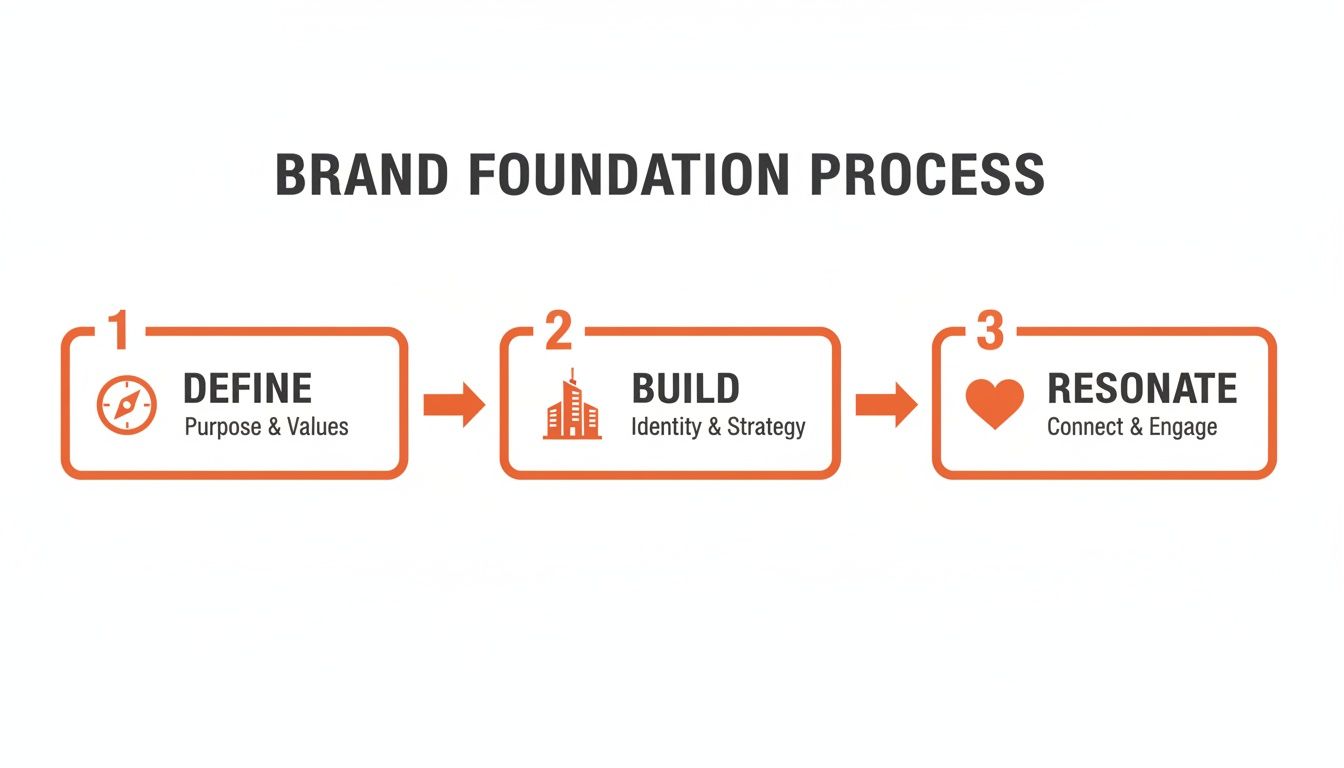
    This whole process is about learning how to define your purpose, build on that foundation, and truly resonate with the right people.

    A diagram illustrating the 3-step Brand Foundation Process: Define, Build, and Resonate.

    As you can see, a strong brand foundation isn't an accident. It's a deliberate process of figuring out your purpose before you start building. This alignment is what creates an authentic connection that makes customers stick around and sets you apart from everyone else.

    To see how this plays out with real companies, check out our guide on examples of product differentiation.

    Find Your People and Understand Their World

    A person writing notes about brand purpose, mission, vision, and values on a desk with a plant and coffee.

    Okay, you’ve wrestled with the big questions and have a sense of your brand's soul. Now comes a question that’s just as critical: who are you even building this for?

    A ton of founders fall into the "my product is for everyone" trap. That’s a fast track to building a brand that feels generic and, ultimately, connects with no one. You have to get specific. Radically specific.

    The goal is to know your ideal customer so intimately that your branding feels like it was personally crafted just for them. This isn't about surface-level stuff; it's about getting inside their head.

    Go Beyond Basic Demographics

    Demographics—age, gender, location—are just the starting line. They don't tell you the real story. Think about it: two people can have the exact same demographic profile but be complete opposites in what they value or how they shop.

    This is where you need to put on your detective hat and dig into psychographics. It’s not some fancy marketing term; it's just about understanding the actual human being behind the data. You're looking for the emotional triggers that steer their decisions day in and day out.

    Start by asking yourself questions like these:

    • What are their biggest hopes and dreams? What are they trying to achieve in their life or career?
    • What keeps them up at night? Uncover the real fears and anxieties tied to the problem you're solving.
    • What are their daily frustrations? Pinpoint those little pebbles in their shoes that your product can pull out.
    • Who do they admire and look up to? Understand their influences—is it a specific thought leader, a community, a type of artist?

    Building a brand for a specific "somebody" instead of a generic "everybody" is the secret to creating a loyal tribe. When you speak directly to their problems and aspirations, they don't just see a product; they feel seen.

    This is the stuff that separates forgettable brands from those that build a passionate, ride-or-die following. You stop just selling a thing and start offering a solution to a real, human problem.

    Creating Your Ideal Customer Profile

    Now, let's make this real. It’s time to build out your Ideal Customer Profile (ICP). This isn't just a throwaway marketing exercise; it's a living document that becomes your brand's North Star.

    Seriously, give this person a name. Find a stock photo that feels right. Write down their story.

    Before you write a line of copy, approve a package design, or schedule a social media post, ask yourself: "What would [Your ICP's Name] think of this?" This simple check-in keeps your brand focused and consistent.

    For example, at Chicago Brandstarters, our ICP isn't just "a Chicago founder." It's "Alex, the kind, hardworking side-hustler."

    • Alex has a 9-to-5 but spends nights and weekends building their dream e-commerce brand.
    • They feel totally isolated and get whiplash from all the conflicting advice online.
    • They crave genuine connection, not transactional networking events.
    • Their biggest fear isn't failing—it's looking back in 10 years and regretting they never even tried.

    Getting this granular allows us to build a community and create content that speaks directly to Alex’s world. We know their struggles because we’ve taken the time to actually understand them. You have to do the same. This is how your brand starts feeling personal and trustworthy, laying the groundwork for a loyal customer base from day one.

    Weave Your Brand Story and Core Message

    Facts and figures have their place, but they don't make anyone love your product. Stories do. You’ve already done the hard work of figuring out why you exist and who you’re for. Now it’s time to weave those truths into a narrative that grabs people by the heart.

    This isn’t about spinning some fairy tale. It’s about being honest about your story and framing it in a way that creates a real, human connection. You’re not just moving units; you're inviting people into a story where they get to be the hero.

    Your Customer Is the Hero, Not You

    I want you to forget about being the star for a minute. Seriously. The most powerful brands on the planet all know a simple secret: the customer is the hero, not the brand.

    Think of your brand as the wise guide in a movie—the Yoda, the Gandalf, the Mr. Miyagi. You have the tool, the plan, or the wisdom that helps the hero (your customer) beat their challenge and win the day. This shift in perspective changes absolutely everything about how you talk to people.

    It’s a classic framework called the hero's journey, and it’s a killer way to structure your brand message. It goes something like this:

    • A Hero (Your Customer): They have a problem they desperately need to solve.
    • Encounters a Guide (Your Brand): You pop up, showing you get their struggle and have a plan.
    • Who Gives Them a Plan (Your Product): You offer a clear path to get them where they want to go.
    • And Calls Them to Action (Your Marketing): You give them a clear, simple first step to take.
    • That Helps Them Avoid Failure: You remind them what’s at stake if they do nothing.
    • And Ends in Success: You paint a crystal-clear picture of what their life looks like after they win.

    When you frame everything this way, your brand stops being about what you do and starts being about what your customer can finally achieve with your help. It’s a small tweak, but it makes a world of difference.

    Nail Your Core Message and Tagline

    Okay, with that story in your head, you can now boil it all down into a single, powerful core message. This is your one-liner. Your elevator pitch. It’s the one idea you want to own inside your customer’s mind.

    Imagine you’re at a coffee shop trying to explain your brand to a friend. You don’t have time for corporate jargon or a 10-minute speech. It needs to be clear, punchy, and stick.

    Your core message should quietly answer three questions:

    1. What problem are you solving for me?
    2. How do you solve it?
    3. How is my life going to be better after?

    For a meal-kit service, the core message isn't, "We deliver pre-portioned ingredients." That’s boring. It's something more like, "We help busy professionals cook delicious, healthy meals at home without all the stress of planning and shopping." See the shift? The first is about the company; the second is about the customer’s transformation.

    Your tagline is the super-short, poetic version of your core message. It's the hook. Nike's "Just Do It" isn't about sneakers; it's about unleashing the hero inside you.

    Build Out Your Messaging Hierarchy

    Once you’ve got your core message and tagline locked in, you can build out your messaging hierarchy. This is just a fancy way of saying you need a set of key talking points to use everywhere—from your website to your social media bios. It keeps you consistent.

    Think of it as a pyramid.

    • Top (The Tagline): The emotional, memorable hook.
    • Middle (The Core Message): The one-sentence summary of your value.
    • Base (The Talking Points): Three to five key points that back up your core message with more detail. These might touch on specific features, benefits, or what makes you different from everyone else.

    Having this hierarchy makes sure that no matter where someone bumps into your brand, they hear the same clear, consistent story. That consistency is how you build recognition and trust, one interaction at a time. If you want to see how this plays out in the wild, we've got an article covering some excellent brand positioning examples that really bring this to life. This simple structure is your secret weapon for crafting a story that actually sticks.

    Design Your Visual Identity for Lasting First Impressions

    Two smiling professionals, a man and a woman, collaborate on a tablet in a modern office or cafe.

    Alright, now for the fun stuff—the visuals. This is what you probably pictured when you heard "branding," but we’re doing it the right way: with a solid strategy already in place.

    Your visual identity is basically your brand's uniform. It’s everything people see: your logo, your colors, your fonts, your photos. Like any good uniform, it needs to be instantly recognizable and tell people who you are before you even say a word.

    This isn't about just picking your favorite color or a cool-looking font. Every single choice has to tie back to your brand's soul and connect with the world of your customers. The goal is a killer first impression that feels both authentic and intentional.

    The Psychology of Color and Shape

    Before you fire up a design tool, it helps to know a little about the psychology behind this stuff. People have subconscious feelings about certain colors and shapes, and you can absolutely use that to your advantage. It’s like picking the right soundtrack for a movie scene—you're setting the mood.

    For example, blues tend to signal trust and dependability (think banks and big tech), while reds can spark feelings of excitement or urgency. Greens are connected to nature, health, and money. These aren't unbreakable rules, but they're powerful shortcuts for communicating your brand's personality.

    The same thing goes for shapes. Rounded, curvy shapes often feel friendly and warm. Sharp angles and straight lines can communicate strength, stability, and efficiency. When you pick a logo shape and font that align with these ideas, you’re baking your brand’s personality right into its DNA.

    The real magic happens when you combine these elements. A brand going for an "organic luxury" vibe might pair a deep forest green with a soft, elegant serif font and a logo inspired by something from nature. It all works together to tell the same cohesive story.

    This consistency is what separates a professional brand from an amateur one. It’s also the secret sauce for getting remembered in a crowded market. It takes an average of 5-7 impressions for someone to even begin to recognize a brand, and consistency is responsible for a whopping 38.7% of total brand lift. On top of that, 59% of global shoppers would rather buy new products from brands they already know and trust. You can dig deeper into these brand recognition findings if you're curious.

    Your Minimum Viable Brand Checklist

    As a founder, you don't need a hundred-page brand book right out of the gate. You just need the essentials, done right. I call this the Minimum Viable Brand (MVB). It’s the core set of assets you need to launch with confidence, look like you know what you’re doing, and keep everything consistent.

    The goal here isn't perfection; it’s a professional and cohesive start. You can always tweak things later as you learn more about your customers and your business grows.

    Below is a checklist of the bare essentials you need to look professional and stay consistent right from your launch.

    Your Minimum Viable Brand Checklist

    Asset Purpose Key Considerations
    Simple, Memorable Logo The face of your brand. Needs to be scalable (look good tiny or huge). Avoid trendy designs that will look dated in a year.
    Basic Color Palette Sets the mood and ensures consistency. Pick 1-2 primary colors, 1-2 accent colors, and a neutral (like dark gray) for text.
    Clear Typography Pairing Makes your content readable and adds personality. One font for headlines (personality) and one for body text (readability). Two fonts max. Google Fonts is your friend.
    Simple Style Tile A one-page cheat sheet for your brand visuals. Puts your logo, colors, and fonts in one place. Your quick reference to keep everything consistent.
    Compelling Launch Page Your digital storefront before you even launch. A simple landing page to show off your new brand and start building an email list.

    This checklist is your starting point—the non-negotiables for a strong launch.

    You don't need a massive budget for this, either. You can get surprisingly far with DIY tools like Canva, or find great, affordable designers on platforms like Upwork or Dribbble. Just make sure you give them a clear brief based on all the brand foundation work you've already done. That’s how you brand a product effectively from day one.

    Launch Your Brand and Build a Loyal Community

    Overhead shot of a branding design workspace with visual identity concept, laptop, color palettes, and sketches.

    Alright, you've done the heavy lifting. Your brand has a soul, a story people can connect with, and a visual uniform that looks sharp. But a brand doesn't truly exist until it starts interacting with real people.

    This final stage is all about putting your brand out into the world. It’s about that first hello, that first sale, that first bit of customer feedback. This is where all your theory meets reality.

    Forget about million-dollar ad campaigns. I want to focus on practical, low-cost ways to launch that actually work for founders who are just starting out. The goal isn't to be everywhere at once; it's to be somewhere that matters, with the people who will become your first true fans.

    Go Where Your People Already Are

    Your ideal customers are already hanging out somewhere online. They're in specific Facebook groups, Subreddits, Slack communities, or maybe they all follow the same few accounts on Instagram. Your job isn't to drag them to your doorstep; it's to go meet them where they live.

    Think of it like being new in town. You don’t stand on your front porch shouting, “Come be my friend!” You go to the local coffee shop, the park, the neighborhood meetup. You show up, you listen, and you contribute to conversations that are already happening.

    This means you need to spend way less time broadcasting and a lot more time engaging.

    • Ask genuine questions. Don't just drop your product link and run. Ask for feedback on your packaging idea or your tagline.
    • Share your hard-won insights. If you learned something the hard way, tell that story. People connect with vulnerability, not a perfect highlight reel.
    • Answer other people's questions. Become a helpful, known presence in the community long before you ever ask for a sale.

    Your brand launch isn't a single event; it's the beginning of a conversation. By showing up authentically and providing real value, you start building a community before you even have a customer.

    Make Social Media Your Stage, Not Your Megaphone

    Let’s be real, social media isn't optional anymore when you're figuring out how to brand a product. It’s your global stage. Some 77% of consumers prefer to shop from brands they follow on social, and 85% use these platforms to check out new companies before they buy.

    This is a huge advantage for solo founders. You can directly share prototypes in active chats and get honest feedback without coming across as self-promotional.

    The mistake I see so many founders make is using social media like a megaphone, just shouting about their features. Don't do that. Use it like a living room. Invite people in, start conversations, and make them feel like they're part of your journey.

    Create a Feedback Loop From Day One

    Your first customers are your most important asset. They aren't just transactions; they are your feedback engine. They're the ones who will tell you what's working, what's confusing, and what they secretly wish your product could do.

    You need to create a simple system to capture this feedback and actually act on it. This doesn't have to be complicated.

    1. Follow up personally. After someone buys, send a personal email (not an automated one) a week later. Just ask how they're using the product and if they have any questions.
    2. Listen everywhere. Set up alerts for your brand name on social media and Reddit. See what people are saying when they don't think you're listening.
    3. Turn customers into advocates. When you get great feedback, ask that person if you can share it. When you get tough feedback, thank them for their honesty and tell them exactly how you plan to fix the issue.

    This process turns your early customers into evangelists. They feel heard and valued, which makes them want to spread the word for you. A brand is a living, breathing thing, and this constant loop of listening and responding is how you nurture it and help it grow. For a detailed guide on your launch sequence, our product launch checklist template can provide a solid framework.

    Your Top Product Branding Questions, Answered

    As you start getting into the weeds of branding a new product, you’ll find a lot of specific questions pop up. These are the ones I hear constantly from founders in our community. Let’s get you some quick, honest answers to help you navigate the tricky parts.

    How Much Should I Actually Budget for Branding?

    This is the million-dollar question, isn't it? The real answer is: it completely depends on your stage. You absolutely do not need a $20,000 branding package when you’re just trying to get your first sale. Instead, focus on that "Minimum Viable Brand" we talked about earlier.

    Think of your branding budget like a dimmer switch, not a hard on/off.

    • Pre-revenue/Idea Stage: Your budget could honestly be near $0. Use free tools like Google Fonts, find a simple icon on a stock site, and use Canva to throw together a basic style tile. Your main investment here is your own time.
    • Early Revenue (under $100k): Here, you might invest $1,000 to $5,000 to work with a freelancer on a more polished logo, a professional landing page, and some decent packaging design. This is all about leveling up your first impression.
    • Growth Stage ($100k+): This is when it makes sense to bring in a small agency or a seasoned designer. Budgets can range from $10,000 to $25,000+ for a full brand identity system that can really scale.

    The key is to spend what’s appropriate for where you are right now. Don't go into debt for a perfect logo before you've even proven people want your product.

    Should I Trademark My Brand Name Immediately?

    Trademarking is basically putting a legal fence around your brand name and logo. It’s important, but the timing is everything. Rushing to trademark too early can be a huge waste of money, especially if you end up pivoting.

    I usually tell founders to follow this simple sequence:

    1. Do a "Good Enough" Search First: Before you fall in love with a name, do a quick and dirty search on the USPTO's TESS database, Google, and social media. If it’s obviously taken, just move on.
    2. Operate Without One (In the Beginning): For the first few months, while you're testing the market and getting those initial sales, it’s generally okay to operate without a registered trademark.
    3. File When You Have Real Traction: Once you have consistent revenue and you're confident this is the name, that's your cue. Hire a lawyer and get it filed.

    Don't let the legal stuff paralyze you from actually starting. The biggest risk in the early days isn't someone stealing your name; it's building something nobody wants.

    How Long Does It Take to Build a Recognizable Brand?

    Building a brand is a marathon, not a sprint. There's no magic timeline, but you have to think in terms of years, not weeks. It all comes down to showing up, consistently, over a long period.

    It’s like making a good friend. You don’t meet someone once and suddenly have a deep, trusting relationship. That bond is built through hundreds of small, consistent interactions over time. Your brand is no different.

    Every email you send, every social media post, every customer service chat—it's all another brick in the foundation. Just keep showing up, keep your promises, and stay consistent. The recognition will follow.


    If you’re a kind, hardworking founder in Chicago looking for a real community to navigate these challenges with, you should check out Chicago Brandstarters. We're a free, vetted group of peers who meet for small dinners and share honest advice in a private chat—no self-promoters allowed. Join us and build your brand with friends who get it. Find out more at https://www.chicagobrandstarters.com.

  • 10 Brand Positioning Examples You Can Steal for 2026

    10 Brand Positioning Examples You Can Steal for 2026

    In a crowded market, a great product isn't enough. You could have a killer solution, but if it gets lost in the noise, you lose. This is where brand positioning comes in. Think of it as your brand's unique fingerprint in your ideal customer's mind. It’s the specific, deliberate space you claim that separates you from everyone else. It's the answer to the question: "Why should I choose you?"

    Getting this right is the difference between being a memorable, go-to choice and just another option on the shelf. Strong positioning is your North Star. It guides every decision you make, from product development and marketing copy to your customer service and pricing. It ensures you’re not just shouting into the void but speaking directly to the people who need you most, in a language they understand.

    This isn't some theoretical lecture. I’m going to break down real-world brand positioning examples from companies you know, like Apple, Patagonia, and Stripe. We'll go beyond the surface and dissect the strategic thinking behind their success. For each one, you’ll get:

    • A clear breakdown of their positioning strategy.
    • An analysis of why it works so well.
    • Actionable takeaways you can adapt for your own venture.

    My goal is to give you a practical playbook, not just inspiration. You’ll learn how to stop guessing and start building a brand that stands for something clear, powerful, and unforgettable. Let's get started.

    1. Apple: Premium Design & Innovation Leadership

    When you think of premium technology, what’s the first name that pops into your head? For most of us, it's Apple. They've masterfully positioned themselves as the leader in beautifully designed, innovative technology that just works. Instead of getting bogged down in a specs war over gigabytes and megapixels, Apple’s positioning focuses on the user experience, the emotional connection, and the seamless integration of their ecosystem.

    A tablet on a white pedestal in a professional studio setting with "PREMIUM DESIGN" branding.

    This is one of the most powerful brand positioning examples because it elevates the product beyond its function. An iPhone isn't just a phone; it's a key to a world of creativity and connection. A MacBook isn't just a laptop; it's a tool for creators. By focusing on the why behind their design and the feeling of using their products, Apple has built a fiercely loyal customer base willing to pay a premium.

    Strategic Breakdown

    • Positioning Statement: For creative people who want the best tools, Apple is the premium technology brand that delivers a superior user experience through elegant design and an integrated ecosystem.
    • Target Audience: Consumers who value design, simplicity, and ease-of-use over raw specs. They are often willing to pay more for quality and a seamless experience.
    • Why It Works: Apple sidesteps direct feature-to-feature comparisons. Their positioning creates a distinct category where they are the leader, focusing on intangible benefits like creativity, status, and simplicity. This strategy is a masterclass in using product differentiation to build an unshakeable brand.

    Actionable Takeaways for Your Brand

    You don't need Apple's budget to apply their principles. Focus on what makes your product uniquely valuable to your specific customer.

    • Obsess Over the Details: Invest in your product quality and design. Whether it’s your packaging, your app's UI, or your customer service, every touchpoint should reflect a commitment to excellence.
    • Build an Ecosystem: How can your products or services work together to create more value than they do alone? Creating an interconnected experience increases customer loyalty and makes it harder for them to switch.
    • Tell Your Design Story: Don't just show me your product; explain the "why" behind your design choices. Help me understand how your thoughtful craftsmanship improves my life.

    2. TOMS Shoes: Purpose-Driven Social Impact

    How do you turn a simple shoe into a statement of global good? TOMS built its entire brand on the answer. They pioneered the "One for One" model, positioning themselves not just as a shoe company, but as a vehicle for social change. Instead of competing on price or trendiness alone, TOMS’s strategy is built on a powerful, simple promise: you buy a pair, we give a pair.

    This is one of the most compelling brand positioning examples because it transforms a purchase into a contribution. A pair of TOMS isn't just footwear; it's a vote for a kinder world. This purpose-driven identity allowed them to expand their model to eyewear for vision care and even coffee to provide clean water. By embedding their social mission directly into their business, TOMS created a brand I feel proud to support.

    Strategic Breakdown

    • Positioning Statement: For socially conscious consumers who want their purchases to make a difference, TOMS is the lifestyle brand that integrates a powerful social mission into its products, making it easy to do good.
    • Target Audience: Consumers motivated by altruism and a desire to support ethical companies. They want to feel good about their purchases and believe businesses have a responsibility to create positive change.
    • Why It Works: TOMS's positioning creates a unique value that goes beyond the physical product. It gives you a tangible, emotional reason to choose them over competitors. The "One for One" concept is simple, memorable, and turns every customer into an advocate for the brand’s mission.

    Actionable Takeaways for Your Brand

    You don’t need a global supply chain to build a purpose-driven brand. Start with what you can authentically impact.

    • Integrate Purpose into Your Core: Don't treat social good like a marketing campaign. Build it into the very fabric of your business so that every sale directly fuels your mission.
    • Be Transparent with Your Impact: Show me exactly what my support is accomplishing. This builds trust and reinforces my decision to choose you.
    • Empower Your Team as Ambassadors: Your employees are your best storytellers. Train them to communicate your brand’s purpose authentically, turning every interaction into a chance to share your mission.

    3. Dollar Shave Club: Challenger Brand Disruption & Authenticity

    How do you take on a market dominated by giants like Gillette? You don’t play their game. Dollar Shave Club (DSC) burst onto the scene by positioning itself as the smart, irreverent, and authentic alternative. Instead of focusing on space-age tech and five-blade systems, DSC’s strategy focused on a simple value proposition, cutting through the corporate jargon with humor.

    This is one of the most brilliant brand positioning examples because it weaponized personality. Their legendary launch video didn't just sell razors; it sold an identity. Joining Dollar Shave Club meant you were in on the joke, too smart to overpay for shave tech you didn't need. They built a club for people who value transparency and a good laugh over a corporate image.

    Strategic Breakdown

    • Positioning Statement: For the modern man who is tired of overpaying for brand-name razors, Dollar Shave Club is the subscription service that delivers high-quality blades for a few bucks a month, with a dose of authentic humor.
    • Target Audience: Price-conscious, digitally-native men who are skeptical of traditional corporate marketing and appreciate brands with a transparent, funny, and relatable personality.
    • Why It Works: DSC created a new conversation. Instead of trying to out-feature the competition, they attacked the industry's pricing and stuffiness. Their founder-led, authentic communication established an immediate bond of trust and made customers feel like insiders, a key aspect of powerful integrated marketing communication examples.

    Actionable Takeaways for Your Brand

    You don't need a viral video to disrupt your market. You just need to be more authentic than your competitors.

    • Let Your Founder Shine: If you’re a founder, you are the most authentic voice your brand has. Let your personality show in your communications, whether it's on social media, in emails, or even on your packaging.
    • Position Against an "Enemy": Define what you stand against. Is it high prices, corporate stuffiness, poor customer service, or complexity? Building your brand against a clear problem makes your value instantly understandable.
    • Use Humor to Connect: Don't be afraid to be funny and irreverent if it fits your brand. Humor breaks down barriers, makes your marketing more memorable, and creates content people actually want to share.

    4. Patagonia: Environmental Stewardship & Long-Term Values

    In a world of fast fashion and disposable goods, how do you build a brand that encourages people to buy less? Patagonia did just that. They positioned themselves as the outdoor brand for environmentally conscious adventurers who see their purchases as long-term investments. They don't just sell jackets; they sell a philosophy of durability, repair, and a fierce commitment to protecting the planet.

    Hiking gear and a 'PROTECT THE PLANET' banner on a rocky mountain viewpoint.

    This values-driven approach is one of the most authentic brand positioning examples you'll find. Instead of treating sustainability as a marketing angle, Patagonia wove it into the fabric of its business, from its "1% for the Planet" initiative to its famous "Don't Buy This Jacket" ad. Their activism and radical transparency have cultivated a loyal community that shares their values, proving that a business can thrive by putting purpose before profit.

    Strategic Breakdown

    • Positioning Statement: For conscious consumers and outdoor enthusiasts who believe in protecting our planet, Patagonia is the apparel brand that delivers exceptional, long-lasting products by putting environmental stewardship at the core of its business.
    • Target Audience: Environmentally and socially conscious people who love the outdoors. They prioritize product durability, ethical manufacturing, and corporate responsibility over low prices or fleeting trends.
    • Why It Works: Patagonia's positioning is powerful because it's authentic and consistent. They aren't just talking the talk; their actions, like suing the government to protect public lands or giving the company away to fight climate change, prove their commitment. This builds immense trust and turns customers into advocates.

    Actionable Takeaways for Your Brand

    You don't need to give your company away to build a purpose-driven brand. You can start by integrating your values into your operations.

    • Make Values Your Foundation: Don't tack your values on as a marketing afterthought. Build your business model, your product development, and your hiring practices around what you stand for.
    • Show, Don't Just Tell: Demonstrate your commitment through tangible actions. Whether you donate a percentage of sales, volunteer as a team, or source materials ethically, your actions will always speak louder than your words.
    • Embrace Radical Transparency: Be honest about your successes and failures. If you're struggling with an aspect of your supply chain, share that journey with your customers. This vulnerability builds trust and humanizes your brand.

    5. Warby Parker: Accessibility & Demystification

    For decades, buying prescription glasses was expensive and confusing. Warby Parker shattered that model by positioning themselves as the transparent, stylish, and accessible alternative. They demystified the eyewear industry by cutting out the middlemen, selling directly to consumers online, and making the whole process feel effortless and even fun.

    This is one of the most effective brand positioning examples because it identified and solved a universal customer pain point: overpaying for a necessity. By offering stylish, quality frames at a fraction of the traditional price and introducing their game-changing "Home Try-On" program, Warby Parker didn't just sell glasses; they sold confidence and convenience. They proved you don't have to choose between affordability and style.

    Strategic Breakdown

    • Positioning Statement: For design-conscious, value-seeking consumers frustrated with the traditional eyewear industry, Warby Parker is the direct-to-consumer brand that makes buying glasses affordable, easy, and socially conscious.
    • Target Audience: Millennial and Gen Z consumers who are digitally native, value transparency, appreciate good design, and are motivated by both price and social impact (via their "Buy a Pair, Give a Pair" program).
    • Why It Works: Warby Parker’s positioning directly attacks the industry's opacity and inflated costs. They built trust through transparent pricing and reduced the biggest barrier to buying online—fit—with their Home Try-On kit. This created a new category where they became the default choice for smart, modern eyewear shoppers.

    Actionable Takeaways for Your Brand

    You can apply Warby Parker’s disruptive model to almost any industry plagued by middlemen and high markups.

    • Eliminate Friction: Identify the biggest hassle in your customer's buying journey and innovate a solution. Warby Parker's Home Try-On program is a masterclass in removing purchase anxiety.
    • Embrace Transparency: Be radically honest about your costs and pricing. This builds immense trust and can be a powerful differentiator in a crowded market. Developing a clear pricing strategy for new products is a critical first step.
    • Compete on Value, Not Just Price: Don't just be the cheapest option; be the smartest option. Combine fair pricing with excellent design, a compelling brand story, and a superior customer experience to create unbeatable value.

    6. Basecamp: Tools for Deep Work & Sustainable Growth

    In a world of project management tools that promise everything, Basecamp stands out by promising to do less. They built an incredible brand by positioning themselves as the calm, sane alternative for teams overwhelmed by complexity. Instead of chasing enterprise features and endless integrations, Basecamp’s strategy is rooted in a philosophy of simplicity, deep work, and sustainable growth.

    This is one of the boldest brand positioning examples because it’s an active rebellion against industry norms. While competitors add more buttons and notifications, Basecamp removes them. This philosophy isn't just about software; it’s a way of working. They don’t sell you a tool; they sell you a better, more focused way to run your business.

    Strategic Breakdown

    • Positioning Statement: For small teams and entrepreneurs who are tired of chaos and complexity, Basecamp is the project management tool that provides just what you need and nothing you don't, so you can focus on the work that matters.
    • Target Audience: Small businesses, agencies, and teams that prioritize clear communication and deep work over exhaustive features. They are philosophically aligned with sustainability and reject the "growth-at-all-costs" mindset.
    • Why It Works: Basecamp’s positioning is a powerful act of exclusion. By proudly stating what they are not (a complex, all-in-one enterprise tool), they attract a fiercely loyal tribe of customers who feel seen and understood. Their transparency and opinionated stance build immense trust and differentiate them in a crowded market.

    Actionable Takeaways for Your Brand

    You can adopt Basecamp’s focused approach by building your brand around a core philosophy.

    • Define Your Enemy: Clearly identify what you stand against. Is it complexity, inefficiency, or an outdated industry practice? Positioning yourself as the antidote makes your value crystal clear.
    • Build in Public: Share your business philosophy openly. Founders Jason Fried and David Hansson do this through books like Rework and blog posts. This transparency builds credibility and attracts customers who share your values.
    • Embrace 'Good Enough': Focus on solving one core problem exceptionally well rather than trying to solve every problem for everyone. Sacrifice a larger market for deeper loyalty with a specific niche.

    7. Allbirds: Sustainability as Core Positioning

    What if your shoes could be comfortable, stylish, and good for the planet? Allbirds built its entire brand on this question. They masterfully positioned themselves as the go-to sustainable footwear brand for environmentally conscious consumers who refuse to compromise. Instead of treating eco-friendly materials as a footnote, Allbirds makes sustainability the core benefit and the primary reason to believe in their product.

    A black canvas sneaker with white sole rests on weathered wood, under an orange banner reading 'SUSTAINABLE COMFORT'.

    This is one of the most effective brand positioning examples because it turns a value proposition into a movement. An Allbirds shoe isn't just footwear; it’s a statement of your personal values. By using innovative materials like wool, sugarcane, and tree fiber, and transparently labeling the carbon footprint of each product, Allbirds invites you to be part of the solution. They've proven that you can build a wildly successful brand by leading with your principles.

    Strategic Breakdown

    • Positioning Statement: For the eco-conscious consumer who values comfort and style, Allbirds is the sustainable footwear brand that delivers innovative, high-quality products without compromising the planet.
    • Target Audience: Millennials and Gen Z consumers who are environmentally aware, seek transparency from brands, and are willing to invest in products that align with their personal values. They prioritize comfort and minimalist design.
    • Why It Works: Allbirds doesn't just claim to be sustainable; they prove it with every decision. From material sourcing to carbon footprint labeling, their commitment is tangible. This builds immense trust and differentiates them in a crowded market where "sustainability" is often just a buzzword.

    Actionable Takeaways for Your Brand

    You can make your mission your primary selling point, just like Allbirds. It’s about embedding your "why" into your product.

    • Make Your Mission Your Product: Don't just tack on a social cause as an afterthought. Weave your core values directly into the design, materials, and production of what you sell.
    • Embrace Radical Transparency: Measure and publicly report your key metrics. Whether it's your environmental impact or supply chain ethics, be honest about your progress and your limitations. This builds trust.
    • Educate, Don't Just Sell: Help your customers understand why your approach is different and why it matters. Explain the benefits of your sustainable choices and what their purchase supports.

    8. Mailchimp: Empowering Small Business & Self-Service

    Before Mailchimp, powerful marketing automation felt like a fortress, accessible only to large enterprises with huge budgets. Mailchimp changed the game by positioning itself as the friendly, accessible marketing partner for the underdog: the small business, the freelancer, and the solo entrepreneur. They built their brand not on complex enterprise features, but on empowerment and simplicity.

    This is one of the most effective brand positioning examples because it championed an underserved market. Instead of chasing corporate clients, Mailchimp focused on making sophisticated tools intuitive and self-service. Their friendly mascot, Freddie, and their approachable brand voice made marketing feel less intimidating, turning a complex B2B service into a tool you actually enjoy using.

    Strategic Breakdown

    • Positioning Statement: For small businesses and entrepreneurs who need to grow without a big marketing team, Mailchimp is the all-in-one marketing platform that makes it easy to build your audience and send beautiful, effective campaigns all by yourself.
    • Target Audience: Solopreneurs, small business owners, and creators who need powerful marketing tools but lack the technical expertise or budget for enterprise-level solutions. They value ease-of-use and self-service.
    • Why It Works: Mailchimp carved out a massive niche by deliberately not serving the enterprise market. This focus allowed them to build a product and a brand that perfectly matched the needs of small businesses. Their freemium model was a genius move, letting you grow with the platform and fostering incredible word-of-mouth marketing.

    Actionable Takeaways for Your Brand

    You can win big by focusing on a specific, underserved audience, even if it seems smaller at first.

    • Build for the Underdog: Identify a customer segment that bigger competitors ignore. Design your product, pricing, and messaging specifically for their unique needs.
    • Educate to Empower: Don't just sell me a tool; teach me how to succeed with it. Create extensive guides, tutorials, and case studies that help me achieve my goals, positioning you as a trusted partner.
    • Celebrate Your Community: Feature your customers in your marketing. Campaigns like "Dear Mailchimp" showcase real success stories, which builds social proof and makes your brand more relatable and authentic.

    9. Ben & Jerry's: Activism as Brand Core

    When you buy a pint of ice cream, are you just buying a dessert or making a statement? With Ben & Jerry's, it's often both. They have brilliantly positioned their brand not just around delicious, chunky ice cream but around a deep commitment to social and environmental justice. This isn't a marketing afterthought; it's baked into their DNA.

    This approach is one of the boldest brand positioning examples because it makes activism a core product feature. From flavors like "Pecan Resist" to their vocal support for climate action and racial justice, Ben & Jerry's connects with consumers on a values level. You're not just choosing a snack; you're supporting a company that uses its platform to fight for a better world, creating a powerful emotional bond that transcends the product itself.

    Strategic Breakdown

    • Positioning Statement: For conscious consumers who want to enjoy indulgent ice cream, Ben & Jerry's is the dessert brand that actively fights for social and environmental justice, making every purchase a statement of values.
    • Target Audience: Consumers who are progressive, socially aware, and prioritize buying from companies that align with their personal values. They are willing to pay a premium for products from ethical and mission-driven brands.
    • Why It Works: Ben & Jerry's positioning creates a tribe of fiercely loyal customers. They aren't afraid to be polarizing because they know their core audience will love them even more for the stands they take. This values-based differentiation makes them nearly immune to competition based purely on price or flavor.

    Actionable Takeaways for Your Brand

    You don't need a global footprint to build a mission-driven brand. In fact, starting with your local community can be even more powerful.

    • Embed Your Mission: Don't just slap a mission statement on your website. Integrate your values into your business operations, from how you source materials to how you treat your employees.
    • Be Authentic and Unapologetic: Choose causes you genuinely believe in, not just ones that are trending. Be prepared that taking a stand might alienate some people, but it will solidify your relationship with those who share your vision.
    • Show, Don't Just Tell: Back up your activism with real action. This could be through Fair Trade certifications, donating a percentage of profits, or using your platform to advocate for specific policy changes.

    10. Stripe: Power & Simplicity for Developers

    In the complex world of online payments, Stripe carved out its kingdom by focusing not on the merchant, but on the developer building the checkout experience. They masterfully positioned themselves as the ultimate toolkit for developers, emphasizing elegant, well-documented APIs and a user-first design philosophy. While competitors focused on merchants, Stripe spoke directly to the builders.

    This is one of the most effective B2B brand positioning examples because it turned a potential commodity into a premium, beloved platform. A payment processor isn't just a utility; Stripe made it a powerful, elegant, and even enjoyable part of the development process. By catering to the people who actually implement the technology, they built a moat of deep loyalty and high switching costs, winning over the startups that would become the next generation of tech giants.

    Strategic Breakdown

    • Positioning Statement: For developers and businesses who want to build sophisticated financial products, Stripe is the payments infrastructure that provides powerful, flexible, and easy-to-use APIs, removing the complexity of global commerce.
    • Target Audience: Developers, technical founders, and product teams who prioritize speed of implementation, powerful features, and excellent documentation over the lowest possible processing fee.
    • Why It Works: Stripe’s strategy brilliantly sidestepped the race-to-the-bottom on pricing. They understood that for a developer, time is the most valuable resource. Saving a week of development pain is worth far more than a fraction of a percentage on transaction fees. This developer-first approach created influential evangelists within organizations who championed Stripe from the ground up.

    Actionable Takeaways for Your Brand

    You don't need to be a fintech giant to adopt a developer-centric mindset. If your product has a technical user, these lessons are for you.

    • Obsess Over Documentation: Your documentation is a core part of your product. Invest in making it clear, comprehensive, and easy to navigate. Treat it as a key marketing tool.
    • Build an Ecosystem, Not Just a Tool: How can you integrate with other tools your audience already loves? Stripe's extensive library of integrations makes it the easy, default choice for developers building a modern tech stack.
    • Invest in Community: Create spaces for your users to learn and connect. Stripe hosts developer conferences, maintains active forums, and produces high-quality educational content that empowers their community and reinforces their brand.

    Top 10 Brand Positioning Comparison

    Brand / Positioning Implementation Complexity 🔄 Resource Requirements ⚡ Expected Outcomes 📊 Ideal Use Cases 💡 Key Advantages ⭐
    Apple — Premium Design & Innovation Leadership High 🔄 — vertical HW/SW integration and sustained R&D Very high ⚡ — design, manufacturing, ecosystem investment Premium margins, strong brand loyalty 📊⭐ Premium product lines; builders prioritizing craftsmanship Differentiation by design; ecosystem lock‑in ⭐
    TOMS — Purpose‑Driven Social Impact Medium 🔄 — embed giving model into operations Medium ⚡ — partnerships, impact measurement, supply chain Emotional loyalty and earned PR; values alignment 📊 Brands integrating social mission into core product Authentic social impact; meaningful differentiation ⭐
    Dollar Shave Club — Challenger Disruption & Authenticity Low–Medium 🔄 — focused DTC model + bold comms Low–Medium ⚡ — viral content, fulfillment Rapid awareness and organic growth; lower CAC 📊⚡ Challenger brands breaking category norms with personality Authentic voice and shareable content; fast traction ⭐
    Patagonia — Environmental Stewardship & Long‑Term Values High 🔄 — values-driven tradeoffs across business High ⚡ — sustainable sourcing, activism funding Deep loyalty, earned media, defensible premium positioning 📊 Mission-first brands willing to sacrifice short‑term growth Credibility through action; long‑term defensibility ⭐
    Warby Parker — Accessibility & Demystification Medium 🔄 — DTC + optical logistics, CX innovations Medium–High ⚡ — tech platform, inventory, fulfillment Scalable growth and trust; reduced purchase friction 📊 Making aspirational categories accessible and transparent Low friction buying (Home Try‑On); transparent pricing ⭐
    Basecamp — Tools for Deep Work & Sustainable Growth Low 🔄 — intentionally small feature set and discipline Low–Medium ⚡ — focused engineering and comms Loyal niche customers; sustainable, predictable revenue 📊 Simple productivity tools for small teams/solopreneurs Clarity of product; high retention and credibility ⭐
    Allbirds — Sustainability as Core Positioning Medium–High 🔄 — product redesign around renewable materials High ⚡ — sustainable raw materials and supply chain Premium positioning among eco‑consumers; PR lift 📊 Apparel/footwear where sustainability is primary benefit Product‑led sustainability; transparent impact reporting ⭐
    Mailchimp — Empowering Small Business & Self‑Service Low–Medium 🔄 — freemium + self‑service growth model Medium ⚡ — product UX, content, community support Viral adoption from freemium; strong LTV as customers scale 📊 Tools that democratize professional capabilities for SMBs Freemium virality; education and community focus ⭐
    Ben & Jerry's — Activism as Brand Core High 🔄 — activism embedded in sourcing and comms High ⚡ — advocacy, grants, ethical sourcing Strong emotional loyalty; polarizing but high engagement 📊 Brands that fuse product with active social advocacy Activism‑driven loyalty and media resonance ⭐
    Stripe — Power & Simplicity for Developers High 🔄 — robust APIs, reliability, global infra Very high ⚡ — engineering, compliance, docs High-value customers, network effects, low churn 📊 Developer‑first infrastructure and B2B platforms Exceptional developer experience; defensible switching costs ⭐

    Your Turn: How to Build Your Own Unforgettable Brand Position

    We've just journeyed through ten powerful brand positioning examples, from Apple's innovation fortress to Patagonia's unwavering environmental stand. We’ve seen how disruptors like Dollar Shave Club used humor to redefine a stale market and how purpose-driven brands like TOMS built empires on giving back. Each story, each strategy, offers a unique blueprint for carving out a meaningful space in a crowded world.

    But looking at finished masterpieces can feel intimidating. It’s like staring at a skyscraper and wondering how you're supposed to lay the first brick for your own shop. The key is to remember that every one of these iconic brands started with a simple, core decision. They didn't begin with a global presence; they began with a point of view.

    Distilling the Lessons: From Examples to Action

    What’s the common thread weaving through these success stories? It’s not about having the biggest marketing budget or the most revolutionary product. It's about uncompromising clarity.

    Each brand we examined knew exactly:

    • WHO they were for (and, just as importantly, who they were not for).
    • WHAT unique value they delivered that no one else could.
    • WHY it mattered on an emotional or philosophical level.

    Think about it. Stripe didn't just build payment processing; they built a tool that gave developers their time back. Basecamp didn't just create project management software; they championed a calmer, more sustainable way to work. Their positioning wasn't a tagline added at the end. It was the central organizing principle for every decision they made.

    Your First Steps to Defining Your Position

    So, how do you translate these big-picture brand positioning examples into your own strategy? Don't try to build the whole skyscraper at once. Just focus on laying a solid foundation. Start by asking yourself three brutally honest questions:

    1. The "Only" Question: What can you realistically claim to be the "only" brand that does X for Y audience? Are you the only coffee shop in your neighborhood that sources beans directly from a single family farm in Colombia? Are you the only project management tool designed for solo creatives who hate admin tasks? Find your "only."

    2. The "Enemy" Question: Who or what are you fighting against? Your enemy doesn't have to be a direct competitor. For Patagonia, the enemy is throwaway consumer culture. For Dollar Shave Club, it was the inflated razor establishment. Defining your enemy gives your brand a clear purpose and a compelling narrative.

    3. The "Evidence" Question: How will you prove your position in everything you do? If your position is "unmatched simplicity," your website checkout better be a single click. If it's "radical transparency," you should publish your manufacturing costs. Your operations must be a living testament to your positioning statement.

    Building a brand is an act of courage. It's about planting a flag and declaring, "This is what we believe, this is who we serve, and this is the change we want to see." The examples in this article prove that a well-defined position is more than a marketing exercise; it's your most powerful competitive advantage. It’s the compass that guides you, the filter for every hard decision, and the magnet that pulls your perfect customers toward you. Now, it's your turn to plant your flag.


    Feeling inspired by these brand positioning examples but need a community to help you build your own? Chicago Brandstarters is a peer support group for kind, ambitious founders just like you, dedicated to helping you translate big ideas into a powerful brand. Join us to find the clarity and support you need to build something unforgettable. Chicago Brandstarters

  • 10 Powerful Positioning Brand Examples to Inspire You in 2025

    10 Powerful Positioning Brand Examples to Inspire You in 2025

    Brand positioning can feel fuzzy until you see it work. Think of it as your brand's unique role in a crowded story—the one part no one else can play. It’s not just a logo. It's the core reason a specific group of people chooses you over everyone else, every single time. Get this right, and marketing feels less like shouting and more like a quiet conversation that pulls people in. Get it wrong, and you're just more noise.

    This article cuts through the theory. We’re breaking down 10 real-world positioning brand examples to show you how great brands carve out their own space. You won’t find generic success stories here. Instead, you'll get a clear look at the specific choices that separate iconic brands from forgotten ones.

    We’ll explore everything from community-based models to positioning based on hometown pride. You'll see how each brand clearly defines who it's for, what makes it different, and what it promises. Most importantly, you'll walk away with simple templates and clear ideas to define your own brand’s unforgettable role. Let's begin.

    1. Premium Community-Based Positioning

    This strategy flips the "open to all" model on its head. Instead of chasing scale, it focuses on building a high-value, exclusive community. Think of it less like a public park and more like a private club where membership is earned, not just bought. It uses careful vetting to create a trusted space, positioning the brand as a curated circle rather than a transactional marketplace. This attracts members who value belonging and shared standards over mass access.

    Group of people enjoying a private meal at a long wooden table with an 'Invitation Only' sign.

    Why This Positioning Brand Example Works

    This strategy builds powerful brand equity through scarcity and trust. By being selective, the value of being "in" goes way up. Members feel a sense of pride and safety, leading to deeper engagement. Brands like Soho House, Y Combinator's network, and Chicago Brandstarters use this to create a powerful flywheel. High-quality members attract more high-quality members, reinforcing the brand’s premium status.

    How to Apply This Strategy

    • Set Clear Vetting Rules: Define your membership qualifications. Is it a specific job, a shared mindset, or a "give-first" attitude? Be transparent.
    • Create Community Rituals: Host recurring events like member-only dinners or private chats to strengthen bonds.
    • Share Member Stories: Use testimonials to show the community's value and justify its selective nature.
    • Balance Exclusivity and Fairness: Make sure your vetting process doesn't accidentally shut out great people from diverse backgrounds.

    2. Values-Aligned Positioning

    This approach builds a brand around a core set of beliefs, not just product features. You're selling why you do what you do. Think of it as planting a flag; it attracts people who believe what you believe, creating an audience filtered by a shared worldview. This moves beyond simple transactions to build deep, emotional loyalty.

    Three diverse professionals smiling, a man and woman shaking hands, with a "SHARED VALUES" logo.

    Why This Positioning Brand Example Works

    This strategy unites customers under a shared mission. It fosters a resilient community that sticks with the brand through thick and thin because their loyalty is tied to their identity, not just a product's function. Brands like Patagonia (environmentalism) and TOMS Shoes (social impact) use their values as their main differentiator. This makes competing on price almost irrelevant.

    How to Apply This Strategy

    • Define Your Values Simply: Don't just say "integrity." Say, "We do the right thing, even when no one is watching."
    • Live Your Values: Weave your principles into everything, from hiring and marketing to customer service.
    • Tell Your Story: Share personal stories that show why these values matter to you. Authenticity is everything.
    • Be Clear About What You're Not: Kindly state the mindsets that don’t fit your community. This reinforces the safety of your space.

    3. Anti-Transactional Networking Positioning

    This strategy directly opposes the shallow, "what can you do for me" vibe of typical business events. Instead of optimizing for LinkedIn connections, it builds a brand around depth and real relationships. It’s the difference between collecting business cards at a chaotic mixer and sharing honest struggles in a confidential peer group. This attracts leaders who are tired of fake networking and crave authentic human connection.

    Why This Positioning Brand Example Works

    This strategy thrives by solving a deep pain for many entrepreneurs: loneliness. By creating a safe space for vulnerability, brands like Chicago Brandstarters and Vistage build intense loyalty. The value isn't a quick transaction but long-term support from trusted relationships. This model filters for members who are serious about growth, not just short-term gains.

    How to Apply This Strategy

    • State What You're Not: Market your brand by saying "no pitch sessions" or "no business card swapping." This attracts the right people.
    • Make Confidentiality Your Bedrock: Trust is your core product. Use strict confidentiality rules to create a "safe space."
    • Tell Vulnerable Stories: Share authentic "war stories" in your marketing. This shows that your community values honesty over posturing.
    • Ask for Commitment: Require a real time commitment to filter for members who are truly invested in building relationships. This is key when learning how to find business partners.

    4. Geographic/Cultural Pride Positioning

    This approach anchors a brand in a specific place and its values. Instead of being a generic company, the brand becomes a champion for a local identity. It's the difference between a faceless corporation and the neighborhood shop that knows your name. This strategy creates an "us against the world" feeling, appealing to people who are proud of where they come from.

    Why This Positioning Brand Example Works

    This approach builds a deeply loyal tribe by tapping into existing pride. It gives people a reason to choose you that goes beyond product features; they're supporting their community. A brand like Chicago Brandstarters uses the "Midwest kindness" ethos to stand out from cutthroat coastal startup scenes. This positioning attracts people who share those values and fosters a culture of genuine support.

    How to Apply This Strategy

    • Define Your Regional DNA: What cultural traits do you embody? Is it Chicago's grit, Austin's weirdness, or Portland's indie spirit?
    • Tell Local Stories: Feature founders from your area who exemplify the values you're promoting.
    • Use Local Language: Weave regional references and landmarks into your messaging to create an authentic sense of place.
    • Champion Local First: Actively support and collaborate with other local businesses. This is a key step when building a business from the ground up.

    5. Stage-Specific Positioning

    This strategy tailors a brand’s offer to customers at a specific point in their journey. Instead of a one-size-fits-all solution, it creates a focused experience for a certain segment, like an idea-stage founder or a business scaling past $1M. It’s like a specialized training program; you wouldn't give a marathon runner the same advice as someone just starting a couch-to-5k plan. This ensures your advice and resources are perfectly aligned with their needs.

    Why This Positioning Brand Example Works

    This approach works because it solves urgent, specific problems. When a brand speaks directly to a founder’s current challenges, it builds immediate trust. This focus makes marketing more efficient and the product more effective. Brands like Y Combinator (early-stage) and Chicago Brandstarters (idea-to-seven-figures) use this to make members feel understood, which dramatically increases loyalty.

    How to Apply This Strategy

    • Define Clear Stages: Map out the customer journey. What revenue, team size, or milestone marks a transition?
    • Create Stage-Specific Content: Develop resources and workshops that address the unique pain points of each stage. Avoid generic advice.
    • Build Relevant Peer Groups: Connect users with others at the exact same stage. A founder struggling with their first hire gets more value from peers facing the same challenge.
    • Celebrate Progress: Acknowledge when members move from one stage to the next. This reinforces the value of your pathway.

    6. Operator/Practitioner Credibility Positioning

    This strategy builds trust by proving you’re still "in the trenches," not just teaching theory. It’s based on the idea that the best advice comes from those who are actively doing the work. Instead of academic theories, this approach uses real-world experience, failures, and current market involvement as its currency. It positions the brand as a guide who knows the terrain because they walk it daily.

    Why This Positioning Brand Example Works

    This approach cuts through the noise of business gurus. It builds huge credibility because the advice is proven, not just plausible. Founders are drawn to leaders who share fresh "war stories" and specific tactics, not recycled frameworks from a textbook. Brands like Chicago Brandstarters, where the founder is an active operator, or individuals like Alex Hormozi build devoted followings because their expertise is validated by their own ventures.

    How to Apply This Strategy

    • Share Your Work: Regularly document your own business challenges and wins on social media to prove you're active.
    • Use Specific Language: Instead of saying "improve your marketing," share the exact ad copy or email sequence you used.
    • Reference Current Projects: Frame your advice around what you are doing right now. This makes your guidance feel urgent.
    • Admit What You Don't Know: This reinforces your credibility in the areas where you do have deep, hands-on expertise.

    7. Vulnerability-First Positioning

    This strategy flips the script on the "always crushing it" narrative. Instead of showcasing only wins, it creates a space for honest struggle, failure, and open conversations about challenges. It positions the brand as a refuge from fake corporate culture, attracting an audience that craves real connection. This approach builds deep trust by making it safe to be human.

    Three women in a cozy room, two engaged in a conversation, with 'Vulnerability First' overlay.

    Why This Positioning Brand Example Works

    This strategy creates powerful psychological safety—the secret ingredient for deep connection. When people feel safe enough to share setbacks without judgment, they form strong bonds with the brand. It’s a huge differentiator in a world obsessed with perfection. Brands like Brené Brown's Dare to Lead program prove that vulnerability is a strength. It attracts a dedicated audience tired of superficial interactions.

    How to Apply This Strategy

    • Lead with Vulnerability: As a founder, openly share your own struggles and mistakes. This sets the tone for the community.
    • Establish Group Norms: Create explicit rules around confidentiality and non-judgment. Make it clear that "what's shared here, stays here."
    • Use Skilled Facilitators: Ensure moderators are trained to maintain psychological safety and guide conversations with kindness.
    • Create Vulnerability Rituals: Start meetings with prompts that encourage sharing, like "What was a challenge this week?" instead of just "What was a win?"

    8. Peer Mentorship vs. Expert-Led Positioning

    This positioning strategy challenges the traditional “guru” model. Instead, it positions the collective wisdom of the group as the main asset. Think of it less like a lecture hall with one professor and more like a workshop where everyone is both a teacher and a student. This approach positions the brand as a facilitator of peer connection, not a single source of truth.

    Why This Positioning Brand Example Works

    This model builds trust by delivering advice that is grounded in shared, recent experience. Members get practical insights from peers who are facing similar challenges right now. This creates a highly supportive environment. Brands like Chicago Brandstarters and Vistage use this to foster deep bonds and a sense of mutual ownership over the group's success.

    How to Apply This Strategy

    • Be a Facilitator, Not a Guru: Your job is to create the space for valuable peer interactions to happen.
    • Structure Peer Teaching: Use formats like member-led workshops, "hot seats," or accountability pods.
    • Connect Peers Strategically: Actively introduce members who have complementary expertise or face similar challenges.
    • Highlight Peer-to-Peer Wins: Share stories of members helping each other. This reinforces the idea that "the group is the guru."

    9. Kindness-Filtered Selection Positioning

    This strategy makes "being a good person" a non-negotiable entry requirement. Instead of screening for status, it filters for character—specifically kindness and a "give-first" mentality. Think of it like building a team for a long journey; you don't just want skilled people, you want the ones who will pass you their water bottle. This approach intentionally rejects transactional self-promoters and builds a culture of mutual support.

    Why This Positioning Brand Example Works

    This strategy builds a powerful, self-policing culture of trust. By explicitly filtering for kindness, the brand attracts people tired of ego-driven, competitive environments. This creates a virtuous cycle where supportive members attract more supportive members. Brands like Chicago Brandstarters use this to create an alternative to cutthroat networking. It proves that being kind isn't just nice; it's a competitive advantage.

    How to Apply This Strategy

    • Define Kindness Clearly: State what "kindness" looks like in your community. Is it mentoring others? Making helpful introductions with no strings attached?
    • Ask Revealing Questions: In applications, ask things like, "Tell me about a time you helped a colleague when you got no credit for it."
    • Check References for Collaboration: Ask references specifically about the applicant's reputation as a teammate.
    • Enforce Your Norms: Create clear community guidelines around kind behavior and have a process for addressing actions that violate them.

    10. Free Model with Progression Positioning

    This strategy offers a valuable product or community for free, positioning the brand as an accessible entry point. Instead of a hard paywall, it builds a clear path for members to "graduate" into paid, next-stage programs. Think of it as offering free T-ball to everyone, then guiding the best players to a paid, advanced baseball academy. This builds trust at scale while creating a qualified funnel for higher-value offers.

    Why This Positioning Brand Example Works

    This strategy excels at building a large, engaged audience without the friction of a price tag. It establishes the brand as a supportive guide, generating immense loyalty. As members succeed through the free offerings, they naturally look to the brand for their next step. Brands like Y Combinator and Product Hunt use this to create powerful ecosystems. They provide value upfront, making the transition to paid programs feel natural.

    How to Apply This Strategy

    • Define the Pathway: Clearly map out what "graduation" looks like. What skills or milestones must a member achieve to be ready for your paid offering?
    • Build Strategic Partnerships: Collaborate with next-stage programs to create a formal progression pipeline for your members.
    • Be Transparent: Honestly communicate how the free offering is sustained. This builds trust.
    • Show the Value: Just because it's free doesn't mean it's not valuable. This helps when understanding how to price a new product for your paid tiers.

    10-Point Brand Positioning Comparison

    Positioning 🔄 Implementation Complexity ⚡ Resource Requirements 📊 Expected Outcomes 💡 Ideal Use Cases ⭐ Key Advantages
    Premium Community-Based Positioning High — intensive vetting, curated rituals High — staff for vetting, venues, legal NDAs Deep trust & loyalty but slower, limited scale Exclusive local founder networks; high-trust cohorts Strong brand loyalty, reduced free-riders
    Values-Aligned Positioning Medium — define/enforce clear values across touchpoints Moderate — content, enforcement, culture programs High member alignment, lower internal friction Mission-driven communities; differentiation strategy Authentic relationships and strong market differentiation
    Anti-Transactional Networking Positioning Medium — messaging pivot + small-format facilitation Moderate — facilitators, verification, intimate events Durable relationships; niche growth via word-of-mouth Founders fatigued by performative networking Clear differentiation; deeper, more honest connections
    Geographic/Cultural Pride Positioning Low–Medium — integrate regional cues and stories Low — local events, storytelling, regional partnerships Strong local identity and network effects; limited national appeal Regional ecosystems seeking identity (e.g., Midwest founders) Defensible local differentiation and community pride
    Stage-Specific Positioning Medium — multiple stage programs and graduation rules Moderate — curricula, stage-matching, partner integrations High relevance and retention; natural progression funnel Programs targeting idea-stage → revenue-stage founders Tight peer alignment; better problem-fit and retention
    Operator/Practitioner Credibility Positioning Low–Medium — founder must demonstrate active operator status Low — founder time, case studies, real war stories High practical trust; attracts experience-seeking founders Entrepreneurs wanting tactical, real-world guidance Immediate credibility and actionable, current advice
    Vulnerability-First Positioning Medium–High — establish norms, moderators, legal protections Moderate — skilled moderators, confidentiality processes Deep psychological safety and honest learning; uneven comfort levels Founders needing emotional support and real problem sharing Strong trust, reduced isolation, richer knowledge transfer
    Peer Mentorship vs. Expert-Led Positioning Medium — design facilitation and peer structures Low–Moderate — matching systems, community managers Scalable collective wisdom; variable advice quality Communities aiming for sustainable, member-driven value Scalable, resilient community; mutual value creation
    Kindness-Filtered Selection Positioning Medium — operationalize kindness criteria and checks Moderate — vetting, reference checks, enforcement Collaborative, low-toxicity culture; subjective exclusions possible Communities prioritizing collaboration over competition Highly supportive, non-zero-sum member culture
    Free Model with Progression Positioning Medium — design free offering + paid progression pathways High — subsidy/sponsorship, partner coordination Large accessible funnel; conversion-dependent monetization Early-stage founders; programs building partner funnels Low barrier entry; strong top-of-funnel growth and goodwill

    From Example to Action: Your Turn to Position Your Brand

    We've explored a powerful lineup of positioning brand examples, each showing a simple truth: great positioning isn’t about casting a wide net. It’s about planting a flag. It’s a brave choice to claim a specific hill in a crowded market and declare who you serve and why you're the only one for them.

    Think of your brand positioning as a lighthouse. It doesn't light up the whole ocean. Instead, it sends a clear, powerful beam toward one channel, guiding the right ships to shore. The brands we looked at all built their own lighthouses. They didn't just sell products; they offered a point of view and a sense of belonging.

    Key Insights to Guide Your Next Steps

    The common thread in these strategies is clarity through focus. By embracing limits—like focusing on a specific audience, a core value, or a unique method—these brands created immense value. They chose a narrow path and became the leader on it.

    Your most important takeaways should be:

    • Positioning is about what you say no to. The real work is deciding what you’re willing to give up. Who are you not for? Answering this is where your identity emerges.
    • Emotion beats features. Every powerful positioning example connects on a human level. They don't just solve a functional problem; they address a deeper need for community, status, or connection.
    • Your story is your advantage. Anyone can copy a product, but no one can copy your story, your values, or your community. This is your most defensible asset.

    Your Action Plan: Define Your Position

    Seeing these positioning brand examples is the first step. Now it's time to build your own. Don't just read this and move on. Take action.

    Start by answering these three questions with complete honesty:

    1. Who is my hyper-specific audience? Go beyond demographics. What are their secret hopes and biggest frustrations?
    2. What is the one unique promise I can make them? What singular problem do you solve better than anyone else?
    3. What is my undeniable proof? How do you prove your promise? Is it through your background, your process, or your community?

    Your answers are the raw materials for your positioning. Let your authentic voice and bold vision be the foundation. Your brand’s power lies not in being perfect for everyone, but in being irreplaceable for the right someone.


    If you’re a founder in Chicago or the Midwest building a brand and crave a community that puts these principles into practice, consider joining us. Chicago Brandstarters is a peer community where kind, ambitious builders share real-world playbooks, skip the common pitfalls, and grow together, using the very positioning strategies we've discussed. Learn more and apply to join at Chicago Brandstarters.