Got that brilliant idea keeping you up at night? I know the feeling. That’s the spark. But a spark is fleeting. A roadmap for business is what you need to turn that spark into a sustainable fire, guiding your idea from a thought into actual revenue.
Why Your Great Idea Needs a Real Business Roadmap
You have an amazing idea. I don't doubt that for a second. But an idea without a clear path forward is just a dream waiting to get lost in the day-to-day chaos.
Let me be clear: a roadmap for business isn't some rigid, fifty-page corporate document you write once and forget. It’s your personal guide from ‘what if’ to ‘what is.’
Think of it like planning a cross-country road trip. You wouldn’t just get in the car and start driving west, hoping you end up in California. You'd pick your destination, identify major cities to stop in, and maybe book a few hotels. Your business roadmap does the exact same thing for your entrepreneurial journey.

From Sticky Notes to Strategic Action
My first roadmap was just a collection of sticky notes on my bedroom wall.
That simple act forced me to get honest with myself about my priorities. It turned my abstract dreams into concrete, actionable steps I could take the next day. This isn't about predicting the future with a crystal ball. It’s about you making intentional choices today that build the future you actually want.
This clarity is your superpower as a founder. It helps you confidently say 'no' to the shiny objects and distractions that constantly pull for your attention. Instead, you can say 'yes' to the opportunities that truly move your business forward.
A roadmap doesn't just tell you what to do; it reminds you what not to do. It’s your strategic filter for every decision, ensuring you stay focused on the destination.
Building Your Foundation First
Imagine trying to build a skyscraper. You wouldn't just show up with a truck full of bricks and start stacking them, would you? Of course not. You'd start with a blueprint—a plan that outlines the foundation, the structure, and every critical system.
Your business deserves that same thoughtful planning.
Your roadmap is that foundational blueprint. It provides the structure you need to support your growth and helps you avoid critical mistakes that can derail an otherwise brilliant idea. Without it, you're just building on shaky ground.
Defining Your Destination and Ideal Customer
Before you draw a map, you have to know precisely where you’re going. This isn't just some fluffy goal; it's your 'North Star'—your core mission. What change are you trying to create in the world, and why should anyone care?
Think of your mission as the destination you’d plug into your GPS before a long trip. Without it, you're just driving aimlessly. This mission statement becomes your gut check for every single decision, helping you navigate the endless choices you'll face. It’s what keeps you grounded when things inevitably get tough.
From Vague Ideas to a Real Person
But a mission is meaningless without people to champion it. This is where your roadmap for business gets personal. You need to get laser-focused on your ideal customer. I don’t mean a vague demographic like ‘millennial women.’ That’s like trying to find a friend in a crowded stadium by shouting their first name. It's useless.
You need to know them intimately.
- Who are they, really? Go beyond age and gender. What do they do for work? What are their passions and frustrations?
- Where do they hang out? Are they scrolling Instagram, networking on LinkedIn, or lurking in specific Reddit communities? What podcasts do they listen to?
- What do they actually value? What beliefs drive their buying decisions? Do they prioritize sustainability, convenience, or status?
Suddenly, 'millennial women' becomes: 'Jessica, a 32-year-old creative professional in Austin who values sustainable products and follows local artists on Instagram.' Now you have a real person to talk to.
When you know exactly who you're building for, every decision becomes simpler—from product features to marketing copy. It’s the difference between shouting into a void and having an intimate conversation with a friend.
Why This Focus Is Your Superpower
When you’re starting out, you absolutely cannot afford to be everything to everyone. Trying to do so dilutes your message and burns through your limited resources. Pinpointing your 'Jessica' is your most powerful asset.
This intense focus ensures you're building something a specific group of people will absolutely love, rather than something a lot of people will just kind of like. That’s how you build a real brand.
This deep customer understanding is the first critical stop on your business roadmap. If you need help refining this crucial step, you might be interested in our guide on how to properly validate your business idea. It's the foundation upon which you'll build every other milestone.
Alright, you've got your grand vision and you know exactly who you're building this thing for. Now for the hard part: how do you actually get from here to there without crashing?
The secret is to stop thinking about it as one giant, terrifying leap. A real-deal roadmap for business breaks the journey down into smaller, manageable legs. It’s a series of intentional, sequential steps.
Think of it like building a house. You don't just start nailing boards together. You have to pour the foundation, then frame the walls, and only then do you get to the roof. Your business grows the exact same way, in phases.
Phase 1: The Hustle (Months 0-12)
Your first year is all about one thing: validation. I call this the Hustle Phase. Your goal isn't to build a perfect, polished machine. It’s to prove your core assumptions are right and, most importantly, get that first dollar in the door.
It’s messy. It’s hands-on. And it’s absolutely critical.
During this phase, your key milestones should be laser-focused on learning:
- Get a Minimum Viable Product (MVP) out the door. It doesn't have to be pretty, but it must be real enough for your ideal customer to use.
- Find your first 10 true fans—these are the people who genuinely get what you're doing and are willing to pay for it.
- Have brutally honest, unfiltered conversations with potential customers. You need to understand their real-world pain points, not what you think they are.
This initial timeline visualization shows how your mission and ideal customer become the guiding stars for your growth strategy.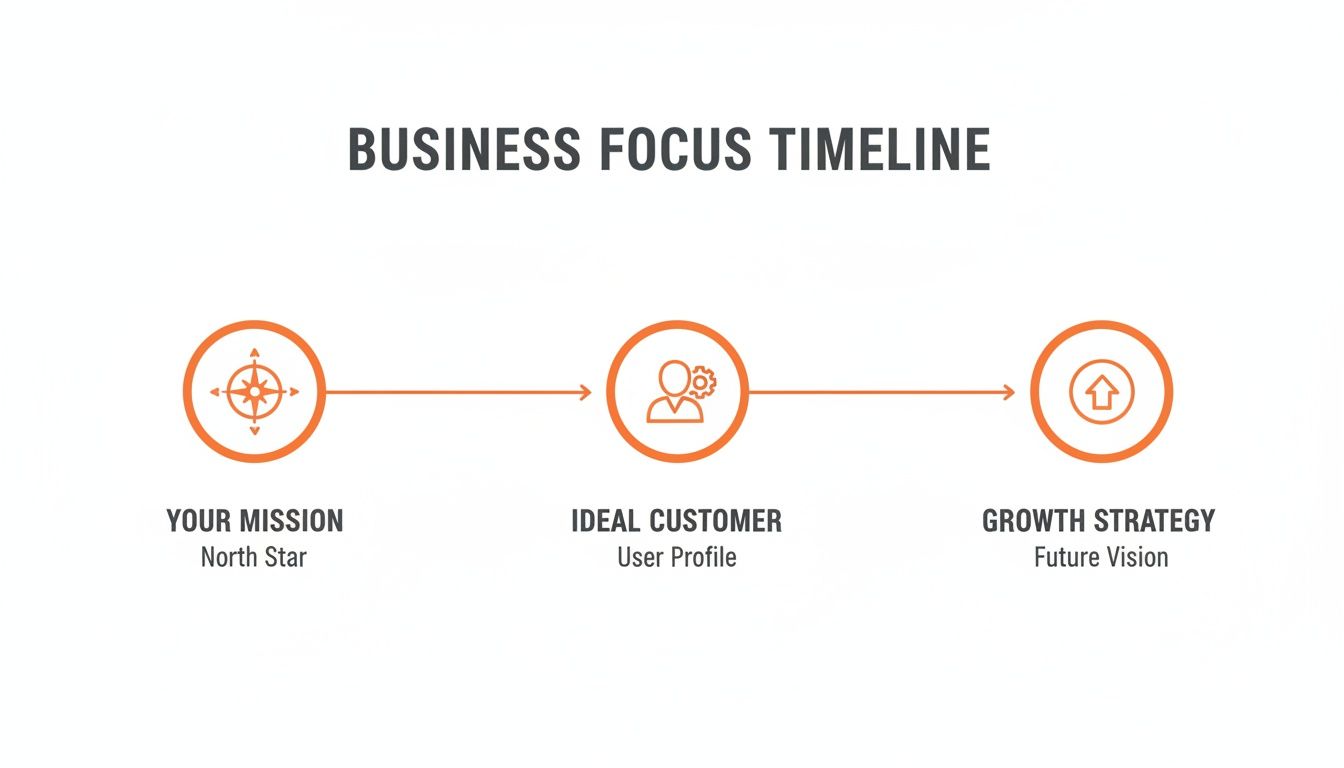
These aren't just one-and-done tasks. You'll come back to these foundational pillars again and again as you grow.
Phase 2: The Foundation (Months 12-24)
Once you've proven that people want what you're selling, year two is about building systems that can run without you. Welcome to the Foundation Phase. You’re graduating from scrappy tactics to sustainable processes.
The goal here is to create an engine that doesn't require you to manually crank it every single day. This is less about frantic discovery and more about deliberate, solid construction.
Maybe this means you dial in your marketing funnel, streamline how you deliver your product, or make that crucial first hire to finally get some tasks off your plate. If you want to dig deeper into this stage, our startup business plan template is a great place to start.
Phase 3: The Scale (Months 24-36)
By year three, you should have a solid foundation and a predictable way to make money. Now, it's time to pour fuel on the fire. This is the Scale Phase.
This is where you start looking at those big growth opportunities that were just distractions before. You're no longer in survival mode; you're actively hunting for ways to multiply your impact and revenue.
This could mean exploring new customer segments, launching a complementary product, or even expanding into different cities or countries.
This phased approach turns a massive, intimidating goal into a series of achievable checkpoints. You build momentum and confidence with every milestone you hit, making the journey feel possible.
This table gives you a high-level look at what to focus on during each phase of your business journey, from that first spark of an idea to really scaling up.
Your 36-Month Roadmap At A Glance
| Timeframe | Primary Focus | Key Milestones Example |
|---|---|---|
| 0-12 Months | Validation & Learning | Launch MVP, secure first 10 paying customers, achieve initial product-market fit. |
| 12-24 Months | Systemization & Repeatability | Document core processes, hire first key employee, reach consistent monthly revenue. |
| 24-36+ Months | Strategic Growth & Expansion | Explore new markets, develop a second product line, build out a leadership team. |
Having a structured roadmap makes a massive difference. Think about it: organizations that use them achieve a 73% faster time-to-insight, turning ideas into actionable strategies way quicker than competitors who just wing it. It's about moving smarter, not just harder.
Choosing The Metrics That Actually Matter
It’s way too easy to get hooked on vanity metrics. Seeing your social media likes shoot up or website traffic spike feels incredible, but those numbers don't pay the bills. Your roadmap needs to be anchored in metrics that signal real financial health, not just popularity.
Think of yourself as the pilot of a small plane. The altitude meter is cool to look at, but the fuel gauge is what tells you if you're actually going to make it to your destination. You need to be obsessed with your "fuel gauge" metrics.
Identifying Your Core KPIs
The whole game is about picking a handful of Key Performance Indicators (KPIs) that you live and breathe. These are different for every business, but they always, always tie directly to revenue and sustainable growth. Trying to track twenty different numbers is a recipe for confusion.
- For an e-commerce brand, you're probably looking at Customer Acquisition Cost (CAC) and Customer Lifetime Value (CLV). Bottom line: are you paying more to get a customer than they'll ever spend with you? If so, you've got a leaky bucket.
- For a software startup, your lifeblood is likely Monthly Recurring Revenue (MRR) and churn rate. How much predictable cash are you bringing in, and how fast are your customers leaving?
- For a service business, it could be your profit margin per project and your client retention rate. Are your jobs actually profitable, and do clients stick around for more?
These aren't just numbers on a spreadsheet; they are the vital signs of your business. They tell you what's working, what's broken, and where to point your limited energy.
You're not trying to become a data scientist overnight. Your goal is to be an informed founder who makes decisions based on reality, not just wishful thinking.
From Theory to a Simple Dashboard
Once you’ve locked in your 2-3 core metrics, track them like a hawk. You don't need some fancy, expensive software for this. A simple spreadsheet is all you need to get going.
Set up a basic dashboard and commit to logging these numbers every single week. This weekly ritual forces you to confront the truth. It makes it impossible to ignore the red flags. From there, you can set realistic targets for these KPIs right inside your roadmap, giving you clear benchmarks to shoot for.
I've seen it happen time and again. A kind-hearted 9-5er in Chicago dreams of building a side-hustle empire. They turn that dream into a real plan by anchoring their roadmap with clear KPIs. When they review their progress, they're able to make 28% tactic pivots to stay on track. These simple visual tools help you sequence big moves—like a product launch in Q1 or landing two key partnerships by year-end—and can boost team performance by as much as 35%. You can learn more about mastering this kind of strategic planning to ensure your business actually succeeds.
Choosing the right metrics is what turns your roadmap from a wish list into a practical, no-BS guide. It keeps you focused on what really matters: building a healthy, profitable business that lasts.
You've got a million ideas swirling around and a to-do list that looks like a novel. So, what do you actually do next? This is the moment most founders freeze up, paralyzed by choice. You end up doing a lot of stuff, but making very little real progress.
The problem is usually emotional guesswork. We chase the shiny new idea or the task that feels exciting, not the one that will actually push the business forward. To build a roadmap that works, you need a system to cut through the noise.
Introducing the RICE Framework
Let me introduce you to a simple but incredibly powerful framework for this exact problem. It's called the RICE model, and it's a way for you to score your ideas objectively, forcing you to think critically instead of just reacting.
It stands for:
- Reach: How many people will this actually touch in a given timeframe?
- Impact: How much will this move the needle on your main goal (like revenue or sign-ups)?
- Confidence: How sure are you about your estimates? Be honest with yourself here. A wild guess gets a low score.
- Effort: How much time and how many resources will this really take from you or your team?
This isn't about getting lost in math. It's about creating a quick, logical filter. You give each factor a score, run a simple calculation (Reach x Impact x Confidence / Effort), and the ideas with the highest scores bubble up to the top. It pulls your ego and emotions right out of the decision.
RICE in the Real World
Let's make this tangible. Imagine you're an e-commerce founder trying to figure out your next quarter's focus. You've got three big ideas on the table:
- Launch a Company Blog: This is a ton of work, but it could have a huge long-term reach.
- Run Targeted Social Media Ads: Much less effort to get started, with a measurable but maybe smaller reach.
- Build a New Product Feature: High impact for your current customers, but it won't reach any new people.
When you score each of these using RICE, the right choice often becomes surprisingly clear. You might realize that while that new feature sounds sexy, the targeted ads offer a much better return on your effort right now.
A prioritization framework like RICE doesn’t just tell you what to do. It gives you permission to ignore everything else. That's how you build real momentum instead of just staying busy.
Think about it: a solo e-commerce founder in the Midwest, feeling crushed by the big-city hustle, finds out that building Strategic Business Roadmaps takes moderate effort but delivers massive organizational alignment. We know that getting executive input can lead to 30% better investment prioritization.
Unlike those rigid, soul-crushing Gantt charts, these high-level maps are about your vision, not micromanaging every single task. That’s perfect for you in the early stages. For more on this, you can discover more insights about project roadmaps and how they drive success. This is how you stop spinning your wheels and start building a business that actually gets somewhere.
Finding Your Community So You Don't Build Alone
Let’s be honest: building a business is an incredibly lonely journey. You're constantly wrestling with problems you’ve never seen before, and it’s so easy to trick yourself into thinking everyone else has it figured out.
I can promise you, they don’t.
The single greatest accelerator I’ve ever found as a founder is a trusted circle of peers who just get it. This isn’t about superficial networking events. It's about genuine connection with people who are right there in the trenches with you.

Why Peer Feedback Is Your Secret Weapon
Your roadmap is a living document, not some sacred text you carve in stone. Getting feedback from people who are a few steps ahead or right alongside you is like having a world-class advisory board on speed dial. They’ll spot the potholes in your plan that you’re too close to see.
This is exactly why I started a group called Chicago Brandstarters. We wanted an intentional space where you can share war stories over dinner, admit you're stuck, and get brutally honest advice from people who have been there.
This kind of environment is where your roadmap gets pressure-tested against reality. For a deeper dive, check out our thoughts on why mastermind groups for entrepreneurs are so powerful for actually moving the needle. It's all about turning theory into tangible results.
The Power of Shared Experience
You’re going to hit walls. You’ll have moments of crippling self-doubt. In those moments, knowing you’re not the only one fighting this battle makes all the difference.
Your goal isn’t to find people who will tell you what you want to hear. Your goal is to find people who care enough to tell you what you need to hear, even when it’s tough.
A strong peer community offers more than just tactical advice. It provides you with:
- Accountability: They’ll call you out when you’re not hitting the milestones on your own roadmap.
- Perspective: They’ll remind you that the crisis you’re facing today is just a temporary roadblock, not a dead end.
- Motivation: Their wins will inspire you, and their struggles will normalize your own.
Whether it's our community or another one, find your people. Your journey will be faster, less stressful, and far more rewarding because you didn't try to do it all alone.
Alright, let's clear up a few questions that always pop up when I talk to founders about their roadmap. Getting these sorted out is the last step before you can really dive in and start mapping your own journey.
How Often Should I Update My Business Roadmap?
Look, your roadmap isn't some sacred text you carve into stone. It’s a living, breathing guide.
I tell most founders to sit down with it once a quarter. That’s the sweet spot—long enough for you to see real progress, but short enough for you to pivot if the market throws you a curveball.
But if you're in the super early days, like pre-product or still chasing that first dollar, you need to check in more often. Monthly is probably best. Things move at lightning speed when you're just getting off the ground, and your map needs to keep up.
Think of your roadmap as a GPS, not a paper map. It’s built to recalculate when you hit a roadblock. It's not there to make you drive off a cliff just because the original plan said to go straight.
What's the Difference Between a Business Plan and a Roadmap?
This one’s easy. Imagine you’re building a house.
The business plan is the massive, formal architectural blueprint. It’s what you show the bank to get your loan. It’s dense, packed with financial projections, market analysis, and all the stuff that proves you’ve done your homework. It’s mostly static.
Your business roadmap? That's the high-level construction schedule you tape to the wall for your crew. It’s visual. It shows what’s happening and when—foundation in Q1, framing in Q2, plumbing in Q3. It's an internal tool for you, focused purely on action and built for flexibility.
Can I Create a Roadmap If I Only Have an Idea?
Yes! In fact, that's the absolute best time to start. Don't overthink it. Your first roadmap will be beautifully simple, and that’s a good thing.
Your "0-3 Months" milestone might just be:
- Talk to 20 people who might be customers.
- Throw up a simple landing page to see if anyone signs up.
That's it. This simple act takes your dream out of your head and gives it the first, most important thing it needs: an actionable step forward.
Building a roadmap alone is tough. At Chicago Brandstarters, you'll find a community of kind, hard-working founders in the trenches with you, ready to pressure-test your plan and cheer you on. Join our free community and start building with support.
Leave a Reply