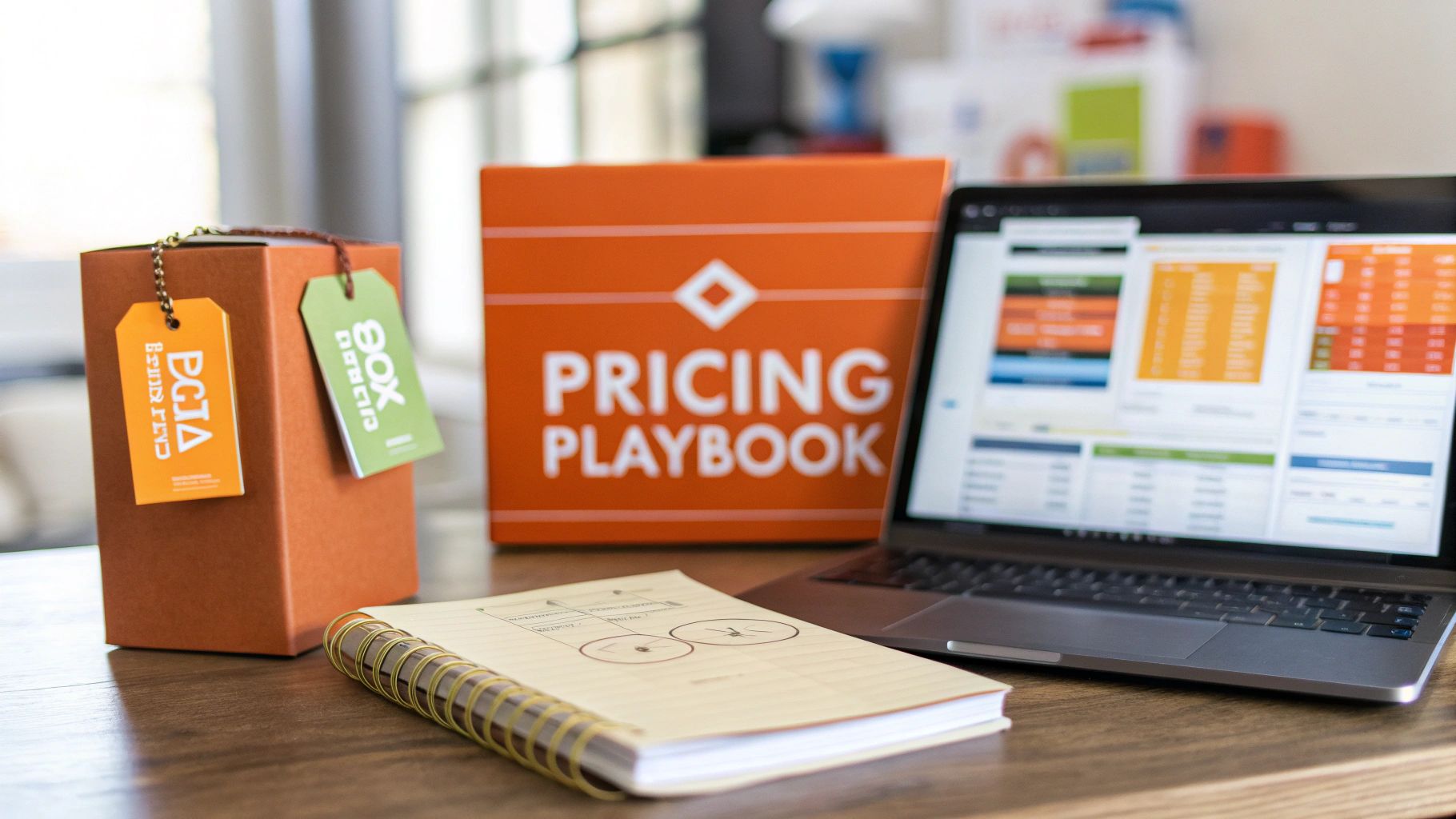
Figuring out how to price a new product is your roadmap to actually making money. I'm not talking about pulling a number out of thin air. You need to strategically link what you charge to the real value your customers get. It’s how you confidently set a price that feels right for your brand, covers your expenses, and taps into what people will actually pay.
Trust me, I learned this the hard way. Your price isn't just a number—it’s a powerful statement about what your product is truly worth.
Moving Beyond Guesswork in Product Pricing
Let’s be real. Pricing a new product often feels like throwing a dart in a dark room and just hoping you hit the board. You’ve poured everything into creating something incredible, and now you have to slap a price tag on it. This is the exact spot where I see most founders, myself included, get completely paralyzed.
My goal here is to cut through the noise and give you a clear, no-BS starting point. I'm not giving you some dusty textbook theory. I'm giving you what's built on my own pricing blunders and the hard-won lessons that came after. We're going to break down the common traps so you can start making confident decisions.
The Cost-Plus Pricing Fallacy
So many of us first-timers fall back on cost-plus pricing. It seems logical, right? You calculate your costs, tack on a profit margin you like, and—boom—you have a price. But this is a classic trap that will absolutely kill your potential.
Imagine you're selling a rare painting. A cost-plus model is like adding up the cost of the canvas, the paint, and maybe a few bucks for your time. You might price it at $100. But what if that painting moves someone so deeply it changes how they see the world? Its value isn't in the materials; it's in the emotion. They might happily pay $5,000 for it.
When you obsess over your costs, you leave a ton of value—and money—on the table. Your price should reflect the problem you solve, not just what it costs you to build.
The single biggest mistake I see is pricing based on costs or a gut feeling. This almost always leads to underpricing and leaving money on the table. Your price is a signal of your product's value and your confidence in it.
Shifting to a Value-First Mindset
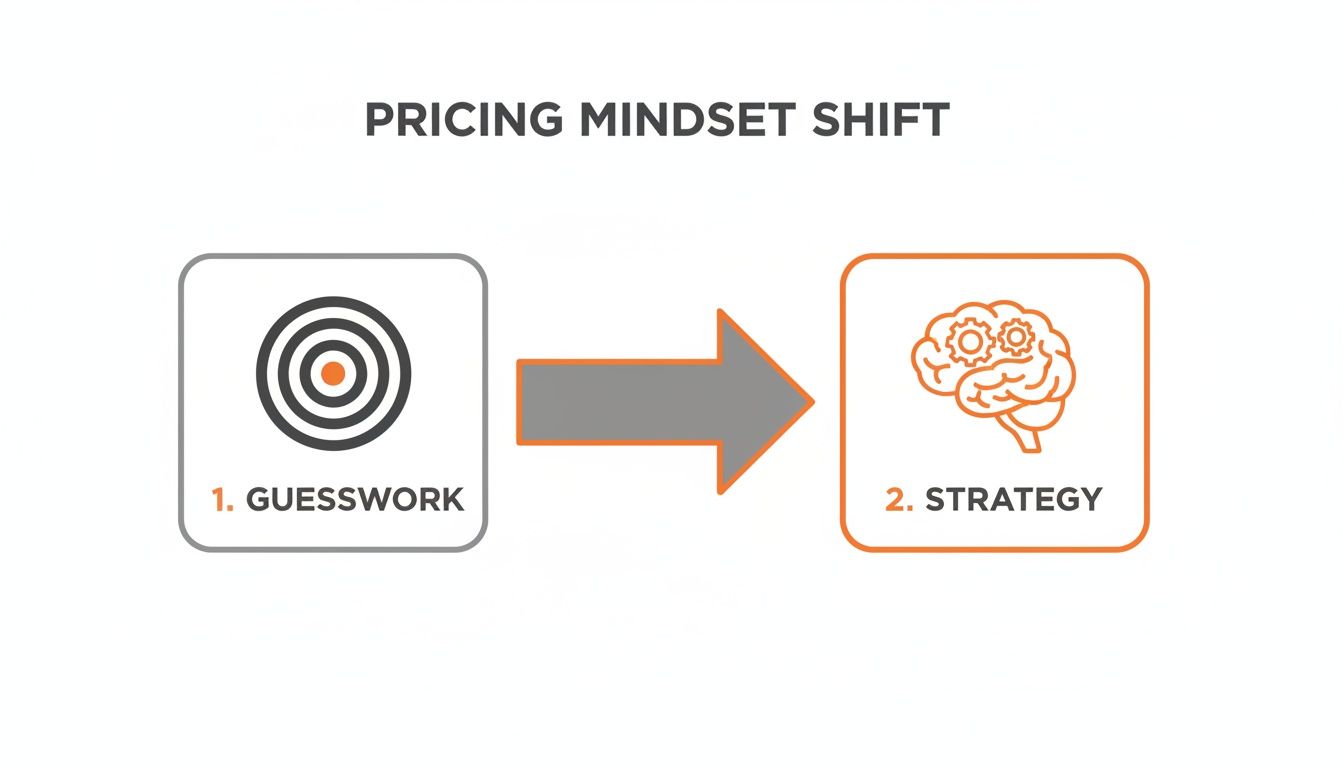
The alternative? Build your entire pricing strategy around customer value. This means you have to make a mental shift from asking, "How much does this cost me to make?" to "How much is this worth to my customer?"
This one change affects everything. It forces you to get inside your customer's head, understand their biggest headaches, and see exactly how your product makes their life better. Your price then becomes a direct reflection of that positive impact.
To get started, you need to laser-focus on a few core ideas:
- Nail the Pain Point: What specific, expensive, or frustrating problem does your product solve? Put a number on it if you can. Does it save them hours of work? Does it cut down on costly errors? Does it help them make more money?
- Know the Alternatives: What are your customers doing right now to deal with this problem? Your price needs to make switching to your solution a complete no-brainer.
- Shout the Value from the Rooftops: Your marketing, your sales calls, and your product itself all need to scream "value." The price should feel like a fair trade for the awesome benefits they're about to get.
By the end of this guide, you'll have a simple framework to stop guessing and start making pricing decisions that actually fuel your growth.
Gathering Your Pre-Pricing Intelligence
Before you even think about putting a price tag on your new product, you need to put on your detective hat. Your mission is to gather intelligence on three critical fronts: your costs, your customers, and your competition. I don't mean getting buried in spreadsheets; I mean building a rock-solid foundation for every pricing decision you make from here on out.
Think of it like building a house. You wouldn’t start framing the walls without pouring a concrete foundation first. This intelligence is that foundation, making sure your pricing strategy doesn't collapse under the slightest pressure.
Doing this homework is what shifts your pricing from a wild guess to a deliberate, informed strategy.
Nail Down Your Unit Economics
First things first, let's figure out your absolute floor—the bare minimum you have to charge just to keep the lights on. This is where your unit economics come into play. You have to know, for every single unit you sell, exactly what it costs you to make and deliver it.
This isn’t just your big overhead costs. I'm talking about everything directly tied to one single sale:
- Cost of Goods Sold (COGS): For a physical product, this is your raw materials, manufacturing labor, and packaging. If you’re selling software, think specific server costs or third-party API calls tied to a single user.
- Variable Costs: These are things like credit card transaction fees, shipping expenses, or sales commissions. Any cost that goes up directly with each sale.
Add it all up. That number is your price floor. If you sell for anything less, you are literally paying your customers to take your product off your hands.
Uncover What Your Customer Is Really Willing to Pay
Knowing your floor is just the start. The real magic happens when you figure out the ceiling—what your customers will actually pay for the value you provide. This is all about perceived value, and the only way I know to find it is by actually talking to people.
I get it, it can feel awkward. But you can never ask, "So, what would you pay for this?" That’s a dead end. Instead, you need to have value conversations. Your goal is to deeply understand the pain your product solves.
Try asking questions like these:
- "How are you dealing with this problem right now?"
- "What's the most frustrating part of that process for you?"
- "If that frustration just vanished tomorrow, what would that be worth to you or your business?"
Their answers are gold. If your product saves them $500 a month in wasted time, a $99/month price tag suddenly feels like a steal. These conversations should be part of your early development anyway, and you can get a better sense of how to structure them by reading up on how to validate a business idea.
You’re not selling a product; you’re selling an outcome. Your price should be a small fraction of the value of that outcome.
Map Out the Competitive Landscape
Finally, it’s time to size up the competition. I’m not telling you to just copy their pricing—that’s a race to the bottom that nobody wins. What you're actually doing is building a "value map" to see where your product fits in the current market.
Pick your top three to five direct competitors and analyze them across two key dimensions: price and their primary value proposition.
- Price: Are they positioned as a budget option, mid-tier, or a premium solution?
- Value: What's their main hook? Is it speed? Simplicity? A killer feature? Unbeatable customer service?
Plot this out on a simple chart. You'll quickly see where the market is crowded and, more importantly, where the gaps are. Is there an opening for a high-touch, premium product? Or maybe a simpler, more affordable option for users who are overwhelmed by complex tools?
This analysis helps you position your product not just to compete, but to win by offering something uniquely valuable. This initial intelligence gathering is the absolute cornerstone of a killer pricing strategy for new products.
Mastering Price Skimming for Maximum Early Returns
Alright, let's talk about your opening move. One of the most powerful plays you can run is price skimming. It’s a bold approach, for sure, but it can pay off big time if you’ve got the right product.
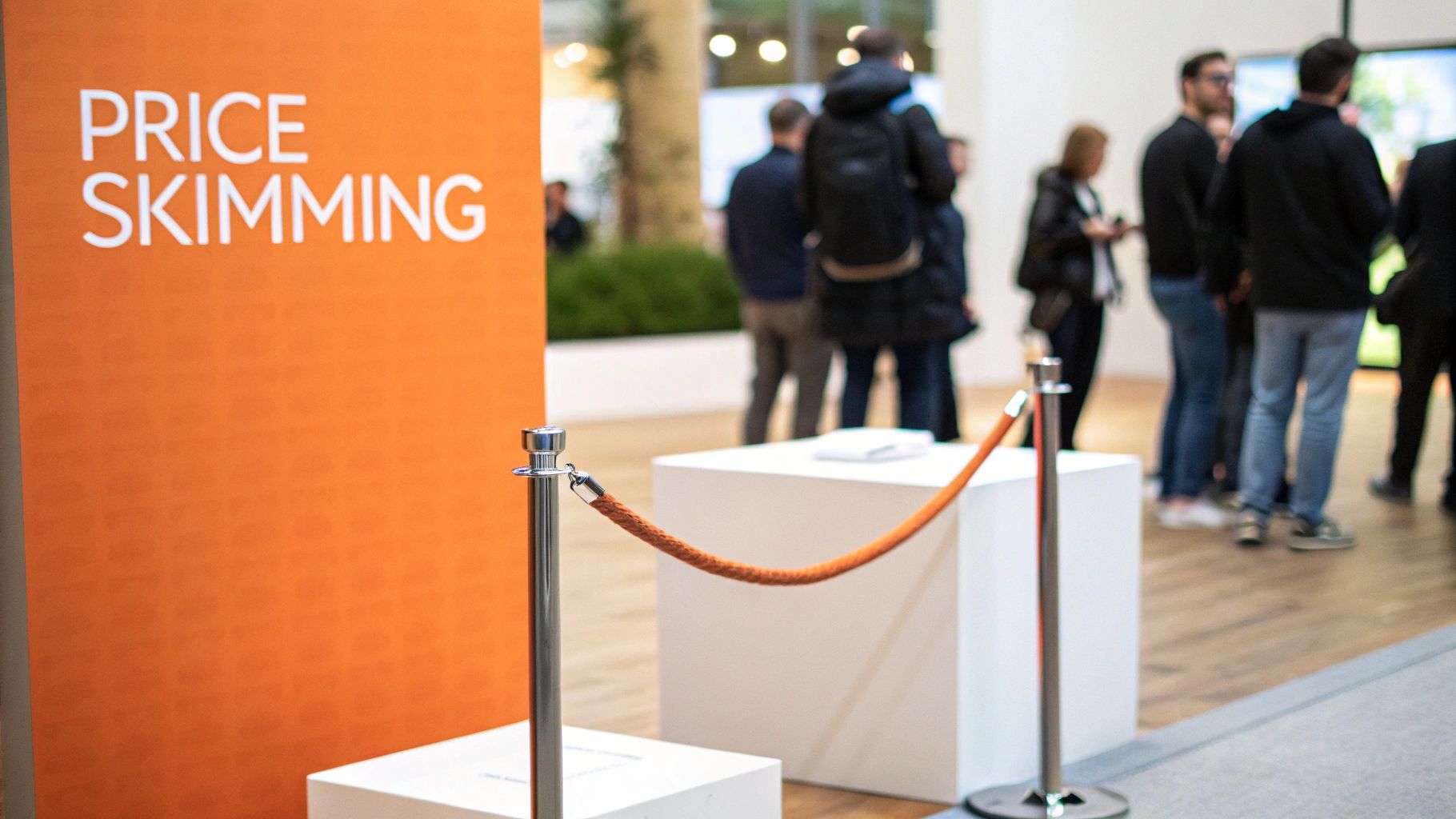
I want you to think of it like this: you're launching the hottest new restaurant in town. For the grand opening, you're not running a two-for-one special. Instead, you're booked out for months with a high-end prix fixe menu. Price skimming is the velvet rope for your product launch—you set a high initial price to capture as much value as possible from the early adopters, the ones who absolutely have to be the first to get what you've built.
This isn't about being greedy. It’s a smart way for you to recoup your R&D costs fast, which you can then pour back into growth and whatever you’re building next.
When Price Skimming Is Your Best Bet
Price skimming doesn’t work for just any product. I've designed it for a very specific situation where you have a clear, undeniable advantage. If you try to skim with a "me-too" product, you'll just look out of touch.
You should seriously consider this strategy if your new product:
- Has a Strong First-Mover Advantage: You've built something genuinely new or so much better than the alternatives that, for a little while, you are the market.
- Is Protected by a Moat: This could be a patent, a unique piece of tech, or a brand that’s already earned a ton of trust. Basically, anything that stops competitors from copying you overnight.
- Targets Eager Early Adopters: Your first wave of customers cares more about the benefits and the status of having the latest and greatest than they do about the price tag.
This whole approach is a signal of confidence. You’re telling the market you’ve created something premium, and the price is a reflection of that value.
Skimming lets you cash in on your most enthusiastic customers first. You can always lower the price later to bring in a wider audience, but it's nearly impossible for you to jack up your price after you've launched low.
Real-World Examples of Skimming Mastery
Tech giants are the undisputed champions of this strategy. I see them use it to cement a premium brand perception from day one and to fund their massive R&D budgets. You see it play out with every new generation of smartphones, gaming consoles, and high-end electronics.
Price skimming has been a home run, especially for tech innovators. Just look at Apple's iPhone launch back in 2007. They came out of the gate with a steep $499 price tag for the base 4GB model. They skimmed massive margins from early adopters who bought 1.4 million units in the first quarter alone, even with zero real competition.
This move let Apple recoup its R&D costs—estimated at over $150 million—in just a few months, giving them the cash to fund the next big thing.
A strategy like this only works when your product has features that truly stand out. If you need some ideas on how to make your product distinct, check out these excellent examples of product differentiation.
The Risks and How to Manage Them
Of course, coming in with a high price isn't a guaranteed win. You have to be ready for the downsides and have a game plan to handle them.
The biggest risk I see is simply misjudging the value and turning off your target market. If your price comes across as outrageous instead of premium, you can kill your launch momentum before it even starts.
Another thing to watch out for: high prices and fat margins attract competitors like sharks to blood. They'll scramble to build their own versions, and your window of exclusivity might be shorter than you think. This is why you need a plan to lower your price strategically as the market gets crowded.
Here’s how you can cover your bases:
- Validate Your Value: Before you launch, you absolutely must have those tough value conversations with potential customers. You need real proof that they see the value as being much higher than your price.
- Have a Pricing Roadmap: Don't just pick a high number and cross your fingers. Map out your price changes for the next 6-12 months. Know exactly when and how you'll lower the price to attract the next wave of buyers.
- Communicate the "Why": Your marketing has to scream why your product is worth the premium. I want you to focus on the unique benefits, the superior quality, and the incredible results customers are going to get.
Price skimming is a powerful tool in your pricing strategy for new products. It’s about being bold, knowing your product's worth, and confidently grabbing the revenue you've earned through innovation before the competition has a chance to catch up.
Using Penetration Pricing to Capture Market Share
Alright, let's flip the script. I just talked about launching with a high, exclusive price. Now, we’re going to look at the polar opposite: penetration pricing.
Forget the velvet rope. I want you to picture hosting a massive, free-for-the-neighborhood block party to introduce your new product.
The goal is brutally simple: get as many people as you can to try what you've built, and do it fast. You launch with an incredibly low price—sometimes even free—to cut through the noise and build a user base from day one. This is all about grabbing market share now so you can figure out how to best monetize it later.
I know this can feel terrifying for a founder. You've poured everything into your product, and now you're basically giving it away. But when you get it right, penetration pricing is a powerful engine for building unstoppable momentum and creating a wide moat before competitors even realize you're a threat.
When to Go Low for a High-Growth Launch
Let's be clear: this isn't about you being the cheapest option forever. It’s a calculated land grab. Penetration pricing works brilliantly in a few key situations, and you need to be honest about whether your product fits the bill.
This approach is your best bet when:
- The Market is Already Crowded: If you're walking into a space with big, established players, a low price is one of the best ways to get customers to even look your way. It dramatically lowers their risk of trying something new.
- Your Product Thrives on Network Effects: Think about a social app or a collaboration tool. Each new user makes the product more valuable for everyone else. A low entry price seeds that initial community, kickstarting the whole flywheel.
- You Can Scale Cheaply: This strategy is a volume game. It only works if your cost per user is extremely low (which is true for most SaaS products). You need to be able to support a massive audience before you start asking them to pay up.
You're making a conscious trade: sacrificing early profits for long-term market dominance.
Spotify and Zoom Are the Kings of This Play
You don’t have to look far to see this strategy in the wild. Two of the best examples are companies you probably use every single day: Spotify and Zoom.
Spotify dove into a world completely dominated by music piracy and Apple's iTunes. People were used to either getting music for free (illegally) or buying songs one by one. Their "freemium" model was a genius penetration play. They offered a gigantic library for free with some ads, getting millions of people completely hooked on the convenience.
Once you’d spent hours building your perfect playlists, upgrading to the $9.99 premium plan to kill the ads and download songs felt like a tiny price to pay. They won the market first, then sold the value.
Zoom pulled the exact same move. The world of video conferencing was filled with clunky, expensive, enterprise-level tools. Zoom came in with a free tier that was just good enough for almost everyone. It was simple and it just worked. This drove insane word-of-mouth growth. As people’s needs grew, or as their companies needed more features and control, upgrading to a paid plan was a total no-brainer.
Penetration pricing is a game of scale. You sacrifice margin on the front end to build an audience so large that it becomes your biggest competitive advantage.
How to Do It Without Going Broke
The biggest risk with this strategy? Attracting a ton of freebie-seekers who will never pay, leaving you with sky-high server costs and no revenue to show for it. You absolutely need a plan to avoid that trap.
When new products go international, penetration pricing can be a blitzkrieg, undercutting local players to grab share and turn an unknown into a household name. Research on SaaS expansion shows companies using this strategy acquired customers 1.8x faster in their first year than their value-based competitors. This is exactly what Spotify did in its 2011 global push. Starting with its famous $9.99 price point but leaning heavily on its massive free tier, it hooked 20 million users in just a few months, paving the way to the 500 million+ it has today. You can dig into more data on pricing strategies for international expansion to see how others are using this play.
To make this work for you, you have to nail these three things:
- Define Your Conversion Path: Know exactly how you're going to nudge free users into paid plans. Will you limit key features? Cap their usage? Offer a clearly superior premium experience? That path needs to be baked into your product from day one.
- Obsess Over User Experience: Your product has to be incredible. Since you aren't competing on price long-term, you have to win on the experience. A low price gets them in the door; a great product makes them want to stay.
- Have a Clear Pricing Roadmap: Just like with price skimming, you need to know when and how you'll start increasing prices or pushing for those upgrades. Maybe it's after a 90-day introductory period, or once you hit a critical mass of 100,000 active users. Have a plan.
Used thoughtfully, penetration pricing is an incredibly effective pricing strategy for new products built for one thing: rapid growth and long-term market leadership.
Testing and Adapting Your Price Post-Launch
Your launch day isn't the finish line for your pricing strategy. It's the starting gun.
The most successful founders I know treat their price not as a fixed number, but as a living, breathing part of their business. It needs constant attention and adaptation. The good news? You don't need a massive budget or a team of data scientists to do this right.
I'll show you how to run simple experiments that give you powerful insights without making you look desperate or confusing your customers. Think of yourself as a scientist in a lab. Your product's price is a key variable, and your job is to constantly tweak it, measure the results, and find the perfect formula for sustainable growth.
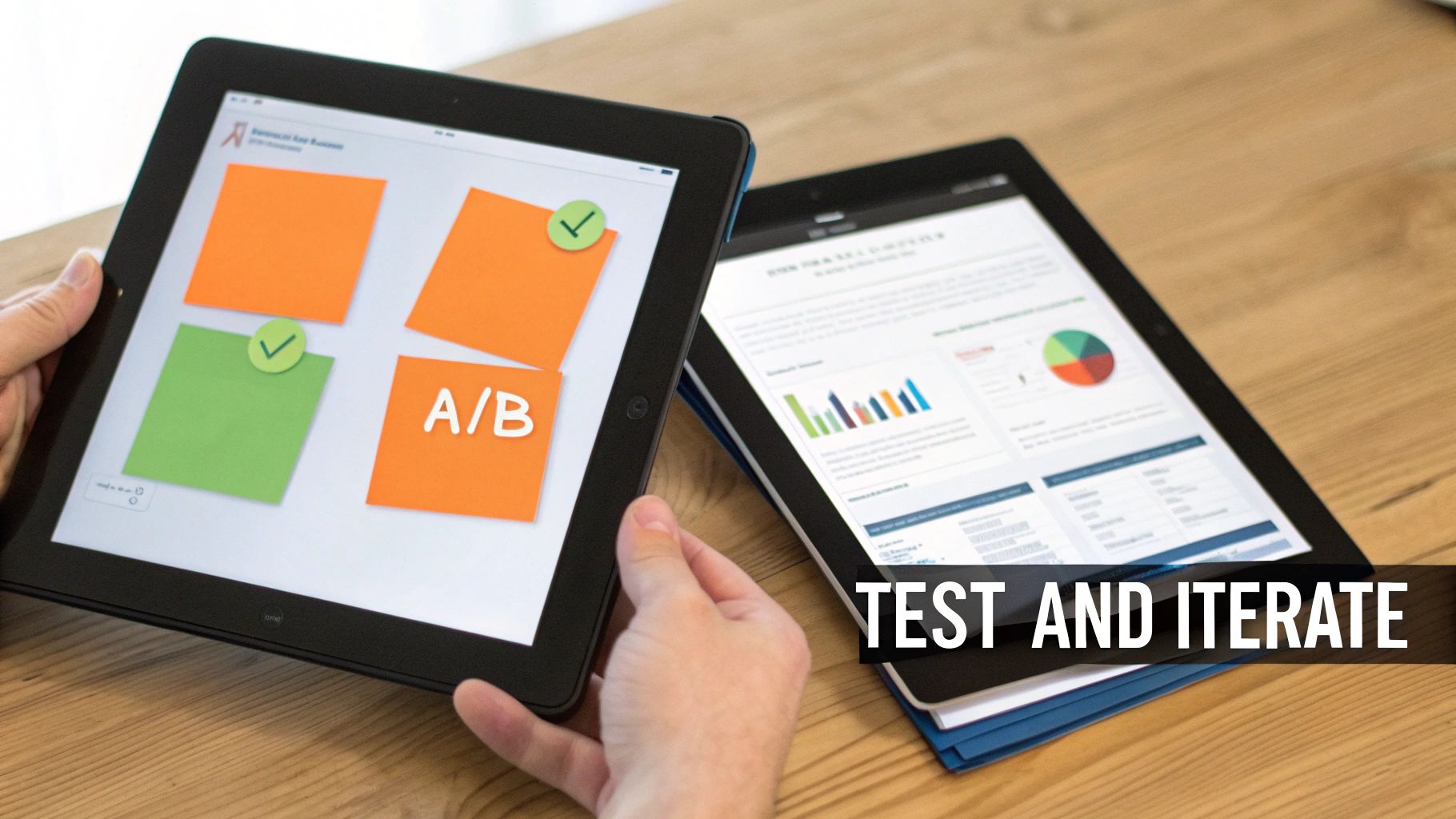
Running Smart Pricing Experiments
Pricing experiments sound intimidating, but they don't have to be. The secret is to test one thing at a time and have a clear idea of what you’re trying to learn. You want clean data, not a mess of conflicting signals.
One of the easiest places for you to start is with your checkout or pricing page. This is called an A/B test. You simply show one version of your page (Version A) to half your visitors and a different version (Version B) to the other half.
Here are a few simple A/B tests you can run right away:
- Discount Framing: Test offering "$20 off" versus "25% off." Even if the dollar value is nearly identical, I can almost guarantee one will convert better.
- Price Anchoring: On your pricing page, try highlighting one of your tiers as "Most Popular." This tiny bit of social proof can nudge new customers toward the exact option you want them to pick.
- Bundling: Create a "starter pack" that bundles your main product with a popular accessory for a single price. This is a fantastic way for you to boost your average order value from day one.
You can use simple tools like Google Optimize or even built-in features on platforms like Shopify to run these tests. Your goal isn't to hit a home run on your first try; it's to find small wins that add up over time.
The Metrics That Truly Matter
When you start testing, it’s easy to get lost in a sea of data. Forget vanity metrics like website traffic or social media likes. For a new product, you need to be absolutely obsessed with the numbers that tell you if your business is actually working.
Your launch price is just your best guess. You discover the real price through continuous testing and a ruthless focus on the right metrics. Don't be afraid to be wrong—be afraid to stay wrong.
Let’s break down the big three that you need to be tracking from day one.
Customer Lifetime Value (LTV)
This is the total amount of money you expect to make from a single customer over their entire relationship with your business. If a customer pays you $50 a month and sticks around for an average of 18 months, their LTV is $900. This number tells you what each new customer is ultimately worth.
Customer Acquisition Cost (CAC)
How much does it cost you in sales and marketing to land one new paying customer? If you spend $1,000 on ads and get 10 new customers, your CAC is $100. This number tells you what you're paying to get that LTV.
The golden rule of a healthy business is simple: your LTV must be significantly higher than your CAC. A common benchmark is an LTV:CAC ratio of 3:1 or better. If you’re spending $100 to acquire a customer who is only worth $90 to you, you don't have a business—you have a very expensive hobby.
Churn Rate
For subscription businesses, churn is the percentage of customers who cancel during a given period. If you start the month with 100 customers and 5 cancel, your monthly churn rate is 5%.
High churn is a blaring alarm bell. It means you have a problem with either your product or your price. It's a leaky bucket that will sink your business, no matter how many new customers you pour in.
Tracking these metrics is non-negotiable. They are the health report for your entire pricing strategy for new products. Understanding your numbers also feeds directly into your profitability calculations. You can learn more about the calculation of gross margin percentage to connect these acquisition metrics to your bottom line.
By treating your launch price as a starting point and relentlessly testing and tracking, you build a resilient business that can adapt, learn, and thrive in any market.
Some Pricing Questions I Get Asked All The Time
Let's dig into a few of the questions I hear constantly from founders trying to nail down their pricing. These are the things that keep us tossing and turning at night. Here are my straight-up answers to help you get unstuck and move forward.
How Do I Price My Thing When There Are No Competitors?
First off, this is a fantastic problem to have. It means you've built something truly new, and you get to set the terms. Your entire focus needs to be 100% on value-based pricing.
Don't even think about what it costs you to make. That's irrelevant right now. Instead, you need to get out of the building and talk to your potential customers. But whatever you do, don't ask, "So, what would you pay for this?" That question is a total trap and you'll get garbage answers.
You need to go deeper and really understand the problem you're solving for them.
- How much actual time or money is this problem costing their business today?
- What's the emotional cost? The headache, the stress of dealing with it over and over?
- What are they paying for the "old way" of solving this problem? Is it a clunky spreadsheet, a part-time intern, a different tool that only does half the job?
Your price should feel like a tiny fraction of the massive value you deliver. This is also a perfect spot for you to use anchoring. Let's say your new software saves a small business 10 hours of manual work every month. If that work costs them $500 in labor, your $99/month price tag suddenly sounds like a steal. It's a no-brainer.
What Are the Biggest Pricing Mistakes You See Founders Make?
I see the same gut-wrenching mistakes again and again. The absolute biggest one is pricing based only on your costs or, even worse, just a random gut feeling. This is a surefire way to underprice your product and leave a mountain of cash on the table.
Another classic mistake is treating pricing as a "set it and forget it" task. Your price isn't set in stone. It has to evolve as your product gets better, your brand gets stronger, and the market changes around you.
Your price is a signal. It tells the world how confident you are in your product and the value it delivers. When you launch, you're making a statement about what you believe all your hard work is worth. Don't sell yourself short.
Finally, please don't launch with a million different pricing tiers. I know it's tempting to try and make an option for every single person, but all you'll do is confuse people and trigger decision paralysis. Start with one or two dead-simple, crystal-clear options. You can always add more tiers later once you have real data on how people are actually using your product.
Should I Put My Prices on My Website?
For almost every new product, especially in e-commerce and SaaS, the answer is a massive, unequivocal yes. Please, for the love of all that is holy, just show your price.
Being transparent with your pricing is one of the fastest ways for you to build trust. When you hide your price behind a "Contact Us for a Demo" button, you're just creating friction. People immediately assume it's crazy expensive and will just bounce over to a competitor who isn't afraid to be upfront.
The only real exception I see here is for super-complex, enterprise-level products where the price truly depends on a custom setup and deep integrations. For pretty much everyone else, putting your price on your site is the confident, smart, and correct move. It shows you believe in the value you’re selling.
If you're a founder in the Midwest and you're looking for a community that has honest conversations like this one, you should check out Chicago Brandstarters. It’s a free, vetted group where we share war stories, tactics, and real support to help each other grow. Apply to join us here.
Leave a Reply