
Thinking about how to start a technology company? I get it. It feels like standing at the base of the Willis Tower and staring straight up. I've been there. The good news is you don’t have to go it alone, especially here in Chicago and the Midwest. I'm going to cut through the noise and give you a real, no-fluff playbook for the road ahead.
This isn’t about chasing Silicon Valley clichés. It's about using our unique Midwestern strengths—grit, real connections, and a get-it-done attitude. So let’s start with the honest truth.
The odds are tough, but they're not impossible. I'll walk you through the core things you absolutely must nail down from day one. This is your first step toward building something that lasts, not just another flash in the pan.
The Honest Look at the Startup Gauntlet
Before you write a single line of code or spend a dollar, you need to understand the field you're playing on. This is a high-stakes game. The data shows that 63% of tech startups fail within five years, which is the highest failure rate of any industry. It’s a brutal stat, driven by insane competition and a heavy reliance on venture capital.
But this isn't a reason to quit. It’s a reason for you to get smarter.
Your goal isn't to avoid failure, because you can't. Your goal is to fail faster, cheaper, and learn more from it than anyone else. That's where a strong community becomes your unfair advantage.
Every year, I see successful tech companies born that hit major revenue milestones, proving you can beat the odds. Experience helps, but you can borrow experience. You can learn from my mistakes and the mistakes of others instead of making them all yourself. The main reasons startups die are almost always avoidable: you run out of cash, or you build something nobody wants.
The Three Pillars of a Strong Start
At the very beginning, your entire world simplifies into three core pillars. Think of these as the only things that truly matter when you're just getting off the ground: the Idea, the Team, and the Community.
This visual breaks down that initial journey perfectly.
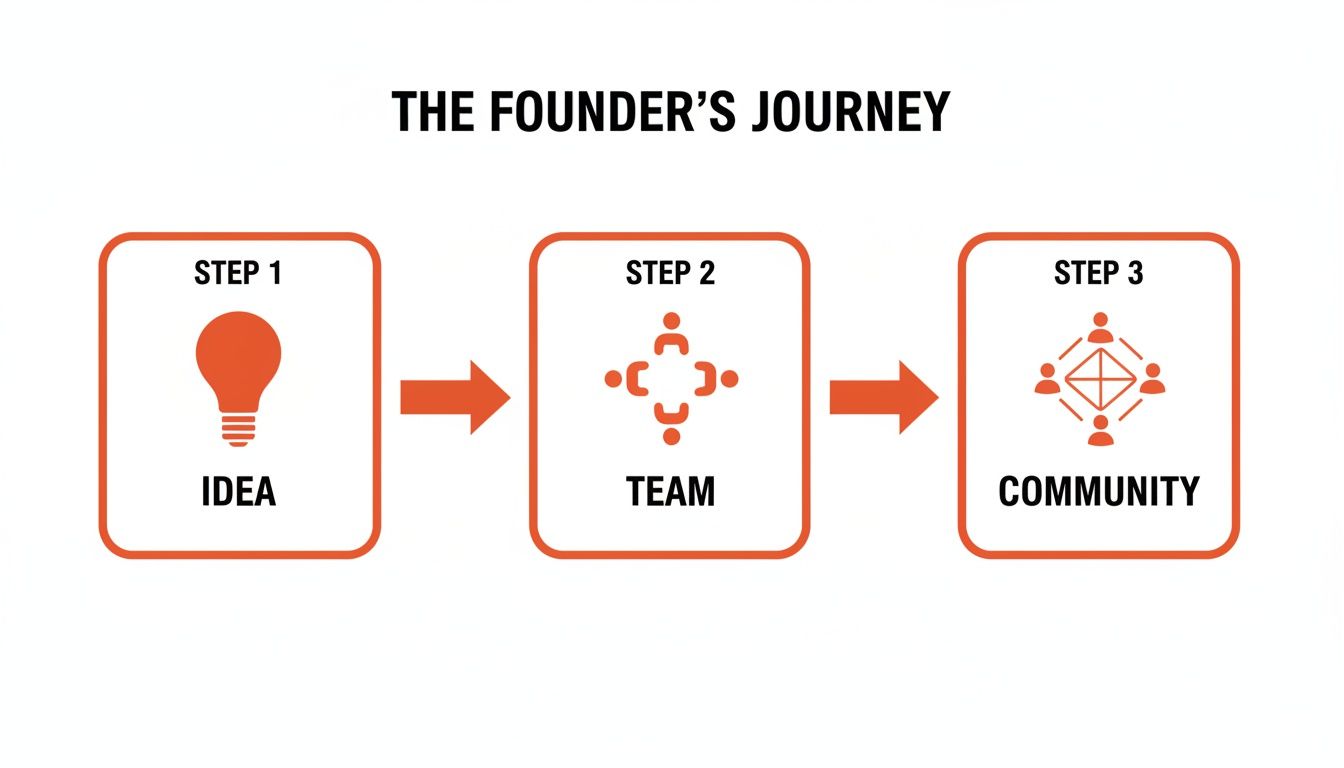
Following this path—from a validated concept, to the right people, to a network that has your back—keeps you from getting lost. You don't need a huge team before your idea is proven. You don't need a huge network before you have a core team to build with.
Here’s a quick summary of these core pillars you have to focus on right now.
Initial Founder Focus Areas
| Pillar | Why It Matters | Your First Actionable Step |
|---|---|---|
| Idea | If nobody will pay for it, you don't have a business. You have a hobby. You're looking for real, painful problems people will gladly pay to solve. | Get out of your building. You should talk to 10 potential customers and ask about their problems, not your solution. |
| Team | These are the people in the trenches with you. Your first hires and co-founders must share your vision and, more importantly, your values. | Write down the non-negotiable values for your founding team. I suggest you think about resilience, kindness, and drive. |
| Community | No founder succeeds in a vacuum. Your community is your safety net, your sounding board, and your source for invaluable shortcuts and war stories. | You can find one local event or meetup to attend this month. Just go, listen, and meet one new person. |
Focusing on these three areas is your first real test. It’s where you separate the talkers from the builders.
Let’s quickly break down what each of these means for you right now.
- The Idea: This isn't just a flash of inspiration. It’s a solution to a painful problem for a specific group of people. Your first job is to prove this before you build anything.
- The Team: Your co-founders and first hires need to be resilient, kind, and driven. I find these are the people who will be with you when things get ugly.
- The Community: This is especially true in Chicago, where real connection is our superpower. For a look at how to start building that network, you can check out our guide to technology events in Chicago.
Nailing these three pillars is the foundation for everything else. The rest of this guide will give you the practical, actionable playbook for each one.
Validating Your Idea and Finding Your First Dollar

Every great tech company begins with an idea. But let me be brutally honest: your idea, right now, is probably worthless. That’s okay—mine are too, until I prove otherwise.
The single biggest mistake you can make when you're figuring out how to start a technology company is falling in love with your own solution before you know for sure that someone will actually pay for it.
This is where you have to escape the "idea bubble." It’s a warm, comfy place where your idea is brilliant and flawless. But it’s a fantasy. The real work begins when you step outside and test your assumptions against reality. Your goal is simple: get your first dollar, even if it's symbolic, before you spend a fortune building something nobody wants.
I once spent weeks wireframing what I thought was a game-changing B2B software tool. I was so sure of it. When I finally showed it to a potential customer, he politely told me, "This is neat, but our spreadsheet is free." That one conversation saved me six months of my life. The lesson? You have to sell the solution before you build it.
From Nice-to-Have to Must-Have
Your job isn't to build something cool; it's to solve a painful, expensive problem. You need a "must-have" solution, not a "nice-to-have" feature.
Think of it like this: a painkiller is a must-have; a vitamin is a nice-to-have. When budgets get tight, you ditch the vitamins long before you stop buying painkillers.
How do you find that pain? You have to talk to people. And I don’t mean your friends or your mom. I mean your actual, real-life target customers. Your mission is to understand their world so deeply that you can explain their problems even better than they can.
This isn’t just about you asking, "Would you use this?" It’s about you digging into their daily workflows and frustrations. For a deeper dive on this, our guide on how to validate your business idea gives you more frameworks. You're hunting for stories, not just "yes" or "no" answers.
Practical Validation Without a Product
You don't need a finished product to validate an idea. You don't even need a single line of code. Your only goal is to test for purchase intent—the signal that someone is willing to trade something valuable (money, time, reputation) for your solution.
Here are a few brutally effective ways for you to do this:
The Landing Page Test: You can put up a simple, one-page website explaining your value proposition. Add a clear call-to-action like "Join the Waitlist" or "Pre-Order for 50% Off." You might spend a little money, maybe $100 on ads, to drive traffic. If 5-10% of visitors sign up, you might be onto something.
The "Concierge" MVP: Instead of building software to automate a task, you should just do it manually for your first few customers. If you're building a meal-planning app, you can literally create custom meal plans in a Google Doc for five people and charge them for it. This proves people will pay for the outcome, not just your fancy tech.
Problem-Focused Interviews: You should get on the phone with 15-20 ideal customers. Here's the rule: you are not allowed to mention your idea for the first half of the call. Just ask open-ended questions about their challenges. Dig into the pain.
Your assumptions are your biggest risk. Customer conversations are your cheapest insurance policy. Get on the phone, get on Zoom, or grab coffee. The answers you need aren't in your head; they're out in the world.
A Validation Checklist to Get You Started
As you go through this, keep track of the signals you're getting. You're looking for patterns of genuine pain, not just polite interest.
You can use this checklist to see if you're ready to move forward:
- Have you talked to at least 20 potential customers? Listening to their stories and frustrations is absolutely non-negotiable.
- Can you clearly state the "job" they are "hiring" your product to do? People buy outcomes, not features.
- Have you found evidence of a budget for this problem? Are they already paying for a clunky, imperfect solution? I find that's a fantastic sign.
- Have you gotten a "pre-sale"? This could be a small deposit, a letter of intent, or even just a firm commitment to be your beta tester.
If you can confidently check these boxes, you've graduated from dreamer to builder. You haven't just thought about how to start a technology company—you've taken the first, most important step. You've found a problem worth solving.
Building Your Founding Team and Tech Stack

Alright, you’ve found a problem that actually matters. Now comes the hard part: the who and the how. The people you bring into your foxhole and the tech you build with will define your company's future. I'm not exaggerating. These first few choices are everything.
Think of it like this: you just confirmed the land you want to build on is solid. Now you need a crew and a foundation. You wouldn't hire a sloppy crew or pour a weak foundation, would you? Of course not. The same gut check applies here.
Your first hires, and especially your co-founder, are more like a marriage than a job. You can fire a bad employee. A bad co-founder will sink your whole ship.
Finding Your First Believers
You're not just hiring for skill at this stage; you're recruiting the first true believers in your mission. These are the people who will be with you when everything is on fire—and trust me, it will be. You need way more than a polished resume. You need grit and a real-deal passion for what you're building.
I’ve learned this the hard way. I now interview for two things above all else: kindness and drive. Someone can be a rockstar coder, but if they're a jerk, they'll create a toxic culture that kills everything. On the flip side, someone can be the nicest person in the world but lack that inner fire to grind through the tough spots. You have to find both.
Here’s my simple playbook for spotting these traits in your interviews:
- Ask about a time they failed. I could care less about the failure itself. I’m listening for ownership. Do they blame others? Or do they talk about what they learned and how they got back up? If they evade the question, that's a massive red flag for me.
- Talk about their side projects. What do they build or create in their spare time, when no one's telling them what to do? This tells me everything about their natural curiosity and drive.
- Watch how they treat everyone. I pay attention to how they talk to the barista or the person at the front desk. Kindness isn’t a switch you turn on for the boss. It’s who you are.
Here in Chicago, your best recruiting channel is your community. Seriously. Groups like Chicago Brandstarters are goldmines because they connect you with people who are already vetted for that Midwestern spirit of genuine hard work and collaboration.
Don't Overthink Your Tech Stack
Now for the tech. The term "tech stack" sounds super intimidating, but it's just the pile of tools you're using to build your product. It’s your digital hammer and nails. I see new founders get obsessed with using the coolest, trendiest new framework they read about on Hacker News. This is a huge mistake.
You don’t need the fanciest tools. You need the right tools to get your Minimum Viable Product (MVP) out the door. Your only goal is speed and learning, not building a perfect, beautiful piece of software art.
Your first tech stack has one job: get you to the next phase of validation as fast and cheap as possible. You are not building for a million users. You are building for user number one.
The biggest choice you'll make is between low-code/no-code tools and building it all from scratch (custom development). There's no one right answer, but here's how I think about it.
Low-Code/No-Code vs. Custom Development
| Factor | Low-Code/No-Code | Custom Development |
|---|---|---|
| Speed | Blazing fast. You can build an MVP in days or weeks. | Painfully slow. A custom build takes months, even for something simple. |
| Cost | Cheap. You usually just pay an affordable monthly subscription. | Expensive. You could easily spend tens or hundreds of thousands of dollars. |
| Flexibility | Limited. You're stuck inside the platform's box. | Infinite. If you can dream it, you can build it. |
| Scalability | Poor. These aren't built to handle tons of users or data. | Excellent. You design it from day one for future growth. |
So, which way do you go?
If you’re a non-technical founder just trying to test a workflow or a service idea, you should start with low-code/no-code. It’s the quickest path to proving people actually want the result your product promises. Tools like Bubble or Webflow can work wonders.
But, if your secret sauce is the technology—a unique algorithm, a complex data thing, or a super specific user experience—you might have to bite the bullet and go the custom development route. Just be mentally and financially prepared for that journey. Your MVP doesn’t have to be perfect, but it does have to work.
Navigating Legal and Financial Essentials

Alright, let's get into the stuff you might not want to do but absolutely have to get right: legal structures and keeping your finances in order.
Messing this up is a rookie mistake that can kill your company before you even have a product. I’m not a lawyer or an accountant—and you absolutely need to hire good ones—but I’ve learned these lessons the hard way, so you don’t have to.
Choosing Your Corporate Structure
Your first major decision is how to incorporate. For most tech startups, especially if you ever plan on taking investment, it boils down to an LLC versus a C-Corporation.
An LLC (Limited Liability Company) is flexible and easy to set up, which seems great at first. But here's the problem I've seen: investors don't like them. The structure makes issuing stock and handling equity a total mess.
A C-Corporation (C-Corp) is the gold standard for venture-backed companies for a reason. It's built from the ground up to issue stock, which is what your investors are buying. If you have any plans to raise money, I believe starting as a C-Corp from day one will save you a ton of expensive legal headaches later.
Who Owns What: The Founder Equity Split
Once you’re incorporated, you need to decide who owns what. This is the founder equity talk, and it’s one of the most awkward conversations you’ll ever have. You have to have it anyway.
The biggest mistake I see founders make is an even split (like 50/50) with no vesting schedule. A vesting schedule is non-negotiable. It’s an insurance policy for your company. It means you and your co-founders earn your equity over time, typically four years with a one-year "cliff."
If your co-founder bails after six months, they get nothing. This protects the company from having a huge chunk of its ownership walk out the door. For me, no vesting is a dealbreaker.
You also need a cap table. Just think of it as a simple spreadsheet that tracks who owns what percentage of your company. You must keep it clean and updated. It’s the single source of truth for ownership.
Your Financial Survival Kit
Now, let's talk money. In the early days, the only financial tool that really matters is your lean budget. Think of it as your company's survival rations. The one metric you need to be obsessed with is your burn rate.
Your burn rate is just the amount of cash you're burning through every month. If you have $50,000 in the bank and your burn is $5,000 per month, you have 10 months of runway—that’s how long you have until the lights go out.
You have only two jobs here:
- Get revenue in the door to slow down your burn.
- Raise more money to extend your runway.
You should make a basic financial projection. It doesn't have to be perfect, but it forces you to think through your real costs. How much for a developer? For some basic marketing? For your lawyers? This isn't just a homework assignment; it's a reality check that will guide every single decision you make.
When you start thinking about fundraising, you need to know the local scene. You can learn more about the venture capital landscape in Chicago to see what investors here are actually looking for. Getting this foundation right gives you the breathing room to focus on what really matters: building something people want.
Winning Early Customers and Crafting Your Pitch
Alright, you’ve put in the work. You’ve validated your idea, found your co-founders, and wrestled with the tech and legal stuff. You’ve actually built something. Now for the hard part: getting real people to use it.
Once you have users, your next challenge is telling that story to investors who can pour fuel on your fire. This whole game is about momentum. You get a little bit of customer traction, then you package that story up to get funding, which helps you get more traction.
I'll start with the scrappy, roll-up-your-sleeves work of finding your first 100 users. Then, we’ll shift gears and talk about how you can build a pitch that actually lands with investors, especially here in the Midwest.
Finding Your First 100 Users
Forget everything you've read about big, expensive marketing campaigns. That's for later. Your first 100 users aren't found with Facebook ads; you win them through pure hustle, real conversations, and a whole lot of elbow grease.
Your only job is to find the people with the burning problem you solve and personally walk them to your solution. Don't shout at the crowd. You should speak directly to the handful of people who will be thrilled to see what you've built.
Here's how you can do it without a big budget:
- Go Where They Live Online: Where do your ideal customers hang out? Are they in a specific subreddit? A niche Facebook group or Slack channel? Don't just show up and drop your link—that's a quick way for you to get banned. Become a real member. You should answer questions, give advice, and when it makes sense, mention what you're working on.
- Use Your Chicago Network: This is our local superpower. You should show up to meetups, but not to pitch everyone you see. Go to listen. Ask people about the problems they're facing. You'd be amazed at the warm introductions that come from a genuine conversation at an event hosted by a group like Chicago Brandstarters. No business cards, no fake positivity, just real talk.
- The “White Glove” Treatment: For your first 25 users, you should do whatever it takes to onboard them personally. Seriously. Get on a Zoom call. Walk them through your product step-by-step and just watch them use it. The feedback you get is absolute gold and worth 100x more than any survey. It’s a grind, but you’ll create die-hard fans for life.
Your goal isn't just getting sign-ups. It’s to find the users who talk back—the ones who tell you what's broken, what they love, and what you need to build next. They are the people who will help you turn your MVP into something truly great.
Switching Gears to Fundraising: Your Pitch
Once you have a small group of users who are genuinely excited about what you've built, it’s time to think about telling your story to investors. Pitching isn't just begging for cash. You're inviting someone to join you on a crazy, difficult journey.
Your pitch deck is the story you tell. It’s not a dry business plan; it's a narrative you design to make someone believe in the future you're trying to create.
An investor’s job is to find outliers. Your pitch deck's job is to prove you're one of them. It must tell a story of inevitable success, starting with a problem so painful that the world needs your solution.
Midwest investors, in my experience, care more about substance than sizzle. They want to see that you know your market inside and out, have a believable path to making money, and actually understand your numbers. You should speak their language, but don't lose what makes you, you.
The Anatomy of a Killer Pitch Deck
Think of your deck as a visual, easily-digestible story. Every slide has one job to do. While you can play with the order a bit, you absolutely have to nail these core parts.
Your Investor-Ready Pitch Deck Checklist:
- The Title Slide: Your company name, logo, and a one-sentence hook. What is it you do? Who is it for? I suggest you keep it dead simple.
- The Problem: What’s the massive, painful problem you’re solving? Use data and relatable stories to make them feel the pain. This is the "why" that hooks them.
- The Solution: This is your "how." You need to show, not just tell. A simple GIF or a couple of clean screenshots are way more powerful than a wall of text.
- Why Now?: Why is this the perfect moment for your company to exist? Did a new technology emerge? A regulation change? A shift in culture? You need a good answer.
- Market Size (TAM, SAM, SOM): You have to show them the money. How big is this opportunity, really? Investors need to see a path to a massive return, so your market has to be big enough for a venture-scale outcome.
- The Competition: Who else is out there? Show you've done your homework, but focus on what makes you different—your "secret sauce." And please, never say you have no competition. It just shows me you haven't looked hard enough.
- The Team: Why are you the ones to pull this off? You should highlight the experience, the passion, and the grit that makes your founding team the only one that can win.
- Traction: This is your proof. You should show your key metrics: user growth, revenue, engagement… whatever you've got. A chart with a line going up and to the right, even if the numbers are small, is incredibly powerful. It makes your story real.
- The Ask: How much are you raising, and what will you spend it on? Be specific. "We are raising $500,000 to hire two engineers and acquire our first 1,000 paying customers over the next 18 months."
Remember, a warm introduction is everything. Cold emails almost never work. Tap into your network. You should ask mentors, advisors, and other founders you know to connect you with investors who are a good fit. This is how you start to master the complex challenge of how to start a technology company that actually lasts.
Frequently Asked Questions About Starting a Tech Company
Let's get into the questions that probably keep you up at night. These are the things I hear all the time from aspiring founders, the stuff you might be afraid to ask out loud because you think it's a "dumb" question. It's not.
I'm going to give you straight, honest answers based on actually being in the trenches and doing this stuff. No fluff. I’ll talk about everything from fundraising timelines to whether you really need a coder on your team.
How Much Money Do I Need to Start?
There's no magic number. Anyone who throws out a single figure is just guessing. The real answer is all about your runway—how many months you can keep the lights on before your bank account hits zero.
Honestly, you can slap together a super bare-bones software MVP (Minimum Viable Product) for under $10,000. This is especially true if you get scrappy with no-code tools and are willing to pour in your own sweat. Think of it as building a shed yourself with stuff from Home Depot; it’s not a skyscraper, but it gets the job done for now.
But if you need to hire good developers and run some real marketing campaigns from day one, it's a completely different story. You're probably looking at needing somewhere in the $50,000 to $150,000 range to give yourself a solid 12-18 months of breathing room.
The key is for you to map out a lean budget and be obsessed with hitting that next milestone, whether it's getting your first paying customer or your first 1,000 users.
Do I Really Need a Technical Co-Founder?
If you're not a developer, I'll be blunt: having a technical co-founder is a massive, game-changing advantage. It's like trying to open a restaurant without a chef. You can design the menu and decorate the dining room, but someone has to actually cook the food.
Investors are almost always wary of funding solo, non-technical founders. I've found they see it as a huge risk. Who's going to build the product? Who’s going to fix it when it breaks at 2 AM or when customers are begging for new features?
If you absolutely can't find a technical co-founder, your next-best moves are hiring a fractional CTO or a development agency you can trust. But be ready—paying for every single line of code without a true technical partner in your corner is not only crazy expensive but also incredibly hard for you to manage.
How Long Does It Take to Get Funding?
Fundraising is a marathon, not a sprint. For a first-time founder, you need to budget at least 6 to 9 months for the whole process. That's from the day you start making your investor list to the moment you see the wire transfer hit your company's bank account.
You will probably talk to 50-100 investors just to get a few people to say "yes." It's purely a numbers game. You will get rejected a lot, and you just have to accept that as part of the process.
Here's the best advice I can possibly give you: start building relationships with investors long before you need their money. Get on their radar. You should send them progress updates every couple of months. Ask for their advice, not their check. Building that trust and rapport first makes the actual "ask" so much warmer and way more likely to work when the time is right for you.
Is Chicago a Good Place to Start a Tech Company?
Absolutely. I'm biased, of course, but the facts back me up. Chicago and the Midwest give you a mix of advantages you just don't find on the coasts.
Here’s why it works so well for you to build a real, lasting business:
- Affordability: Your burn rate is so much lower here. Every dollar you raise goes further, buying you more runway to get things right.
- Strong Talent: We have an amazing talent pool coming out of world-class universities, and these are people who have that classic Midwestern work ethic.
- Supportive Community: The tech scene here is just less cutthroat. It feels more collaborative. I find that people genuinely want to see you succeed.
We might not have the same sheer volume of venture capital as Silicon Valley, but our ecosystem is growing incredibly fast. More importantly, Midwest investors tend to care more about real revenue and sustainable growth than they do about hype. That focus on solid business fundamentals creates a much healthier environment for anyone, like you, trying to build a company that's meant to last.
The journey of starting a technology company is demanding, but you don't have to walk it alone. If you're a kind, hardworking builder in Chicago, you'll find your people at Chicago Brandstarters. We're a free, vetted community built on real relationships, not transactional networking. Learn more and see if it's the right fit for you at https://www.chicagobrandstarters.com.
Leave a Reply