A framework for making decisions is just a simple, repeatable process that guides your choices. It's how you move beyond just a gut feeling.
Think of it like a recipe. You wouldn't toss expensive ingredients in a bowl and hope for a Michelin-star dish. You'd follow proven steps for a great result, every time. A framework does the same for your business strategy, building it on clarity, not chance.
Why Your Gut Feeling Isn't Enough

As a founder, I get hit with a firehose of decisions every day. It’s so easy to just go with your intuition. I mean, your gut got you this far, right?
The problem is, building a business on gut feelings is like sailing through a hurricane without a compass. It feels decisive in the moment, but it's a fast track to getting lost. The hidden costs of bad calls go beyond money—they burn your time, energy, and momentum. Those are your most precious resources.
This isn't just a startup problem. One study found that huge Fortune 500 companies lose an incredible $250 million in wages every year from broken decision-making. As a startup, you don't have that cash to burn. You need a better way.
The Power of a Repeatable Process
I once worked with a founder about to give up. Her main product line was bombing, and her gut screamed at her to shut it all down.
Instead of panicking, she took a breath. She used a simple decision-making framework to look at customer feedback, market trends, and production costs.
This structured approach uncovered something totally unexpected. Her customers were obsessed with one tiny feature of her failing product. So, she didn't quit. She pivoted her entire company around that one feature.
The result? A 300% jump in pre-orders. That simple process didn't just save her business—it showed her a path to massive growth her intuition completely missed.
This is exactly why having a repeatable process isn't some "nice-to-have" corporate thing. It's the most powerful tool in your arsenal for building a resilient brand. It gives you the clarity to make big, bold moves with real confidence, turning uncertainty into your biggest advantage.
Start With a Classic: The SWOT Analysis
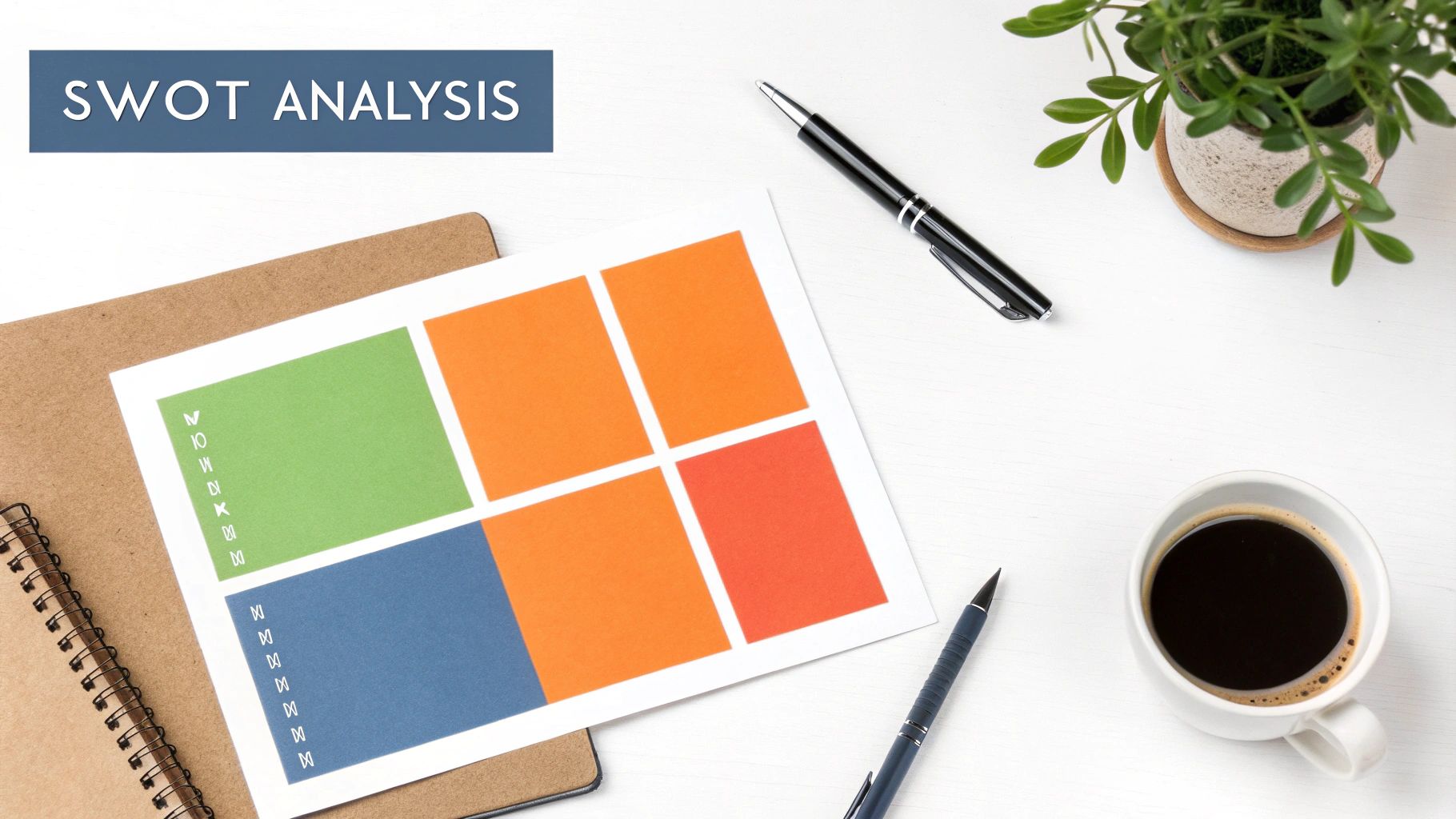
If you're just getting your feet wet with decision-making frameworks, let's start with a classic. The SWOT analysis is still around for a reason: it’s simple, and it works. I use it to map my Strengths, Weaknesses, Opportunities, and Threats.
Think of it like getting ready for a Chicago winter. Your strengths are your insulated coat and snow tires—internal advantages you already have. Your weaknesses are that drafty old window you keep forgetting to seal; internal things holding you back.
Opportunities are those rare, sunny winter days perfect for getting things done. Threats are the surprise blizzards that can shut everything down. These last two are external forces—you can prepare for them, but you can’t control them.
Breaking Down the Four Boxes
The real magic of a SWOT analysis is how it forces you to separate your thinking into two buckets: internal factors (Strengths and Weaknesses) and external factors (Opportunities and Threats). This gives you a brutally honest snapshot of where you actually stand.
- Strengths: What do you do better than anyone else? This could be a killer product feature, a deep network in your neighborhood, or a unique skill your team has.
- Weaknesses: Where are you falling short? Maybe it's a tiny marketing budget, a shaky supply chain, or no brand recognition. Don't be gentle here.
- Opportunities: What's happening out there that you can jump on? Think new tech, changing customer habits, or a competitor dropping the ball.
- Threats: What could seriously hurt your business? This is where you list new competitors, rising costs, or a potential economic downturn.
This simple act of sorting stops you from confusing what you can control with what you can only react to. It’s the first step to building a real strategy instead of just putting out fires.
By forcing you to look at your venture from these four distinct angles, the SWOT analysis turns a messy cloud of ideas and fears into an organized map. You can’t chart a course until you know your starting point.
A good SWOT analysis provides clarity. Let’s make this concrete with an example for a local startup here in Chicago. The table below shows how a new apparel brand might fill this out.
SWOT Analysis Template for a Chicago Startup
| Category | Guiding Question | Example (For a Local Apparel Brand) |
|---|---|---|
| Strengths | What internal advantages do we have over others? | Our designs are created by a well-known local artist, giving us an authentic Chicago connection. |
| Weaknesses | What internal factors are holding us back? | We have limited production capacity and rely on a single local manufacturer. |
| Opportunities | What external trends or events can we exploit? | There's a growing "shop local" movement and several upcoming neighborhood festivals. |
| Threats | What external factors could jeopardize our business? | Fast-fashion giants can produce similar styles for a fraction of the cost. |
See how that works? The framework instantly reveals a path. The brand's strength (local artist) directly taps into an opportunity (the "shop local" movement). It also highlights a critical threat (fast fashion) that their weakness (limited production) makes them vulnerable to. Right away, you can see they need to double down on their local story and perhaps find a backup manufacturer. That's a strategy.
Upgrade Your Decisions with Data

Alright, you've mapped your landscape with a SWOT analysis. Now it's time to add a critical layer to your framework for making decisions: data.
This isn't about becoming a spreadsheet guru. It's about listening to the story your customers and the market are telling you through numbers.
So many founders I know have access to powerful tools like Google Analytics or Shopify reports but get overwhelmed. The sheer volume of numbers feels like staring into a blizzard. But here’s the secret: you don’t need to track everything.
You just need to identify the three to five Key Performance Indicators (KPIs) that truly matter for your business right now. Think of yourself as a ship captain again. Data is your weather forecast, sea charts, and crew reports all in one. It doesn’t replace your judgment, but it gives you the clarity to make confident moves.
Identifying Your North Star Metrics
Your KPIs are your business's vital signs. They tell you if you're healthy, growing, or heading for trouble.
For an early-stage founder, these metrics often revolve around validating your idea and finding your first customers. You can learn more about how to validate a business idea, which is a critical first step.
Here are a few examples of KPIs that might matter to you:
- Customer Acquisition Cost (CAC): How much does it cost you in marketing and sales to get one new customer?
- Customer Lifetime Value (LTV): How much total revenue can you expect from a single customer?
- Conversion Rate: What percentage of website or store visitors actually make a purchase?
- Monthly Recurring Revenue (MRR): If you're a subscription business, this is your lifeblood.
Choosing the right KPIs is about focus. Picking too many is like trying to listen to five radio stations at once—you just get noise. Start by asking, "What are the one or two numbers that, if they moved, would fundamentally change my business?"
Don't Just Collect Data; Use It
It's shocking how many companies collect data they never use. One global survey revealed a staggering gap: while 79% of organizations have defined KPIs, only 36% actually use them consistently to drive decisions.
The study also found that highly data-driven companies are three times more likely to report significant improvements in their decision-making. That's a powerful insight. It means your advantage isn't just in gathering numbers, but in building the habit of acting on them.
The goal isn’t to drown in data. It’s to find the essential signals that tell you whether you’re on the right track or need to change course.
I suggest you set up a simple dashboard—it can even be a basic spreadsheet. Review your key metrics weekly. This consistent rhythm turns abstract numbers into a clear, actionable story about your business, empowering every choice you make.
Making Tough Calls When the Future is a Total Blur
So far, we’ve looked at frameworks that help you make sense of what you already know. But what about when the data is murky and the future feels like a shot in the dark? This is the exact moment I see most founders freeze up.
You don't have to get stuck. When you’re staring into the fog of uncertainty, the goal isn't to magically predict the one "right" future. Your smartest move is to have a framework that gets you ready for multiple futures.
Think of it like building a choose-your-own-adventure story for your company. You map out a few ways things could go, decide what you’d do in each chapter, and then figure out the signs that tell you which story you’re actually in. This turns gut-wrenching anxiety into focused action.
A Four-Step Playbook for Navigating the Unknown
This approach is about building strategic flexibility. Instead of betting the farm on a single outcome, you build a main plan with a few backup plans in your back pocket.
Here's a simple, four-step process you can use for your next big, uncertain decision:
- Diagnose Your Uncertainty: First, get painfully honest about what you don't know. Is it a simple unknown with limited outcomes, or true ambiguity where you can't even list all the possibilities? Big difference.
- Brainstorm Scenarios: Based on that uncertainty, dream up two or three believable future scenarios. For example, a best-case (hockey-stick growth), a worst-case (the market tanks), and a weird-case (a surprise competitor pops up).
- Develop Your Plans: Now, build your primary plan for the most likely scenario. Then, create smaller "pivot" plans for the others. What moves would you make if the worst-case happens?
- Set Your Tripwires: This is the most important step. A tripwire is a specific, measurable event that screams, "It's time to switch plans!" It’s a trigger you decide on before things get chaotic, so you pull emotion out of the equation. For example: "If our customer acquisition cost jumps by 50% for two straight months, we immediately activate Plan B."
This process gives you a clear playbook, no matter how the story unfolds. You’ve already done the hard thinking when you were calm and rational.
By preparing for multiple outcomes, you're no longer a victim of the future—you're an active player, ready to adapt. Your decision stops being "what do I do?" and becomes "which pre-built plan do I execute now?"
Experts have pointed out that leaders often get uncertainty wrong. They look for data that confirms what they believe instead of exploring other possibilities. A classic case study looked at three hospital ICUs with the same average infection rate. But when they dug in, the distribution of those infections was wildly different, revealing huge risks the average number hid. If you want to go deeper, you can explore more about how leaders can better handle uncertainty with a structured approach.
Using this four-step framework helps you sidestep the trap of just going with your gut or relying on simple averages. You end up building a more resilient business—one that can thrive not just in spite of uncertainty, but because of it.
Putting Your Framework into Practice
All this theory is great, but let's get our hands dirty. A framework for making decisions is worthless if you don't use it. I'm going to walk you through how to apply these models to three real-world scenarios you will absolutely face as a founder.
We'll kick things off with a product decision, then tackle hiring, and finally size up a potential partnership. This is where we make abstract concepts immediately useful for your business.
When you're staring down uncertainty, this simple decision tree can guide your thinking. It breaks the process down into four clear steps: Diagnose, Brainstorm, Plan, and Act.
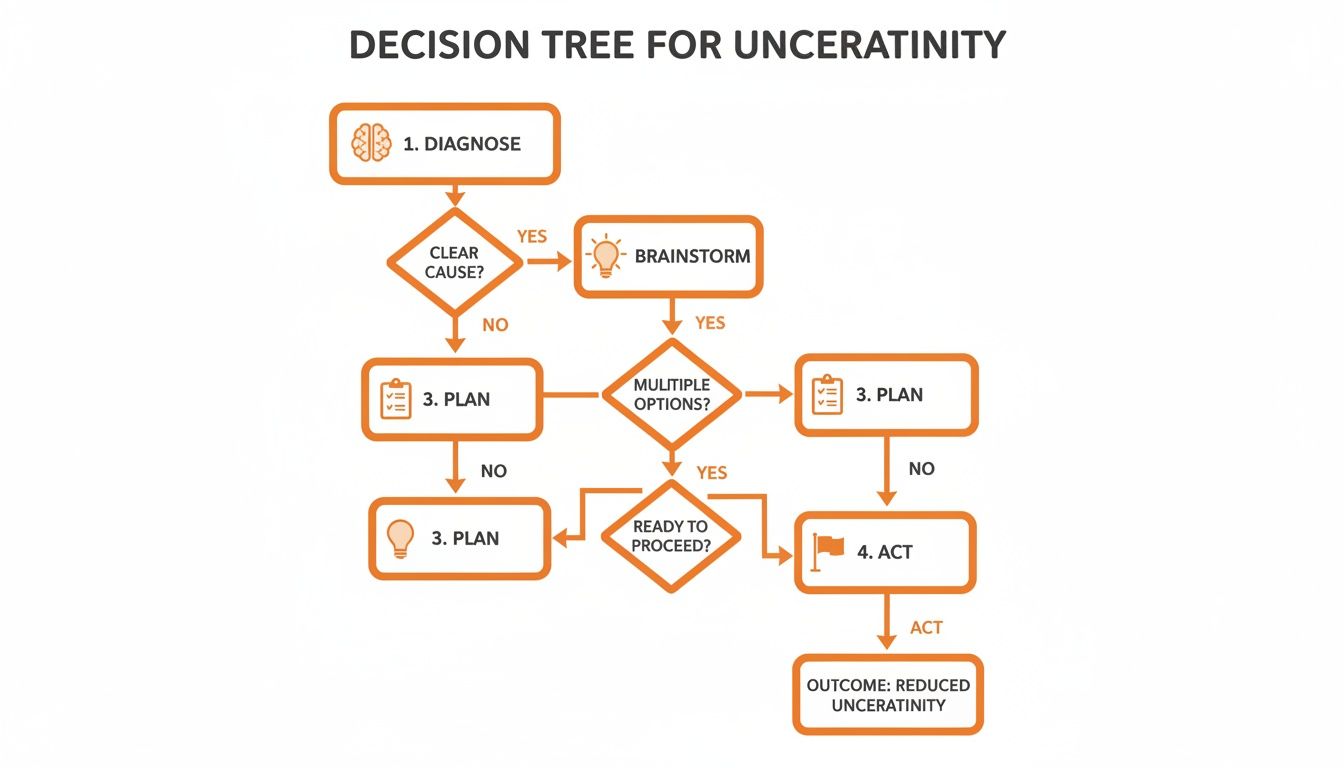
This visual is a crucial reminder: you can't just jump straight to a solution. You have to move deliberately from understanding the problem to taking action.
Scenario 1: The Product Feature Debate
Imagine you run a small e-commerce brand that sells custom notebooks. You have two potential features to build next: an online monogramming tool or a subscription box. Your resources are tight, so you can only pick one.
In a spot like this, a decision matrix is your best friend. It’s a simple grid that helps you score your options against what actually matters to your business.
Decision Matrix Example: New Product Feature
| Criteria (Scored 1-5) | Monogram Tool | Subscription Box |
|---|---|---|
| Customer Demand | 4 | 3 |
| Revenue Potential | 2 | 5 |
| Technical Difficulty (Low=5) | 5 | 2 |
| Brand Alignment | 4 | 4 |
| Total Score | 15 | 14 |
Looking at the scores, the monogram tool squeaks out a win. Sure, its direct revenue potential might be lower, but it’s a heck of a lot easier to build and it’s something customers are already asking for. It’s the lower-risk, faster path to adding real value.
Scenario 2: The First Hire Dilemma
Your business is growing, and you’ve accepted you can’t do it all yourself anymore. You need help, but what kind of help? Do you hire a full-time employee or bring on a contractor?
This decision has massive ripple effects on your cash flow, culture, and legal paperwork. Hiring your first employee is a huge step, especially when you're starting out. It's a common hurdle; I know many founders wonder how to get their business off the ground, which is why we put together a guide on how to start a business with no money.
Let’s use a simple pros-and-cons list to get some clarity.
- Full-Time Employee:
- Pros: Deeper commitment and integration into your company culture. They can take on more tasks as needs pop up.
- Cons: Way more expensive (salary, benefits, taxes), adds management overhead, and it's much harder to undo if it's a bad fit.
- Contractor:
- Pros: Lower financial commitment upfront. You get specialized skills for a specific project, and it’s a more flexible arrangement.
- Cons: They're less integrated, might be juggling other clients, and their knowledge walks out the door when the contract ends.
The right choice here depends entirely on your most painful need. If you need a specific skill for a short-term project (like a website redesign), a contractor is perfect. If you need someone to grow with the company and wear multiple hats, an employee is the better long-term investment.
Scenario 3: The Partnership Opportunity
A popular local coffee shop approaches you about a collaboration. They want to sell your notebooks in their stores and co-host a community event. It sounds exciting, but is it the right move?
Before you jump in, dust off your SWOT analysis skills. Let's look at this purely through the lens of Opportunities and Threats.
- Opportunity: Does this partnership give you access to a new audience you couldn't reach on your own? Does their brand reputation elevate yours?
- Threat: Is there a risk of brand misalignment? What if the partnership flops—could it damage your reputation? What are the real resource costs (your time, your money) to make this happen?
By walking through these questions, you move from an emotional "yes!" to a strategic one. You can see the real benefits clearly while also creating a plan to handle the downsides.
Your Go-To Decision Making Checklist
Okay, you’ve seen the theory. Now it’s time to build the habit. A killer decision-making framework is useless if you don't use it until it's second nature.
Think of this checklist like a pilot's pre-flight routine. You run through it every time, especially when the pressure is on. It’s a simple, repeatable process that stops you from skipping a crucial step when you’re moving fast.
The Founder's Go-To Checklist
-
Define the Real Problem: What question are you actually trying to answer? Get specific. Write it down in one clean sentence.
-
Gather the Right Intel: Take inventory. What data do you have versus what data do you need? Pinpoint your key metrics and call out any huge knowledge gaps.
-
Evaluate Your Options: You need at least three viable paths. Don't forget, doing nothing is always an option. Score each one against your core business values.
-
Pressure-Test Your Choice: Time to play devil’s advocate. What are the biggest risks with your top choice? Seriously, what's the most likely way this could blow up in your face?
The point isn't to get rid of all risk—that's impossible. It's about making sure you're taking the right risks. A simple process like this turns your blind spots into calculated bets on your company's future.
-
Commit and Communicate: Make the call. Then, make sure every single person on your team understands the "why" behind it. Getting your team on board is everything.
-
Review and Learn: Put a date on the calendar to circle back and review the outcome. Did it work? What did you learn? This last step turns one good decision into a compounding advantage over time.
This checklist is meant to be a living tool. If you're looking to get deeper into structuring your overall strategy, our guide on building a startup business plan template is a great resource for formalizing your long-term goals.
Common Questions and Sticking Points
Founders I work with often run into the same questions when they start using a more structured way to make decisions. Here are some of the most common ones, with my straight-up advice.
What If My Data Is Conflicting?
This happens all the time. Your customer surveys say people want Feature A, but your analytics show they only use Feature B. It can feel like you're getting pulled in different directions.
Don't let it paralyze you. Conflicting data isn't a stop sign; it's a signal to dig deeper. Is the survey data from your ideal customers, while your sales data is a mix of everyone?
This is where your gut as a founder comes back in. A framework for making decisions isn't supposed to spit out the answer for you. It's about giving your intuition better, cleaner information to work with. Pick the data source that points most directly at your strategic goals, make the call, and accept it as a calculated risk.
How Do I Get My Team on Board?
You can design the most brilliant decision-making process, but it's useless if your team isn't bought in. Dropping a new spreadsheet on them and expecting cheers won't happen.
You get them on board by bringing them in from the beginning. It's been shown over and over that when you involve your team, you don't just get better ideas—you build a team that actually cares. People always support what they help create.
Walk them through the framework on a small, low-stakes decision first. Show them how it leads to a clearer outcome. When they see it works and feel their input is valued, they'll become champions for the process, not roadblocks.
At the end of the day, your team needs to see that this new way of doing things makes their jobs easier and the company stronger. A shared sense of purpose is a powerful thing.
What If I Make the Wrong Decision?
Let’s get one thing straight: you will. It’s not a question of if, but when. The best founders I know don’t make fewer mistakes; they just get incredibly good at catching and correcting them fast.
A bad decision is only a true failure if you learn nothing from it. When you've used a framework, you have a paper trail—a clear record of your assumptions, the data you looked at, and the logic you followed. This makes it so much easier to go back, see exactly where you zigged when you should have zagged, and fix your approach for next time. This is how you turn a mistake into one of your most valuable business assets.
At Chicago Brandstarters, we believe that building a great company starts with making great decisions, together. If you're a kind, hard-working founder in Chicago looking for a community that shares honest war stories and real support, not just transactional networking, let’s connect. Learn more about joining our free community at https://www.chicagobrandstarters.com.
Leave a Reply