I get it. You're swimming in flashy 'get rich quick' e-commerce advice that feels empty. It's all unsustainable ad spends and fleeting overnight wins. That's not how you build a real, lasting business, especially not here in the Midwest. We build things that matter.
This isn't just another list. I've poured years of my own experience into 10 real e-commerce growth strategies that I’ve personally used and watched work for founders right here in our Chicago community. Think of me as a guide, not a guru. This is your playbook for building a business that doesn't just make you money, but makes you proud.
We're skipping the fluff. I'll use simple analogies to make complex ideas click, share stories from the trenches, and give you steps you can take today. My goal is to hand you a clear, prioritized map that feels authentic to you, whether you’re launching a side-hustle or scaling toward your first million. We'll cover everything from building a loyal tribe to mastering your numbers to forging powerful alliances. These aren't just theories; they're the pillars of sustainable growth.
Building a business is like building a house. You can't just throw up the walls and hope it stands; you need a solid foundation. These ten strategies are your blueprint and your toolbox. I'll help you build a strong, resilient brand that can weather any storm. Let’s start laying the first bricks.
1. Community-Driven Growth & Word-of-Mouth Marketing
Forget chasing expensive clicks for a minute. What if your growth engine ran on genuine connection? That’s the heart of community-driven growth, one of the most powerful and sustainable e-commerce growth strategies you can use. Instead of just buying customers, you’re building a tribe of advocates who can't wait to spread the word about your brand. This isn't about manufacturing hype; it's about fostering real relationships that create organic momentum.
This works because you trust your friends more than you trust an ad. When you build a community, you create a home for your customers to share, give feedback, and feel like they belong to something bigger. Think of it like a flywheel: the more you invest in genuine connection, the faster it spins, generating word-of-mouth that paid ads can't touch. I've found this strategy works best when you lead with transparency and a bit of vulnerability.

Why It Works & When to Use It
I recommend this strategy for early-stage brands building from scratch or for established brands that want deeper customer loyalty. It sings when your product has a strong story, a clear mission, or solves a real problem for a niche audience. Look at brands like Glossier and Patagonia. They didn't just sell stuff; they built movements around shared values. By putting community first, they turned their customers into evangelists who drove their growth.
Actionable Steps to Build Your Community
Ready to start? Here are some practical steps you can take today:
- Create a "Third Place": Build a dedicated space for your community to gather. This could be a private Slack or Discord server, a Facebook Group, or a forum on your site. This gives your biggest fans a direct line to you and each other.
- Share Your Founder Story: Don't hide behind a corporate mask. I want you to share your journey—the struggles, the wins, the "why." People connect with people, not logos. This is a core belief for me at Chicago Brandstarters, where real stories build real trust.
- Implement a Value-Aligned Referral Program: Instead of just throwing cash, create referral perks that reflect your brand. Think exclusive products, early access, or donations to a cause you all believe in. Warby Parker's "Buy a Pair, Give a Pair" model baked social good right into their growth loop.
- Host Exclusive Events: Connection happens in real time. You can organize virtual workshops, AMAs (Ask Me Anything) with you as the founder, or in-person meetups. These events make your community members feel like true insiders.
2. Direct-to-Consumer (DTC) Sales Model
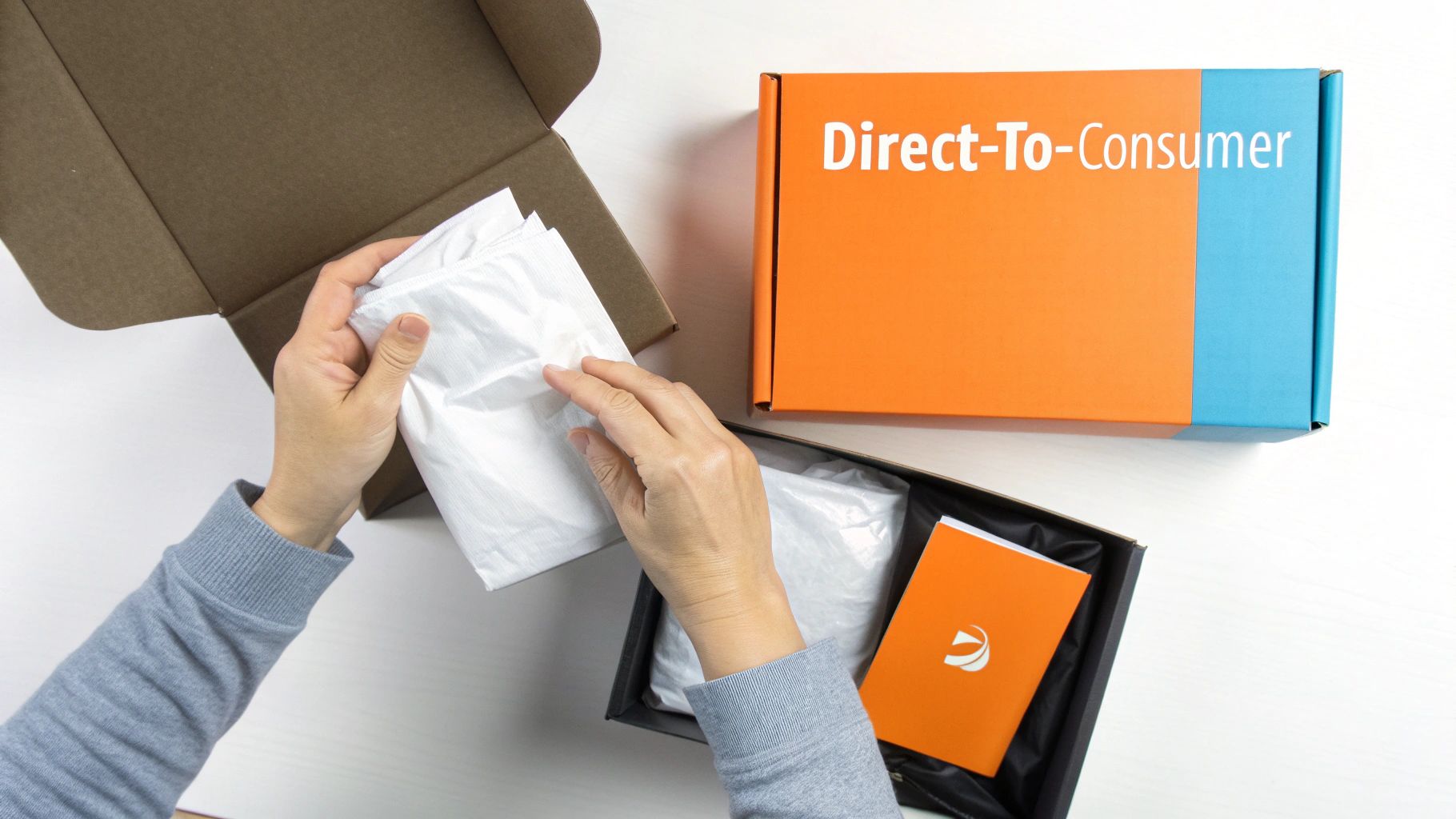
Imagine cutting out the middlemen and talking directly to your customers. That’s the power of the Direct-to-Consumer (DTC) model, a key piece of modern e-commerce growth strategies. Instead of fighting for shelf space or giving up your margins to retailers, you control the whole journey, from the first click to the unboxing. You own the data, the relationship, and the brand experience.
This model lets you build a sustainable business on your terms. It’s like owning your own storefront instead of renting a small booth in a giant, noisy market. Every piece of customer feedback comes straight to you, letting you improve your products at a speed traditional retail just can't match. If you value your autonomy and want to build a real connection with your audience, the DTC path is for you.
Why It Works & When to Use It
The DTC strategy is perfect for new product-based brands that want to build a strong identity and own customer relationships from day one. I've seen it work wonders when you have a unique product or a powerful story that might get lost in a big-box store. Brands like Native deodorant and Allbirds used the DTC model to shake up massive industries by listening directly to their customers, which let them rapidly perfect their products and messaging.
Actionable Steps to Launch Your DTC Brand
Ready to build your direct sales engine? Here are the essential steps to get started:
- Build Your Digital Storefront: You need to invest in a solid e-commerce platform like Shopify from the very beginning. It’s the foundation of your whole operation, so don't cut corners. Your website is your flagship store.
- Create a Memorable Unboxing Experience: The first physical thing your customer touches is the box. You can use custom packaging, a handwritten note, or a small gift to make it unforgettable.
- Own Your Customer List: Start building an email and SMS list from day one, even before you launch. This is your most valuable asset—a direct line to your audience that you completely control.
- Plan Your Logistics Early: Don't wait for your first sale to figure out shipping. You should research and partner with a reliable third-party logistics (3PL) provider to handle fulfillment. This frees you up to focus on growth, not packing boxes.
3. Strategic Partnerships & Wholesale Expansion
Relying only on your direct channel can feel like trying to fill a stadium one person at a time. Strategic partnerships and wholesale are like opening new gates. You tap into established audiences and grow faster than you ever could on your own. This strategy involves you partnering with complementary brands or getting your products into retail stores, instantly borrowing credibility and accessing a built-in customer base.
This isn't just about moving product; it's about building your brand. When another respected brand or retailer co-signs your product, it tells consumers you're trustworthy. Think of it as a strategic alliance: you get their audience and distribution, and they get to offer their customers your cool product. I find it’s one of the most effective e-commerce growth strategies for scaling without just pouring more money into ads.
Why It Works & When to Use It
This approach is perfect when you've built a solid DTC foundation and you're ready to scale your reach. It’s especially good for brands with a physical product that has broad appeal. Think of Harry's razors landing in Target or Liquid Death expanding into 7-Eleven. They didn't just boost sales; they became household names. This strategy works best once you have your manufacturing and supply chain dialed in to handle bigger orders.
Actionable Steps to Expand Your Reach
Ready to move beyond your website? Here’s how you can get started with partnerships:
- Start Small and Strategic: Don't try to partner with everyone at once. You should identify one or two key partners whose audience and values perfectly align with yours. For kind founders, this values-first approach is everything.
- Negotiate Crystal-Clear Terms: Before you sign anything, define everything: wholesale pricing, payment terms, sales territory, and any exclusivity clauses. A clear contract saves you headaches later and protects your brand.
- Equip Your Partners for Success: Your partners are your sales team. You need to give them high-quality marketing assets, product training, and dedicated support so they can represent your brand effectively.
- Maintain Your DTC Channel: Don't abandon your direct channel. Wholesale and DTC should help each other. You can use your DTC site to test new products, own customer data, and keep your highest profit margins. We can help you navigate this; Chicago Brandstarters often introduces founders to vetted partners and helps you find allies who align with your mission.
4. Content Marketing & Educational Authority Building
Stop selling and start teaching. This is the heart of using content to build authority, a key part of modern e-commerce growth strategies. Instead of just shouting about your product, you become the go-to resource in your niche, generously sharing knowledge that solves your customer's problems. This builds incredible trust and attracts an audience that sees you as an expert guide, not just a vendor.
This long-term play flips the old marketing funnel on its head. You're not interrupting people; you're attracting them organically by giving real value first. As you consistently create helpful blogs, videos, or podcasts, you build a library of assets that works for you 24/7, drawing in traffic and building your brand's credibility. It’s like planting an orchard instead of just buying fruit; the early work is heavy, but the harvest is sustainable and grows over time.

Why It Works & When to Use It
I've seen this strategy work wonders for brands in complex or passion-driven niches where customers research heavily before buying—think fitness, finance, or specialized hobbies. It’s perfect if you're a founder with deep expertise to share. Just look at Andrew Huberman. He built a massive, trusted brand with his podcast, which then easily supports product sales. It's about earning attention, not buying it.
Actionable Steps to Build Your Authority
Ready to become the trusted voice in your space? Here’s how you can start:
- Pick One Platform to Master: Don't try to be everywhere at once. You should choose one main channel—like a blog for SEO or a YouTube channel for visual guides—and get great at it before you expand.
- Solve Problems, Not Just Sell Products: Create content that answers the questions your ideal customers are typing into Google. You need to address their pain points, fears, and goals before you ever mention what you sell.
- Repurpose Your Core Content: Turn one great blog post into a series of tweets, an email newsletter, a short video, and a podcast segment. This maximizes your effort and lets you reach different audiences on multiple platforms.
- Focus on SEO from Day One: Research the keywords your audience uses and build your content around them. This is how you capture sustainable, high-intent organic traffic that converts better than paid ads.
- Share Your Founder Journey: Weave your personal story and the "why" behind your brand into your content. As I always stress at Chicago Brandstarters, this authentic, Midwestern approach to vulnerability builds a connection that slick marketing can’t buy.
5. Email Marketing & Customer Retention Optimization
If paid ads are like renting an audience, your email list is a home you own. Email is still one of the highest ROI marketing channels because you control the platform and have a direct line to your most engaged fans. This is where you turn one-time buyers into loyal, repeat customers. This creates a predictable revenue stream that frees you from the whims of ad platforms. Keeping a customer is 5 to 25 times cheaper than finding a new one. Retention is the secret weapon of profitable e-commerce.
This strategy is about more than just sending discounts. You're building a relationship in their inbox. You nurture customers from their first welcome email to their tenth purchase by giving value, sharing your story, and making them feel seen. Think of it as your main communication channel—a place to share wins, be open about challenges, and build a lasting connection that turns customers into lifelong fans. This direct, authentic communication is a core principle for me and my work at Chicago Brandstarters.
Why It Works & When to Use It
This strategy is non-negotiable from day one. Whether you have zero sales or thousands, you should be building your email list. It’s especially powerful for brands trying to increase customer lifetime value (LTV) and build a stable, profitable business. Brands like Casper and Dollar Shave Club masterfully use email not just to sell, but to educate, entertain, and remind customers of their value, making sure they stick around. For a Chicago-based founder like you, this is your chance to inject local authenticity directly into your customers' lives.
Actionable Steps to Optimize Your Email & Retention
Ready to turn your inbox into a revenue machine? Here are some steps you can take:
- Build Your Welcome Series: Don't just send a coupon. You should create an automated 3-5 part welcome sequence that introduces your founder story, explains your brand values, and showcases your best-sellers. This is your best chance to make a lasting impression.
- Segment Your Audience: Treat your customers like individuals. You can segment your list based on their behavior—like first-time buyers, high-value customers, and people who viewed a product but didn't buy. Send targeted, relevant content to each group.
- Share Vulnerable Founder Updates: People connect with people. I want you to use your email list to share honest updates about your journey, the highs and the lows. This builds immense trust and makes subscribers feel like real insiders.
- Systematize Your Campaigns: Create a simple content calendar. Plan for weekly campaigns that mix promotion, storytelling, and user-generated content. Consistency is how you stay top-of-mind without burning out your list. You should aim for 30-40% of your customers to make a repeat purchase within their first six months.
6. Paid Advertising & Performance Marketing Mastery
When you have a product that's ready to scale, pouring gasoline on the fire is one of the most effective e-commerce growth strategies. That gasoline is paid advertising. This isn’t about blindly boosting posts; it’s the disciplined science of performance marketing. It means you understand your numbers inside and out, from Customer Acquisition Cost (CAC) to Return on Ad Spend (ROAS), and you use data to fuel rapid, predictable growth. I see most founders either avoid paid ads or spend money inefficiently, burning cash with little to show for it.
Mastering paid media gives you a powerful lever to control your growth. Instead of waiting for organic traffic, you can put your product directly in front of your ideal customer the moment they’re looking for a solution. Think of it as a direct injection of qualified traffic into your sales funnel. The key is to treat every dollar you spend as an investment that must generate a measurable return. This lets you scale your winners and cut your losers with brutal efficiency.
Why It Works & When to Use It
This strategy is perfect when you have proven product-market fit and a clear grasp of your unit economics (especially your Lifetime Value or LTV). If you know a customer is worth $150 to you over time, you can confidently spend a certain amount to get them. It's a game of arbitrage. Brands like Dollar Shave Club used this perfectly, leveraging viral YouTube ads to scale aggressively once they knew their numbers worked. Native deodorant also scaled massively by mastering performance marketing on Instagram, turning eyeballs into loyal subscribers.
Actionable Steps for Paid Ad Mastery
Ready to turn your ad spend into a growth machine? Here’s how you can get started:
- Master ONE Channel First: Don't spread yourself thin across Google, TikTok, and Instagram. You need to pick the platform where your ideal customer lives and focus all your energy on mastering it. Only expand once you have a profitable, repeatable system.
- Test Creative Aggressively: Your ad creative is the biggest variable. Never launch with just one ad. You should create and test at least 10 different variations of images, videos, and headlines to find what really clicks before you scale the budget.
- Know Your LTV:CAC Ratio: This is your north star. As a rule, you should never spend more than 30% of your projected LTV to acquire a customer. Always aim for at least a 3:1 LTV to CAC ratio to ensure you’re building a profitable business.
- Scale with Lookalike Audiences: Once you have a solid base of 500-1,000 customers, use that data to create lookalike audiences on platforms like Facebook and Instagram. This tells the algorithm to find more people who look and act just like your best customers, which dramatically improves your targeting.
7. Influencer Partnerships & Brand Ambassador Programs
Move beyond interruptive ads and tap into the power of trusted voices. Influencer partnerships let you borrow credibility and reach highly engaged, niche audiences through creators they already follow. This isn't about celebrity endorsements; it's about forming real collaborations with people whose values and audience align perfectly with your brand. The right partnership feels less like an ad and more like a trusted friend's recommendation.
This strategy is one of the most effective e-commerce growth strategies because it uses social proof at scale. When a creator you trust loves a product, you’re more likely to check it out. I've found that micro-influencers (those with 10K-100K followers) are often the sweet spot, delivering higher engagement and better ROI than mega-influencers. Think of it as planting seeds in dozens of fertile gardens instead of just one giant field.
Why It Works & When to Use It
This strategy is powerful for brands with visually appealing products or those in specific lifestyle niches like fitness, beauty, or sustainable living. It's ideal for launching new products to create initial buzz or for scaling awareness once you've found product-market fit. Gymshark built its empire on the backs of fitness athletes, turning them into long-term ambassadors who embodied the brand's spirit, driving explosive growth from day one.
Actionable Steps to Build Your Program
Ready to connect with creators? Here’s how you can start building authentic partnerships:
- Start with Micro-Influencers: You should identify 5-10 micro-influencers whose engagement rate is more impressive than their follower count. Look for real interaction in their comments. Your budget can go much further here.
- Focus on 'Values Fit' Over Vanity Metrics: The best partnerships happen when a creator genuinely loves your product and shares your mission. This is especially vital for kind founders like you who lead with purpose.
- Prioritize Long-Term Relationships: You should propose multi-post collaborations or a 3-6 month partnership instead of a single post. This builds deeper audience trust and turns influencers into true brand ambassadors.
- Grant Creative Freedom: You're hiring them for their unique voice and connection to their audience. Give them clear guidelines and goals, but let them create content in their own style. It will feel far more authentic.
- Track Everything: You must provide each influencer with a unique discount code and UTM-tracked links. This is the only way you can accurately measure the ROI of each partnership and optimize your strategy.
8. Product Expansion & Complementary Offerings Strategy
Once you've found product-market fit with your hero product, what's next? The answer often isn't about finding more new customers, but serving your existing customers more deeply. This is the essence of product expansion, a powerful e-commerce growth strategy focused on increasing customer lifetime value (LTV). Instead of relying on a single product, you strategically launch complementary products or bundles that solve related problems for the people who already trust you.
Think of your first product as the foundation of a house. A strong foundation is critical, but you build real value by adding the rest of the structure. Product expansion is how you add more rooms, creating more reasons for customers to stay and invest in your brand. It turns a one-time purchase into a long-term relationship, which dramatically reduces your reliance on costly customer acquisition.
Why It Works & When to Use It
This strategy is perfect for brands that have a loyal, established customer base and a deep understanding of their needs. If you’re constantly selling out of your core product and getting feedback like, "I wish you also sold X," it’s time for you to consider expansion. Brands like Casper didn't stop at the mattress; they expanded into pillows, sheets, and bed frames because they knew their customers wanted a complete sleep solution. This approach builds a defensible moat around your business.
Actionable Steps for Product Expansion
Ready to build out your product line? Here are some practical steps for you to get started:
- Survey Your Superfans: Your best customers are a goldmine of ideas. You should send out surveys or hop on calls to ask them directly: "What other problems can I help you solve?" Their pain points are your product roadmap.
- Start with Bundles: Before you commit to new manufacturing, test the waters by creating product bundles. This is a lower-risk way for you to see what combinations work and can immediately increase your average order value.
- Launch an Adjacent Product: Use your customer research to expand into a logical next category. Dollar Shave Club mastered this, moving from razors to a full suite of men's grooming products, capturing more of their customers' monthly spend. Getting the numbers right is crucial, and understanding how to price a new product is your first step.
- Test with Your Inner Circle: Before a big launch, you should offer the new product exclusively to your most loyal customers or community members. At Chicago Brandstarters, I see founders get priceless feedback this way, which lets them perfect the product before a wider release.
9. Referral Programs & Incentivized Growth
If community is your growth engine, a referral program is the high-octane fuel that makes it run faster. This strategy turns your happiest customers into your best sales team by giving them a great reason to share your brand. It moves beyond passive word-of-mouth into a structured, trackable, and scalable system for finding new customers who already trust you because their friends do. I think it’s one of the most direct and efficient e-commerce growth strategies you can use.
This approach turns advocacy from a hope into a deliberate acquisition channel. You're not just hoping people talk; you're giving them the tools and motivation to do it. Think of it as a flywheel: a happy customer refers a friend, that friend becomes a happy customer, and they, in turn, refer another. This creates a self-sustaining cycle of low-cost, high-trust customer acquisition. It's how startups like Dropbox and Airbnb achieved their explosive early growth.

Why It Works & When to Use It
A referral program is perfect once you have a product that customers genuinely love and a small base of loyal fans. It’s most effective when you’ve achieved product-market fit and are ready to scale beyond paid channels. Brands like Warby Parker built their empires on this model, offering a simple $20 for you, $20 for your friend incentive that was easy to understand and share. This strategy works because it uses social proof at the point of acquisition, which dramatically lowers your customer acquisition costs (CAC).
Actionable Steps to Build Your Referral Program
Ready to turn your customers into advocates? Here’s how you can launch a program that gets results:
- Make It Frictionless: The easier you make it to share, the more people will do it. You need to provide a single, unique link that customers can copy and share anywhere. The process from click to conversion should be seamless for the new customer.
- Reward Both Sides: Create a win-win. Rewarding both the referrer and the new customer, like Uber did, motivates both people to complete the action. This reciprocity is key to a successful program.
- Offer Compelling Incentives: You should test different rewards to see what motivates your audience. While cash or store credit works, don't overlook non-monetary rewards like exclusive access, free products, or unique experiences that align with your brand.
- Promote It Everywhere: Your referral program shouldn't be a secret. You need to promote it in post-purchase emails, on your website's main navigation, within customer accounts, and across your social channels. Make it a visible part of the customer journey.
10. Operational Excellence & Unit Economics Mastery
Chasing revenue without understanding your numbers is like trying to fill a bucket with a hole in it. Operational excellence and a mastery of your unit economics are the foundation of all sustainable e-commerce growth strategies. This is about moving beyond vanity metrics and getting brutally honest about whether each sale actually makes you money. It’s the difference between a business that looks impressive and one that is genuinely profitable and built to last.
This approach forces you to become a student of your own business finances. By obsessively tracking metrics like Customer Acquisition Cost (CAC), Lifetime Value (LTV), and gross margin, you can make surgical decisions instead of just guessing. Think of it as your financial dashboard: without it, you're flying blind, pouring cash into channels that don't work and celebrating sales that are actually losing you money. Mastering this is what separates fleeting brands from enduring ones.
Why It Works & When to Use It
This strategy is non-negotiable from day one and becomes even more critical as you scale. Early-stage founders like you need it to find a profitable growth model, while established brands use it to optimize for long-term health. It’s especially crucial before you raise capital or make big investments in marketing or inventory. Brands like Dollar Shave Club didn't just sell razors; they mastered their CAC payback period, ensuring they could scale without burning through cash. This is your bedrock for building a resilient business.
Actionable Steps to Master Your Metrics
Ready to get a handle on your numbers? Here are the essential steps you can take:
- Build Your Financial Dashboard: You don't need a CFO on day one. Create a simple spreadsheet (or use tools like Tableau) to track your five core metrics daily: CAC, LTV, Gross Margin %, Average Order Value (AOV), and Repeat Purchase Rate.
- Target a 3:1 LTV to CAC Ratio: This is the golden rule of DTC. For every dollar you spend to get a customer, you should aim to get at least three dollars back over their lifetime. If your ratio is lower, you have a problem.
- Analyze by Channel: Don't just look at a blended CAC. You must break down your acquisition costs for each marketing channel (Facebook, Google, TikTok, etc.). This will show you your true winners and losers, letting you reallocate your budget for maximum impact.
- Hold Monthly Metric Reviews: Schedule a non-negotiable meeting each month with a co-founder or advisor to review your numbers. I do this with founders in Chicago Brandstarters to hold them accountable and find opportunities for improvement.
- Optimize Your Inventory: Your financials are directly tied to how efficiently you manage stock. Understanding metrics like your inventory turnover ratio is crucial for you to manage cash flow and improve margins.
Top 10 E-commerce Growth Strategies Compared
| Strategy | Implementation Complexity 🔄 | Resource Requirements ⚡ | Expected Outcomes 📊 (Quality ⭐) | Ideal Use Cases 💡 | Key Advantages ⭐ |
|---|---|---|---|---|---|
| Community-Driven Growth & Word-of-Mouth Marketing | Medium — ongoing moderation & culture building 🔄 | Low–Medium — time, community manager, events ⚡ | Long-term organic growth; high loyalty and referrals 📊 ⭐⭐⭐⭐ | Values-driven brands, early-stage founders with limited ad spend 💡 | Low CAC; high LTV; authentic advocacy |
| Direct-to-Consumer (DTC) Sales Model | High — e‑commerce, fulfillment, compliance 🔄 | High — platform, inventory, logistics, marketing budget ⚡ | Higher margins & customer ownership; control of brand experience 📊 ⭐⭐⭐⭐ | Product brands seeking control and margins (founder-led) 💡 | Full margin capture; customer data; fast product iteration |
| Strategic Partnerships & Wholesale Expansion | Medium–High — partner vetting, contracts, integration 🔄 | Medium — sales resources, co-marketing, distribution adjustments ⚡ | Rapid reach and revenue scale via existing channels 📊 ⭐⭐⭐ | Brands ready to broaden distribution and credibility 💡 | Exponential reach; revenue diversification; shared costs |
| Content Marketing & Educational Authority Building | Medium — strategy + consistent production 🔄 | Low–Medium — time, skills (writing/video), modest tools ⚡ | Long-term organic traffic, brand authority; compounding returns 📊 ⭐⭐⭐⭐ | Founders building personal brands, SEO-driven acquisition 💡 | Low long-term cost per viewer; repurposable assets; SEO gains |
| Email Marketing & Customer Retention Optimization | Low–Medium — segmentation & automation setup 🔄 | Low — ESP, copywriting, data; modest ongoing effort ⚡ | High ROI and predictable recurring revenue; strong retention 📊 ⭐⭐⭐⭐⭐ | Any DTC or subscription business focused on repeat purchases 💡 | Highest ROI; owned channel; highly measurable |
| Paid Advertising & Performance Marketing Mastery | High — creative testing, attribution, continuous ops 🔄 | High — ad spend, creative production, expert management ⚡ | Immediate traffic and scale when optimized; measurable ROAS 📊 ⭐⭐⭐ | Fast-growth goals or product-market fit testing at scale 💡 | Rapid scaling; precise targeting; fast feedback loops |
| Influencer Partnerships & Brand Ambassador Programs | Medium — sourcing, contracting, relationship mgmt 🔄 | Medium — fees, product seeding, program management ⚡ | Increased reach and authentic UGC; variable ROI 📊 ⭐⭐⭐ | Consumer brands seeking cultural relevance and UGC 💡 | Credibility transfer; long-term content assets; engaged audiences |
| Product Expansion & Complementary Offerings Strategy | High — product development, inventory & ops complexity 🔄 | High — R&D, inventory capital, market testing ⚡ | Higher AOV & LTV; stickier customer relationships 📊 ⭐⭐⭐⭐ | Established brands with repeat buyers ready to cross-sell 💡 | Increases LTV; diversifies revenue; improves unit economics |
| Referral Programs & Incentivized Growth | Low–Medium — program design and fraud prevention 🔄 | Low–Medium — incentives, tracking tools, modest ops ⚡ | Lower CAC and viral growth potential; measurable performance 📊 ⭐⭐⭐⭐ | Brands with satisfied customers or active communities 💡 | Low CAC; measurable & scalable; leverages existing advocates |
| Operational Excellence & Unit Economics Mastery | High — rigorous tracking, modeling, process changes 🔄 | Medium — analytics tools, finance expertise, dashboards ⚡ | Sustainable profitability and investor readiness; uncovers levers 📊 ⭐⭐⭐⭐ | Scaling companies focused on efficient, durable growth 💡 | Prevents unprofitable scaling; enables data-driven allocation |
Your Next Move: Stop Doing It Alone
There you have it. Ten powerful, field-tested e-commerce growth strategies designed to take your brand from a spark to a sustainable business. I've walked you through the entire landscape, from building a loyal tribe through community and content to scaling your reach with strategic partnerships and paid ads. We dissected how to master your unit economics, optimize your email for retention, and expand your product line without losing focus.
Think of each strategy as a different tool in your workshop. A referral program is your lever for exponential growth. Mastering your operations is the solid foundation that keeps everything from collapsing. Content marketing is your magnet, drawing in the right people who believe what you believe. You don't need to use every tool at once, but knowing which one to grab for the right job is what makes you a true craftsperson.
From Information to Transformation
The gap between knowing these strategies and actually using them can feel like a chasm. It’s one thing to read about optimizing your DTC sales model; it’s another to stare at a spreadsheet at 1 a.m., trying to figure out why your conversion rate just dropped 15%. This is where theory meets reality, and it's often a lonely place.
This is where I see most founders get stuck. Paralysis by analysis is a real threat. You second-guess your decisions, wonder if you're focusing on the right thing, and feel the immense pressure of carrying it all yourself. I've been there. The biggest unlock for my own journey wasn't a new marketing tactic. It was finding a trusted circle of peers who were also in the trenches, navigating the same uncertain path.
Key Takeaway: The most potent growth strategy isn't a tactic; it's a support system. Having people who understand your struggles, celebrate your wins, and give you honest feedback is the ultimate unfair advantage.
Your Action Plan for Momentum
So, what's next? Don't just close this tab and let these ideas fade. I want you to take immediate action. Here’s a simple framework to get you started:
- Pick ONE Strategy to Master: Don't try to boil the ocean. You should review the ten strategies we covered and choose the one that feels most aligned with your current bottleneck. Is customer acquisition your biggest challenge? Focus on paid ads or influencer partnerships. Struggling with repeat purchases? Double down on email marketing.
- Define a 30-Day "Quick Win": What is the smallest, most impactful action you can take in that area over the next month? If you picked community, your goal might be to host one small virtual event. If it's content, your goal could be to publish two high-value blog posts. Make it specific and achievable.
- Find Your People: This is the most crucial step. You need to find other founders to share this journey with. Share your 30-day goal with them. Ask for their feedback. Offer to help them with their goals. This support system is how you build resilience and momentum. It turns the isolating grind into a collective mission.
The journey of building an e-commerce brand is a marathon, not a sprint. The strategies I've shared are your roadmap, but your fellow founders are the support crew who will hand you water, cheer you on, and help you get back up when you stumble. True, sustainable growth is a team sport. Stop trying to do it alone.
I started Chicago Brandstarters for this exact reason. We are a free, curated community of kind and ambitious founders who meet for small dinners, share what’s really going on behind the scenes, and help each other win. If you're building a brand in the Midwest and are tired of going it alone, join us at Chicago Brandstarters.
Leave a Reply