
I'm going to be direct, because your business's future hinges on this. Stop using your personal credit card for business expenses. It's a messy habit that tangles your finances and slams the brakes on your growth. The absolute first step in building real business credit is drawing a clean line in the sand, legally and financially, between you and your company.
Create a Separate Legal and Financial Identity
Think of your business as a ship and your personal finances as your house on the shore. If that ship sails into a storm—like a lawsuit or a mountain of business debt—you don't want the waves crashing through your living room. Setting up a separate legal entity, like an LLC or S-Corporation, builds a solid seawall between them.
This isn't just about paperwork. It's a fundamental shift that tells lenders, vendors, and the IRS that your business stands on its own. Without this separation, your personal assets are completely exposed. Your car, your savings, even your home could be on the line. More importantly, you can't build a credit history for something that doesn't officially exist.
Get Your Business a Social Security Number
Once you make your entity official, you need an Employer Identification Number (EIN) from the IRS. It's totally free, and you can apply online in minutes. Think of the EIN as a Social Security Number for your business.
You'll need this nine-digit number for everything important:
- Opening a business bank account.
- Filing your company's taxes.
- Applying for credit with vendors.
This simple number makes your business a distinct, legitimate player. It's non-negotiable for everything we're about to cover. If you're just getting started, my guide on how to start a business with no money might give you some useful ideas.
Why This Matters for Funding
I’ve seen this play out so many times at Chicago Brandstarters dinners. Founders are swapping stories, and one theme keeps popping up. A shocking 82% of small businesses get rejected for traditional loans because their credit file is too thin.
But here's the twist: founders who properly separate their finances and build business credit first? Their approval odds can jump by over 50%. This isn't just theory. Federal Reserve data shows creditworthy businesses get interest rates around 6.2%, while new businesses get stuck with rates closer to 11.8%. That's real money you're leaving on the table.
This table breaks down your essential first moves.
Key Steps to Separate Your Business & Personal Finances
| Action | Why It Matters | What It Unlocks |
|---|---|---|
| Form a Legal Entity (LLC/S-Corp) | It creates a legal "seawall," protecting your personal assets (home, car, savings) from business liabilities. | You can open business accounts, sign contracts as the company, and start building a separate credit profile. |
| Get an Employer Identification Number (EIN) | This is the official government ID for your business, like a Social Security Number for your company. | You'll need it to open a business bank account, file taxes, and apply for most credit and licenses. |
| Open a Dedicated Business Bank Account | This establishes a clear financial record, proving your business's cash flow and health to lenders. | A clean paper trail for bookkeeping, easier tax filing, and a foundational relationship with a bank. |
| Get a Business Phone Number & Address | It makes your business look legitimate to credit bureaus and lenders; they look for these signs of a "real" operation. | A professional appearance, listings in directories, and a key data point for D&B, Experian, and Equifax. |
Getting these pieces right from the start makes everything else—from getting your first vendor account to securing a big loan—so much easier.
The moment you open a dedicated business bank account and run all your money through it, you create a clear, financial story. This story is what you'll use to prove your business's reliability to the world.
Get Your Business on the Credit Bureaus' Radar
Okay, you've built the seawall. Now it's time to get your company on the map. It’s like throwing a huge party but forgetting to send invitations—nobody shows up if they don't know you exist.
The goal is simple: make sure the major business credit bureaus know you're open for business.

This whole thing kicks off with Dun & Bradstreet (D&B). They're the gatekeepers of the D-U-N-S Number, a unique nine-digit ID for your business. Think of it as the master key that unlocks your business credit file. Without it, you’re a ghost to many lenders and suppliers.
The good news? You can get your D-U-N-S Number for free. This is your non-negotiable first move.
Once you have that number, D&B creates a credit file for you. But they aren't the only game in town. You also need to pop up on the radar of Experian Business and Equifax Business. Often, these bureaus will automatically create a file for you once you start getting tradelines, which we'll get into next.
Creating a Professional Footprint
Just registering isn't enough. You have to look like a legitimate, stable operation. Credit bureaus and lenders are absolutely judging a book by its cover here. They look at your company's digital and physical presence to see if you're credible. A flimsy profile screams high risk.
Think of it like building a killer LinkedIn profile, but for your company's financial reputation. Every detail matters because it paints a picture of your trustworthiness. That first impression must be solid.
A complete, professional business profile is more than window dressing. It's a signal to creditors that you are a serious, low-risk business worthy of their trust and capital.
To build that strong first impression, you need a few key pieces. These aren't just "nice-to-haves"; they are the core data points bureaus use to verify and score your business.
- A Professional Business Phone Number: Get a dedicated line. A VoIP service like Google Voice or RingCentral works perfectly.
- A Physical Business Address: You need a real street address. A P.O. Box is a massive red flag and a fast track to getting denied.
- A Simple Business Website: A clean, professional site with your business name, address, and phone number (matching everything else!) proves you're a real, active company.
These details might seem tiny, but they're critical. They prove your company is a legit operation, not just a shell game. Keeping this info consistent helps the bureaus connect the dots and accurately track your financial activity.
Establish Tradelines with Starter Vendors
Alright, this is where the real work begins, and trust me, it’s much simpler than it sounds. You don't train for a marathon by running 26 miles on day one. You start with a jog around the block. We’re applying that same logic to building business credit.
Your first move is opening tradelines with vendors who offer net-30 terms. This is just a fancy way of saying they give you 30 days to pay. The magic is that they report your payment history to the business credit bureaus, which is exactly what we want.
It’s like this: buy supplies you need anyway, like boxes from Uline. Pay the bill early. That simple act kicks off a positive payment history and gets your business on the bureaus' radar almost immediately.
Why Starter Vendors Are Your Secret Weapon
Starter vendors are your ticket into the world of business credit because they're often willing to give terms to new businesses. They’re designed to be a first step.
Your goal is to get three to five of these tradelines reporting positive payment history as quickly as possible. This layering strategy creates a strong foundation and shows the bureaus your business is reliable. It’s the fastest way to build momentum before you ever ask a bank for a loan.
The single biggest factor in your business credit score is your payment history. Making small, consistent purchases on net-30 terms and paying them off early sends a powerful signal that your business is a low-risk, trustworthy partner.
Finding the Right Vendors to Work With
Not all vendors report to credit bureaus, so you have to be strategic. The key is to find companies known for helping new businesses establish credit. A simple purchase of $50 to $100 is often enough to get the account activated and reporting. You don't need a huge budget; you just need to show consistent, responsible payment behavior.
Here are a few solid options that many founders in our community have used.
Starter Vendor Accounts That Report to Credit Bureaus
Here’s a quick list of popular starter vendors. They’re a great place to begin because they're known for reporting payment activity, which is exactly what you need.
| Vendor Name | Products Offered | Reports To | Pro Tip |
|---|---|---|---|
| Uline | Shipping, packaging, and warehouse supplies | D&B, Experian | One of the easiest to get approved for. A classic first step. |
| Grainger | Industrial supplies, tools, safety equipment | D&B | Their product range is huge. Great for almost any business. |
| Quill | Office supplies, furniture, ink & toner | D&B | Owned by Staples. Often runs promotions for new business accounts. |
| Crown Office Supplies | Office supplies, tech, breakroom essentials | Multiple bureaus | Requires a small annual fee but reports widely. |
This isn't an exhaustive list, but it’s a powerful starting point. Getting two or three of these accounts active and paying them early will do wonders for your credit profile in just a few months.
This isn't just about a score; it's about unlocking real financial power. As a hard-working Chicagoan in our Chicago Brandstarters community, you're likely dreaming of that seven-figure leap. Consider this: businesses with robust credit can negotiate supplier terms up to 60 days longer, improving cash flow by an average of 17%. That’s real money you can put back into your business. You can discover more insights about credit and capital from major financial players who study this stuff daily.
Advance to Business Credit Cards and Credit Lines
Alright, you've spent a few months paying off those starter vendor accounts early. You've officially graduated from the training wheels phase. You've proven your business knows how to handle its bills.
Now, you level up. We're moving on to tools that give you more flexibility and carry more weight with lenders: business credit cards and lines of credit.
Think of it this way: your vendor tradelines were like getting your driver's permit. You learned the rules of the road with restrictions. Getting a business credit card is like getting your full license—suddenly, you have the freedom to go anywhere. These revolving credit accounts are a much bigger deal to the bureaus, a true sign of your financial health.
This is where your hard work starts paying off. You're turning that foundational credit history into real, versatile capital. No more just buying supplies on terms—now you have a flexible tool for a marketing push, stocking up on inventory, or handling a surprise expense. It's a huge milestone.
Choosing the Right Business Credit Card
You need to be careful here. Not all business credit cards are created equal, and many are useless for our mission.
Your main goal—your only goal right now—is to find a card that reports your activity to the major business credit bureaus, like Experian Business and Equifax Business. It's shocking, but some "business" cards only report to your personal credit. This completely defeats the purpose and puts your personal assets at risk. Avoid them.
Another key feature to hunt for is a card that doesn't require a personal guarantee (PG). Many starter cards will ask for one, and you might have to bite the bullet at first. But the long-term goal is to secure credit based solely on your business's merit. This is how you truly build that seawall.
When you get a business credit card that reports to the business bureaus and doesn't require a personal guarantee, you've hit a major milestone. You are now borrowing on your company's reputation, not your own.
Managing Your New Credit Responsibly
Once you have the card, how you use it is everything. The most important rule is to keep your credit utilization ratio (CUR) as low as possible. This is just the percentage of available credit you're using.
Lenders get nervous when they see a business maxing out its cards. It's a huge red flag.
I always tell founders to keep their utilization below 30%. If you have a $10,000 credit limit, don't carry a balance over $3,000. Of course, paying your balance in full each month is the gold standard. It shows you have strong cash flow and keeps your utilization at a perfect 0%.
This isn't just theory. Imagine you're a budding Chicago entrepreneur, just like the founders in Chicago Brandstarters, trying to make your vision real. Did you know businesses with established credit scores access loans at rates 42% lower than those without? That's the difference between paying an extra $15,000 in interest on a loan or keeping that cash to fuel your growth.
You can learn more about the 2026 business leaders outlook from J.P. Morgan and see just how critical this financial edge is.
Keep an Eye on Your Reports and Fix Any Mistakes
Building business credit isn't a "set it and forget it" task. Think of it like steering a ship; you have to keep your eyes on the compass and make small adjustments to stay on course. It's an active, ongoing process.
Your business credit profile needs the same attention. You have to check in regularly to make sure all your hard work—opening accounts, paying bills early—is getting reported correctly. You need to know the score of the game while you're still playing.
Peeking Under the Hood of Your Credit Profile
Services like Nav are fantastic for this. They give you a single dashboard to see what the big three bureaus—Dun & Bradstreet, Experian, and Equifax—are saying about you. This is your chance to see what lenders see before they see it. You're not just looking for a score; you're looking for the story your report tells.
Here's what to focus on:
- Your D&B PAYDEX Score: This is a big one. It's a simple 1-to-100 score showing how fast you pay your bills. Anything 80 or above is the gold standard. It tells the world you consistently pay on time, or even better, early.
- Active Tradelines: Are the accounts you opened actually showing up? I've seen it happen—a founder opens five vendor accounts, but only three are reporting. If a vendor isn't reporting, that account isn't helping your credit.
- Payment History: Scan for any blemishes. A single late payment can ding your score, so make sure your on-time payments are recorded properly.
Think of your business credit report as your company's financial resume. If there's a typo on it—like an incorrect late payment—it can cost you that loan. Proactive monitoring is how you proofread that resume before anyone else sees it.
Found an Error? Here’s What to Do.
What if you spot something that looks off? First, don't panic. Errors happen more often than you'd think, but you have the right to dispute them. An incorrect late payment is like a stain on a white shirt—you need to get it out fast.
Here’s your game plan:
- Gather Your Proof: Dig up the evidence. This could be a bank statement showing the payment clearing on time, a canceled check, or an email confirmation. Paper trails are your best friend.
- Contact the Bureau Directly: Each bureau has a formal dispute process. I recommend sending a formal dispute letter via certified mail. It feels old-school, but it creates an undeniable paper trail that they received your claim.
- Be Clear and Specific: Don't just write, "This is wrong." State exactly which account is incorrect, what the error is, why it's wrong, and what the correct information should be. Include the account number, date, and other details.
For instance, your letter could say something sharp and to the point like:
"My Dun & Bradstreet report incorrectly lists account #12345 with XYZ Supplies as 30 days late for the March 15, 2024 payment. As you can see from the attached bank statement, payment was made on March 1st, 14 days ahead of schedule. Please correct this record immediately to reflect an early payment."
Proactively managing your credit profile is about protecting the asset you've worked so hard to build. Don't let someone else's mistake undermine your efforts.
Putting It All Together: Your Path to a Financially Strong Brand
Okay, let's tie this all together. Building business credit isn't just an administrative chore; it's a strategic move that separates the brands constantly scrambling for cash from the ones that scale with confidence. This journey is about more than numbers on a report. It's about building a resilient company that can jump on opportunities.
We've walked through the entire roadmap: setting up your legal entity, getting on the bureaus' radar, using vendor accounts to your advantage, and graduating to business credit cards. You have the full playbook now. The real secret? Consistent, disciplined action.
Think of it as a continuous loop. You have to protect your hard work by constantly monitoring your credit.
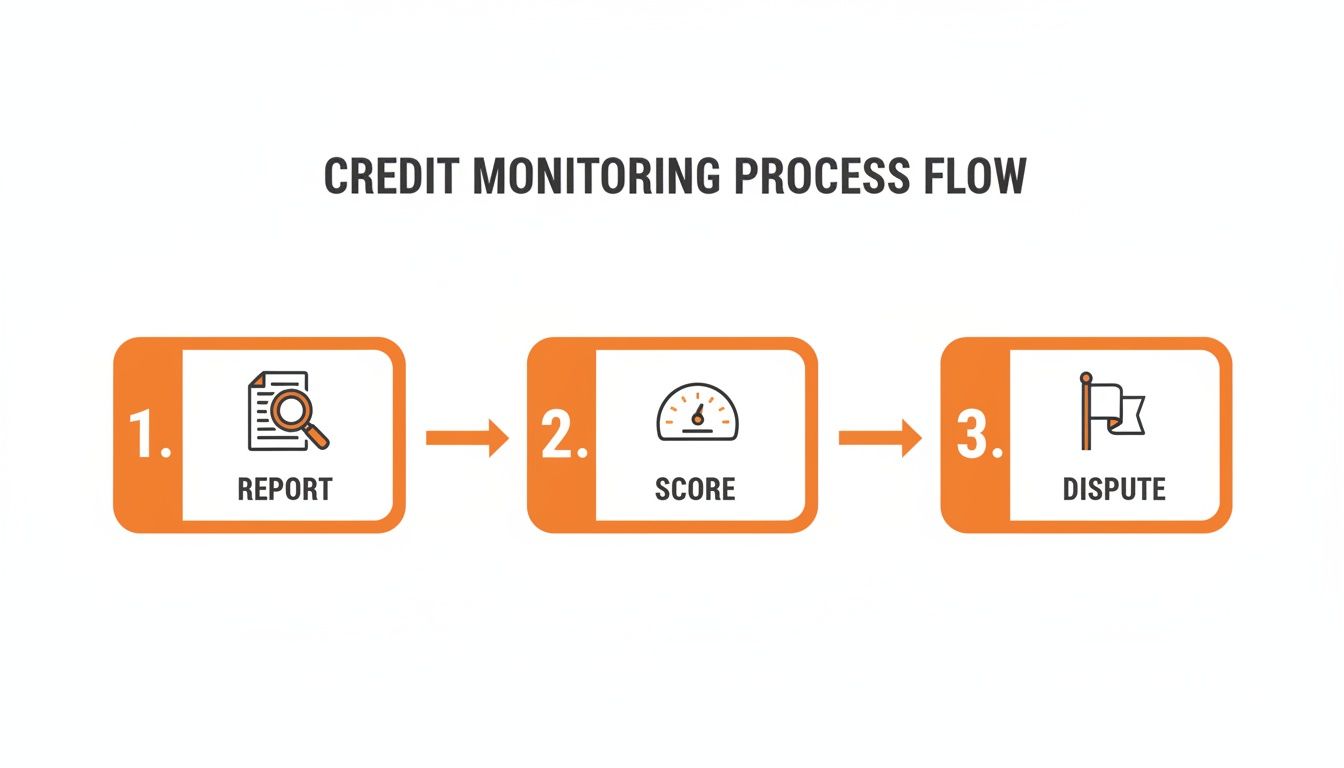
This cycle of pulling your reports, understanding your scores, and immediately disputing errors is what keeps your financial story accurate and powerful. It’s simple, really. Pay your bills early, keep an eye on your reports, and never stop building those relationships.
This is how you create a brand with true financial strength—the kind that lasts.
Frequently Asked Questions
Founders ask me these same questions all the time, so I want to tackle them head-on. Building business credit can feel like a black box at first, but it’s really just a matter of following a clear, consistent process.
Let's clear up a few common questions.
How Long Does It Take to Build Good Business Credit?
Think of it like getting in shape. You won't see a six-pack after one trip to the gym, but you'll notice a difference quickly if you stick with it.
You can often see a measurable business credit score within 60-90 days after your first few vendor tradelines start reporting. Simple as that.
To build a truly strong score—the kind that unlocks better financing—you should plan on 6 to 12 months of consistent, positive payment history. Patience is your best friend here. If you're looking for other funding options, my deep dive into Chicago's venture capital scene can offer some perspective.
Can I Build Business Credit Without a Personal Guarantee?
Absolutely, and that should be your ultimate goal.
A personal guarantee is like having a co-signer on a loan; if your business can't pay, you're personally on the hook. The whole point of building business credit is to let your company stand on its own two financial feet.
You start this process by opening starter vendor accounts (like Uline or Grainger) that don't require a personal guarantee. As you build a solid payment history, you can then apply for business credit cards from issuers that also don't require one. This fully separates your personal and business finances, creating that crucial "seawall" of protection.
The PAYDEX score is a key business credit metric from Dun & Bradstreet, ranging from 1 to 100. It measures how promptly you pay your bills. A score of 80 or higher is the gold standard, showing you consistently pay on time or early—a massive green flag for lenders.
This score is often the very first thing a lender or supplier checks. Keeping it high is one of the most impactful things you can do for your company's financial health. It’s a direct reflection of your reliability as a business.
At Chicago Brandstarters, we believe in helping kind, bold founders build resilient brands. Join our free community to connect with fellow Chicagoans who are turning their ideas into reality.
Leave a Reply