
I'll be direct. Building a brand is tough, especially here in Chicago where your hustle is just the price of entry. I've watched so many founders with incredible products get crushed, not by rivals, but by their own supply chains. It's the silent killer of growing businesses: your cash gets trapped in inventory that won't sell, suppliers vanish right before a big launch, and unexpected shipping costs eat you alive.
Think of your supply chain as the engine in your race car. You could have the most beautiful, sleek car body (your brand and product), but if your engine sputters and leaks oil, you're not finishing the race. You're stuck on the roadside watching everyone else fly by. A weak supply chain will stall your growth, no matter how brilliant your idea is.
This isn't some high-level corporate guide full of abstract theories. This is a battle-tested playbook for you, the founder in the trenches. My goal is to give you a clear, actionable roadmap. We are going to break down the ten most critical strategies for best practice supply chain management that will help you move faster, save precious capital, and build a resilient business that lasts. I'll use simple analogies, real talk, and specific steps you can implement tomorrow to build your unfair advantage.
I will show you how to:
- Align your inventory directly with what your customers actually want.
- Turn your suppliers into strategic partners who help you win.
- Manage risk so one bad supplier doesn't sink your entire operation.
- Use simple data to make smarter, more profitable decisions.
Ready to sharpen your secret weapon? Let's get to work.
1. Demand-Driven Supply Chain Planning
Too often, supply chain management feels like you're trying to predict the weather a year from now. You guess, invest heavily in inventory, and pray you were right. A demand-driven approach flips this on its head. Instead of relying on murky long-range forecasts, you align your supply chain operations with real-time customer demand signals. It's less like a blind bet and more like a responsive conversation with your customers.

This method, made popular by concepts like Demand-Driven Material Requirements Planning (DDMRP), uses actual point-of-sale data, daily orders, and market trends to inform what you produce and stock. For you, an early-stage founder, this is a game-changer. It stops the crippling cash flow problems that come from making too much and tying up your money in slow-moving stock. This is a core component of effective, best practice supply chain management for any growing brand.
How I Recommend You Implement a Demand-Driven Approach
You don't need a complex system to start. You can begin small and build from there.
- Start Simple: Before you spend on expensive software, I want you to create a simple inventory tracking spreadsheet. Log daily sales and update your inventory levels manually. This hands-on process gives you a real feel for your sales velocity.
- Capture Demand Signals: Use the built-in analytics from your e-commerce platform, like Shopify Analytics, to track what’s selling. Pay close attention to which products, sizes, or colors are moving fastest.
- Track Sell-Through Rates: Calculate your sell-through rate (units sold / units received) every single week. This simple number is your early warning system for spotting what’s hot and what’s not, letting you react before a trend dies.
- Build Flexible Supplier Relationships: Don't lock yourself into massive, inflexible orders. You need to find manufacturing partners who can handle smaller, more frequent production runs. Share your sales data with them to build trust; when they see your numbers, they're more likely to offer you flexible terms.
2. Vendor Relationship Management (VRM) & Strategic Partnerships
Many founders view suppliers as just another line on a spreadsheet, constantly hunting for the lowest price. This feels smart, but it often backfires on you. A more powerful strategy is treating your vendors as true partners. I want you to invest in long-term relationships built on trust and shared goals. It’s less like a one-time transaction and more like building a championship team where everyone wins together.
This method, a core element of best practice supply chain management, is about creating collaborative bonds. When you treat suppliers with respect and transparency, you get far more than just a good price. You get their best work, priority access during busy seasons, and a flexible partner who is willing to help you navigate the chaos of growth. It’s the difference between a vendor who just takes your order and a partner who actively helps you succeed.
How I Recommend You Build Strategic Supplier Partnerships
You don't need a huge budget to foster strong relationships. It starts with a shift in your mindset and consistent, genuine effort.
- Schedule Quarterly Business Reviews: I suggest you set up a recurring call with your top 1-2 suppliers each quarter. Go beyond just placing orders; discuss your business plans, growth projections, and upcoming product launches. This transparency builds immense trust.
- Pay On Time, Every Time: The single most effective way for you to become a preferred customer is to be reliable. Paying your invoices promptly builds a reputation that will pay you dividends.
- Give Before You Ask: Look for ways to add value to your suppliers. I've found that introducing them to other founders in my network who might need their services shows I view the relationship as a two-way street.
- Share Your Vision in Writing: Create a simple partnership agreement that outlines what you both expect, how you'll communicate, and shared goals for growth. This formalizes your relationship and ensures you are both aligned from the start.
3. Just-In-Time (JIT) Inventory Management
Imagine you're running a restaurant where ingredients arrive at the exact moment the chef needs them, never sitting on a shelf. That’s the core idea behind Just-In-Time (JIT) inventory. This strategy means you order and receive goods only when you need them for production or to fulfill a customer order. It eliminates your need for vast, expensive warehouses full of stock that might never sell.
Popularized by the Toyota Production System, JIT is a cornerstone of lean manufacturing and a powerful tool for best practice supply chain management. For you, a cash-strapped founder, this is a lifesaver. Instead of tying up your precious capital in piles of inventory, your money is only committed for the shortest possible time. This dramatically improves your cash flow and reduces the risk of getting stuck with products nobody wants. Chicago-based jewelry brand Kinsley Armelle uses this principle by manufacturing close to demand, keeping their operations nimble.
How I Recommend You Implement Just-In-Time Inventory
JIT requires precision and strong supplier relationships, but you can start applying its principles right away.
- Start with Predictable Products: I'd begin with your most stable, best-selling items. Their consistent demand makes them ideal for a JIT model, as you can more reliably predict your needs.
- Build Supplier Redundancy: Don’t rely on a single source. You should cultivate relationships with two or three backup suppliers for your most critical components. This protects you from stockouts if your primary partner faces a disruption.
- Use Pre-Orders to Test Demand: Before you commit to a large production run of a new product, use a pre-order model. This tells you what real-world demand looks like and lets you manufacture exactly what's needed, minimizing your financial risk.
- Prioritize Nearshoring: Consider working with domestic or near-shore suppliers. Shorter lead times and closer proximity make JIT far more manageable for you and reduce the risk of international shipping delays. You can also improve your inventory turnover by getting stock faster and selling it through more quickly.
4. Supply Chain Visibility & Transparency Technology
Operating a supply chain without visibility is like you're driving a car at night with the headlights off. You know you're moving, but you have no idea what's coming next—from roadblocks to sharp turns. This is where visibility and transparency technology comes in. It gives you a real-time, end-to-end view of your entire supply chain, from the moment you order raw materials to the final delivery at your customer’s doorstep.
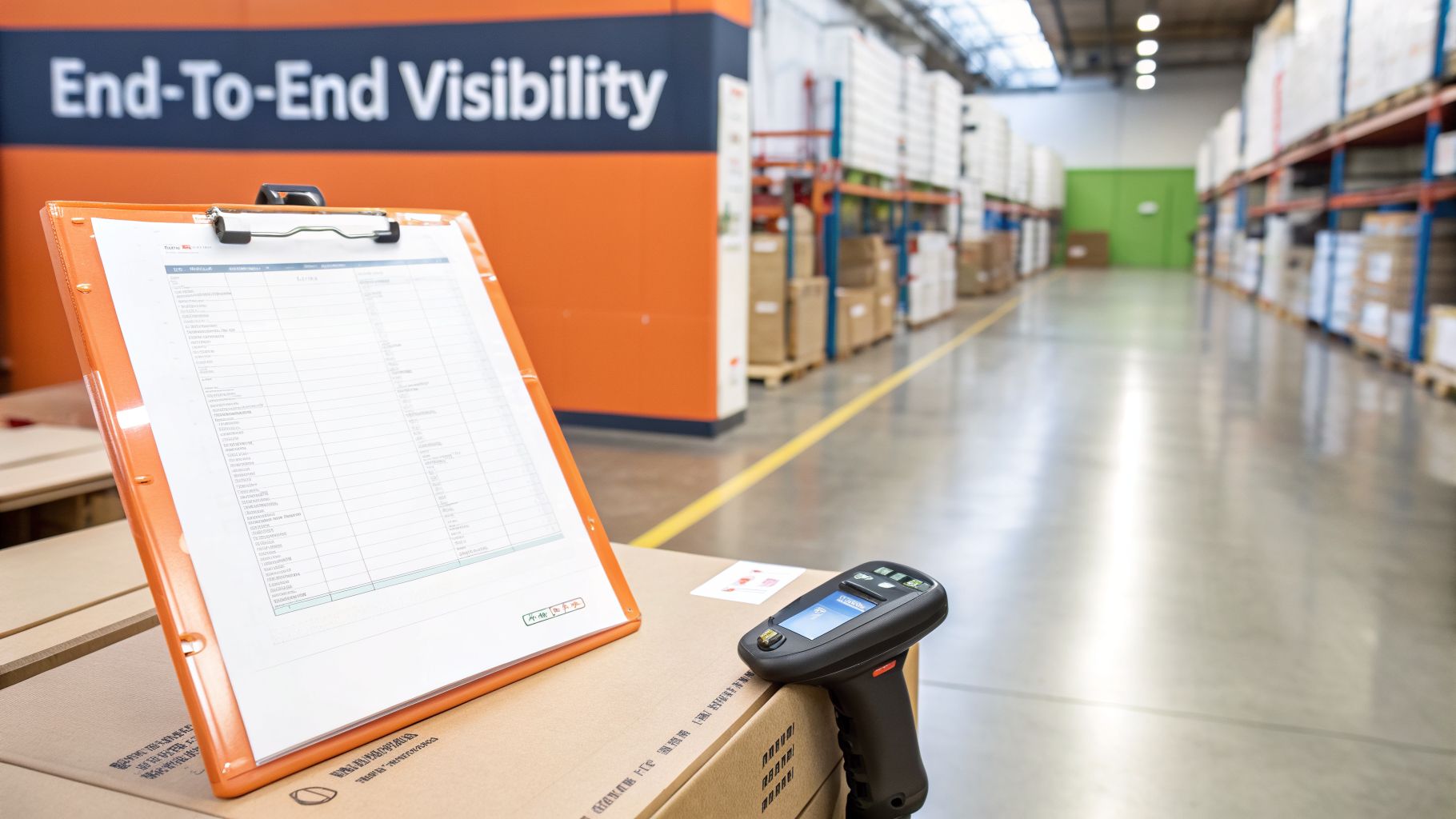
This approach uses systems like software, APIs, or even well-organized manual tracking to follow your inventory, shipments, and supplier performance. For your growing brand, this is a core element of best practice supply chain management because it prevents costly surprises. You can spot a delayed shipment from a supplier or a bottleneck in your fulfillment center before it becomes a disaster your customers experience.
How I Recommend You Implement Supply Chain Visibility
You don't need a massive enterprise system to get started. You can build up your visibility stack piece by piece as you grow.
- Start with Your Core Tools: Begin with a simple spreadsheet or use the free tools you already have. I've seen people connect the Google Sheets app to their Shopify store via its API to pull in daily sales and inventory data automatically. This gives you a live dashboard without any initial cost.
- Choose Integrated Systems: When you're ready for dedicated software, pick tools that integrate seamlessly with your e-commerce platform. Brands I know in Chicago often start with platforms like Cin7 or Katana because they sync directly with Shopify or WooCommerce, keeping your inventory levels accurate across all your sales channels. This is also important if you're deciding on your fulfillment strategy, as you can read more about in our guide to FBA versus FBM.
- Demand Updates from Suppliers: Don't be afraid to ask your suppliers for weekly inventory and shipment status updates. This information is your data. If a supplier hesitates, explain that this transparency helps you place smarter, more predictable orders with them in the future.
- Set Up Automated Alerts: Use your inventory management software (or even a simple formula in your spreadsheet) to create automated alerts for low stock levels or delayed shipment ETAs. These notifications let you be proactive instead of reactive.
5. Lean Supply Chain & Waste Elimination
Imagine your supply chain is a pipeline. Every unnecessary step, every moment of delay, and every extra product is a tiny crack leaking your cash and efficiency. Lean thinking is my art of systematically finding and sealing every single one of those cracks. It’s about delivering maximum value to your customer with the absolute minimum amount of waste.
This isn't just a corporate buzzword; for you, a bootstrapped founder, it’s a survival strategy. Popularized by the Toyota Production System, the lean approach focuses on eliminating "muda" (waste) in all its forms: overproduction, excess inventory, defects, waiting, and unnecessary motion or processing. Amazon’s obsessive focus on cutting steps in its fulfillment centers is a prime example of lean principles at a massive scale. It's a cornerstone of best practice supply chain management because it forces you to be resourceful and intentional.
How I Recommend You Implement a Lean Approach
You can start applying lean thinking today without any fancy tools or consultants. It's a mindset that begins with one simple question: "Is this step adding value for my customer?"
- Map a Single Process: Choose one area, like order fulfillment, and map out every single step. From the moment an order comes in to the moment it’s on a truck, write it all down. Where are the delays? Where are the repetitive tasks? This visual map will instantly reveal to you your biggest opportunities.
- Ask 'Why?' Five Times: When you find a bottleneck or a wasteful step, ask "Why?" repeatedly until you uncover the root cause. Why is packing taking so long? Because the tape is on the other side of the room. Why? Because I didn't organize the packing station. Why? You get the idea. This simple technique stops you from just treating symptoms.
- Focus on the Big Drains First: Zero in on overproduction and waiting time. These two forms of waste are often the biggest cash drains for new brands like yours. Producing too much ties up your capital, while time spent waiting for materials or approvals is time your product isn't selling.
- Implement the 5S Methodology: This is a simple but powerful framework you can use for organizing your workspace to maximize efficiency.
- Sort: Remove everything you don't need.
- Set in Order: Arrange necessary items logically for you.
- Shine: Clean and maintain your workspace.
- Standardize: Create clear, repeatable procedures for yourself.
- Sustain: Make it a habit.
6. Supplier Diversification & Risk Management
Relying on a single supplier is like you're walking a tightrope without a net. It might feel efficient and simple at first, but one gust of wind—a factory fire, a port shutdown, or a sudden political conflict—and your entire business is in freefall. Supplier diversification is your safety net. Instead of putting all your eggs in one basket, you build a portfolio of suppliers across different geographies and with varying capabilities.
This strategy isn't about ditching your main partner; it's about building resilience for yourself. My goal is for you to have trusted primary and secondary sources for your critical components, so a disruption with one doesn't become a catastrophe for you. Recent global events showed me just how critical this piece of best practice supply chain management is. It allows you to maintain production, control costs, and keep promises to your customers, even when the world gets unpredictable.
How I Recommend You Implement Supplier Diversification
You can start building a more resilient supply chain without overhauling your entire operation. It's about taking small, strategic steps.
- Audit Your Risk: Start by mapping out your supply chain. I want you to identify every component or finished good that comes from a single source. These are your biggest vulnerabilities.
- Prioritize What Matters Most: You don't have to diversify everything at once. Focus first on your highest-margin products or the components that are absolutely essential for your top sellers.
- Keep Backup Suppliers "Warm": Once you've identified a secondary supplier, don't just keep their number on file. Send them 10-20% of your order volume regularly. This builds a relationship, keeps them familiar with your quality standards, and ensures they'll prioritize you in a crisis.
- Consider Nearshoring: You should look for backup suppliers closer to home. Having a partner in Mexico or Central America can be a lifesaver if your primary Asian supply lines are disrupted. It might cost a bit more, but the speed and reliability can be worth the premium.
- Network for Vetted Partners: Don't go it alone. Tap into founder communities like my own, Chicago Brandstarters, to get recommendations for vetted suppliers. Learning from others' experiences is a shortcut to finding reliable partners.
7. Data-Driven Demand Forecasting & Analytics
Operating your supply chain without data-driven forecasting is like driving at night with the headlights off. You might guess where the road is going, but you're bound to hit some expensive potholes. Instead of relying on gut feelings, data-driven demand forecasting uses your historical sales data, market trends, and predictive analytics to anticipate what your customers need with much greater accuracy. This practice is a cornerstone of best practice supply chain management, turning your planning from guesswork into a calculated science.
This approach isn't just for giants like Walmart, which uses advanced analytics to manage inventory at the store level. Direct-to-consumer brands I know, like Ritual, use cohort analysis to predict repurchase rates. Even you, as a local Chicago apparel brand, can track seasonal patterns to know exactly when to stock up on winter coats. For you, this means preventing the dual nightmares of costly overstock and sales-killing stockouts.
How I Recommend You Implement Data-Driven Forecasting
You don't need a data science degree to get started. The key for you is to begin with the data you already have and build from there.
- Establish a Baseline: Before you do anything else, pull the last 12 months of your sales data. Organize it by week and by month to create a simple historical record for yourself. This is your foundation.
- Identify Seasonality: Look at your baseline data. When do your sales predictably spike or dip? Is it a holiday, a season, or a specific month? Recognizing these patterns is your first step toward predictive power.
- Use Your E-commerce Analytics: Dive into your Shopify or Google Analytics. These tools are goldmines for spotting trends early. I want you to look at which products are gaining traction and which are slowing down, giving you a real-time pulse on the market.
- Create a Simple Forecast: A basic but effective formula for you is: (Last Year's Sales for the Period) + (Your Target Growth %) = This Year's Forecast. Start by forecasting three months out and measure your accuracy by comparing your forecast to actual sales each month. This lets you refine your growth assumptions over time.
- Visualize Your Data: You don't need fancy software. Use Excel or Google Sheets to create simple charts of your sales data. Visualizing demand patterns often reveals insights to me that raw numbers hide.
8. Nearshoring & Localized Supply Chains
Relying entirely on suppliers halfway across the world feels like a high-stakes gamble with long odds. You face extended lead times, complex logistics, and political risks you can't control. Nearshoring and localization flip this script by bringing your production closer to your end customers. Think of it as shortening the distance between your idea and your customer's hands, which reduces the chance of something going wrong along the way.
This strategy involves you moving your manufacturing from distant countries to ones closer to home—for example, from Asia to Mexico if you're a US-based brand. The primary benefit isn't always a lower unit price but a lower total landed cost. This approach drastically cuts down your shipping times, transportation expenses, and communication delays, which is a critical piece of modern, best practice supply chain management for brands like yours that prioritize speed and resilience.
How I Recommend You Implement Nearshoring & Localization
You can explore this without completely overhauling your entire operation. A hybrid model is often the smartest way for you to start.
- Map Your Current Chain: First, I want you to get a clear picture of your existing suppliers. Where are they located? What are their real lead times, door-to-door? This gives you a baseline to compare against.
- Calculate Total Landed Cost: Don't just compare the per-unit manufacturing price. You need to factor in shipping, tariffs, customs fees, and the cost of holding inventory while it’s in transit. Speed has a tangible value for you.
- Research Nearby Options: Look for potential partners in regions known for your product category. If you're a US brand, this might be Mexico for apparel, Central America for textiles, or Canada for specialized packaging.
- Start with a Pilot Order: Before you make a huge commitment, test a potential nearshore supplier with a small production run. Use this order to evaluate their quality, communication, and reliability firsthand. I find that a personal visit can also build a much stronger relationship than emails ever could.
9. Quality Management Systems & Supplier Quality Control
Relying on luck for product quality is like you building a house without a blueprint. You might get a few straight walls, but you’re risking a total collapse. Implementing a quality management system means you stop hoping for good products and start building a process that guarantees them. This is about you setting clear, non-negotiable standards for everything from your raw materials to the final item that lands on your customer’s doorstep.
Think of it as your insurance policy for your brand's reputation. A robust quality system, a key part of best practice supply chain management, catches defects before they can damage your customer's trust and trigger expensive returns. It shifts your focus from reacting to problems to preventing them in the first place, ensuring the premium experience your customers expect, much like Apple does with its famously strict supplier audits.
How I Recommend You Implement a Quality Management System
You don't need a team of inspectors or a complex lab to start. Your quality control begins with clear communication and simple, repeatable checks.
- Create a Quality Specification Sheet: Before you even place an order, I want you to document your exact expectations. Specify materials, dimensions, colors, stitching, and packaging. This document is your contract of quality; leave no room for interpretation.
- Require Supplier Certifications: Ask your suppliers for relevant certifications, like ISO 9001. This shows you they have their own documented quality processes, which saves you a lot of guesswork and headaches.
- Implement Sampling Inspections: You don't need to check every single unit when a shipment arrives. Start by inspecting a random sample (e.g., 5-10% of the order). This is an efficient way for you to spot widespread issues early.
- Establish a Defect Tracking System: I use a simple spreadsheet to log every defect I find. Note the type of issue, the product, and the date. Over time, you'll see patterns that help you and your supplier identify the root cause of problems. For a deeper dive into working with partners, you can learn more about how to manufacture a product.
- Build Quality Into Your Agreements: Make quality a formal part of your supplier contracts. I always include clauses for accepting or rejecting shipments based on my inspection results. This puts accountability front and center.
10. Collaborative Planning & Information Sharing with Ecosystem Partners
Operating your supply chain in a silo is like you're trying to navigate a busy highway with blinders on. You only see what’s directly in front of you, missing the signals from other drivers that could help you avoid a pileup. Collaborative planning means you take those blinders off. It’s about creating open communication channels with your suppliers, manufacturers, and logistics partners to align on everything from forecasts to inventory.

This transparency helps you and your partners see the same road ahead. When your supplier knows your growth plans and you know their capacity limits, you can plan together instead of reacting to surprises. This is the essence of best practice supply chain management, turning your transactional relationships into strategic partnerships. It prevents the bullwhip effect, where small shifts in your sales cause massive, costly disruptions for your suppliers.
How I Recommend You Implement Collaborative Planning
Building trust is the foundation, and you can start by being the first one to share information.
- Start with Key Partners: You don’t need to do this with everyone at once. Pick your top 2-3 most critical suppliers and schedule a dedicated meeting where you can discuss mutual growth.
- Share Real Data: Be radically transparent. I give my key partners access to my Shopify dashboard or a weekly export of sales data. Real numbers build credibility far more than vague projections. When they see what's selling, they can better prepare for you.
- Establish a Rhythm: Create a recurring monthly or quarterly review meeting. Use this time to discuss your upcoming promotions, sales forecasts, and any potential bottlenecks you see on the horizon. Ask them, "What do you need from me to be successful?"
- Plan for Growth Together: If you are forecasting 50% growth for next year, tell your partners now. This gives them time to secure raw materials and allocate production capacity for you. Nothing hurts a partnership more than your surprise massive order with a tight deadline.
- Use Simple Tools: You don't need a complex portal. A shared Slack channel or Microsoft Teams group can work wonders for your real-time communication on order status, shipping delays, or quality control questions.
Top 10 Supply Chain Best Practices Comparison
| Approach | 🔄 Implementation Complexity | 💡 Resource Requirements | 📊 Expected Outcomes | ⚡ Ideal Use Cases | ⭐ Key Advantages |
|---|---|---|---|---|---|
| Demand-Driven Supply Chain Planning | Medium — requires real-time data integration and supplier communication | Moderate — POS/inventory integrations and analytics | Improved inventory turns; fewer overproduction and stockouts | DTC/retail brands with variable demand; bootstrapped founders | Lean cash use, responsive production, better cash conversion |
| Vendor Relationship Management & Strategic Partnerships | Medium — time‑intensive relationship building and governance | Low–Moderate — time, communication processes, contracts | Priority access to capacity; flexible terms during growth or shortages | Founders needing supplier support, reliability and collaboration | Long-term reliability, better pricing over time, supplier-driven innovation |
| Just-In-Time (JIT) Inventory Management | High — tight synchronization with suppliers and processes | Low–Moderate — frequent logistics, reliable suppliers, forecasting | Low inventory carrying cost and obsolescence; higher disruption risk | Stable-demand products with dependable suppliers | Minimizes working capital, reduces waste and storage costs |
| Supply Chain Visibility & Transparency Technology | Medium–High — system integrations and data governance | Moderate–High — software, APIs, maintenance, training | Early issue detection; data-driven decisions; better customer updates | Growing brands with multi-channel inventory and complex logistics | Enhanced forecasting, accountability, and operational transparency |
| Lean Supply Chain & Waste Elimination | Medium — requires cultural change and process mapping | Low–Moderate — training, time, process improvement tools | Reduced operational costs; improved flow and quality | Bootstrapped founders focused on efficiency and cost reduction | Sustained cost savings and continuous improvement culture |
| Supplier Diversification & Risk Management | Medium — sourcing multiple suppliers and coordination | Moderate — audits, contracts, inventory buffers, admin overhead | Reduced single-source risk and greater continuity; possible higher costs | Brands exposed to geopolitical or supply disruptions | Resilience, negotiation leverage, continuity of supply |
| Data-Driven Demand Forecasting & Analytics | Medium — modeling, data cleaning and validation needed | Moderate — analytics tools, clean historical data, skills | Better forecast accuracy; lower waste and fewer stockouts | Brands with sufficient sales history and repeat purchases | Smarter production planning and improved purchasing decisions |
| Nearshoring & Localized Supply Chains | Medium — new supplier vetting and logistics realignment | Moderate–High — higher unit costs, supplier visits, new contracts | Shorter lead times, lower transport footprint, higher per-unit cost | Trend-driven or time-sensitive products; sustainability-focused brands | Faster restocks, better quality control, reduced trade risk |
| Quality Management Systems & Supplier Quality Control | Medium — process definition, audits and corrective actions | Moderate — inspections, testing, quality personnel or consultants | Fewer defects/returns; stronger brand reputation and consistency | Products where quality impacts safety, compliance, or brand trust | Consistent product quality, lower rework and warranty costs |
| Collaborative Planning & Information Sharing | Medium — governance, regular communication and trust | Low–Moderate — meetings, shared tools, data-sharing agreements | Reduced bullwhip effect; aligned forecasts and inventory | Multi‑partner supply chains seeking coordinated growth | Aligned incentives, faster response, stronger partner relationships |
It's a Marathon, Not a Sprint: Your Next Move
We’ve just walked through a massive amount of information. I get it. Seeing a list of ten complex practices can feel like you’re standing at the bottom of a mountain, staring up at a peak you can’t even see. But here’s the secret: you don't climb it all at once. You take it one step at a time. This journey toward exceptional supply chain management is a marathon for you, not a frantic sprint.
The core idea I want you to walk away with is that your supply chain is not a static cost center you set up and forget. It's a living, breathing part of your business that grows and changes right alongside you. It's your brand's engine. A clunky, inefficient engine sputters, wastes fuel, and eventually breaks down. A well-oiled machine, however, gets you where you need to go reliably and efficiently, letting you focus on the road ahead instead of worrying about what’s under the hood.
Your First Step: Pick Your Battle
Don't try to implement all ten of these best practices by next Tuesday. You’ll burn yourself out and likely do none of them well. Instead, I want you to do this:
- Review the list: Go back through the ten practices we covered, from demand-driven planning to supplier collaboration.
- Identify your biggest pain point: Where are you feeling the most pressure right now? Is it your unpredictable inventory levels (look at JIT or demand forecasting)? Are your supplier relationships causing constant headaches (focus on VRM)? Are shipping costs eating you alive (explore nearshoring or lean principles)?
- Choose ONE practice: Pick the single strategy that directly addresses your most urgent problem. The one that, if you could solve it, would give you the most breathing room.
That’s your starting point. Devote your energy to understanding and implementing that one practice. Master it. Automate what you can. Create a simple process for it. Once it’s running smoothly and you’re seeing the benefits, then, and only then, should you return to the list and pick your next battle. This is how you build a resilient, best practice supply chain management system—methodically and sustainably.
Why This Matters More Than Anything
For founders like us, especially those of us in Chicago and the Midwest building real, tangible product brands, our supply chain is our promise to our customers. It's how we turn a great idea into a physical product that arrives on someone’s doorstep. Getting it right means you'll have happier customers, better margins, and fewer sleepless nights. It’s the foundational work that separates the brands that fizzle out from the ones that become household names.
You’re building something from scratch, often with limited resources and a small team (or maybe it's just you). You’re driven by a desire to make an impact, and you’re tired of the old way of doing things. Applying these principles isn't just about operational efficiency; it’s about you building a business on your own terms, one that is strong, kind, and built to last. It’s about creating a company that won't let you down, so you can deliver on the promises you make.
The path of a founder can be incredibly lonely, but you don't have to walk it alone. That’s why I created Chicago Brandstarters, a free, vetted community for founders like us to share tactics and support each other without the BS of typical networking. If you value real conversations with peers who are in the trenches with you, you’ll find a home with us.
Leave a Reply