You've got a product idea in your notes app, a name you like, and three friends who told you they'd buy it. Maybe you've already asked a supplier about minimum order quantities. What you don't have is one stranger who has paid you anything or changed a habit for you.
That gap is where most of the money gets lost. Learning how to test a product concept means writing your go, revise and stop lines before a single result arrives, then climbing a ladder from polite praise to a paid deposit. Compliments never count as demand. Commitment does.
Five Validation Tests From Problem Talk to Paid Commitment
Here's the whole path on one screen. Each stage buys you a different kind of evidence, and each one has a signal you can check without arguing with yourself about it.
| Stage | Test | Evidence it gives | Pass signal |
|---|---|---|---|
| 1 | Problem interviews | How people handle the problem today | A named workaround and a recent cost in money or time |
| 2 | Landing page with one action | Whether strangers act on the offer | Qualified visitors convert above your preset rate |
| 3 | Deposit or preorder | Willingness to pay | Qualified buyers pay before the product exists |
| 4 | Manual pilot | Whether the delivered service solves the problem | Customers come back for a second use |
| 5 | Prototype usability test | Whether users finish realistic tasks | Five users complete the main task without help |
Why the order matters
A landing page tests a promise. A promise means nothing until you know the problem is real, so interviews come first. Run the page too early and you'll spend two weeks rewriting headlines when the actual issue is that nobody feels the pain you assumed.
Slot the prototype test wherever you have something clickable or holdable. For a physical product, that's often early, since a 3D print or a cardboard mockup answers questions no interview can. If you're still assembling the rest of the launch, use a guide to start an online business step-by-step to keep testing tied to a real plan instead of a hobby.
Launch is a hypothesis
A peer-reviewed 2021 study analyzed 83,719 new stock-keeping units across 31 consumer-packaged-goods categories in the United States, introduced from 2002 through 2009, and found 25% were no longer purchased one year after launch, with failure reaching about 40% after two years. Shipping isn't proof. It's the start of the experiment.
Write the pass signal for each stage on paper before you run it. Move forward only when a stage clears its own line, so stage one produces facts instead of encouragement.
Set Go, Revise and Stop Lines Before You Test
Decide what failure looks like while you're still calm. Once you've spent money and told people about the idea, you'll read every ambiguous result as a maybe.
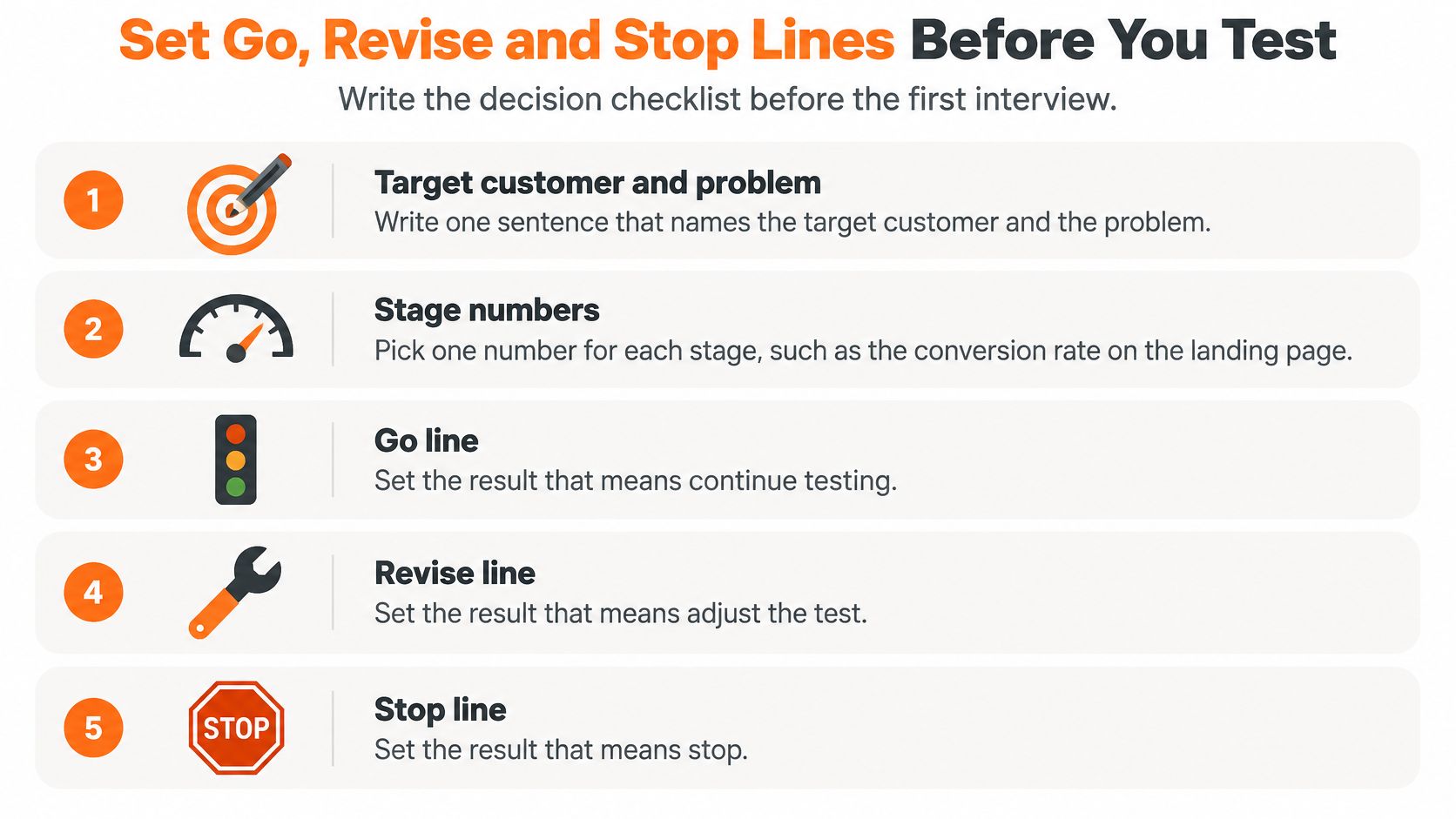
Write the decision checklist before the first interview.
The five lines you write down
- One sentence: Name the target customer and the problem, like "independent pet groomers who lose bookings to phone tag." If you can't write it in one sentence, you're testing two ideas at once.
- One number per stage: Pick the landing page conversion rate or the count of deposits from qualified buyers. One number, not a range you can slide later.
- A minimum sample: Two responses prove nothing in either direction. Decide how many people you need before you look at any of them.
- Three outcomes: Go, revise, stop. Attach a result to each.
- Same-day recording: Log the result the day it lands, while the numbers still look plain and you haven't built a story around them.
Plan for volume, too. Product Development and Management Association findings summarized in the Journal of Innovation and Knowledge report that only one concept succeeds for roughly every 7 to 10 concepts evaluated, so a single idea you're emotionally attached to is a bad bet from the start.
Reading a result that lands in the middle
Revise means change the offer, the price or the channel before you touch the product. Those are cheap. Retooling isn't.
When people call the idea good and then keep their current option, the product may be fine while the reason to switch is weak. Shopify's product validation guide makes the same point: buyers judge you against the habit, supplier or substitute they already trust, including the choice to do nothing. Put your offer next to their current solution and one realistic alternative, force a choice under a real budget, then ask why the winner won.
Practical rule: the stop line you wrote in advance outranks the friendliest call you take all week.
Interview Customers About the Problem They Already Pay to Solve
Your first conversations should be about their life, not your product. The moment you pitch, you start collecting politeness.
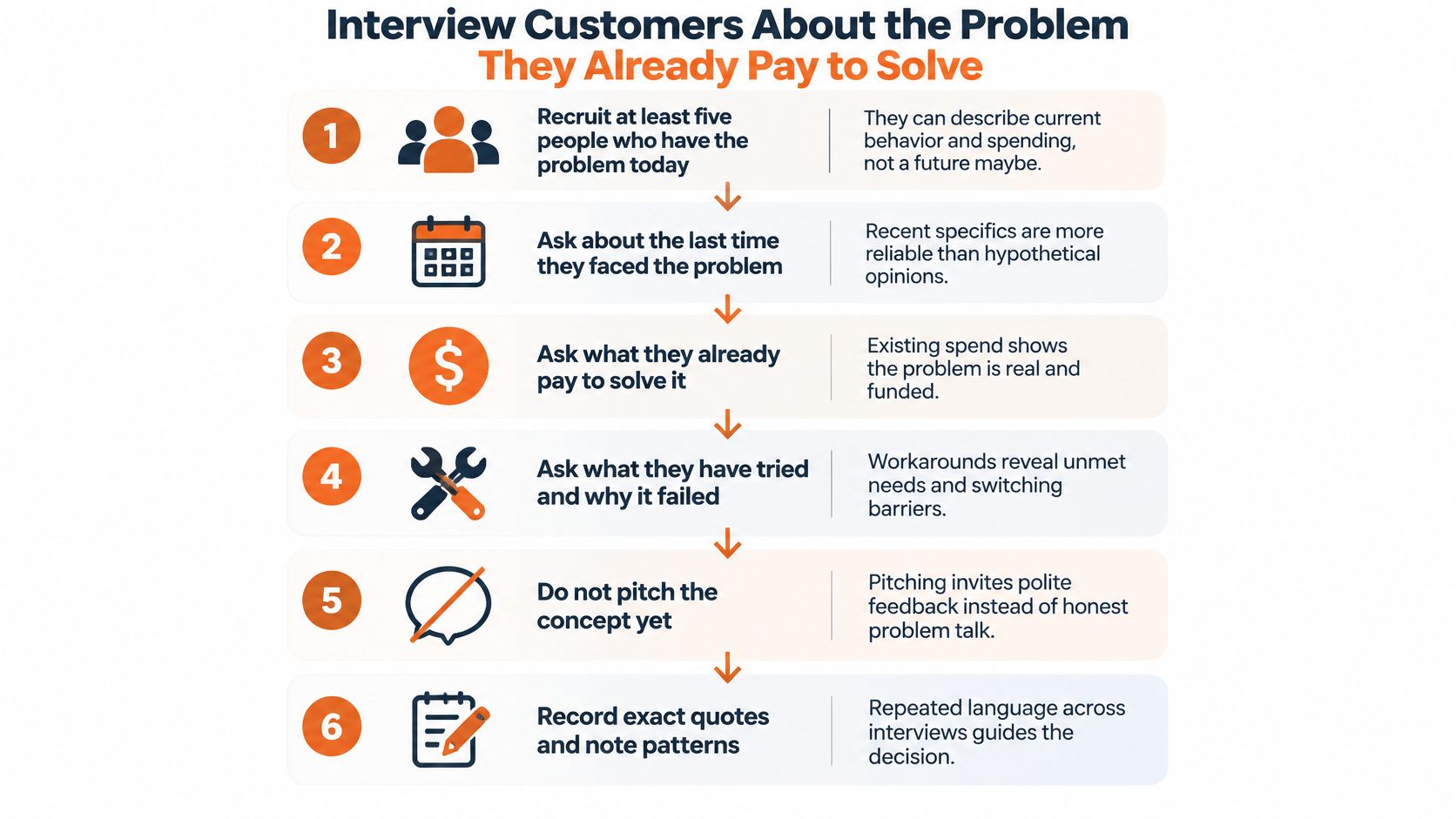
Here's the six-step interview flow I use, with the reason for each step.
The six steps
- Recruit at least five people who have the problem today. They can describe current behavior and spending instead of a future maybe.
- Ask about the last time they faced the problem and what they did next. Recent specifics beat hypothetical opinions every time.
- Ask which alternatives they tried or considered, and why they dropped them. Abandoned solutions tell you where the switching barriers sit.
- Ask what the process cost in money, hours and frustration. A problem nobody funds is a complaint, not a market.
- Ask what they'd fix first if they could change one part. Their priority order is rarely yours.
- Close with a concrete next step: sharing data, joining a pilot, making an introduction, placing a deposit.
Don't pitch before step six. This validation sequence puts problem interviews ahead of a landing page, then a pre-sale or letter of intent, then a manually delivered version of the service, moving you from reported pain to observable commitment.
Watch the walkthrough below before you write your questions, and note how much of it is listening rather than explaining.
What you're listening for
Three things: a named workaround, a specific cost, and a story with dates. "I use a shared spreadsheet and my office manager spends Friday afternoons reconciling it" is evidence. "That sounds useful" is air. For a question bank you can adapt, work through these customer discovery interview prompts.
Keep going until the same workaround keeps showing up, which usually takes five to ten conversations. If every person describes a different problem, your audience is too broad. Narrow it before you spend another dollar on testing.
Measure Commitment Instead of Compliments
People are polite. Saying they'd use your idea costs them nothing, and you'll hear it constantly if you ask the wrong question.
Ipsos reported in 2025 that 40% of tested concepts weren't sufficiently relevant to drive behavior change relative to consumers' most-purchased products, according to its concept and product testing launch announcement. Warm reactions overstate demand by a wide margin.
The commitment ladder, weakest to strongest
- Praise. "Great idea." "I'd use this." Worth zero.
- Agreeing to a follow-up call. Cheap, but it's a calendar entry.
- Sharing access to their current workflow or data. Now they've risked something.
- Signing a letter of intent. Their name is on paper.
- Paying a deposit or placing a preorder. Money moved.
Count rungs 3 through 5 as demand. Everything below that is a lead, not a customer.
A no from someone who won't pay is useful information, not a verdict on the whole idea. Ask what they'd stop doing and what they'd buy instead, and you'll usually learn that your competitor is a habit rather than a company. If you want the mechanics of asking for money before the product exists, this guide to pre-selling a product covers the offer and the refund terms.
Put a taste of the product next to the promise
Ipsos also reported that combining concept and product testing produced 20% higher success rates than testing them in isolation. So show something: a sample, a mockup, a five-minute manual version of the service. Let people react to the experience, not just the sentence describing it.
Ask for a date, a next step and a payment method. Polite support rarely answers all three.
Run a One-Page Landing Test With a Pass Line Set First
A landing page answers one question: will a stranger act on this offer? Build it to answer that and nothing else.
Five steps
- Define the audience and the traffic source first. Say small business owners reached through one targeted ad set. Vague traffic produces uninterpretable numbers.
- Write one page with the problem, the proposed solution and one measurable action: a waitlist sign-up, an early access request, or a started checkout. Two calls to action split your signal.
- Set your pass line before launch, both the conversion rate and the minimum number of qualified visitors.
- Send traffic for a fixed window and leave the page alone. Editing mid-test destroys the comparison you're paying for.
- Compare the result with your own threshold, not with someone else's benchmark.
Benchmarks are context, not pass marks
Unbounce's 2024 benchmark, cited in this landing page test template, analyzed more than 41,000 landing pages, 57 million conversions and 464 million visitors from July 2023 through July 2024. The median conversion rate across industries was 6.6%, SaaS pages had a 3.8% median, and the top 25% of SaaS pages reached at least 11.6%.
Those pages sell things that exist. Yours doesn't, so there's no guaranteed benchmark for it. Traffic quality, audience fit, price and the offer move your result far more than button color does.
Set a minimum count of qualified visitors you can realistically reach in one week, say 200 for a narrow B2B audience, and write that number next to your conversion threshold before the page goes live. Continue if qualified visitors convert above the line. Revise the offer or drop the concept if they don't.
Sign-ups from friends and family don't count. They match no target profile, and they'll flatter a page that strangers ignore. Count only visitors who fit the audience you defined in step one.
Test a Prototype With Five Users, Then Repeat
Usability testing and market testing are different jobs. Five people can tell you where your interface breaks. They can't tell you whether anyone will buy.
Six steps for a round
- Recruit five people who match your target customer. Friends who want to help will forgive problems your buyers won't.
- Give each one a realistic task, like setting up the product or placing a first order. "Look around and tell me what you think" produces opinions, not behavior.
- Ask them to think out loud and say what they expect before each click.
- Watch where they hesitate, click the wrong thing or give up, and write down every moment. Don't rescue them.
- List the three most common problems across the sessions and fix the largest one first.
- Run another round with five new people.
Keep the sessions short and the tasks concrete. If you're still shaping the artifact itself, this walkthrough on prototyping and product design covers what to build at each fidelity level so you don't over-invest in a mockup you'll throw away.
For problems that only appear over days rather than minutes, a diary approach helps. See Transpawrent on tracking owner experiences for how to capture owner experiences as they happen, which is useful when your product fits into a routine you can't watch live.
What five people can and can't tell you
Nielsen Norman Group says five users can reveal almost as many usability problems as much larger groups, which makes small rounds efficient for finding flaws. For numbers you can trust, the same source recommends at least 20 users for statistically meaningful results, and its qualitative guidance describes roughly 40 participants for many studies measuring task success and time on task.
Five users are a few tasters in a kitchen. They'll catch the burnt sauce immediately. They can't tell you how many diners will order the dish.
End every round with a written list of fixes and a date for the next session, or the test becomes a story you tell instead of work you do.
Run Your First Test This Week
Three moves, in order.
- Pick one concept and write its problem in a single sentence. One concept, not the three you've been rotating.
- Book at least five problem interviews and write the pass line for that stage before the first call.
- Once the interviews show a repeated problem with a named workaround, schedule the landing page or the manual pilot and set its pass line before anything goes live.
Keep a log with one row per interview: the workaround, the cost, the date, and the next step the person agreed to. Review it Friday against the rules you wrote earlier in the week, not against how you feel about the idea by then.
If you want to rehearse, read your questions aloud to a friend outside your target group so you hear how they land before you ask strangers. And if you're documenting the test publicly, AI-generated listicle pages for agencies from Landra can help you turn your findings into a page that attracts the exact audience you're trying to recruit.
You don't need a prototype to get help with this. We welcome members at the idea stage with nothing built yet, and people who've already made the expensive early mistakes are glad to walk you through theirs.
Book the first interview before the day ends. Everything else waits on that conversation.
Chicago Brandstarters is a free, vetted community for kind, hard-working Chicagoans and Midwesterners building brands, where small private dinners and an active group chat give you honest feedback on your interview questions, your pass lines and your first preorder offer. You can apply to join even if your concept is still a sentence in your notes app. Visit Chicago Brandstarters and bring the test you're about to run.
Leave a Reply