

Most ecommerce marketing plans fail because they try to do everything at once. SEO, paid social, creators, marketplaces, email, loyalty, content, and discounts all sound sensible on paper. A bootstrapped brand can still run out of cash before any of those channels proves it can produce profitable orders.
Treat your ecommerce marketing plan as a risk-management system. Each spend decision should answer three questions: what are we testing, what result earns the next investment, and when do we stop? U.S. retail ecommerce sales reached an estimated $1.2337 trillion in 2025, up 5.4% from 2024, while total retail sales grew 3.5%, according to the U.S. Census Bureau's 2025 ecommerce report. Digital demand is real. That doesn't make every channel profitable for your store.
Why Most Ecommerce Marketing Plans Fail Before They Start
A full channel rollout isn't proof of a solid plan. It often means the founder has confused activity with evidence. You can publish daily, buy clicks, collect followers, and still lose money on every order if your offer, checkout, fulfillment cost, or repeat purchase economics remain weak.
The first job of your plan is to protect cash while you learn. Before you scale traffic, prove that a defined buyer wants the product, understands the promise, and can complete checkout without costly friction. Baymard's research identifies extra costs, slow delivery, card-security concerns, required account creation, and complicated checkout among the reasons shoppers abandon carts, while 42% report abandoning because they were browsing or weren't ready to buy, according to Baymard's cart abandonment research.

Replace the wish list with gates
Use three operating stages:
- Demand proof: interviews, landing-page signups, preorders, or a small batch tell you whether people will act.
- Unit-economics proof: contribution margin after fulfillment, returns, discounts, and acquisition costs stays acceptable.
- Repeat proof: buyers return, recommend the product, or purchase a complementary item without constant discounting.
At each stage, cap spending before you start. A channel earns more budget only after it meets the gate you set in advance. A useful Million Dollar Sellers launch framework can help you think through launch sequencing, but your own cash position should decide the pace.
Checkout work and retention deserve budget before another traffic source when existing visitors leak out or first-time buyers never return. That choice feels less exciting than launching an ad set. It usually gives you cleaner evidence.
Setting Revenue Goals and Stage Gates
Start with a revenue target, then work backward until you reach a number you can influence each week. A target without margin and cash rules is a hobby project with better branding.
Write one page containing:
- Revenue target: the sales amount you want for the month or quarter.
- Order target: revenue target divided by average order value.
- Traffic target: order target divided by expected conversion rate.
- Margin floor: contribution margin after product cost, fulfillment, payment fees, discounts, returns, and acquisition spend.
- Cash limit: the amount you can spend before the next cash inflow or inventory payment.
Your arithmetic doesn't need to be complicated. If your target is $10,000 and your average order value is $50, you need 200 orders. If your store converts at 2%, you need 10,000 qualified sessions. Those figures are planning assumptions, not forecasts. Replace them with your own measured data as soon as orders arrive.
Make spending conditional
Build gates around evidence rather than optimism.
- Gate one: buyers take a meaningful action, for example a preorder, deposit, or waitlist signup.
- Gate two: the product produces positive contribution margin before you add more acquisition spend.
- Gate three: repeat purchasing or complementary-product demand gives you a reason to invest in retention.
- Gate four: a channel reaches a payback period your cash position can tolerate.
Set aside cash for seasonal demand and inventory surprises before you commit to recurring software, agency retainers, or large ad budgets. A smaller brand needs flexibility more than it needs an impressive marketing stack.
Review this target sheet weekly. If revenue rises while margin falls, you haven't necessarily improved the business. You may have purchased expensive demand. Track customer-acquisition cost, average order value, repeat-purchase rate, payback period, and 90-day contribution margin beside sales.
Defining Your Real Audience and Positioning
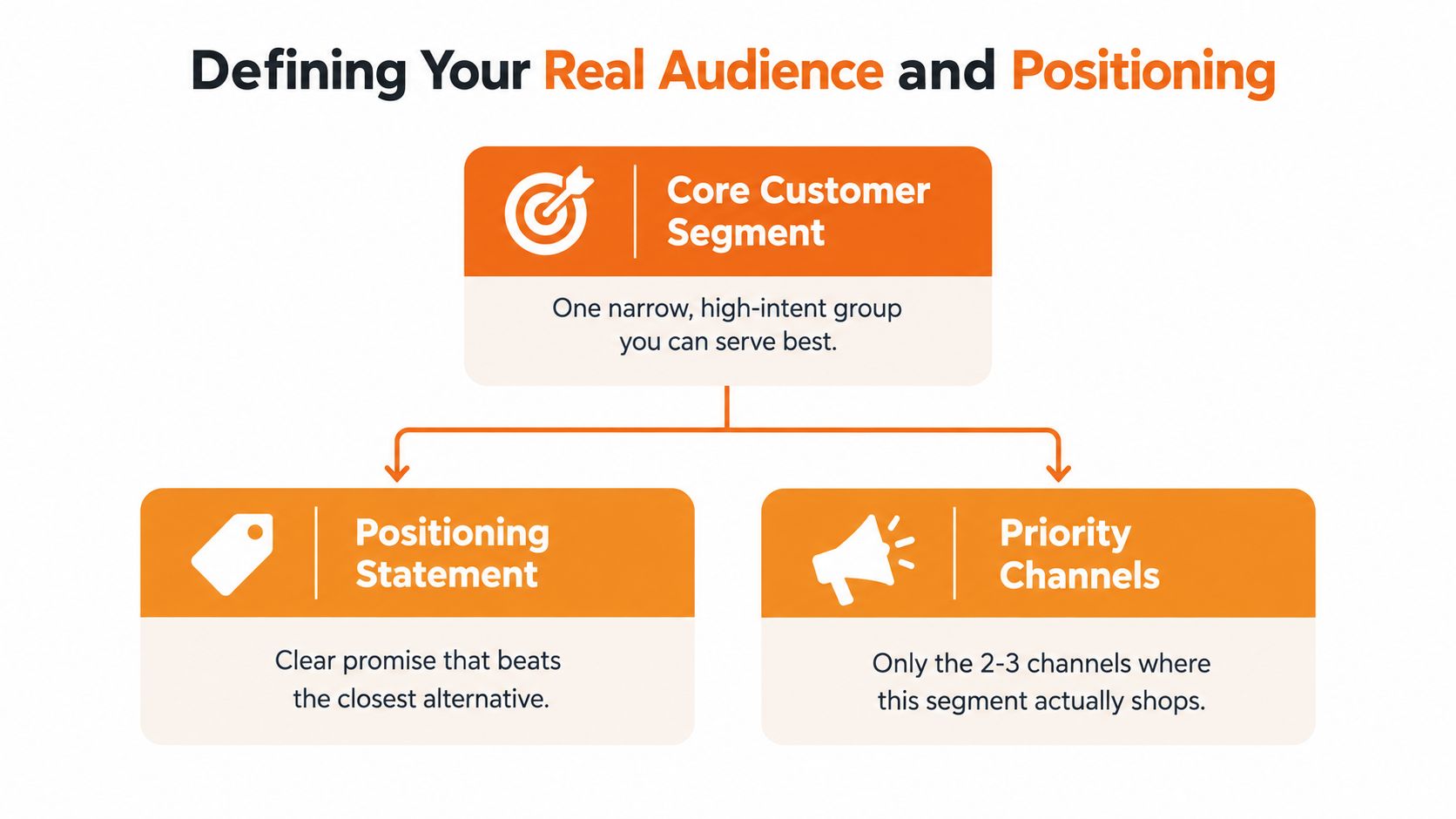
“Everyone who likes this product” isn't an audience. It gives you no useful answer when you choose a message, channel, price, or landing page.
Start with behavior and intent. Separate people who have only shown curiosity from those who have paid, purchased repeatedly, bought high-margin products, or stopped buying. You can build this map from order records, customer interviews, support conversations, and a simple spreadsheet. You don't need a large dataset to spot obvious differences in objections and buying reasons.
Turn segments into decisions
Use a practical map:
- First-time buyers: What convinced them to take the first risk?
- Repeat buyers: What job does the product keep doing?
- High-value customers: Which bundle, use case, or service earns their larger order?
- Lapsed customers: What changed, and what would make another purchase reasonable?
Then write a positioning statement that names the buyer, the problem, the promise, and the alternative you beat. A Chicago product brand might position a durable item for Midwestern commuters who are tired of replacing cheaper versions. A local food brand might focus on buyers who want small-batch production and transparent sourcing rather than the lowest price.
Your channels should follow the segment. A buyer searching for a specific product may respond to paid search and useful product content. A buyer who discovers products through trusted local creators may need creator demonstrations and an email capture offer. Don't assign equal budget to every possible audience.
Choose one priority segment for the next ninety days. Write down two secondary segments you won't actively pursue until the first segment reaches your chosen proof point. Give contractors the same positioning statement, approved claims, offer boundaries, and customer objections. That prevents a freelancer from turning a focused brand into a collection of disconnected messages.
Marketplace Versus Owned Site Strategy
Marketplaces can produce discovery and trust faster than a new store. They also place the customer relationship inside someone else's rules. Your listing, pricing, reviews, reach, and access to buyer information depend on the platform.
An owned site takes longer to attract demand, yet it gives you more control over merchandising, email capture, customer education, pricing, and post-purchase communication. Neither path wins in every situation. The right choice depends on whether you need fast validation, customer ownership, margin protection, or brand control.
| Factor | Marketplace-First | Owned-Site-First |
|---|---|---|
| Time to first sale | Often faster when shoppers already search the category | Usually slower while you build qualified traffic |
| Customer-data ownership | Limited by platform rules and available buyer information | Greater control over consented first-party data |
| Contribution-margin impact | Platform fees and price competition can compress margin | You carry traffic-acquisition and conversion costs directly |
| Brand-control needs | Listing format, reviews, and policies constrain presentation | You control product education, offers, checkout, and follow-up |
| Best early use | Demand validation and selective discovery | Retention, positioning, and long-term customer economics |
A two-track model usually gives a small brand more room to learn. Use a marketplace for a narrow product range or a controlled validation test. At the same time, send every compliant customer toward your owned email or SMS audience through packaging, support, and post-purchase education. Don't violate platform rules or assume you can export information you didn't collect with consent.
Your site needs its own product feed and search foundation. Google recommends adding Product structured data to product pages and uploading a product feed to Google Merchant Center. Google says using both methods can help it verify that price, availability, reviews, and shipping information match what appears on the page.
Use Chicago Brandstarters' omnichannel marketing strategy resources when you need to think through the handoff between marketplace discovery and owned retention. Pick a primary track, set a review date, and make the trade-off deliberately.
Building a Testable Channel Mix and Budget
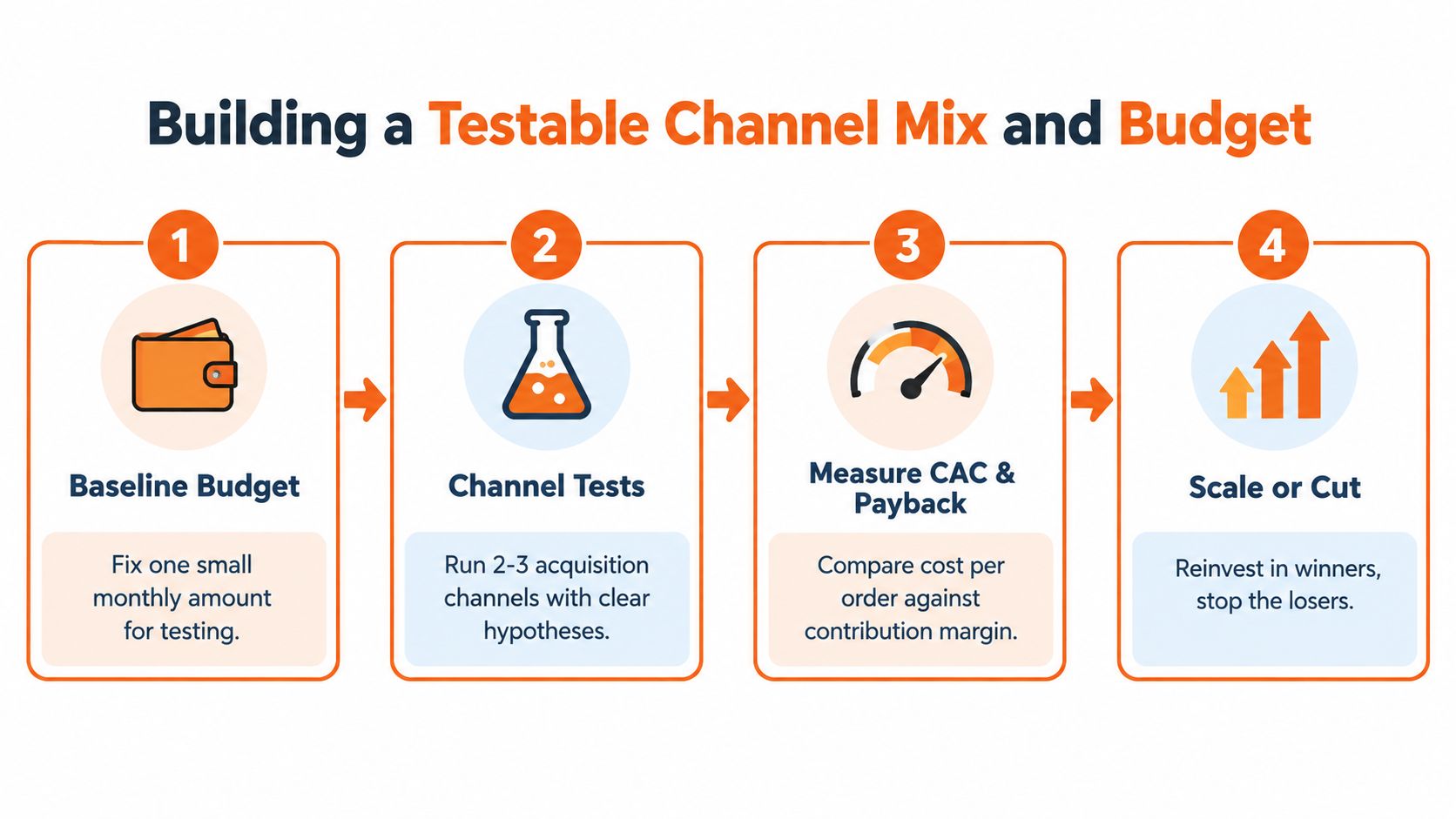
Give every channel a job. Acquisition brings qualified visitors, conversion turns visits into orders, and retention creates another chance to earn from a buyer you already paid to acquire. A channel that doesn't fit one of those jobs probably doesn't belong in the next test.
Start with a fixed monthly testing amount you can lose without damaging inventory or operating cash. Split that amount across a small baseline for conversion and retention, then reserve an experimental slice for acquisition. Paid search, social content, email automation, creator partnerships, and marketplace advertising carry different risks, so don't judge them with one platform metric.
Write the test before spending
For each channel, record:
- Hypothesis: “People searching for this problem will buy this product after seeing this promise.”
- Audience and offer: Define who sees the message and what they receive.
- Success measure: Use contribution margin, not clicks or reported ROAS alone.
- Stop rule: Pause when incremental gross profit fails to cover variable fulfillment and acquisition costs.
- Next action: Scale, revise the offer, run another controlled test, or cut the channel.
Email automation often deserves early attention because it reaches consented contacts and supports post-purchase education. Klaviyo's benchmarks give you several separate comparison points, including an average 37.39% open rate, 1.29% click rate, US$0.10 revenue per recipient, and 0.08% placed-order rate, all reported in its 2025 ecommerce email benchmarks. Compare your results by flow and audience, not against one blended number.
Use this data-driven budget allocation for stores as a reference when you build your monthly allocation. Keep seasonal cash buffers separate from routine testing, and use the Chicago Brandstarters marketing budget allocation resources to pressure-test your assumptions. A mediocre channel doesn't deserve endless optimization. Cut it when the economics stay weak.
Tracking KPIs and Running Review Loops
A founder's dashboard should fit on one screen. Track the customer journey from landing-page view through product view, add-to-cart, checkout start, payment attempt, and purchase. Break results down by device, source, geography, new versus returning customer, and payment method so an average doesn't hide a broken segment.
Your cohort dashboard should contain:
- Conversion rate and average order value, which show whether traffic becomes revenue.
- Gross-margin dollars per session, which connects visitor quality to economics.
- Customer-acquisition cost and payback period, which show how quickly a channel recovers spend.
- Repeat-purchase rate and 90-day contribution margin, which show whether the first order creates a healthy customer relationship.
Automation needs the same discipline. Automated emails generated 37% of sales from only 2% of email volume, and automated-message click-to-conversion ran at roughly one in three, compared with one in 18 for scheduled messages, according to Omnisend's 2025 ecommerce marketing report. Abandoned-cart, welcome, and browse-abandonment messages produced 87% of automated orders in that report. Start with those flows, cap frequency, and suppress messages after conversion.
Review the account at three speeds
Run a short weekly scorecard for spend, orders, margin, errors, and major funnel changes. Run a monthly cohort review for repeat behavior and payback. Reset the plan quarterly when your product mix, cash position, seasonality, or audience changes.
Don't accept last-click attribution as the whole truth. Branded search and retargeting often collect credit after another channel created demand. When ad-platform revenue rises but blended profit falls, trust contribution margin, cohort payback, and controlled holdouts before you increase spend.
For more background on attribution logic, Refport's guide to attribution models for SaaS provides a useful comparison, even though ecommerce teams need to adapt the model to orders and margin. Keep analytics implementation simple enough to maintain, using Google Analytics for beginners from Chicago Brandstarters as a practical starting point.
Your First Ninety Days of Execution
The first ninety days should produce evidence, not a crowded calendar.

Days one through thirty
Start with customer conversations, the product page, and checkout diagnostics. Install the funnel events, confirm that price and availability display correctly, review shipping and returns language, and test the purchase path on mobile and desktop. Build the consented email capture point, welcome flow, cart flow, and post-purchase education.
Then choose two acquisition channels. A Chicago-area founder selling a physical product might test high-intent search against local creator content, while keeping marketplace distribution narrow enough to compare margin and customer ownership. Each test needs a written hypothesis, a spend ceiling, and a stop rule.
By the end of the first month, you should know which objections block purchase, which traffic source brings qualified visits, and whether the product can support paid acquisition at all. If you don't know those answers, adding another channel only increases noise.
Days thirty-one through ninety
Month two should focus on the strongest early signal. Improve the product page around real questions, test the offer without destroying margin, and check whether first buyers engage with education or replenishment messages. Keep a holdout group for promotional messages so you can estimate incremental purchases rather than crediting every sale to an email click.
Month three gives you a budget decision. Reinvest only where incremental profit remains positive, pause channels that fail your floor, and delay marketplace expansion when fulfillment or inventory can't support it. Seasonal demand can tempt you to spend faster than your cash cycle allows. Protect stock and delivery quality before chasing the spike.
Use this video as a practical prompt for keeping execution visible on the calendar:
A good ninety-day outcome may be a profitable small test, clear demand evidence, a working checkout, and a repeatable review habit. It doesn't need to look like a scale-up story. You want enough proof to decide where the next dollar belongs.
Chicago Brandstarters gives Chicago and Midwest founders a free, vetted community with small private dinner groups and an active founder chat for sharing practical ecommerce decisions, including channel testing, email, and budget discipline. Visit Chicago Brandstarters to meet operators who can challenge your assumptions before you commit more cash.
Leave a Reply