You're building your brand the honest way. You picked a product. You fought with packaging. You argued with your 3PL. You tweaked your Shopify theme at midnight. You finally got a little traction.
Then a legal letter lands in your inbox or arrives by certified mail.
Some company you've never heard of says your store, checkout flow, product page widget, Wi-Fi setup, or backend process infringes its patent. They want money. Fast. Your stomach drops because you didn't copy anyone. You're just trying to sell mugs, supplements, pet gear, or skincare without breaking your cash flow.
I've seen founders freeze here. That's the first mistake. A patent troll counts on that freeze. It wants you scared, isolated, and eager to make the problem disappear.
If you've been asking what are patent trolls, here's the straight answer. They're paper predators. They use patents like a baseball bat, not like a shield for something they built. Once you see the playbook, the fear gets smaller and your options get clearer.
The Letter You Never Want to Get
The first letter always feels personal. It isn't.
It reads like a threat because it is one. The sender usually wraps that threat in polished legal language, patent numbers, and a deadline that tries to force a rushed decision. For an early-stage ecommerce founder, that's brutal because your instinct is to protect the business, keep your team calm, and avoid any public mess.
What that letter usually means
A lot of these senders are non-practicing entities, often called patent trolls. They do not manufacture products or supply services based on their patents but instead focus solely on monitoring the market for alleged infringers, purchasing patents from bankrupt companies, and aggressively suing vulnerable firms with little money to defend themselves to secure early settlements, as described by Metis Partners in its explanation of patent trolls.
That one definition clears up a lot.
They aren't mad that you copied their successful product. They often don't have a product. They have paper, lawyers, and a business model built around pressure.
Practical rule: Treat the first demand letter like a kitchen fire. Don't panic, but don't wave it away with a dish towel either.
Why ecommerce founders get rattled fast
If you run a product brand, your brain goes straight to disaster math. Will this spook investors? Will Amazon suspend me? Should I pull a feature from my site? Did my agency install something risky? Did my software vendor dump legal risk on me in a hidden contract clause?
That reaction is normal. But you need to separate noise from signal.
A patent demand doesn't automatically mean the claim is strong. It means somebody thinks pressure might get paid. If your business touches international suppliers, overseas marketplaces, or cross-border sales channels, it also helps to understand the basics of cease and desist for cross-border disputes so you can tell the difference between a real legal escalation and intimidation theater.
The first mental shift
Don't read that letter like a confession form. Read it like a sales pitch.
The troll is selling fear. The product is settlement. Once you get that, you stop acting like a guilty defendant and start acting like a founder protecting cash, advantage, and focus.
So What Exactly Are Patent Trolls
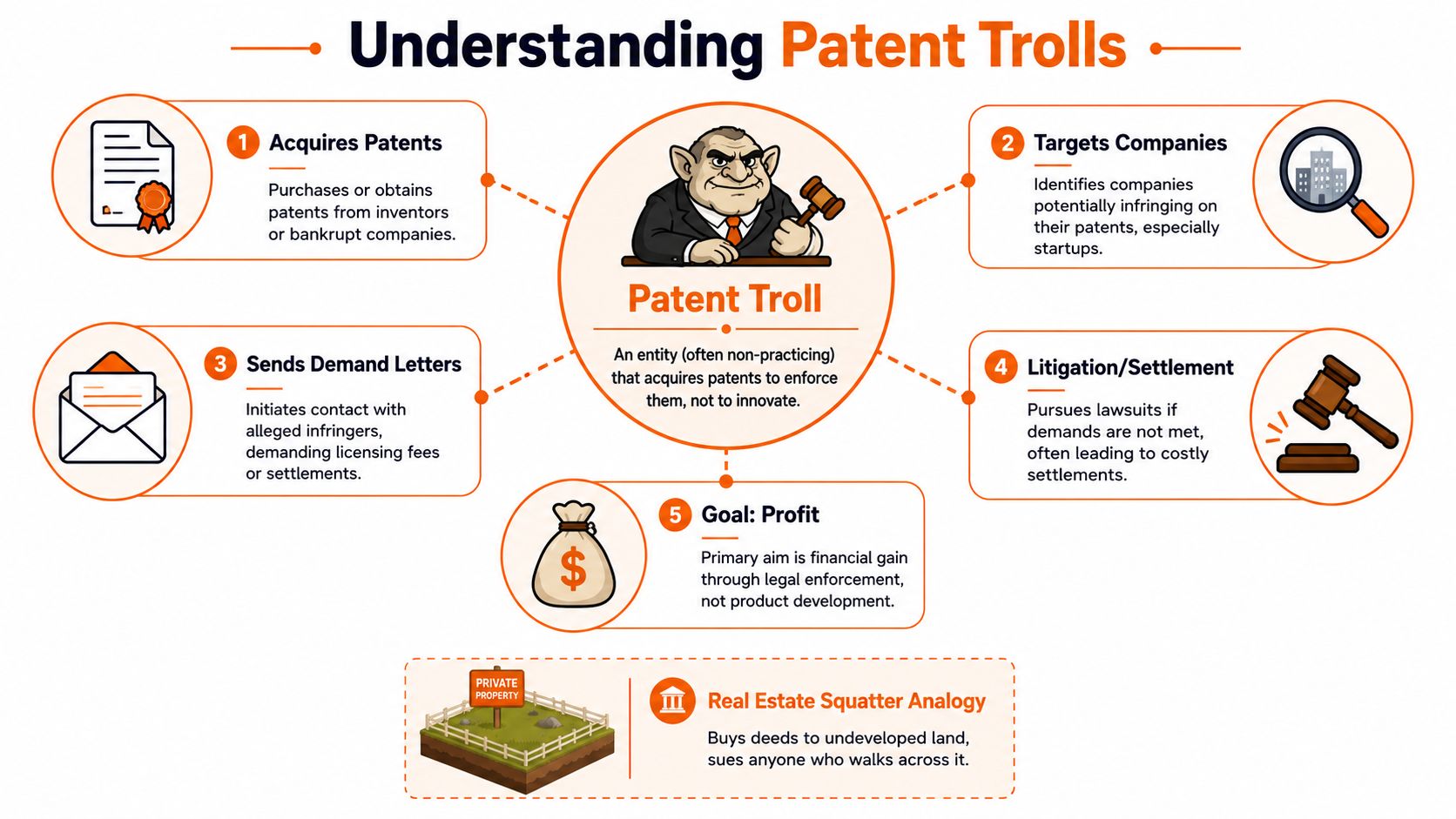
A patent troll is like a squatter who buys the deed to an empty lot, builds nothing on it, and then sues anyone who steps across the dirt.
That's the cleanest way I know to explain it.
The plain-English definition
When founders ask me what are patent trolls, I tell them this: they are entities that acquire patents and enforce them for money, instead of using those patents in an actual operating business.
That's why you'll also hear terms like Patent Assertion Entity or Non-Practicing Entity. Those labels sound tidy. The behavior is what matters.
A real operator might use patents to stop a direct copycat from ripping off a product it designed, manufactured, and sold. A troll often goes after ordinary business activity with a vague patent and a scary letter.
The difference between a real patent dispute and a troll play
A quick way to understand it is:
| Situation | What it usually looks like |
|---|---|
| Real operating company | Built a product, sells it, then fights a competitor copying that product |
| Patent troll | Owns patent rights, builds nothing, then pressures users or small companies into paying |
If you want a good primer on the broader legal frame, this guide to understanding intellectual property infringement is useful because it helps founders separate normal IP disputes from the more opportunistic patent-assertion game.
The scale of the problem
The phrase itself has been around for a while. The term “patent troll” was coined in 1999. In 2012, these entities were responsible for 62% of all patent lawsuits in the United States, costing the U.S. economy an estimated $29 billion per year and causing defendants to lose half a trillion dollars in wealth between 1990 and 2010, according to Maynard Nexsen's summary of patent troll litigation data.
That's why founders can't brush this off as a weird edge case.
Here's a short explainer worth watching if you want the visual version of the playbook.
My opinion on the label
I don't care much about the academic debate over whether every non-practicing entity is evil. I care about behavior. If somebody buys broad patent rights and uses legal cost pressure to shake down small businesses, I call that trolling. Founders should too.
How Their Business Model Works
This business model is ugly because the math is ugly.
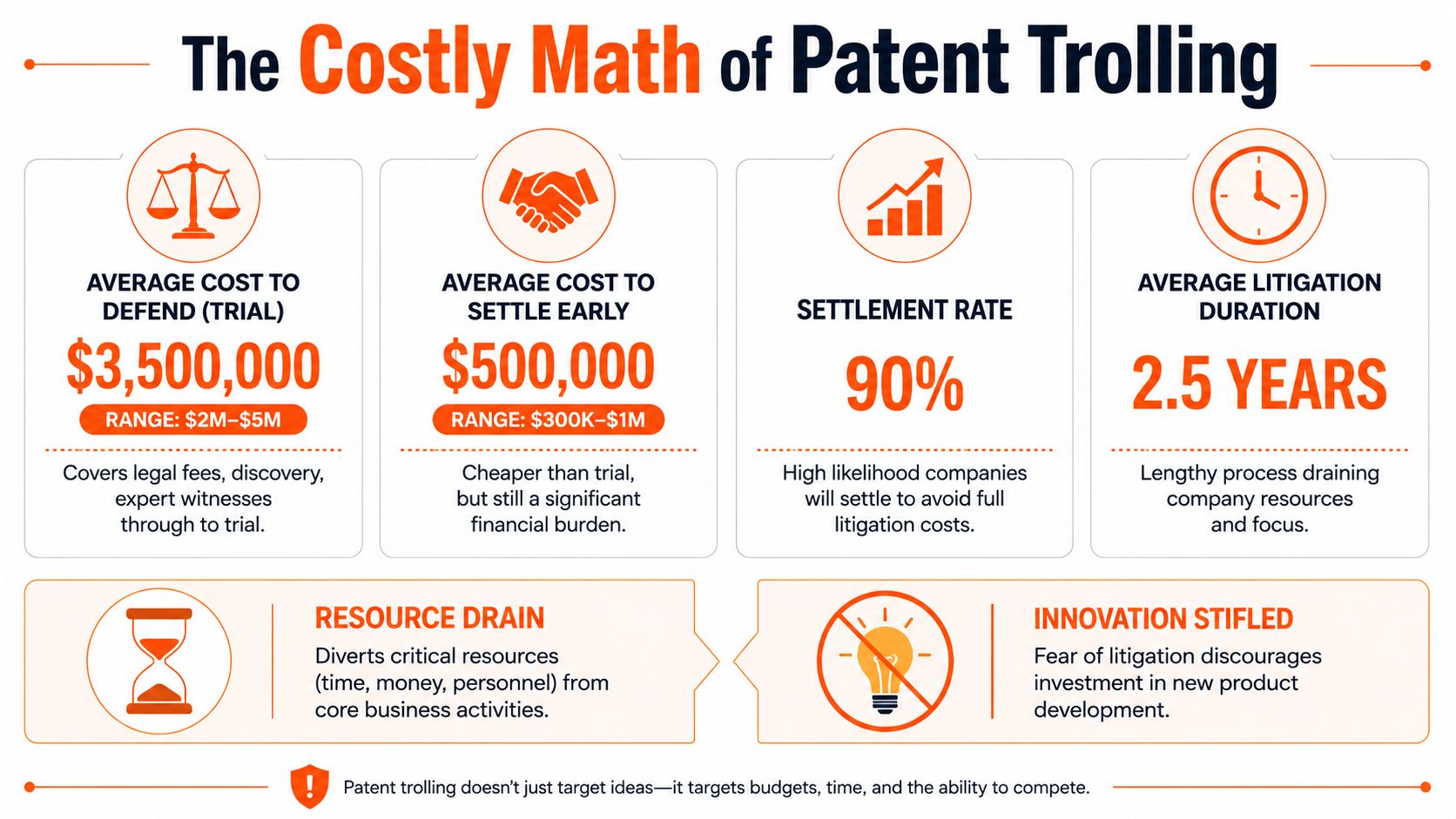
The troll doesn't need to prove much on day one. It just needs to make you believe that fighting will cost more than folding. That's the whole machine.
The core math
Here's the fact founders need to burn into memory. The cost of defending a patent lawsuit often exceeds $1 million, while the licensing fee demanded by the troll typically ranges from $10,000 to $100,000, which pressures over 90% of targeted small businesses to settle regardless of the lawsuit's merit, according to the Wikipedia summary on patent trolls.
That's why these letters are so effective.
If I told you that you could pay a smaller amount today or risk a massive legal bill over a long fight, you'd at least consider paying even if you knew the claim smelled bad. The troll knows that. It prices the demand to sit in the pain zone where settlement feels gross but practical.
Why this works on normal founders
Founders are trained to allocate capital. You kill bad ad campaigns. You negotiate freight. You cut software bloat. So when a troll asks for a number that feels lower than a legal war chest, your operator brain says, “Maybe I should just make it go away.”
That instinct is rational. It's also exactly what the troll is betting on.
A troll doesn't need your respect. It needs your spreadsheet to tell you surrender is cheaper.
What the troll is really selling
It's selling speed and uncertainty relief.
You're not buying justice. You're buying silence, or at least the hope of silence. That's why I tell founders to stop viewing a patent troll demand as a legal argument first. It's a pricing strategy first.
The ugly part is what follows inside your company:
- Cash gets diverted: Money that should go to inventory, tooling, packaging, and marketing gets rerouted to lawyers.
- Team focus breaks: Your ops lead, tech contractor, and founder time get sucked into document gathering and calls.
- Product decisions get warped: You stop building what customers want and start trimming features because a legal threat spooked you.
The founder trap
Early on, almost every dollar in your business has a job. A troll tries to fire that money from its real job and hire it for nonsense.
That's why I call it a tax on momentum. It punishes people who are trying to make and sell real things while creating nothing useful itself.
Why Founders Are Such Easy Targets
A lot of founders think, “We're tiny. Nobody cares about us yet.”
That's backwards. Being small often makes you easier to shake.

Early-stage ecommerce brands have the same soft spots
Most product brands use similar plumbing. Shopify or another storefront platform. Standard checkout tools. Email software. Review widgets. Search bars. Inventory systems. Wi-Fi networks. Cloud storage. Barcode scanners. Ordinary business software.
That sameness is convenient for you and profitable for a troll. A troll can look at common tools and common workflows, then send a wave of letters to businesses that probably lack in-house patent counsel.
The tactic has a name. Patent trolls often employ “bottom feeder” tactics by targeting the end-users of technology, such as small businesses that use Wi-Fi or e-commerce software, rather than the large manufacturers. This maximizes their chances of securing a quick settlement from businesses without specialized legal teams, as explained by the Virginia Law Review article on patent trolls and preemption.
Why they go after users instead of makers
Going after a giant platform company is expensive and messy. Going after a founder selling candles, backpacks, or protein powder is simpler.
You probably have:
- Limited legal bench: No in-house IP lawyer. Maybe no outside patent counsel on speed dial.
- Messy records: Product decisions live in Slack, email, Figma, Google Drive, and your head.
- Thin margins: One annoying legal bill can wreck a quarter.
- Urgency addiction: Founders hate unresolved threats, so they're easier to pressure with deadlines.
The emotional angle matters too
Kind founders are often the easiest to bully. I mean that sincerely.
If you built your brand around customer care, fair dealing, and honest work, you assume other parties are acting in good faith. Trolls use that against you. They count on your decency to create confusion. You think, “Maybe we accidentally stepped on something.” They think, “Good. They're pliable.”
You aren't weak because you hate conflict. You're only exposed if you confuse politeness with passivity.
The hidden risk in agency and vendor stacks
A lot of ecommerce brands don't build their stack from scratch. Agencies install apps. Freelancers set up flows. Software vendors embed functions. If a troll comes knocking, you may find out too late that the legal risk sits with you, not the tool provider.
That's why founders need to know enough to ask better questions. You don't need a law degree. You need basic defensive instincts.
How to Protect Your Brand Proactively
You can't make yourself lawsuit-proof. You can make yourself a worse target.
That's the goal. Patent trolls like easy money. Your job is to look expensive, organized, and hard to intimidate.
Start with a clean paper trail
If your records are chaos, fix that now.
Keep one folder for product development. Put dated drafts there. Save packaging revisions, CAD files, agency scopes, software contracts, feature requests, screenshots, and launch notes. If you changed a checkout flow, keep the before-and-after. If a contractor recommended a plugin, save that email.
This isn't glamorous. It is useful.
A founder with organized records gives counsel something to work with. A founder with missing documents burns time and money rebuilding history from memory.
Run basic diligence on your stack
I'm not telling you to become a patent search specialist. I'm telling you to stop installing business-critical tech with zero legal curiosity.
Use a simple checklist:
- Ask vendors direct questions: Do they have any known patent disputes tied to this product or feature?
- Read indemnity clauses: If a claim hits, do they defend you, partially help, or leave you alone in the storm?
- Review your contracts before rollout: Especially for custom tools, embedded software, and weird niche plugins.
- Audit what you use: Your live store may have leftover apps and code from old agencies.
If you need a practical founder workflow for that kind of review, I'd skim this startup due diligence checklist and adapt it to your legal and vendor stack.
Think about insurance before you need it
Most founders buy insurance reactively. That's like shopping for umbrellas after your shoes are already soaked.
Talk to a broker who understands ecommerce and IP-adjacent risk. Ask plain questions. What is covered? What is excluded? Does the policy help with defense costs? How does the carrier define intellectual property claims? Where are the traps?
For a broader founder-friendly refresher on protecting what you build, this guide on your intellectual property protection is a useful companion read.
Build a small response team now
Don't wait for the letter to figure out who your people are.
Write down:
- Your business attorney
- A patent-focused lawyer or firm you can call
- Your insurance broker
- Your technical lead or agency contact
- The person who controls your document storage
That list alone can save you a lot of stupid scrambling.
Founder move: If your legal plan depends on “I'll just ask around when it happens,” you don't have a legal plan.
What to Do When You Get That Letter
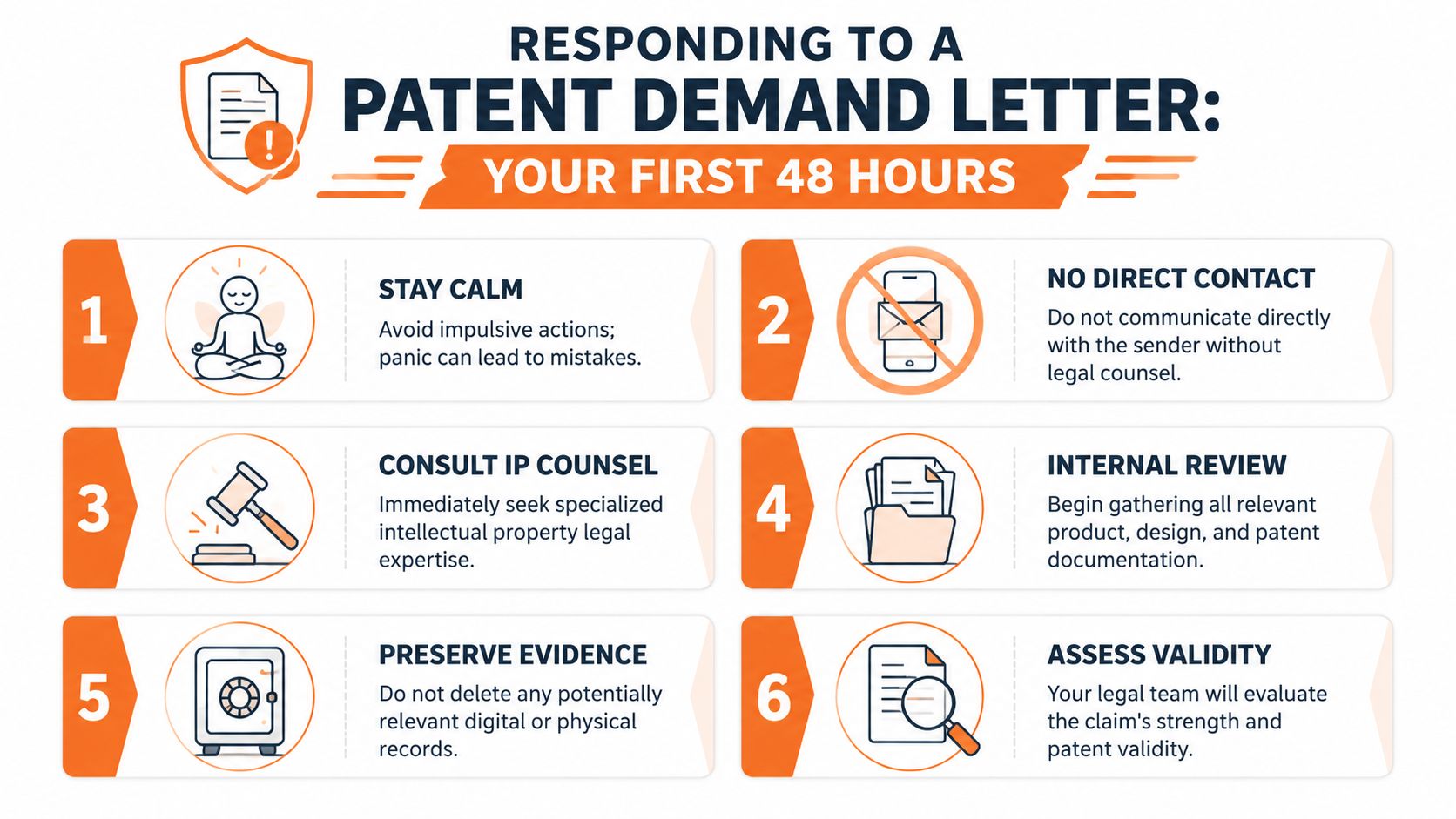
The first 48 hours matter because panic creates bad facts.
Don't reply emotionally. Don't admit anything. Don't delete documents. Don't tell your vendor, “We definitely infringed, right?” in an email that can later become a problem.
Your first moves
Use this order.
Get calm
Read the letter once. Save it. Then stop. Fear makes founders overtalk.
Stop direct contact
Don't call the sender. Don't email “we take this seriously.” Don't ask for more time on your own. Every sentence you send can help the other side.
Preserve records
Save the letter, envelope, emails, attachments, contracts, invoices, vendor agreements, product specs, screenshots, and internal discussions. Tell your team not to delete or “clean up” anything.
What bad-faith trolling looks like
The Virginia Attorney General says patent trolls engage in bad-faith assertions by sending demand letters without verifying infringement, offering licenses at “nuisance prices” that ignore the patent's actual value, and making deceptive claims or threats they don't intend to follow through on, as described in the Virginia Attorney General's patent trolling brochure.
That gives you a useful filter.
If the letter is vague, thin on specifics, obsessed with quick payment, and light on actual infringement analysis, your suspicion should go up.
Get the right lawyer, not just any lawyer
A general business attorney can be helpful, but patent assertions need specialist eyes. Ask hard questions when you talk to counsel:
| Question | Why it matters |
|---|---|
| Have you handled patent demand letters like this before? | You want pattern recognition, not improvisation |
| Do you think this sender is a serious litigator or a volume intimidator? | The response strategy changes based on that answer |
| What facts and documents do you need from me today? | Speed matters, but focus matters more |
| What should my team stop saying in writing? | Loose internal chatter creates risk |
Also check your policies right away. If your business has coverage that may touch defense costs or adjacent legal exposure, review it fast. This article on business insurance for online store owners is a good practical starting point before you talk with your broker and counsel.
Decide with a cold brain
Sometimes the right move is to fight. Sometimes the right move is a tightly controlled settlement. I won't romanticize either path.
What I hate is when founders make that decision from shame or panic. This is a business problem now. Treat it like one. Gather facts. Price the options. Protect the company.
If you respond at all, respond through counsel and with a strategy, not with wounded pride.
Your Fight Plan and Where to Find Help
Patent trolls win when founders feel alone.
That's why your fight plan should be simple. Get informed. Get organized. Get real counsel. Keep your records tight. Don't confuse a scary letter with a strong case. Most of all, don't let a bully rush you into a bad decision.
What I want you to remember
You don't need to become an IP nerd overnight. You need a few habits and a little steel.
- Know the playbook: A troll wants fast, low-friction payment.
- Protect your paper trail: Good records strengthen your position.
- Use specialist help: This is not the time for amateur hour.
- Talk to other founders: War stories save money because they shorten your learning curve.
If you're building in the Midwest, don't try to white-knuckle every problem in private. Find smart operators who've been in the arena and can tell you what worked. If you need that kind of peer support, start with advice on how to find a business mentor and build your circle before the next fire starts.
You're building something real. Don't let somebody with old paper and a pressure tactic push you off your path.
If you want a room full of kind, serious founders who share real war stories instead of fake networking energy, take a look at Chicago Brandstarters. It's a free community for builders who want honest feedback, trusted connections, and practical help while growing from idea stage to seven figures.
Leave a Reply